
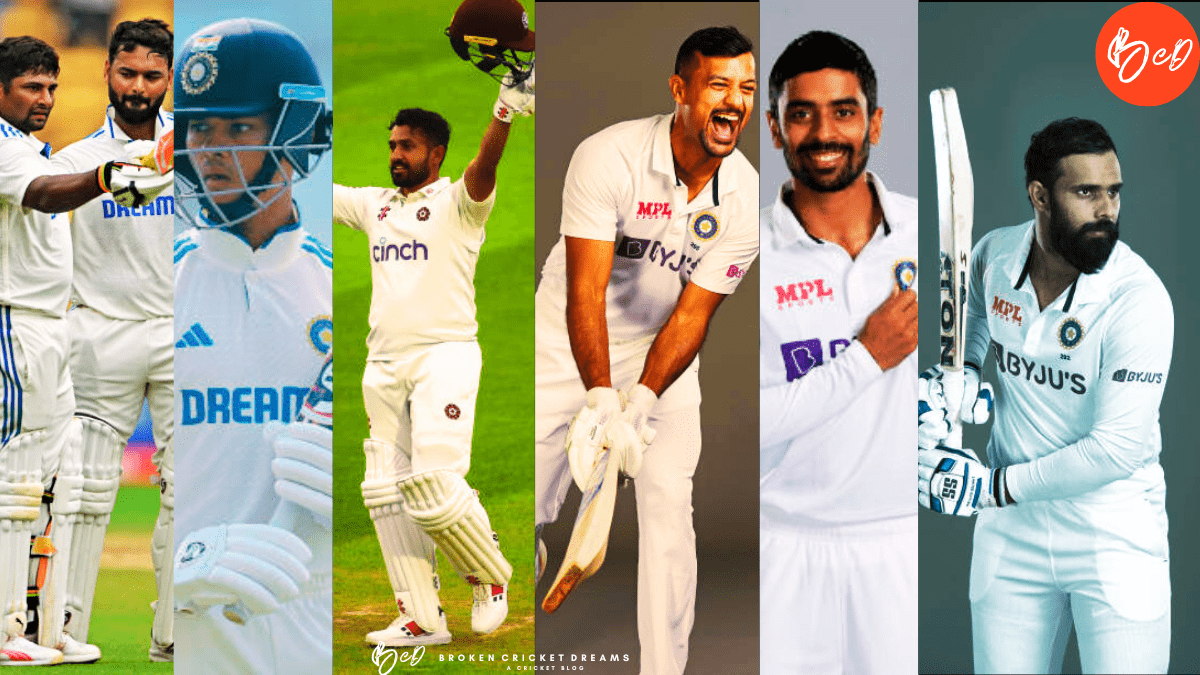
I am beginning to wonder if the 29-year-old Abhimanyu Easwaran will ever get a game for Team India.
Despite India’s top order struggling in the 2024-25 Border Gavaskar Trophy, Easwaran remained on the sidelines.
Jaiswal & KL Rahul had their moments, Rohit Sharma had to ‘opt out’ of the fifth Test due to poor form, Gill was in & out, and even Padikkal got a game. Dhruv Jurel and Nitish Kumar Reddy were also handed opportunities for other roles, but Easwaran never got a look-in.
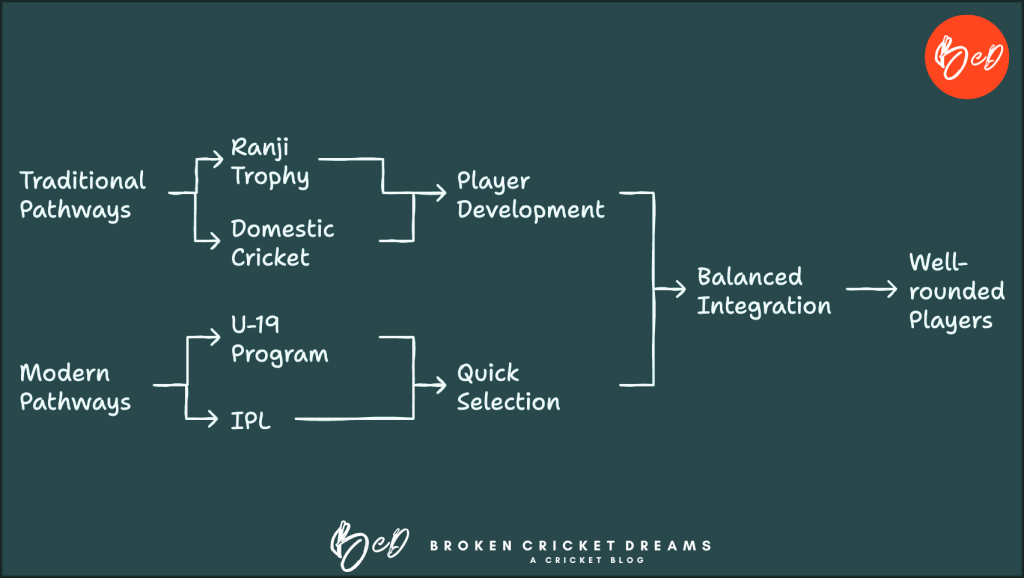
This raises a larger question—Does domestic cricket still matter in India team’s national selection? Has the Ranji Trophy lost its influence, with the India U-19 setup and IPL now serving as the primary pathways to the top?
I looked at Ranji Trophy stats from the last 35 years to see what patterns I can find in the evolution of national selection.
Table of Contents
- The Curious Case of Abhimanyu Easwaran
- IPL Fast-Track Vs Ranji Grind: Which Opens the Door To Team India?
- India’s Golden Generation
- Why Comebacks are Nearly Impossible for Ranji Stalwarts
- Final Verdict: Is Domestic Cricket Still Relevant?
- Ranji Stats Reference
The Curious Case of Abhimanyu Easwaran
Easwaran came into the spotlight in the 2018-19 Ranji season when he top scored for Bengal with 861 runs. Since then, he has been on the fringes, consistently scoring in the various first-class tournaments, and has also performed well in the India A tours to South Africa and Bangladesh.
BGT 2024-25 was the third time since 2021 that Easwaran has been selected as a ‘standby’ or a reserve opener. This year, he was coming off the back of four consecutive centuries across Duleep, Irani, and Ranji trophies, but still did not get a game.
And it is the not the case that India’s top order has no vacancies. In the last couple of years, Ruturaj Gaikwad, Yashasvi Jaiswal, Ishan Kishan, Devdutt Padikkal, and Prithvi Shaw all leapfrogged him for the reserve Test opener spot due to performances in other formats and the IPL.
Also Read: 46 Unlucky Indian Cricketers Who Never Played for India in Tests but Dominated Ranji Trophy
Recent Ranji Trends: What the Numbers Reveal
- Shahbaz Nadeem was the top wicket-taker in the 2015-16 Ranji season (51 wickets), 2016-17 season (56), 3rd highest in 2021-22, and 6th highest wicket-taker in 2022-23. He played only 2 Tests.
- Mayank Agarwal had to score the most runs by any Indian in a domestic season (2141 runs) in 2017-18 to make his way to the national team.
- Between 2020-23, Sarfaraz Khan scored over 3500 runs batting at #5 at an average of 106.07.

IPL Fast-Track Vs Ranji Grind: Which Opens the Door To Team India?
It is tough to break into the Indian national cricket team. Heck, with as many as 106 players vying for a spot in the national team, it is even harder to make the cut.
The traditional pathway was going through domestic cricket, but has the Ranji Trophy and domestic cricket lost its significance?
Is the route through the U-19 program, followed by success in the IPL, now the preferred path over spending 3-4 seasons grinding in domestic cricket?
Let’s go back 25 years to see how Indian cricket has evolved.
Mohammad Kaif & Virat Kohli Pave the Way
Mohammad Kaif’s U-19 triumph in 2000 revolutionized Indian cricket forever. Kaif, Yuvraj Singh, Reetinder Sodhi, Venugopal Rao, Ajay Ratra would all go on to represent Team India.
Eight years later, Virat Kohli followed suit, earning a national call-up soon after leading India to U-19 World Cup glory. Ravindra Jadeja was the vice-captain in that U-19 side.
Since 2008, the IPL has also propelled relatively unknown domestic players to glory. Jasprit Bumrah had begun in Gujarat’s domestic circuit, but it was Mumbai Indians’ scouting lead by coach John Wright, that brought him into the limelight in 2016.
Let’s look at a more recent case, Nitish Kumar Reddy. Reddy made his way to the Andhra FC team after becoming player of the tournament in the 2017-18 Vijay Merchant Trophy (U-16 cricket). His breakthrough came at the 2023 IPL auction, and after impressing in the 2024 IPL, Reddy was elevated to the national squad (and ended up becoming India’s best batter in the BGT).
As the India U-19 system and IPL evolved, a clear pathway emerged—players identified at the U-19 level were fast-tracked to IPL auctions, and those who proved themselves over a season or two often found a route to the national team.

The U-19 & IPL Pathway Express: Gill, Jaiswal
Yashasvi Jaiswal’s inspirational journey is a prime example: He made his FC debut in 2019 and took Mumbai cricket by storm by becoming the youngest double centurion in List A cricket. However, it was his standout performance at the 2020 U-19 World Cup, where he was the player of the series & the highest run scorer, that caught everyone’s attention.
He was then be picked by the Rajasthan Royals in the IPL. After a couple of middling seasons, he took the 2023 IPL by storm scoring 625 runs including a 13-ball 50.
This lead to his Test call-up in the West Indies, where he scored a scintillating 171 and hasn’t looked back since. His 2024 Test season was an all-timer: 1478 runs at 54.74 with 3 hundreds and 9 fifties. Jaiswal has played 19 Tests already, but has only played 16 other first-class matches.
Dhruv Jurel was India’s vice-captain in the same U-19 WC, who also followed a similar path to the India Test cap through the Rajasthan Royals. Before Jaiswal, Rishabh Pant (2016 U-19 WC), Shubman Gill, and Prithvi Shaw (2018) all took a comparable route.
Embed from Getty ImagesPujara & Rahane, The Last Warriors of The Ranji Selection Era
Cheteshwar Pujara and Ajinkya Rahane were perhaps the last prototypes of consistent select based upon domestic performances.
Like Jaiswal, Pujara was the player of the tournament and the highest run scorer of the 2006 U-19 WC. However, before breaking into the India Test squad in 2010, he was prolific in the domestic circuit. He was the fifth highest run-scorer in 2006-07 (595 runs at 59.5), the highest run-scorer in the 2007-08 season (807 runs at 73.36), 3rd highest in 2008-09 (906 runs at 82.36 including a 302), and scored 554 runs at 79.14 in the 2009-2010 (5 matches) before being selected for India.
Ajinkya Rahane was the second-highest run-scorer in both the 2008-09 and 2009-10 Ranji seasons. He would make his international debut two years later (He got a break in T20 & ODI cricket two years before Test cricket, weirdly enough).
Fun fact: Gautam Gambhir played in the 2007-08 season and was #3 run-scorer (730 runs at 91.25) despite already being in the national team.
Embed from Getty ImagesThe Toils of Domestic Cricket Feat Agarwal, Sarfaraz
Times have changed. The journeys for Mayank Agarwal & Sarfaraz Khan have been tougher.
Agarwal also came through from the U-19 system (2010) and was fast-tracked to the IPL, but talent didn’t convert to runs.
To get back into national contention, Mayank Agarwal had to break the door down.
And boy, did he dominate, finishing as the top scorer in both the 2017-18 Ranji and Vijay Hazare Trophies. With 2,141 runs across formats, he set a record for the most runs by an Indian in a single domestic season. His breakthrough finally came in the 2018 Border-Gavaskar Trophy (Listen to Harsha Bhogle talk about Agarwal’s journey).
Sarfaraz faced an equally challenging route. A member of India’s 2014 and 2016 U-19 squads, his early IPL stint failed to impress. He then turned to domestic cricket, amassing 928 runs in 2019-20, 982 in 2020-21 (leading all batters), and averaging 106.07 from 2020-23. His relentless run-scoring, capped by a double century in the 2024 Irani Cup, finally earned him a Test debut—five years after his purple patch began.
Akash Deep is another recent player who is a success story after toiling for several years at the domestic level.
Multi-Format Transitions: Shreyas, KL Rahul, SKY
Suryakumar Yadav’s had to wait until he was almost 31 to get an international debut.
Since 2021, he has become one of the greatest T20I players of all-time, racking up over 2500 T20I runs and four centuries. Although Yadav has extensive FC experience under his belt, it was his T20 form, that propelled his selection to the 2023 ODI World Cup teams and a Test debut.
Shreyas Iyer’s T20I & ODI form, along with his IPL credentials, got him his break in Test cricket in 2021.
*To Shreyas Iyer’s credit, he did score a record 1321 runs in the 2015-16 season, top scoring the Ranji charts (next highest was 879 runs). Coincidentally, Suryakumar Yadav was #4 on the list with 788 runs (SKY was the 4th highest scorer in the 2011-12 season)
Embed from Getty ImagesThe KL Rahul Conundrum
Finally, we come to KL Rahul, the most enigmatic batter of our generation.
KL Rahul was the 2nd highest scorer in the Ranji Trophy in 2013-14 (1033) and the 4th highest run scorer in 2014-15 (1033) before breaking into the IPL teams. He was destined as the next big thing in Indian cricket and was handed a debut in 2014.
A decade later, he only averages 33.57 in Test cricket despite playing 58 Tests. For someone of his talent, that is not great returns.
Here is how his cricket season works: Rahul tops the charts in the IPL (659, 593, 670, 626, 616, 274, 520 since 2018) -> Gets selected for T20I/ODI -> India play an overseas Test and need a quick replacement for an opener, #3, or keeper, and Rahul is called in to fill the gap. He scores some beautifully looking 50s, an amazing match-winning hundred, and several low scores, before he is dropped at the end of the season.
Lather, rinse, repeat.
KL Rahul got his break due to the Ranji Trophy, but it is his IPL & ODI form keep that keep bringing him back to the Test arena (to be fair, KL Rahul did look really good in the 2024-25 BGT).
Embed from Getty ImagesWhy Comebacks are Nearly Impossible for Ranji Stalwarts
As a counterpoint to KL Rahul are the stories of Karun Nair, Hanuma Vihari, KS Bharat, and Abhinav Mukund.
Comebacks are nearly impossible for Ranji stalwarts.
It takes 3-6 years for a player to grind in domestic cricket to earn a national call-up. Then, they are made to carry drinks for a year or two, finally getting a chance in a tough overseas Test. If they do not deliver immediately, they’re dropped after two games—never to be seen again.
In the last 5 years, #ViratKohli has played 69 innings.
— Broken Cricket Dreams Cricket Blog (@cricket_broken) January 4, 2025
🚨 Averages of all batters who have played 69 innings in the last 5 years
30.72 – Virat Kohli 🇮🇳 (69 Innings)
31.18 – Zak Crawley 🏴 (94)
33.28 – Tom Latham 🇳🇿 (70)
33.64 – Kraigg Brathwaite 🌴 (73)
34.14 – Ollie Pope 🏴… pic.twitter.com/gvHV66zW1L
Karun Nair: The One-Test Wonder Tragedy
Karun Nair’s international scores read: 4, DNB, 13, 303*, 26, 0, 23, 5, DNB.
He was dropped after four innings.
Four.
Virat Kohli’s last eight innings read after the Perth 100 read: 7, 11, 3, DNB, 36, 5, 17, 6. Being dismissed in a similar manner, averaging about 30 in the last 5 years, and yet, he will most likely still survive the axe. Different standards for different players.
Hanuma Vihari and How Not to Treat Cricketers
Hanuma Vihari began his journey with 841 runs at 93.44 with 3 tons (including a 201*) in the 2013-14 season.
Vihari had been carried around since 2018 in England, Australia, West Indies, New Zealand, and back to Australia as an understudy to Cheteshwar Pujara. At that Sydey Test, he put his body on his line to draw a famous Test.
After Sydney, Vihari only received 4 opportunities spread across three series at #3 when Pujara was initially dropped:
- 20 (53) & 40*(84) in Johannesburg
- 58 (128) in Mohali (vs Sri Lanka)
- 31 (81) & 35 (79) in Bengaluru
- 20 (53) & 11 (44) in Birmingham
For a player transitioning from #6 to #3, those are respectable figures, especially since he was mostly played in overseas conditions.
Now begins the difficult part.
Back in the domestic cricket, his returns has been below-par: 490 runs at 35.00 in 2022-23, 522 runs at 40.15 in 2023-24, and 250 runs at 27.77 in the current season.
Embed from Getty ImagesAbhinav Mukund and the Horror of 2011
After churning runs in the domestic circuit, Mukund was called up to the West Indies series and scored decent knocks of 48 & 62 in six innings.
Then, came the 0-4 horror tour of England. He scored 49 (88) at Lord’s, 12 (32), 0 (1), and 3 (41) in the next three innings before being dropped…for the next six years.
After scoring heavily in Ranji between 2015-2017, he was recalled in 2017. His score? 0 (8), 16 (32), 12 (26), and 81 (116) at Galle. Mukund never played international cricket again.
KS Bharat Fiasco
KS Bharat was Wriddhiman Saha’s understudy and the next Test wicket-keeper in line, at least for home Tests. He had been carrying drinks for about 4 years.
Once India believed Bharat was ready, Saha was ‘forced’ to retire. 12 innings to his name, Bharat hasn’t been effective with the bat averaging 20.09, but was solid with the gloves.
In any case, it looks like India has made a decision to go forward with the trio Rishabh Pant, Dhruv Jurel, and KL Rahul.
India lost the final year of Saha and never groomed Bharat properly.
The Lesson?
These players end up becoming overseas scapegoats.
By the time a player finally breaks into the national XI—after years of grinding in domestic cricket and warming the bench—they’ve lost valuable game time and likely the form that got them there in the first place.
Once a player is dropped, unless they have a Robin Uthappa & DK 2014 season, Agarwal’s 2017 season, or Sarfaraz’s 5 years, it is extremely difficult for them to be noticed again.
Karun Nair’s recent List A performance provides hope, but will he actually get another run? Tough to say.
Coming up from domestic cricket is a rough deal. Making a comeback? Nigh impossible.
Embed from Getty ImagesIndia’s Golden Generation
Easwaran has been scoring in domestic cricket for seven years without getting a game. Fellow India A opener, Priyank Panchal, now 34, might never get an international cap despite bossing the better part of the last decade in the domestic circuit.
This made me wonder? How did India’s golden generation of the 2000s make it to the national team before IPL & U-19 cricket setups matured?
The 90s: Beginning of the End
Gautam Gambhir had great back-to-back 2001-02 (565 runs at 70.62) & 2002-03 seasons (833 runs at 75.72, Top Scorer) before getting an ODI debut in 2003 and Test debut in 2004.
Virender Sehwag scored a 78 (56) at #5 in the 1998/99 Deodhar Trophy and was the sixth highest run-scorer in the Duleep Trophy that year. The next year, he continued to make runs at the Duleep Trophy including season-best 274 and was the seventh highest run-scorer in the 2000-2001 season (Five of the players above him were Mongia, Laxman, Vikram Rathour, Yuvraj, and Kaif).
Dravid consistently performed in Ranji from 1991-1995 (380 runs at 63.33 in 1991/92, 586 runs at 83.71 in 1992-93, 644 runs at 80.5 in 1993-94, 191 runs in one innings in 1994-95) along with a wonderful India A series against England A in 1995 before getting an international debut.
Sachin Tendulkar was a schoolboy genius. Rare case, never really happens anymore.
VVS Laxman, after having an indifferent start to his Test career as an opener between 1996-99, Laxman went back to his roots and broke all records in domestic cricket (601 runs at 203.66 in 1997-98, 754 runs at 83.77 in 1998-99, and a mammoth season of 1415 runs at 108.84 in 1999-2000. Next best in that 1999/2000 season scored 1075 runs).
Sourav Ganguly scored 439 runs at 73.16 in 1990 before a brief ODI debut. After a couple of middling seasons back in Ranji, he scored 722 runs at 80.22 in 1993/94. A double century in one 1994/95 Ranji game and a 171 in the Duleep Trophy got him his break for the England tour of 1995.
The Bowlers
Anil Kumble impressed in Karnataka debut in 1989, got a few games in U-19 first class tours, and got the national selection in 1990 ODI series against Sri Lanka and Test debut a few months later in England.
Harbhajan Singh did a little bit of everything: Coming up from Punjab U-19s, he performed well in the 1997-98 Ranji Trophy & Duleep Trophy, the 1998 U-19 WC before getting the Test debut in 1998.
Zaheer Khan came up through the MRF Pace Foundation program and bagged the player of the match award in the 2001 Ranji Final to make his name in the domestic circuit.
Most of the fan favorites from the 2000s also had to toil in domestic cricket, but 2-3 consecutive season of runs was good enough to take them to the next level.
Not anymore.
The 2004 U-19 Generation
Between the Laxmans and the Jaiswals, came the Shikhar Dhawans.
Every now and then, comes a generation with several great players at once. This was absolutely the case with the 2004 U-19 side, who became the fringe players for the next decade: VRV Singh, RP Singh, Suresh Raina, Robin Uthappa, Dinesh Karthik, Ambati Rayudu, Shikhar Dhawan, and to a lesser extent, Faiz Fazal.
These players would be the transition between first-class, U-19, and the IPL. They saw it all—U-19, India A, early international debuts, being dropped, first class toil, inaugural IPL, back to internationals, back to being dropped.
Fun Fact: Robin Uthappa (912) and Dinesh Karthik (884), two of the earliest picked in the national side post 2004, were the top two scorers in the 2014-15 season and used the domestic season to break their way back to the national side.
How Did Australia Find Konstas and McSweeney?
In this season of the Sheffield Shield, Konstas scored 471 runs at 58.87 with two tons. McSweeney scored 291 runs at 97.00 in just four innings.
He had earlier scored 3 tons last summer at 40.94.
Overall though, McSweeney averages 36.31 in FC cricket, while Sam Konstas averages 39.57.
Australia backs players in form and throws them straight into the action. In India, with so much depth, a player often gets their chance five years after their peak.
Final Verdict: Is Domestic Cricket Still Relevant?
Indian selectors are not necessarily wrong with their selection policies. The idea of the ‘X-factor’ is important and the selections of Jaiswal, Pant, Bumrah, and Reddy have largely been inspirational picks.
However, what message is being sent to players next in line? That they should continue to toil for years and other youngsters will most likely continue to jump them in line?
Domestic cricket has essentially now become a ladder for IPL auctions rather than Indian selection. From the stats below, we can see that post the Covid-break, players who performed in domestic cricket like Rajat Patidar, Shams Mulani, R Sai Kishore, Manav Suthar, and Vijaykumar Vyshak were scouted and got gigs in the IPL auction. If they perform in the IPL, they can get fast-tracked to the next level.
There should be a system in place so a domestic player gets a chance before an IPL star does. Otherwise, grassroots will always be grassroots.
Ranji Trophy Back in the News?
Post the BGT debacle, Indian team changed internal rules and also are changing policies regarding domestic cricket. Will we see Rohit, Virat and Pant back in action in Ranji Trophy? Does that do the Indian team any good with the international calendar crowding all space?
Good to see that domestic cricket is getting the attention it deserves, but I am not sure if this is the way to go.
For starters, they ould give Easwaran a game. Easwaran has not given up hope, but as cricket fan, I definitely have.
Hopefully, it is not another Broken Cricket Dream.
****
Thank you all for reading and following along. Appreciate the support!
Reference: Recent Ranji Trends Stats
For your kind reference, here are the list of the top run-scorers and wicket-takers in the last decade (divided up by the Covid-induced break since there was no 2020-21 Ranji season).
| Ranji Season | Top Run Scorers | Top Wicket-Takers |
| 2016-17 | 1310: Priyank Panchal (Gujarat) 989: Nitin Saini (Haryana) 978: Prashant Chopra (HP) 972: Rishabh Pant (Delhi) 945: G Rahul Singh (Services) | 56 – Shabhaz Nadeem (Jharkhand) 43 – Anupam Sanklecha (Maharashtra) 41 – Mohammad Siraj (Hyderabad) 41 – Pankaj Singh (Rajasthan) 41 – Shadab Jakati (Goa) 39 – Ashok Dinda (Bengal) 38 – Parvez Rasool (J & K) |
| 2017-18 | 1160: Mayank Agarwal (Karnataka) 912: Faiz Fazal (Vidarbha) 775: RR Sanjay (Vidarbha) 753: Anmolpreet Singh (Punjab) 752: Hanuma Vihari (Andhra) 683: Gautam Gambhir (Delhi) | 44: Jalaj Saxena (Kerela) 39: Rajneesh Gurbani (Vidarbha) 35: Ashok Dinda (Bengal) 34: Akshay Wakhare (Vidarbha) 34: Krishnappa Gowtham (Karnataka) 34: Navdeep Saini (Delhi) 34: Dharmendrasinh Jadeja (Saurashtra) |
| 2018-19 | 1331: Milind Kumar (Sikkim) 1037: Wasim Jaffer (Vidarbha) 953: Rinku Singh (UP) 898: Priyank Panchal (Gujarat) 892: Punit Bisht (Meghalaya) 865: Yogesh Nagar (Meghalaya) 861: Abhimanyu Easwaran (Bengal) 860: Yashpal Singh (Manipur) 854: Sheldon Jackson (Saurashtra) | 68: Ashutosh Aman (Bihar) 59: Dharmendrasinh Jadeja (Saurashtra) 55: Aditya Sarwate (Vidarbha) 53: Gurinder Singh (Meghalaya) |
| 2019-20 | 1340: Rahul Dalal (Arunachal) 998: Taruwar Kohli (Mizoram) 976: Punit Bisht (Meghalaya) 967: Paras Dogra (Pondicherry) 928: Sarfaraz Khan (Mumbai) | 67: Jaydev Unadkat (Saurashtra) 55: R Sanjay Yadav (Meghalaya) 52: Harshal Patel (Haryana) 50: Diwesh Pathania (Services) |
Post-Covid
| Ranji Season | Top Run Scorers | Top Wicket-Takers |
| 2021-22 | 982: Sarfaraz Khan (Mumbai) 658: Rajat Patidar (MP) 623: Chetan Bist (Nagaland) 614: Yash Dubey (MP) 608: Shubham Sharma (MP) | 45: Shams Mulani (Mumbai) 32: Kumar Kartikeya (MP) 25: Shahbaz Nadeem (Jharkhand) 23: Gaurav Yadav (MP) 21: Styajeet Bachhav (Maharashtra) |
| 2022-23 | 990: Mayank Agarwal (Karnataka) 907: Arpit Vasavada (Saurashtra) 867: Anustup Majumdar (Bengal) 859: Dhruv Shorey (Delhi) 830: Sachin Baby (Kerela) | 50: Jalaj Saxena (Kerela) 46: Shams Mulani (Mumbai) 44: L Kishan Singha (Manipur) 43: Dharmendrasinh Jadeja (Saurashtra) 42: Sagar Udeshi (Pondicherry) 42: Shahbaz Nadeem (Jharkhand) 41: Akash Deep (Bengal) 39: Rajesh Bishnoi (Meghalaya) 39: Manav Suthar (Rajasthan) 38: Avesh Khan (MP) |
| 2023-24 | 902: Ricky Bhui (Andhra) 830: Sachin Baby (Kerela) 829: Chesteshwar Pujara (Saurashtra) 816: N Jagadeesan (Tamil Nadu) 784: Shaswat Rawat (Baroda) 767: Baba Indrajith 690: Karun Nair (Vidarbha) | 53: R Sai Kishore (Tamil Nadu) 41: Gaurav Yadav (Pondicherry) 41: S Ajith Ram (Pondicherry) 41: Dharmendrasinh Jadeja (Saurashtra) 41: Kumar Kartikeya (MP) 41: Hitesh Walunj (Maharashtra) 41: Bhargav Bhatt (Baroda) 40: Aditya Sarwate (Vidarbha) 39: Vijaykumar Vyshak (Karnataka) |
The likes of Jalaj Saxena, Dharmendrasinh Jadeja, Kumar Kartikeya have been among the wickets, but will this translate to the next level? Only time will tell.
Sources: ACS Cricket Stats
© Copyright @Nitesh Mathur and Broken Cricket Dreams, LLC 2023. Originally published on 01/19/2025. Unauthorized use and/or duplication of this material without express and written permission from this site’s author and/or owner is strictly prohibited. Excerpts and links may be used, provided that full and clear credit is given to Broken Cricket Dreams with appropriate and specific direction to the original content (i.e. linked to the exact post/article).

0 Comments