In I Have the Streets, R Ashwin doesn’t just tell his story, he reveals the person behind the player. Cricketers are people too, filled with desires, doubt, flaws, and fire.
There is so much to learn from Ashwin. And what better way to understand his mind than through his own words?
His story is one of self-doubt but also fierce self-belief, a touch of ego but with quiet confidence, a desire to disrupt, but also a willingness to learn. And above all, it’s grounded in a deep love for cricket from the streets of Chennai to the grandest stages in the world.
So here are 25 quotes from R Ashwin’s autobiography that offer a window into the mind behind the cricketer.
Right at the beginning of the book, you realize that Ashwin suffered from health issues as a child, which lingered into adulthood. At every stage, he faces self-doubts, fitness issues, social awkwardness, and a constant desire to fit in.
1. “I don’t eat much, but I play a lot. If I eat or drink too much, I vomit. If I run hard, I cough, which leads to vomiting. I play, I cough, I vomit and I continue playing. On an average, I have wheezing bouts twice a month. Each one lasts six or seven days.”
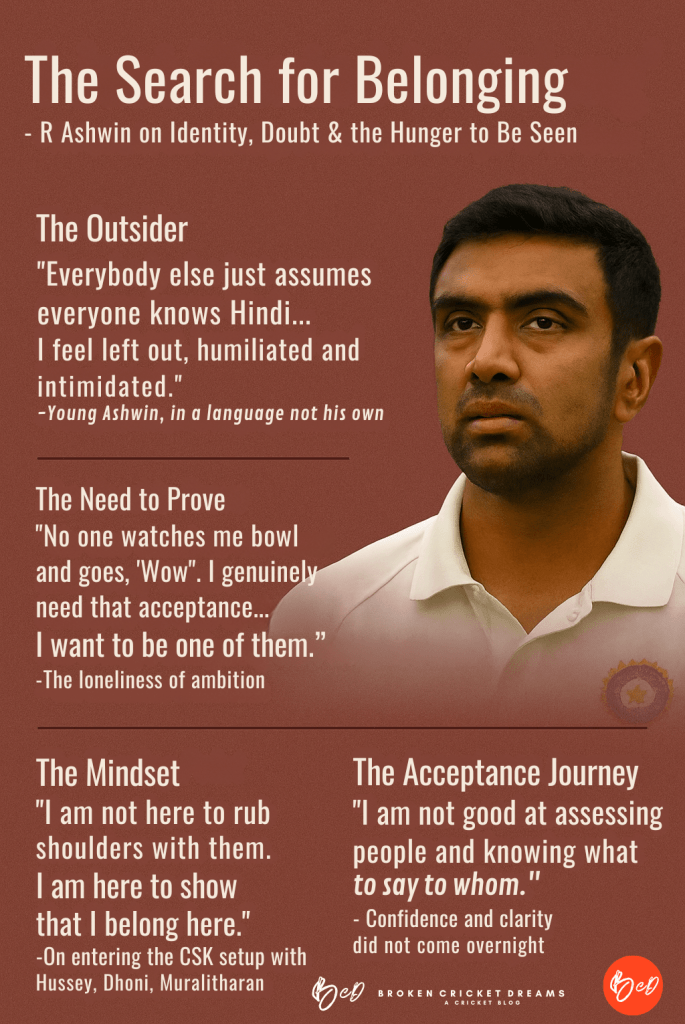
2. “Everybody else just assumes everyone knows Hindi and sets off speaking their own version of Hindi. I find it rude and alienating that no one makes an effort to talk to the one boy who doesn’t know their language…I feel left out, humiliated and intimidated.”
3. “No one watches me bowl and goes, ‘Wow’…I genuinely need that acceptance, though, to lose that feeling of being in awe all the time. I want to be one of them as soon as possible. So I’m always trying to analyze how they are looking at me. What is running through their heads? Do they think I am a proper cricketer or just a guy to make up the numbers.”
4. “I am not good at assessing people and knowing what to say to whom.”
5. “I am amazed that even Murali has self-doubt….These are inhuman expectations of him, but he doubts himself too, just like other humans.”
Life Lessons #1: External pressure, internal fears, and the desire to belong, they are all part of life. The key is to stay grounded in who you are and turn those doubts into positive energy.
Proving a Point, Over and Over Again
Whether it was the Ranji Trophy, the IPL, or the Indian time, Ashwin has had to prove himself over and over again. His interests in movies and engineering degree already made him a well-rounded person, and switching from a batter to an off-spinner made him a cricketing all-rounder. Resetting and performing repeatedly in different areas of life speaks to the strength of his mental resolve.
6. “Not for the first time, I find myself in a situation where nobody gives me a chance. I suspect nobody wants to give me a chance. My response is the only one I know: work harder, run harder, push harder.“
7. “Anirudha and I show up, we sign our contracts, and then VB gives us a glorious speech on what a huge opportunity this is. ‘You guys will rub shoulders with the likes of Michael Hussey, M.S. Dhoni, Matthew Hayden, and Muralidaran’…listen to it earnestly but also think to myself, ‘I am not here to rub shoulders with them, I am here to show that I belong here.'”
8. “It has been such a quick turnaround. From being a batter who bowled some seam-up, I am now an offspinner with one-and-a-half successful first-class seasons behind me.”
10. “One of the three streams offered to me, I pick computer engineering….I feel like I will die trying to balance studies and cricket. It feels like these four years of my life will never end…Every day is a hustle, trying to manage both college and cricket.”
Life Lesson #2: Challenges will come. And when they do, channel your inner R Ashwin and work harder, run harder, and push harder. In striving to prove a point, you may just discover excellence.
Always Asking, Always Evolving
Ashwin has kept evolving his game throughout the years. He has changed his action numerous times, invented new deliveries, and even became a T20 finisher.
But how did he get here? Ashwin evolved because he never stopped asking questions. From local bowlers to legends, he kept learning.
9. “It is during one of these [tennis ball] games that I come across SK. He has a beautiful and correct offspinner’s action, but the ball turns in weird directions and zips off the dusty surfaces…He is a bit of a terror in these matches. I am completely fascinated by what he does with the ball. So I start shadowing him. I take my bike and ride to wherever he is playing…I finally approach him to ask him how he does is. He is nice enough to show me that he flicks it with the middle finger and sends it out of the front of his hand when he wants to turn in the other way…In Madras, it is called the sodakku ball.”
11. “…Haydos’s company. I hesitate to speak with him; I wait for him to finish whatever he is doing and then introduce myself. He is extremely friendly. I ask him all the kinds of questions, and he patiently answers. I suspect he enjoys having conversations…How do you deal with pressure? How do you face Murali? How do you stand at slip for Shane Warne? I’ve watched you take some great catches; what is your mindset at slips?”
Influence of WV Raman and MS Dhoni
The most compelling moments in the book come from R Ashwin’s experiences with his mentor, WV Raman and his first early interactions with MS Dhoni. With Raman, you can vividly picture Ashwin honing his skills and elevating his craft. With Dhoni, you witness the foundation of a partnership that would shape Indian cricket for the next decade.
12. “Raman and I are made for each other. For the life of me, I can’t keep repeating the same thing. And Raman the coach comes up with something every day to help me keep discovering sping bowling to the fullest. One fine day, he tells me, run in 5 percent slower. Then another day, run in 10 percent faster.”
13. “…but Raman told me taking the new ball was the wrong call. And I told him, we had them nine down, trusted my seam attack, and they didn’t deliver…Raman said, ‘No, you’re wrong. Own up to your mistake. And do not come and tell me they didn’t deliver. If they didn’t deliver, you have a part in it.”
14. “When it comes to cricket, I am basically made of questions. MS doesn’t discourage me and answers every single question sincerely. He never brings up the optional nets either.”
15. “Each captain is different. Some can make donkeys run. Some people can buy wounded horses, treat them, train them, and make them run. But M.S. Dhoni will only make a racehorse run. He needs to be convinced you’re a racehorse before he makes you run. He will wait for a racehorse. If he doesn’t believe you’re a racehorse, he’ll probably give you time to become one, but he won’t make you run if you aren’t there yet.”
Life Lesson #3: Growth begins with curiosity. Ask questions. Stay open. The more you seek, the clearer your path becomes.
Indian Cricket Through Ashwin’s Eyes
Ashwin’s love for Indian cricket comes through in the way he speaks about his peers and predecessors.
16. “Tennis-ball cricket is a massive phenomenon in Madras. During the summer break, you can’t pass through a neighbourhood without witnessing at least one intense match going on in the sector ground. You don’t need a proper turf, a pitch or equipment for these games. It is a pure expression of love for the game and competition.”
17. “The other is Cheteshwar Pujara, who is only 15 and has already scored a triple-century in Under-14 cricket….There is an aura around him, an aura of thousands of runs.”
18. “And there are some ruthless players of spin going around…Shiv Sundar Das, Mithun Manhas, Halhadar Das, Robin Uthappa, Yere Goud, Rajat Bhatia, Sanjay Bangar…S. Bharat & Badri.”
19. “I, though, have seen the future of Tamil Nadu cricket and Indian cricket. His name is Dinesh Karthik. He is unlike any player I have seen in Chennai.”
20. “What makes this extra special for me is that Pravin Amre has stuck his neck out for me and overruled the other selectors because I batted in both of the morning sessions and actually scored some runs. This is what we had heard about Bombay: tough runs are valued there.”
Life Lesson #4: India’s cricketing soul doesn’t live in the big stadiums or in the IPL. It lives in the gullies and streets. That’s where toughness is built, where stories begin, and where Indian cricket comes to life.
Dreams Deferred, Dreams Passed Down
Finally, you get to learn about Ashwin’s family life. The sacrifice made by his parents, the dreams of his father, and how it came together with the 2011 World Cup final win. You also get to see Ashwin’s humor and his love for cinema.
21. “All those years ago, Appa traded his dreams for the job security provided by the Indian Railways, also his father’s employer. Ironically, now, a tardily running Indian Railways train is the way of his son’s, and I suspect his own renewed, dream.”
22. “Appa loves his cricket. He is a lower-divison league cricketer, a fast bowler. I am told he is a very good tennis-ball cricketer as well. My oldest memory of cricket is watching him take a wicket on a weekend. He bowled out somebody, sending the bail flying.”
23. “Thatha didn’t allow him to pursue cricket because he didn’t earn enough to raise the family and also provide for his cricketing needs. Appa doesn’t want the same to happen to me. His biggest worry is our orthodox extended family. Sometimes, even Thatha tells him cricket is not going to put food on my plate.”
24.”The movie Chennai 600028 is still fresh in our memories. It is also based on street cricketers. In our minds, we are in a movie.”
25. “Boy, I’m telling you, you’re a really really special cricketer,” Gary tells me…The kind of strides you made from 2009 to 2011 in every aspect of your game…See, everyone comes in here with what they’re good at and also their weaknesses. They continue to play to their strengths, and they try to hide their weaknesses, but very few come in with their strengths, evolve with their strengths, know what their weaknesses are, and work on those weaknesses.”
Life Lesson #5: Behind every dream fulfilled is a sacrifice quietly made. Sometimes, the dreams of one generation find life in the next. It truly does take a village to raise a child.
So, What Can We Learn from R Ashwin?
When I was younger, I liked R Ashwin, but the more I’ve seen him evolve, the more he’s become one of my favorite cricketers. Not just for the skill, but for how he thinks, adapts, and stays true to the game.
So, what did I learn from him?
Ask questions, Own your mistakes. Keep on evolving. Keep adapting. And above all, never stop loving what you do.




0 Comments