
Gutenberg’s Printing Press. Columbus setting sail in 1492. The assassination of Archduke Ferdinand. Hiroshima and Nagasaki. The Moon Landing.
Rarely does an event feel so monumental that it promises to change the course of the world as we know it.
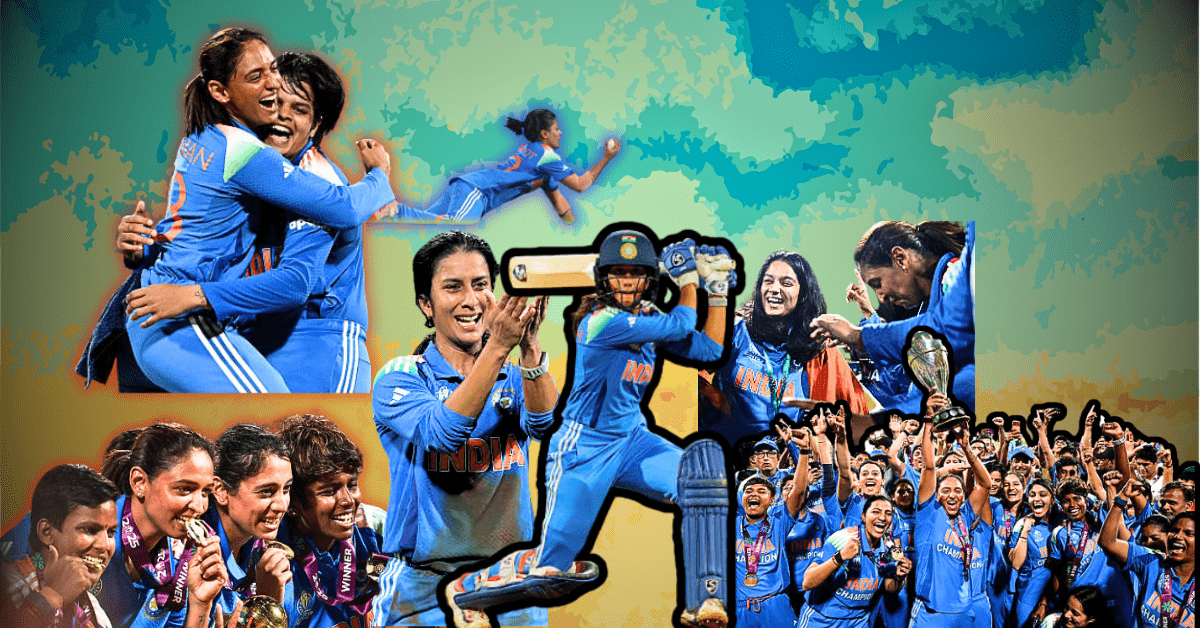
But on November 2nd, it felt like one of those moments: India’s women cricket team winning the World Cup. Alright, perhaps not at the level of Gutenberg or the Moon Landing, but you get the point. Some moments carry an emotional force that transcends the game itself.
India has long been called the “Sleeping Giant” of world sport, a nation of passion and population, yet far from realizing its global potential. We are reminded of this with every passing FIFA World Cup and the Olympics. But even within cricket, India’s most popular sport, women’s cricket remained the final frontier.
This wasn’t an underdog story like Kapil Dev’s men of ‘83. There were expectations for the home nation, shadowed by past disappointments. A semi-final run felt realistic, but beating this world-class Australian side? Let’s be honest, not many dreamed that far.
And yet, here we are.
It wasn’t a flawless campaign by any measure. This was an imperfect victory, and that’s what made it so special. Three losses in a row. Mandhana and Harmanpreet not quite at their best early on. In-form Pratika Rawal getting injured on the eve of the semi-finals. The public turning against the team on social media. We had seen this story before.
But when Jemimah Rodrigues fought her inner demons to script an unforgettable semi-final chase, every run she took held a nation’s breath. Her silky cover drives gliding across the field, the hunger burning fiercely in her eyes, and that smiling face, the charming grace masking the depths of fear, self-doubts, and the what-ifs. She stretched her body and mind to the limit because she knew she had to see it through and remain at the crease till the end. Oh, that muddied jersey, I’ll never forget.
Then came Shafali Verma, the out-of-favor young star meeting the moment. Dancing around the pitch, hitting sixes down the ground, taking magical wickets that turned the tide as if pressure meant nothing to her.
And when the ever-positive Amanjot Kaur sprinted in for Laura Wolvaardt’s catch…dropped, caught, dropped, and caught again, in that moment, we finally started to believe.
Every player stood up and in the field, they put their bodies on the line, diving around the boundary. Lifting the trophy in the presence of Diana Edulji, Anjum Chopra, and other pioneers, bringing in Rawal on a wheelchair, celebrating with Mithali Raj and Jhulani Goswami, this was poetic justice.
Deserved world champions, a team whose grit, grace, and courage have the power to ignite the nation.
The barrier is now shattered.
Think of the impact this win will have on India’s sports culture and even its social fabric. Somewhere in a small town, a mother realizes that her daughter could dream bigger than she ever dared to. Somewhere in a boardroom, an executive finally questions pay disparity. Somewhere in the stands, a young girl’s destiny just changed, dreaming of becoming the next Richa Ghosh or Shree Charani, inspired by World Cup heroines like Deepti Sharma.
Change will not come overnight.
But on this night, it began.
This is part of a new series of short articles, where I try to aim for 500 words and make every word count. This one ended up at 549 words.
BCD#405 © Copyright @Nitesh Mathur and Broken Cricket Dreams, LLC 2023. Originally published on 11/08/2025. Unauthorized use and/or duplication of this material without express and written permission from this site’s author and/or owner is strictly prohibited. Excerpts and links may be used, provided that full and clear credit is given to Broken Cricket Dreams with appropriate and specific direction to the original content (i.e. linked to the exact post/article).

0 Comments