SA20 Auction gathered lots of attention around the world.
This was not like South Africa’s earlier failed attempts to a T20 league. Graeme Smith is at the head of the organization (league commissioner), the IPL groups own all the franchises, and there was even an auction in this one. This was actually quite an enthralling event to witness.
Big Takeaways & Highlights from SA20 Auction
Sri Lankan (most) players go unsold despite a stellar Asia Cup performance
MI Cape Town stay true to their franchise and get as many as six uncapped South African players
This was a proper T20 league auction. Not one where home grown players’ reputation was kept in thought. T20 captain Temba Bavuma, Test captain Dean Elgar, and Andile Phehlukwayo were all unsold.
Tristan Stubb’s profile skyrockets. From an injury replacement at Mumbai Indians to $519,000 price at the SA20 auction.
Just like the IPL, the auction propelled a few relatively unknown names in the bags of riches. In this case, it was Donavon Ferreira at $311,000.
Prior to the auction, each franchise could acquire the services of maximum five players – 1 South African (capped), 1 uncapped, and three overseas players.
MI Cape Town (owned by Mumbai Indians group): Kagiso Rabada, Rashid Khan, Sam Curran, Dewald Brevis (uncapped)
Durban Super Giants (owned by Lucknow Super Giants group): Quinton de Kock, Jason Holder, Kyle Mayers, Reece Topley, Prenelan Subrayen (uncapped)
Base price -175,000 Rands ($10,000): Chris Wood, Duanne Olivier, Daryn Dupavillon
SA20 Auction Round 10 – The Nexxt
This was an express round for uncapped players.
Players
International Team
Franchise
Price Sold (South African Rands)
US Dollar Conversion
Jordan Cox
*Uncapped English player
Sunrisers Eastern Cape
R. 325,000
$18,000
Dilshan Madushanka
Sri Lanka
Durban Super Giants
R. 275,000
$15,235
List of Unsold Players in Round 9
Base price -175,000 Rands ($10,000): Andile Simelane, Tiaan van Vuuren, Jonathan Bird, Caleb Seleka, Matthew Boast, Bryce Parsons, Dunith Wellalage
SA20 Auction Round 11 – The eXXpress Auction
Players
International Team
Franchise
Price Sold (South African Rands)
US Dollar Conversion
Johnson Charles
West Indies
Durban Super Giants
R. 425,000
$24,000
Adam Rossington
*Uncapped English
Sunrisers Eastern Cape
R. 425,000
$24,000
Nandre Burger
*Uncapped South African
Joburg Super Kings
R. 175,000
$10,000
Donavon Ferreira
*Uncapped South African
Joburg Super Kings
R. 5,500,000
$311,000
Matthew Breetzke
*Uncapped South African
Durban Super Giants
R. 175,000
$24,000
Mitchell van Buuren
*Uncapped South African
Paarl Royals
R. 175,000
$10,000
Wihan Lubbe
South Africa
Paarl Royals
R. 350,000
$20,000
Marco Marais
*Uncapped South African
Pretoria Capitals
R. 175,000
$10,000
Delano Potgieter
*Uncapped South African
MI Cape Town
R. 175,000
$10,000
Roelof van der Merwe
South Africa/Netherlands
Sunrisers Eastern Cape
R. 175,000
$10,000
Marques Ackerman
*Uncapped South African
Sunrisers Eastern Cape
R. 175,000
$10,000
Ferisco Adams
*Uncapped South African
Paarl Royals
R. 325,000
$18,000
Imraan Manack
*Uncapped South African
Paarl Royals
R. 175,000
$10,000
Christiaan Jonker
South Africa
Durban Super Giants
R. 175,000
$10,000
Evan Jones
*Uncapped South African
Paarl Royals
R. 1,700,000
$96,000
Malusi Siboto
*Uncapped South African
Joburg Super Kings
R. 175,000
$10,000
Ramon Simmonds
*Uncapped South African
Paarl Royals
R. 175,000
$10,000
James Fuller
*Uncapped South African/New Zealand
Sunrisers Eastern Cape
R. 425,000
$24,000
List of Unsold Players in Round 10
Base price – 850,000 Rands ($48,000): Adam Lyth
Base price: – 425,000 Rands ($24,000): Jeffrey Vandersay, Jake Lintott, Paul Walter, Tom Moores, Sam Cook, George Scrimshaw
Base price -175,000 Rands ($10,000): Grant Roelofsen, Glenton Stuurman, Mbulelo Budaza, Ziyaad Abrahams, Aya Gqamane, Steve Eskinaz, Diego Rosier, Khaya Zondo, Johan van Dyk, Pieter Malan, Dayyan Galiem, Henry Brookes, Farhaan Behardien, Pite van Biljon, Unmukt Chand, Bayers Swanepoel
SA20 Auction – Round 12 – The eXXpress Auction
Players
International Team
Franchise
Price Sold (South African Rands)
US Dollar Conversion
Odean Smith
West Indies
MI Cape Town
R. 1,700,000
$96,000
Jimmy Neesham
New Zealand
Pretoria Capitals
R. 3,600,000
$203,000
Eoin Morgan
England
Paarl Royals
R. 2,000,000
$113,000
Kusal Mendis
Sri Lanka
Pretoria Capitals
R. 425,000
$24,000
Brydon Carse
England
Sunrisers Eastern Cape
R. 425,000
$24,000
Sarel Erwee
South Africa
Sunrisers Eastern Cape
R. 175,000
$10,000
Simon Harmer
South Africa
Joburg Super Kings
R. 200,000
$11,000
Wiaan Mulder
South Africa
Durban Super Giants
R. 1,900,000
$107,000
Caleb Seleka
*Uncapped South African
Joburg Super Giants
R. 175,000
$10,000
Daryn Dupavillon
South Africa
Pretoria Capitals
R. 1,700,000
$96,000
Ziyaad Abrahams
*Uncapped South African
MI Cape Town
R. 175,000
$10,000
Wesley Marshall
*Uncapped South African
MI Cape Town
R. 175,000
$10,000
Aya Gqamane
*Uncapped South African
Sunrisers Eastern Cape
R. 175,000
$10,000
Codi Yusuf
*Uncapped South African
Paarl Royals
R. 175,000
$10,000
Olly Stone
England
MI Cape Town
R. 850,000
$48,000
Grant Roelofsen
*Uncapped South African
MI Cape Town
R. 175,000
$10,000
Shane Dadswell
*Uncapped South African
Pretoria Capitals
R. 175,000
$10,000
Eathan Bosch
*Uncapped South African
Pretoria Capitals
R. 175,000
$10,000
Tom Abell
*Uncapped English
Sunrisers Eastern Cape
R. 850,000
$48,000
Final List of Unsold Players in Round 12
Temba Bavuma, David Bedingham, Andile Phehlukwayo, Roston Chase, Craig Overton, Siyabonga Mahima, Thimas Kaber, Paul Walter, Sam Cook, Diego Rosier, Farhaan Behardein, Pieter Malan, Rahkeem Cornwall, Hardus Viljoen
Frequently Asked Questions – Get to Know the Players
Who is Junaid Dawood?
Junaid Dawood is a 25-year-old leg break bowler who plays domestic cricket in South Africa.
Who is Shaun von Berg?
Shaun von Berg is a South African bowling allrounder from South Africa.He is a 36-year-old cricketer who has played 124 first class matches and has taken 447 wickets. He was recently purchase by the Pretorius Capitals in the SA20 auction.
Does Ross Taylor still play cricket?
Even though Ross Taylor retired earlier in 2022, he still plays exhibition cricket. He played for the Road Safety series and was in the SA20 auction. He was unsold with base price at 850,000 Rands ($48,000).
Who is Nandre Burger?
Nandre Burger is a 27-year-old South African cricketer. He is a left-handed medium-fast bowling all-rounder.
Who is Donavon Ferreira?
Donavon Ferreira is a 24-year-old South African cricketer. He is a wicketkeeper from Pretoria. He was sold for 5,500,000 South African Rands ($311,000) in the SA20 Auction to Joburg Super Kings.
Who is Matthew Breetze?
Matthew Breetze is a 23-year-old South African cricketer who is a wicket-keeper from the Eastern Province.
Which team purchased Mitchell van Buren in the SA20 Auction?
Mitchell van Buuren, a 24-year-old legspinner from South African was purchased by the Paarl Royals.
Who is Wihan Lubbe?
Wihan Lubbe is a South African cricketer who has played 2 T20Is.
Was Unmukt Chand picked up the 2022 SA20 Auction?
No, Unmukt Chand, an U-19 World Cup winning captain from India who now plays for Team USA, was not picked up for SA20 Auction. His base price was 175,000 South Africa Rands.
Who are the captains in SA20 cricket league in South Africa?
Rashid Khan (MI Cape Town), Quinton de Kock (Durban Super Giants), Aiden Markram (Sunrisers Eastern Cape), Faf du Plessis (Joburg Super Kings), David Miller (Paarl Royals), and Wayne Parnell (Pretoria Capitals) are the six captains of the SA 20 franchise league.
How many foreign players can play in the XI in SA20?
Four foreign players can play in the XI at the same time in SA 20.
Ben Stokes: Phoenix from the Ashes released today on Amazon Prime Video, the same day the English scored a commanding century against South Africa. This is a story that captures England captain, Ben Stokes’ journey through the ups and downs of his illustrious career.
Ben Stokes: Phoenix from the Ashes Review: Skip It or Watch It?
I will get straight to the point—The Review. Ben Stokes: Phoenix from the Ashes Review is not necessarily a must watch documentary. However, it is an important one.
It is skippable in the sense that Ben Stokes’ career is an open book—Humble roots in New Zealand, an upcoming youngster in the England circuit, The Bristol brawl incident, eleven-month court trial & media pressure, Carlos Brathwaite 4 sixes in Kolkata, IPL heroics, the 2019 World Cup final and Headingly heist, finger and knee injuries, his father’s terminal brain cancer, mother’s legal suit against The Sun newspaper for exploiting another personal tragedy, global pandemic, mental health break, and captaincy comeback. In a sense, nothing new is revealed about Ben Stokes. In addition, the picturization and flashback sequences are not the most coherent.
However, it is an important film due to the first-person points of view of Stokes & his family as well as Sam Mendes’ interview with Stokes while he was struggling with his mental health. It was courageous for Stokes to explain what he was going through on such a large platform. Appearances of Joe Root, Stuart Broad, manager Neil Fairbrother, and Stokes’ father adds immense value to the documentary.
Watch It For: The Interview, Highlight Packages, Ben Stokes’ cricket practice videos from U-12 & U-15 cricket, Mark Wood’s comic timing, Joe Root’s heartfelt messages
Don’t Watch it for: The overly dramatic background music
Prime Video Summary: A refreshingly honest filmabout an extraordinary cricketer. Directors Chris Grubb and Luke Mellows were allowed unprecedented access to Ben’s Life with interviews and insights by Sam Mendes.
Protagonist: Ben Stokes
Major Cast:
Teammates: Joe Root, Jos Buttler, Mark Wood, Stuart Broad, Jofra Archer
Commentators/Ex-Cricketers: Ian Bishop, Isa Guha, Shane Warne
Other: Dean Wilson (journalist), Phil Scott (England’s strength & conditioning coach), Neil Fairbrother (Stokes’ Manager), Vithushan Ehantharajah
Context: The Bristol brawl halted Stokes career due to the litigation, investigation, and media tensions that followed. The documentary walks through what Stokes’ family went through at this point. Although he was not found guilty of affray, the media only portrayed the negative side of things. Stokes had already been involved in a few incidents earlier in the England team like punching lockers, getting banned from driving to four speeding tickets, etc., and this incident was almost the nail in the coffin.
Stokes clears up what exactly happened and why he was involved in the incident in the documentary (he was defending his friends from homophobic abuses)
2. Heartbreak at the 2016 T20 World Cup Final
Quotes: That experience would have broken lesser mortals; Makes you even more hungry
“That experience would have broken lesser mortals” – Ian Bishop
Context: The 2016 T20 World Cup Final would forever be remembered for Ian Bishop’s iconic Remember the Name phrase when describing Carlos Brathwaite’s heroics. On the other end of the spectrum was Stokes, absolutely gutted. How he came back from the lows of 2016 to the highs of 2019s is an inspirational journey for all.
Context: The 2016 T20 World Cup final was a disappointment. However, it is portrayed in the film that the 2017 Bristol incident was the most impactful turning point in Ben Stokes’ career and life. He became a more mature individual, grew closer to family, and learned which people who could trust. At this point, he almost quit cricket and had to dive deep to figure out what used to drive him to give it his all.
4. Mental Health Awareness
Quote: This can happen to someone who is perceived as invincible; I noticed how emotionless I was
“This can happen to someone who is perceived as invincible” – Joe Root
Context: The interview was conducted two weeks after Ben Stokes’ suffered his major panic attack and decided to take a break from cricket. Stokes looked visibly fatigued and recalled a panic attack he suffered which included shortness of breath.
Mental health, especially in sport, is an important topic and can occur to anybody regardless of his or her stature.
5. The Larger-Than-Life Hero
Quote: His life is a story you could not script; Trauma, grief, strength, and defiance
“His life is a story you could not script” – Sam Mendes
Context: Rarely hasa cricketer in recent memory suffered the ebbs and flows to the extent as Stokes has. He has touched glory with starring roles in World Cup and Ashes victories. On the other hand, he has had to see his father, a former Rugby league player in New Zealand, pass away after a fight with terminal brain cancer.
If you have yet to see this documentary, check out the trailer below.
Ben Stokes: Phoenix from the Ashes Frequently Asked Questions (FAQ)
Who is the director of Ben Stokes – Phoenix from the Ashes documentary?
Chris Grubb & Luke Mellows is the director of Ben Stokes – Phoenix from the Ashes. Sam Mendes, who also interviews Ben Stokes, is the producer alongside Sunil Patel & Mark Cole.
Where can I watch Ben Stokes Phoenix from the Ashes?
Ben Stokes: Phoenix from the Ashes is released in Amazon Prime Video on August 26, 2022 worldwide.
Technology in cricket has often been an area of debate. Ten pieces of technology have fundamentally changed how the game is played:
(1) The DRS, (2) Hawkeye, (3) Virtual Eye,(4) Snickometer, (5) Ultra-Edge, (6) Hotspot (7) LED stumps, (8) Spidercam, (9) Bushnell (sporting optics), and (10) Stump Mic.
Today, we look at several aspects of these technologies: Cost, impact, and history.
Why Do We Need Think About Technology in Cricket?
Let’s rewind our clocks to 21st March, 2018.
ICC World Cup Qualifiers in Zimbabwe. Scotland vs West Indies. A spot in the World Cup on the line.
Over 31.4, Ashley Nurse to Richie Berrington: Berrington is adjudged LBW out by the umpire, but it would have definitely gone down the leg side.
There was no DRS.
Couple of overs later, rain arrived. West Indies beat Scotland by 5 runs (DLS method). Heartbreak for Scotland.
Jason Holder later said in the post-match presentation:
“That’s beyond my control. I think it’s a question for the ICC. At the beginning of the tournament, they set up the rules, and those rules are the rules we played with. It’s cricket. Sometimes it goes for you, sometimes it goes against you.”
– Jason Holder
Landscape of Cricket is Changing
In a tournament as important as the World Cup Qualifiers, there should be no excuse that technology is not used (not all games were televised either, but that is a separate issue).
So, why was DRS not used? It’s because implementing technology in cricket is expensive and not all cricket boards & broadcasters have that kind of money.
Cricket is going where the money is going. Franchise cricket is taking over the cricket calendar and players now have various choices in how to earn money (as they should).
Recently, in our Finances in Cricket section, we have explored:
We will now explore how money is utilized from the administration side of things. For example, how much money is needed to host a Test match as compared to limited over matches & franchise leagues?
However, in order to answer this question, we must first understand the economics of technology used. Let’s begin our exploration.
Technology in cricket is used predominantly for three reasons—Ball Tracking, Edge Detection, and Infrared Imaging.
The reason for the high costs for these technologies are as follows: (1) initial installation costs of the technology itself, (2) additional camera setup, (3) maintenance & staff costs to ensure the technologies run smoothly.
1. DRS (Decision Review System): $20,000-60,000 Per Day
What is the Full Form of DRS? What Does DRS Stand For?
DRS stands for Decision Review System.
The Decision Review System is the entire toolkit utilized via broadcasters to assist umpires during a cricket match. The DRS primarily helps in LBW decisions (ball tracking) & faint nicks (edge detection/hot spot).
How Much Does DRS Cost?
Minimum Cost: $12,000-15,000 per day (4 camera system)
Maximum Cost: $60,000-100,000 per day
Test Match Estimate: $300,000-$500,000 per Test ($600,000 – $2.5 million for a Test series depending on the amount of Tests and the technologies used).
World Cup 2023 Estimate: $2.8 million-$4.8 million (48 ODI matches)
Currently, a complete system of DRS costs approximately $100,000 per day. Hence, a full five-day Test match would cost around $500,000 and a five-match Ashes series will cost around $2.5 million. It was estimated that the 2021-22 full-package Big Bash league would cost around $2 million AUD ($1, 333, 600 USD) at an average of $32,787 AUD ($21,862 USD) per match for the 61 matches.
According to a Cricbuzz report, the Bangladesh Premier League in 2019 bought a DRS package without Snicko, Ultra-edge, and Hotspot for $75,000 per match (Just the Ball-tracking technology and ultra motion replays) and a full-package would have cost them $100,000 per match.
Currently, a team captain can review a decision up to two unsuccessful DRS decisions. In Test matches, the reviews are reset after 80 overs.
Impact/Features:
DRS has certainly impacted cricket for the positive. Although it has taken a few years to evolve, the DRS has definitely helped cricket in getting rid of the howlers (recall, 2008 Sydney Test).
It has also provided cricket yet another strategic aspect (think Headingly 2019 – Tim Paine Review). Finally, the DRS has changed the dynamics of the game. For example, spinners have drastically benefitted in LBW decisions since the beginning of the review system.
The most common DRS technology used is for Ball-Tracking purposes. Hence, the majority of DRS costs goes in the implementation of Hawk-eye.
2. Hawkeye
How Much Does Hawkeye Cost?
Hawkeye has been used in multiple sports—Tennis, Rugby, Gaelic Football, Soccer, NASCAR, etc.
In Gaelic Football, it was estimated that the installation cost of Hawkeye is 250,000 pounds ($317,600). It would take them a further 500,000 pounds ($635, 200) to run it the entire season.
With Hawk-eye, cricket broadcasters have data like never before.
In 2013, ESPNCricinfo integrated Hawkeye data with their live score coverage. This included addition of features such as: (1) Pitch Map, (2) Ball Speeds, (3) Beehive (trajectory of the ball), (4) variable bounce, and (5) Wagon Wheel.
Virtual Eye is the other ball-tracking company based in New Zealand.
How Does Virtual Eye Work?
According to Virtual Eye (also known as Eagle Eye), they utilize the “high-frame rate cameras” to “track the centre of the ball in every frame…[Their] software then calculates the precise ball track in 3D space and predicts the path once the release, bounce, and impact points are known.”
Impact/Features:
Similar to Hawkeye, Virtual Eye provides (1) Wagon Wheels, (2) Pitch Maps, (3) Six Distances, (4) 3D Flyovers, and (5) ball tracking.
In the BPL report, they paid for $75,000 instead of $100,000 and missed out on Hotspot, Snicko-meter, and Ultra-Edge.
It is known that Hotspot costs around $10,000. However, due to concerns with the technology (silicone tape/other bat coatings could fool the system), it has not been used unanimously in the DRS packages over the years.
4. Snicko-meter (Real-time Snicko – RTS)
How Much Does Snicko-meter Cost?
Real-Time Snicko (RTS) can cost around £2,500 ($3430.50).
How Does Snicko-meter Work?
The snicko-meter utilizes the stump mic and measures sound waves (via an oscilloscope).
The technology is made effective with split-screen display (one showing the waves in the snicko-meter & the other displaying slow motion camera). This ensures the sound corresponds to the nick of the bat.
Ultra-edge is Hawkeye’s version of the Snicko. After the 2015 testing with MIT (Massachusetts Institute of Technology) in Boston, USA, it was accepted by the ICC. In particular, Ultra-edge can differentiate between the sounds of clothing, bat, and pad.
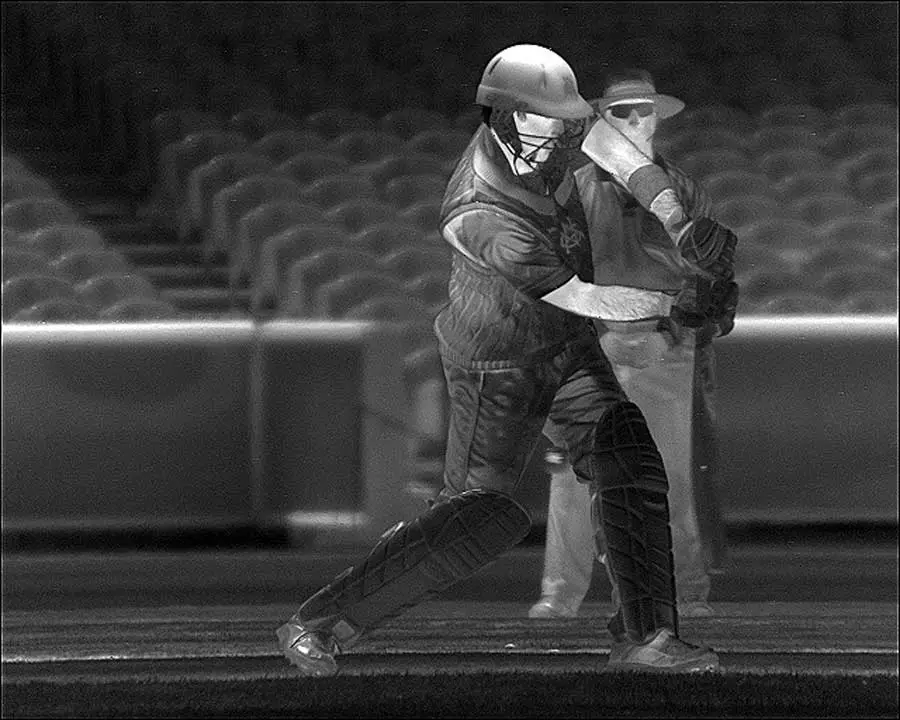
With a four-camera setup, Hotspot uses infrared thermal imaging technology to detect where the ball hits.
Impact/Features:
The pros of HotSpot was that it could catch even the faintest of edges. However, the inventor himself had doubts of the validity of the HotSpot during the 2013 Ashes since coating on bat can prevent HotSpot to be displayed.
In addition, it has been suggested that HotSpot has not been preferred in India since it is a military technology.
Is one possible faint nick worth $10,000 per match?
There are other technologies that have enhanced the level of cricket broadcasting over the past decade: Helmet cameras, Stump Mics, LED Stumps, SpiderCam, etc. These technologies are not necessarily part of the DRS and, we may not have all the cost information.
Although I could not find the exact cost of the Spidercam, I bet this can cost the broadcasting companies upwards of hundreds of thousands or even a few million dollars.
How does the Spidercam Work?
The Spidercam tries to offer a ‘bird-eye’s view’ on the cricket ground. It is made possible with a cable suspended camera system. This helps the camera move in multiple directions.
On Amazon, Bushnell range finder for golf costs anywhere from $100-300. For professional sporting equipment, it may be a bit more expensive.
How does the Bushnell Work?
A range finder is used to measure distances of remote objects and has been used in the military and golf.
Watch this videoof Simon Doull explaining in a Cricbuzz discussion that the range finder plots from the “middle of the ground to the grandstand and tiers of the grandstand. It’s not where the ball might have landed.”
Impact/Features:
With T20 cricket, displaying the distance of sixes has become central to broadcasting needs.
10. Stump Mic
Impact/Features:
Stump microphones are placed near the stumps and pick up sounds like edges (important for snicko & Ultra-edge to work) as well as sledges & Rishabh Pant singing spider man main theme song.
Bonus
PitchVision
Their catch phrase is “technology used in the highest level of the game is now available for everyone to use.”
2008 – DRS is first experimented in the India-Sri Lanka Test series. Virtual Eye technology made an error in Virender Sehwag’s dismissal. Dilshan was given not out due to lack of evidence. Doubts crept in.
2009 – Review system started to be officially implemented in Test matches (with agreement from both teams)
2018 – ICC Women’s World Twenty20 first ICC T20 World Cup to feature the DRS
Who Pays for These Technologies?
In the early days of the DRS, the broadcasters of the home team used to take most of the responsibility of these costs.
Now, the payment is usual divided between the home team cricket board & the broadcasters. However, as the review system gets further uniformed around the world (especially with World Cups and major tournaments), the ICC has started to bear some of the responsibility and subsidize the overall cost.
Final Thoughts
Although cricket might not have as much broadcasting prowess as other sports like American football, but it is certainly in the right direction. I hope more independent companies can chime in as well, which may help reduce the costs. The competition may also drive better products.
I also hope that the ICC can make uniform regulations and can cover the costs, especially in major tournaments like the World Cup Qualifiers.
What is the difference between Ultra-edge & snickometer in cricket?
Ultra-edge is Hawkeye’s version of the snicko.
What does DRS stand for?
DRS stands for Decision Review System.
Why is Hotspot technology not used in cricket anymore?
HotSpot technology is not used in cricket anymore due to doubts about the validity of the technology. Bat coating & silicone tape can hide the image detection on Hot Spot.
West Indies from the 1980s and Australia from the early 2000s have usually held the tag of the greatest cricket teams to ever to be assembled, but do they have a new challenger now?
With the Australia women team winning the 2022 Commonwealth Gold medal, the debate is on—is this Australian women team among the greatest cricketing sides ever?
List of Greatest Cricket Teams
We will consider the modern-day cricket i.e. only the eras after the 1970s (there were great dominant Australian teams in the 1940s and earlier as well).
Winners of the 1975 ODI World Cup, 1979 ODI World Cup, and Runner Up in the 1983 ODI WC (regarded as a massive upset), Clive Lloyd’s men etched their name into glory.They were world beaters in Test match cricket as well with towering fast bowlers even till the mid-1990s.
Record
Most Consecutive Test Series without defeat (29), from 1980-1995
Key Players
Clive Lloyd (C), Garfield Sobers, Sir Vivian Richards, Sir Gordon Greenidge, Desmond Haynes, Michael Holding, Malcolm Marshall, Sir Andy Roberts, Joel Garner, Courtney Walsh, Curtly Ambrose, Lance Gibbs, Colin Croft, Deryck Murray, Lawrence Rowe, Alvin Kallicharan, Roy Fredericks, Rohan Kanhai, Larry Gomes
2020 T20 World Cup, 2022 ODI World Cup, 2022 Commonwealth Gold, 26 Winning ODI Streak (2018-2021)
Women’s cricket in Australia was always going to be one step forward due to awareness and funding. They have most of the ODI and T20 World Cups anyway, so how much better could this team be?
Well, this team is very, very good. They do not lose Test matches, have only lost a couple of ODIs in the last four years, and when it seemed the gas was running out, Ash Gardner & co made sure Australia had the mental strength to comeback from jaws of defeat. All this with the great Ellyse Perry on the sidelines.
16 Series Without Defeat (2001-2004) followed by 9 series (2005-2008)
Key Players
Ricky Ponting, Steve Waugh, Matthew Hayden, Adam Gilchrist, Justin Langer, Shane Warne, Glenn McGrath, Brett Lee, Shane Watson, Andrew Symonds, Michael Bevan, Mark Waugh, Dean Jones, Darren Lehmann, Damien Martyn, Stuart MacGill, Jason Gillespie, Simon Katich, Brad Hogg, Brad Hodge, Michael Kasprowicz, Andy Bichel, Nathan Bracken
During this era, South Africa did not win a World Cup. Nor did they establish absolute dominance, but the thing was in an era where the Australian side had begun their descent, no team in the world was quite as strong.
South Africa though challenged teams all around the world, most notably winning in Australia and drawing in India. The era finally collapsed after 2015-16 season, but they gave it all in their final stand – The Blockathon.
Test Record
14 series without defeat (2008-14)
Key Players
Graeme Smith, Jacques Kallis, Faf du Plessis, Hashim Amla, AB De Villiers, Dale Steyn, Morne Morkel, Mark Boucher, Vernon Philander, JP Duminy, David Miller, Imran Tahir, Shaun Pollock (end of career), Makhaya Ntini (end of career), Ashwell Prince
Most World Cup winning teams are some of the greatest teams in a nations history, but why did I choose the England 2015-2022 team? It is because of the dominant nature of their high risk ODI cricket that they became famous for. Started by Brendon McCullum in the 2015 ODI World Cup, Eoin Morgan took the baton and carried England forward.
Yes flat pitches, bigger bats, and all but 498/4, 481/6, 444/3, 418/6, 408/9, & 399/6 is just another level of dominance. High risk meant that they lost more often, but they changed ODI cricket forever.
Key Players
Eoin Morgan, Joe Root, Alex Hales, Jonny Bairstow, Jason Roy, Jos Buttler, Ben Stokes, Jofra Archer, Liam Plunkett, Adil Rashid, Chris Woakes, Moeen Ali, David Willey, Sam Curran, Mark Wood, Tom Curran, Chris Jordan, Liam Livingstone, James Vince, Joe Denly
Honorable Mention
Sri Lanka (1996-2015), Pakistan (1985-1999), India (2008-2013), India (2018-present), South Africa (1992-1999), England (2008-2011)
Do you agree that these are the greatest cricket teams? Comment below and let us know.
India is quietly growing its massive depth in cricket, which means there will always be a few unlucky Indian cricketers. Here is our Top 13 list as well as a list of cricketers at the bottom who only played 1-5 matches for India without being given more chances.
We have already done a list of 22 Unlucky Players of All Time. This is a list that only pertains to Indian cricketers who debuted for India.
All-rounder from Jammu & Kashmir, did not get to bat in his only ODI and 10-0-60-2. Waited 3 years for another chance and got picked for the T20I series vs England.
Run out for 5(6) and decent figures of 4-0-32-1. Never to play an international game again. 4 years and only 2 games where he did not have much of a chance to showcase his talent.
That match seem familiar? Not only was it Sachin Tendulkar’s last match in his 24-year career, it was also Pragyan Ojha’s last match in his five-year international career.
5/40 & 5/49 with a player of the match performance. Next thing you know, the Ashwin-Jadeja pair is tried out next season, and Ojha was never picked again. He was only 27 at that time (only 35 right now and doing commentary).
Batting at #4, top scored with 43 (37) and won the player of the match award in his only T20I. A poor ODI series meant his career ended 9 days later. 2 Tests (in SA), 7 ODIs, and 1 T20I only for the domestic giant (10245 runs, 54.49 average, 32 – 100s, 45 – 50s). Vital cog in CSK’s 2011 victory.
ODI debut: 9.2-0-56-3, T20I debut: 4-0-10-4, best T20I debut by an Indian.
Two days later, his second T20I & final match, 4-1-31-2.
Was picked after only 8 List A matches and performed well only to be dropped. Now doesn’t even get IPL gigs (net bowler for Gujarat Titans this year). With Khaleel Ahmed, Natarajan, and Arshdeep Singh in the scheme of things, it looks like the 29-year old has a tough road to a comeback and may have already played his last match.
A casualty of India’s bizarre chop and change policy between 2016-2019 in their quest to find a perfect #4 batter.
Debuting a year later than Virat Kohli & the first Indian to hit an IPL century, Pandey has never been able to do justice to his talent due to limited opportunities. It seemed that his time had come with a magnificent chase of 330, where he hit an unbeaten 104* at #6 to take India home.
An average of 44.31 in T20I with 3 fifties, more opportunities were expected, but it looks like that the time has passed.
104* (1 hundred, 1 fifty), but didn’t get anymore than his 12 ODIs and 1 T20I. Made frequent appearances for KKR but his forte was first class cricket – 9398 runs, 49.98 average, best of 303*, 29 hundreds, 39 fifties – and never played a single Test match. His ODI debut itself was delayed for more than a year after he suffered a shoulder injury on the eve of his potential ODI debut.
Also fascinating is the XI fielded in Tiwary’s last match – 8 out of these 11 can be considered ‘unlucky Indian cricketers,’ at least in limited overs cricket.
Although Kambli had a decent 104 match ODI career and was rightly axed after India collapsed for 54 in the Champions Trophy final, it was his Test career that perplexes me. 17 Tests, best of 227, 4 hundreds, 3 fifties, and yet he played his last Test at the age of 23.
Sachin Tendulkar would play, almost to the date, 18 years longer in his Test career.
More than Manish Pandey, Ambati Rayudu suffered the most & so did India as they crashed out of the 2019 ODI CWC semi-final.
A talent of his generation, ODI average of 47.05 (3 hundreds, 10 fifties) – he was unceremoniously dropped both before the 2015 ODI World Cup (after player of the series performance vs Zimbabwe) and the 2019 ODI World Cup.
His last 10 ODI scores were 24, 13*, 47, 40*, 0, 90, 13, 18, 2. Unlucky Indian cricketer at its finest.
Just Ordered a new set of 3d glasses to watch the world cup 😉😋..
Amit Mishra played 22 Tests, 36 ODIs, and 10 T20Is, and he never looked out of sorts. With figures of 4-0-23-1 in his last T20I, 6-2-18-5 (player of the match & player of the series – 15 wickets) in his last ODI, we wonder how things could have been.
A domestic cricket giant with a couple of Test double centuries, he last played Test cricket atthe age of 30.
Most capped Ranji player, most runs, 57 hundreds, 91 fifties, average of 50.67. Played 20 of his 31 Tests in West Indies, South Africa, England, Bangladesh, and Australia. Maybe if we was given more chances at home…
Although Jayant Yadav recently played, it seems that was more because of injuries and COVID replacement.
Scoring a century at #9 and a handy offspinner, it seemed that he was bound for better things. However, he has ended with only 4 Tests & 1 ODI. With Ashwin, Jadeja, Chahal, Kuldeep, Bishnoi, Sundar, and Axar’s glorious Test debut, it seems that his international career is good as done.
1. Karun Nair
Last but not the least – Karun Nair. Someone who has scored a triple century definitely deserves a rope longer than 6 Test matches.
Notable Exclusion: Faiz Fazal (55* in his only ODI with a 126* partnership with KL Rahul), Shahbaz Nadeem (Rewarded for domestic performances but only played 2 Tests)
List of Indian Cricketers Who Only Played in 1-5 International Matches
What is our definition of the ‘unlucky cricketer’?
Only given 1-3 opportunities without much chances after
Dropped inexplicably even after a few good performances
Here is a list of several other unlucky Indian cricketers who deserve a mention – Only played between 1-5 matches. In some cases, did not even get to bat or ball. How can someone showcase talent in these limited opportunities? I am glad the current Rohit Sharma-Rahul Dravid lead management are giving each player a run and ‘allowing players to fail’ (i.e. players will get enough of a run. If they do not perform, then only will they be dropped).
In any case, most of the retired players are now prominent coaches or commentators.
Cricket at the 2022 Birmingham Commonwealth games was a watershed moment in world cricket.
With the ICC trying to push for cricket’s inclusion in the 2028 LA Olympics, women’s cricket at CWG was a trial run. No post-match presentation ceremonies, Barbados participating as a separate qualified nation, different Covid-19 protocols, and finally a ‘Gold Medal’ match for cricket.
The good news? It was more or less a success. The semi-finals, finals, and the Bronze medal match all went down to the wire. Unlike the rumored T10 format for the Olympics, it was nice to see that T20 did the job fairly well. The best of all – crowds were in!
Hosting a world wide tournament in England is one thing…in a non-Test cricket playing nation…that may be a different challenge altogether.
India, Australia, England, and New Zealand qualified for the semi-finals. With the exception of a NZ team (which was on a downfall earlier), this was not exactly was a surprise.
Sri Lanka were bowled out for 46 & 102, Barbados bundled out for 62 & 64, and Pakistan all out for 99. On the flip side, Australia chased 155 out of nowhere, and the big teams had 11 scores combined between 150-170.
3. Australia are Invincible
In the opening match of the tournament, Renuka Singh’s four wicket haul were struggling at 49/5, courtesy Renuka Singh’s 49/5.
Then, I tweeted this – a seemingly arrogant headline by ESPNCricinfo, already gifting the gold medal to Australia
And suddenly, @ESPNcricinfo's headline of "…But the Gold seems reserved for #Australia" seems a bit far fetched….👀😅🤔
— Broken Cricket Dreams Cricket Blog (@cricket_broken) July 29, 2022
And guess what? Ash Gardner scored an unbeaten 52*(35) to take Australia home with Grace Harris and Alana King providing strong support.
It seems that Gold is reserved for this Australian team. This team is invincible – ODI World Cup, T20 World Cup, record streak of ODI wins, and now the Commonwealth Gold Medal.
This team is so strong that Ellyse Perry, yes the Ellyse Perry, sat on the sideline all tournament.
4. India lose out on nerves again, but is lack of WIPL the only reason?
India lost the final against Australia by 9 runs, the same margin they had lost in the 2017 ODI World Cup final. And in a similar fashion as well.
Chasing 162, India had recovered to a steady 118/2 in 14.2 overs. The young star, Jemimah Rodrigues and senior captain-slash-arch-nemesis, Harmanpreet Kaur were playing. Rodrigues was dismissed for 33 and Kaur followed soon with 65. Some baffling decisions with Yastika Bhatia, a regular #3 being sent at #9 & three run outs ensured India fell 9 run short, with 3 balls still to spare.
Social media went haywire with India’s inability to finish and ‘lack of mental strength’ accusations galore. Lots of pointers that the Women’s IPL has already been delayed 2-3 years too long and that resulted in not enough pressure situation practice.
That is partially true but a WIPL wouldn’t magically have done anything. Results and increased depth from WIPL will probably be seen in a decade from now at the earliest. This loss could be attributed to nerves in a final (regardless of the team), an Australian team one level above, and error in judgment by the set batters.
5. Early retirements a concern in women’s cricket too
Trent Boult’s semi-unofficial-retirement (in fashion of AB De Villiers), Ben Stokes’ ODI retirement, and Quinton de Kock’s Test retirement are not the only signs of cricket’s changing landscape.
Lizelle Lee (30) & Deandre Dottin (31) both announced shock retirements from international cricket. Although the reasons were different, it shows growing dissent between the players and respective boards.
Today we rank the best sport movies & documentaries.
Welcome to the “All of the Above” best sport movies, TV shows, & documentaries ranking list. We consider everything sports – drama films, biopics, sports documentaries, streaming platform content, Hollywood, Bollywood, English, Hindi, Spanish, American football, soccer, cricket, boxing, and more. Let’s cut to the chase.
The best sport movie of all time is Remember the Titans followed closely by the Blind Side, while Bhaag Milkha Bhaag (Run Milkha Run) makes the cut as the best Bollywood sports movie.
List of Best Sports Movies and Documentaries
Disclaimer: This list is based upon the movies I have watched so far, but here are some sports films on my watchlist.
Currently Watching: Man in the Arena (2021), Becoming Champions (2018), Welcome to Wrexham (2022)
American Football: Rudy (1993), Draft Day (2014), Concussion (2015), American Underdog (2021), Hard Knocks (2022)
Baseball: 42 (2013), Eight Men Out (1988)
Basketball: White Men Can’t Jump (1992), Hoop Dreams (1994), The Way Back (2020), Space Jam: A New Legacy (2021), Glory Road (2006)
Boxing: Raging Bull (1980), Ali (2001), Million Dollar Baby (2004), Irudu Suutru/Saala Khadoos (2016), Mukkabaaz (2017), Mike (2022)
Cricket: Chakda ‘Xpress (TBD), Kai Po Che
Golf: The Greatest Game Ever Played (2005)
Miscellaneous: ESPN 30 for 30 (ex: OJ: Made in America), Cool Runnings (1993), Kai Po Che (2013), I Tonya (2017), Free Solo (2018), Icarus (2017), Budhia Singh – Born to Run (2018), Saand ki Aankh (2019), The Way Back (2020), Saina (2021), 14 Peaks, Tony Hawk: Until the Wheels Off (2022), Hawaa Hawaai (2014)
Racing: Rush (2013), Schumacher (2021)
Rugby: Invictus (2009)
Soccer/Association Football: Escape to Victory (1981), Goal Trilogy (2005), The Damned United (2009), All or Nothing (Arsenal 2022, Tottenham Hotspurs, etc.), Diego Maradona (2019), Bigil (2019), Jaadugar (2022)
Tennis: Venus & Serena (2012), Borg vs McEnroe (2017), King Richard (2021), Serena (2022)
These will be added one by one to the ranking list once I have finished watching them.
61. Apne (2007)
Sport: Boxing
Genre: Sports Drama
Language: Hindi
In the most literal sense, it is a family-driven boxing drama marred by false doping accusation.
60. Dil Bole Hadippa! (2009)
Sport: Cricket
Genre: Sports Drama/Rom-Com
Language: Hindi
Girl playing cricket by concealing her identity in an all-boys’ team. A bit of romance and of course, an India-Pakistan local club match as well.
59. Brothers (2015)/ Warriors (2011)
Sport: MMA (mixed martial arts)
Genre: Sports drama (fiction)
Language: Brothers (Hindi), Warriors (English)
Brothers is the official Bollywood remake of the 2011 American film, Warriors.
58. Sachin: A Billion Dreams (2017)
Sport: Cricket
Genre: Documentary
Language: Hindi, English, Marathi
Documenting the journey of the greatest cricketer of all-time, the film explores the life behind the scenes and how he battled pressure while giving people hope. Great background music by AR Rahman as well.
57. Space Jam (1996)
Sport: Basketball
Genre: Sports fantasy, live-action & animation
Language: English
In the age of Marvel & Avengers, Space Jam looks like a joke in animation. Michael Jordan flying with Bugs Bunny and getting kidnapped in outer space isn’t exactly bingeworthy material, but if you are a sports fan, you have to watch it once in your life.Considered a classic.
56. Home Team (2022)
Sports: American Football
Genre: Comedy/Biography
Language: English
Where to Watch: Netflix
Any movie with Kevin James is bound to be funny. A college football star coach who was removed from duty due to an investigation goes on to coach his son’s middle school football team. A good watch.
55. MS Dhoni: The Untold Story (2016)
Sport: Cricket
Genre: Biography
Language: Hindi
Based on Indian captain MS Dhoni’s journey before he broke into stardom, the movie explores his family life, love angles, & early struggles. Late Sushant Singh Rajput did justice to the role, but the story & direction were a bit short.Good first half, but the story isn’t as tight in the second half. It did not help that the movie was released during the latter years of Dhoni’s career, before his retirement.
54. Sultan (2015)
Sport: Wrestling
Genre: Sports drama
Language: Hindi
Sultan is a fictional drama based on a couple who are both professional wrestlers and develop ego clashes along the way.
53. Azhar (2016)
Sport: Cricket
Genre: Sports Drama, Biography
Language: Hindi
The movie explores the larger-than-life character of Indian captain Mohammad Azharuddin, and his interpretation of the 2000 match fixing scandal.
52. Welcome to Wrexham (2022)
Sport: Soccer
Genre: Documentary
Language: English (both American & British accents with a slight dose of Welsh)
Where to Watch: FX on Hulu
Imagine Deadpool’s actor Ryan Reynolds. Now imagine Rob McElhenney. Now imagine they randomly bought a fourth division team in Wales and try to resurrect it and promote it to the next level. Well, this is exactly what happened. Some humor, mostly reality, and a bit of soccer as well. Basically, Ted Lasso but in real-life.
*Note: I have only watched 5 episodes so far. This ranking is subject to change. 15 episodes will be released in total by the end of the season.
51. Becoming Champions (2018-)
Sport: Soccer/Association Football
Genre: Documentary Series
Language: Multiple Languages (Spanish, French, English, etc.)
Where to Watch: Netflix
The journeys of the 10 FIFA World Cup winners and how it all fit in the history of their respective countries. Good watch, but I have one complaint – there were a few World Cup clips, but not enough for a soccer documentary. Lots of newspaper cuttings instead.
50. Beyond the Boundary (2020)
Sport: Cricket
Genre: Documentary
Language: English
Where to Watch: Netflix
This hour-long film documents the 2020 T20 World Cup – a watershed moment in women’s cricket. Watch it for the inspirational journey of Thailand and the India-Australia final.
49. Toofan (2021)
Sport: Boxing
Genre: Sports Drama
Language: Hindi
Amateur fighter turned boxer gets banned for five years due to corruption and attempts to make a comeback.
48. Ta Ra Rum Pum (2007)
Sport: Racing
Genre: Sports Drama
Language: Hindi
A carefree star NASCAR drive whose life turns upside down after a life-threatening crash.
47. Soorma (2018)
Sport: Field Hockey
Genre: Sports Drama
Language: Hindi
Based on the true story of India’s drag flicker specialist, Sandeep Singh, this is an inspirational story of a comeback of from being shot and paralyzed.
46. 99 (2009)
Sport: Cricket
Genre: Crime Comedy
Language: Hindi
Not quite a sports movie in its entirety, 99 is a fictional behind the scenes underworld account of the match-fixing & betting scandal that married the India-South Africa series.
45. Ben Stokes: Phoenix from the Ashes (2022)
Sport: Cricket
Genre: Documentary
Language: English
Live through Ben Stokes’ ups and downs of his iconic career, rising from the lows of mental health break and grief to the captaincy of England cricket team.
44. Bandon Me Tha Dum (2022)
Sport: Cricket
Genre: Documentary
Language: English
Where To Watch: Voot Select
Relive India’s dramatic victory in Australia in the players’ own words – featuring Rishabh Pant, R Ashwin, Pat Cummins, Vihari, Pujara, and Tim Paine himself.
Beautiful tribute to college basketball broadcaster, a former coach, and the face/voice of ESPN—Dick Vitale.
42. Toolsidas Junior (2022)
Sport: Snooker
Genre: ‘Coming of age’ Sports Drama
Language: Hindi
Vowed to avenge his father’s defeat in a local club’s snooker competition, the young son goesout of his way to learn the game and enters the contest. Nice, cute movie.
41. Dhan Dhana Dhan Goal (2007)
Sport: Soccer
Genre: Sports Drama
Language: Hindi
Set in Southall, a predominantly South Asian community in the UK, a club overcomes their differences and comes together to play a tournament and save it from being demolished.
Sharman Joshi shines as a middle-class man trying to come up with some money so he can send his talented son for a camp at the majestic Lord’s cricket ground.
38. Chhalaang (2020)
Sports: Multi-sports
Genre: Sports Drama/Comedy
Language: English
A sports film from the coach’s point of view. Funny and entertaining throughout.
37. Gold (2018)
Sport: Field Hockey
Genre: Historical Drama (based on true story)
Language: Hindi
On the backdrop of the Partition, the movie explores one of the all-time great field hockey teams disrupted by the separation of British India into current cay India & Pakistan.
36. 83 (2021)
Sport: Cricket
Genre: Biography
Language: Hindi
Where to Watch: Netflix
Well directed movie on Kapil Dev’s unlikely 1983 World Cup movie. Ranveer Singh and co do justice to their roles.
It is a story of two girls daring to play soccer against societal pressure. Very nicely done comedy sports film.
34. Jo Jeeta Wohi Sikandar (1992)
Sports: Track & Field
Genre: Sports Drama
Language: Hindi
Story of two competing colleges in a sport tournament—A classic.
33. Jersey (2022)/Jersey (2018)
Sport: Cricket
Genre: Sports Drama
Language: Telugu (original 2018)/ Hindi (2022 – official remake
Where to Watch: Netflix
Directed by Gowtam Tinnanuri, Jersey is a fictional yet emotional movie based on a father’s drive to fight societal & physical for the sake of his son.The Pankaj Kapur & Shahid Kapoor starrer was a 2022 Hindi remake of the 2018 Telugu film.
Never before seen scenes of camera in Justin Langer’s new Australiadressing room as Australia try to recover from the sandpaper gate scandal.
Where to Watch: Amazon Prime
31. Safety (2020)
Sport: College Football
Genre: Biographical Drama
Language: English
Where to Watch: Disney+
As much as it is about football, this movie is about two brothers and a community coming together. Based on the true story of Ray McElrathbey and Clemson University. If you have time, this is a nice watch.
30. Coach Carter (2005)
Sports: Basketball (High School)
Genre: Biography
Language: English
Where to Watch: Netflix
An inspiring true story about a coach who halted an entire school system to make sure his basketball players became all-round students and go to college.
29. Rise (2022)
Sports: Basketball
Genre: Biography
Language: English
Where to Watch: Disney+ESPN
A movie about family & sports on the true story of the Antetokounmpo brothers – Giannis, Thanasis, and Kostas from Nigeria to Greece to the NBA.
28. The Skater Girl (2021)
Sports: Skating
Genre: ‘Coming of age’ Sports Drama
Language: Hindi/English
Where to Watch: Netflix
Inspirational story that shows how one person can have an immense impact in someone else’s lifeif they have the support & resources. In this case, a skateboard changes a young girl’s lifewho now dares to dream.
27. Kaun Pravin Tambe? (2022)
Sport: Cricket
Genre: Biography
Language: Hindi
One of the most underrated inspirational stories of a man who never gave up and finally received recognition and opportunities at the age of 41.
Mark Wahlberg plays the role of real-life inspiration of Vince Papale, who ends up playing for the Philadelphia Eagles at the age of 30 without having a professional background in the sport. A story of hope, realizing dreams, and friendship.
25. The Mighty Ducks: Game Changer (2021-)
Sport: Ice Hockey
Genre: Series
Language: English
Where to Watch: Disney+
Nothing better than a group of misfits coming together as an underdog team. Great life lessons in this one and funny as well.
24. Paan Singh Tomar (2012)
Sport: Track & Field (Steeplechase)
Genre: Biography
Language: Hindi
Interesting twist of tale of a national level sportsman turned a rebel dacoit.
23. They Call Me Magic (2022)
Sport: Basketball
Genre: Documentary
Language: English
Where to Watch:Apple TV
Brilliant documentary on one of the greatest American athletes of all time, Earvin ‘Magic’ Johnson Jr. This documentary is as much about basketball as it is about HIV/AIDS awareness, the city of Los Angeles, the Black community, and life of a businessman.
22. Shaolin Soccer (2001)
Sport: Soccer
Genre: Sports Comedy
Language: Cantonese/English (dubbed)
You know what’s better than Kung Fu or soccer? How about Kung Fu in a soccer match. Add an ounce of comedy as well.
21. Shabaash Mithu (2022)
Sport: Cricket
Genre: Biography
Language: Hindi
Inspirational story about women’s cricket in India.Not only is Mithali Raj’s journey well captured, but also the growth in Indian women’s cricket (and in the mindset of the general public) from the 90’s to the 2017 ODI Cricket World Cup.
Fictional story of Marvyn Korn, a star college basketball coach, who loses everything due to anger management issues. The TV series is about how he finds himself learning the important things in life and building relationships while coaching high school girls.
19. Man in the Arena: Tom Brady (2021-)
Sport: American Football
Genre: Documentary (TV Series)
Language: English
Where to Watch: ESPN+/Hulu
Documentary on the rise of Tom Brady. Champions are not made in a day. They are made with relentless efforts over the decades.
18. The Longest Yard (2005)/(1974)
Sport: American football
Genre: Sports Comedy
Language: English
The remake of the 1974 film, the 2005 version is a star cast of Adam Sandler, the Great Khali, Terry Crews, and Chris Rock. This comedy movie revolves around a football match between prisoners and guards for a reduced jail sentence.
17. Hustle (2022)
Sport: Basketball
Genre: Sports Drama
Language: English
Where to Watch: Netflix
Adam Sandler at his best (in a serious role, yes really). Scouting a 22-year-old basketball talent from Spain, he does his all to get him to the NBA draft, even if it means to fight against all odds. Inspirational. Must watch.
Movies In this series: Rocky (1976), Rocky II (1979), Rocky III (1982), Rocky IV (1985), Rocky V (1990), Rocky Balboa (2006), Creed (2015), Creed II (2018), Creed III (2023)
15. Mary Kom (2014)
Sport: Boxing
Genre: Biography
Language: Hindi
Priyanka Chopra nails her role in the true story of Olympic medal winner, Mary Kom.
14. Air (2023)
Sport: Basketball
Genre: Biographical Sports Drama
Language: English
Where to Watch: Prime Video
The story of Nike and how they signed Michael Jordan against all odds. With a star cast of Matt Damon, Ben Affleck, Viola Davis, Chris Tucker, and Jason Bateman, this is a classic.
13. Ford v Ferrari (2019)
Sport: Grand Prix
Genre: Biographical Sports Drama
Language: English
Where to Watch: Prime Video
Matt Damon & Christian Bale come together for an enticing sports drama based on the 1966 24 Hours of Le Mans car race.
12. Dangal (2016)
Sport: Wrestling
Genre: Sports Drama
Language: Hindi
The highest grossing Indian movie of all-time depicting the story of Mahavir Phogat and his daughters.
11. Chak De India (2007)
Sport: Field Hockey
Genre: Sports Drama
Language: Hindi
Chak De has all the ingredients of a hit sports movie – Disappointment, despair, comeback, teamwork, friendship, fights, joy, and of course, good music.
10. Iqbal (2005)
Sport: Cricket
Genre: ‘Coming of Age’ Sports Drama
Language: Hindi
Depicting a deaf and mute aspirational cricketer trying to balance poverty and cricket dreams, Shreyas Talpade plays his debut role to perfection.
9. The Karate Kid Series (1984, 1986, 1989, 1994, 2010)
Sport: Martial Arts
Genre: ‘Coming of Age’ Sports Drama
Language: English
Center to any sport is the relationship between the teacher and the student. No movie does this better as Mr. Miyagi and Daniel LeRusso. The sequels and Jackie Chan’s reboot are also pretty good (and now has the Netflix series – Cobra Kai).
8. Lagaan (2001)
Sport: Cricket
Genre: Historical Sports Drama
Language: Hindi/English
One of the greatest movie of Indian cinema, Lagaan is a fictional cricket match between Britishers and Indian colonists (who do not know the sport) in exchange for reduced tax.
7. Forrest Gump (1994)/Laal Singh Chaddha (2022)
Sport: Ping Pong (table tennis)/American Football
Genre: Sports Comedy
Language: English/Hindi (official remake)
Although not officially a sports movie, there are several sporty elements to Forrest Gump, All American college football, national level ping pong champion, and even ran across America.
6. The Last Dance (2020)
Sport: Basketball
Genre: Docuseries
Language: English
Where To Watch: ESPN+, Netflix
Relive the ups and downs of Michael Jordan, Scottie Pippin, and Dennis Rodman’s career in Phil Jackson’s Chicago Bull’ssix-peat victory and their final breakup.
5. Ted Lasso (2020-)
Sport: Soccer
Genre: Sports Comedy
Language: English (American & British)
Where to Watch: Apple TV
One of the most inspirational comedy shows in recent times.Comedy, drama, team spirit, mental health issues, and a bit of relegation-promotion soccer drama – this series has it all. Here’s my favorite scene from Ted Lasso
“Be Curious, Not Judgmental”
4. Moneyball (2011)
Sport: Baseball
Genre: Sports Drama (based on a true story)
Language: English
Not many books and movies can say they have had as much of a dramatic effect as Moneyball did. Data and statistics have changed sports all around the world, thanks toBilly Beane’s revolution at Oakland.
3. The Blind Side (2009)
Sport: American football
Genre: ‘Coming of Age’ Biography
Language: English
This movie is as much a sport movie as it is a film about a mother and a son.The film depicts ‘Big Mike’Michael Oher’s journey from povertyto the NFL via adoption into the Tuohy family. Sandra Bullock gives a performance of the generation by her portrayal of Leigh Anne Tuohy.
2. Bhaag Milkha Bhaag (2013)
Sport: Track & Field (400 m)
Genre: Biography
Language: Hindi
The movie that began Bollywood’s obsession with biopics. Farhan Akthar’s stupendous transformation into Milkha Singh’s character is breathtaking. No other Indian sports movie has been able to match the direction, story, and filming of Bhaag Milkha Bhaag.
1. Remember the Titans
Sport: American football
Genre: Biography
Language: English
And Remember the Titans is #1 on our Best Sport Movie & Documentaries list. Based on a true story, high school football becomes central in racial integration. There was conflict, tension, inspiration, and happiness. Here are some of the inspirational moments from the movie.Denzel Washington at his absolute best.
****
Frequently Asked Questions – Best Sports Movies & Documentaries
What is the best sports movie of all time?
Remember the Titans has to be the best sports movie of all time, followed closely by, Bhaag Milkha Bhaag, the best Bollywood biopic of all time.
Who is Anil Mehta?
Anil Mehta is a cinematographer, famous for his contributions to India sports films like Lagaan and Jersey.
What are the best new 2022 sport movies and documentaries?
Hustle, Shabaash Mithu, They Call Me Magic, Bandho Ma Tha Dum, Kaun Pravin Tambe, and Welcome to Wrexham are some of the best 2022 sports movies & documentaries (across languages and genres).
What are the best cricket movies and documentaries?
Lagaan, Iqbal, Shabaash Mithu, Kaun Pravin Tambe, The Test, Jersey, 83, Ferrari Ki Sawari, Bad Sport, Bandhon Mein Tha Dum, Ben Stokes: Phoenix from the Ashes, 99, Beyond the Boundary, Azhar, MS Dhoni, MS Dhoni: The Untold Story, Sachin Tendulkar: A Billion Dreams, and Dil Bole Hadippa are the best cricket movies and documentaries of all time.
What are the best movies to watch on Netflix in 2022?
Hustle, The Skater Girl, Coach Carter, Jersey, 83, Bad Sport, Beyond the Boundary, Becoming Champions, and Home Team are some of the best sports films to watch in Netflix in 2022 and 2023.
Today we rank the salary of cricketers (men) from each Test playing nation.
Trent Boult’s shock yet understandable decision to leave the New Zealand contract has put the cricket world into frenzy. This begs the question of how much do cricketers from each country earn from a national contract.
The salary of cricketers in Australia from central contracts and match fees is the most lucrative between $362,500-1.75 million with England & India close behind with salary up to $1.5 million & 1.295 million respectively. Afghanistan, $20,000-40,000 and Zimbabwe at $4,000-90,000 rank at the bottom of the spectrum. New Zealand, South Africa, and West Indies players earn somewhere in the middle, which is why several of them have to go to England, Australia, and India to ply their trade to earn a bit more.
We present a complete breakdown of the earnings and rank each nation’s central contract strength from lowest to highest.
Salary of Cricketers from Each Nation – The Complete List (Lowest to Highest)
For the sake of this analysis, we will only consider the 12 Test playing nations.
How Did We Calculate the Estimated Salary Ranges?
We have done a bit of research based on annual reports, press releases, and trusted sources from each national board. We arrived at estimates for player salaries based on retainer central contracts and match fees. Brand endorsements, sponsorships, team/board bonuses, and match awards are not taken into consideration.
All of our sources are listed below each nation’s analysis for your reference.
Afghanistan Cricket National Contract Estimated Salary
Estimated Salary Range:$20,000-$40,000 (which may vary depending on the contract grade)
In 2023, government changed hands in Afghanistan. According to the Guardian, their cricket board paid the players around $1,000-$3,500 monthly salary.
Highest Paid Afghanistan Player Breakdown: England captain Rashid Khan earns around $2.2-3.36 million annually excluding sponsorships, match awards and bonuses:
$2.14 million (INR 18 Crore): IPL
$40,000: Afghanistan central contract
$29,953 (£22,800 – £2,850/match): ICC World Cup match fees
The variability depends on the number of leagues Rashid Khan plays in a year subject to availability. In the past, Rashid Khan has also played in the following leagues:
$340,000 (ILT20), $164,216 (£125,000, The Hundred), $220,893 ($340,000 AUD, BBL), $110,000 (SA20), $75,000 (MLC), $160,000 (CPL), and $80,000 (BPL)
*Note: Match fees is not publicly disclosed for Afghanistan cricket.
Afghanistan Cricket Board Annual Report Analysis
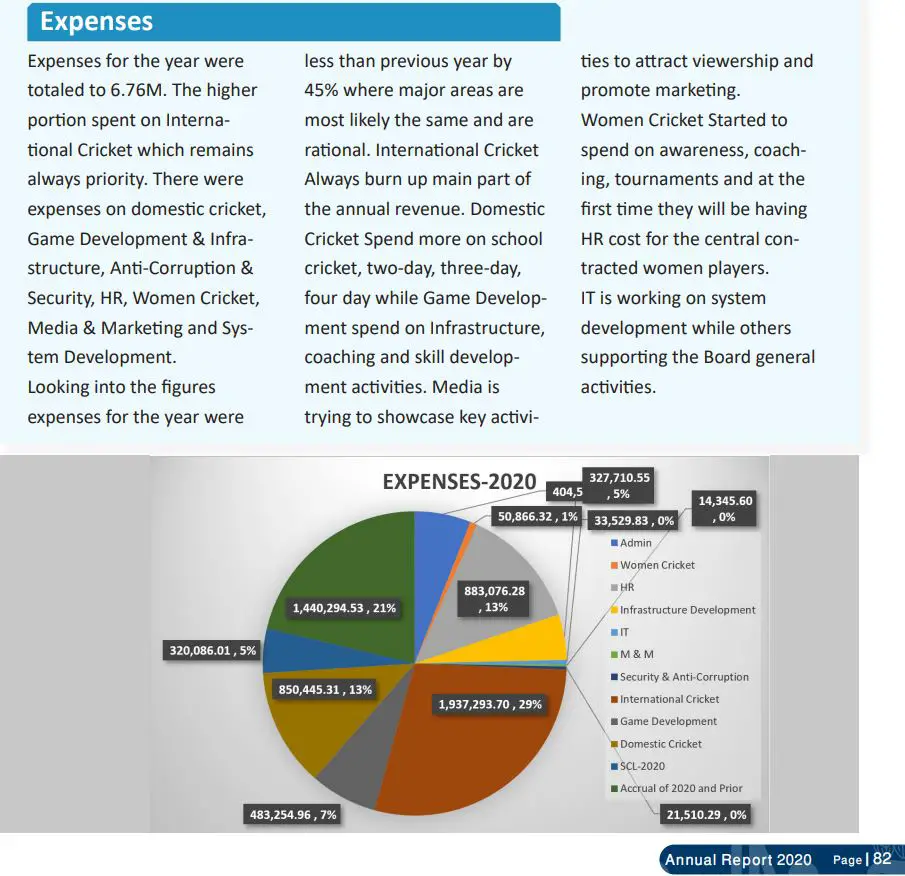
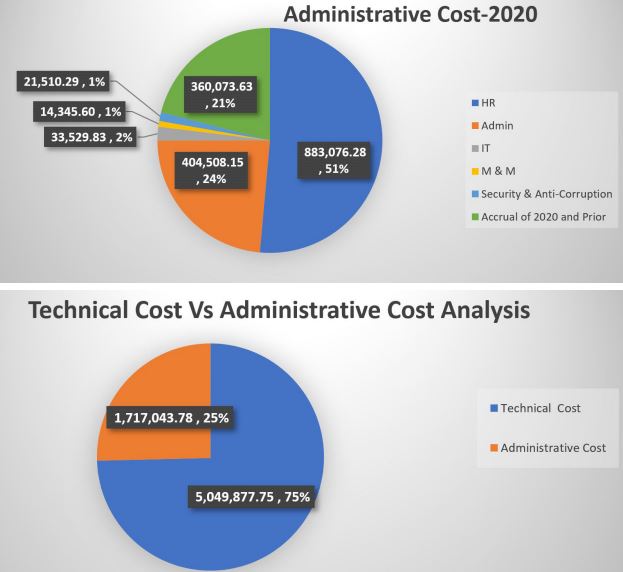
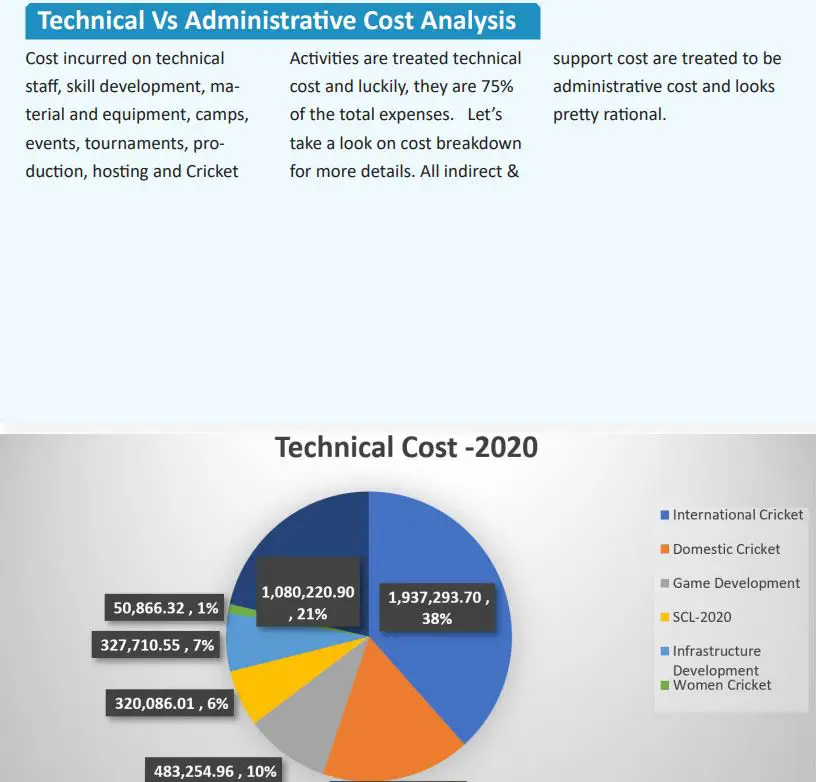
Since data is not widely available on Afghanistan central contracts, we make an educated estimate based on their annual report. As per ACB’s 2020 Annual report, the ACB had a revenue of $7.15 million and expenses around $6.76 million (images attached below). From the expenses, $1.71 million was administrative cost, while $5.05 million was technical cost.
Around $1.937 million was spent on international cricket, $1.44 million accrual of 2020 (or prior) overall, and $ 883,000 was spent on HR activities. Although it is not stated what portion of this money was allocated for player salaries, we can estimate that around $1 million were spent on salaries of players, coaches, support staff, etc. Currently, there are 34 centrally contracted players (listed below). Hence, we came up with the above estimate for the Afghanistan cricketer salary.
List of Afghanistan Centrally Contracted Cricketers
Grade A: Rashid Khan, Najibullah Zadran, Mohammad Nabi
Match fees information is not available for Afghanistan cricket.
*Note: The annual report is from 2020, prior to the Taliban takeover. No official data is available since the political situation changed in Afghanistan. For example, 25 centrally contracted women’s cricketers were added in 2020 and several development programs started. This is, most likely, no longer the case.
According to Zimbabwe’s 2020-21 Annual Report, they had allocated $659,827 for statutory obligations and salaries, $788,891 for salaries in domestic cricket, and $1,620,326 for HR-related activities in international cricket.
Highest Paid Zimbabawe Player:Sikandar Raza plays in multiple leagues around the world. His annual income before sponsorships can range from $122,000-$516,000 depending on how many T20 leagues he plays in.
In 2023, he was picked up for the IPL for $57,123 (50 Lakh INR)
He has also played in MLC, the Hundred, PSL, and ILT20. Since his draft signing price was not publicly available, we take the average salary of these tournaments: $60,526 (MLC), $117,000 (Hundred), $77,206 (PSL), $138,888 (ILT20), which totals about $393,620.
Raza played 16 ODIs and 11 T20Is in 2023, adding about $21,600 in match fees.
In 2017, Graeme Cremer was the highest earned Zimbabwe cricketer (from central contracts & match fees only), estimated around $90,000.
Zimbabwe Cricket National Contract
Based on Cricket Monthly, in 2017 Zimbabwe’s players earned:
Top Tier:$66,000
Middle Tier:$48,000
Bottom Tier:$36,000
What Are Match Fees for Zimbabwean Cricketers?
Test:$2,000
ODI: $1,000
T20I: $500
Estimated Match Fees: Between November 2021 and October 2022 (between the two consecutive T20 World Cups), Zimbabwe played a total of 15 ODIs ($15,000), and 16 T20Is ($8,000).
Zimbabwe cricket has faced lots of contract negotiation issues over the years, but it seems like not much as changed since 2013. In 2013, ESPNCricinfo reported Zimbabwean domestic cricketer’s salary as follows:
Highest Paid Irish Player Breakdown (2023):Josh Little was picked up in the IPL 2023 auction for about $500,000 (4.4 Crore INR). He also played 14 ODIs and 14 T20Is in 2023, earning about $21,700 in match fees.
Altogether, his annual on-field salary was in the range of $600,000-$800,000 in 2023.
He has also had stints in the Hundred, MLC, CPL, and PSL, which could potentially add a further $100,000-$300,000 if was available for all tournaments in a season.
Ireland Cricket National Contract
Central Contract: $75,000
According to Ireland’s 2019 Directors’ Report and Financial Statements, the wages and salaries amounted to $3.7 million (3,690,196 euros), from which $1.57 million (1,557,584 euros) was allocated for high performance player contracts & match fees distributed among 25 centrally contracted players.
What Are Match Fees for Irish Cricketers?
ODI: $1,100
T20I: $450
Estimated Match Fees: Between November 2021 and October 2022 (between the two consecutive T20 World Cups), South Africa played a total of 9 ODIs ($9,900), and 22 T20Is ($9,900).
A player who played all three formats in this time period would have earned $19,800 in match fees alone.
Maximum Possible Salary:$211,950 (Top Tier Contract + 3-format Maximum Match Fees)
Minimum Possible Salary:$54,950 (Bottom Tier Contract + T20Is only)
Highest Paid Bangladesh Player Breakdown (2024): In 2024, Mustafizur Rahman earned around $390,000-$410,000 excluding sponsorships, match awards and bonuses:
$240,000 (2 Crore INR): IPL
$58,800: Bangladesh Central Contract
$49,122 (60 Lakh BDT): BPL
$43,200: Match Fees (4 ODIs, 15 T20Is)
In 2017, Shakib Al Hasan was the highest earned Bangladesh cricketer (from central contracts & match fees only), estimated around $140,000.
Bangladesh Cricket National Contract
Grade A+: $98,400 (BDT 12,000,000 BDT)
Grade A: $79,200 (9,600,000 BDT)
Grade B: $58,800 (7,200,000 BDT)
Grade C: $39,600 (4,800,000 BDT)
What Are Match Fees for Bangladesh Cricketers?
Test:$6,600 (800,000 BDT)
ODI: $3,300 (400,000 BDT)
T20I: $2,000 (250,000 BDT)
Estimated Match Fees: Between November 2021 and October 2022 (between the two consecutive T20 World Cups), Bangladesh played a total of 10 Tests ($70,000), 12 ODIs ($42,000), and 17 T20Is ($39,950).
A player who played all three formats in this time period would have earned $151,950 in match fees alone.
Estimated Average Range: $72,300–145,350 (with some players with higher salaries due to negotiations)
Highest Paid Pakistan Player Breakdown: Captain Babar Azam earned around $756,385 million annually excluding sponsorships, match awards and bonuses:
~$277,985 USD ($420,000 AUD): BBL
~$220,000: PSL
$190,800: Pakistan Central Contract
$67,600: Match Fees (5 Tests, 17 ODIs, 4 T20Is)
In 2017, Sarfaraz Ahmed was the highest earned Bangladesh cricketer (from central contracts & match fees only), estimated around $270,000.
Pakistan Cricket National Contract
Category A: $190,800 (54 Million PKR)
Category B: $127,200 (36 Million PKR)
Category C: $63,600 (18 Million PKR)
Category D: $31,800 (9 Million PKR)
This overhauls the earlier contract system based on red ball – $56,400 (12,600,000 PKR) vs white ball – $51,600 (11,400,000 PKR) split.
What Are Match Fees for Pakistani Cricketers?
Test:$4,500 (1,200,000 PKR)
ODI: $2,300 (650,000 PKR)
T20I: $1,500 (420,000 PKR)
Estimated Match Fees: Between November 2021 and October 2022 (between the two consecutive T20 World Cups), Pakistan played a total of 7 Tests ($26,600), 9 ODIs ($20,700), and 24 T20Is ($41,640).
A player who played all three formats in this time period would have earned $88,940 in match fees alone.
Pakistani players named in PCB central contracts 2022-23 will be paid 838,000 PKR per Test match, 515,000 PKR for an ODI and 372,075 PKR for a T20i match. There is 10% increase in salaries.
Maximum Possible Salary: $351,000 (A1 Contract + 3-format Maximum Fees)
Minimum Possible Salary: $65,000 (D3 Contract + ODI Player Only)
Highest Paid Sri Lanka Player Breakdown:Matheesha Pathirana earned around $1.6-$1.82 million annually excluding sponsorships, match awards and bonuses:
$1.55 Million (INR 13 Crore): IPL
$50,000-$100,000: SL National Contract
$72,000: Match Fees (18 T20Is in 2024)
$10,000-$100,000: SA20 (Wildcard Pick)
In 2017, Angelo Matthews was the highest earned Sri Lankan cricketer (from central contracts & match fees only), estimated around $320,000.
Sri Lanka Cricket National Contract and Player List
A1: $100,000, A2: $80,000, A3: $70,000
B1: $65,000, B2: $60,000, B3: $55,000
C1: $50,000, C2: $45,000, C3: $40,000
D1: $35,000, D2: $30,000, D3: $25,000
*there are additional bonuses for team victories against top opponents ($150,000 for series victory vs #1 team, $125, 000 vs #2 team, etc. till $30,000 bonus for series win vs #7 team)
What Are Match Fees for Sri Lankan Cricketers?
Test:$7,500
ODI: $5,000
T20I: $4,000
Estimated Match Fees: Between November 2021 and October 2022 (between the two consecutive T20 World Cups), Sri Lanka played a total of 10 Tests ($75,000), 8 ODIs ($40,000), and 17 T20Is ($136,000).
A player who played all three formats in this time period would have earned $251,000 in match fees alone.
In 2017, Faf Du Plessis was the highest earned South African cricketer (from central contracts & match fees only), estimated around $440,000.
South African Cricket National Contract
Top Tier: $363,000
Medium Tier: $221,000
Bottom Tier: $145,000
What Are Match Fees for South African Cricketers?
Test:$6,925
ODI: $1,900
T20I: $911
Estimated Match Fees: Between November 2021 and October 2022 (between the two consecutive T20 World Cups), South Africa played a total of 10 Tests ($69,250), 13 ODIs ($24,700), and 13 T20Is ($11,843).
A player who played all three formats in this time period would have earned $105,793 in match fees alone.
“The cricketers are in South Africa’s highest tax-paying band, 45% and 45% of a million US dollars is a lot more than 45% of a million Rand. So if money is what matters, then it all adds up.”
In 2017, Jason Holder was the highest earned West Indian cricketer (from central contracts & match fees only), estimated around $270,000.
West Indies Cricket National Contract (2017)
Top Tier: $140,000
Mid Tier: $120,000
Bottom Tier: $100,000
According to CWI’s 2021 Financial Statements, overall international retainers added to $2,248,583 and match fees amounted to $3,454,310. Including captain’s allowances, players insurance, injury payments, incentives, franchise retainers, etc., the total payment to players totaled a whopping $8,758,878.
Overall, WI have 18 contracted players for the men’s team & 19 for the women’s respectively. Assuming the men & women early equally, on average retainer + match fee is about $236,726.43 per West Indian cricketer.
What Are Match Fees for West Indian Cricketers?
Test:$5,750
ODI: $2,300
T20I: $1,735
Estimated Match Fees: Between November 2021 and October 2022 (between the two consecutive T20 World Cups), West Indies played a total of 7 Tests ($40,250), 21 ODIs ($48,300), and 24 T20Is ($41,640).
A player who played all three formats in this time period would have earned $130,190 in match fees alone.
Estimated Match Fees: Between November 2021 and October 2022 (between the two consecutive T20 World Cups), New Zealand played a total of 9 Test matches ($59,400), 13 ODIs ($32,500), and 14 T20Is ($22,498).
A New Zealander men’s cricketer playing all three formats would have earned up to $114,398 in match fees in the 2021-22 season. Hence, Trent Boult is trying to make the most of this match fee while giving up his $300,000+ retainer.
We look at Rishabh Pant’s 2024 season. In 2025, he has only played 6 Tests so far and not featured much in limited overs cricket.
In 2017, Virat Kohli was the highest earned Indian cricketer (from central contracts & match fees only), estimated around $1,000,000.
What are Match Fees for Indian Cricketers?
For a player in the XI for these formats, an Indian player earns
Test: Rs. 15 Lakh ($18,800)
Test Cricket Initiative Scheme: Rs. 30 Lakh ($37,600) if the player plays more than 50-75% of Tests in a season.
ODI:Rs. 6 Lakh ($7,524)
T20I: Rs. 3 Lakh ($3,762)
*However, the fee is deducted 50% if the player is in the squad but not playing in the XI. The corresponding figures are $9,400 (Tests), $3,762 (ODIs), and $1,881 (T20Is).
Estimated Match Fees: Between November 2021 and October 2022 (between the two consecutive T20 World Cups), India played a total of 8 Test matches ($150,400), 18 ODIs ($135,432), and 35 T20Is ($131,670).
For someone who played all three formats and every game in this time period, that player had the potential to earn up to $417,502 in match fees on top of their annual contract.
Maximum Possible Earnings: $1.51 million (Full Contract + Maximum Fees for 3-format player)
Minimum Possible Earnings: $349,500 (White Ball Only + 1-format ODI player only)
Highest Paid England Player Breakdown:Jos Buttler earns around $3.5-$3.85 million annually excluding sponsorships, match awards and bonuses:
$1.88 Million (INR 15.75 Crore): IPL
$1.04 Million (£800,000): England central contract
~$500,000 (SA20)
$260,930: £200,000: The Hundred
$165,000: Match Fees (15 ODIs, 15 T20Is)
In 2017, Joe Root was the highest-paid cricketer from England (from central contracts & match fees only), estimated around $1,380,000.
England Cricket Central Contracts
Full Contract (Max): $1.125 million (£925,000)
*Between 2016-2021, contracts were separated based on formats (figures below)but now aredivided between central contracts, increment contracts, and pace bowling development contracts.
Red Ball Only: $790,000 (£650,000)
White Ball Only:$300,000-365,000 (£250,000-300,000)
What Are Match Fees for England Cricketers?
Tests:$17,600 (£14,500)
White Ball: $5,500 (£4,500)
Estimated Match Fees: Between November 2021 and October 2022 (between the two consecutive T20 World Cups), England played a total of 15 Tests($264,000), 9 ODIs ($49,500), and 13 T20Is($71,500).
For someone who played all three formats and every game in this time period, that player had the potential to earn up to $385,000 in match fees on top of their annual contract.
Maximum Salary Estimate: $1.75 million (Negotiated Contract + All 3-formats Maximum Match Fees)
Minimum Salary Estimate: $362,500 (Minimum Contract + Home Test matches only)
Highest Paid Australian Player Breakdown: Australian captain Pat Cummins earns around $3.6-4.5 million annually excluding sponsorships, match awards and bonuses:
$2.14 million (INR 18 Crore): IPL
$1.2-2 Million ($2-3 Million AUD): Australian central contract
$159,150: Match Fees (7 Home Tests, 2 Away Test, 2 ODIs, 7 T20Is)
In 2017, Steve Smith was the highest earned Australian cricketer (from central contracts & match fees only), estimated around $1, 470,000.
Australia Cricket National Contract
Minimum Contract: $300,000
Average Contract: $951,000
It is reported that players like David Warner and other prominent Australian cricketers may earn upwards of $1.5 million based on the final negotiations. The average men’s Australian cricketer is earning around $600,000.
What are Match Fees for Australian Cricketers?
For a player in the XI for these formats, an Australian player earns
Home Test Fees: $12,500 USD ($18,000 AUD)
Away Test Fees: $17,725 USD ($25,000 AUD)
ODI Fees: $4,800 USD ($7,000 AUD)
T20I Fees: $3,800 USD ($5,500 AUD)
Estimated Match Fees: Between November 2021 and October 2022 (between the two consecutive T20 World Cups), Australia played a total of 10 Test matches (5 Home – $62,500, 5 Away – $88,625), 14 ODIs ($67,200), and 17 T20Is ($64,600).
A player who played all formats during this time period could have earned match fees alone up to $282,925.
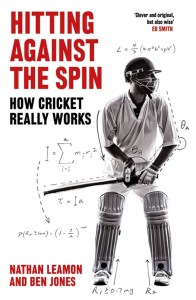
Hitting Against the Spin: How Cricket Really Works Review: Skip It or Read It?
Definitely read this one. If you are a cricket fan who loves stats and number crunching, this is a must read. But even if statistics are not your thing, read Hitting Against the Spin for the stories and a commentary on the evolution of the game.
Ben Jones, an analyst at Cricviz, and Nathan Leamon, England’s analyst with a math degree from Cambridge. put together this revolutionary book. In their own words, “Michael Lewis wrote Moneyball: The Art of the Winning”, book about the data revolution at Oakland A’s. It’s one of the most influential books ever written about sport, and sparked a wave of change that left very few sports in the world untouched.” (316).
Does this book have such an influence?
Only time will tell. Although it is far too early to gauge theimpact of Hitting Against the Spin, it will definitely change perspectives. Match-ups and flexible batting orders are already a part of modern day T20 cricket, but this book may offer an insight into other untapped areas of cricket.
Hopefully, this is just a start in data usage & cricket research.
Read It For
The stories, insights, graphics (variety of tables, graphs, & Hawkeye/ball-tracking visualizations), and references. The writers have done an excellent job intertwining themes and anecdotes from Poker, game theory, the Iliad & Odyssey, Ryanair, theoretical physicist—Richard Feynman, rackets (racquetball), tennis, golf, American football, soccer, baseball, and of course, Moneyball (the book & movie).
Don’t Read It For
Traditional Reading. This book is divided in two parts: Mechanics of the Game & T20—Changing the Game. Although each chapter carries themes from earlier references in the book, it is not necessarily to read this book straight through. If you want to read about swing bowling or leg spin, you can directly jump to those chapters. I personally jumped back and forth and was lot more fun that way.
Rating: 4.5/5
⭐⭐⭐⭐⭐
Rating: 4.5 out of 5.
Hitting Against the Spin Book Details, Authors, and Where to Purchase?
Title Name:Hitting Against the Spin: How Cricket Really Works
Publisher Summary: “How valuable is winning the toss? And how should captains use it to their advantage? Why does a cricket ball swing? Why don’t Indians bat left-handed? What is a good length and why? A fascinating whistle-stop tour of modern cricket and sports analytics, bringing cricket firmly into the twenty-first century.
Authors: Nathan Leamon, Ben Jones, with a foreword from Eoin Morgan
Length: 400 pages
Language: English
Publisher: Constable
Chapters:
Part One: Mechanics of the Game
Strong Back, Soft Front, Wild Heart – How to Win a World Cup
Playing Your Natural Game
Zen and the Art of Fast Bowling
Why Don’t Indians Bat Left-Handed?
Sachin’s Helping Hand
Oppenheimer and Duality
The Cat That Turned into a Fence
Why the Ball Swings – A Tale of Two Rivers
Hitting Against the Spin – England in India
Part Two: T20 – Changing the Game
Shortening the Game
Leg-spin and the Right to Feel Good
Technicolour Cricket
Moneyball 2.0
The Sultan’s of Spin – Multan Sultans in the PSL
Before we get to the rest of the article, consider subscribing to my email list. It really will help this website grow. Don’t forget to check out similar articles below!
“There are many Tethered Cats in cricket, habitual actions that have outlived the conditions that created them. It is the case in most sports, but cricket seem to be particularly well-resourced in that regard (4).
2. Chesterton’s Fence
“Chesterton used the story to illustrate his principle that you should not be allowed to remove a rule or a tradition unless and until you fully understand the reasons why it was first put in place, and all the effects that its presence has (5).
3. Application to Cricket:
“This is the problem with Tethered Cats. Sometimes, a perfectly reasonable response to current circumstances becomes a habit, then a tradition, then an article of faith that outlives the circumstances that created it. We rarely question what we know to be self-evidently true, particularly when everyone else is doing the same thing. And so, the bias towards batting first seems to have outlived the circumstances that created it by several decades (175).
Context
One of the long-running themes in the book is the dichotomy between ‘Tethered Cats’ and ‘Chesterton’s Fence’ and how they apply to cricket.In a book about data, strategies, and analytics, I found it deeply insightful that several cricketing decisions are still based on tradition without reason.The best discussion about these philosophies is when analyzing why captains still choose to bat first regardless of what the modern data tells them.
2. Risk, Game Theory, and Decision Making in Cricket
What Is It?
Game Theory is a branch of mathematics and economics where behavioral strategies impact decision making. This can be best understood by thePrisoner’s Dilemma or the Nash Equilibrium (scene from A Beautiful Mind).
Quotes
“We are all loss averse, genetically programmed to be, and straying from the accepted path carries a twofold risk, firstly the increased failure rate of the innovation, and secondly the increased criticism and loss of standing that will accompany any failure (72). – Shooting 3 points, running on 4th down, reverse sweep.”
“Indeed, planning for a draft is a fascinating exercise in managing uncertainty.” (353)
“Whenever a batsman plays a defensive shot near the line of the stumps, he is weighing two competing risks – one is that the ball will seam aways from him and he will edge it, the other is that it will nip back into him and he will be bowled or LBW. Without the same threat from LBWs, left-handers are free to set themselves up so as to reduce the risk of edging the ball.” (119).
Context
Sport is a reflection of life and one of the key aspects of life is managing risks. The evolution of cricket has revolved around the idea of risk and decision making. Whether that is the advent of the reverse sweep, mystery bowlers in Sri Lankan cricket, or playing more aggressively in the modern T20 cricket, the team that optimizes the outcome of risk and anticipates the opposition usually has better odds of winning.
So far, we have talked about the philosophical background in Hitting Against the Spin, but the actual analysis is quite brilliant as well. These are just three of the many examples.
Example 1: How Did England Win the 2019 World Cup?
After the 2015 debacle, Nathan Leamon and co were brought in to revolutionize England’s white-ball side. England were able to build a side through extensive analysis—batting strength and run rate, winning record prior to the World Cup, team experience as well as accidental changes—ODI regulations, England’s list A cricketers (like Roy, Buttler) trained in 40-over domestic tournaments. Once the players were picked, they were provided a long rope to play freelyand even fail on the odd occasion.
Example 2: Innovation
In the current era, there are several 360-degree players—Suryakumar Yadav, Glenn Maxwell, and AB De Villiers earlier. This sort of play is now an expectation in T20 cricket today. It wasn’t the case when Kevin Pietersen brought out the switch hit against Muttiah Muralitharan. The authors describe the three stages of innovation as follows: Status Quo -> Honing and Perfection -> Competition -> Back to Status Quo.
The circle of life.
Example 3: T20 vs Test Cricket
T20 cricket is really changing how we view cricket. Averages, strike rates, etc. and the level of impact differ from format to format. Hence, the way we analyze cricket and pick players should have different metrics.
“The relative value of runs and wickets changes throughout a T20 match; in a Test match, they largely do not (302)”
“Cricket, like much of life, is ever-evolving. The moment one problem is resolved, another emerges (Eoin Morgan xii, Dec 2020)
Examples
“The introduction of DRS was possibly the single most revolutionary moment in the history of Test cricket (166).”
“Swing changes the way the ball moves through the air, and as a result changes the balance of power in the match. The most elusive element of the game, it is also arguably the most important. Without swing, cricket would be a totally different game.” (217).
“The increased success of left-handed batsmen was a direct, unforseen consequence of better umpiring” (363).
Context
The Butterfly Effect dictates that one small change can have an immense impact around the world. In Hitting Against the Spin, there are several instances where a small change in the rules and regulations changed how cricket was played.
5. Impact of Data and Moneyball in Cricket & Other Sports
Context
One of the key commentaries in the book is about the warnings of data. Statistics and data are only useful if analyzed from an unbiased point of view. If it is used to prove a personal point or win an argument, then it is of no use. The authors also distinguish Simplicity vs Complexity and how both perspectives are necessary to properly embed data into the context of the game.
Quotes
“Data democratizes truth. It makes us all, perhaps not equal, but closer to equal in the validity of our thoughts. It allows to tell right from wrong, insightful from mistaken…The data is never enough on its own. But expert insight buttressed by objective fact has a far better chance of being truth than myth and story.” (365)
“Balance and nuance must remain legitimate tools for useful understanding of many areas of the game to emerge….But once the exercise becomes about winning the argument, rather than discovering the truth, it is incredibly unlikely that you will achieve the latter.“
“If data analysis can be used correctly, to help aid the growth of the language around the game, that will be a contribution to the sport far greater than it has made to any single bowling attack or batting order...If we can succeed in identifying and giving name to the macro-patterns and strategies that already exist and shape T20 teams, then we can start to understand and describe them (315).”
“Humility, doubt, nuance, opening ourselves to the challenge, admitting the paradox of duality, these are necessary tools (171).
Impact of Moneyball and the Misconception
“I have nothing at all against Moneyball, the book by Michael Lewis. Firstly, it’s a great book. If you haven’t read it, then do; it’s a lovely way to spend a couple of days (and the film is fun too). And secondly, it got me a job. Ultimately, it was Andy Flower reading Moneyball that led to him recruiting me to work with the England cricket team and launched a whole new career for me. It is the term ‘Moneyball’ I find problematic. Because like all such zeigeisty words (think synergy, paradigm shift, etc.), it ends up being used to mean something slightly different by everyone who uses it, and so ends up not meaning anything at all. Moneyball was and is a story. It is not a technique, not a well-defined concept, and not a philosophy (339).
Here are some other quotes that were quite revealing, but to understand the true context, you should read the book.
Where Did the Title Come From?
“In the era when home advantage feels, at times, like it is becoming insurmountable, the rare success against high class opposition with armour-plated home records are worth looking at in detail. The sides who manage to buck the trend, such as England in 2012 or India in Australia in the winter of 2018-1, are welcome reminders that through diligence and attention to detail it is possible to learn the skills required to plan and win in alien conditions, even against those who are native to those surfaces and styles of play. Overcoming the innate structure in your upbringings and cricketing culture is possible, to overturn what is expected – to Hit Against the Spin (252).
Impact of Rahul Dravid on England’s Test Success
“Dravid in particular had already started to influence the England players and coaches’ thinking around the best method against spin. And in the preparations for the tour of India, this focus was redoubled (223).
On Ben Stokes’ 2018 Auction Purchase by Rajasthan Royals
“Zubin Barucha, ‘and so they’re playing game theory too, and trying to push you up. So the strategy going into the auction was very simple – we have to spend ninety percent of our money on eleven players and then just wing it from there (334). – On Ben Stokes RR 2018 auction
Individuals vs a Role-Defined Team
“In the words of Johan Cruff: Choose the best player for every position, and you’ll end up not with a strong XI, but with strong 1s (301).”
Thanks for reading! Be sure to check out other featured content below and once again, don’t forget to subscribe!
Who are some of the unlucky Indian cricketers who never played for India? Rajinder Goel,Amol Muzumdar, Padmakar Shivalkar, AG Ram Singh, B.B. Nimbalkar, Amarjit Kaypee, Sudhakar Adhikari, Hari Gidwani,Jalaj Saxena, and Pandurang Salgaoncar are the Top 10 unluckiest players who never played for India.
Here is the complete list of 39 unlucky Indian players who never played for India (plus honorable mentions at the bottom).
Keep on reading.
List of Unlucky Players Who Never Played for India
*Note: Sunil Valson is not on this list because he was selected in the 1983 ODI World Cup on the basis of his List A exploits in the Deodhar & Duleep Trophies, not Ranji Trophy
46. Sheldon Jackson (Saurashtra, 2011-)
Role: Batter/Keeper
FC Record: 90 Matches, 6608 Runs, best of 186, 48.94 average, 20-100s, 36-50s
Claim to Fame: Integral part of the 2019-20 & 2022-23 winning Ranji Trophy teams & 2012-13, 2015-16, 2018-19 runner-up campaigns. 17th Highest run-scorer in the 2012-13 Ranji Trophy (756 Runs, centuries in quarter & semi-finals), 5th Highest run-scorer in the 2014-15 Ranji Trophy Season (819 Runs), and 9th Highest run-scorer in the 2018-19 Ranji Trophy Season (854 Runs), Scored consecutive tons in the 2015 Vijay Hazare Trophy and scored 59* in record Irani Trophy run-chase (third highest run chase in India’s first-class system)
How Close Was He to Indian Test Cap?
Scored 854 runs at 47.44 in the 2018-19 Ranji Trophy and 809 runs at 50.56 the year after, but did not make it to the India A tours (was called up to India A tours earlier). Despite being a consistent presence in the Saurashtra line up, he has not been able to get into the national spotlight, which lead him to depression. He was rewarded with an IPL contract and some games with KKR though.
45. Pankaj Dharmani (Punjab, 1992-2010)
Role: Right Arm Bat, Wicketkeeper
FC Record: 147 Matches, 9312 Runs, best of 305*, 50.06 average, 100s-26, 50s-42
Claim to Fame: 1194 Runs in 1999-2000 season (at one point, he scored 608 runs without being dismissed)
How Close Was He to Indian Test Cap?
In 1996, he was selected to play 1 ODI, but did not get a chance in Test cricket. Played for India A vs England in tour matches as well.
He captained West Zone, but that was as far as he got in the Indian selection ladder.
43. Manoj Tiwary (Bengal, 2004-2023*)
Role: Right Arm Bat
FC Record: 139 Matches, 9776 Runs, best of 303*, 48.88 average, 100s-29, 50s-44
Claim to Fame: 29 first-class hundreds, 139 FC matches
How Close Was He to Indian Test Cap?
Siddharth Monga’s ESPNCricinfo description of Tiwary starts with, “Manoj Tiwary is not the most fortunate man in Indian cricket.” He received some opportunities in limited overs cricket (and did well) but was never given a consistent run or got injured. Even with 9776 first class runs, he did not play a single Test match.Selected for India A a number of times.
FC Record: 116 Matches, 420 Wickets, best 8/123 (innings) & 12/142 (match), 28.28 average, 5w/10w – 26/5
Claim to Fame: Highest wicket-taker for Bengal in his last decade of first-class cricket for almost every year (the only other year Dinda wasn’t #1 for Bengal, it was Mohammad Shami)
How Close Was He to Indian Test Cap?
He played 13 ODIs and 9 T20Is and was trolled for his T20 bowling, but unfortunately did not get a run in the format he preferred the most. In 2012, he played for India A against England.
FC Record: 97 Matches, 6701 Runs, best of 366, 48.91 average, 100s-21, 50s-27
Claim to Fame: 366 Runs vs Andhra in 1993/94, the fourth best score of all time in Ranji (3rd best at that time). He entered at 30/1 & left at 880/5, a world record
How Close Was He to Indian Test Cap?
Although he was among the best in the domestic circuit, he could not break into the national squad at any stage of his career.
FC Record: 134 Matches, 9777 runs, 50.13 average, 24-100s, 52-50s
Claim to Fame: 5th Highest Ranji Trophy run scorer of all time (8700)
How Close Was He to Indian Test Cap?
Not that close. Although he is a stalwart in the first-class circuit, most of his runs has come for Sikkim in the Plate Group.He was a rewarded with a Kochi Tuskers Kerela contract in IPL 2011.
Claim to Fame: Part of the 1998 U-19 WC Squad, 44 first class wickets in the 1999-2000 season
How Close Was He to Indian Test Cap?
Was close to selection after his stellar 1999-2000 season, but came even closer in 2007, when he was included in the India-Bangladesh Test series. However, he did not play in the XI and was never considered for selection again.According to Siddharta Vaidyanathan from ESPNCricinfo, at his first-class debut at the age of 16, “Pawar was being touted as India’s next great left-arm spin hope.” Unfortunately, that never materialized.
Role: Allrounder (Right arm legspin/lower order batter)
FC Record: 50 Matches, 108 Wickets/1202 Runs, 6/34 (best innings), best of 142*, 28.62 bowling average, 24.53 batting average, 2/0 (5w/10w), 2-100s
Claim to Fame: Bowling alongside Salim Durani for Central Zone, they dismantled North Zone for 85/10. Played number of gutsy knocks as well including two hundreds
FC Record: 50 Matches, 134 Wickets/1536 Runs, 7/58 (best innings), best of 97, 26.24 bowling average, 24.38 batting average, 5/0 (5w/10w), 11-50s
Claim to Fame: Was regularly selected for West Zone in the Duleep Trophy
How Close Was He to Indian Test Cap?
Dilip Vengsarkar said that “he was unlucky to have never played for India.” Sandeep Patil concluded that “he was in contention for the Indian berth in those days” but fell short in his bating to get the allrounder spot.
Claim to Fame: 5th Highest wicket taker of 2003-04 Ranji Trophy (33 wickets in just 9 innings)
How Close Was He to Indian Test Cap?
Was selected for the tour to East Africa in 2004 and later for the fourth Test vs Australia in 2004 & series against Bangladesh that year, but never got a shot. By his own admission, taking Marcus Trescothick’s wicket in a Board President’s XI in 2006 was one of his most memorable moments.
Claim to Fame: In the 2006-07 season, he took 57 wickets, 9th best season haul of time (6th best at that time). According to ESPNCricinfo, after 10,658 & 2,113 List A deliveries, he had not bowled a single no ball.
How Close Was He to Indian Test Cap?
Although he was called up for the fast bowling conditioning camp by Greg Chappell, the dream was never fulfilled due to competition and lack of pace. With Irfan Pathan, Munaf Patel, Sreesanth, and VRV Singh getting chances, Bose never got a shot despite his consistency.
Role: Allrounder (Left hand bat, Slow Left arm orthodox)
FC Record: 80 Matches, 194 Wickets/2297 Runs, 7/85 (best innings), best of 104, 27.30 bowling average, 25.80 batting average, 100s-2, 50s-16 7/1 – 5w/10w
Claim to Fame: Top scored in the final with 71 in Karnataka’s first Ranji Trophy win in the 1973-74 season
How Close Was He to Indian Test Cap?
With the spin quartet ruling Indian cricket, there was not much chance for him to break into the Indian squad. Took 6/79 & 3/89 in the 1978/79 Karnataka vs West Indians tour match.
31. Syed Hyder Ali (Railways, 1963-1988)
Role: Allrounder (left hand bat/slow left arm orthodox)
FC Record: 113 Matches, 366 Wickets/3125 Runs, 9/25 (best innings), best of 121, 19.71 bowling average, 22.64 batting average, 100s-3, 50s-10, 25/3 – 5w/10w
Claim to Fame: Has the 4th Best bowling figures in Ranji Trophy history, 9/25
How Close Was He to Indian Test Cap?
Well respected in the domestic circuit, he never made it to the national stage due to India’s famed spin quartet.
Claim to Fame: Best bowling figures in Ranji Trophy History (10/78 in 1956-57); Took 15 wickets in the 1955-56 semi-final to push Bengal to the final
How Close Was He to Indian Test Cap?
Chuni Goswami, who captained Bengal to the 1971/72 title, reckons that Chatterjee “would have been very successful if he was born in this era. It’s really sad that he could not play for India because of poor backing from the state administration.”
29. Rajinder Singh Hans (Uttar Pradesh, 1976-1987)
Claim to Fame: 9/152 one of the best individual wickets haul
How Close Was He to Indian Test Cap?
Was called up to the 1979-80 Test series but never played an international game.
28. Yere Goud (Karnataka, Railways, 1994-2011)
Role: Batter
FC Record: 134 Matches, 7650 Runs, best of 221*, 45.53 average, 16-100s, 39-50s
Claim to Fame: Won 2 Ranji Trophies, 3 Irani Cps, and a Duleep Trophy, and a Ranji one-day trophy. Played 100 Ranji Trophy matches
How Close Was He to Indian Test Cap?
Despite score 761 runs in the 2001-02 Ranji season and regular member of the India A ide at that time, he could not find a place in the Indian middle order. At his retirement, Javagal Srinath that Goud was the “Rahul Dravid of the Railways team.”
FC Record: 111 Matches, 7679 Runs, 50.85 average, 23-100s, 31-50s
Claim to Fame: Highest scorer of the 2003-04 Ranji Trophy season with 1066 runs in just 12 innings
How Close Was He to Indian Test Cap?
He was selected in the squad for the 4th Test vs Australia in 2004 based on a good performance in India A’s tour to Kenya and was also the reserve opener in the 2005 Zimbabwe Test series.
26. Surinder Bhave (Maharashtra, 1986-2001)
Role: Right Arm Bat
FC Record: 97 Matches, 7971 Runs, best of 292, 58.18 average, 28-100s, 27-50s
Claim to Fame: Joint 6th highest number of centuries in Ranji Trophy
How Close Was He to Indian Test Cap?
Was selected for the 1992-93 SAARC Quadrangular tournament, a competition betwen India, Pakistan, Sri Lanka, and Bangladesh made up of ‘A’ squads. Bhave scored 81, but the final was abandoned due to riots in Dhaka.
Claim to Fame: Was selected for East Zone in Duleep Trophy in 2009. Leading wicket-taker for Odisha in the 2018-19 season
How Close Was He to Indian Test Cap?
Statistically, he should have been right at the top in the national conversation. However, with India’s pace attack rising in this decade, Mohanty never got his chance.
*still playing
24. Priyank Panchal (Gujarat, 2008-)
Role: Right Arm Opening Batter
FC Record: 111 Matches, 7901 Runs, best of 314*, 47.02 average, 26-100s, 31-50s
Claim to Fame: Scored 1310 runs at 87.33 in 2016-17, when the weight of his runs lead Gujarat to a maiden Ranji Trophy victory. Between 2016-19, he had the most first class runs by anyone in India
How Close Was He to Indian Test Cap?
When Rohit Sharma was injured for the tour of South Africa in 2021, Panchal was called up as cover.He was also in the England Test series squad that year and has been on the fringes with the India A for a number of years now.Earlier this year, Panchal was India A’s red ball captain, but another member in that India A squad got the Test cap before him—Shreyas Iyer.
Almost 33, it is difficult to see him making a debut now.
Claim to Fame: Most successful bowler for Hyderabad in that era with 86 wickets in five seasons
How Close Was He to Indian Test cap?
He was named in the probables for the 1977-78 tour of Australia, but that was the farthest he got.
V Ramnarayan was “India’s third-best offspinner, kept out of the national side only by the giant skills of Erapalli Prasanna and Srinivas Venkataraghavan.”Based on this opinion, he wrote the book, “Third Man.”
22. KN Ananthapadmanabhan (Kerela, 1988-2004)
Role: Right arm Legspin/Allrounder
FC Record: 105 Matches, 344 Wickets/2891 Runs, 8/57 (best innings), best of 200, 27.54 bowling average, 21.90 batting average, 25/5 (5w/10w), 3-100s, 8 -50s
Claim to Fame: Scored a double century and cemented his tag of an all-rounder
How Close Was He to Indian Test Cap?
Received a few opportunities for India A, but not on the national stage as his career coincided with Anil Kumble.Now an umpire.
21. Sistanshu Kotak (Saurashtra, 1992-2013)
Role: Left-handed Batter
FC Record: 130 Matches, 8061 Runs, 60 Wickets, 6/81 (best innings), best of 168*, 41.76 batting average, 15-100s, 55-50s
Claim to Fame: At the time of his retirement, Kotak was the highest scorer in Ranji Trophy never to have won the title. They went to the finals in his final game in 2013, but lost to Mumbai in the finals
How Close Was He to Indian Test Cap?
In his own words Kotak said that “Every player wants to play for his country. That could not happen for me, but that is not a regret. Maybe I was not destined to.”
FC Record: 139 Matches, 8317 Runs, best of 220, 42.21 average, 16-100s, 51-50s
Claim to Fame: Won the 2010-11 Ranji Trophy, 5th highest number of Ranji matches played (126)
How Close Was He to Indian Test Cap?
With India’s middle order settled and even Amol Muzumdar not getting a chance, the likes of Rashmi Parida never got to see the green light for national selection.He did play a tour game against England though.
FC Record: 139 Matches, 8700 Runs, Bet of 224, 51.17 Average, 27-100s, 42-50s
Claim to Fame: At the time of his retirement, only Tamil Nadu player to play 100 Ranji Trophy matches
How Close Was He to Indian Test Cap?
Not very close due to the competition. He played in a Board President’s XI match vs Sri Lanka, but did not get any further.
Like many first-class giants during this time, Sharath just couldn’t break through the Indian squad with the golden generation of Dravid, Tendulkar, Ganguly, and VVS Laxman around. When he retired from Tamil Nadu cricket (came back year later for Assam), he said “My not playing for India, and the fact that Tamil Nadu did not win a Ranji Trophy title in my time, remain my biggest disappointments. The hard work factor was missing during the time I played.”
18. Parvez Rasool (Jammu & Kashmir, 2008-2022)
Role: Allrounder (Right arm off break, Right arm bat)
FC Record: 87 matches, 299 Wickets/5023 Runs, 8/85 (best innings) & 12/73 (best match), best of 182, 27.92 bowling average, 37.76 batting average, 20/4 – 5w/10w, 100s-13, 50s-20
Claim to Fame: Lala Amarnath Award (best allrounder) in 2013-14 & 2016-17 seasons
What a colossal allrounder he was in Ranji Trophy. First cricketer from Kashmir to be picked for India A, he took seven wickets against Australia while representing the Board President’s XI team in 2013. He went on to play a couple of limited overs matches in 2014 and was recalled in 2017 for the T20 squad, but never for Test cricket.
Claim to Fame: Holds the record for the 5th best season hall—62 wickets in 1999-2000 season.
How Close Was He to Indian Test Cap?
He was selected for an India A vs England A in 1994/95 and did pretty well. However with Test season ending soon and Rajesh Chauhan India’s first choice off-spinner, he could not make it into the team. With 113 wickets after the age of 40, he still had a desire to play for the nation.
16. Faiz Fazal (Vidharba, 2003-2023*)
Role: Right Arm Opener (right arm medium part-time)
FC Record: 135 Matches, 9128 Runs, best of 206, 41.68 average, 100s-24, 50s-39
Claim to Fame: In the 2015-16 season, he scored 714 runs at 44.62 (including 127 in chase of 480 in Irani Cup)
How Close Was He to Indian Test Cap?
Played 1 ODI, scored 55 runs. Never played for India again. For all his first first-class run-scoring abilities, never received a Test call up.Did receive an India A call up during that time though.
He was later selected for the first Test against England in 2001 in the 14-man squad. However, he did not win the competition for the opening batter battle as Shiv Sunder Das and Deep Dasgupta opened.
12. Mithun Manhas (Delhi, 1997-2016)
Role: Right arm batter/wicketkeeper/allrounder
FC Record: 157 Matches, 9714 Runs, best of 205*, 45.82 average, 100s-27, 50s-49
Claim to Fame: 7th all-time Ranji run-scorer (8554), 9th most centuries (25), 3rd most matches played in Ranji (135)
How Close Was He to Indian Test Cap?
With India’s Fab Four in their prime, there was never a chance that Manhas could break into India’s Test squad. Domestic giant nevertheless.
FC Record: 133 Matches, 410 Wickets/6567 Runs, 8/36 (best innings) & 16/154 (best match), best of 194, 25.97 bowling average, 34.74 batting average, 28/7 – 5w/10w, 100s-14, 50s-32
Claim to Fame: Lala Amarnath (best all rounder award) in 2014-15, 2015-16, and 2017-18. Became the only Indian to hit a 100 & take an 8-wicket innings haul twice in the same match. Only player apart from Anil Kumble to take 16 wickets in a Ranji Trophy match
How Close Was He to Indian Test Cap?
Although he was selected in India A in 2013, he was out of contention till 2019 when he returned to play for India A against England Lions and South Africa A. He said “I spoke to the selectors and asked them. They told me that I am in their sights and they are watching me, and if they get the chance, they’ll give me an opportunity.”
That opportunity never came. The closest he got was in 2021 when Ravindra Jadeja was injured for the England Test series. However, Axar Patel got the nod (and Axar made it count).
*still playing
9. Hari Gidwani (Delhi, Bihar, 1972-1992)
Role: Right arm bat
FC Record: 119 Matches, 6805 Runs, best of 229, 42.53 average, 100s-15, 50s-32
Claim to Fame: Scored centuries in 5 consecutive Ranji Trophy matches between 1986-1988
How Close Was He to Indian Test Cap?
Scored 46 against West Indies and a century vs Sri Lanka in tour matches but did not climb the final ladder to national glory.In his own words, Gidwani stated that “I was closest to India selection in 1975-76 when I got a hundred against the visiting Sri Lankan team.”
Claim to Fame: Once hit Sunil Gavaskar on the hand. Was one of the fastest bowlers in the 1970s in India’s domestic circuit
How Close Was He to Indian Test Cap?
Very, very close. Played the unofficial Tests vs Sri Lanka in 1974. Then was in the West Zone team who played the West Indies XI. Madan Lal and Syed Abid Ali were selected after these matches respectively, with Salgaoncar narrowly missing out. On a couple of occasions, he was called for the 1975 World Cup team, but could not make it past the trials.
7. Sudhakar Adhikari (Mumbai, 1959-1971)
Role: Right Arm Opener
FC Record: 65 Matches, 3779 Runs, best of 192, 40.63 average, 100s-11, 50s-18
Claim to Fame: Scored a century in the morning and reached his wedding venue by the night
How Close Was He to Indian Test Cap?
According to V Ramnarayan (in the list above himself), Adhikari was “considered distinctly unlucky not to gain the approval of the Indian selections in the 1960s.”
6. Amarjit Kaypee (Haryana, Punjab, 1980-2000)
Role: Right hand bat
FC Record: 117 Matches, 7894 runs, best of 210*, 52.27 average, 100s-27, 50s-34
Claim to Fame: At the time of his retirement, he was the highest run-scorer in Ranji history. 6th Most number of Ranji 100s (27), 2nd at the time. Once scored 150+ in both innings of a match
How Close Was He to Indian Test Cap?
According to ESPNCricinfo, “there have been many cricketers who have received a raw deal from a jaundiced selectorial eye and Kaypee must consider himself very unlucky in this regard.”
Role: Right hand bat/wicketkeeper/Right arm Fast medium
FC Record: 80 Matches, 4841 Runs, best of 443*, 47.93 average, 100s-12, 50s-22
Claim to Fame: Highest individual score in Ranji Trophy history and the highest score for a cricketer never to have played international cricket—443*
How Close Was He to Indian Test Cap?
Played for the country unofficially against a Commonwealth match in 1949-50. However despite an illustrious domestic career from 1939-1965, he did not play a Test match.
Role: Allrounder (Left hand bat/slow left arm orthodox)
FC Record: 56 Matches, 265 Wickets/3314 Runs, 8/14 (best innings), best of 126, 18.56 bowling average, 35.25 batting average, 24/8 – 5w/10w, 100s-6, 50s-22
Claim to Fame: Became the second cricketer to score 1000 runs and take 100 wickets in the Ranji trophy
How Close Was He to Indian Test Cap?
Played in two unofficial Tests in 1935-36 in the tour to England and was selected in 1945 to a tour to Ceylon, but never had the honor to don the Indian cap. Due to his excellent all-round abilities, Natarajan Sriram reckons that “AJ Ram Singh takes his place as one of the unluckiest cricketers in the history of Indian cricket.”
Claim to Fame: 361 Ranji wickets for Mumbai (record), Joint-second 10-wicket hauls in Ranji (11)
How Close Was He to Indian Test Cap?
He went to Sri Lanka in 1973-74 and played a couple of tour matches.
From the age of 22 to the age of 48, Shivalkar played first class cricket. Yet during those 26 years, not once did he get a chance to represent India at a national level. With Bishan Singh Bedi, one of the all-time greatest, wreaking havocand Rajinder Goel not getting a chance, Shivalkar was left behind.
FC Record: 171 Matches, 11167 runs, best of 260, 48.13 average, 100s-30, 50s-60
Claim to Fame: 2nd highest All-time Ranji Runs (9205), 5th highest all-time centuries (28), 2nd most number of Ranji matches (136), Vice-captain of the 1994 India U-19 Team (As of 2007, he had won Mumbai 7 Ranji trophy titles)
How Close Was He to Indian Test Cap?
By his own admission, he came close to the Indian team spot in 1994. Even after years of consistent runs scoring, selectors did not consider him. He deliberated quitting cricket in 2002, but ended up playing till 2013.
Fun fact. When Vinod Kambli & Sachin Tendulkar scored the 664-run partnership in their school days, Amol Muzumdar was slotted in the next position. That was probably the closest he got to the India cap.
Claim to Fame: Most Ranji wickets of all-time (637), 3rd Longest career (27 years), Highest wicket taker in the 1978-79, 79-80, 83-84, and 84-85 season. 53 five-fers & 17 10-fers, both Ranji records
How Close Was He to Indian Test Cap?
He played an unofficial Test against Ceylon in 1964-65, taking 4/33 in the second innings.According to Bishan Singh Bedi, ‘Goely, as I called him, was a much better bowler than me. Honestly, I was just lucky that I got the break [to play for India]. I was very fortunate. That is where Goely might have missed out. But I rated him very highly.”
Will Sarfaraz Khan Remain an Unlucky Indian Cricketer?
Will Sarfaraz Khan add to the list of unlucky Indian cricketers who never played international cricket? The man has been bludgeoning runs for the last couple of first couple of first-class seasons.
At the moment, his first-class record reads: 37 Matches, 3505 Runs, 79.65 average, 13 centuries, 9 fifties, and a best of 301*.
Some like Jaydev Unadkat and Shahbaz Nadeem have recently lived to see the dream by playing a couple of Test matches after years of toil. Others like Priyank Panchal, KS Bharat, & Abhimanyu Easwaran have traveled with the reserve and India A squads for the last few years without breaking into the XI. Prithvi Shaw scored a 379 and still cannot break in the Indian Test squad.
On the other hand, the likes of Shreyas Iyer, Ishan Kishan, and Suryakumar Yadav have broken into India’s Test squads due to heroics in other formats. There is no right and wrong here, but due to timing and form, some first-class legends have missed out on international Test careers.
Honorable Mentions And Those Who Just Played 1-3 Test Matches (Separated by Era)
1950-1970
Vaman Vishwanath Kumar (2 Tests)
Played 2 Tests and got 7 wickets despite having a FC career of 599 wickets. In the era of the spin quartet
Abdul Ismail, Saad Bin Jung, AV Jayaprakash, Barun Burman, Uday Joshi, Sarkar Talwar, Vijay Mohanraj, Michael Dalvi, Naushir Mehta, Anil Mathur
1980-1990
Sadanand Vishwanath (3 Tests)
S Vasudevan, Abdul Azeem
1990-2000
Ajay Sharma (1 Test)
Scored 10,000+ first class runs at an average of 67.46 played exactly 1 Test for India (and later getting banned for match-fixing scandal). Also had 7 double tons in Ranji Trophy history.
Hrishikesh Kanitkar (2 Tests)
Ashish Winston Zaidi, Sunil Subramaniam
Post 2000s
Subramaniam Badrinath (2 Tests)
Vinay Kumar
Although Kumar played 31 ODI matches for India, he played only 1 Test match. For someone with 139 FC match experience & 504 wickets at an average of 22.44 to his name, that is a shame
Rishi Dhawan, Basant Mohanty
Also Read other articles in our Unlucky Cricketer Series:
Unlucky Indian Cricketers Who Never Played for India – Frequently Asked Questions (FAQ)?
Who is the unluckiest Indian cricketer and why?
Rajinder Goel is the unluckiest cricketer. Despite taking 750 first class wickets and 637 Ranji Trophy wickets (100+ more than the next highest), he was never considered at the highest level.
Who is the unluckiest player in cricket history?
Rajinder Goel & Amol Muzumdar are the unluckiest players in Indian history. They both have played for more than two decades and hold records in their respective crafts. Due to competition from India’s spin quartet in the 1960s, Rajinder Goel could not break through India’s ranks and due to the presence of the Fab Four, Amol Muzumdar could not break through.
Who are the best Indian players who have not played for the Indian national team?
Rajinder Goel, Padmakar Shivalkar, Amol Muzumdar, Hari Gidwani, AJ Ram Singh, B.B. Nimbalkar, Amarjit Kaypee, Paras Dogra, Mithun Manhas, and Pandurang Salgaoncar are the Top 10 unluckiest players who never played for India.
Who has played the most Ranji Trophy games without representing India?
Devendra Bundela (145), Amol Muzumdar (136), Mithun Manhas (135), Rashmi Parida, and Rajinder Goel (123) played the most Ranji Trophy matches without representing India.