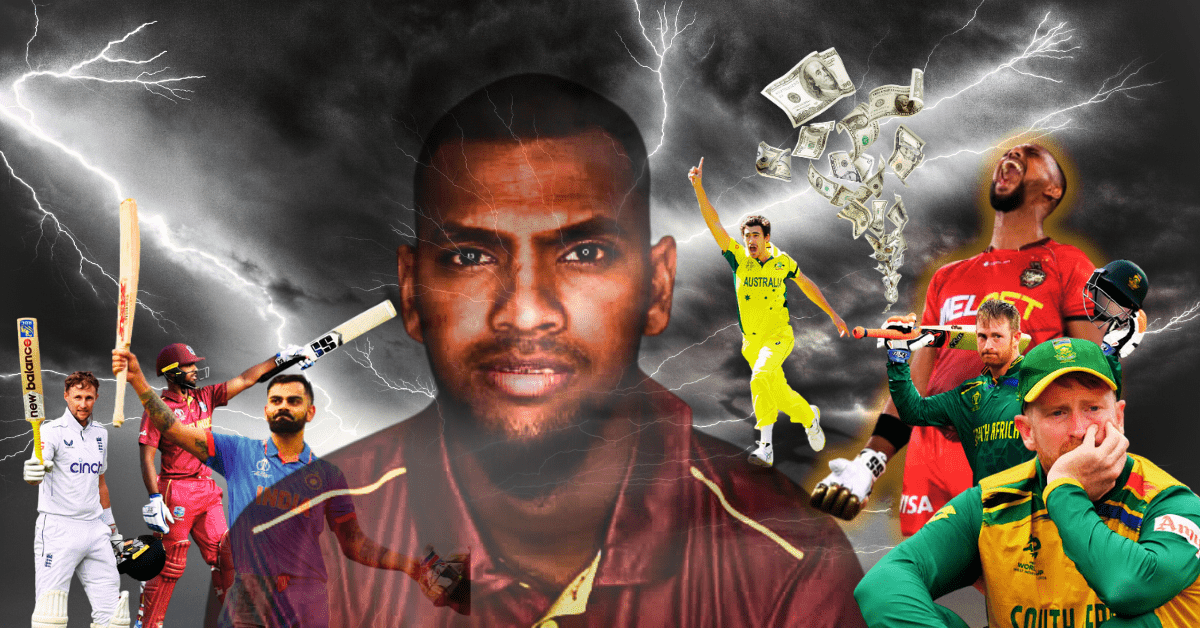
In his 8th Test, Zak Crawley scored 267. By himself.
Ollie Pope was the Player of the Match in South Africa in just his 6th Test, scoring 135* and taking six catches.
Jamie Smith took Test cricket by storm with scores of 70, 95, 111, 67, 89, 40, 44*, 184, 88, 51 in his first year, batting in the lower order.
Ben Stokes once scored 258 runs at 130.3 SR in South Africa. On a good, he wins you Test matches single-handedly. On a great day, he wins you World Cups.
Harry Brook is already England’s next big start with 10 tons at 26, and Ben Duckett pioled up 462 runs against India not too long ao.
England don’t lack talent. This batting line up is designed to look unbeatable on their best days.
The problem is…this team is built only for those days. At the slightest hint of discomfort, it falls apart.
The Argument: England Optimized for Their Best Days, Not the Non-Ideal Ones
I have been trying to build habits for the last couple of years: going to the gym, eating healthy, reading. Some stick. Most vanish within a few months.
It finally dawned on me why I was not consistent. I was trying to optimize for my ideal day—getting up early, meditating, coming home, hitting the gym, cooking, writing, reading, all while sleeping at a reasonable hour.
The moment I stayed a little later at work, my ideal day completely fell apart. Come home, eat junk, watch TV, go to sleep.
“Don’t have enough time? Do the short version. Don’t have enough energy, do the easy version. Find a way to show up, not put up a zero for that day because doing something is almost always infinitely better than doing nothing.”
England optimized for their peak. On their best days, they could chase record 4th innings totals. On their worst, they simply didn’t show up.
Crawleys, Ollies, and a Whole Lot of Dropped Dollies
In the first two Tests, England lasted just 32.5, 34.4, 76.2, and 75.2 overs. The Ashes was lost then and there.
Ben Duckett managed only 221 balls across all ten of his innings.
Zak Crawley was dismissed in the first over three times, and twice more within the first five. Even though he had a couple of decent innings later, the opening partnership never gave England enough time at the crease.
Ollie Pope started positively but was dropped after the 3rd Test, having survived just 189 balls at an average of 20.83.
Jamie Smith’s horrendous shot, Will Jacks’ dropped catch, the list goes on. At least Stokes fought, but even he ended up a walking wicket by the end of the series.
This was supposed to be the worst Australian team of the decade. And maybe it was. No Hazlewood, Cummins barely played, Lyon hobbled out of the series.
And yet, they still found a way to get the job done.
In the first Test, Australia were 83/6. Carey and Starc did the bare minimum and hung around for 35 runs to take the total to 132. Enough to swing momentum back to Australa.
Weatherald and Labuschagne did not set the series on fire. Yet they batted 288 and 404 balls respectively. On his worst days, Labuschagne took screamers at slip and plucked wickets before lunch bowling his Dibbly Dobblies. Khawaja, out of form, batting out of place, sidelined by golf injury & controversy, with risk of a mid-series career-end, came back to score crucial knocks of 82 & 40 at Adelaide.
Even Scotty Boland wasn’t at his accurate best, yet he and his fellow 35-year old pacers, Neser and Starc, maintained their fitness level and discipline through the series.
Add in-form players, Mitchell Starc, Steve Smith, Alex Carey, Beau Webster, and Travis Head, and you’ve got a world-beating, Ashes-conquering side.
Commentators say Australia won the ‘big moments.’ I say, they just did the bare minimum, and England crumbled under pressure.
The Australian Test team managed to show up. They did not put up a Zero even on their worst days.
It is easy to criticize this England side through the lens of recency bias.
England’s peak from 2010-12 was built on a simple formula: The grit of Cook-Strauss-Trott at the top, with the KPs and Bells to capitalize further down. It worked brilliantly.
In the following decade, England tried to replicate this strategy without much success. Stoneman, Carberry, Compton, Lees, Hameed, Malan, Vince, Sibley, Denly, Burns. A revolving door with the same result.
And so, the pendulum swung the other way. England overcorrected.
Fortune favors the brave. Eoin Morgan showed it can be done in limited overs cricket, so why not try that out? Surely, it can’t be any worse than 68/10 at MCG in 2022, right?
The easy answer: England needs more Joe Roots, players who can adapt to Bazball on their best days, but have an inner Cook-ball when the situation demands.
But that’s easier said than done. County Cricket does not produce dozens of Joe Roots anymore.
What England need is an insurance policy. A compromise blending the old and the new. Think Sehwag-Dravid, Smith-Amla, Langer-Hayden, Fleming-Astle, partnership-builders alongside dominators.
Even when Crawley scored 267, Burns and Sibley had dented the swing threat for 27 balls. When Pope scored 135, Joe Denly batted exactly 100 balls, Sibley 95, and Crawley scored 44 (137). Stokes, meanwhile, had the advantage of a 55.3-over old ball when he came in to bat before his 258.
A strong batting line-up needs all sorts of characters.
I am not suggesting that England go back to Sibley-Burns. That experiment has failed, but the Crawley-Duckett-Pope experiment has not delivered either.
Crawley averages 31.98 in FC cricket, 31.18 in Test cricket, 32.22 in the preceding India series, and 27.30 in the Ashes. Is that the standard England want to settle for? Is flamboyance more important than victories?
Why Don’t England Succeed for Long Periods of Time?
On the TalkSport podcast, host Jon Norman asks Jarrod Kimber and ‘Bumble’ a deceptively simple question, “Why is that England don’t maintain their success for long?”
Apart from the 1950s, there is not a single period of Test cricket dominance in their cricketing history unlike the West Indies of the 80s, Australia of the 2000s, or the current Indian age. They show glimmers of brilliance—think Ashes 2005, the 2010-12 era, and the early days of Bazball.
The pattern is clear: England’s peaks come when everything falls into place, but they lack a backup plan on their ‘bad days.’ As James Clear says,
“In a lot of ways, the bad days are more important the good days…What can I stick to even on the bad days, and that becomes the baseline. That’s where you start from, and then on the good days, you have got capacity to go ahead and ramp it up.”
High ceilings are useless without a floor, and that is why long-term success has always eluded them. Hopefully, England management recognizes this and can harness the talents of Jacob Bethell, Asa Tribe, and James Rew to build that floor for future Test dominance.
****
On a personal note, this year I am optimizing my schedule for non-ideal days. Too early to say if this system is working better to build habits, but I am definitely more consistent now than without this mindset.
“It would be lovely to just look at this here this week and go, why do we complain, why do we worry about Test match cricket?
…Why do people knock this format? It is just so wonderful, but I am afraid, other countries don’t have the luxury that England, India, Australia have…So, we and India and Australia have to keep an eye on the future of Test match cricket. If we let this go, we are not doing the game a service…We need to keep an eye on this and keep pushing it forward and look after those who are not as fortunate.”
Nasser Hussain
It is a beautiful sentiment, and most fans would likely agree, Nasser.
But it is also paradoxical.
This is probably not the ideal week to bring this up—not after five gripping Tests, packed crowds, and an absolute bonkers of a finish. But here is the uncomfortable truth:
In trying to save Test cricket, the Big 3 may be unintentionally suffocating it.
The Narrative that ‘Test Cricket Is Dying’ is Hurting the Game
Each time the Ashes, the Border-Gavaskar Trophy, or an India-England series rolls around, we hear the same recycled narrative: “Test Cricket is in Danger.”
But is it really?
The love for the format was evident in the World Test Championship final, with South Africa showcasing their quality and a neutral English crowd adding to the occasion.
Test cricket is thriving, at least in England, Australia, and India.
And that’s precisely the problem. In their effort to protect and profit from the format, the Big 3 have increasingly started playing exclusively amongst themselves.
The spectators get quality Test cricket, packed stadiums, polished broadcasts, and high TV ratings. The format “stays alive.”
The Never-Ending Tri-Series
At this point, Test cricket has morphed into a never-ending tri-series between India, England, and Australia.
ENG in IND (Nov 16-Feb 17)
AUS in IND (Feb-Mar 17)
IND in ENG (Jul-Sept 18)
ENG in AUS (Nov 17-Jan 18)
IND in AUS (Nov 18-Jan 19)
AUS in ENG (Aug-Sep 19)
IND in ENG (Aug-Sept 21/22)
IND in AUS (Nov 20-Jan 21)
ENG in IND (Feb-Mar 21)
ENG in AUS (Dec 21-Jan 22)
AUS in IND (Feb-Mar 23)
AUS in ENG (Jun-Jul 23)
ENG in IND (Jan-Mar 24)
IND in AUS (Nov 24-Jan 25)
IND in ENG (Jun-Aug 25)
ENG in AUS (Nov 25-Jan 26)
Whoever said it was right.
India vs England is prep for the upcoming Ashes. Just like the Ashes will be prep for the next BGT.
Meanwhile, the rest of the world waits:
Zimbabwe have not toured Australia for a Test series since 2003.
Australia last played a Test against Bangladesh in 2017.
England did not tour Sri Lanka between 2012 and 2018.
India last visited New Zealand 2-match Test series in February 2020 before the pandemic. That feels ages ago.
Even the popular NZ-Eng series hasn’t seen a four-Test series since 1999.
And these are just a few examples.
Test cricket has practically only grown from 2 thriving cricketing nations to 3 thriving nations in a 150 years.
— Broken Cricket Dreams Cricket Blog (@cricket_broken) August 5, 2025
The Game Theory Problem: Everyone for Themselves
The Prisoner’s Dilemma is a classic game theory problem, a study of how rational decisions made in self-interest can lead to worse outcomes for everyone involved.
Imagine two individuals who are both accused of a crime and interrogated separately. Each has two choices: stay silent (cooperate) or betray the other (defect):
If both stay silent, they get out with light sentences (let’s say 1 year each).
If one defects while the other stays silent, the defector goes free (0 years) while the other gets a heavy sentence (10 years).
If they both defect, they each serve moderate time (3 years).
Logically, each person would want to defect to avoid the worst-case scenario. But when both individuals make the ‘rational’ choice, they end up worse off than if they had trusted each other. And that’s the dilemma:
Acting in self-interest leads to a collectively worse outcome, even when cooperation would have helped them both.
Cooperation Requires Sacrifice, but Cricket’s Not Designed for It
We have all criticized the ICC at one point or another.
But let’s give them some grace. Unlike other global sporting bodies, the ICC isn’t a centralized power.
Cricket is not a single unified business. Rather, it is network of competing bodies trying to protect their self-interests with the ICC acting as a mediator. Consider the Test-playing nations:
12 International Boards with their own finances and calendars. The boards need to care of their players, staff, stadiums, and local boards.
And of course, the broadcasters, whose rights deals prop up the whole system
That’s 50+ separate individual business entities, each trying to show profits, satisfy sponsors, and keep their board of directors happy.
Now, in theory, this can work. Money is not a zero-sum game, and multiple businesses can succeed together.
However, cricket has two unavoidable constraints:
The calendar: There are only so many days of the year and even fewer in a cricket summer seasons are even shorter.
The players: Unlike soccer, where there is a plethora of international quality athletes, cricket keeps copying and pasting the same pool of global T20 stars (think Rashid Khan, Pooran, Klaasen, Faf, Russell, etc.).
And when everyone’s fighting for the same weeks and the same set of players, it turns into Survival of the Fittest, a capitalistic model where some thrive but at the expense of the others.
Supply and Demand: The Big 3 Leagues are Draining the World’s Talent
England and Australia have short cricket summers, which means cramming Tests, County, bilateral series, and T20 leagues in a tight window.
The impact?
We rarely see the stars like Steve Smith or Mitchell Starc playing a full season of Big Bash or Ben Stokes playing in The Hundred.
Here’s the catch: The Big Bash and The Hundred and the individual franchises still need to maintain profitability. So what do they do?
They import talent. They poach the West Indians, South Africans, Kiwis, Pakistanis, and beyond to elevate the standard of their own leagues.
While England, Australia, and India try to ‘preserve Test cricket’ at home, their T20 leagues drain the talent pipelines of Test cricket elsewhere.
The smaller nations have a supply of great talent, but they don’t have the financial strength to retain them. These players have to go where the demand is: The IPL, Big Bash, MLC, The Hundred, SA20, ILT20.
But wait, Cricket West Indies, PCB, CSA, NZC, they all need to make money too, right?
To survive in the limited calendar, they have to make tough choices: Launching their own T20 leagues, trimming down Test tours due to cost and scheduling clashes, and squeezing random bilateral ODI series with India to stay financially afloat.
This creates a cascading effect: (1) oversaturation of cricket, (2) early Pooran-esque retirements, (3) higher injury risks, and (4) growing friction between players and their boards.
The Vicious Cycle of Modern Test Cricket
We can summarize the vicious cycle of modern Test cricket that we have know become accustomed to.
1. Big 3 Dominate the Calendar
India, England, and Australia pack their summers with high-profile Test series, leaving no room for their stars in domestic T20 leagues (except for the IPL)
2. Top Players are Poached from Smaller Nations
Leagues like the BBL and The Hundred fill the gaps by importing talent from smaller nations.
3. Smaller Boards Cut Tests to Survive
With finances tight, smaller boards prioritize limited over bilateral and launch their own leagues, but are unable to retain their players.
4. Test Quality Drops Justifying More Big 3 Series
Then, once in a blue moon, an Australia visits a West Indian side and completely decimates it. The “Test cricket is dying” narrative returns, reinforcing the idea that only the Big 3 can keep the format alive.
Final Thoughts: The Big 3 Didn’t Mean to Kill It. But They Are
As fans, we want it all—packed stadiums in the Caribbean, epic five-Test rivalries, a thriving County game, an entertaining IPL season, the Poorans & Klaasens lighting up the 2026 T20 World Cup, an ODI game that still provides finishes like the 2019 WC Finals, return of the Champions League T20, room for Associates to grow, and much more.
Unfortunately, with a finite cricket calendar, a limited player pool, and every board, franchise, and broadcasters all acting rationally in their own self-interest, something has to give.
The Big 3 claim to be protecting Test cricket, but what have they actually sacrificed?
Niccolò Machiavelli argued in his famous political treatise, The Prince, that it is “much safer to be feared than to be loved.”
The BCCI has taken that philosophy to heart, wielding its soft power in ways that are gradually eroding trust in cricket.
The Champions Trophy may just be the tipping point.
The Accusations
Since cricket’s resumption after the financially and mentally taxing COVID-induced break, the BCCI has increasingly dictated terms. Subtle but significant decisions across the last four ICC tournaments have raised serious concerns.
2021 T20 World Cup: India’s last two matches were scheduled against Scotland and Namibia, conveniently positioned as the final group-stage fixtures—providing them the best chance to boost their NRR if needed.
Champions Trophy: On the flip side, in a format where an opening loss is nearly fatal, India starts against Bangladesh while their toughest fixture—New Zealand—is left until the end.
2024 T20 World Cup: Matches in the Caribbean were scheduled to suit Indian prime-time television, not local fans. It was decided ahead of the tournament that if India qualify for the 2024 T20 WC semi-final, they would get to play in Guyana irrespective of group stage standings.
Travel Disparities: In the same tournament, Sri Lanka had to face airplane delays and four flights at four venues, while India stayed in one location and had gap between their Sunday to Sunday matches.
And now, India are playing all their matches in the same venue at Dubai while South Africa take a trip from Pakistan to Pakistan via the UAE.
I am not claiming that this is outright corruption or that ICC tournaments are rigged. Far from it.
But, these are not mere coincidences either. It raises serious concerns about the independence of fixtures, and that independence is what keeps sport fair and compelling to watch.
South Africa flew out to Dubai from Karachi after playing England. Then flew back to Lahore barely 12 hours after landing in Dubai.
Ironically, it is Team India, one of the greatest ODI sides in modern history, that is suffering from this loss of trust.
Let’s take a look at the squad:
Virat Kohli – The greatest ODI Player of all time.
Rohit Sharma – Legendary opener, three double centuries, including a 264-run masterpiece.
Shreyas Iyer – Resolved India’s #4 conundrum and as Abhishek AB on Twitter mentioned, the only #4s with a 100+ SR and 50+ average.
KL Rahul – The finest #5 batter of this generation.
Shami – India’s best ICC ODI bowler.
– 54 batters have scored 1500+ runs at No.4 in ODIs. – Only 7 of them averaged 50+ at this position. – But among them, just one has a 100+ strike rate.
Besides the core, you have the all-rounder engine room of Axar Patel, Hardik Pandya, and Ravindra Jadeja. They can be the insurance policy and arrest the slide when wickets fall early or provide the finishing touch. On the field, they can stall opposition with economical spells, timely wickets, catches, and game-changing run-outs.
If the opposition somehow manages to get through these eight, then they pray that they do not run into ICC #1 Shubman Gill, the guile of Varun Chakravarthy, or Kuldeep Yadav’s artistry. The likes of Rishabh Pant are carrying drinks, and Jasprit Bumrah, Yashasvi Jaiswal, Abhishek Sharma, Tilak Verma, and Sanju Samson are not even in the squad.
Since 2011, India has lost just seven ICC ODI World Cup and Champions Trophy matches out of 51. England lost six in the 2023 World Cup alone.
Yet, because of the UAE-Pakistan hosting fiasco, even die-hard cricket fans are now questioning the seriousness of this tournament. Heck, Peter Della Penna is not even watching the tournament at all!
I haven't watched a single ball of this Champions Trophy, first time I've not watched a major ICC event since 2005. I can't exactly call it a boycott. I just can't watch it seriously with a straight face when the thumb is so blatantly on the scales for one team vs all others. https://t.co/ZIZWqhsI3S
— Peter Della Penna (@PeterDellaPenna) March 5, 2025
The Needless UAE Debate
This Indian side is one of the most balanced ODI sides in recent memory. However, the focus in the last couple of weeks has diverted to an unnecessary debate. Nasser Hussain & Mike Atherton claimed that India had an ‘undeniable advantage.’
Rassie van der Dussen pointed out that “If you can stay in one place, stay in one hotel, practice in the same facilities, play in the same stadium, on the same pitches it’s definitely an advantage. I don’t think you have to be a rocket scientist to know that.”
(Side note: As someone who has been stranded a bazillion times in the Dallas Fort Worth airport, I can relate to David Miller’s frustrations. Once, I almost landed at my destination only for the plane to turn sent back to Dallas due to a tornado warning, forcing me to sleep in the airport — I get it, David. Flights have a way of ruining a good night’s sleep or an entire weekend, but that’s a whole other story.)
When the Nasser Hussain’s of the world question India’s authority, the whole world erupts. Journalists, fans, cricketers all weigh in, and the Indian Newtonian brigade swiftly respond with their equal and opposite stingers.
As CricBlog argues, India only playing in the UAE isn’t really that much of an advantage as critics claim.
Frankly, they could have broken the 400 barrier in the flat pitches of Pakistan. This team would have dominated anywhere.
The point isn’t whether India needs these advantages — it’s that they exist at all.
And dude, these players are accustomed to playing double Super Overs on a Sunday night into Monday morning for IPL matches, squeezing interviews and sponsorship committments, getting a few of hours of sleep, and traveling to another city for a game just 36 hours later. The kind of relentless schedule and travel is the reality for today’s IPL generation of professional athletes.
Hypocrisy, Thy Name is India
As William Shakespeare most certainly did not say, “Hypocrisy, Thy Name is India.”
The BCCI’s stance on cricketing relations with Pakistan is simple: “We refuse to play bilateral cricket Pakistan due to geopolitical reasons. We will not play them at all (well, of course, except in the cases of money, TV rights, and yep that’s about it, money).
When ICC tournaments were held every four years, I could understand the financial weight India-Pakistan matches carried, but with these tournaments happening every year now, the matches no longer hold the same significance. And honestly, they have become predictably boring.
The argument always has been, the ICC earnings from these encounters would be reinvested into grassroot cricket and growth of the game worldwide. Growth of cricket, my foot!
In a Big-3 led 10-team World Cup sport, the ICC’s exploitation of India-Pakistan is just a cash cow, stripping ICC fixtures of their independence and adding logistical burden for every other nation. As Jarrod Kimber rightly exclaimed on this point, “Can we just grow up as sport?”
Mohammed Shami admits that playing all their Champions Trophy matches in Dubai has been an advantage for India 🗣️ pic.twitter.com/5FrE3fPmAf
In school, sometimes a new kid arrives and gets all the attention. In the cricket world, India is the new (financial) kid. And they also happen to be the smartest student in the room.
Social media is already pandering to Indian audiences due to the views and monetization. Not only has the tune of the high level administrators become more rosy towards India, but YouTube channels of Pakistani cricketers, podcasts from Australia and England — EVERYbody caters to Indian audiences.
Is that a bad thing? No, can actually be pretty entertaining to be honest.
Nobody questions the BCCI anymore. Everyone just quietly wants to be friends with them and take a piece of the pie.
Remember in 2003 when teams accused Ricky Ponting of playing with a “spring bat”? How could a team be so good (and slightly arrogant). Well, India is that team now, and the BCCI is that board.
The ICC-B team, also known as the BCCI, need to clean up their image.
We love the cricketers.
Let us enjoy the cricket too. I will end it with the complete quote from Machiavelli:
“It is much safer to be feared than loved because….love is preserved by the link of obligation which, owing to the baseness of men, is broken at every opportunity for their advantage; but fear preserves you by a dread of punishment which never fails.”
I am beginning to wonder if the 29-year-old Abhimanyu Easwaran will ever get a game for Team India.
Despite India’s top order struggling in the 2024-25 Border Gavaskar Trophy, Easwaran remained on the sidelines.
Jaiswal & KL Rahul had their moments, Rohit Sharma had to ‘opt out’ of the fifth Test due to poor form, Gill was in & out, and even Padikkal got a game. Dhruv Jurel and Nitish Kumar Reddy were also handed opportunities for other roles, but Easwaran never got a look-in.
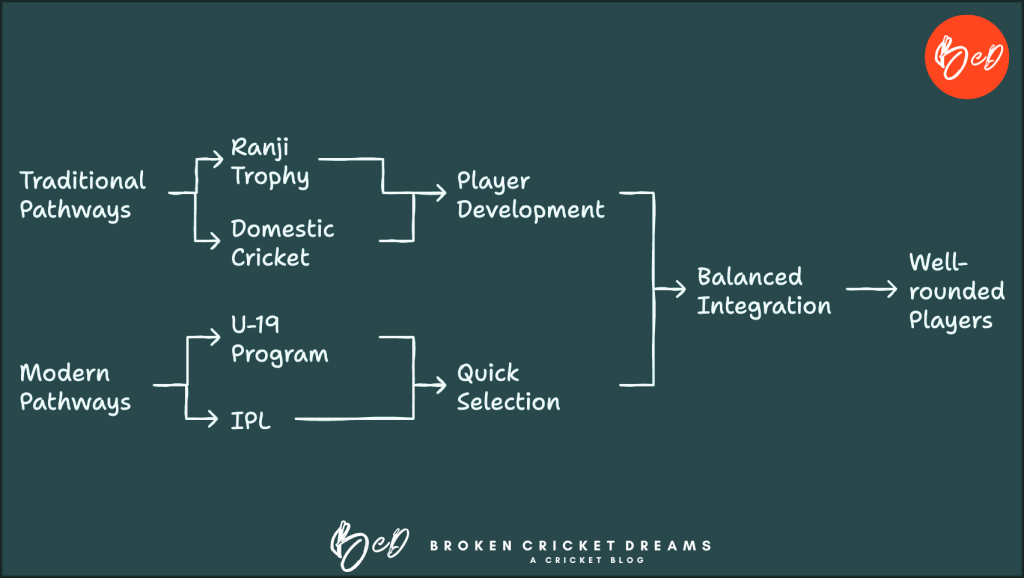
This raises a larger question—Does domestic cricket still matter in India team’s national selection? Has the Ranji Trophy lost its influence, with the India U-19 setup and IPL now serving as the primary pathways to the top?
I looked at Ranji Trophy stats from the last 35 years to see what patterns I can find in the evolution of national selection.
Easwaran came into the spotlight in the 2018-19 Ranji season when he top scored for Bengal with 861 runs. Since then, he has been on the fringes, consistently scoring in the various first-class tournaments, and has also performed well in the India A tours to South Africa and Bangladesh.
BGT 2024-25 was the third time since 2021 that Easwaran has been selected as a ‘standby’ or a reserve opener. This year, he was coming off the back of four consecutive centuries across Duleep, Irani, and Ranji trophies, but still did not get a game.
And it is the not the case that India’s top order has no vacancies. In the last couple of years, Ruturaj Gaikwad, Yashasvi Jaiswal, Ishan Kishan, Devdutt Padikkal, and Prithvi Shaw all leapfrogged him for the reserve Test opener spot due to performances in other formats and the IPL.
Shahbaz Nadeem was the top wicket-taker in the 2015-16 Ranji season (51 wickets), 2016-17 season (56), 3rd highest in 2021-22, and 6th highest wicket-taker in 2022-23. He played only 2 Tests.
Mayank Agarwal had to score the most runs by any Indian in a domestic season (2141 runs) in 2017-18 to make his way to the national team.
Between 2020-23, Sarfaraz Khan scored over 3500 runs batting at #5 at an average of 106.07.
IPL Fast-Track Vs Ranji Grind: Which Opens the Door To Team India?
The traditional pathway was going through domestic cricket, but has the Ranji Trophy and domestic cricket lost its significance?
Is the route through the U-19 program, followed by success in the IPL, now the preferred path over spending 3-4 seasons grinding in domestic cricket?
Let’s go back 25 years to see how Indian cricket has evolved.
Mohammad Kaif & Virat Kohli Pave the Way
Mohammad Kaif’s U-19 triumph in 2000 revolutionized Indian cricket forever. Kaif, Yuvraj Singh, Reetinder Sodhi, Venugopal Rao, Ajay Ratra would all go on to represent Team India.
Eight years later, Virat Kohli followed suit, earning a national call-up soon after leading India to U-19 World Cup glory. Ravindra Jadeja was the vice-captain in that U-19 side.
Since 2008, the IPL has also propelled relatively unknown domestic players to glory. Jasprit Bumrah had begun in Gujarat’s domestic circuit, but it was Mumbai Indians’ scouting lead by coach John Wright, that brought him into the limelight in 2016.
Let’s look at a more recent case, Nitish Kumar Reddy. Reddy made his way to the Andhra FC team after becoming player of the tournament in the 2017-18 Vijay Merchant Trophy (U-16 cricket). His breakthrough came at the 2023 IPL auction, and after impressing in the 2024 IPL, Reddy was elevated to the national squad (and ended up becoming India’s best batter in the BGT).
As the India U-19 system and IPL evolved, a clear pathway emerged—players identified at the U-19 level were fast-tracked to IPL auctions, and those who proved themselves over a season or two often found a route to the national team.
The U-19 & IPL Pathway Express: Gill, Jaiswal
Yashasvi Jaiswal’s inspirational journey is a prime example: He made his FC debut in 2019 and took Mumbai cricket by storm by becoming the youngest double centurion in List A cricket. However, it was his standout performance at the 2020 U-19 World Cup, where he was the player of the series & the highest run scorer, that caught everyone’s attention.
He was then be picked by the Rajasthan Royals in the IPL. After a couple of middling seasons, he took the 2023 IPL by storm scoring 625 runs including a 13-ball 50.
This lead to his Test call-up in the West Indies, where he scored a scintillating 171 and hasn’t looked back since. His 2024 Test season was an all-timer: 1478 runs at 54.74 with 3 hundreds and 9 fifties. Jaiswal has played 19 Tests already, but has only played 16 other first-class matches.
Dhruv Jurel was India’s vice-captain in the same U-19 WC, who also followed a similar path to the India Test cap through the Rajasthan Royals. Before Jaiswal, Rishabh Pant (2016 U-19 WC), Shubman Gill, and Prithvi Shaw (2018) all took a comparable route.
Pujara & Rahane, The Last Warriors of The Ranji Selection Era
Cheteshwar Pujara and Ajinkya Rahane were perhaps the last prototypes of consistent select based upon domestic performances.
Like Jaiswal, Pujara was the player of the tournament and the highest run scorer of the 2006 U-19 WC. However, before breaking into the India Test squad in 2010, he was prolific in the domestic circuit. He was the fifth highest run-scorer in 2006-07 (595 runs at 59.5), the highest run-scorer in the 2007-08 season (807 runs at 73.36), 3rd highest in 2008-09 (906 runs at 82.36 including a 302), and scored 554 runs at 79.14 in the 2009-2010 (5 matches) before being selected for India.
Ajinkya Rahane was the second-highest run-scorer in both the 2008-09 and 2009-10 Ranji seasons. He would make his international debut two years later (He got a break in T20 & ODI cricket two years before Test cricket, weirdly enough).
Fun fact: Gautam Gambhir played in the 2007-08 season and was #3 run-scorer (730 runs at 91.25) despite already being in the national team.
The Toils of Domestic Cricket Feat Agarwal, Sarfaraz
Times have changed. The journeys for Mayank Agarwal & Sarfaraz Khan have been tougher.
Agarwal also came through from the U-19 system (2010) and was fast-tracked to the IPL, but talent didn’t convert to runs.
To get back into national contention, Mayank Agarwal had to break the door down.
And boy, did he dominate, finishing as the top scorer in both the 2017-18 Ranji and Vijay Hazare Trophies. With 2,141 runs across formats, he set a record for the most runs by an Indian in a single domestic season. His breakthrough finally came in the 2018 Border-Gavaskar Trophy (Listen to Harsha Bhogle talk about Agarwal’s journey).
Sarfaraz faced an equally challenging route. A member of India’s 2014 and 2016 U-19 squads, his early IPL stint failed to impress. He then turned to domestic cricket, amassing 928 runs in 2019-20, 982 in 2020-21 (leading all batters), and averaging 106.07 from 2020-23. His relentless run-scoring, capped by a double century in the 2024 Irani Cup, finally earned him a Test debut—five years after his purple patch began.
Suryakumar Yadav’s had to wait until he was almost 31 to get an international debut.
Since 2021, he has become one of the greatest T20I players of all-time, racking up over 2500 T20I runs and four centuries. Although Yadav has extensive FC experience under his belt, it was his T20 form, that propelled his selection to the 2023 ODI World Cup teams and a Test debut.
Shreyas Iyer’s T20I & ODI form, along with his IPL credentials, got him his break in Test cricket in 2021.
*To Shreyas Iyer’s credit, he did score a record 1321 runs in the 2015-16 season, top scoring the Ranji charts (next highest was 879 runs). Coincidentally, Suryakumar Yadav was #4 on the list with 788 runs (SKY was the 4th highest scorer in the 2011-12 season)
Finally, we come to KL Rahul, the most enigmatic batter of our generation.
KL Rahul was the 2nd highest scorer in the Ranji Trophy in 2013-14 (1033) and the 4th highest run scorer in 2014-15 (1033) before breaking into the IPL teams. He was destined as the next big thing in Indian cricket and was handed a debut in 2014.
A decade later, he only averages 33.57 in Test cricket despite playing 58 Tests. For someone of his talent, that is not great returns.
Here is how his cricket season works: Rahul tops the charts in the IPL (659, 593, 670, 626, 616, 274, 520 since 2018) -> Gets selected for T20I/ODI -> India play an overseas Test and need a quick replacement for an opener, #3, or keeper, and Rahul is called in to fill the gap. He scores some beautifully looking 50s, an amazing match-winning hundred, and several low scores, before he is dropped at the end of the season.
Lather, rinse, repeat.
KL Rahul got his break due to the Ranji Trophy, but it is his IPL & ODI form keep that keep bringing him back to the Test arena (to be fair, KL Rahul did look really good in the 2024-25 BGT).
Why Comebacks are Nearly Impossible for Ranji Stalwarts
As a counterpoint to KL Rahul are the stories of Karun Nair, Hanuma Vihari, KS Bharat, and Abhinav Mukund.
Comebacks are nearly impossible for Ranji stalwarts.
It takes 3-6 years for a player to grind in domestic cricket to earn a national call-up. Then, they are made to carry drinks for a year or two, finally getting a chance in a tough overseas Test. If they do not deliver immediately, they’re dropped after two games—never to be seen again.
In the last 5 years, #ViratKohli has played 69 innings.
🚨 Averages of all batters who have played 69 innings in the last 5 years
Virat Kohli’s last eight innings read after the Perth 100 read: 7, 11, 3, DNB, 36, 5, 17, 6. Being dismissed in a similar manner, averaging about 30 in the last 5 years, and yet, he will most likely still survive the axe. Different standards for different players.
Hanuma Vihari and How Not to Treat Cricketers
Hanuma Vihari began his journey with 841 runs at 93.44 with 3 tons (including a 201*) in the 2013-14 season.
Vihari had been carried around since 2018 in England, Australia, West Indies, New Zealand, and back to Australia as an understudy to Cheteshwar Pujara. At that Sydey Test, he put his body on his line to draw a famous Test.
AfterSydney, Vihari only received 4 opportunities spread across three series at #3 when Pujara was initially dropped:
20 (53) & 40*(84) in Johannesburg
58 (128) in Mohali (vs Sri Lanka)
31 (81) & 35 (79) in Bengaluru
20 (53) & 11 (44) in Birmingham
For a player transitioning from #6 to #3, those are respectable figures, especially since he was mostly played in overseas conditions.
Now begins the difficult part.
Back in the domestic cricket, his returns has been below-par: 490 runs at 35.00 in 2022-23, 522 runs at 40.15 in 2023-24, and 250 runs at 27.77 in the current season.
After churning runs in the domestic circuit, Mukund was called up to the West Indies series and scored decent knocks of 48 & 62 in six innings.
Then, came the 0-4 horror tour of England. He scored 49 (88) at Lord’s, 12 (32), 0 (1), and 3 (41) in the next three innings before being dropped…for the next six years.
After scoring heavily in Ranji between 2015-2017, he was recalled in 2017. His score? 0 (8), 16 (32), 12 (26), and 81 (116) at Galle. Mukund never played international cricket again.
KS Bharat Fiasco
KS Bharat was Wriddhiman Saha’s understudy and the next Test wicket-keeper in line, at least for home Tests. He had been carrying drinks for about 4 years.
Once India believed Bharat was ready, Saha was ‘forced’ to retire. 12 innings to his name, Bharat hasn’t been effective with the bat averaging 20.09, but was solid with the gloves.
In any case, it looks like India has made a decision to go forward with the trio Rishabh Pant, Dhruv Jurel, and KL Rahul.
India lost the final year of Saha and never groomed Bharat properly.
The Lesson?
These players end up becoming overseas scapegoats.
By the time a player finally breaks into the national XI—after years of grinding in domestic cricket and warming the bench—they’ve lost valuable game time and likely the form that got them there in the first place.
Once a player is dropped, unless they have a Robin Uthappa & DK 2014 season, Agarwal’s 2017 season, or Sarfaraz’s 5 years, it is extremely difficult for them to be noticed again.
Easwaran has been scoring in domestic cricket for seven years without getting a game. Fellow India A opener, Priyank Panchal, now 34, might never get an international cap despite bossing the better part of the last decade in the domestic circuit.
This made me wonder? How did India’s golden generation of the 2000s make it to the national team before IPL & U-19 cricket setups matured?
The 90s: Beginning of the End
Gautam Gambhir had great back-to-back 2001-02 (565 runs at 70.62) & 2002-03 seasons (833 runs at 75.72, Top Scorer) before getting an ODI debut in 2003 and Test debut in 2004.
Virender Sehwagscored a 78 (56) at #5 in the 1998/99 Deodhar Trophy and was the sixth highest run-scorer in the Duleep Trophy that year. The next year, he continued to make runs at the Duleep Trophy including season-best 274 and was the seventh highest run-scorer in the 2000-2001 season (Five of the players above him were Mongia, Laxman, Vikram Rathour, Yuvraj, and Kaif).
Dravid consistently performed in Ranji from 1991-1995 (380 runs at 63.33 in 1991/92, 586 runs at 83.71 in 1992-93, 644 runs at 80.5 in 1993-94, 191 runs in one innings in 1994-95) along with a wonderful India A series against England A in 1995 before getting an international debut.
Sachin Tendulkar was a schoolboy genius. Rare case, never really happens anymore.
VVS Laxman, after having an indifferent start to his Test career as an opener between 1996-99, Laxman went back to his roots and broke all records in domestic cricket (601 runs at 203.66 in 1997-98, 754 runs at 83.77 in 1998-99, and a mammoth season of 1415 runs at 108.84 in 1999-2000. Next best in that 1999/2000 season scored 1075 runs).
Sourav Ganguly scored 439 runs at 73.16 in 1990 before a brief ODI debut. After a couple of middling seasons back in Ranji, he scored 722 runs at 80.22 in 1993/94. A double century in one 1994/95 Ranji game and a 171 in the Duleep Trophy got him his break for the England tour of 1995.
The Bowlers
Anil Kumble impressed in Karnataka debut in 1989, got a few games in U-19 first class tours, and got the national selection in 1990 ODI series against Sri Lanka and Test debut a few months later in England.
Harbhajan Singh did a little bit of everything: Coming up from Punjab U-19s, he performed well in the 1997-98 Ranji Trophy & Duleep Trophy, the 1998 U-19 WC before getting the Test debut in 1998.
Most of the fan favorites from the 2000s also had to toil in domestic cricket, but 2-3 consecutive season of runs was good enough to take them to the next level.
Not anymore.
The 2004 U-19 Generation
Between the Laxmans and the Jaiswals, came the Shikhar Dhawans.
Every now and then, comes a generation with several great players at once. This was absolutely the case with the 2004 U-19 side, who became the fringe players for the next decade: VRV Singh, RP Singh, Suresh Raina, Robin Uthappa, Dinesh Karthik, Ambati Rayudu, Shikhar Dhawan, and to a lesser extent, Faiz Fazal.
These players would be the transition between first-class, U-19, and the IPL. They saw it all—U-19, India A, early international debuts, being dropped, first class toil, inaugural IPL, back to internationals, back to being dropped.
Fun Fact: Robin Uthappa (912) and Dinesh Karthik (884), two of the earliest picked in the national side post 2004, were the top two scorers in the 2014-15 season and used the domestic season to break their way back to the national side.
How Did Australia Find Konstas and McSweeney?
In this season of the Sheffield Shield, Konstas scored 471 runs at 58.87 with two tons. McSweeney scored 291 runs at 97.00 in just four innings.
He had earlier scored 3 tons last summer at 40.94.
Overall though, McSweeney averages 36.31 in FC cricket, while Sam Konstas averages 39.57.
Australia backs players in form and throws them straight into the action. In India, with so much depth, a player often gets their chance five years after their peak.
Final Verdict: Is Domestic Cricket Still Relevant?
Indian selectors are not necessarily wrong with their selection policies. The idea of the ‘X-factor’ is important and the selections of Jaiswal, Pant, Bumrah, and Reddy have largely been inspirational picks.
However, what message is being sent to players next in line? That they should continue to toil for years and other youngsters will most likely continue to jump them in line?
Domestic cricket has essentially now become a ladder for IPL auctions rather than Indian selection. From the stats below, we can see that post the Covid-break, players who performed in domestic cricket like Rajat Patidar, Shams Mulani, R Sai Kishore, Manav Suthar, and Vijaykumar Vyshak were scouted and got gigs in the IPL auction. If they perform in the IPL, they can get fast-tracked to the next level.
There should be a system in place so a domestic player gets a chance before an IPL star does. Otherwise, grassroots will always be grassroots.
Ranji Trophy Back in the News?
Post the BGT debacle, Indian team changed internal rules and also are changing policies regarding domestic cricket. Will we see Rohit, Virat and Pant back in action in Ranji Trophy? Does that do the Indian team any good with the international calendar crowding all space?
Good to see that domestic cricket is getting the attention it deserves, but I am not sure if this is the way to go.
Hopefully, it is not another Broken Cricket Dream.
****
Thank you all for reading and following along. Appreciate the support!
Reference: Recent Ranji Trends Stats
For your kind reference, here are the list of the top run-scorers and wicket-takers in the last decade (divided up by the Covid-induced break since there was no 2020-21 Ranji season).
The likes of Jalaj Saxena, Dharmendrasinh Jadeja, Kumar Kartikeya have been among the wickets, but will this translate to the next level? Only time will tell.
All IPL owners are expected to bid in sale of The Hundred teams for a minority stake and change the name of franchises. This would add to the list of growing influence of IPL teams in world franchise cricket—CPL, SA20, MLC, ILT20.
Jay Shah becomes the youngest chair of the ICC, unanimously elected. Three of the last 4 ICC chairs have been Indian. In the last 15 years, Sharad Pawar (as president), N Srinivasan, Shashank Manohar, and Jay Shah have served at the highest ranked ICC position.
****
What Should India’s Role Be in the World?
India has clearly solidified its status as both a soft and hard power in world cricket now. One can even say that the BCCI has become a quasi-monopoly.
Now that it has established its dominance, what’s next? One question that currently keeps me up at night is,
“What should India’s role be in the cricketing world?”
Should the BCCI be doing more for the cricket world or should they act solely for Indian cricket’s self-interest?
Based on the current trajectory, there are three distinct possibilities how India’s reign will turn out:
(1) Absolute power corrupts the BCCI absolutely and results in the complete downfall of the ICC and international cricket as a whole.
(2) The BCCI focuses on enriching Indian cricket only, and the IPL becomes an all year round phenomenon.
(3) Indian cricket administration takes a vocal role in expansion of cricket in the world, leads the revival of cricket in smaller nations, and takes them along as the BCCI grows financially.
Since the first point is an extreme case, we will rule this out for the rest of our discussion and direct our focus on the final two points.
We will explore what can happen if the BCCI only focuses on its self-interest by utilizing Adam Smith’s ‘invisible hand,’ dig deeper into the possibility of India helping other nations by employing Smith’s ‘impartial spectator’ & Jean-Jacques Rousseau’s ‘mirror,’ and keep up the hope of India becoming world cricket’s ‘Brother’s Keeper’ by studying this Bible verse as well as a Sanskrit shlok.
The Invisible Hand
Imagine you are having a lavish dinner at a restaurant. The chefs, waiters, and all the other staff are at your service with a smile. The food is delicious.
All in all, a great time.
But let’s hold back a moment and reflect—Did you come to the restaurant to help the chefs and waiters?
No.
You went there only to enjoy a nice meal and have a good evening. Did the chef and waiters do their best only to please you?
Probably not. They were doing their duty, and you happened to be a beneficiary.
And that folks is what Adam Smith calls the ‘invisible hand.’ Smith states that it is “not from the benevolence of the butcher, the brewer, or the baker that we expect our dinner, but from their regard to their own interest” (Theory of Moral Sentiments). Basically the implicit idea behind free market capitalism.
We can apply this same idea to how Indian cricket can proceed in the future. Contrary to the popular belief, the BCCI can choose to only focus on the betterment of Indian cricket, and it might actually not turn out to be a bad thing for the rest of the nations.
If Indian cricket and the brand value of the IPL grows, the pay checks will get bigger, the standard of facilities will rise, and more people in the world (even non-cricketers) will gain employment. Overseas cricketers and coaches will become better, young kids from around the world will pick up cricket as a sport organically, and the sport will grow competitive with abundant prospering talent.
Choice 1: Follow your own interests, and the others will grow as a by product.
I Am My Brother’s Keeper
While self-preservation can be a driver for progress, on the opposite end of the spectrum is using power as a tool to help others.
A passage from Ezekiel 25:17 in The Bible embodies this idea perfectly,
“Blessed is he who, in the name of charity and goodwill, shepherds the weak through the valley of darkness, for he is truly his brother’s keeper, and the finder for lost children.”
Much of cricket’s problems stem from the imbalance between the different nations. Poorer financial health, unstable governments, lack of domestic awareness.
Bangladesh promises yet never delivers, West Indies excites with an underlying sense of nostalgic disappointment, Pakistan is well…Pakistan, Kenya disappeared, and Zimbabwe is as close to the rope of disappearing as Suryakumar’s catch was on the 29th of June.
Maybe a better redistribution of wealth, an odd tri-series with India as a participant, more TV rights, etc. can help tip the scales back in balance.
A prominent Sanskrit Shlok captures this sentiment:
“Sarve Bhavantu Sukinha” May all be happy
“Sarve Santu Nirayamaya” May all be free from illness
“Sarve Badryani Pashyantu” May all see what is auspicious
“Maa Kaschid-Dukha-Bhaag-Bhavet” May no one suffer
“Ohm Shanti Shanti Shanti” Om Peace, Peace, Peace
The world is a better place when everybody prospers and nobody suffers.
If we focus on doing good for the larger masses of people, then the society will benefit and in turn, the individual will be prosper as well. In our scenario, if the BCCI makes their aim to help cricket grow as a sport worldwide and use their monetary power to support other struggling nations, then it will help them in the longterm as well.
Choice 2: The ones in power have a moral obligation to help others for the sake of doing the right thing.
Individuality Versus The Collective Good
Let’s not be naive.
There is no way that the BCCI takes ownership of becoming the cricket world’s caretaker. Or is there?
Human beings are complicated.
We are not merely satisfied by our own successes. What do we sometimes value more?
External validation.
Rousseau describes this aptly—“Social man lives always outside himself, he knows how to live only in the opinion of others…from their judgment alone that he derives the sense of his own existence” (Discourse on Inequality). We do not judge ourselves honestly. Rather, we take society as a mirror and judge ourselves as a reflection to others.
This is where things get interesting. By all objective measures, India is doing well. They are winning World Cups, have the approval of billions of fans, and have the power.
But you can sense that the BCCI wants something more. They are trying everything to be a little bit bigger, better, grander (see: Building a 100,000 spectator stadium to host the World Cup final….).
So with self-interest and external validation as the chief motivators, is India heading in the wrong direction?
Not quite.
And this is where Adam Smith comes back to the picture.
Impartial Spectator
Smith partially agrees with Rousseau that individuals do not necessarily uplift others for the sake of uplifting others.
He asserts that it is “not the soft power of humanity” or the “feeble spark of benevolence which Nature has lightened up in the human heart.”
Rather, it is a “stronger power, a more forcible motive. It is reason, principle, conscience, the inhabitant of the beast, the man within, the great judge and arbiter of our conduct.”
He calls this strong internal force—The impartial spectator from which “we learn the real littleness of ourselves…and the natural misrepresentations of self-love.”
Smith argues that this impartial spectator, that we each have within us, is what “prompts [us] to sacrifice [our] own interests to the greater interests of others.” The impartial spectator is a realization that we are flawed beings, and that is okay. We can have selfish desires, and it is natural that we judge ourselves based on what others will think. We don’t have to try to be perfect and do the right thing all the time.
But deep down, an impartial spectator will guide us to go to greater heights and inspire us to becoming altruistic beings.
The BCCI will make mistakes. They will try to promote Indian cricket interests like never before. It may seem that they are only helping other cricket boards or donating to charities for a photo-op (or tax breaks), but every now and then, they will end up doing the right thing and sacrifice for the greater good due to the impartial spectator (the inner checks & balances in this case).
Choice 3: Even if it feels that going all in and fighting for individual gain is the right way to go, sometimes an inner voice will force us to do the right thing for everybody.
Nash from CricBlog podcast had an interesting perspective. Although the BCCI is set to receive an absurd 38% from ICC’s pie in the next cycle, that is still a sacrifice given the BCCI provides about 90% of revenue in the first place.
.@NashvSant with his take on the 38% India receives from the ICC's revenue distribution model. Thoughts?
🚨 Listen to full episodes of The CricBlog Podcast 🚨
I will leave you with this final thought from Robert Frost’s acclaimed poem,
“Two roads diverged in a yellow wood,
And sorry I couldn’t travel both…and,
I took the one that’s less traveled by,
And that has made all the difference.”
Which road will Jay Shah, and the BCCI take?
****
My Two Cents
Money is power, and power corrupts, but all that is powerful may not be corrupt.
As outsiders, we always assume the worst in others, especially those in power. But maybe, we ought to give them a chance.
Although Choice 1 seems the most realistic, and Choice 2 the most idealistic, I think Choice 3 is where we will end up being.
Personally, I like Choice 2 the best. I like to see the best in people believe that deep down, we all want to help others without expecting anything in return.
Picture a future where cricketers from other countries do not retire prematurely to take up another job. A future where the Netherlands and Scotland are just as worthy prospects as England are for the annual Euro Cup. A future where the BCCI sets cricket camps funds domestic 4-day tournaments around the world. A future where they use abundant resources to help other sports in a country grow.
Some of this is already happening. Although it happened 3-5 years too late, investing in the Women’s Premier League was the step in the right direction. Other examples including increase support for groundsmen and staff, raising Ranji trophy salaries, and distributing wealth to the Indian Olympians at Paris.
I am proud to announce that the @BCCI will be supporting our incredible athletes representing #India at the 2024 Paris Olympics. We are providing INR 8.5 Crores to the IOA for the campaign.
To our entire contingent, we wish you the very best. Make India proud! Jai Hind! 🇮🇳…
I am pleased to announce prize money of INR 125 Crores for Team India for winning the ICC Men’s T20 World Cup 2024. The team has showcased exceptional talent, determination, and sportsmanship throughout the tournament. Congratulations to all the players, coaches, and support… pic.twitter.com/KINRLSexsD
When the two biggest sporting leagues in the world unite!
BCCI Honorary Secretary, Mr. @JayShah, visited the @NFL headquarters in New York to meet with Commissioner Mr. Roger Goodell and his distinguished team. This introductory meeting focused on sharing… pic.twitter.com/beWeqFEOJi
The unsung heroes of our successful T20 season are the incredible ground staff who worked tirelessly to provide brilliant pitches, even in difficult weather conditions. As a token of our appreciation, the groundsmen and curators at the 10 regular IPL venues will receive INR 25…
Cricket can be separated into three financial segments: (1) India, (2) Australia-England, and (3) The Rest of the World. Financial growth means more talent acquisition, robust systems, better grassroots growth, and eventually, more World Cup wins.
Simple as that. Australia has been employing this model for decades.
India last won an ICC trophy in 2013, when the IPL was still in an infancy and the ‘Big 3’ were coming into being.
Team India has finally attained the silverware they deeply desired. The 2024 T20 World Cup victory ensures that the domination of Indian cricket has begun.
Indian cricket is now officially a monopoly in the cricketing world.
The Pros and the Cons of an Indian Cricket Monopoly
The Affirmative
Just like almost everything in life, there are two sides of the coin. First we begin with the affirmative.
1. Jarrod Kimber argues that the IPL and money flowing in cricket means players like Ali Khan and other Associate cricketers can now become professionals. Cricket has lost many cricketers like American legend Bart King because their individual international teams were simply not good enough. And this is not the first time we are seeing a monopoly in cricket. The Sunil Gavaskars, West Indian legends, South Africans, etc. played in County Cricket because it offered cricketers a great experience and financial incentive back then.
2. Furthermore, when Indian cricket grows, not only do Indian players flourish, but international players prosper as well. The profits BCCI earns are reinvested in the sport along with donations made to charities and investing in other sports. Sounds all pretty and rosy, doesn’t it?
3. The growth of the IPL has also resulted in the growth of other leagues around the world. While the CPL, PSL, and SA20 might not be at the same level as the IPL, one can argue that these tournaments have rekindled the passion for cricket that was missing in these regions and have provided additional opportunities.
4. The IPL provides financial security. Indian cricketers can now take up cricket as a viable career even if they do not make the international level.
The main argument against the Indian monopoly is that the BCCI can strong arm any cricketing decision to be in their favor.
1. Case and point, the 2025 Champions Trophy. Pakistan are scheduled to host this tournament with India’s matches currently slated in Lahore. What is most likely going to happen is after few uncertain months, India will end up playing their matches in a neutral venue while the rest of the tournament takes place in Pakistan.
2. Despite the political tensions and bilateral international boycott against Pakistan, India will most definitely still be looped into the same group as Pakistan in every single tournament from now till forever. Why? Because money.
3. The backbone of the Indian monopoly lies in the Indian players. As long as professional Indian cricketers are barred from playing non-IPL leagues, the IPL will remain the greatest domestic T20 competition. Every other league is essentially fighting to be the second best league because there is no chance to upstage the IPL or just survive.
4. We can already see what happens when a couple of nations dominate the ICC decision making. We get 10-team World Cups, an unbalanced World Test Championship, direct entry to World Cups (without qualifiers for top teams), lack of knockouts in World Cup formats, no tangible movement for 2-tiered Test system, and many other such great ideas that do not see the light of day.
5. And finally, there are unspoken decisions that make you wonder: quasi-guarantee of last group match (in case NRR goes south), no reserve day for one semi-final, no evening matches (to potentially avoid dew), biased commentary, and a favorable flight schedule unlike Sri Lanka, Bangladesh, and later Afghanistan.
Post the US Civil War (1861-1865), America entered the ‘Gilded Age’ that lasted till the end of the twentieth century. This was an era marked by remarkable economic growth, Industrial Revolution, and railroad expansion but also widespread political corruption, poor working conditions, strikes, and economic inequality in the United States.
I recommend you watch The Men Who Built Americaon Amazon Prime. It covers the stories of JP Morgan, John D. Rockefeller, Andrew Carnegie, Cornelius Vanderbilt, and Henry Ford and portrays the journey of the great monopolies—U.S. Steel, Standard Oil, Tobacco Company, etc.
According to Statista, John D. Rockefeller’s net worth (inflation adjusted as of 2006) was $305.3 billion. Carnegie ($281.2 billion) and Vanderbilt ($168.4 billion) closely followed.
These men ran businesses unchecked across America for several decades until the Sherman Anti-Trust Act of 1890 (and later, the Clayton Antitrust Act of 1914) finally began to restore free market competition.
Most of these businessmen would go on to become larger than life philanthropists later in life and by the time the era had come to an end, the US had become a global economic superpower.
BCCI, fueled by the IPL, may change the economic face of cricket in the generations to follow, but cricket needs its own version of the Sherman Anti-Trust Act before it is too late.
A Warning
The economic imbalance had become so extreme that JP Morgan had to loan money to the US government and pull banks out of the Panic of 1907.
In the current proposed financial ICC model, BCCI is set to earn 38.5% of the ICC share (approximately $231 million out of the estimated $600 million) over the next four-year cycle. Apart from this revenue, Indian cricket earn loads of money from the IPL and broadcast deals. Imagine a situation where the BCCI loans money to the ICC in times of crisis and thereby holds a higher leverage in international cricket.
There are plenty of other examples of monopolies in world history as well. Think Dutch East India Company, the British Empire, De Beers, AT&T, and now the Big Tech companies in the US or the Ambanis and Adanis in India.
Just like them, the Indian cricket machinery has now has become both a soft and hard power in international cricket.
In fact, India has now become the new benevolent dictator in cricket. Is this good or bad?