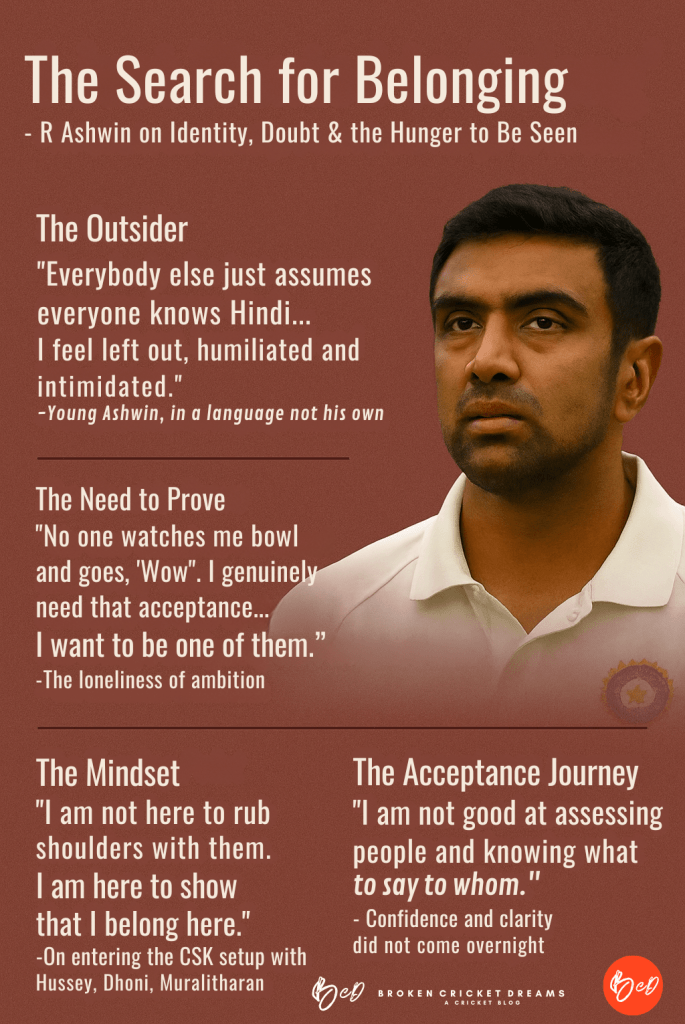
In I Have the Streets, R Ashwin doesn’t just tell his story, he reveals the person behind the player. Cricketers are people too, filled with desires, doubt, flaws, and fire.
There is so much to learn from Ashwin. And what better way to understand his mind than through his own words?
His story is one of self-doubt but also fierce self-belief, a touch of ego but with quiet confidence, a desire to disrupt, but also a willingness to learn. And above all, it’s grounded in a deep love for cricket from the streets of Chennai to the grandest stages in the world.
So here are 25 quotes from R Ashwin’s autobiography that offer a window into the mind behind the cricketer.
Right at the beginning of the book, you realize that Ashwin suffered from health issues as a child, which lingered into adulthood. At every stage, he faces self-doubts, fitness issues, social awkwardness, and a constant desire to fit in.
1. “I don’t eat much, but I play a lot. If I eat or drink too much, I vomit. If I run hard, I cough, which leads to vomiting. I play, I cough, I vomit and I continue playing. On an average, I have wheezing bouts twice a month. Each one lasts six or seven days.”
2. “Everybody else just assumes everyone knows Hindi and sets off speaking their own version of Hindi. I find it rude and alienating that no one makes an effort to talk to the one boy who doesn’t know their language…I feel left out, humiliated and intimidated.”
3. “No one watches me bowl and goes, ‘Wow’…I genuinely need that acceptance, though, to lose that feeling of being in awe all the time. I want to be one of them as soon as possible. So I’m always trying to analyze how they are looking at me. What is running through their heads? Do they think I am a proper cricketer or just a guy to make up the numbers.”
4. “I am not good at assessing people and knowing what to say to whom.”
5. “I am amazed that even Murali has self-doubt….These are inhuman expectations of him, but he doubts himself too, just like other humans.”
Life Lessons #1: External pressure, internal fears, and the desire to belong, they are all part of life. The key is to stay grounded in who you are and turn those doubts into positive energy.
Proving a Point, Over and Over Again
Whether it was the Ranji Trophy, the IPL, or the Indian time, Ashwin has had to prove himself over and over again. His interests in movies and engineering degree already made him a well-rounded person, and switching from a batter to an off-spinner made him a cricketing all-rounder. Resetting and performing repeatedly in different areas of life speaks to the strength of his mental resolve.
6. “Not for the first time, I find myself in a situation where nobody gives me a chance. I suspect nobody wants to give me a chance. My response is the only one I know: work harder, run harder, push harder.“
7. “Anirudha and I show up, we sign our contracts, and then VB gives us a glorious speech on what a huge opportunity this is. ‘You guys will rub shoulders with the likes of Michael Hussey, M.S. Dhoni, Matthew Hayden, and Muralidaran’…listen to it earnestly but also think to myself, ‘I am not here to rub shoulders with them, I am here to show that I belong here.'”
8. “It has been such a quick turnaround. From being a batter who bowled some seam-up, I am now an offspinner with one-and-a-half successful first-class seasons behind me.”
10. “One of the three streams offered to me, I pick computer engineering….I feel like I will die trying to balance studies and cricket. It feels like these four years of my life will never end…Every day is a hustle, trying to manage both college and cricket.”
Life Lesson #2: Challenges will come. And when they do, channel your inner R Ashwin and work harder, run harder, and push harder. In striving to prove a point, you may just discover excellence.
Always Asking, Always Evolving
Ashwin has kept evolving his game throughout the years. He has changed his action numerous times, invented new deliveries, and even became a T20 finisher.
But how did he get here? Ashwin evolved because he never stopped asking questions. From local bowlers to legends, he kept learning.
9. “It is during one of these [tennis ball] games that I come across SK. He has a beautiful and correct offspinner’s action, but the ball turns in weird directions and zips off the dusty surfaces…He is a bit of a terror in these matches. I am completely fascinated by what he does with the ball. So I start shadowing him. I take my bike and ride to wherever he is playing…I finally approach him to ask him how he does is. He is nice enough to show me that he flicks it with the middle finger and sends it out of the front of his hand when he wants to turn in the other way…In Madras, it is called the sodakku ball.”
11. “…Haydos’s company. I hesitate to speak with him; I wait for him to finish whatever he is doing and then introduce myself. He is extremely friendly. I ask him all the kinds of questions, and he patiently answers. I suspect he enjoys having conversations…How do you deal with pressure? How do you face Murali? How do you stand at slip for Shane Warne? I’ve watched you take some great catches; what is your mindset at slips?”
Influence of WV Raman and MS Dhoni
The most compelling moments in the book come from R Ashwin’s experiences with his mentor, WV Raman and his first early interactions with MS Dhoni. With Raman, you can vividly picture Ashwin honing his skills and elevating his craft. With Dhoni, you witness the foundation of a partnership that would shape Indian cricket for the next decade.
12. “Raman and I are made for each other. For the life of me, I can’t keep repeating the same thing. And Raman the coach comes up with something every day to help me keep discovering sping bowling to the fullest. One fine day, he tells me, run in 5 percent slower. Then another day, run in 10 percent faster.”
13. “…but Raman told me taking the new ball was the wrong call. And I told him, we had them nine down, trusted my seam attack, and they didn’t deliver…Raman said, ‘No, you’re wrong. Own up to your mistake. And do not come and tell me they didn’t deliver. If they didn’t deliver, you have a part in it.”
14. “When it comes to cricket, I am basically made of questions. MS doesn’t discourage me and answers every single question sincerely. He never brings up the optional nets either.”
15. “Each captain is different. Some can make donkeys run. Some people can buy wounded horses, treat them, train them, and make them run. But M.S. Dhoni will only make a racehorse run. He needs to be convinced you’re a racehorse before he makes you run. He will wait for a racehorse. If he doesn’t believe you’re a racehorse, he’ll probably give you time to become one, but he won’t make you run if you aren’t there yet.”
Life Lesson #3: Growth begins with curiosity. Ask questions. Stay open. The more you seek, the clearer your path becomes.
Indian Cricket Through Ashwin’s Eyes
Ashwin’s love for Indian cricket comes through in the way he speaks about his peers and predecessors.
16. “Tennis-ball cricket is a massive phenomenon in Madras. During the summer break, you can’t pass through a neighbourhood without witnessing at least one intense match going on in the sector ground. You don’t need a proper turf, a pitch or equipment for these games. It is a pure expression of love for the game and competition.”
17. “The other is Cheteshwar Pujara, who is only 15 and has already scored a triple-century in Under-14 cricket….There is an aura around him, an aura of thousands of runs.”
18. “And there are some ruthless players of spin going around…Shiv Sundar Das, Mithun Manhas, Halhadar Das, Robin Uthappa, Yere Goud, Rajat Bhatia, Sanjay Bangar…S. Bharat & Badri.”
19. “I, though, have seen the future of Tamil Nadu cricket and Indian cricket. His name is Dinesh Karthik. He is unlike any player I have seen in Chennai.”
20. “What makes this extra special for me is that Pravin Amre has stuck his neck out for me and overruled the other selectors because I batted in both of the morning sessions and actually scored some runs. This is what we had heard about Bombay: tough runs are valued there.”
Life Lesson #4: India’s cricketing soul doesn’t live in the big stadiums or in the IPL. It lives in the gullies and streets. That’s where toughness is built, where stories begin, and where Indian cricket comes to life.
Dreams Deferred, Dreams Passed Down
Finally, you get to learn about Ashwin’s family life. The sacrifice made by his parents, the dreams of his father, and how it came together with the 2011 World Cup final win. You also get to see Ashwin’s humor and his love for cinema.
21. “All those years ago, Appa traded his dreams for the job security provided by the Indian Railways, also his father’s employer. Ironically, now, a tardily running Indian Railways train is the way of his son’s, and I suspect his own renewed, dream.”
22. “Appa loves his cricket. He is a lower-divison league cricketer, a fast bowler. I am told he is a very good tennis-ball cricketer as well. My oldest memory of cricket is watching him take a wicket on a weekend. He bowled out somebody, sending the bail flying.”
23. “Thatha didn’t allow him to pursue cricket because he didn’t earn enough to raise the family and also provide for his cricketing needs. Appa doesn’t want the same to happen to me. His biggest worry is our orthodox extended family. Sometimes, even Thatha tells him cricket is not going to put food on my plate.”
24.”The movie Chennai 600028 is still fresh in our memories. It is also based on street cricketers. In our minds, we are in a movie.”
25. “Boy, I’m telling you, you’re a really really special cricketer,” Gary tells me…The kind of strides you made from 2009 to 2011 in every aspect of your game…See, everyone comes in here with what they’re good at and also their weaknesses. They continue to play to their strengths, and they try to hide their weaknesses, but very few come in with their strengths, evolve with their strengths, know what their weaknesses are, and work on those weaknesses.”
Life Lesson #5: Behind every dream fulfilled is a sacrifice quietly made. Sometimes, the dreams of one generation find life in the next. It truly does take a village to raise a child.
So, What Can We Learn from R Ashwin?
When I was younger, I liked R Ashwin, but the more I’ve seen him evolve, the more he’s become one of my favorite cricketers. Not just for the skill, but for how he thinks, adapts, and stays true to the game.
So, what did I learn from him?
Ask questions, Own your mistakes. Keep on evolving. Keep adapting. And above all, never stop loving what you do.
I am beginning to wonder if the 29-year-old Abhimanyu Easwaran will ever get a game for Team India.
Despite India’s top order struggling in the 2024-25 Border Gavaskar Trophy, Easwaran remained on the sidelines.
Jaiswal & KL Rahul had their moments, Rohit Sharma had to ‘opt out’ of the fifth Test due to poor form, Gill was in & out, and even Padikkal got a game. Dhruv Jurel and Nitish Kumar Reddy were also handed opportunities for other roles, but Easwaran never got a look-in.
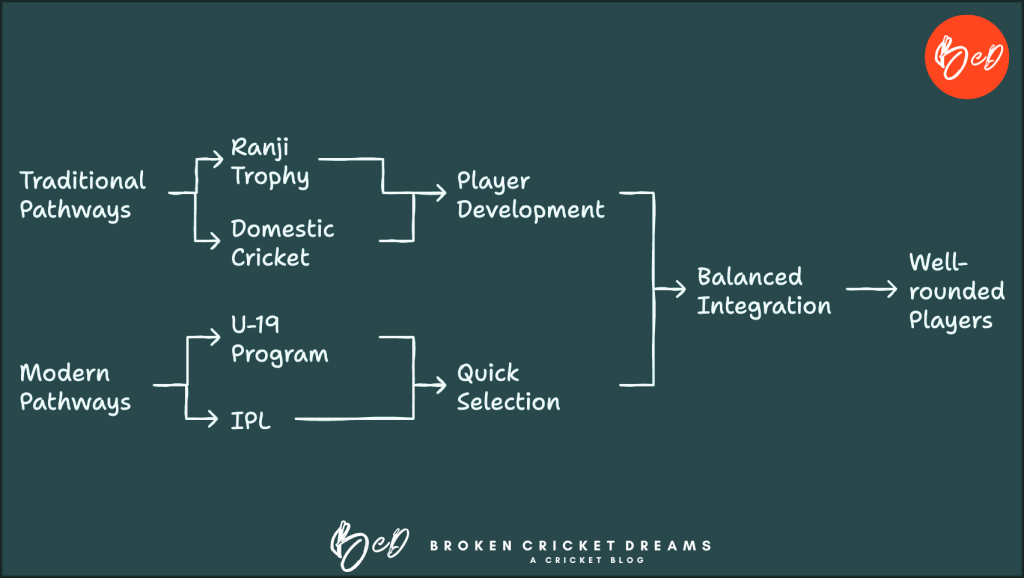
This raises a larger question—Does domestic cricket still matter in India team’s national selection? Has the Ranji Trophy lost its influence, with the India U-19 setup and IPL now serving as the primary pathways to the top?
I looked at Ranji Trophy stats from the last 35 years to see what patterns I can find in the evolution of national selection.
Easwaran came into the spotlight in the 2018-19 Ranji season when he top scored for Bengal with 861 runs. Since then, he has been on the fringes, consistently scoring in the various first-class tournaments, and has also performed well in the India A tours to South Africa and Bangladesh.
BGT 2024-25 was the third time since 2021 that Easwaran has been selected as a ‘standby’ or a reserve opener. This year, he was coming off the back of four consecutive centuries across Duleep, Irani, and Ranji trophies, but still did not get a game.
And it is the not the case that India’s top order has no vacancies. In the last couple of years, Ruturaj Gaikwad, Yashasvi Jaiswal, Ishan Kishan, Devdutt Padikkal, and Prithvi Shaw all leapfrogged him for the reserve Test opener spot due to performances in other formats and the IPL.
Shahbaz Nadeem was the top wicket-taker in the 2015-16 Ranji season (51 wickets), 2016-17 season (56), 3rd highest in 2021-22, and 6th highest wicket-taker in 2022-23. He played only 2 Tests.
Mayank Agarwal had to score the most runs by any Indian in a domestic season (2141 runs) in 2017-18 to make his way to the national team.
Between 2020-23, Sarfaraz Khan scored over 3500 runs batting at #5 at an average of 106.07.
IPL Fast-Track Vs Ranji Grind: Which Opens the Door To Team India?
The traditional pathway was going through domestic cricket, but has the Ranji Trophy and domestic cricket lost its significance?
Is the route through the U-19 program, followed by success in the IPL, now the preferred path over spending 3-4 seasons grinding in domestic cricket?
Let’s go back 25 years to see how Indian cricket has evolved.
Mohammad Kaif & Virat Kohli Pave the Way
Mohammad Kaif’s U-19 triumph in 2000 revolutionized Indian cricket forever. Kaif, Yuvraj Singh, Reetinder Sodhi, Venugopal Rao, Ajay Ratra would all go on to represent Team India.
Eight years later, Virat Kohli followed suit, earning a national call-up soon after leading India to U-19 World Cup glory. Ravindra Jadeja was the vice-captain in that U-19 side.
Since 2008, the IPL has also propelled relatively unknown domestic players to glory. Jasprit Bumrah had begun in Gujarat’s domestic circuit, but it was Mumbai Indians’ scouting lead by coach John Wright, that brought him into the limelight in 2016.
Let’s look at a more recent case, Nitish Kumar Reddy. Reddy made his way to the Andhra FC team after becoming player of the tournament in the 2017-18 Vijay Merchant Trophy (U-16 cricket). His breakthrough came at the 2023 IPL auction, and after impressing in the 2024 IPL, Reddy was elevated to the national squad (and ended up becoming India’s best batter in the BGT).
As the India U-19 system and IPL evolved, a clear pathway emerged—players identified at the U-19 level were fast-tracked to IPL auctions, and those who proved themselves over a season or two often found a route to the national team.
The U-19 & IPL Pathway Express: Gill, Jaiswal
Yashasvi Jaiswal’s inspirational journey is a prime example: He made his FC debut in 2019 and took Mumbai cricket by storm by becoming the youngest double centurion in List A cricket. However, it was his standout performance at the 2020 U-19 World Cup, where he was the player of the series & the highest run scorer, that caught everyone’s attention.
He was then be picked by the Rajasthan Royals in the IPL. After a couple of middling seasons, he took the 2023 IPL by storm scoring 625 runs including a 13-ball 50.
This lead to his Test call-up in the West Indies, where he scored a scintillating 171 and hasn’t looked back since. His 2024 Test season was an all-timer: 1478 runs at 54.74 with 3 hundreds and 9 fifties. Jaiswal has played 19 Tests already, but has only played 16 other first-class matches.
Dhruv Jurel was India’s vice-captain in the same U-19 WC, who also followed a similar path to the India Test cap through the Rajasthan Royals. Before Jaiswal, Rishabh Pant (2016 U-19 WC), Shubman Gill, and Prithvi Shaw (2018) all took a comparable route.
Pujara & Rahane, The Last Warriors of The Ranji Selection Era
Cheteshwar Pujara and Ajinkya Rahane were perhaps the last prototypes of consistent select based upon domestic performances.
Like Jaiswal, Pujara was the player of the tournament and the highest run scorer of the 2006 U-19 WC. However, before breaking into the India Test squad in 2010, he was prolific in the domestic circuit. He was the fifth highest run-scorer in 2006-07 (595 runs at 59.5), the highest run-scorer in the 2007-08 season (807 runs at 73.36), 3rd highest in 2008-09 (906 runs at 82.36 including a 302), and scored 554 runs at 79.14 in the 2009-2010 (5 matches) before being selected for India.
Ajinkya Rahane was the second-highest run-scorer in both the 2008-09 and 2009-10 Ranji seasons. He would make his international debut two years later (He got a break in T20 & ODI cricket two years before Test cricket, weirdly enough).
Fun fact: Gautam Gambhir played in the 2007-08 season and was #3 run-scorer (730 runs at 91.25) despite already being in the national team.
The Toils of Domestic Cricket Feat Agarwal, Sarfaraz
Times have changed. The journeys for Mayank Agarwal & Sarfaraz Khan have been tougher.
Agarwal also came through from the U-19 system (2010) and was fast-tracked to the IPL, but talent didn’t convert to runs.
To get back into national contention, Mayank Agarwal had to break the door down.
And boy, did he dominate, finishing as the top scorer in both the 2017-18 Ranji and Vijay Hazare Trophies. With 2,141 runs across formats, he set a record for the most runs by an Indian in a single domestic season. His breakthrough finally came in the 2018 Border-Gavaskar Trophy (Listen to Harsha Bhogle talk about Agarwal’s journey).
Sarfaraz faced an equally challenging route. A member of India’s 2014 and 2016 U-19 squads, his early IPL stint failed to impress. He then turned to domestic cricket, amassing 928 runs in 2019-20, 982 in 2020-21 (leading all batters), and averaging 106.07 from 2020-23. His relentless run-scoring, capped by a double century in the 2024 Irani Cup, finally earned him a Test debut—five years after his purple patch began.
Suryakumar Yadav’s had to wait until he was almost 31 to get an international debut.
Since 2021, he has become one of the greatest T20I players of all-time, racking up over 2500 T20I runs and four centuries. Although Yadav has extensive FC experience under his belt, it was his T20 form, that propelled his selection to the 2023 ODI World Cup teams and a Test debut.
Shreyas Iyer’s T20I & ODI form, along with his IPL credentials, got him his break in Test cricket in 2021.
*To Shreyas Iyer’s credit, he did score a record 1321 runs in the 2015-16 season, top scoring the Ranji charts (next highest was 879 runs). Coincidentally, Suryakumar Yadav was #4 on the list with 788 runs (SKY was the 4th highest scorer in the 2011-12 season)
Finally, we come to KL Rahul, the most enigmatic batter of our generation.
KL Rahul was the 2nd highest scorer in the Ranji Trophy in 2013-14 (1033) and the 4th highest run scorer in 2014-15 (1033) before breaking into the IPL teams. He was destined as the next big thing in Indian cricket and was handed a debut in 2014.
A decade later, he only averages 33.57 in Test cricket despite playing 58 Tests. For someone of his talent, that is not great returns.
Here is how his cricket season works: Rahul tops the charts in the IPL (659, 593, 670, 626, 616, 274, 520 since 2018) -> Gets selected for T20I/ODI -> India play an overseas Test and need a quick replacement for an opener, #3, or keeper, and Rahul is called in to fill the gap. He scores some beautifully looking 50s, an amazing match-winning hundred, and several low scores, before he is dropped at the end of the season.
Lather, rinse, repeat.
KL Rahul got his break due to the Ranji Trophy, but it is his IPL & ODI form keep that keep bringing him back to the Test arena (to be fair, KL Rahul did look really good in the 2024-25 BGT).
Why Comebacks are Nearly Impossible for Ranji Stalwarts
As a counterpoint to KL Rahul are the stories of Karun Nair, Hanuma Vihari, KS Bharat, and Abhinav Mukund.
Comebacks are nearly impossible for Ranji stalwarts.
It takes 3-6 years for a player to grind in domestic cricket to earn a national call-up. Then, they are made to carry drinks for a year or two, finally getting a chance in a tough overseas Test. If they do not deliver immediately, they’re dropped after two games—never to be seen again.
In the last 5 years, #ViratKohli has played 69 innings.
🚨 Averages of all batters who have played 69 innings in the last 5 years
Virat Kohli’s last eight innings read after the Perth 100 read: 7, 11, 3, DNB, 36, 5, 17, 6. Being dismissed in a similar manner, averaging about 30 in the last 5 years, and yet, he will most likely still survive the axe. Different standards for different players.
Hanuma Vihari and How Not to Treat Cricketers
Hanuma Vihari began his journey with 841 runs at 93.44 with 3 tons (including a 201*) in the 2013-14 season.
Vihari had been carried around since 2018 in England, Australia, West Indies, New Zealand, and back to Australia as an understudy to Cheteshwar Pujara. At that Sydey Test, he put his body on his line to draw a famous Test.
AfterSydney, Vihari only received 4 opportunities spread across three series at #3 when Pujara was initially dropped:
20 (53) & 40*(84) in Johannesburg
58 (128) in Mohali (vs Sri Lanka)
31 (81) & 35 (79) in Bengaluru
20 (53) & 11 (44) in Birmingham
For a player transitioning from #6 to #3, those are respectable figures, especially since he was mostly played in overseas conditions.
Now begins the difficult part.
Back in the domestic cricket, his returns has been below-par: 490 runs at 35.00 in 2022-23, 522 runs at 40.15 in 2023-24, and 250 runs at 27.77 in the current season.
After churning runs in the domestic circuit, Mukund was called up to the West Indies series and scored decent knocks of 48 & 62 in six innings.
Then, came the 0-4 horror tour of England. He scored 49 (88) at Lord’s, 12 (32), 0 (1), and 3 (41) in the next three innings before being dropped…for the next six years.
After scoring heavily in Ranji between 2015-2017, he was recalled in 2017. His score? 0 (8), 16 (32), 12 (26), and 81 (116) at Galle. Mukund never played international cricket again.
KS Bharat Fiasco
KS Bharat was Wriddhiman Saha’s understudy and the next Test wicket-keeper in line, at least for home Tests. He had been carrying drinks for about 4 years.
Once India believed Bharat was ready, Saha was ‘forced’ to retire. 12 innings to his name, Bharat hasn’t been effective with the bat averaging 20.09, but was solid with the gloves.
In any case, it looks like India has made a decision to go forward with the trio Rishabh Pant, Dhruv Jurel, and KL Rahul.
India lost the final year of Saha and never groomed Bharat properly.
The Lesson?
These players end up becoming overseas scapegoats.
By the time a player finally breaks into the national XI—after years of grinding in domestic cricket and warming the bench—they’ve lost valuable game time and likely the form that got them there in the first place.
Once a player is dropped, unless they have a Robin Uthappa & DK 2014 season, Agarwal’s 2017 season, or Sarfaraz’s 5 years, it is extremely difficult for them to be noticed again.
Easwaran has been scoring in domestic cricket for seven years without getting a game. Fellow India A opener, Priyank Panchal, now 34, might never get an international cap despite bossing the better part of the last decade in the domestic circuit.
This made me wonder? How did India’s golden generation of the 2000s make it to the national team before IPL & U-19 cricket setups matured?
The 90s: Beginning of the End
Gautam Gambhir had great back-to-back 2001-02 (565 runs at 70.62) & 2002-03 seasons (833 runs at 75.72, Top Scorer) before getting an ODI debut in 2003 and Test debut in 2004.
Virender Sehwagscored a 78 (56) at #5 in the 1998/99 Deodhar Trophy and was the sixth highest run-scorer in the Duleep Trophy that year. The next year, he continued to make runs at the Duleep Trophy including season-best 274 and was the seventh highest run-scorer in the 2000-2001 season (Five of the players above him were Mongia, Laxman, Vikram Rathour, Yuvraj, and Kaif).
Dravid consistently performed in Ranji from 1991-1995 (380 runs at 63.33 in 1991/92, 586 runs at 83.71 in 1992-93, 644 runs at 80.5 in 1993-94, 191 runs in one innings in 1994-95) along with a wonderful India A series against England A in 1995 before getting an international debut.
Sachin Tendulkar was a schoolboy genius. Rare case, never really happens anymore.
VVS Laxman, after having an indifferent start to his Test career as an opener between 1996-99, Laxman went back to his roots and broke all records in domestic cricket (601 runs at 203.66 in 1997-98, 754 runs at 83.77 in 1998-99, and a mammoth season of 1415 runs at 108.84 in 1999-2000. Next best in that 1999/2000 season scored 1075 runs).
Sourav Ganguly scored 439 runs at 73.16 in 1990 before a brief ODI debut. After a couple of middling seasons back in Ranji, he scored 722 runs at 80.22 in 1993/94. A double century in one 1994/95 Ranji game and a 171 in the Duleep Trophy got him his break for the England tour of 1995.
The Bowlers
Anil Kumble impressed in Karnataka debut in 1989, got a few games in U-19 first class tours, and got the national selection in 1990 ODI series against Sri Lanka and Test debut a few months later in England.
Harbhajan Singh did a little bit of everything: Coming up from Punjab U-19s, he performed well in the 1997-98 Ranji Trophy & Duleep Trophy, the 1998 U-19 WC before getting the Test debut in 1998.
Most of the fan favorites from the 2000s also had to toil in domestic cricket, but 2-3 consecutive season of runs was good enough to take them to the next level.
Not anymore.
The 2004 U-19 Generation
Between the Laxmans and the Jaiswals, came the Shikhar Dhawans.
Every now and then, comes a generation with several great players at once. This was absolutely the case with the 2004 U-19 side, who became the fringe players for the next decade: VRV Singh, RP Singh, Suresh Raina, Robin Uthappa, Dinesh Karthik, Ambati Rayudu, Shikhar Dhawan, and to a lesser extent, Faiz Fazal.
These players would be the transition between first-class, U-19, and the IPL. They saw it all—U-19, India A, early international debuts, being dropped, first class toil, inaugural IPL, back to internationals, back to being dropped.
Fun Fact: Robin Uthappa (912) and Dinesh Karthik (884), two of the earliest picked in the national side post 2004, were the top two scorers in the 2014-15 season and used the domestic season to break their way back to the national side.
How Did Australia Find Konstas and McSweeney?
In this season of the Sheffield Shield, Konstas scored 471 runs at 58.87 with two tons. McSweeney scored 291 runs at 97.00 in just four innings.
He had earlier scored 3 tons last summer at 40.94.
Overall though, McSweeney averages 36.31 in FC cricket, while Sam Konstas averages 39.57.
Australia backs players in form and throws them straight into the action. In India, with so much depth, a player often gets their chance five years after their peak.
Final Verdict: Is Domestic Cricket Still Relevant?
Indian selectors are not necessarily wrong with their selection policies. The idea of the ‘X-factor’ is important and the selections of Jaiswal, Pant, Bumrah, and Reddy have largely been inspirational picks.
However, what message is being sent to players next in line? That they should continue to toil for years and other youngsters will most likely continue to jump them in line?
Domestic cricket has essentially now become a ladder for IPL auctions rather than Indian selection. From the stats below, we can see that post the Covid-break, players who performed in domestic cricket like Rajat Patidar, Shams Mulani, R Sai Kishore, Manav Suthar, and Vijaykumar Vyshak were scouted and got gigs in the IPL auction. If they perform in the IPL, they can get fast-tracked to the next level.
There should be a system in place so a domestic player gets a chance before an IPL star does. Otherwise, grassroots will always be grassroots.
Ranji Trophy Back in the News?
Post the BGT debacle, Indian team changed internal rules and also are changing policies regarding domestic cricket. Will we see Rohit, Virat and Pant back in action in Ranji Trophy? Does that do the Indian team any good with the international calendar crowding all space?
Good to see that domestic cricket is getting the attention it deserves, but I am not sure if this is the way to go.
Hopefully, it is not another Broken Cricket Dream.
****
Thank you all for reading and following along. Appreciate the support!
Reference: Recent Ranji Trends Stats
For your kind reference, here are the list of the top run-scorers and wicket-takers in the last decade (divided up by the Covid-induced break since there was no 2020-21 Ranji season).
The likes of Jalaj Saxena, Dharmendrasinh Jadeja, Kumar Kartikeya have been among the wickets, but will this translate to the next level? Only time will tell.
Who are some of the unlucky Indian cricketers who never played for India? Rajinder Goel,Amol Muzumdar, Padmakar Shivalkar, AG Ram Singh, B.B. Nimbalkar, Amarjit Kaypee, Sudhakar Adhikari, Hari Gidwani,Jalaj Saxena, and Pandurang Salgaoncar are the Top 10 unluckiest players who never played for India.
Here is the complete list of 39 unlucky Indian players who never played for India (plus honorable mentions at the bottom).
Keep on reading.
List of Unlucky Players Who Never Played for India
*Note: Sunil Valson is not on this list because he was selected in the 1983 ODI World Cup on the basis of his List A exploits in the Deodhar & Duleep Trophies, not Ranji Trophy
46. Sheldon Jackson (Saurashtra, 2011-)
Role: Batter/Keeper
FC Record: 90 Matches, 6608 Runs, best of 186, 48.94 average, 20-100s, 36-50s
Claim to Fame: Integral part of the 2019-20 & 2022-23 winning Ranji Trophy teams & 2012-13, 2015-16, 2018-19 runner-up campaigns. 17th Highest run-scorer in the 2012-13 Ranji Trophy (756 Runs, centuries in quarter & semi-finals), 5th Highest run-scorer in the 2014-15 Ranji Trophy Season (819 Runs), and 9th Highest run-scorer in the 2018-19 Ranji Trophy Season (854 Runs), Scored consecutive tons in the 2015 Vijay Hazare Trophy and scored 59* in record Irani Trophy run-chase (third highest run chase in India’s first-class system)
How Close Was He to Indian Test Cap?
Scored 854 runs at 47.44 in the 2018-19 Ranji Trophy and 809 runs at 50.56 the year after, but did not make it to the India A tours (was called up to India A tours earlier). Despite being a consistent presence in the Saurashtra line up, he has not been able to get into the national spotlight, which lead him to depression. He was rewarded with an IPL contract and some games with KKR though.
45. Pankaj Dharmani (Punjab, 1992-2010)
Role: Right Arm Bat, Wicketkeeper
FC Record: 147 Matches, 9312 Runs, best of 305*, 50.06 average, 100s-26, 50s-42
Claim to Fame: 1194 Runs in 1999-2000 season (at one point, he scored 608 runs without being dismissed)
How Close Was He to Indian Test Cap?
In 1996, he was selected to play 1 ODI, but did not get a chance in Test cricket. Played for India A vs England in tour matches as well.
He captained West Zone, but that was as far as he got in the Indian selection ladder.
43. Manoj Tiwary (Bengal, 2004-2023*)
Role: Right Arm Bat
FC Record: 139 Matches, 9776 Runs, best of 303*, 48.88 average, 100s-29, 50s-44
Claim to Fame: 29 first-class hundreds, 139 FC matches
How Close Was He to Indian Test Cap?
Siddharth Monga’s ESPNCricinfo description of Tiwary starts with, “Manoj Tiwary is not the most fortunate man in Indian cricket.” He received some opportunities in limited overs cricket (and did well) but was never given a consistent run or got injured. Even with 9776 first class runs, he did not play a single Test match.Selected for India A a number of times.
FC Record: 116 Matches, 420 Wickets, best 8/123 (innings) & 12/142 (match), 28.28 average, 5w/10w – 26/5
Claim to Fame: Highest wicket-taker for Bengal in his last decade of first-class cricket for almost every year (the only other year Dinda wasn’t #1 for Bengal, it was Mohammad Shami)
How Close Was He to Indian Test Cap?
He played 13 ODIs and 9 T20Is and was trolled for his T20 bowling, but unfortunately did not get a run in the format he preferred the most. In 2012, he played for India A against England.
FC Record: 97 Matches, 6701 Runs, best of 366, 48.91 average, 100s-21, 50s-27
Claim to Fame: 366 Runs vs Andhra in 1993/94, the fourth best score of all time in Ranji (3rd best at that time). He entered at 30/1 & left at 880/5, a world record
How Close Was He to Indian Test Cap?
Although he was among the best in the domestic circuit, he could not break into the national squad at any stage of his career.
FC Record: 134 Matches, 9777 runs, 50.13 average, 24-100s, 52-50s
Claim to Fame: 5th Highest Ranji Trophy run scorer of all time (8700)
How Close Was He to Indian Test Cap?
Not that close. Although he is a stalwart in the first-class circuit, most of his runs has come for Sikkim in the Plate Group.He was a rewarded with a Kochi Tuskers Kerela contract in IPL 2011.
Claim to Fame: Part of the 1998 U-19 WC Squad, 44 first class wickets in the 1999-2000 season
How Close Was He to Indian Test Cap?
Was close to selection after his stellar 1999-2000 season, but came even closer in 2007, when he was included in the India-Bangladesh Test series. However, he did not play in the XI and was never considered for selection again.According to Siddharta Vaidyanathan from ESPNCricinfo, at his first-class debut at the age of 16, “Pawar was being touted as India’s next great left-arm spin hope.” Unfortunately, that never materialized.
Role: Allrounder (Right arm legspin/lower order batter)
FC Record: 50 Matches, 108 Wickets/1202 Runs, 6/34 (best innings), best of 142*, 28.62 bowling average, 24.53 batting average, 2/0 (5w/10w), 2-100s
Claim to Fame: Bowling alongside Salim Durani for Central Zone, they dismantled North Zone for 85/10. Played number of gutsy knocks as well including two hundreds
FC Record: 50 Matches, 134 Wickets/1536 Runs, 7/58 (best innings), best of 97, 26.24 bowling average, 24.38 batting average, 5/0 (5w/10w), 11-50s
Claim to Fame: Was regularly selected for West Zone in the Duleep Trophy
How Close Was He to Indian Test Cap?
Dilip Vengsarkar said that “he was unlucky to have never played for India.” Sandeep Patil concluded that “he was in contention for the Indian berth in those days” but fell short in his bating to get the allrounder spot.
Claim to Fame: 5th Highest wicket taker of 2003-04 Ranji Trophy (33 wickets in just 9 innings)
How Close Was He to Indian Test Cap?
Was selected for the tour to East Africa in 2004 and later for the fourth Test vs Australia in 2004 & series against Bangladesh that year, but never got a shot. By his own admission, taking Marcus Trescothick’s wicket in a Board President’s XI in 2006 was one of his most memorable moments.
Claim to Fame: In the 2006-07 season, he took 57 wickets, 9th best season haul of time (6th best at that time). According to ESPNCricinfo, after 10,658 & 2,113 List A deliveries, he had not bowled a single no ball.
How Close Was He to Indian Test Cap?
Although he was called up for the fast bowling conditioning camp by Greg Chappell, the dream was never fulfilled due to competition and lack of pace. With Irfan Pathan, Munaf Patel, Sreesanth, and VRV Singh getting chances, Bose never got a shot despite his consistency.
Role: Allrounder (Left hand bat, Slow Left arm orthodox)
FC Record: 80 Matches, 194 Wickets/2297 Runs, 7/85 (best innings), best of 104, 27.30 bowling average, 25.80 batting average, 100s-2, 50s-16 7/1 – 5w/10w
Claim to Fame: Top scored in the final with 71 in Karnataka’s first Ranji Trophy win in the 1973-74 season
How Close Was He to Indian Test Cap?
With the spin quartet ruling Indian cricket, there was not much chance for him to break into the Indian squad. Took 6/79 & 3/89 in the 1978/79 Karnataka vs West Indians tour match.
31. Syed Hyder Ali (Railways, 1963-1988)
Role: Allrounder (left hand bat/slow left arm orthodox)
FC Record: 113 Matches, 366 Wickets/3125 Runs, 9/25 (best innings), best of 121, 19.71 bowling average, 22.64 batting average, 100s-3, 50s-10, 25/3 – 5w/10w
Claim to Fame: Has the 4th Best bowling figures in Ranji Trophy history, 9/25
How Close Was He to Indian Test Cap?
Well respected in the domestic circuit, he never made it to the national stage due to India’s famed spin quartet.
Claim to Fame: Best bowling figures in Ranji Trophy History (10/78 in 1956-57); Took 15 wickets in the 1955-56 semi-final to push Bengal to the final
How Close Was He to Indian Test Cap?
Chuni Goswami, who captained Bengal to the 1971/72 title, reckons that Chatterjee “would have been very successful if he was born in this era. It’s really sad that he could not play for India because of poor backing from the state administration.”
29. Rajinder Singh Hans (Uttar Pradesh, 1976-1987)
Claim to Fame: 9/152 one of the best individual wickets haul
How Close Was He to Indian Test Cap?
Was called up to the 1979-80 Test series but never played an international game.
28. Yere Goud (Karnataka, Railways, 1994-2011)
Role: Batter
FC Record: 134 Matches, 7650 Runs, best of 221*, 45.53 average, 16-100s, 39-50s
Claim to Fame: Won 2 Ranji Trophies, 3 Irani Cps, and a Duleep Trophy, and a Ranji one-day trophy. Played 100 Ranji Trophy matches
How Close Was He to Indian Test Cap?
Despite score 761 runs in the 2001-02 Ranji season and regular member of the India A ide at that time, he could not find a place in the Indian middle order. At his retirement, Javagal Srinath that Goud was the “Rahul Dravid of the Railways team.”
FC Record: 111 Matches, 7679 Runs, 50.85 average, 23-100s, 31-50s
Claim to Fame: Highest scorer of the 2003-04 Ranji Trophy season with 1066 runs in just 12 innings
How Close Was He to Indian Test Cap?
He was selected in the squad for the 4th Test vs Australia in 2004 based on a good performance in India A’s tour to Kenya and was also the reserve opener in the 2005 Zimbabwe Test series.
26. Surinder Bhave (Maharashtra, 1986-2001)
Role: Right Arm Bat
FC Record: 97 Matches, 7971 Runs, best of 292, 58.18 average, 28-100s, 27-50s
Claim to Fame: Joint 6th highest number of centuries in Ranji Trophy
How Close Was He to Indian Test Cap?
Was selected for the 1992-93 SAARC Quadrangular tournament, a competition betwen India, Pakistan, Sri Lanka, and Bangladesh made up of ‘A’ squads. Bhave scored 81, but the final was abandoned due to riots in Dhaka.
Claim to Fame: Was selected for East Zone in Duleep Trophy in 2009. Leading wicket-taker for Odisha in the 2018-19 season
How Close Was He to Indian Test Cap?
Statistically, he should have been right at the top in the national conversation. However, with India’s pace attack rising in this decade, Mohanty never got his chance.
*still playing
24. Priyank Panchal (Gujarat, 2008-)
Role: Right Arm Opening Batter
FC Record: 111 Matches, 7901 Runs, best of 314*, 47.02 average, 26-100s, 31-50s
Claim to Fame: Scored 1310 runs at 87.33 in 2016-17, when the weight of his runs lead Gujarat to a maiden Ranji Trophy victory. Between 2016-19, he had the most first class runs by anyone in India
How Close Was He to Indian Test Cap?
When Rohit Sharma was injured for the tour of South Africa in 2021, Panchal was called up as cover.He was also in the England Test series squad that year and has been on the fringes with the India A for a number of years now.Earlier this year, Panchal was India A’s red ball captain, but another member in that India A squad got the Test cap before him—Shreyas Iyer.
Almost 33, it is difficult to see him making a debut now.
Claim to Fame: Most successful bowler for Hyderabad in that era with 86 wickets in five seasons
How Close Was He to Indian Test cap?
He was named in the probables for the 1977-78 tour of Australia, but that was the farthest he got.
V Ramnarayan was “India’s third-best offspinner, kept out of the national side only by the giant skills of Erapalli Prasanna and Srinivas Venkataraghavan.”Based on this opinion, he wrote the book, “Third Man.”
22. KN Ananthapadmanabhan (Kerela, 1988-2004)
Role: Right arm Legspin/Allrounder
FC Record: 105 Matches, 344 Wickets/2891 Runs, 8/57 (best innings), best of 200, 27.54 bowling average, 21.90 batting average, 25/5 (5w/10w), 3-100s, 8 -50s
Claim to Fame: Scored a double century and cemented his tag of an all-rounder
How Close Was He to Indian Test Cap?
Received a few opportunities for India A, but not on the national stage as his career coincided with Anil Kumble.Now an umpire.
21. Sistanshu Kotak (Saurashtra, 1992-2013)
Role: Left-handed Batter
FC Record: 130 Matches, 8061 Runs, 60 Wickets, 6/81 (best innings), best of 168*, 41.76 batting average, 15-100s, 55-50s
Claim to Fame: At the time of his retirement, Kotak was the highest scorer in Ranji Trophy never to have won the title. They went to the finals in his final game in 2013, but lost to Mumbai in the finals
How Close Was He to Indian Test Cap?
In his own words Kotak said that “Every player wants to play for his country. That could not happen for me, but that is not a regret. Maybe I was not destined to.”
FC Record: 139 Matches, 8317 Runs, best of 220, 42.21 average, 16-100s, 51-50s
Claim to Fame: Won the 2010-11 Ranji Trophy, 5th highest number of Ranji matches played (126)
How Close Was He to Indian Test Cap?
With India’s middle order settled and even Amol Muzumdar not getting a chance, the likes of Rashmi Parida never got to see the green light for national selection.He did play a tour game against England though.
FC Record: 139 Matches, 8700 Runs, Bet of 224, 51.17 Average, 27-100s, 42-50s
Claim to Fame: At the time of his retirement, only Tamil Nadu player to play 100 Ranji Trophy matches
How Close Was He to Indian Test Cap?
Not very close due to the competition. He played in a Board President’s XI match vs Sri Lanka, but did not get any further.
Like many first-class giants during this time, Sharath just couldn’t break through the Indian squad with the golden generation of Dravid, Tendulkar, Ganguly, and VVS Laxman around. When he retired from Tamil Nadu cricket (came back year later for Assam), he said “My not playing for India, and the fact that Tamil Nadu did not win a Ranji Trophy title in my time, remain my biggest disappointments. The hard work factor was missing during the time I played.”
18. Parvez Rasool (Jammu & Kashmir, 2008-2022)
Role: Allrounder (Right arm off break, Right arm bat)
FC Record: 87 matches, 299 Wickets/5023 Runs, 8/85 (best innings) & 12/73 (best match), best of 182, 27.92 bowling average, 37.76 batting average, 20/4 – 5w/10w, 100s-13, 50s-20
Claim to Fame: Lala Amarnath Award (best allrounder) in 2013-14 & 2016-17 seasons
What a colossal allrounder he was in Ranji Trophy. First cricketer from Kashmir to be picked for India A, he took seven wickets against Australia while representing the Board President’s XI team in 2013. He went on to play a couple of limited overs matches in 2014 and was recalled in 2017 for the T20 squad, but never for Test cricket.
Claim to Fame: Holds the record for the 5th best season hall—62 wickets in 1999-2000 season.
How Close Was He to Indian Test Cap?
He was selected for an India A vs England A in 1994/95 and did pretty well. However with Test season ending soon and Rajesh Chauhan India’s first choice off-spinner, he could not make it into the team. With 113 wickets after the age of 40, he still had a desire to play for the nation.
16. Faiz Fazal (Vidharba, 2003-2023*)
Role: Right Arm Opener (right arm medium part-time)
FC Record: 135 Matches, 9128 Runs, best of 206, 41.68 average, 100s-24, 50s-39
Claim to Fame: In the 2015-16 season, he scored 714 runs at 44.62 (including 127 in chase of 480 in Irani Cup)
How Close Was He to Indian Test Cap?
Played 1 ODI, scored 55 runs. Never played for India again. For all his first first-class run-scoring abilities, never received a Test call up.Did receive an India A call up during that time though.
He was later selected for the first Test against England in 2001 in the 14-man squad. However, he did not win the competition for the opening batter battle as Shiv Sunder Das and Deep Dasgupta opened.
12. Mithun Manhas (Delhi, 1997-2016)
Role: Right arm batter/wicketkeeper/allrounder
FC Record: 157 Matches, 9714 Runs, best of 205*, 45.82 average, 100s-27, 50s-49
Claim to Fame: 7th all-time Ranji run-scorer (8554), 9th most centuries (25), 3rd most matches played in Ranji (135)
How Close Was He to Indian Test Cap?
With India’s Fab Four in their prime, there was never a chance that Manhas could break into India’s Test squad. Domestic giant nevertheless.
FC Record: 133 Matches, 410 Wickets/6567 Runs, 8/36 (best innings) & 16/154 (best match), best of 194, 25.97 bowling average, 34.74 batting average, 28/7 – 5w/10w, 100s-14, 50s-32
Claim to Fame: Lala Amarnath (best all rounder award) in 2014-15, 2015-16, and 2017-18. Became the only Indian to hit a 100 & take an 8-wicket innings haul twice in the same match. Only player apart from Anil Kumble to take 16 wickets in a Ranji Trophy match
How Close Was He to Indian Test Cap?
Although he was selected in India A in 2013, he was out of contention till 2019 when he returned to play for India A against England Lions and South Africa A. He said “I spoke to the selectors and asked them. They told me that I am in their sights and they are watching me, and if they get the chance, they’ll give me an opportunity.”
That opportunity never came. The closest he got was in 2021 when Ravindra Jadeja was injured for the England Test series. However, Axar Patel got the nod (and Axar made it count).
*still playing
9. Hari Gidwani (Delhi, Bihar, 1972-1992)
Role: Right arm bat
FC Record: 119 Matches, 6805 Runs, best of 229, 42.53 average, 100s-15, 50s-32
Claim to Fame: Scored centuries in 5 consecutive Ranji Trophy matches between 1986-1988
How Close Was He to Indian Test Cap?
Scored 46 against West Indies and a century vs Sri Lanka in tour matches but did not climb the final ladder to national glory.In his own words, Gidwani stated that “I was closest to India selection in 1975-76 when I got a hundred against the visiting Sri Lankan team.”
Claim to Fame: Once hit Sunil Gavaskar on the hand. Was one of the fastest bowlers in the 1970s in India’s domestic circuit
How Close Was He to Indian Test Cap?
Very, very close. Played the unofficial Tests vs Sri Lanka in 1974. Then was in the West Zone team who played the West Indies XI. Madan Lal and Syed Abid Ali were selected after these matches respectively, with Salgaoncar narrowly missing out. On a couple of occasions, he was called for the 1975 World Cup team, but could not make it past the trials.
7. Sudhakar Adhikari (Mumbai, 1959-1971)
Role: Right Arm Opener
FC Record: 65 Matches, 3779 Runs, best of 192, 40.63 average, 100s-11, 50s-18
Claim to Fame: Scored a century in the morning and reached his wedding venue by the night
How Close Was He to Indian Test Cap?
According to V Ramnarayan (in the list above himself), Adhikari was “considered distinctly unlucky not to gain the approval of the Indian selections in the 1960s.”
6. Amarjit Kaypee (Haryana, Punjab, 1980-2000)
Role: Right hand bat
FC Record: 117 Matches, 7894 runs, best of 210*, 52.27 average, 100s-27, 50s-34
Claim to Fame: At the time of his retirement, he was the highest run-scorer in Ranji history. 6th Most number of Ranji 100s (27), 2nd at the time. Once scored 150+ in both innings of a match
How Close Was He to Indian Test Cap?
According to ESPNCricinfo, “there have been many cricketers who have received a raw deal from a jaundiced selectorial eye and Kaypee must consider himself very unlucky in this regard.”
Role: Right hand bat/wicketkeeper/Right arm Fast medium
FC Record: 80 Matches, 4841 Runs, best of 443*, 47.93 average, 100s-12, 50s-22
Claim to Fame: Highest individual score in Ranji Trophy history and the highest score for a cricketer never to have played international cricket—443*
How Close Was He to Indian Test Cap?
Played for the country unofficially against a Commonwealth match in 1949-50. However despite an illustrious domestic career from 1939-1965, he did not play a Test match.
Role: Allrounder (Left hand bat/slow left arm orthodox)
FC Record: 56 Matches, 265 Wickets/3314 Runs, 8/14 (best innings), best of 126, 18.56 bowling average, 35.25 batting average, 24/8 – 5w/10w, 100s-6, 50s-22
Claim to Fame: Became the second cricketer to score 1000 runs and take 100 wickets in the Ranji trophy
How Close Was He to Indian Test Cap?
Played in two unofficial Tests in 1935-36 in the tour to England and was selected in 1945 to a tour to Ceylon, but never had the honor to don the Indian cap. Due to his excellent all-round abilities, Natarajan Sriram reckons that “AJ Ram Singh takes his place as one of the unluckiest cricketers in the history of Indian cricket.”
Claim to Fame: 361 Ranji wickets for Mumbai (record), Joint-second 10-wicket hauls in Ranji (11)
How Close Was He to Indian Test Cap?
He went to Sri Lanka in 1973-74 and played a couple of tour matches.
From the age of 22 to the age of 48, Shivalkar played first class cricket. Yet during those 26 years, not once did he get a chance to represent India at a national level. With Bishan Singh Bedi, one of the all-time greatest, wreaking havocand Rajinder Goel not getting a chance, Shivalkar was left behind.
FC Record: 171 Matches, 11167 runs, best of 260, 48.13 average, 100s-30, 50s-60
Claim to Fame: 2nd highest All-time Ranji Runs (9205), 5th highest all-time centuries (28), 2nd most number of Ranji matches (136), Vice-captain of the 1994 India U-19 Team (As of 2007, he had won Mumbai 7 Ranji trophy titles)
How Close Was He to Indian Test Cap?
By his own admission, he came close to the Indian team spot in 1994. Even after years of consistent runs scoring, selectors did not consider him. He deliberated quitting cricket in 2002, but ended up playing till 2013.
Fun fact. When Vinod Kambli & Sachin Tendulkar scored the 664-run partnership in their school days, Amol Muzumdar was slotted in the next position. That was probably the closest he got to the India cap.
Claim to Fame: Most Ranji wickets of all-time (637), 3rd Longest career (27 years), Highest wicket taker in the 1978-79, 79-80, 83-84, and 84-85 season. 53 five-fers & 17 10-fers, both Ranji records
How Close Was He to Indian Test Cap?
He played an unofficial Test against Ceylon in 1964-65, taking 4/33 in the second innings.According to Bishan Singh Bedi, ‘Goely, as I called him, was a much better bowler than me. Honestly, I was just lucky that I got the break [to play for India]. I was very fortunate. That is where Goely might have missed out. But I rated him very highly.”
Will Sarfaraz Khan Remain an Unlucky Indian Cricketer?
Will Sarfaraz Khan add to the list of unlucky Indian cricketers who never played international cricket? The man has been bludgeoning runs for the last couple of first couple of first-class seasons.
At the moment, his first-class record reads: 37 Matches, 3505 Runs, 79.65 average, 13 centuries, 9 fifties, and a best of 301*.
Some like Jaydev Unadkat and Shahbaz Nadeem have recently lived to see the dream by playing a couple of Test matches after years of toil. Others like Priyank Panchal, KS Bharat, & Abhimanyu Easwaran have traveled with the reserve and India A squads for the last few years without breaking into the XI. Prithvi Shaw scored a 379 and still cannot break in the Indian Test squad.
On the other hand, the likes of Shreyas Iyer, Ishan Kishan, and Suryakumar Yadav have broken into India’s Test squads due to heroics in other formats. There is no right and wrong here, but due to timing and form, some first-class legends have missed out on international Test careers.
Honorable Mentions And Those Who Just Played 1-3 Test Matches (Separated by Era)
1950-1970
Vaman Vishwanath Kumar (2 Tests)
Played 2 Tests and got 7 wickets despite having a FC career of 599 wickets. In the era of the spin quartet
Abdul Ismail, Saad Bin Jung, AV Jayaprakash, Barun Burman, Uday Joshi, Sarkar Talwar, Vijay Mohanraj, Michael Dalvi, Naushir Mehta, Anil Mathur
1980-1990
Sadanand Vishwanath (3 Tests)
S Vasudevan, Abdul Azeem
1990-2000
Ajay Sharma (1 Test)
Scored 10,000+ first class runs at an average of 67.46 played exactly 1 Test for India (and later getting banned for match-fixing scandal). Also had 7 double tons in Ranji Trophy history.
Hrishikesh Kanitkar (2 Tests)
Ashish Winston Zaidi, Sunil Subramaniam
Post 2000s
Subramaniam Badrinath (2 Tests)
Vinay Kumar
Although Kumar played 31 ODI matches for India, he played only 1 Test match. For someone with 139 FC match experience & 504 wickets at an average of 22.44 to his name, that is a shame
Rishi Dhawan, Basant Mohanty
Also Read other articles in our Unlucky Cricketer Series:
Unlucky Indian Cricketers Who Never Played for India – Frequently Asked Questions (FAQ)?
Who is the unluckiest Indian cricketer and why?
Rajinder Goel is the unluckiest cricketer. Despite taking 750 first class wickets and 637 Ranji Trophy wickets (100+ more than the next highest), he was never considered at the highest level.
Who is the unluckiest player in cricket history?
Rajinder Goel & Amol Muzumdar are the unluckiest players in Indian history. They both have played for more than two decades and hold records in their respective crafts. Due to competition from India’s spin quartet in the 1960s, Rajinder Goel could not break through India’s ranks and due to the presence of the Fab Four, Amol Muzumdar could not break through.
Who are the best Indian players who have not played for the Indian national team?
Rajinder Goel, Padmakar Shivalkar, Amol Muzumdar, Hari Gidwani, AJ Ram Singh, B.B. Nimbalkar, Amarjit Kaypee, Paras Dogra, Mithun Manhas, and Pandurang Salgaoncar are the Top 10 unluckiest players who never played for India.
Who has played the most Ranji Trophy games without representing India?
Devendra Bundela (145), Amol Muzumdar (136), Mithun Manhas (135), Rashmi Parida, and Rajinder Goel (123) played the most Ranji Trophy matches without representing India.