Which cricketers have played the most World Cup matches? How many World Cups did Sachin Tendulkar Play in?
Here is a quick answer: Sachin Tendulkar played 45 World Cup matches, but he is actually the second for the most World Cup matches. Ricky Ponting at 46 has played the most ODI WC matches.
Here are all the details. Keep reading.
Key Takeaways – Most World Cup Matches
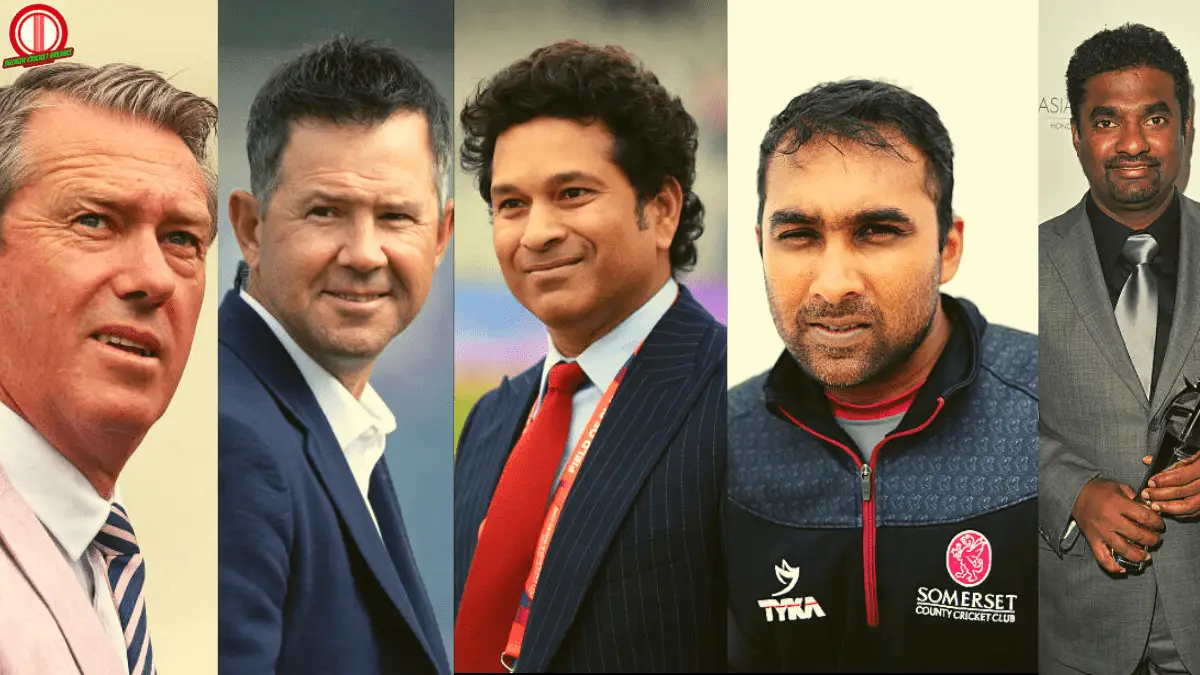
Ricky Ponting (46), Sachin Tendulkar (45), Mahela Jayawardene (40), Muttiah Muralitharan (40), and Glenn McGrath (39) have played the most World Cup matches.
The Top 20 cricketers in this list consist of: 1 South African, 2 Indians, 3 Australians, 2 from West Indies, 3 Pakistanis, 4 from New Zealand, and 5 Sri Lankan.
13 of the players with the longest World Cup careers were proper batters (or keepers), 2 bowlers, and 5 all-rounders.
*Note: Shakib Al Hasan & Mushfiqur Rahim currently have played 29 World Cup matches. They have a chance to go to the Top 5-6 in this list if they play all World Cup 2023 matches (Sadly, Tamim Iqbal ends his World Cup career at 29 matches after he was controversially left out of the World Cup).
31 Matches: Shivnarine Chanderpaul, Adam Gilchrist, Chaminda Vaas
30 Matches: Mohammad Azharuddin, Andy Flower, Arjuna Ranatunga
29 Matches: MS Dhoni, Ijaz Ahmed, Lasith Malinga, Eoin Morgan, Mushfiqur Rahm, Shakib Al Hasan, Tamim Iqbal
Final Thoughts
Longevity is the key to several positive outcomes in life.
These players have stayed at the top of the game for more than a decade. WE can just sit back and appreciate their contributions to their teams, the Cricket World Cup, and the sport of cricket in general.
Frequently Asked Questions (FAQ) – Most World Cup Matches Played by Cricketers
Which cricketers have played the most Cricket World Cup matches?
Ricky Ponting (46), Sachin Tendulkar (45), Mahela Jayawardene (40< Muttiah Muralitharan (39), and Glenn McGrath (39) have played the most World Cup matches.
How many World Cup matches has Virat Kohli played?
Virat Kohli has played 26 World Cup matches so far.
Other 2023 Cricket World Cup Content
If you liked reading facts about the World Cup, consider checking these articles out:
Winners of the Man of the Match in the Cricket World Cup Final – Everything you need to know.
Who was adjudged the man of the match in the 2019 World Cup Final? Which players won the Man of the Match in each of the Cricket World Cup Finals?
As acclaimed American author Mark Twain once said,
“The two most important days in your life are the day you are born and the day you find out why.”
– Mark Twain
This quote perfectly epitomizes the World Cup Final for cricketers. It is the pinnacle of achievement, the day many of them dreamed of as a kid.
If you help your team conquer the World Cup Final, your legacy is etched in stone forever and you finally find out what you were born to do.
Without further ado, here is everything you need to know about the player of the match award winners in each ODI Cricket World Cup.
Key Takeaways
Ben Stokes won the most recent player of the match award in the 2019 World Cup Final.
The distribution of the man of the match in WC Finals coincide with the World Cup winners: 5 from Australia and the rest as follows: West Indies, India (2), England, Pakistan, Sri Lanka (1).
7 player of the final winners had all-round contributions, two were bowlers, two keepers, and one (surprisingly, Ben Stokes) contributing only as a batter.
At a Glance: Man of the Match in the Cricket World Cup Final
Player
World Cup
Performance
Clive Lloyd
1975
102 (85) 1/38 1 Run-Out Captain
Sir Vivian Richards
1979
138 (157) 0/35 1 Catch
Mohinder Amarnath
1983
26 (80) 3/12
David Boon
1987
75 (125) 1 Run Out
Wasim Akram
1992
33 (18) & 3/49
Aravinda de Silva
1996
107*(124) 3/42 2 Catches
Shane Warne
1999
4/33
Ricky Ponting
2003
140*(121) Captain
Adam Gilchrist
2007
149(104) 2 Catches 1 Stumping
Mahendra Singh Dhoni
2011
91*(79) 1 Run-Out 1 Catch Captain
James Faulkner
2015
3/36
Ben Stokes
2019
84*(98)
List of Award Winners: Man of the Match in the Cricket World Cup Final
1. Sir Clive Lloyd (West Indies), 1975 Prudential World Cup Final
Performance: Century, Wicket, Run-Out, Captain
Result: West Indies defeat Australia by 17 runs
Runs: 102 (85)
Strike Rate: 120.00
4s/6s: 12/2
Wickets: 12-1-38-1
Economy: 3.16
Match Situation
Batting first, West Indies were in a precarious position at 50/3. In comes captain cool, Clive Lloyd, and stitches a 149-run partnership with Rohan Kanhai against the Australians. West Indies end at 291/8 after their 60 overs. Imagine, a 120-strike rate in 1975. That too in a World Cup Final.
Australia start out well in response. Standing at 115-2, the Chappell brothers look to carry Australia home before Lloyd-Richards run out captain Ian Chappell for 62. No worries, Australia are still in the game at 170-4 with Doug Walters at 35.
Not anymore. Walters bowled Lloyd, reads the scorecard the next ball. Australia fight it out till 274, but the match was lost much before that.
2. Sir Vivian Richards (West Indies), 1979 Prudential World Cup Final
Performance: Century, Economical Bowling, Catch
Result: West Indies defeat England by 92 runs
Runs: 138* (157)
Strike Rate: 87.89
4s/6s: 11/3
Wickets: 10-0-35-0
Economy: 3.50
Match Situation:
I will read you the scorecard of nine players for WI that day.20, 13, 9, 45, 4, 0,0, 0, 0*. Collis King scored 86 (66) & Viv Richards scored 138*(157).
Richards came to the crease when Greenidge departed. When he began, the score was 22/1. Then, be batted and batted and batted. In the end, West Indies had 286/9 in 60 overs.
Brearley-Boycott began slowly but steadily taking England to 129. Joel Garner, though, had other plans. His figures read 5/38 as England collapsed from 129/0 to 194/10.
A classic from Vivian Richards. A sign for more to come in the next decade.
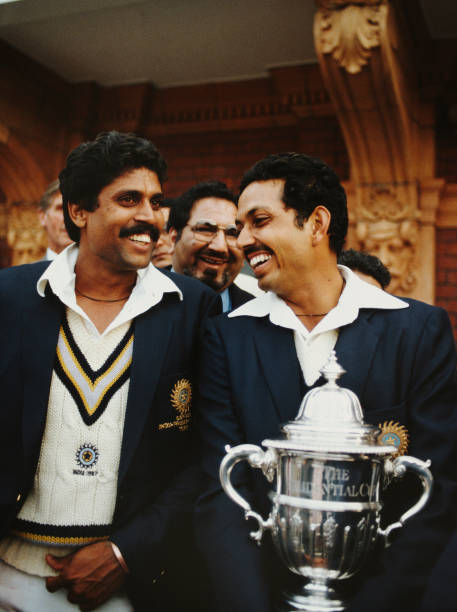
3. Mohinder Amarnath (India), 1983 Prudential World Cup Final
Performance: 3 Wickets, Runs on the Board
Result: India defeat West Indies by 43 Runs
Runs: 26 (80)
Strike Rate: 32.50
4s/6s: 3/0
Wickets: 7-0-12-3
Economy: 1.71
Match Situation:
When you think of Mohinder Amarnath, you think of his batting exploits and Test centuries. Not in the 1983 final.
With Dujon & Marshall in a 43-run partnership, there was still outside hope for the West Indies. They had recovered from 76/6. Then Amarnath took the wickets of Dujon, Marshall, and Holding to wrap up a famous victory for Team India.
Earlier, he was India’s third highest scorer with 26 runs, surviving the early spells of the West Indian fast bowlers.
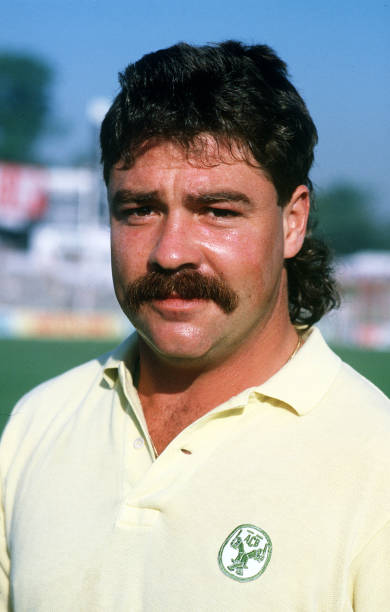
4. David Boon (Australia), 1987 Reliance World Cup Final
Performance: 75 (125), Run-Out
Result: Australia defeat England by 7 Runs
Runs: 75 (125)
Strike Rate: 60.00
4s/6s: 7/0
Match Situation:
One of the closest World Cup Finals. While it was Mike Veletta’s 45*(31) that propelled Australia to 253, it was David Boon’s steady 75 that provided Australia with the base.
England had contributions from Gooch, Bill Athey, Mike Gatting, Allan Lamb that drew them close , but the lower order couldn’t push through.
5. Wasim Akram (Pakistan), 1992 Benson & Hedges World Cup Final
Performance: 33 (18) & 3/49
Result: Pakistan defeat England by 22 runs
Runs: 33 (18)
Strike Rate: 183.33
4s/6s: 4/0
Wickets: 10-0-49-3
Economy: 4.90
Match Situation:
A true all-round performance by Wasim Akram. Wasim came it at #6 with Pakistan at 197/4 in 43.3 overs. Imran Khan had departed for 72, but Wasim provided Inzamam support with a quick 33 (18) to take Pakistan to a competitive 249/6.
Wasim first nicked England’s golden boy, Ian Botham for a duck in the third over. Still, England recovered from 69/4 to 141/4. Then came in Wasim and delivered those two deliveres to Allan Lamb & Chris Lewis. England 141/6 and never recovered.
6. Aravinda de Silva (Sri Lanka), 1996 Wills World Cup Final
Performance: Century, 3 Wickets, 2 Catches
Result: Sri Lanka Defeat Australia by 7 Wickets
Runs: 107*(124)
Strike Rate:
4s/6s: 13/0
Wickets: 9-0-42-3
Economy:
Match Situation:
Wickets, runs, catches. Aravinda de Silva provided an all-round spectacle for the generation.
His off-breaks had taken out a dangerous Mark Taylor for 74, Ricky Ponting for 45, and Ian Healy for two. To top it off, he took catches to dismiss Steve Waugh and Stuart Law.
However, Australia had runs on the board with 241 runs and the famous Jayasuriya-Kaluwitharana pair were back in the hut within 23 runs. Then, Aravinda de Silva formed two partnerships to take Sri Lanaka home.
Gurusinha-de Silva scored 125 together, while de Silva & Ranatunga put together 97 runs to take Sri Lanka home with 22 balls remaining.
7. Shane Warne (Australia), 1999 ICC World Cup Final
Performance: 4/33
Result: Australia defeat Pakistan by 8 Wickets
Wickets: 9-1-33-4
Economy: 3.66
Match Situation:
An anti-climactic final. At 77-3 , Pakistan were decently poised.
Then came Warne. Ijaz Ahmed. Moin Khan. Shahid Afridi. Wasim Akram. All back in the pavilion. Pakistan would collapse for 132 in 39 overs. Australia chased it with almost 30 overs to spare.
8. Ricky Ponting (Australia), 2003 ICC World Cup Final
Performance: 140*(121), Captain
Result: Australia defeat India by 125 Runs
Runs: 140*(121)
Strike Rate: 115.70
4s/6s: 4/8
Match Situation:
Sourav Ganguly won the toss and chose to field first. Match was lost right there or so is what the narrative suggests. In reality, it was anexhibition of high-quality batting.
Gilchrist & Hayden set the tone with 105-runs in just 14 overs (Gilchrist would take it to a whole new level in the next edition). Ricky Ponting made sure there was no spot in the field left to score. 8 sixes, fours. Ponting, 140*, Martyn 88*, Australia 359/2.
Tendulkar out in the first over. India lose by 125 runs.
9. Adam Gilchrist (Australia), 2007 ICC World Cup Final
Performance: 149 (104), 2 catches, and 1 stumping
Result: Australia defeat Sri Lanka by 53 runs (D/L method)
Runs: 149 (104)
Strike Rate: 143.26
4s/6s: 13/8
Match Situation:
One of the least remembered World Cups. A tournament ridden with controversies, rain, mismanagement, Bob Woolmer’s death, and the financial loss induced by India-Pakistan’s early exits. For a few moments, the negativity was upstaged by one of the greatest final knocks.
Adam Gilchrist absolutely smashed it. 8 sixes, 143.26 SR. An opening partnership of 172 in 22.5 overs, in which Hayden only scored 38 (55).
And Gilchrist was not done. He did his part as a keeper by catching Tharanga & Russel Arnold and stumping Malinga at the end.
10. MS Dhoni (India), 2011 ICC Cricket World Cup Final
Performance: 91*(79), Run-Out, and a Catch
Result: India defeat Sri Lanka by 6 Wickets
Runs: 91*(79)
Strike Rate: 115.18
4s/6s: 8/2
Match Situation:
One of the best ODI chases by the greatest finisher in cricket’s history. Dhoni had played his part as a captain, caught behind Sangakkara for 48, and inflicted a run-out of Kulasekara at the end. However, it was Jayawardene’s blistering show of 103*(88) that took the match firmly into Sri Lanka’s favor.
At 31/2, with both Sehwag-Sachin in the hut and a review lost due to Malinga, there seemed to be no hope. The pressure of a home final. Then, began the recovery via Virat Kohli & Gautam Gambhir. This gave India some belief. When Kohli departed, another 161 runs were needed.
Then, came in MS Dhoni. Dhoni was struggling for form in the World Cup and Yuvraj Singh was player of the tournament contender. It turned out Dhoni came to tackle the Muralitharan factor and the decision paid dividends. The Gambhir-Dhoni duo stitched a 109 run-partnership and Dhoni-Yuvi finished it in style.
The final six is going to go down as one of the most iconic shots in Indian cricket history.
11. James Faulkner (Australia), 2015 ICC Cricket World Cup Final
Performance: 3/36
Result: Australia defeat New Zealand by 7 Wickets
Wickets: 9-1-36-3
Economy: 4.00
Match Situation:
After Starc had jolted the Kiwis with McCullum-size wicket, New Zealand had managed to somewhat recover. From 3/39 in 12.2, Ross Taylor & Grant Elliot had taken NZ to 150 in 35 overs. In that World Cup, with the powerplay rules, teams were comfortable doubling their scores after their 35th over. 300 was still possible.
In comes James Faulkner and bowls a really wide one to Taylor. Taylor, looking for the aggressive option, edges to Brad Haddin. Next Two balls later, Corey Anderson bowled for duck.
150-3. 150-4. 151-0-5. 151-6. 167-7. 183-10. Despite Aaron Finch’s duck, Australia chased it easily. Match over in a space of three deliveries.
12. Ben Stokes (England), 2019 ICC Cricket World Cup Final
Performance: 84*(98), 0/20
Result: Match Tied, England won in Super Over
Runs: 84*(98)
Strike Rate: 85.71
4s/6s: 5/2
Wickets: 3-0-20-0
Economy: 6.66
Match Situation:
This one is the freshest in all of our memories. One of the greatest ODI matches of all-time, and the best ending without a doubt.
New Zealand had runs on the board with 241, but England were still favorites to sweep them aside. But Matt Henry & de Grandhomme had other plans, combining with figures of 20-4-65-2. Joe Root had an off day at 7(30), and when captain Morgan was dismissed, England’s score stood at 86/4 in 23.1 overs. The Kiwis back in it.
Then came the recovery, led by Jos Buttler’s brisk 59 (60) with Stokes playing the supporting role. Lockie Ferguson brought his A game and would dismiss Buttler & Woakes in two balls.
At the end of the 47th over, Ben Stokes was 57*(87) and 33-runs were still needed. Then, the giant woke up. A couple of sixes, intense running, run-outs, Boult falling over the boundary, the dive that was deflected to the boundary. We all remember it like yesterday.
Stokes scored another 8*(3) in the Super Over and held his nerve.
A few moments later, Martin Guptill run out. By the barest of margins.
One of the all-time clutch performances of all-time.
Winning the man of the match in the Cricket World Cup Final is a prestigious achievement. Only have twelve have achieved it so far, and we remember all of their contributions fondly.
I hope we get to witness another memorable final and new heroes emerge. Who will it be this time?
The list of Pakistan fast bowlers continues to grow—Shaheen Shah Afridi, Naseem Shah, and Haris Rauf have been ripping apart batting line ups all year.
Join us as we explore the mesmerizing realm of Pakistani fast bowlers – where passion meets skill and legends are born. Who are the greatest? The unluckiest? Who took the most wickets?
By the Numbers: Which Pakistani Fast Bowlers Have Taken the Most Wickets Across Formats?
The land of Pakistan is a factory that unearths gem of fast bowlers year in and year out.
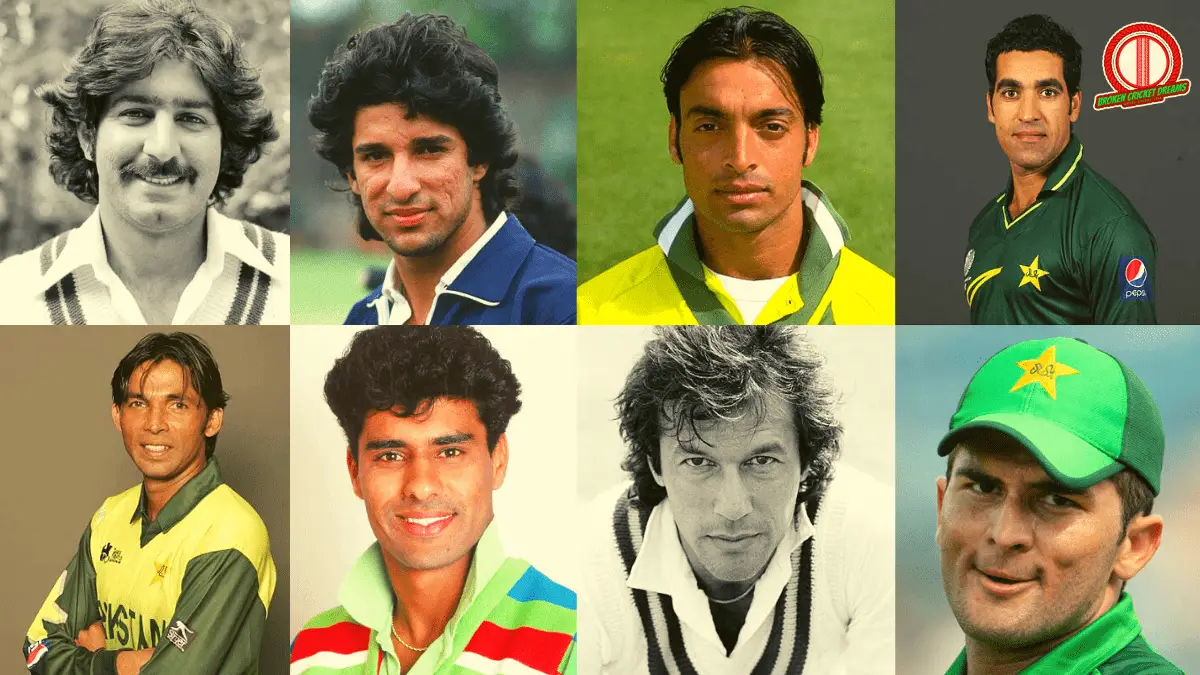
Wasim Akram (916), Waqar Younis (789), Imran Khan (544), Shoaib Akhtar (438), and Umar Gul (427) are the Top 5 wicket-takers in Pakistan cricket history across formats.
Here is the complete list of the most wickets by Pakistani fast bowlers or medium pacers – all formats combined (Test/ODI/T20I).
Top 35 List of Greatest Pakistan Fast Bowlers (Ranked)
Some aspects we considered while ranking these bowlers were (1) longevity, (2) Test match impact, (3) World Cup heroics, (4) other international match-winning performances, and (5) pace/talent/swing.
The New Generation: Up and Coming Pakistani Fast Bowlers
First up, we begin with the youth of Pakistan. These youngsters will inevitably rise up the list in the future, but for now, we are putting them here.
*Note: Youngsters like Shaheen Shah Afridi & Naseem Shah are further down below since they have already taken more than 100 international wickets in their short careers.
1975 ODI WC: Asif Iqbal,Sarfraz Nawaz, Imran Khan, Naseer Malik, Asif Masood, Pervez Mir
1979 ODI WC: Asif Iqbal, Sikander Bakht, Imran Khan, Mudassar Nazar, Hasan Jamil
1983 ODI WC: Imran Khan, Mudassar Nazar, Rashid Khan, Sarfraz Nawaz, Shahid Mahboob, Tahir Naqqash
1987 ODI WC: Imran Khan, Manzoor Elahi, Saleem Jaffar, Wasim Akram
1992 ODI WC: Imran Khan, Aaqib Javed, Wasim Akram, Wasim Haider
1996 ODI WC: Wasim Akram, Aaqib Javed, Ata-ur-Rehman, Waqar Younis
1999 ODI WC: Wasim Akram, Waqar Younis, Azhar Mahmood, Abdul Razzaq, Shoaib Akhtar
2003 ODI WC: Waqar Younis, Abdul Razzaq, Azhar Mahmood, Mohammad Sami, Shoaib Akhtar, Wasim Akram
2007 ODI WC: Azhar Mahmood, Mohammad Sami, Naved-ul-Hasan Rana, Rao Iftikhar Anjum, Umar Gul, Yasir Arafat
2011 ODI WC: Abdul Razzaq, Shoaib Akhtar, Umar Gul, Wahab Riaz, Junaid Khan (replaced Sohail Tanvir)
2015 ODI WC: Wahab Riaz, Sohail Khan, Rahat Ali (Junaid Khan Withdrawn), Mohammad Irfan, Ehsan Adil
2019 ODI WC: Hasan Ali, Mohammad Amir, Mohammad Hasnain, Shaheen Shah Afridi, Wahab Riaz
T20 World Cup
2007 T20 WC: Iftikhar Anjum Rao, Mohammad Asif, Sohail Tanvir, Umar Gul, Yasir Arafat
2009 T20 WC: Rao Iftikhar Anjum (replaces Shoaib Akhtar), Mohammad Amir, Sohail Tanvir, Umar Gul, Yasir Arafat (replaces Abdul Razzaq)
2010 T20 WC: Abdul Razzaq, Mohammad Amir, Mohammad Asif, Mohammad Sami, Hammad Azam
2012 T20 WC: Yasir Arafat, Umar Gul, Abdul Razzaq, Mohammad Sami, Sohail Tanvir
2014 T20 WC: Bilawal Bhatti, Junaid Khan, Mohammad Talha, Sohail Tanvir, Umar Gul
2016 T20 WC: Anwar Ali, Mohammad Amir, Mohammad Irfan, Wahab Riaz, Mohammad Sami
2021 T20 WC: Shaheen Shah Afridi, Hasan Ali, Haris Rauf, Mohammad Wasim Jr., Shahnawaz Dahani (Reserve)
2022 T20 WC: Shaheen Shah Afridi, Mohammad Hasnain, Haris Rauf, Naseem Shah, Mohammad Wasim Jr., Shahnawaz Dahani (Reserve)
Final Thoughts
We have all heard the phrase, “Pace is pace.”
Pure pace can wreak havoc for the opposition teams while providing moments of beauty for the audience.
Pakistan cricket has been a blessing to the cricketing world due to the fast bowlers talent they produce. It was Sarfraz Nawaz & Imran Khan early on, Fazal Mohammad & Khan Mohammad even earlier. The trio of Wasim Akram-Waqar Younis-Shoaib Akhtar took the legend of Pakistani fast bowling to new heights.
Each generation since, Pakistan continues to find raw talent like Shaheen Shah Afridi, Haris Rauf, and Naseem Shah today, and I hope they continue to produce such gems for years to come.
Frequently Asked Questions (FAQ) – Greatest Pakistan Fast Bowlers
Why does Pakistan produce so many fast bowlers?
Pakistan produces so many fast bowlers due to their cricketing culture. In the early days of Pakistan Test cricket, the likes of Fazal Mahmood, Mahmood Hussain, and Khan Mohammad set the tone. This was taken to another level by the duo of Imran Khan & Sarfraz Nawaz and then solidified in their cricketing DNA by Waqar Younis and Wasim Akram.
Who are some of the most famous fast bowlers from Pakistan?
Sarfraz Nawaz, Imran Khan, Wasim Akram, Waqar Younis, Shoaib Akhtar, Mohammad Asif, Umar Gul, Shaheen Shah Afridi, Mohammad Amir, and Wahab Riaz are some of the most famous fast bowlers from Pakistan.
Which bowlers have taken the most wickets in Pakistan cricket history?
Wasim Akram (916), Waqar Younis (789), Imran Khan (544), Shoaib Akhtar (438), and Umar Gul (427) have taken the most wickets in Pakistan cricket history across formats.
Who has taken the greatest number of wickets in the Cricket World Cup (ODI)? Here’s a quick preview: Glenn McGrath has taken the most ODI World Cup wickets (71). Both McGrath & Mitchell Starc have dominated World Cup bowling from every measure.
The World Cup is closer than it appears. Less than 30 days to go for the 2023 Cricket World Cup now, can you believe it?
So, let’s dive right in and find out all about the greatest World Cup wicket-takers.
ODI Cricket World Cup Wicket Takers – By the Numbers
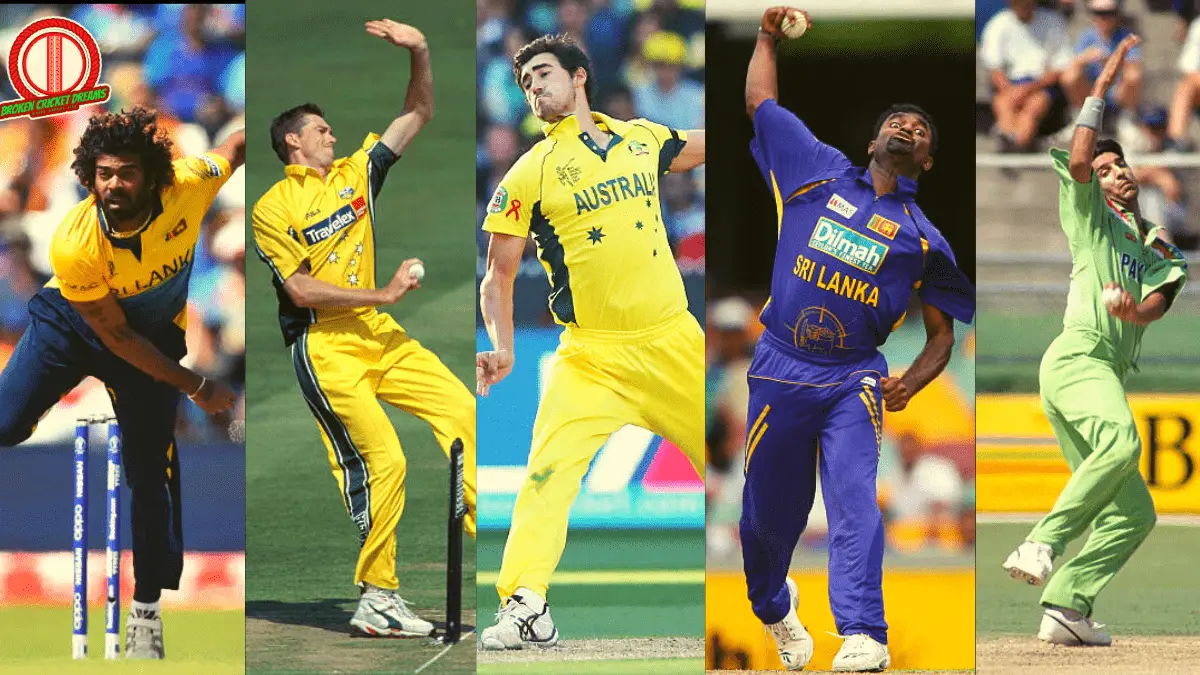
The top 5 wicket takers in the ODI Cricket World Cup (CWC) are Glenn McGrath (71), Muttiah Muralitharan (68), Lasith Malinga (56), Wasim Akram (55), and Mitchell Starc (49).
From the Top 20 wicket-takers in the ODI CWC, nations most represented are as follows: Australia (5), New Zealand (4), Sri Lanka, Pakistan (3), South Africa, India (2), and Bangladesh (1). Surprisingly, the West Indies do not make the Top 30 in this list.
Mitchell Starc has the best average (14.81), bowling strike rate (19.12), and most occurrences of 4 wickets or more (6: 3 – 4-fers, 3 – 5-fers). On the other end of the spectrum, Shakib Al Hasan has the worst average (35.94) and strike rates (42.14).
The best figures from this group of 20 are Glenn McGrath (7/15), Tim Southee (7/33), Chaminda Vaas (6/25), Mitchell Starc (6/28), and Lasith Malinga (6/38). Note that Shane Bond also has World Cup figures of 6/23, but his overall wicket tally of 30 ranks him at #26 in this list.
Mitchell Starc (49), Trent Boult (39), Tim Southee (34), and Shakib Al Hasan (34) are the only active players still in this list who are expected to play in the 2023 ODI World Cup.
The ODI Cricket World Cup: Who Has Taken the Most Number of Wickets?
Honorable Mentions: Shane Warne – 32, Chris Harris – 32, Mohammad Shami – 31, Anil Kumble – 31, Shaun Pollock – 31, Shane Bond – 30, Ian Botham – 30, Shoaib Akhtar – 30, and Shahid Afridi – 30.
Final Thoughts
Although these players have taken the greatest number of wickets in the Cricket World Cup, but more than the numbers, they have given us plenty of memories to remember them by.
Think Wahab Riaz vs Watson, Chaminda Vaas’s hat-trick, Boult vs Starc at Eden Park, Wasim Akram in the final, that Shane Bond spell, Imran Tahir’s celebrations, and much more.
I will leave you with this question for the 2023 ODI World Cup is, “Can Mitchell Starc break the World Cup record for the most wickets?”Comment below!
The top 5 wicket takers in the ODI Cricket World Cup (CWC) are Glenn McGrath (71), Muttiah Muralitharan (68), Lasith Malinga (56), Wasim Akram (55), and Mitchell Starc (49).
Frequently Asked Questions (FAQ) – Most Number of Wickets in the Cricket World Cup
Who has taken the most wickets in World Cup?
Glenn McGrath (71), Muttiah Muralitharan (68), Lasith Malinga (56), Wasim Akram (55), and Mitchell Starc (49) have taken the most number of wickets in the Cricket World Cup.
How many World Cup wickets does Mitchell Starc have?
Mitchell Starc has taken 49 ODI World Cup wickets from just 18 matches. He boasts an absurd bowling average of 14.18 & strike rate of 19.12. He has taken 4-wickets thrice and 5-wickets thrice as well.
Can Mitchell Starc break the World Cup record for the most wickets?
Yes he can. If he is fit and plays in all the games on India’s pitches, then he can take 23 wickets to break Glenn McGrath’s record of 71 wickets. In case Australia reaches the final, he may have as many as 11 matches to break the World record (otherwise, he can play a maximum of 9 matches in the group stage).