
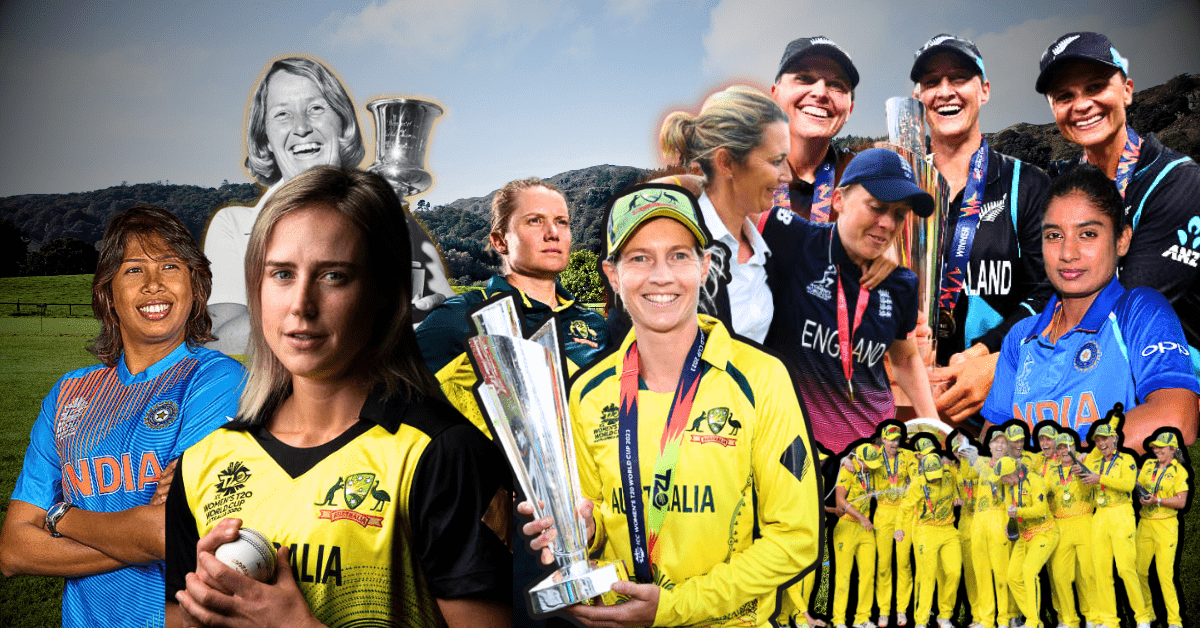
How far ahead is the Australian women’s cricket ecosystem compared to the rest of the world?
In the ongoing Women’s ODI World Cup, Australia were 76/7 against Pakistan, and for a moment, it seemed that the favorites might fall.
An upset brewing? #ICCWomensWorldCup2025
— Harsha Bhogle (@bhogleharsha) October 8, 2025
But in true Australian fashion, Beth Mooney’s magnificent century, Kim Garth grit at #9, and Alana King’s fiery 51* turned it into a 107-run victory. Earlier, Ash Gardner had rescued them with 115 (83) from #6 and later repeated the feat alongside Sutherland against England.
Add seven ODI and six T20 World Cup victories, the picture is clear: What other nations have built in the last five years, Australia have been perfecting for over 50.
How far behind are the rest, and can we actually quantify the health of women’s cricket across the top nations?
Let’s find out.
Key Takeaways
- Australia ($19.56 M), England ($15.02 M), India ($2.37 M), and New Zealand ($2.27 M) spend the most on women cricketers’ salaries (both central contracts and domestic combined).
- Cricket Australia aims to generate $121 million in revenue alone from women’s cricket by 2024. On the other hand, nations like South Africa, Ireland, and Bangladesh are just now starting to professionalize domestic cricket.
- Despite leading women’s cricket in pay, Australian women still earn far less than the men: $139,719 AUD vs $951,046 AUD in 2023–24 average retainer value.
Table of Contents
- Theory on Economics in Women’s Cricket
- Australia
- England
- New Zealand
- India
- South Africa
- West Indies
- Ireland
- Pakistan
- Bangladesh
- Sri Lanka
- Other Nations
- Final Thoughts
Also Read: Who Can Still Afford to Host Test Cricket in 2025?
How I Assessed Cricket Boards’ Financial Commitment and Long-Term Vision for Women’s Cricket
To understand the full picture of each cricket board’s investment in women’s cricket, I examined the following factors for the top women’s cricket boards:
- Long-term investment in girls’ and women’s sports
- Salaries of centrally contracted players
- Number of contracted female players (both international & domestic)
- Performance in ICC tournaments*
- Socioeconomic indicators. These include UN/WHO metrics such as
- Female Labor Force participation: % of women actively employed or seeking work
- Female Literacy Rate: Share of women who can read and write at a certain level
- Global Inequality Index: Measures income and opportunity gaps affecting women
- Women, Peace, & Security Index (WPSI): Assesses women’s safety, inclusion, and empowerment
After analyzing these factors, I grouped the nations into five categories:
- 🟢 Strongly Invested: Australia, England
- 🟡 Progressing: New Zealand, India
- 🟠 Transitioning from amateur to professional: South Africa, Ireland, West Indies, Bangladesh, Sri Lanka, Pakistan
- 🟣 Emerging: Scotland, Zimbabwe
- 🔴 At Risk: Afghanistan
*Includes the 2022 Commonwealth Games along with 13 ODI World Cups and 9 T20 World Cups.
My Theory on Women’s Economics in Cricket
In the The Economics of Sport Dominance article, I theorized how a nation evolves from a single-nation sport into a multi-nation and Olympic dominating nation based on GDP per capita, Global Hunger Index, and poverty rate.
We can apply a similar framework to women’s sports. For a nation to rise in women’s sport, certain base needs must be met: A female literacy rate of at least 60-80%, female labor force participation rate above 40-50%, and no government restrictions on women (unlike Afghanistan).
7 Steps of Achieving Sustainability in Women’s Cricket
Once these prerequisites are achieved, a cricket board typically progresses through seven steps:
- Professionalize the Base: Create contracts, domestic leagues, and comprehensive player support to elevate ‘amateur’ players, allowing them to focus on cricket rather than juggling other jobs.
- Have a Catalyst Moment: A breakthrough win or tournament performance that sparks interest (ex: India’s 2017 ODI World Cup run).
- Institutionalize Momentum: Build grassroots pathways and scholarship programs to build on the momentum from the initial spark.
- Build Systems: Invest in coaching, leadership, administration as well as grown fans of women’s cricket and increase sponsorships.
- Deepen Talent Pool: Expand local tournaments, scouting networks to increase depth so women’s cricket does not only depend on one ‘golden generation’.
- Expand International Exposure and Raise Standards: Create domestic T20 league, invest in emerging, A, and U-19 tours, and raise standards for new batch of players.
- Achieve Profitability and Re-invest: At this stage, both the talent pool and the audience have matured. Domestic leagues, sponsorships, TV rights are set. Money is flowing in and being re-invested into local talent and systems built earlier, which outputs in increased depth and better tournament performance.

Top 10 Richest Women Cricket Boards (By Overall Salary)
Alright, now time for the reveal.
Here are the cricketing nations ranked loosely by estimated salaries for women’s cricketers (central contracts and domestic cricketers combined). We also look at investment trajectory, strategic vision, and recent grassroots development.
Note: Salaries and match fee information of some emerging nations were not available. Also, Women CPL salary information was not publicly available, so they are not used for this analysis.
1. Australia ($19.56 million)
Women’s Cricket Health: 🟢 Exceptionally Strong
10-Year Investment Trajectory: Grow women’s cricket revenue $21M AUD ($13.66M USD) to $121M AUD ($78.72M USD) by 2034.
Central & Domestic Contracts
| Category | Central Contracts | Domestic State Contracts |
| Average Salary* | $333,333 AUD ($216,873 USD) excluding match fees | $120,000 AUD ($78,074 USD) incl. WNCL, WBBL, match fees |
| Maximum Salary | $800,000 AUD ($520,495 USD) $500,000 AUD ($325,000 USD) for next 6 | $163,322 AUD ($106,260 USD) |
| Number of Players | 18 central contracts | 131 across 7 teams (including the 18 central) |
| Match Fees | $2,000 AUD/match day | Included in average |
- 1 $AUD = $0.65 USD, WNCL – Women’s National Cricket League, WBBL – Women’s Big Bash League
Highest Paid WPL Australian Player Breakdown: In 2024, Ash Gardner earned an estimated $831,951 USD (or $1.28 million AUD) annually across WPL ($380,000 USD), The Hundred ($86,613), central contract/WBBL ($325,000), and match fees ($40,338 USD/$62,000 AUD), not including awards, bonuses, or sponsorships.
She played 31 days of international cricket: 1 Test (3 days), 12 ODIs, and 16 T20Is in 2024.
Australia’s Women’s Socioeconomic Metrics
- Female Labor Force Participation: 61.7%
- WPSI: 0.902 (#11)
- Female Literacy Rate: 99%
- Gender Inequality Index: 0.056 (#20)
Do they have a T20 league? Yes, WBBL.
Tournament Performance: 19/23 (14 Wins, 5 Runners-Up)
Bottom Line: Australia’s high socioeconomic index and investment in women’s cricket is unparalleled, directly translating into high salaries, strong grassroots participation, team depth, and World Cup success.
Potential Challenges: Australia are in a unique place, culturally. They have an abundance of sports culture and women in sports. Hence, the main challenge I see for Australia is retaining cricket as the #1 sport for young girls aspire to pick up.
Embed from Getty Images2034 Strategic Vision (Women and Girls Action Plan 2024-34)
Australia’s vision for girls’ and women’s cricket is divided into 3 phases:
- Horizon 1 (2024-27): Accelerate participation.
- Horizon 2 (2027-30): Establish cricket as a sport of choice for women and girls.
- Horizon 3 (2030-34): Become Australia’s leading women’s sport by revenue, team performance and pay.
2034 Targets
- Girls (5-12) Participation → 100,000 (from 25,000 currently)
- Average women’s match attendance → 600,000 (from 110,000)
- 80% of women’s matches telecasted in primetime
- 40% of women in leadership roles
- $500 million AUD invested in infrastructure
- Revenue from women’s cricket → $121M AUD (from $21M)
Quotes from Action Plan and Annual Report
“…some of our girls who are playing in India earn significant amounts of money in the WPL, and on top of this deal now, they will become million-dollar athletes. And so they should because they’re the best in the world at what they do.“
-Todd Greenberg, CEO Australia Cricketers’ Association
“We are also exceptionally proud that following the last MOU, our elite players are by far the highest paid female team sport athletes in Australia.”
Investment & Grassroots Growth
- Registered women/girls: 47,000 → 80,000 (2014-24)
- 2023-24 season: +18% to 93,091 registered players, including 44% rise in school competitions
- ~$100M AUD ($65 M USD) invested in facilities over last 10 years.
- CommBank’s Growing Cricket for Girls Fund supported 4,408 girls aged 5-18
- Weber WBBL: Most-watched sports league in Oct-Nov.
How we estimated salaries for Australian women cricketers
We estimated the average salary for an Australian contracted player as follows:
- According to the 2023–28 MOU, the average retainer for centrally contracted women’s cricketers was $139,719 AUD, which rose ~8% to $150,897 AUD the next year.
- Adding the estimated average WBBL salary of $48,800 AUD brings most players’ total earnings to about $200,000 AUD.
- When accounting for top earners, the squad-wide average rises to roughly $333,000 AUD, with the top player at $800,000 AUD and the next six around $500,000–$600,000 AUD.
Sources
- Women and Actions Girls’ Plan 2024-34
- $160K new deal for state contracted players, 25% Hike, Sydney Article, Equal Match Fees
- CA signs new five-year MoU in massive pay boost for female cricketers, Australian cricket set to break $100K minimum wage barrier for female barriers
- Australian Women State Squads 2025-26
Also Read: What is the Salary of women cricketers in the WBBL in Australia?
Embed from Getty Images2. England ($15.02 Million)
Women’s Cricket Health: 🟢 Exceptionally Strong
5-Year Investment Trajectory: The ECB plans to invest £20-25 Million ($27-33M USD) annually in women’s cricket by end of the decade.
Central & Domestic Contracts
| Category | Central Contracts | Domestic State Contracts |
| Salary Range | £90,000-£130,000 ($118,600-$171,250) | Minimum (Tier 1): £33,333 Average (Tier 1): £53,333 |
| Number of Players | 20 17 Central 3 Development | 270+ across 18 teams 120+ Tier 1 players (8 Counties) 150+ Tier 2 players (10 Counties) |
| Match Fees | £12,500 (Test) £5,000 (ODI) £3,500 (T20I) | N/A |
Tier 1 counties include Durham, Essex, Hampshire, Lancashire, Nottinghamshire, Somerset, Surrey, and Warwickshire with Yorkshire to join in 2026 and Glamorgan in 2027.
- £1 = $1.33 USD
- The salary cap for Tier 1 counties is £500,000-£800,000, and a minimum of 15 contracted players are required for each Tier 1 county. The average domestic salary otherwise is £25,000, with £28,000 for senior pro level and £20,000 for Rookie level.
- Note: Although 270+ players play across the domestic system, only 153 are supported by official domestic contracts.
Highest Paid WPL England Player Breakdown: England captain Nat Sciver-Brunt earns around $931,978 annually excluding sponsorships, match awards and bonuses:
- $426,000 (£320,000): WPL
- ~ $173,077 (£130,000): England central contract
- $187,722 (£141,000): Match fees (2024: 2 Tests, 12 ODIs, 16 T20Is)
- $86,539 (£65,000): The Hundred
- ~ $58,640 ($90,000 AUD): WBBL, Gold
England’s Women’s Socioeconomic Metrics
- Female Labor Force Participation (UK): 57.3%
- WPSI: 0.860 (#26)
- Female Literacy Rate: 99%
- Gender Inequality Index: 0.083 (#31)
Do they have a T20 league? Yes, The Women’s Hundred.
Tournament Performance: Number of ICC Trophies/Commonwealth: 17/23 (5 Wins, 12 Runners-Up)
Bottom Line: England’s women’s cricket is thriving. From leading the charge in the equal pay movement & the Women’s Hundred revolution to investing in domestic cricket & nationwide grassroots push, women’s cricket is in good place in England.
Potential Challenges: Although England has invested in the grassroots level, their social progress has not directly translated into tournament wins. Increasing salaries in the Women’s Hundred and increasing the standard of domestic cricket will hopefully lead them to create dominance like the Australian dynasties.
Embed from Getty ImagesTargets & Forecasts
Domestic Investment
- +£19M per year investment in women’s domestic cricket by 2027.
- +£25M investment annually above forecasted revenues by 2029.
Equity Commitments (ICEC Report 2023)
The 2023 Independent Commission for Equity in Cricket (ICEC) recommended the following:
- Equal match fees for men and women ✅ (implemented in 2023)
- Equal domestic pay by 2029
- 100% equal international salary parity by 2030
- Other Recommendations: Parity in Hundred salaries, captain’s allowances, win bonuses, introduction of Rookie Contracts, merit-based and inclusive talent pathway, financial aid, and more
Investment & Grassroots Growth
- £1.2 million invested in a network of 100 Cricket Development Officers
- Core City Hubs Programme: 285 hubs across 13 cities, engaging 30,000 players including 9,000 women and girls
- £3.7M public funding from ESC Lottery fund, of which £850,000 was allocated for for Tacking inequality – Womens and Girls and £101,000 for “Female Talent Pathway”
Participation & Engagement (2023)
- 20% growth in women’s and girls’ teams from 2022 to 2023.
- 717 new women’s & girls’ teams
- 26,752 girls participated in Stars and Dynamos
- 7.4 million total audience for women’s cricket across formats
- 140% increase in women’s international (122,000) and 167% increase in viewership of Women’s Test
- 349,401 attended the 2025 The Women’s Hundred
- +3000 bursaries (scholarships) to “enable individuals, especially women, ethnically diverse individuals, and disabled people, to qualify as coaches.”
- 538% increase in women’s professional players from 2020 to 2025
Quotes from PCA Women Impact Report
“For years I had a full-time job alongside playing top level domestic cricket as an amateur. The progress made in the past five years has been astounding…”
-Eve Jones, Lancashire
“A key priority for the players was agreeing a maternity policy which supports those wishing to start a family whilst still playing the game. The ECB were supportive of the policy and in 2025 now provide a fully paid maternity leave period of up to 12 months, with a 12-month contract extension for players returning from maternity leave.”
How We Estimated Salaries for England women cricketers
- 120 Tier 1 players * £53,333 average = £6,399,960
- 150 Tier 2 players × £20,000 = £3,000,000
- 20 central contracts × £110,000 = £2,200,000
- Subtract overlapping County pay (20 * £53,333)
- Adding everything up, England spends about £11,283,300 on player salaries, or about $15.02 million.
Sources
- ECB – Impact of Cricket Report, 2024/25 Financial Statements, 2023 ICEC Report, PCA Women’s Cricket Impact Report
- England Female Pay Increases – The Guardian, County Cricket Salary increases – BBC, Basic Salary Equality – Cricinfo
- Match Fees – The Cricketer, Equal Pay – Daily Star
- The Hundred Salary Bands, Centrally Contracted Players, Women’s Hundred Salary Boost – ESPNCricinfo
Also Read: What is the Salary of women cricketers in The Hundred (Women’s) in England?, How Much Debt Does Each County Owe?, I Read Every County Cricket Club’s Financials—Fascinating Revelations!
3. New Zealand ($2.27 Million)
Women’s Cricket Health: 🟡 Financially Improving, fewer resources
5-Year Investment Trajectory: NZC short-term focus is on developing young cricketers and increasing financial sustainability with TV rights and free-to-air opportunities for women’s cricket.
Central & Domestic Contracts
| Category | Central Contracts | Domestic State Contracts |
| Average Salary* | $152,796 NZD ($87,859 USD) | $18,646 NZD ($10,722 USD) |
| Maximum Salary | $163,246 NZD ($93,868) | $19,146 NZD ($11,009 USD) |
| Number of Players | 17 | 72 players across 6 teams |
| Match Fees | $85,700 NZD* (included in salary) | $13,750 NZD* (included in salary) |
- $1 NZD = $0.58 USD
- The salary for the Rank 1 player breakdown: $63,000 (Retainer), $85,700 (Match Fees), $6,750 (CPPT), $6,300 (Retirement Fund), Insurance ($1,496)
- Match fees and CPPT is the same for all White Ferns contracts; only retainer and retirement fund fluctuate by ranking
- CPPT: Cricket Players’ Property Trust
- Match Fees Includes:
- $10,250 (Test – which White Ferns have not played for 20+ years)
- $4000 (ODI), $2500 (T20I)
- $800 (Domestic ODI), $575 (Domestic T20)
Highest Paid New Zealand WPL Player breakdown: Amelia Kerr earns about $435,755 annually excluding bonuses, match awards, and sponsorships. In 2024, she earned around $582,960 with the 2024 T20 WC prize money.
- $192,000: WPL
- $147,203 ($256,000 NZD): 2024 T20 World Cup prize money
- $86,539 (£65,000): The Hundred
- $85,545 ($148,946 NZD): Salary (retainer + match fees)
- ~ $71,671 ($110,000 AUD): WBBL, Platinum
Kerr played in 9 ODIs and 21 T20Is in 2024.
New Zealand’s Women’s Socioeconomic Metrics
- Female Labor Force Participation: 66.9%
- WPSI: 0.904 (#10)
- Female Literacy Rate: 99%
- Gender Inequality Index: 0.082 (#30)
Do they have a T20 league? No.
Tournament Performance: 8/23 (2 Wins, 6 Runners-Up)
Bottom Line: The 2024 T20 World Cup win boosted the White Ferns, and they have recently focused on developing grassroots cricket. However, compared to the Big 3, they do not have nearly as much participation in girls cricket or financial investment in women’s cricket.
Potential Challenges: As the senior pros head towards retirement, NZ need to focus on increasing their talent depth. They do well with the resources they currently have, but risk falling behind with the lack of resources.
Embed from Getty ImagesEquity Commitments
The landmark agreement between NZC, New Zealand Cricket Players Association (NZCPA), and Major Associations in 2022 yielded the following:
- Equal match fees for men and women on the same day
- Player payments based on 29.75% of NZC’s projected commercial revenue over 5 years (NZ$349m), expected to total NZ$104M.
- Prioritizes growth in participation of women and girls, leveraging free-to-air TVNZ coverage.
“At domestic level we increased the number of women’s annual contracts awarded by 30% to further invest in the development of our pipeline…As a result, cricket is becoming the most attractive professional sport in the country for young female athletes…The 15-strong squad who contested the World Cup final received circa NZ$256,000 in prize money each, on top of their annual retainers and match fees.”
Investment & Grassroots Growth
- Average Live Audience for White Fern matches → 190,000 in 2020/21 (from 31,000 in 2016/17)
- Around 821,000 people watched at least one of 20 Women’s Super Smash matches
- Youth & Grassroots Programs: ‘Girls Smash’ (7-13), ‘Yeah! Girls’ (10-17)
- In Otago alone, about 124 teams of girls took place in Girls Smash. Wellington, Marlborough, and Canterbury followed with over 1,000 girls involved now.
- Around 43,596 females participated in 2020-21 before the Covid-19 dropoff to 26,321 the next year
- Aspiring Female Umpire & Pathway to Performance Programs: 20 coaches/umpires trained in 2023-24, 12 women promoted to Head or Assistance Coach roles in the 2024 National U-19 Women’s Tournament, 15 new female coaches developed through Cricket Wellington Women & Girls Coaching Course
- Female Leadership Initiatives: Leadership Development Contestable Fund, other leadership programs for women and girls
How We Estimated Salaries for White Ferns central contracts:
- NZC lays out the salary bands of players based on different rankings:
- Rank 1 – $163,246
- Rank 9 – $148,946
- Rank 17 – $142,346
- However, it does not layout the rankings in the middle so we take the average between the highest and lowest for this average: ($163,246+$142,346)/2 = $152,796.
- Combining both domestic and central contracts, NZCricket spends around $2.27 million on player salaries
- ($152,796 * 17) + ($18,646 * 72) = $3,940,044 NZD ($2,265,565 USD)
Sources
- 2023-24 Annual Report, Women and Cricket 2022 Report, 5-Year Strategic Plan
- 2024 T20 World Cup – $2.3 Million Prize Money
- Equal Match Fees – Cricinfo, White Fern Contract List, Amelia Kerr WPL
Also Read: Universe Conspires to Fulfill Devine’s Destiny
4. India ($2.37 Million)
Women’s Cricket Health: 🟡 Financially Stable, Lacking Vision
10-Year Investment Trajectory: BCCI spends around $10-11 million per-year on women’s domestic cricket, which means they will spend more than $100M in a 10-year cycle on women’s cricket.
Central & Domestic Contracts
| Category | Central Contracts | Domestic State Contracts |
| Average Salary | 22,50,000 INR ($25,628) | 191,441 INR* ($2181) |
| Maximum Salary | 50,00,000 INR ($56,932) | N/A |
| Number of Players | 16 | 1072 across 31 teams |
| Match Fees | 15,00,000 INR (Test) 6,00,000 INR (ODI) 3,00,000 INR (T20I) | 20,000 INR/match 10,000 INR (bench) |
- 1 INR = $0.01 USD ($1 = 87.8 INR)
- Salary Grades: 50 Lakh (Grade A), 30 Lakh (B), 10 Lakh (C)
Highest Paid Indian WPL Player breakdown: Smriti Mandhana earns about $757,420 annually before sponsorships, match awards, or bonuses.
- $387,138 (3.4 Crore INR): WPL
- $184,460: Match Fees (In 2024, Mandhana played 1 Test, 13 ODIs, and 23 T20Is).
- $86,539 (£65,000): The Hundred
- $56,932: Central Contract
- $42,351 ($65,000 AUD): WBBL, Silver
India’s Women’s Socioeconomic Metrics
- Female Labor Force Participation: 32.8%
- WPSI: 0.595 (#128)
- Female Literacy Rate: 65.8%
- Gender Inequality Index: 0.403 (#102)
Do they have a T20 league? Yes, WPL.
Tournament Performance: 4/23 (0 Wins, 4 Runners-Up)
Bottom Line: As the financial powerhouse of world cricket, India is pouring money into the WPL and have thousands of women cricketers playing in the domestic circuit. However, there seems to be a lack of longterm vision and systemic grassroots growth.
Potential Challenges: India’s main challenge will be navigating an evolving socioeconomic landscape and create a better cricket infrastructure for more girls to participate.
Embed from Getty ImagesWomen Premier League (WPL) and Domestic Tournament Financials
Note: The next little bit is just finances. Feel free to scroll down to Jay Shah’s tweets or South Africa section.
Surplus form WPL 2023: 377.50 Crore INR ($42,984,000)
Income (682.61 Crore INR – $77.7 Million)
- Media Rights Income: 162.15 Crore INR
- Franchise Consideration: 467.00 Crore INR
- Sponsors: 48.17 Crore INR
- Ticket Sales: 5.29 Crore INR
WPL Expenses (305.11 Crore INR – $34.7 Million)
- League Expenses: 38.46 Crore, Payments to Franchises/Rights: 141.08 Crore, Prize Money: 20.25 Crore
- Match Expenses: 6.70 Crore, Medals/Balls/Kits/Clothing: 1.93 Crore, Consultancy Fees: 1.91 Crore
- Opening/Closing Ceremony: 27.17 Crore , Administrative/Other Expensive: 54.95 Crore, Security: 8.84 Crore
Women’s Domestic Expenses (89.82 Crore INR – $10.2 Million)
- Women’s International Tours
- Australia Women’s Tour to India: 15.53 Crore, England W tour to India: 9.39 Crore
- England A Women’s tour: 1.98 Crore
- Women’s Emerging Asia Cup: 1.7 Crore, Women’s Tour to Bangladesh: 5.91 Crore, Women’s Asian Games: 2.22 Crore
Note: According to Times of India, about 96 Crore INR is budgeted for women’s domestic cricket in the 2025/26 BCCI budget. We have not been able to find the BCCI budget, but it is close to the 89.82 Crore INR from BCCI’s 2023/24 annual report.
Strategic Vision
Apart from match fees pay equity and annual financial reports, I did not find any strategic visions or 5 to 10-year plans from BCCI like Australia, England, or New Zealand have neatly presented.
Hence, I looked at Jay Shah’s tweets to see his vision for women cricket and grassroots development in India.
Hosting the @ICC @cricketworldcup in India enables us to have a significant impact at the grassroots level.
— Jay Shah (@JayShah) November 4, 2023
My sincere thanks to @DP_World, who share our vision of promoting the game and empowering women's cricket. As part of the Beyond Boundaries Initiative, 250 kits were… https://t.co/D1oWXNWuQ3
Test cricket remains the pinnacle of the game, and I am dedicated to preserving its stature while enhancing its appeal to fans. Simultaneously, women's cricket will be a cornerstone of our growth strategy as we take the sport to new horizons.
— Jay Shah (@JayShah) December 1, 2024
Women’s Cricket in India is on the upswing and the World Cup triumph has taken the stature of women’s cricket several notches higher. I am delighted to announce INR 5 crore for the entire team and support staff as prize money. This is surely a path-breaking year.
— Jay Shah (@JayShah) January 29, 2023
In a historic stride for Indian cricket, Jacintha Kalyan has become the trailblazing pioneer as the first female cricket pitch curator in our nation. 🙌 Taking the helm of pitch preparation for the inaugural leg of the Women's Premier League in Bengaluru, Jacintha embodies the… pic.twitter.com/AVqLondy77
— Jay Shah (@JayShah) February 27, 2024
After pay equity, today's bidding for media rights for Women's IPL marks another historic mandate. It's a big and decisive step for empowerment of women's cricket in India, which will ensure participation of women from all ages. A new dawn indeed! #WIPL @ICC @BCCIWomen
— Jay Shah (@JayShah) January 16, 2023
How We Estimated Average Domestic Indian Women Cricket Salaries
- There are two major tournaments: Senior Women’s T20 Trophy and Senior Women’s ODI Trophy. In both tournaments, teams play about 7 matches in group-stages and can further qualify to pre-quarters, quarters, semi-finals, and finals.
- 1072 women cricketers are named in the Senior Women T20 Squad for the 31 teams, averaging 34.58 players per team. This means 11 players will play each match and about 23.6 players will be on the bench.
- Playing XI earns 20,000 INR: 11 * 20,000 = 220,000. Bench earns 10,000: 23.6 *10,000 = 236,000
- Hence, each team pays their players about 456,000 INR per match on average.
- If teams do not qualify, the tournament spend on salary is 456,000 * 14 = 6,348,000 INR. If qualifying teams play ~ 16 matches, the total is close to 7,296,000 INR. From the 31 teams, if 8 qualify and 23 do not, we can estimate the total cost as follows: (8*7,296,000) + (23*6,348,000) = 205,200,000/1072 = 191,441 INR per player per season.
- Overall, the BCCI pays its central contract holders about 3.6 Crore INR and about 20.5 Crore INR to its domestic players, for a total of 20.8 Crore INR (or $2.37 million total) excluding match fees for international players.
Sources
- 2023-24 Annual Report, Equal Match Fee, BCCI Annual Contracts, Domestic Pay – Cricinfo, WPL 2023
- Gulab Singh Cricket Team Story
Also Read: WPL23 Auction Takeaways
5. South Africa
Women’s Cricket Health: 🟠 Have vision, but in the process of professionalizing
Investment Trajectory: South Africa government investment 15M ZAR ($USD 869,000) in women’s cricket in the lead-up to the 2023 T20 World Cup and the U-19 T20 WC.
Central & Domestic Contracts
| Category | Central Contracts | Domestic State Contracts |
| Average Salary* | N/A | N/A |
| Number of Players | 15 | 68 (plus 17 high performance and academy contracts) |
| Match Fees | Test: $6,925 ODI: $1,900 T20I: $911 | N/A |
- 1 ZAR = $0.06 USD ($1 = 17.23 ZAR)
- Unfortunately, there is no publicly available information of how much the central contracts are worth for women’s cricketers in South Africa. The match fees is from ESPNCricinfo’s 2017 report and may be outdated. CSA now provides equal match fee for both their women’s and men’s cricketers.
Highest Paid South African WPL Player breakdown: Marizanne Kapp earns between $400,000-$480,000 annually before sponsorships, etc. Here is the breakdown:
- $170,800 (1.5 Crore INR): WPL
- $86,539 (£65,000): The Hundred
- ~ $71,671 ($110,000 AUD): WBBL, pre-signed
- ~ $51,226: Match Fees
- $20,000-$100,000: Central Contract
South Africa’s Women’s Socioeconomic Metrics
- Female Labor Force Participation: 53%
- WPSI: 0.688 (#91)
- Female Literacy Rate: 94.5%
- Global Inequality Index: 0.388 (#95)
Do they have a T20 league? No.
Tournament Performance: 3/23 (1 Wins, 2 Runners-Up)
Bottom Line: South Africa have produced world-class cricketers in the last few years, but women’s domestic cricket is just becoming professional. Hosting the 2023 T20 World Cup created a cycle of investment in women’s cricket according to the Nielsen report. They are now focusing on investing in women’s domestic and junior level cricket to complete the transition from amateur to professionalization.
Potential Challenges: Making the finals of the 2023 and 2024 T20 World Cups was no easy feat, but can they sustain the momentum once the golden generation retires?
Embed from Getty ImagesStrategic Goals
- Professionalize women’s cricket in South Africa
- Strengthen feeder systems with the Emerging Women’s Team.
Investment & Grassroots Growth
- Junior Women’s Teams grew from 191 → 204 over the last year.
- In 2023, CSA created a six-team professional domestic tournament, where at least 11 domestic players in each team would be contracted and have contracted coaches.
Excerpts from Integrated Report 2024/25
“…the continued professionalisation of the women’s game through the appointment of a permanent head coach marks a landmark achievement.“
-Rihan Richards, President (CSA)
“Focus on women’s cricket: Significant attention was given on advancing the growth and professionalisation of women’s cricket. The committee supported increased investment in domestic women’s structures, advocated for broader enhanced media coverage and commercial partnerships and the integration of former women players in strategic discussions, reflecting CSA’s commitment to transformation and gender inclusivity.”
Sources
- South Africa’s women’s team to get equal match fees as the men
- CSA Women’s Contracts, Domestic Contracts
- Professional Domestic League – Cricbuzz
6. West Indies ($1-2 Million)
Women’s Cricket Health: 🟠 Increasing Investments
10-Year Investment Trajectory: In 2023, CWI announced they would start significant investments in women’s cricket. For example, business class flights for long-haul travels and single rooms for international assignments were added to match the men’s team policy, adding $500,000 in budget alone.
Central & Domestic Contracts
| Category | Central Contracts | Domestic State Contracts |
| Average Salary* | $50,000-$100,000 | N/A |
| Number of Players | 15 (3 with multi-year contracts) | 14 (Women’s academy) |
| Match Fees | ODI: $2,300 T20I: $1,735 | N/A |
- *Note: The match fees reflects equal match fees, when it does come into effect, based on our estimates for Men’s match fees.
Highest Paid West Indian WPL Player breakdown: Deandra Dottin earned approximately $269,200 in 2023-24. She had retired from international cricket, so no salary estimate is added.
- $193,569 (1.7 Crore INR): WPL
- $42,351 ($65,000 AUD) – $71,671 ($110,000 AUD): WBBL
- $33,284 (£25,000) – 2023 Hundred
West Indies played about 7 ODIs and 16 T20Is in 2024, which could add an additional $43,860 in match fees for those who played on top of the central contract.
West Indies’ Women’s Socioeconomic Metrics
- Female Labor Force Participation: 62.9% (St. Lucia), 61.3% (Jamaica), 59.7% (Barbados), 49.7% (T & T), 40.3% (Guyana)
- WPSI: 0.779 #47 (Barbados), 0.769 #49 (Guyana), 0.721 #71 (T & T), 0.710 #77 (Jamaica)
- Female Literacy Rate: 99.6% (Barbados), 98.7% (T & T), 93.1% (Jamaica), 88.4% (Guyana)
- Global Inequality Index: 0.262 #69 (T & T), 0.297 #76 (Barbados), 0.358 #88 (Jamaica), 0.327 #82 (St. Lucia), 0.427 #109 (Guyana)
Do they have a T20 league? Yes. Women CPL.
Tournament Performance: 3/23 (1 Wins, 2 Runners-Up)
Bottom Line: Failure to qualify for the 2025 ODI World Cup marked a low note for the 2016 T20 World Cup winners and the 2022 ODI World Cup semi-finalists. The successes in the last decade would have inspired a new generation of players. Does the WI have systems in place to capitalize for this talent?
Potential Challenges: The need to widen talent pool and depth to match the dominance of Australia & England.
Embed from Getty Images“The MOU was signed by Cricket West Indies and the West Indies Players’ Association and set a clear path for West Indies cricket to achieve parity in international and regional match fees, international captain’s allowances, international team prize money and regional individual prize money for all West Indies cricketers by 1 October 2027.”
Goals
- “Establishment of Key Performance Indicators for Territorial Boards linked to new funding model with clear minimum standards including dedicated support for women and girls programmes and high-performance programmes.”
Sources
- 2025-26 Contracts, 2024-27 Strategic Plan
- Women Contracts, West Indies the latest team to commit to gender pay equality, Trinidad and Tobago Guardian
- Equal Pay by 2027
7. Ireland ($1.75 Million)
Women’s Cricket Health: 🟠 Increasing Investments, low resources
10-Year Investment Trajectory: Increased annual investment from €500,000 ($582,000) before 2019 to €1.5M ($1.75M). The investment will go towards player contracts and match fees, coaching and support staff, infrastructure, etc. In 10 years, about $15-20M can be invested in women’s cricket if they continue on this path.
Central & Domestic Contracts
- 25 contracts (11 central, 9 educational, 5 casual)
- Average Salary: $50,000-$75,000 (including match fees).
Highest Paid Irish WPL Player breakdown: Gaby Lewis was selected in The Hundred as an overseas wildcard in 2023, where salaries may be between £7,500-£15,000 ($10,000-$20,000). This means her annual salary that year could have been close to $60,000-$100,000.
Ireland’s Women’s Socioeconomic Metrics
- Female Labor Force Participation: 60.1%
- WPSI: 0.892 (#13)
- Female Literacy Rate: 99%
- Global Inequality Index: 0.054 (#19)
Do they have a T20 league? No.
Tournament Performance: 0/23
Bottom Line: With high socioeconomic indices, Ireland shouldn’t have trouble progressing to the next level of professionalization in women’s cricket. The next step is to find more players that can consistently be selected in overseas T20 leagues to raise their standards.
Potential Challenges: They are investing well for their size, but they also need to think about widening their talent pool.
Embed from Getty ImagesInvestment and Growth
- 45% increase in women’s cricket investment (from 2016 to 2021)
- 1,582 female cricketers registered across all levels
- Funding: Received €70,000 from Sport Ireland for 2024, with €103,038 total expenditure after carryover.
- Broadcast Boost: Virgin Media aired women’s internationals free-to-air for the first time; €60,000 allocated to televise the England series at Clontarf.
- Professionalization: Entry into the ICC Women’s Championship (2021) led to the first full-time contracts for women.
- Sponsorship: Certa renewed as main team sponsor.
Goals (by 2023)
- Get Cricket to be in top 10 choice of sports for girls in Ireland
- Achieve 50% increase in participation
- Develop talent pool of accredited female coaches and officials
Sources
- 2024 Financial Document
- Cricket Ireland Central Contracts, Women and Girls Cricket Action Plan
- Strategic Plan 2024-27
8. Pakistan
Women’s Cricket Health: 🟠 National investment in grassroots women’s cricket growing, the beginning of professionalization for women’s cricket in the country.
Investment Trajectory: Increased women cricket’s spending from 70M PKR ($249,000) to 240M PKR ($854,000).
Central & Domestic Contracts
| Category | Central Contracts | Domestic State Contracts |
| Average Salary* | $2,000-$12,500 | 420,000 PKR ($1,495) |
| Number of Players | 20 (18 central, 2 emerging) | 65 |
| Match Fees | N/A | 20,000 PKR/match 10,000 PKR (bench) |
- $1 = 281.04 PKR
- Currently, a domestic Pakistan player can play upwards of 31 days of cricket in a year
- The retainer salaries of Pakistan’s contracted players is not available. I’d expect it to be higher than their domestic salaries.
A number of players including Fatima Sana are in the upcoming WBBL draft. However, in the past, not Pakistan players have made it to the Hundred or WBBL teams.
Pakistan’s Women’s Socioeconomic Metrics
- Female Labor Force Participation: 24.3%
- WPSI: 0.481 (#158)
- Female Literacy Rate: 46.5%
- Global Inequality Index: 0.536 (#145)
Do they have a T20 league? No.
Tournament Performance: 0/23
Bottom Line: Pakistan have started domestic contracts, which is a step in the right direction. However, domestic pay is too low to encourage widespread growth at the moment.
Potential Challenges: Overcoming cultural and socioeconomic challenges to increase awareness and promote more girls taking up sports. Pakistan needs an inspiring tournament run to motivate a generation.
Embed from Getty ImagesHighlights from 5-Year Plan (2019-23)
In the 2019-23 5-Year Plan, the PCB laid out their vision as follows:
- Develop a National High Performance Center for women
- Build infrastructure and development programs for female coaches
- Ensure inclusion of women in reformed grassroots programs and integrate women’s cricket into the six Cricket Associations.
Pakistan’s 2025-26 domestic season includes tournaments for Women’s U-19 T20 Tournament, Inter-university tournaments, and National Women’s ODI and T20 tournaments signifying a step in the right direction.
“Our Pathways structure continues to evolve with the aim of building a strong future for Pakistan women’s cricket. The U19 T20 tournament, followed by the tour to Bangladesh will offer young players valuable exposure and an opportunity to develop the skills required at the international level…We are also actively engaging in discussion with various departments to introduce a departmental tournament for women’s cricket. This initiative will provide additional playing opportunities for our women cricketers.”
– Rafia Haider, Head of Women’s Cricket
This PCB Podcast with Rafia Haider is a revelation, which shows the planning and vision PCB has women’s cricket.
Overview of Women’s Cricket in Pakistan
“Socially, we have a limitation. We have been able to overcome these challenges, credit to PCB and support of parents...Progress has been made in the last couple of years especially with budgetary approvals, working on FTP, domestic setup add-ons. I am having a good time that I have an empowered role. We have domestic programs, 9 academies with dedicated support staff across Pakistan that works round the year…The rewards for best players have been enhanced. For our regional tournament, skills and fitness will be emphasized. We were lacking fitness standards, and this is a focus for us. Contracts will be based on fitness and performance...”
Create a Robust Inter-Collegiate Ecosystem
“Schools are non-existent (as development pool). Most of our players come from a handful of colleges and universities. The PCB has started new program for schools to register in and nominate their players (over 50 institutions have showed interest). Men’s cricket have clubs and street cricket. The goal is to create a proper inter-school and inter-collegiate tournaments. We are targeting U-15 and U-17 development to start off early that builds our U-19 pool…We are increasing number of series and engagements with international teams in both U-19 and national level…Merit based selection is key.”
Increasing Visibility
Until we increase visibility, we cannot increase engagement. Lack of awareness in women’s cricket can only be solved when our national stars become household names (ex: Sadia, Fatima, Diana who have broken the barrier). People appreciated our show in the Women’s WC Qualifiers. Projection is key, so families know that things can better. Trying to create positive engagement with current players via social media platforms so younger players to be part of the story.”
Domestic Infrastructure for Women’s Cricket
“HPC Karachi is dedicated for women’s cricket. Karachi stadium and facilities are available to women’s teams, U-19, and extended skill camps. We are working with the NCA to ensure additional support staff. We are also working with increasing stadium availability and intra-region practice matches. Coaching staff will engage within their districts and schools. We lack in the refereeing and coaching side. There are ex-players who have taken Level 2 & Level 3 coaching. We are trying to facilitate this with ICC and NCA to organize this. We are also increasing a focus on mixed refereeing.”
Message for the People
One thing that should change is the people’s attitude is bring their kids in. There is progress, but a lot more needs to come in. This is a societal effort, we need to realize that women’s sports is important. If you put your heart into it, hardwork is essential. Yes there are limitations in society and administration. We are trying our level best to bring cricket to their doorsteps, but people need to come forward as well.”
–Rafia Haider (Translated)
It is evident that PCB are trying focus on developing U-19 talent with training & fitness camps, coaching development, and talent hunts for emerging players.
Snapshots from the ongoing Women's U19 skills and fitness camp at the Hanif Mohammad High-Performance Centre in Karachi 📸
— Pakistan Cricket (@TheRealPCB) October 20, 2025
More details ➡️ https://t.co/0bYjLMVTOq#BackOurGirls | #PakistanFutureStars pic.twitter.com/XNp7MEbZa3
Sources
- The Story of Pakistan women’s cricket: The Cricket Monthly, ESPNCricinfo
- PCB 5-Year Plan (2019-23)
- Pakistan’s women cricketers receive 50% increase in monthly retainers, PCB Domestic Contracts
- Pakistan 2025 Contract List, More Domestic Contracts – Cricbuzz
9. Bangladesh ($200,000-$300,000)
Women’s Cricket Health: 🟠 Low player salary, but structures beginning to be put in place
Investment Trajectory: 30 domestic state contracts started this year.
Central & Domestic Contracts
| Category | Central Contracts | Domestic State Contracts |
| Average Salary* | BDT 90,000 ($9,000) | N/A |
| Maximum Salary | BDT 120,000 ($12,000) | N/A |
| Number of Players | 18 | 30 |
| Match Fees | $300 (ODIs) $150 (T20Is) | N/A |
- 1 BDT = $0.01 ($1 = 121.67 BDT)
- Salary Grades (Per Month): Grade A: BDT 120,000 ($1,000), Grade B: BDT 100,000 ($850), Grade C: BDT 70,000 ($600), Grade D: BDT 60,000 ($500)
Bangladesh player Salary breakdown: In 2024, Nigar Sultana played 6 ODIs and 19 T20Is, which earned her about $4,650 in match fees. Presuming that she has a Grade A contract, Sultana’s overall salary annually is between $17,000-$20,000.
Unfortunately, not many Bangladesh players have been selected for the WPL, WBBL, and the Hundred.
Bangladesh’s Women’s Socioeconomic Metrics
Do they have a T20 league? No.
Tournament Performance: 0/23
- Female Labor Force Participation: 44.2%
- WPSI: 0.593 (#131)
- Female Literacy Rate: 72%
- Global Inequality Index: 0.487 (#125)
Bottom Line: Bangladesh are showing signs of professionalizing, but need to elevate to the next level. If they produce 2-3 more world class players who get into the WPL/Hundred/WBBL drafts, then that can change the perspective of women’s cricket in Bangladesh.
Potential Challenges: Pay may be too low for aspiring women’s cricketers to devote a career into the sport.
Embed from Getty Images“The women’s national contract is similar to the first-class players’ contract for male cricketers. The board has decided to introduce this in an effort to provide financial stability to a large pool of women cricketers. Thirty cricketers, who are not a part of the central contract, have been placed in the women’s national contract…”
Sources
10. Sri Lanka ($16,500-$100,000)
Women’s Cricket Health: 🟠 Lower paid, just started professionalizing
Investment Trajectory: A 23,855,000 LKR ($78,667) “ICC Women’s Cricket Financial Grant” was provided to SLC for 2023.
Central & Domestic Contracts
| Category | Central Contracts | Domestic State Contracts |
| Average Salary* | 2,400,000 LKR ($7,915) | N/A |
| Maximum Salary | 3,600,000 LKR ($11,872) | N/A |
| Number of Players | 25 | 15 |
| Match Fees | $750/match $250 bonus for matches won | N/A |
- $1 = 303.24 LKR
- National Contracts are divided in Grades A-D, but the amounts are not specified (salaries may range from 100,000 LKR to 300,000 LKR).
- *Emerging players earn a ‘fixed monthly rate and an attendance allowance’
Highest Paid Sri Lankan WPL Player breakdown: Chamari Athapaththu earns approximately $226,741 annually before sponsorships and other awards:
- $86,539 (£65,000): The Hundred
- ~ $71,671 ($110,000 AUD): WBBL, pre-signed
- $34,159 (30 Lakh INR): WPL
- $22,500: Match Fees (9 ODIs, 21 T20Is in 2024)
- $11,872: Central Contract
Sri Lanka’s Women’s Socioeconomic Metrics
- Female Labor Force Participation: 31.6%
- WPSI: 0.743 (#60)
- Female Literacy Rate: 91.6%
- Global Inequality Index: 0.367 (#93)
Do they have a T20 league? No.
Tournament Performance: 0/23
Bottom Line: Sri Lanka have the heart, but the structure is just not there yet. I hope that the 2024 Asia Cup win inspired the next generation of talent so Sri Lanka are in a safer place after Athapaththu retires
Potential Challenges: Raising domestic salaries to professionalize the sport is the most important challenge Sri Lanka must overcome.
Embed from Getty ImagesRecent Growth
- Hired Assistant Coach and two consultants/mentors for Women’s National Team
- 14 women umpires selected in their umpire recruitment drive
- Tournament Committee invited 15 domestic clubs to create an invitational women’s 50-over tournament
Income from Women’s Cricket (2022-23)
- From inbound tours: 55,103,073 LKR ($181,714)
- From outbound tours: 33,390,279 LKR ($110,112)
Sources:
- SLC 2023 Annual Report
- SLC to enhance fees of women cricketers, SLC raise match fees of National Women’s Players for the year 2023, Domestic Contracts – Cricbuzz
Zimbabwe, Scotland and Afghanistan
- 19 Zimbabwe women cricketers were awarded contracts during the 2022-23 season.
- The 2019 suspension of ZC negatively impacted women’s cricket in Zimbabwe, but they are bouncing back and have qualified for the next iteration of the ODI Championship.
- 9 Scotland women cricketers received a pro contract in 2023-24.
- The ICC and other boards have pooled in money to support the displaced Afghanistan women’s cricket team to provide them with facilities, training camps, and practice matches.
USA, Netherlands, Thailand, and the UAE women’s teams are also teams that may rise in the next couple of decades.
Sources: Initiative to support women’s cricketers of Afghanistan, Zimbabwe Cricket 2024-25 Annual Report
I'm proud to announce on behalf of the @ICC a landmark initiative we've partnered on with the BCCI, England & Wales Cricket Board and Cricket Australia to assist displaced Afghan women cricketers in both their cricketing and development journeys.
— Jay Shah (@JayShah) April 13, 2025
Media release:… pic.twitter.com/Rf3n0ZBy53
Other Sources: Female Labor Force Participation Rate vs GDP per Capita, 2024, Women, Peace, and Security Index, Female Literacy Rate, McKinsey’s Study on Women’s Sports, Australian Sports Foundation Funding, General Inequality Index (GII) by United Nationals Human Development, FICA Women’s Professional Cricket Global Employment Report 2022
Final Thoughts: Where Does Women’s Cricket Go from Here?
Aside from the lack of marketing and rain, the 2025 ODI World Cup marks another milestone with a record $13.88 million prize money. It reflects how much the women’s game has grown in visibility and value since the successful 2017 and 2020 World Cups.
Women’s cricket is no longer.a niche sport.
However, unless more countries 10x their investments in women cricket (and maybe the ICC needs to help out), Australia & England will almost always be in the finals and two out of South Africa-West Indies-India-New Zealand will complete the rest of the semi-finalists.
I am hopeful of Ireland, Scotland, and Sri Lanka rising up the ranks, but only time will tell.
For now, let’s admire Australia’s dominance and let it remind us what long-term planning can achieve in women’s cricket.
****
Thank you for reading.
If you like this article on Economics in Cricket, you may enjoy these articles as well.
If you like content on women’s cricket, you may enjoy:
- 76 Greatest Women Cricketers of All Time
- What Can Ellyse Perry Not Do?
- Need For Change in Women’s Cricket: Hoping Against Hope
BCD#403 © Copyright @Nitesh Mathur and Broken Cricket Dreams, LLC 2023. Originally published on 10/26/2025. Unauthorized use and/or duplication of this material without express and written permission from this site’s author and/or owner is strictly prohibited. Excerpts and links may be used, provided that full and clear credit is given to Broken Cricket Dreams with appropriate and specific direction to the original content (i.e. linked to the exact post/article).

Very informative. Well written.
Thank you!
Hey it’s wonderful article, newzealand do have their t20 league I think its called super Smash or something.
Thank you for reading, appreciate the kind words!
I should have clarified – I meant Franchise T20 league where foreign players/investment can come in (like WPL, Women’s Hundred, WBBL, and Women CPL).
Holy smokes – this is a banger
Thank you so much for reading 🙏