

Edinburgh, SCO—Relaxing by a pool, sipping red wine, taking a bite of an hors d’oeuvre, an ICC Board representative jumps up in ecstasy and shouts across the room: “What about a SUPER 7s?”
Another board member raises his dark sunglasses, pulls out a pen, scribbles out calculus on his napkin, and concurs: “That’s at least two more India-Pakistan matches. I’d prefer 64, but two takes us to the end of the broadcasting cycle.”
A third glances at his watch: “How much time do we have until the tournament? Fifteen months? And the World Cup qualifiers? Just a couple of months?”
All three grin and nod in unison.
“Good Enough.”

When the world was celebrating the final week of the FIFA World Cup, the ICC quietly announced changes to the 2027 ODI World Cup.
They thought cricket fans wouldn’t notice.
We did.
On paper, it remains a 14-team World Cup. In practice, the new format effectively turns it into a 12-team farce through a three-team ‘Super Series’ followed by a group stage and then a “Super 7s” stage.
Netherlands opener Max O’Dowd said it best:
So you’re telling me, associate sides have to play in a 3 year 50 over tournament, to qualify for a qualifier to qualify for another tri-series qualifier to then qualify for a World Cup. https://t.co/DzdlqS0tZG
— Maxwell O'Dowd (@Maxiboi23) July 15, 2026
We have seen the playbook before: eliminate jeopardy for the top-ranked teams, reduce the presence of Associate nations, and increase the likelihood of another India-Pakistan match, the ICC’s main cash cow.
Why the ICC made the decision is clear. But how had such a significant change even been approved?
Then I came across a question on X from cricket statistician, Kausthub Gudipati that demanded a closer look:
Can such decisions be passed without a vote from all full members and 3 associate representatives?
— Kausthub Gudipati (@kaustats) July 16, 2026
Or was it allowed since the format of Super-7s was never officially announced? (So it's still 14 teams on paper)
Surely someone at the ICC Annual Conference in Edinburgh must have protested.
Who proposed the format? Which committees considered it? Were there alternatives? Was there a vote, and if so, who supported it?
To better understand how it all works, I decided to read through ICC’s 47-page Memorandum & Articles of Association, the published terms of reference for the ICC Men’s Cricket Committee, and other governance documents available on ICC’s website.
How does a Bill Get Passed at the ICC?
One of the memories that has stuck with me since elementary school is the Schoolhouse RoOne of the memories that has stuck with me since elementary school is the Schoolhouse Rock video, “I’m just a Bill.”
“I’m just a Bill, yes only a Bill, and I’m sitting here on Capitol Hill!”
For those who have not seen it, the cartoon explains just how difficult it is for a proposed bill to become law in the United States. Bills can die in committee, fail to pass either chamber of Congress or be vetoed by the President.
Similarly, the ICC has its own governance structure for making major decisions.
First, Who Actually Makes the Decision?
With Mauritius joining, the ICC now has 111 Members: 12 Full Members and 99 Associate Members.
ICC’s announcement confirmed that the World Cup format passed through at least two bodies: The Chief Executives’ Committee (CEC) recommended the format, and the ICC Board approved it.
There may have been earlier stages of discussions that were not disclosed.
- Chief Executives Committee – Each of the 12 Full Members appoints one representative, while Associate cricket is represented by 3 elected members.
- ICC Board of Directors – 12 Full Member Directors, 3 Associate Member Directors, the ICC Chair, 1 Independent Director, and the ICC Chief Executive, who attends but does not vote.
Each of the 17 directors has one vote. Under Article 4.9, A Board resolution requires the support of at least two-thirds of voting members present and voting.
The 99 Associate Members are collectively represented by three of the Board’s 17 voting directors, while each 12 Full Member appoints its own director.
The Life of a Cricket Proposal
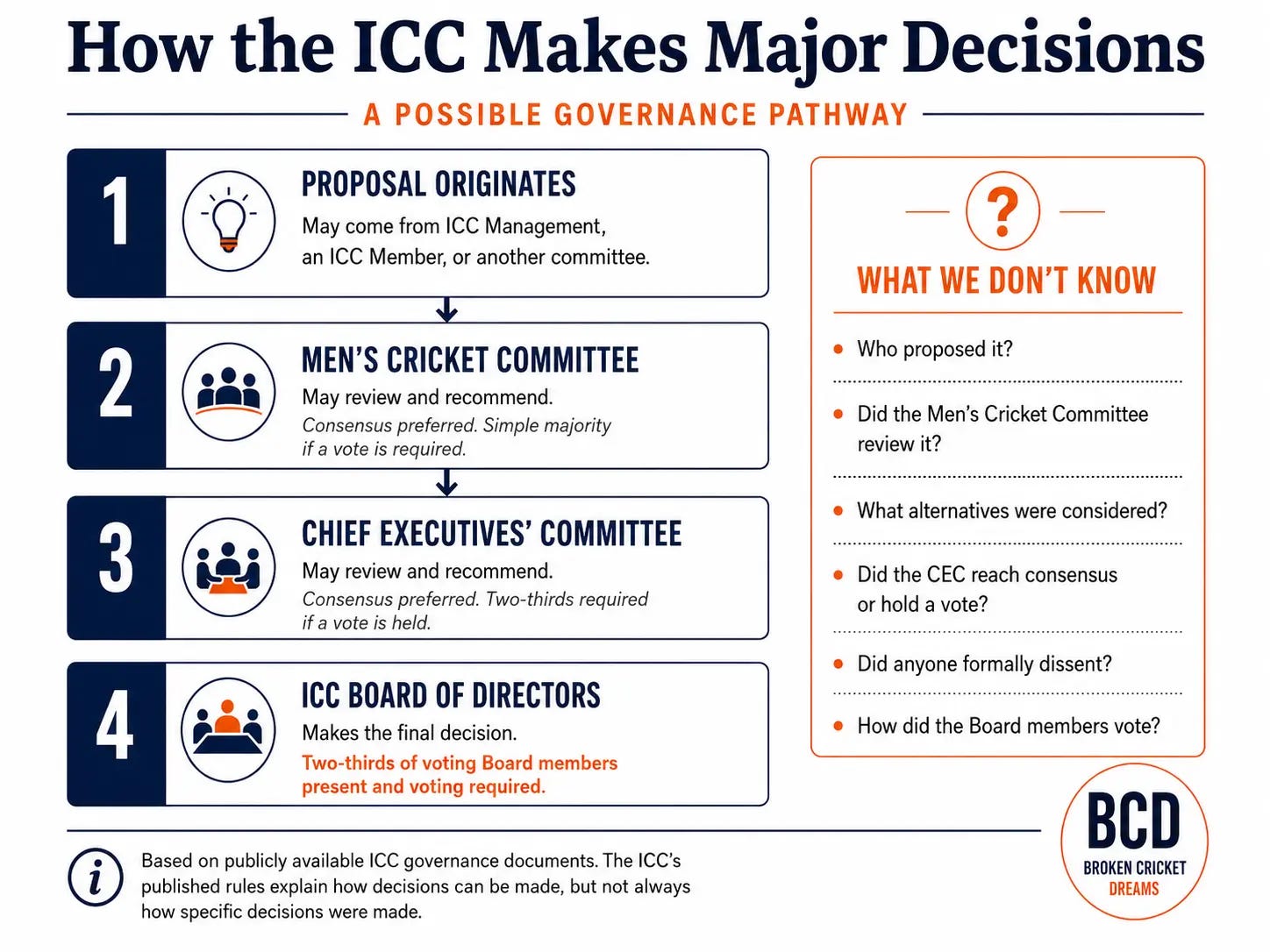
A proposal involving men’s international cricket could follow this path.
Step 1: The Proposal
- May originate with the ICC Management, an ICC Member, or an ICC committee
- We do not know who proposed the Super 7s
Step 2: Men’s Cricket Committee
- Review proposals involving men’s cricket and ICC events
- Discusses issues, make recommendations, but do not have final decision making authority
- We do not know whether the men’s cricket committee reviewed the new WC format
Chair: Sourav Ganguly
Other Prominent Members: Temba Bavuma (current player), Scott Edwards, Desmond Haynes, Hameed Hassan, VVS Laxman, Jonathan Trott, Shaun Pollock
*Note: Scott Edwards voiced his disappointment with this decision. That does not prove that the committee was bypassed, but it makes the absence of an explanation striking.
Step 3: Chief Executives’ Committee
- Attempts to reach a consensus
- If consensus cannot be reached, members may vote (2/3 majority of those present and voting is required)
- Make recommendations to the ICC board
- The ICC confirmed that the CEC recommended the new format.
2025 CEC Associate Representatives: Anuraag Bhatnagar (Hong Kong), Gurdeep Klair (Canada), Gurumurthy Palani (France, now elected to the board),
Step 4: The ICC Board
- Makes the final decision
- 2/3 support is needed from those present and voting
- The ICC confirmed that the Board approved the new format
Previous Board Associate Representatives: Mubashshir Usmani (UAE), Imran Khawaja (Singapore), Mahinda Vallipuram (Malaysia)
Elected in 2026: Palani, Usmani, and Dr. Rudie van Vuuren (Namibia)
Can three Associate representatives adequately speak for 99 Associate members, including nations with ODI status like Netherlands, Scotland, and Nepal that were directly affected by the new format?
But here’s the catch.
We still do not know whether the Super 7s proposal followed this exact pathway, who proposed it, whether anyone objected or how the Board members voted.
The ICC’s governance documents explain how decisions can be moved, but they do not shed light on how this particular decision was taken.
According to Article 4.9 (C) of the Articles of Association, every Board decision must be entered into the Board minutes’s book. Those records, however, are not required to be published.
Separately, Article 11 requires the proceedings and minutes of format ICC Members’ meetings to remain confidential.
In other words, internal records exist.
The public simply cannot see it.
The UN Has its Flaws. Documentation is Not One of Them
The UN Digital Library provides voting records for resolutions adopted by the General Assembly and Security Council since 1946. Some resolutions are adopted without a vote. Others follow debates, proposed amendments, and formal votes.
Either way, the outcome is recorded.
Take the extension of the mandate of the UN Assistance Mission in Afghanistan as an example. The public record includes the original draft resolution, official meeting record, and the complete voting record. We can see the Security Council approved the extension by a vote of 15-0 in March 2026.
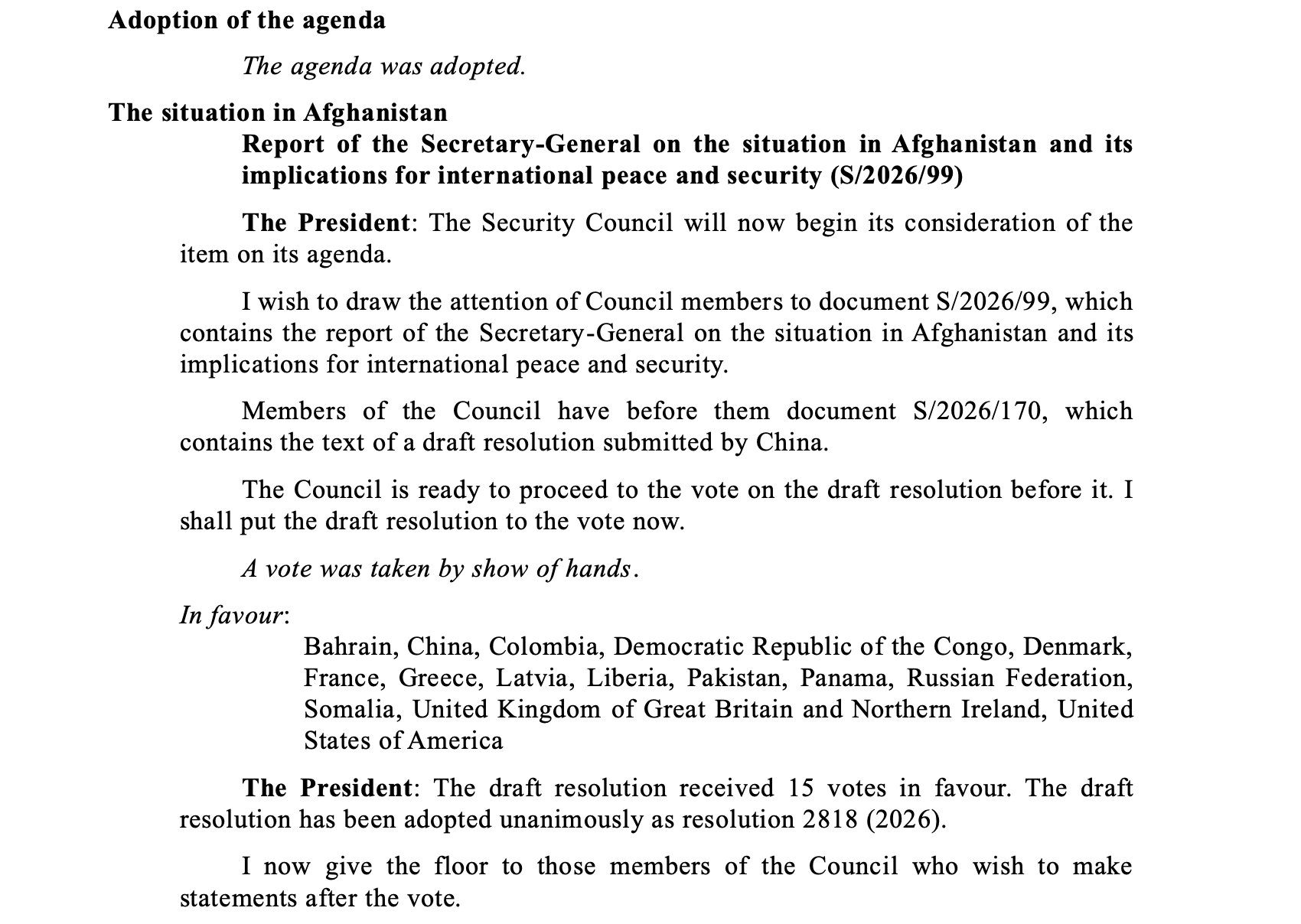
You do not have to agree or disagree with a decision to understand how it was made.
FIFA: Love It, Hate It, But You Can’t Ignore It
In 2010, Russia was awarded the 2018 FIFA World Cup and Qatar was awarded the 2022 World Cup behind closed doors. Five years later, corruption investigations engulfed the organization. Several FIFA officials were arrested, and President Sepp Blatter resigned.
FIFA needed to repair its image.
So for the 2026 World Cup host selection, FIFA held a public voting, which was contested between USA-Mexico-Canada and Morocco.
North America received 134 votes, Morocco 65, and and one association voted for neither. FIFA also published the complete voting results here.
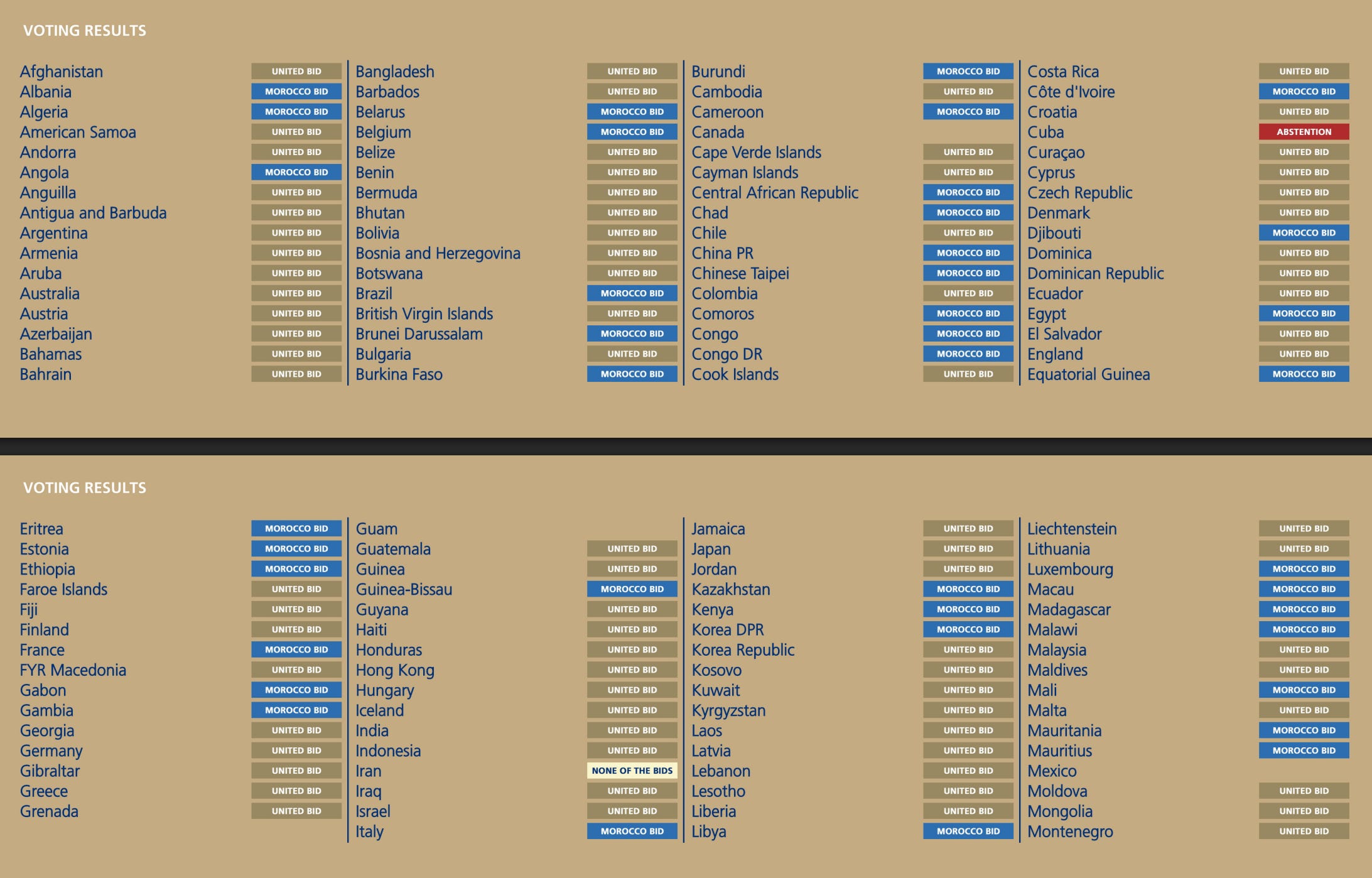
Now, FIFA is not perfect. Some days, a red card is reversed due to political interference. On other days, President Infantino reveals plans to sell stakes related to the World Cup out of nowhere.
FIFA’s decision to expand the WC from 32 to 48 teams was approved unanimously by the FIFA Council and released via a press conference. The underlying study was never published, but FIFA disclosed that:
“The decision was taken following a thorough analysis, based on a report that included four different format options. The study took into account such factors as sporting balance, competition quality, impact on football development, infrastructure, projections on financial position and the consequences for event delivery”
That is not complete transparency, but it at least it tells that some deliberation went into the decision.
FIFA is not the only sporting organization that is moving in this direction.
World Rugby publishes its minutes and detailed World Rugby Council decisions, World Athletics publishes its Council Meeting Agenda and Decisions, and UEFA publishes media releases of votes from its Congress elections.
We are not asking ICC to invent a new standard. We are asking them to meet one that already exists.
Transparency Around the World: The Push for Accountability
Asking for transparency is not a new phenomenon.
In the early 2000s, a series of major accounting scandals damaged public trust in American companies. In response, the US government passed the Sarbanes-Oxley Act in 2002, commonly known as SOX. Among other reforms, SOX requires senior executives of publicly traded companies to certify the financial and information contained in their annual and quarterly reports.
SOX did not directly apply to ICC or FIFA, but laws and standards like it helped make regular financial disclosure the norm for major organizations around the world.
Today, publishing financial reports is simply expected. You can find ICC and FIFA‘s reports here.
From Financial Reporting to Governance
Following the 2008 financial crisis, attention shifted beyond financial reporting to a broader question: How were major organizations being governed?
The United Kingdom introduced the first UK Stewardship Code in 2010, aiming to improve governance in companies. Other countries like Japan introduced their own stewardship codes. In 2017, Japan went one step further and encouraged investors to ‘voluntarily disclose’ their voting records.
Just like SOX, governance standards will become expectations for major global organization. There is no reason ICC or any sporting organization should be exempt.
The Ask is Simple
Transparency does not mean live streaming every conversation or disclosing sensitive information. Some conversations should remain private.
However, certain decisions demand a little more than a brief press release. When the ICC makes major decisions like fundamentally changing the World Cup format, the public should be able to answer a few basic questions:
- Who proposed the change?
- Was there data or a research study to back the new decision?
- How did each representative vote?
To its credit, the ICC did approve a new Governance Review Committee in Edinburgh.
We do not know if a new committee will bring greater transparency, but perhaps this is a first step.
The least the ICC can do stop taking its audience for granted.
We will continue to ask questions.
Because transparency is all we ask for.
If you liked this piece, you may enjoy the following other research or satire articles:
- Who Can Still Afford to Host Test Cricket in 2025? Inside the $923 Million Divide in Board Finances
- Quota System in South African Cricket and Transformation Policy
- The Brutal Economics of Associate Cricket
- Oh Lord, Please Save the Bowlers! 12 Rules To Change Cricket’s Dynamics
- Exclusive Interview with Wiaan Mulder: “I’m Not Here to Break Records. I’m Here to Confuse Future Cricket Historians.”
#414 © Copyright @Nitesh Mathur and Broken Cricket Dreams, LLC 2023. Originally published on 07/28/2026. Unauthorized use and/or duplication of this material without express and written permission from this site’s author and/or owner is strictly prohibited. Excerpts and links may be used, provided that full and clear credit is given to Broken Cricket Dreams with appropriate and specific direction to the original content (i.e. linked to the exact post/article).

0 Comments