BULAWAYO, ZIM—In a move that stunned fans, broke Twitter, baffled statisticians, and visibly aged every commentator in the box, South African makeshift captain & No. 3 Wiaan Mulder inexplicably declared the innings on 367* at Lunch on Day 2. He later explained that he “never liked the idea of being remembered,” and the only reason he scored so many runs in the first place was to “confuse generations of future cricket historians.”
Although Mulder publicly stated that he stopped short of the 400* record out of respect for the legendary Brian Lara, our exclusive interview revealed a far more complicated reality.
The Declaration Heard Around the World
Announcement to the Reader:
“We like to ask the tough questions. The ones that have puzzled mankind for centuries:
Did aliens build the Pyramids? Are we alone in this vast Universe? What’s in the Bermuda Triangle?
And most importantly….Why did Wiaan Mulder Declare on 367*? Today, we ask the man himself.”
BCD: “Spill it. Why did you really declare?”
Mulder: “Not gonna say.”
BCD: “For nearly three hours after the declaration, we sat on the edge of our seats, waiting for an explanation. Social media was in meltdown mode. Was it a possible weather alert? Over-rate fines? A silent protest? Or did you just….get bored? What was it, Wiaan? We deserve the truth.”
Mulder: “You don’t wanna know.”
BCD: “Try me.”
Mulder: “It wasn’t a cricketing decision. It was a situational call.”
BCD: “Situational?”
Mulder: “Situation being….I may or may not have gotten a stomach bug…and let’s just say, I had to use the restroom for more than 30 minutes.”
BCD: “So…it wasn’t Lara?”
Mulder: “No, no. Of course it was Lara. I was watching the Wimbledon during lunch and caught a glimpse of him in the crowd. And it reminded me…the great Brian Lara still walks among us.”
BCD: “You were watching Wimbledon while you were in the toilet?”
Mulder: “That’s besides the point.”
BCD: “But why retire on 367?”
Mulder: “367 is a prime number. There was something beautiful, poetic about that.”
BCD: “So now are a math enthusiast too? Alright then, explain this: Why stop short of Lara’s 400, but not Hashim Amla’s 311*? You were on 307 before those back-to-back boundaries…and 307 is also prime.”
Mulder: “Yeah…I have been living with that mistake ever since lunch. Should’ve stopped at 307. Got carried away. Guess I had one too many beers this morning.”
BCD: “Alright then. But you were on 367!”
Mulder: “Some days you average 26.20. Other days, you score 367. Just the law of averages. Nothing more.”
BCD: “But 400 was right there. Why not go all the way or at least attempt to? Won’t you regret it? Records are meant to be broken. How will the sport progress otherwise?”
Mulder: “I knew I was close to a record. That’s when I knew it was time to walk away.”
Pause. Mulder takes a deep breath.
“Besides, breaking 400 would have skewed my Test average too much. I didn’t want to challenge Sobers, Lara, and Bradman on the same day.”
BCD: “You’re saying you declared for statistical balance?”
Mulder: “I am saying…I never liked the idea of being remembered. But I do like the idea of some poor cricket analyst 30 years from now looking at the scorecard and going, “Wait, what?”
And just as I was about to ask my next question, Mulder gazed into the distance, channeled his inner Juliet, and began to speak. Everything slowed down.
Mulder (continued):
“What’s in a number?
Everything in the world is temporary.
Records fade. Players retire. Names blur.
But confusion? Confusion sticks.”
BCD: “What does that even mean?”
Mulder: “Exactly.”
****
Before I could wrap up the interview and tie loose ends, Mulder stood up, dropped his mic, and vanished into the corridor in the most Mulder fashion. No explanation. He left behind an unfinished cup of tea, a stunned reporter, and a world still trying to make a sense of it all.
Sources say that Mulder plans to retire with 799 wickets, 99 hundreds, a Test average of 99.91, and a business startup with Brian Charles Lara called Legacy Records.
In all seriousness, what a wonderful knock by Wiaan Mulder. Scoring a triple century with a 100+ strike rate and then coming out to bowl is out of this world!
What an achievement. You’re a legend in my eyes, Wiaan.
I hope this is just the beginning of many more moments of glory to come. And I hope South African cricket continues to rise like it has over the past few days with spirit, class, and belief.
Also, credit where it’s due: Mulder gave a wonderfully grounded interview to Shaun Pollock after the day’s play.
This is one of the best interviews I’ve ever seen. Wiaan Mulder is a legend, even if he doesn’t think so. https://t.co/2ryHVJTmEM
— Broken Cricket Dreams Cricket Blog (@cricket_broken) July 7, 2025
🚨 Wiaan Mulder by the end of his career
1. Breaks 400* record 2. Takes 11 Wickets in an Innings 3. Catches every catch in the innings 4. Becomes a wicket keeper for a match and inflicts most stumpings 5. Hits 8 Sixes in an Over 6. Scores 952 runs by himself 7. Breaks most…
— Broken Cricket Dreams Cricket Blog (@cricket_broken) July 7, 2025
Cricket fans, I have cracked it.
The only fathomable reason why Wiaan Mulder would declare is because 367 is a prime number.
He saw the beauty in mathematics, and said, “That’s it, I’m done.”
Mathematician. Quizzer. History buff. Computer Scientist. CEO. Director. Storyteller. Writer. Public Speaker. Sports Administrator. Tanks of World War II. Cricket, football, volleyball. What connects all these seemingly unrelated worlds?
Just one individual: Joy Bhattacharjya.
When I first started watching Cricbuzz Live seven years ago, Joy immediately caught my attention. I already knew Harsha Bhogle, the voice of Indian cricket, and Gaurav Kapur from his early IPL shows and Breakfast with Champions.
Joy was a new face to me. And yet, I found myself waiting for his segments— the anecdotes, insights, and of course, the Joy Factor questions.
As a mathematician trying to find my voice in cricket writing myself, I find Joy’s story inspiring. I wanted to understand how he made the leap and bridged connections between his different interests. Without further ado, let’s explore Joy’s journey together.
To understand how Joy became such a compelling storyteller, we have to look no further than his own home.
He grew up in a household where curiosity was the way of life. Both his parents were voracious readers. His sisters would go on to become educators, and his brother-in-law was a Rhodes Scholar. It was his father, an Army officer in the Corps of Electrical and Mechanical Engineers, whose stories left the deepest impression, from accounts of the 1946 Calcutta riots to the memories of the 1965 war.
Surrounded by books, Joy found his spark in Children’s Britannica, and local contests during Saraswati and Durga Puja celebrations gave him his first taste of quizzing.
He believes that success is a “function of the number of books that you read,” where each book or idea is capable of pushing you “into a hundred rabbit holes.”
Before sports, stats, or television, there was just a boy who had an endless hunger to learn.
The Formative College Years and the Beginning of Quizzing
Joy studied mathematics during his undergraduate years at Jadavpur University in Kolkata, followed by a year of MSc, and a Master’s in Computer Applications.
In his Tedx Talk, he recalls a literal bridge on campus with humanities and pure sciences on one side, and engineering on the other. That bridge would become a metaphor for his career: connecting numbers with narrative, creativity with logic.
It was during college that Joy took quizzing to a national level, appearing on Quiz Time in 1988, India’s first inter-collegiate quiz show.
In the 1990s, he transitioned into a career in media. He worked as a producer across television, served as Head of Content for the quiz show, Mastermind India, and eventually became the Head of Production at ESPN Star Sports. There, he helped launch Super Selector in 2001, a precursor to Dream XI and India’s fantasy league boom.
Since then, he has worked with National Geographic and the History Channel, hosted the CricIQ on ESPNCricinfo, and continues to write a quiz column for the Times of India.
From Super Selector to Team Director of KKR
The IPL changed the careers of many—Brendon McCullum, Lalit Modi, and yes, Joy Bhattacharjya. In 2008, Joy became the Project Director of Kolkata Knight Riders.
His experience designing Super Selector, a gamethat let fans build custom teams from live international matches helped him pitch a similar, data-driven strategy to IPL teams for the inaugural auction. In the end, it was KKR that brought him on board. Think of it like cricket’s early Moneyball moment.
Because the IPL was still new, Joy had the freedom to define his role: Auction strategy, logistics, marketing, operations, essentially everything behind the scenes that helped the team succeed.
And boy, did they succeed. After a shaky, multi-captain start, KKR lifted the trophy in 2012 & 2014, a clear high point in Joy’s career.
These days, Joy often reflects on this chapter fondly during Cricbuzz Live, from the aura of Jacques Kallis and the bond between Balaji and Gambhir, to the unlikely friendship of Ricky Ponting and Laxmi Ratan Shukla, and the star power of Shah Rukh Khan and Ganguly.
What I enjoy the most is the banter, dry humor, the movie references, and the pure conversation between Joy, Harsha, and Gaurav. Cricket talk at its finest.
Building Indian Sports: FIFA U-17 and Prime Volleyball League
As the IPL mature, Joy Bhattacharjya’s skills were called upon elsewhere.
India was gearing up to host the FIFA U-17 World Cup, and Joy was appointed as the Project Director. Organizing a global tournament across six cities, adhering to FIFA’s detailed operations manual, even relocating matches out of Guhawati due to rain forecast, all while delivering the most attended U-17 World Cup in history with over 1.3 million spectators, was no small feat.
Since then, he has shifted focus to volleyball, becoming the CEO of Prime Volleyball League (formerly, the Professional Volleyball League). Under his leadership, the league has gained momentum, expanded at the college level, and invested in grassroots development.
Even before the IPL, Joy was involved in organizing Premier Hockey League (PHL). As his LinkedIn profile states, he is “passionate about building sport, not just cricket, in India.” In his own words, “Every federation of every sport want India.” Now, the onus is on India to become a welcoming sporting nation.
His recent podcasts like Market and Sports are particularly fascinating on the impact of the IPL and India’s bid for the 2036 Olympics.
But wait, there is more.
He has also an author having co-written Do Different: The Untold Dhoni and The Great Indian Cricket Circus. Off-camera, Joy continues to surprise. He has taken up functional resistance training and he even got a tattoo!
True to form, he keeps pushing boundaries, both in sport and in life.
In 1984, the late mathematician Vaughan Jones discovered the Jones Polynomial, a breakthrough that bridged knot theory and statistical mechanics. He later received the Fields Medal, mathematics’ highest honor, and his work continues to influence quantum physics and molecular biology.
In a similar vein, Joy followed a range of interests and connected them, one by one. Three decades later, we can reflect on the enormity of what he’s built and the far-reaching impact he continues to have. He explored, he connected, he built bridges.
Joy has taught me the value of staying open-minded by welcoming new ideas, exploring unfamiliar disciplines, and committing to a life of learning. And doing it all without ever sacrificing humor, curiosity, or ‘joy.’
In Bengali, ‘Da’ means elderly brother.
Over time, Joy Bhattacharjya became more than a name on a panel or the host of quiz show. He became Joy Da, an elder brother to India’s sporting fraternity, a figure of warmth, wisdom, and enduring curiosity.
I will leave you with this question:
Would you rather be a jack of all trades, master of one, or all of the above like Joy?
Zimbabwe had South Africa in trouble at 55/4 when debutant Lhuan-dre Pretorious inside-edged to the keeper. The fielding side went up. The umpire and Pretorious stayed still.
Zimbabwe has made an impressive financial comeback, turning their $19 million deficit into stability. As a result, they now have the funds to host 8 Tests, a major win for a small cricketing nation.
But 8 Tests mean up to 40 days of cricket. Even at the minimum rate, implementing DRS for that many days would cost them at least $480,000, and potentially well into the millions.
So, the trade-off is clear: Zimbabwe can either afford to hosts more Tests or implement DRS, but not both.
For those wondering about DRS costs due to the ongoing #SAvZim match,
DRS costs about $60,000-$100,000 a day
For a 2-Test (5 day) series, the costs will rise an extra $600,000 to $2 million
— Broken Cricket Dreams Cricket Blog (@cricket_broken) June 28, 2025
As many have suggested on social media, the more interesting question is: Can the ICC subsidize the cost of DRS around the world?
Taking a Look at ICC’s Financials
Key Takeaways
According to their 2024 Financial Report, the ICC recorded $474 million surplus in 2024, a slight drop from $596 million in 2023.
ODI World Cup years remain the most profitable for ICC, but revenues from T20 World Cups are closing the gap. Notably, 2018 was the only non-pandemic year where ICC recorded a loss ($46 million), incidentally the last time there was no men’s ICC event.
The Bottom Line: Funding DRS across all Test matches would cost the ICC less than 5.1% of the their annual operating costs and about 2.3% of their reserve balance.
ICC Revenues, Costs, Total Surplus
Revenues from ICC Events
Costs from ICC Events
Other Revenues/Costs*
Total Comprehensive Income
2024
+$728,474,000
-$231,674,000
-$22,762,000
+$474,038,000
2023
+$839,147,000
-$246,489,000
+$3,356,000
+$596,014,000
2022
+$412,862,000
-$168,000,000
-$36,487,000
+$208,375,000
2021
+$432,146,000
-$96,510,000
-$10,029,000
+$325,607,000
2020
+$34,771,000
-$34,387,000
-$18,800,000
-$18,416,000
2019
+$602,908,000
-$184,565,000
-$25,683,000
+$392,660,000
2018
+$34,337,000
-$49,501,000
-$31,238,000
-$46,402,000
*Other revenues/cost include interest and investment income, general and administrative expenses, foreign exchange, net gain on financial assets, strategic investments, etc.
In 2017, the ICC restructured its financial model for the 2015-23 period, eliminating the $10-million contribution towards the Test fund. Instead, they agreed to redistribute ICC’s surplus back to the boards after every few years (practically, a bonus). This change actually proved lucrative to the Full Members:
Adjustment of dividend against advance to Members:
2019: -$300,000,000
2023: -$1,418,522,000
“In 2023, these advances have been offset against the surplus distributed to Members with the first tranche of such distribution (i.e. dividends) amounting to USD 300 million declared during the year 2020 and the second/final tranche amount of USD 1,418.5 declared during the year 2023, both with the approval of the Board of Directors.”
“The success of our media rights and commercial programme for our next four-year cycle means we are able to invest more money than ever before into our sport…This is by far the largest level of investment ever to go into cricket. It’s a once-in-a-generation opportunity for our Members to accelerate growth and engage more plays and fans and drive competitiveness.”
The Math: What Would it Actually Cost to Fund DRS Globally
There are 71 Test matches scheduled in the current World Test Championship (WTC) cycle.
Suppose, Zimbabwe, Afghanistan, and Ireland, who are not part of the WTC, play 32 Tests in the next two years. (They are already playing 17 this year, Zimbabwe – 11, Afghanistan – 3, Ireland – 3).
That brings the total to roughly 103 Test matches, or a maximum of 515 days of Test cricket. Recall that DRS costs vary widely based on the setup:
Barebones system: $12,000-$15,000/day
Full-feature DRS: $60,000-$100,000/day
Suppose the ICC negotiates through partnerships, media rights, and pays upfront for the DRS, bringing the costs down to $50,000 per day for a full-functioning system.
At this conservative average,
$50,000/day x 515 days = $25.75 million
Spread over 2 years for the WTC cycle, that’s ~$12.88 million per year
That’s a fraction of ICC’s annual expenses and even less if we consider when you consider the finds available in the reserve pool (And if we really think about it, that’s about the amounts Rishabh Pant ($3.21 million), Shreyas Iyer ($3.18), Venkatesh Iyear ($2.83), Arshdeep Singh ($2.14), and Yuzvendra Chahal ($2.14 million) were paid this year in the IPL. So the money exists in the cricketing world, but the redistribution is the issue).
One alternative approach could be to decouple Snicko and Hawkeye from the DRS package. Snicko alone can cost as little as $3,500/day, while Hawkeye is the most expensive part of the DRS package.
Another idea is for the Big 3 to fund their own DRS (since they have deals with media companies) and for ICC to subsidize DRS outside the Big 3.
Should the ICC Bear the Cost of DRS?
Can the ICC bear the Cost of DRS? Yes.
But should they? That’s less straightforward.
If the ICC uses reserve funds to cover DRS, it may come at the cost of other priorities: Associate cricket development programs, women’s cricket, and grassroots infrastructure. $12-15 million is not a small amount.
Even if those areas are not directly impacted, protecting the surplus might push the ICC further down its current trajectory: expanding media rights, but at the cost of a competitive balance.
The trade-offs?
India-Pakistan forced together in group stages again
ODI World Cup limited to 10-14 teams
Champions Trophy kept alive with little purpose beyond revenue
Back-to-back T20 World Cups, reducing space in the cricket calendar
So yes, the ICC can pay for the DRS, but doing so means reconsidering what they value the most: commercial growth of the game or its fairness.
What would you choose? Risk losing hundreds of thousands of dollars for one inside edge decision or let a single moment swing the course of a match?
****
Thank you all for reading. Please subscribe here and check out other financial and research articles below.
If you Enjoy Reading these Financial Cricket Articles, you may also like:
India’s $923 million in reserves is greater than the financial balance of the other 11 Test nations combined (~ $734 Million). India has been profitable in at least each of the last 10 years.
For financially strong boards like India and England, ICC distributions make up only around 10% of their total revenue. In contrast, boards such as Zimbabwe (~85%) and others like Afghanistan, Sri Lanka, and New Zealand (each around 48%) remain heavily reliant on ICC funding.
Some of the more surprising outcomes include Australia currently operating at a loss, and Bangladesh and Pakistan ranking unexpectedly high. On a positive note, South Africa, New Zealand, Sri Lanka, West Indies, and Zimbabwe have all recovered from COVID-era setbacks and now maintain at least some level of reserve capital.
How I Evaluated the Financial Health of Cricket Boards
To assess the financial strength of cricket boards, I reviewed the official financial statements of all 12 Full Member nations. Based on this analysis, each country is assigned a category reflecting its overall financial health.
🟢 Financially Strong: India, Bangladesh, England, Pakistan, South Africa, New Zealand, Sri Lanka
🟡 Stable: West Indies, Zimbabwe, Afghanistan
🔴 Financially Vulnerable: Australia, Ireland
The classification is based primarily on each board’s most recently reported reserves, but also considers long-term trends in profitability, revenue, expenditure, and annual surplus or deficit over the past 5-10 years, wherever data was available.
In a previous analysis, I estimated that hosting a Test match can cost between $350,000-$1.4 million. This benchmark, combined with each board’s current reserves and cash flow, helps assess whether they can sustainably host Test cricket. To host 5 home Tests per year as part of a 10-Test calendar, a cricket board would need at least $1.7 to $7 million in available cashflow and reserves.
BCCI earned a profit of 5,761.01 Crore INR from the IPL in 2023-24. contributing to 59.14% of their total revenue. The WPL resulted in a surplus of 377.50 Crore INR.
For the 2023 ODI World Cup, BCCI received Rs. 324.95 Crore INR, while the expenses were 276.15 Crore INR.
The 2023-24 ICC distribution was 1042.35 Crore INR ($115,496,100).
Financial Health: 🟢 Strong (on paper) 6-Year Financial Trend: Balance rose from $82M (2022) to $427M (2023), mostly via assets
COVID Recovery: ✅ Fully recovered.
Can They Afford to Host Tests? ✅ Yes, but long series may strain resources. They currently have $16.99 million in cash flow, which should be good enough for them to host 5 Test series in a season.
India Tour Dependency:Low. India toured Bangladesh in 2019/20, 2022/23 (+3 ODIs), and 2024/25 for 2 Test. There was not a meaningful enough changes in the finances in India tours.
ICC Income: $16 million (34.12% of annual revenue)
Bottom Line: Growth is real, but heavily skewed by asset gains. Still reliant on consistent tours and ICC support.
*Note: BCB had 2017-20 annual report and 2022-23 but not one for 2020-21 period.
Additional Notes:
The gain of assets took BCB’s balance from 10,654,580,032 BDT ($87 Million) to 46,205,040,900 BDT ($377.31 Million).
Quote from Annual Report
“The BCB finances have been boosted by proactive steps taken by the Board since 2017. This is evident in the figures. In the six years between 2011 and 2016 the Board had earned US $33.32 million in media, team sponsor and other rights while in just three years from 2017 to 2020, the BCB’s earnings stood at approximately US $29 million from the same sources.
Financial Health: 🟢 Exceptionally Strong 10-Year Financial Trend: Reserves grew from a low of $2.2 million (2021) to $69.29 million (2025), but incurred a small operating loss for the 2024-25 financial year.
COVID Recovery: ✅ Fully recovered. Suffered a loss of £14.875 million in 2020. They then had three consecutive years of profits between 2022-2024.
Can They Afford to Host Tests? ✅ Enough reserves and cash flow to host marquee Test series.
India Tour Dependency:Moderate. Can survive without India and Ashes for a couple of seasons, but because of their high administrative expenses, they need these tours often. 2019 (Ashes + WC), 2023 (Ashes), and 2022 (India tour) all resulted in profits.
ICC Income: $41.33 Million (10.35% of annual revenue)
Bottom Line: Large revenues but also large administrative expenses. Ashes and India tours drive profitability.
ECB Reserves (2015-2025)
2015: +£ 70,039,000($111.17 Million) – @ £0.63 per USD
2016: +£ 73,106,000($104.44 Million) – @ £0.70 per USD
2017: +£ 35,747,000($44.68 Million) – @ £0.80 per USD
2018: +£ 8,580,000($12.08 Million) – @ £0.71 per USD
2019: +£ 11,248,000($14.80 Million) – @ £0.76 per USD
2020: +£ 17,097,000($22.20 Million) – @ £0.77 per USD
2021: +£ 2,222,000($3.04 Million) – @ £0.73 per USD
2022: +£ 22,973,000($30.63 Million) – @ £0.75 per USD
2023: +£ 35,392,000($43.69 Million) – @ £0.81 per USD
2024: +£ 58,246,000($73.73 Million) – @ £0.79 per USD
2025: +£ 55,431,000 ($69.29 Million) – @ £0.80 per USD
2025 Cash Flow: £263,343,000 ($329.18 Million)
*Even though there is a great deal of cash at hand, the amounts falling due within one year to creditors is £258,225,000.
ECB Turnover and Expenses
*Year Ended 31 January, 2025
Year
Turnover
Administrative Expenses
Other Gains/Charges*
Total Comprehensive Income
2016
+£133,967,000
–£114,186,000
–£16,714,000
+£3,067,000
2017
+£118,886,000
–£137,166,000
–£19,079,000
-£37,359,000
2018
+£125,465,000
–£137,761,000
–£14,871,000
–£27,167,000
2019
+£172,319,000
–£142,376,000
–£27,275,000
+£2,668,000
2020
+£227,993,000
-£164,182,000
–£57,962,000
+£5,849,000
2021
+£207,112,000
-£191,097,000
–£30,890,000
–£14,875,000
2022
+£302,504,000
–£226,171,000
–£55,582,000
+£20,751,000
2023
+£334,019,000
–£248,676,000
–£72,924,000
+£12,419,000
2024
+£336,066,000
–£248,540,000
–£64,672,000
+£22,854,000
2025
+£319,558,000 (+$399,447,500)
–£259,305,000 (-$324,131,250)
–£63,068,000 (-$78,835,000)
–£2,815,000 (-$3,518,750)
*Other gains and charges include Cost of Sales, other operating income, tax on profit, and effective portion of changes in fair value of cash flow hedges.
Quote from Annual Reports
“In 2017, ECB continued with high levels of contributions to our cricket network and stakeholders. A special fee distribution of +£1.3m was paid to each First Class County in each 2016 or 2017, relating to the 2018 home India series broadcast revenue. A further special distribution of +£1m is scheduled to be paid to each First Class County in either 2018 or 2019, relating to Cricket World Cup 2019 revenue. These previously unprecedented contributions, coupled with continued significant investment in strategic Participation and Growth initiatives, including the expansion of our first nationwide entry-level programme, resulted in a loss for the financial year of – £ 30.2 m (2016: – £ 37.3m).”
“Cricket was always going to face a difficult challenge to compete for engagement in 2024. While England Men hosted West Indies and Sri Lanka in a non-Ashes year, a blockbuster sporting summer saw both the Paris Olympics and the men’s football Euros taking place in the same time zone. This was not helped further by poor weather, particularly in the first half of the summer. Despite this, attendance of 2.84m represented our best ever attendance for a non-Ashes or India year. The recreational game saw record highs in terms of participation, driven by an increase of around 10 per cent in women’s and girls’ sections and teams.
Financial Health: 🟢 Stable 10-Year Financial Trend: Surplus increased from $65 million (2015) to $71.83M (2023).
COVID Recovery: ✅ Fully recovered. Had a slight loss in 2021 ($2.9 million loss), but have been above water year after year otherwise.
Can They Afford to Host Tests? ✅ Yes. $62 million of cash in hand, annual profit of $10.9 million last year. Can definitely host a few 3 to 4-match Test series
India Tour Dependency:None. PCB are surviving even without India tours (Indirectly though, the ICC pool grows due to India-Pakistan ICC matches, which increases the amount that ICC pays each board).
ICC Income: $16 million (27.93% of annual revenue)
Bottom Line: Financially solid with recent home series in Pakistan. However, despite nominal growth in reserves, the sharp devaluation of the Pakistan Rupee from 104 PKR per USD in 2017 to 286 in 2023 has significantly eroded the real value of those gains.
PCB Reserves
2015: + 6,694,788,996 PKR ($65,748,316)– @ 101.8 PKR per USD
2016: + 8,283,173,629 PKR ($79,058,370)– @ 104.77 PKR per USD
2017: + 8,434,024,058 PKR ($80,447,198) – @ 104.83 PKR per USD
2018: + 8,283,173,629 PKR ($68,040,457)– @ 121.73 PKR per USD
2019: + 13,263,657,218 PKR ($84,237,003)– @ 157.47 PKR per USD
2020: + 17,099,164,322 PKR ($102,077,260)– @ 167.50 PKR per USD
2021: + 16,262,237,513 PKR ($103,189,088) – @ 157.61 PKR per USD
2022: + 17,304,552,163 PKR ($83,804,720) – @ 206.50 PKR per USD
2023: + 20,393,054,686 PKR ($71,829,749) – @ 286.62 PKR per USD
2023 Cash Flow: PKR 17,978,488,170 ($62,696,229)
PCB Revenues and Expenses
*Year ended June 30, 2023
Year
Revenues (in PKR)
Operating Cost (in PKR)
Other Gains/Charges* (in PKR)
Total Comprehensive Income (in PKR)
2016
+4,143,841,297
–3,299,320,243
+691,161,695
+1,535,682,749
2017
+4,373,244,912
–4,034,088,153
–135,604,446
+203,552,313
2018
+5,131,003,966
-5,136,332,519
-145,521,876
–150,850,429
2019
+11,248,251,959
–5,907,837,843
–359,930,527
+4,980,483,589
2020
+9,334,821,085
–5,030,821,564
–468,492,417
+3,835,507,104
2021
+6,330,842,117
-7,086,927,287
–1,258,277,393
–835,926,809
2022
+9,033,872,425
-7,599,150,590
–393,407,185
+1,041,314,650
2023
+16,424,122,531 (+$57,293,595)
-12,450,222,610 (-$43,446,377)
–885,478,598 (-3,089,210)
+3,088,502,523 (+$10,934,428)
“During this period, PCB hosted England twice after 17 years for two memorable series. Similarly, New Zealand also toured Pakistan twice for the red and white-ball series, and our teams toured Sri Lanka, the Netherland, Sharjah and participated in ICC Men’s T20 World Cup in Australia….In conclusion, PCB’s financial health continues to strengthen with cash reserves reaching its highest level ever.“
Financial Health: 🟢 Recovering 10-Year Financial Trend: Pre-Covid, CSA’s reserve went as high as $85.68 million, but 5 loss-making years between 2017-23 dropped their reserves to $20.02 million. A strong 2024 saw them bounce back to $63.83 million.
COVID Recovery: ✅ Fully recovered.
Can They Afford to Host Tests? ✅ Yes, +$50.97 million cash flow at the end of 2024 financial year.
India Tour Dependency:Very High. India’s 2023/24 tour (2 Tests, 3 ODIs, 3 T20Is) was a massive boost to CSA’s revenues.
ICC Income: R567 million – $30.58 million (37.88%)
Bottom Line: CSA now has both the surplus and cash flow to support Test cricket.
Why are the World Test Champions not hosting Tests in 2025?
South Africa will be going through stadium upgrades as they prepare to host the 2027 ODI Cricket World Cup. Hence, they will not be hosting a home Test, especially the esteemed Boxing Day Test.
In 2026-27, home Tests will be back for South Africa: 3 Tests vs Australia and England and 2 Tests vs Bangladesh. Women Tests vs Australia and India.
In the last 10 years, the Rand has gone from $1 USD = R. 9.65 to $1 USD ~ 18 R.
2013:+R400,011,000 (+$37.96 Million) – @ R10.54 per USD
2014:+R599,421,000 (+$53.95 Million) – @ R11.11 per USD
2015:+R707,095,000 (+$57.72 Million) – @ R12.25 per USD
2016:+R814,254,000 (+$57.07 Million) – @ R14.27 per USD
2017:+R655,444,000 (+$49.07 Million) – @ R13.35 per USD
2018: +R1,056,445,000 (+$85.68 Million) – @ R12.33 per USD
2019: +R856,430,000 (+$59.26 Million) – @ R14.45 per USD
2020: +R906,692,000 (+$48.33 Million) – @ R18.76 per USD
2021: +R685,669,000 (+$47.72 Million) – @ R14.37 per USD
2022: +R487,795,000 (+$30.87 Million) – @ R15.80 per USD
2023: +R368,406,000 (+$20.02 Million) – @ R18.40 per USD
2024: +R1,183,262,000 (+$63.83 Million) – @ R18.54 per USD
2024 Cash Flow: R 945,008,000 ($50.97 Million)
CSA Revenues and Expenses
*Year ending April 30, 2024
Year
Revenues
Operating Cost
Other Gains/Charges*
Total Comprehensive Income
2015
+R765,600,000
-R695,476,000
+R37,550,000
+R 107,674,000
2016
+R822,926,000
-R777,047,000
+R61,280,000
+R 107,159,000
2017
+R674,935,000
-R910,392,000
+R76,647,000
-R 158,810,000
2018
+R1,526,393,000
-R1,219,049,000
+R42,655,000
+R 349,999,000
2019
+R929,492,000
-R1,215,801,000
+R86,294,000
-R 200,015,000
2020
+R1,074,063,000
-R1,193,672,000
+R169,871,000
+R50,262,000
2021
+R512,438,000
-R732,362,000
-R1,099,000
-R 221,023,000
2022
+R778,353,000
-R996,624,000
+R19,397,000
-R 197,874,000
2023
+R700,240,000
-R904,441,000
+R84,812,000
-R 119,389,000
2024
+R1,888,455,000 (+$101,860,909)
-R1,158,812,000 (-$62,480,037)
-R85,213,000 (-$4,596,438)
+R 814,856,000 (+$43,943,740)
Other gains/charges includes investment income, net foreign exchange gains, fair value adjustments, share of loss from associate, share of profit from joint venture, and impairment of investment in associate
Quotes from Annual Reports
“We realised a 170% increase in revenue, reaching R1.89 billion. This increase was anchored by the inbound tour by India, and supported by several initiatives, including the successful hosting of the ICC U19 World Cup 2024.”
“Our financial stability has been reinforced with a net cash inflow of R810 million from operating activities and other strategic investments, including in African Cricket Development, the company behind the SA20 product. …The outcome was a profit before tax of R815 million, reversing the previous year’s loss.”
“I am pleased to present a strong financial performance for the year ending 30 April 2024. The results reflect revenue of R1.89 billion and net profit of R815 million, exceeding expectations and putting CSA in a healthy financial position for the balance of our four-year financial cycle and beyond.”
“Sri Lanka Cricket has stepped into 2024 with financial flexibility, a healthy balance sheet and bottom line, while having remained steadfast in our commitment to the development of the sport locally and in the international arena. In 2023, SLC has committed operational expenditure of 4.3 billion rupees towards international cricket and 2.8 billion rupees towards domestic cricket, providing vital funding to ensure that both structures have the best opportunities to achieve success.”
“The financial results in 2023 yet again demonstrates Sri Lanka Cricket’s prudent management of finances, as we made a revenue of 1,959 million (includes Participation Fee Income-Inbound from ACC, Participation Fee Income-Outbound from ACC, Sponsorships, Ground Hiring Income from Pakistan Cricket Board, Development Grant from ACC), positioning us strongly to invest in cricket and ensure its future growth.”
Financial Health: 🟨 Modest 10-Year Financial Trend: Reserves balanced between $10-20 million since 2016, with minor dip in 2022.
COVID Recovery: ✅ Recovered. 4 out of 5 years in the green from 2020-24.
Can They Afford to Host Tests? ✅ Yes, but usually break-even or slight loss.
India Tour Dependency:Very high. India toured NZ in 2019/20 and 2022/23 (England also visited), both high profit years for NZC. Australia visited in 2024, which was also a profitable year.
ICC Income: 28.38 Million (48.45% of 2024 revenue)
Bottom Line: Well-run but tight margins. Financial health depends on India or ICC deals.
NZC Reserves (2016-2024)
2013:+ $ 7,077,531 NZD ($5.44 Million USD) @ $1.30 NZD per USD
2016:+ $32,628,000 NZD ($23.47 Million USD) @ $1.39 NZD per USD
2017:+ $26,043,000 NZD (19.29 Million USD) @ $1.35 NZD per USD
2018: + $17,879,000 NZD ($12.16 Million USD) @ $1.47 NZD per USD
2019: + $15,149,000 NZD ($10.10 Million USD) @ $1.50 NZD per USD
2020: + $19,829,000 NZD ($13.13 Million USD) @ $1.51 NZD per USD
2021: + $20,384,000 NZD ($14.26 Million USD) @ $1.43 NZD per USD
2022: + $13,653,000 NZD ($8.59 Million USD) @ $1.59 NZD per USD
2023: + $29,205,000 NZD ($18.03 Million USD) @ $1.62 NZD per USD
2024 Cash Flow: $33,881,000 NZD ($20.17 Million USD)
NZC Revenue and Expense
Balance as of 31 July, 2024
Year
Revenue (in $ NZD)
Operating Cost (in NZD)
Other Gains/Charges* (in NZD)
Total Comprehensive Income (in NZD)
2017
+$48,709,000
–$41,757,000
-$13,537,000
–$6,585,000
2018
+$55,442,000
–$42,231,000
-$21,375,000
–$8,164,000
2019*
+$59,400,000
-$60,700,000
+$0
–$1,300,000
2020
+$60,610,000
–$40,734,000
-$15,196,000
+$4,680,000
2021
+$62,518,000
–$43,509,000
–$18,454,000
+$555,000
2022
+$66,401,000
-$46,496,000
-$26,636,000
-$6,731,000
2023
+$97,064,000
-$63,067,000
-$18,445,000
+$15,552,000
2024
+$98,402,000 (+$58,572,619 USD)
-$64,136,000 (-$38,176,190 USD)
-$28,654,000 (-$17,055,952 USD)
$5,612,000 (+$3,340,476 USD)
*2019 Annual Report was not available, so the estimate is based on the 2017-18 and the 2020-21 reports (The -$60,700,000 includes both operating cost/other charges).
Quotes from Annual Report
“As our positive 2023-24 fiscal result shows, NZC is in a sound financial position, something of major importance to our Major Associations given our top-down funding model. Our long-term forecast warns of some head winds, and we have taken steps to ensure we will be best placed to navigate what is currently a volatile global cricket environment.”
“This is a plan that strives to safeguard the financial and commercial sustainability of NZC for the benefit of all, placing high amongst its priorities the need to invest and grow our commercial foothold in South Asia, to operate in an environmentally sustainable fashion, and to build strong partnerships with our broadcast partners at home and in India. The bottom line is that we all depend on each other to survive and flourish.”
“Revenue from broadcast, sponsorships, and ticketing all delivered year-on-year growth as new partnerships were formed, both domestically and offshore, including the marquee and offshore, including the marquee deal reached with Sony as our broadcast partner in the India sub-continent from 2024-2031.”
Financial Health: 🟨 Rebounding 6-Year Financial Trend: Recovered from –$18.9M (2017) to +$10.8M (2022)
COVID Recovery: ✅ Recovered.
Can They Afford to Host Tests? ✅ Yes. They are hosting 8 Tests this year, but need to be cautious. They have plenty in reserves, but cash flow tends to be low.
India Tour Dependency:Very high. India visited Zimbabwe for 3 ODIs in 2022, which corresponds to the largest revenue they had in the six-year period. Hosting ICC Qualifiers also gives them a boost.
ICC Income: $13.5 Million (85.29% of 2022 Revenue)
Bottom Line: Quiet financial rebuild. Still ICC-reliant, but out of crisis.
Financial Health: 🟨 Fragile 10-Year Financial Trend: Flat but steady. Modes surplus maintained since 2020.
COVID Recovery: ✅ Recovered, but hindered by sanctions.
Can They Afford to Host Tests? ❌ Not realistically, neutral venues inflate costs
India Tour Dependency:Moderate. While India doesn’t play Afghanistan often, it has played an indirect role in Afghanistan’s development with IPL contracts and home stadiums in Dehradun and Lucknow.
ICC Income: $4.75 Million (48% of revenue). This will rise to about $16.82 million in the 2024-27 cycle.
ACB Reserves (2017-2022)
Bottom Line: Surviving via ICC support. Lack of a home base continues to hurt.
2017:+1,902,994
2018: +$538,841
2019: +$1,550,462
2020: +$1,940,462
2021: +$2,180,462
2022: +$5,250,462
ACB Revenues and Expenses
Year
Revenues
Operating Cost
Total Comprehensive Income
2018
+$10,849,111
–$12,213,264
– $1,364,153
2019
+$13,121,708
–$12,110,087
+$1,011,621
2020
+$7,150,000
–$6,760,000
+$390,000
2021
+$6,170,000
–$6,410,000
+$240,000
2022
+$9,920,000
-$6,850,000
+$3,070,000
Additional Notes
ACB is investing heavily in developing domestic cricket stadiums, namely (1) Kabul International Cricket Stadium, (2) Logar Cricket Ground, (3) Najibullah Tarakai International Cricket Ground, (4) Paktika Cricket Ground, (5) Wardak Cricket Ground, and (6) Balk Cricket Ground. Budget for each ground ranges from $1-5 million.
Quotes from Annual Reports
“Hosting bilateral series and other tournaments is a significant challenge for Afghanistan…has had to host all of its ‘home’ games in neutral countries such as the United Arab Emirates, India, or Qatar. This has resulted in increased expenses for the ACB, as it has to host both the Afghanistan team and the visiting team at the same time, which incurred higher costs for logistical arrangements and accommodation of both teams.”
“The recent political changes in the country have made it more challenging to transfer money into Afghanistan due to imposed international sanctions. This has caused difficulties for the Afghanistan Cricket Board (ACB) as most of its income comes from ICC distributions, the payments made twice a year. However, the ACB’s leadership and finance team have been working closely with the ICC to find alternative ways to transfer funds into the country to support the organization overcome this issue in the long term.”
“During 2018, ACB hosted Zimbabwe and Bangladesh in February and June, respectively. The forecasted revenue for each series was forecasted at USD 400k.”
Financial Health: 🔴 Negative Reserves, but Expected to Rebound 10-Year Financial Trend: Cricket Australia slipped from $111.03 Million USD reserves in 2016 to a $234K deficit in 2024. Six of the last 10 years have resulted in losses. Massive profits from the 2015 World Cup year has been keeping them afloat.
COVID Recovery: ❌ Still incomplete.
Can They Afford to Host Tests? ✅ Yes, but high operating costs make financial planning critical.
India Tour Dependency:High. CA posted profits in 2019 and 2021 with record revenue numbers.
ICC Income: $37.53 Million (13.86% of 2024 annual revenue)
Bottom Line: CA currently has negative reserves, but cash on hand ($25.7 M AUD), access to $50 M in secured funding. The recently concluded BGT and upcoming Ashes in 2025-26 will put them in a position to bounce back over the next two years.
CA Reserves (2013-2024)
2013: +$8,147,220 AUD ($7.47 Million USD) – @ $1.09 AUD per USD
2014: +$26,676,000 AUD ($25.17 Million USD) – @ $1.06 AUD per USD
2015: +$114,168,000 AUD ($88.52 Million USD) – @ $1.29 AUD per USD
2016: +$149,895,000 AUD ($111.03 Million USD) – @ $1.35 AUD per USD
2017: +$98,600,000 AUD ($75.27 Million USD) – @ $1.31 AUD per USD
2018: +$87,841,000 AUD ($65.07 Million USD) – @ $1.35 AUD per USD
2019: +$97,743,000 AUD ($65.07 Million USD) – @ $1.43 AUD per USD
2020: +$54,588,000 AUD ($37.39 Million USD) – @ $1.46 AUD per USD
2021: +$59,450,000 AUD ($45.05 Million USD) – @ $1.32 AUD per USD
2022: +$48,795,000 AUD ($33.18 Million USD) – @ $1.47 AUD per USD
2023: +$31,901,000 AUD ($21.27 Million USD) – @ $1.50 AUD per USD
2024 Cash Flow: $25,621,000 AUD ($17.09 Million USD)
Cricket Australia might have low reserves, but their total assets total $96,589,000 AUD ($64.39 Million USD)
CA Revenues and Expenses
*Year ending 30 June, 2024
Year
Revenues(in AUD)
Operating Cost(in AUD)
Other Gains/Charges* (in AUD)
Total Comprehensive Income (in AUD)
2014
+$295,897,820
-$193,784,041
-$82,585,431
+$18,528,348
2015
+$380,875,000
-$227,259,000
-$66,124,000
+$87,492,000
2016
+$339,787,000
-$223,826,000
-$80,234,000
+$35,727,000
2017
+$313,005,000
-$251,582,000
-$112,718,000
–$51,295,000
2018*
+$399,265,000
–$272,077,000
-$137,947,000
–$10,759,000
2019
+$485,901,000
-$340,201,000
-$135,798,000
+$9,902,000
2020*
+$390,098,000
–$305,474,000
-$127,779,000
–$43,155,000
2021
+$405,350,000
-$302,350,000
–$98,138,000
+$4,862,000
2022
+$391,004,000
-283,439,000
-$118,220,000
–$10,655,000
2023
+$426,643,000
-$324,192,000
-$119,345,000
-$16,894,000
2024
+$406,245,000 (+$270,830,000 USD)
-$318,036,000 (-$212,024,000 USD)
-$120,473,000 (-$80,315,000 USD)
–$32,264,000 (-$21,509,000)
*’Member Funding’ and ‘Strategic Funding’ contribute to the other gains
Additional Notes:
Player salaries alone cost $121.4M AUD in 2024, underlining the board’s heavy expenditure base.
CA’s share of the 2015 World Cup host profit added $51M AUD to its earnings that year.
Quotes from Annual Reports
“The net result of operations for the year ended 30 June 2017, after distributions to State Associations of $112,242,699 (2016:$106,259,550) was a net loss of $50,802,002 (2016: surplus $9,701,628). The reduction in net result for the year ended 30 June 2017 was in line with Management and budgetary expectations and the Long Range Plan (LRP) four year planning cycle projections.”
“As we know, CA is currently at a low-point in its four-year cycle. Despite this, the first year of the new player agreement has resulted in a 7% uplift in player payments, and the extension of funding agreements with members included a 3.5% uplift this year. The net deficit for the current year, after funding to members, is $31.9M, a further $14.7M down to the previous year. Considering the content-driven $18.2M year-on-year revenue decrease, this result was anticipated and highlights the emphasis on managing costs and driving revenue through business transformation initiatives. CA depleted its reserves through the impacts of COVID, which in aggregate cost around $100m. Despite this, CA has cash and deposits of $25.7m, with a further $50m in funding available though a secured banking facility and is forecast to rebuild reserves through upcoming seasons hosting India and England.
Financial Health: 🔴 At-risk 7-Year Financial Trend: After modest reserves between 2019-2021, Cricket Ireland’s financial reserves have fallen to $3.15 million deficit in 2023. That year marked a critical transition point, with signs of stability ahead.
COVID Recovery: ❌ Not yet complete.
Can They Afford to Host Tests? ❌ Not currently. Their cash in hand has dropped from €1,336,4995 to €434,185 between 2022 and 2023. Hosting even a single Test would leave virtually no liquidity.
India Tour Dependency:High. Indias’s T20I visits (2 each in 2018 & 2022 and 3 T20Is in 2023) lead to noticeable revenue spikes, but also increased costs. Even an England tour could ease the pressure.
ICC Income: $4.75 Million in 2023 (40.36% of annual revenue). Under the 2024-27 ICC distribution model, Ireland is projected to earn $18.04 million offering a welcome financial cushion.
Bottom Line: Ireland remains heavily dependent on ICC funding, and current financial fragility limits its ability to invest ambitiously in the short term.
Cricket Ireland Reserves (2018-2023)
2017: +€216,817 (+199,472) – @ € 0.92 per USD
2018: +€13,470 (+$11,710.2) – @ € 0.87 per USD
2019: +€3,673 ($3,306) – @ € 0.90 per USD
2020: +€1,541,035 (+$1,263,648) – @ € 0.82 per USD
2021: +€310,166 (+$272,946) – @ € 0.88 per USD
2022: +€133,982 (+$125,943) – @ € 0.94 per USD
2023: -€3,464,422 (-$3,152,624) – @ € 0.91 per USD
2023 Cash In Bank and in Hand:€ 434,185
Cricket Ireland Revenues and Expenses
The financial end for Cricket Ireland year is 31 December.
Year
Income
Expenses
Total Retained Earnings
2018
+€9,708,177
– €9,911524
-€203,347
2019
+€10,624,514
–€10,634,311
-€9,797
2020
+€7,934,398
–€6,397,036
+€1,537,362
2021
+€9,739,048
–€10,969,917
-€1,230,869
2022
+€13,103,793
–€13,279,977
-€176,184
2023
+€10,211,129 (+$11,769,397)
-€13,809,533 (-$15,916,935)
-€3,598,404 (-$4,147,538)
*expenses include both direct and administrative expense and Income includes both ‘income’ and ‘other operating income.’
Quotes from Annual Report
“2023 was a challenging, but ultimately successful year – both on- and off-the-field…Covid was still a real and present threat when this Strategic Plan was developed and the uncertainty of the time saw an ambitious but measured document…However, as we enter a new phase in our development as a cricket nation, we will see an uplift in our ICC distribution over the period, and anticipate our allocation to be approximately US$70M, albeit weighted to the backend where around 40% of these funds will be paid in 2027….2023 will be a year to remember for many – and it will hopefully be seen in time as a seminal year for Irish cricket.”
I can understand why South Africa, Sri Lanka, and New Zealand did not host many Tests in recent years.
COVID-19 losses, funding issues, and player availability made things complicated. But now? These boards have rebuilt their reserves. ICC distributions are growing, and India tours bring massive broadcast revenue.
Countries like Ireland and Afghanistan still cannot afford to host a single Test. Australia, despite paying its players among the highest salaries in the game, hasn’t turned a profit in years. India sits at the economic center of world cricket, and it is doing its part.
The money now exists for countries outside the Big 3. The onus is now on every board to give Test cricket the calendar space it deserves.
****
Thank you all for reading. Please subscribe here and check out other financial and research articles below.
If you Enjoy Reading these Financial Cricket Articles, you may also like:
Dear Temba, thank you. For bearing the burden of pain, expectations, and voices that never believed in you. For carrying the weight of a nation as its leader. For your Player of the Series performance in Sri Lanka and for becoming this team’s most consistent batter over the last two years.
You stood tall in the Final. You hobbled on one leg and carried generations on your back with an unforgettable 147-run stand with Markram.
You didn’t just survive. You answered the critics. And most importantly, the call of a nation desperate for a moment like this.
Dear Kagiso, thank you. For walking through fire—the off-field controversies, the noise, and the no balls—to deliver one of the finest bowling displays in South African history. For the many five-fers across the two-year cycle, the brilliance in Bangladesh, and the records you shattered along the way.
But at Lord’s, you climbed higher. In those four days, you touched greatness.
Dear Aiden, thank you. For the innings of a lifetime against the fiercest of attacks in Starc, Hazlewood, Cummins, and Lyon. You held your nerve and found your flow.
After the disappointment of the T20 World Cup, you came back stronger. From the innings against Pakistan to the balcony at Lord’s, you never looked back.
And yes, thank you for those beautifully exquisite cover drives. And for the golden arm off-spin, always delivering when its least expected. As Temba said, you got character, mate. And that is what matters.
Dear Lungi, thank you. For proving you could bowl the long, decisive spells. You changed the game with grit and rhythm when it mattered the most.
Dear Marco, thank you. For that catch. For the spells. For becoming the all-rounder that South Africa can rely on. And for the Player of the Series performance against Pakistan that helped carry this team to the Final.
Dear Keshav, thank you. For being the senior pro that the team could look up to. The heartbeat of the team. Your constant contributions in Bangladesh and Sri lanka, and that magnificent performance against the West Indies were vital in bringing South Africa to the Final.
And those tears of joy and relief after the win? Those moments are etched in our memories forever.
Dear Kyle, thank you. For that century in Bangladesh and the 105 in Sri Lanka. And most of all, for hitting the winning runs. That image will never be forgotten.
Dear David, thank you. For choosing the road less traveled by and going to that New Zealand tour while others played in the SA20. For scoring that gutsy 110. And what a performance in the final, rescuing South Africa in the first innings and staying till the very end in the second.
Dear Tristan, thank you. For taking clutch catches in the final and for providing sparks of brilliance throughout the campaign with knocks of 122, 106, 68*, 30* that lit up the campaign. The future is bright, and it’s all yours.
Dear Ryan, thank you. For that 259 against Pakistan in a must-win game. The innings that kept the dream alive and pushed South Africa one step closer to glory.
Dear Wiaan, thank you. For doing the tough jobs with a smile. An all-round showing against the West Indies, a century at #7 in Bangladesh, and a crucial knock at #3 in the Final that kept South Africa in the game.
Dear Dean, thank you. For opening this World Test Championship cycle with a magnificent 185. For setting the tone. You may have retired, but your imprint in this triumph remains.
Dear Tony, Senuran, Dane, Corbin—thank you. Tony’s 177, Muthuswamy’s 4-fer vs Bangladesh, Dane’s 5-fers vs Sri Lanka and Pakistan, and Corbin’s 4-fer & 81* vs Pakistan all played a role. Every contribution mattered. The bench is strong, and South Africa’s future in Test cricket is bright.
And Dear Coach Conrad Shukri and the Support Staff, thank you. For backing this group. You helped nurture an environment from which champions could emerge.
So once again, I say, Thank you Temba. Thank you Kagiso. Thank you Aiden. Thank you Conrad. And to Ryan, Wiaan, Tristan, David, Kyle, Marco, Keshav, Lungi, Tony, Corbin, Dane, and Senuran, Dean, Nandre, Gerald, and anyone I am forgetting, thank you.
I may not be South African, but through Hashim Amla’s elegance, Faf du Plessis’ blockathons, AB de Villiers’ magic, and Dale Steyn’s action I spent hours trying to imitate, I fell in love with South African cricket.
More often than not, I found myself cheering for them. Every story felt personal. Every match felt like it was mine. And when the 2015 semi-final ended in a heartbreak, it left scars, even for a neutral fan.
That’s why this win means more. This team didn’t just lift a trophy, they healed something. And if it healed something in me, I can only imagine what it meant to those who lived this journey for a lifetime.
I may not grasp every nuance of South African society or the full weight of what this means in a broader context. But I understand what it means to love a team through pain and to finally see them rise.
“This is for every cricketer that played a part in the beautiful cricketing history of the Rainbow nation. And for every Protea fan who stood by their team through the highs and lows.
This is for you. And this is for me.
What an absolute moment for world cricket.
This is for Graeme Smith. This is for Shaun Pollock. This is for Graeme Pollock. This is for Lance Klusener. This is for Dale Steyn. This is for Shabnim Ismail. This is for Allan Donald. This is for AB de Villiers. This is for Laura Wolvaardt. This is for Hashim Amla. This…
— Broken Cricket Dreams Cricket Blog (@cricket_broken) June 14, 2025
South Africa’s Dream, Realized by Bavuma and the Class of 2025
Persistence pays.
Through the heartbreaks and doubts, this team did not give up. Did not deviate from the end goal.
Thank you, Temba. Thank you, South Africa.
For the belief. For the fight. For the quiet grace with which you carried the weight of history. From a fan who watched with admiration, I will not forget what the Class of 2025 gave us.
****
I’ll leave you with the best content from Temba Bavuma’s WTC win. Thank you for reading.
If you are interested in South African cricket, you may enjoy:
Legacy or Livelihood: Dilemma Facing Modern Cricketers
Nicholas Pooran and Heinrich Klaasen made their choices.
They were not dropped. They simply walked away.
Why? Because they received better offers.
Pooran stepped away from international cricket at 29. Klaasen followed at 33. The one that started the trend: Quinton de Kock left Tests at 29 and all internationals by 31.
International cricket once offered pride, purpose, and legacy. But today, that is no longer enough. One IPL deal can outpay a decade of national contracts. T20 leagues offer flexibility, certainty, and family time. International cricket? Long tours, lower pay, and a scheduling mess.
Nicholas Pooran could earn $3.09-$4.03 million across 9 franchise leagues and play around 91 matches in a year (more if team qualifies for playoffs/finals).
In contrast, a West Indies central contract and international match fees would only add about $130,000-$180,000.
Had they signed central contracts, Klaasen and Pooran would have earned just 5-16% and 3-6% respectively of their total income from international cricket.
By comparison, top players from the wealthier big 3 boards earn significantly more from internationals:
Joe Root: 83.43% of $1.63 million, Mitchell Starc: 32-38% of ~$2.3 million, and Virat Kohli: 32% of $3.9 million
*Note: We will only look at national contracts, match fees, and franchise league income (not sponsorship or miscellaneous income).
How Much Does Nicholas Pooran Earn from Franchise Leagues?
Cricket West Indies (CW) is actually in its strongest financial position in years. As detailed in our financial deep dive, CWI turned a $21 million deficit into a $46 million surplus.
For the first time in a decade, they can afford to host 3-match Test series, upgrade infrastructure, and explore player retention strategies.
And yet, it was not enough to keep their biggest star.
Nicholas Pooran does not play Tests and has not featured in an ODI since 2023 (arguably is his strongest format). And with West Indies failing to qualify for the 2023 ODI World Cup and the 2025 Champions Trophy, his international workload had vanished.
If Pooran had signed a central contract, he would have earned just 3.35-6.61% from international cricket. Here is how the numbers stack up:
Central Contract: $100,000-$150,000 (If he had signed the national contract)
Match Fees: $31,200 (he played 18 T20Is in the last 12 months)
IPL Salary: $2.1 million
IPL Match Fees: $126,000
Other Franchise League Salary: $783,000-$1,807,000
If he continued playing international cricket, he would likely need to drop two franchise leagues, costing him $200,000-$400,000 in total earnings. That would bring his total down to $2.74 million-$3.91 million.
Percent of Annual Income from Central Contract:3.35-6.61%
Nicholas Pooran’s Salary Breakdown (Franchise Only)
Pooran will most likely earn the most sought after prices in each of the franchise leagues. We have provided an estimate of each of his leagues (based on averages and maximum cap the league has).
Earning about $3.09-$4.03 Million from 91 matches means he earns about $33,000-$43,000 per T20 league game. That’s more than most people’s annual household income.
Even we round up that T20I match fees to $2000, one T20I game only earns Pooran about 6% of what one franchise T20 game can earn him.
No Tests, no ODIs, 6% of T20 income, what motivation does Pooran have to sign the national contract?
Pooran League by League Salary Estimates
Salary
Number of Matches
IPL
$2.1 Million
IPL (Match Fees)
$126,000
14
BBL
$196,000-$275,000
10
ILT20
$150,000-$272,000
10
SA T20
$110,000-$250,000
10
Hundred
$103,000-$270,000
8
MLC
$92,000-$200,000
7
PSL
$66,000-$300,000
10
CPL
$46,000-$160,000
10
BPL
$20,000-$80,000
12
Total
$3.09-$4.03 Million
91
91 days in franchise cricket does not sound like much, but this does not include training, travel, and jet lag. 91 match days means he will rarely have time between leagues.
Notes:
Nicholas Pooran was a wildcard pick in 2024 SA T20, where the minimum price is 175,000 ZAR ($9890), but this salary is outside the salary cap.
The ILT20 is going to cut its salary cap by 20% in the upcoming season and go to an auction model. The maximum price earlier for ILT20 was $340,000. Reducing it by 20%, we get our estimate of $272,000. In addition, wildcard signings for this season can go up to $250,000
We show maximum estimates from franchises, but Pooran will most likely not play all leagues. For example, with the PSL clashing with the IPL now, he will most likely give up the $66,000-$300,000 income or only pay a couple of games and receive a pro-rated amount.
Central Contract: $68,000-$363,000 (If he had signed the national contract)
Match Fees: $145,000-$221,000
IPL Salary: $2.74 million
IPL Match Fees: $126,000
Active Franchise League Salary: $435,823-$463,518 (MLC, SA20, The Hundred)
Percent of Annual Income from Central Contract: 5.44-16.62%
The Big 3 vs the Rest: Exactly How Much More Money are India, England, and Australia Paying?
Pooran and Klaasen are top tier players for their teams. How does their income compare with the top tier players of the Big 3?
We look at Joe Root (England), Virat Kohli (India), and Mitchell Starc (Australia) since they are most likely receiving their country’s highest contracts.
Joe Root Salary ($1,629,520)
Central Contract: ~£800,000 ($1,079,520)
Match Fees: £207,500 ($280,000)
£162,500 (Tests), £45,000 (ODIs)
Hundred: ~£200,000 ($270,000)
Percent of Annual Income from Central Contract:83.43%
Maximum Days of Cricket: 86 Days (65 – Tests, 9 – ODIs, 12 – Hundred)
England’s national contracts can go as high as £800,000 ($1,079,520) and the top category for the Hundred at £200,000 ($270,000). In addition, match fees for England internationals is as follows: £12,500 (Test), £5,000 (ODI) and £3,500 (T20I).
In the last 12 months, Joe Root has played 9 ODIs and 13 Tests taking his match fee total to £207,500.
Since Joe Root is contracted by ECB, he does not receive extra County salary, but can play for County teams when availability allow (For context, a non-centrally contracted England player earns a minimum of $29,000 and an average of $125,000 from County cricket).
The match fees for Indian cricketers is: $17,500 – 15 Lakh Rs (Test), $7,000 – 6 Lakh Rs (ODI), and $3,500 – 3 Lakh (T20I). At his peak in 2022-2023 when he played all formats, Kohli earned about $435,000 in match fees between 2022-2023 when India played 9 Tests, 27 ODIs, and 20 T20Is)
*This excludes ~$50,000-$75,000 for IPL winning bonus and player of the match awards.
“Australia’s lowest central contract is US$225,000 although the vast majority, if not all, of Australia’s Test XI, would be earning more than US$600,000.”
The match fees tiers are as follows: $12,500 USD (Home Test), $17,725 (Away Test), $4,800 (ODI), $3,800 (T20I). In the last 12 months, Starc has played 7 Tests (5 home, 2 away), 6 ODIs, and 5 T20Is.
*Starc has not played in the Big Bash for about a decade. An Australia player who plays BBL and 3 formats can earn an additional $200,000-$300,000 to what Starc is earning.
International cricket is crumbling in front of our eyes.
QDK, Pooran, and Klaasen won’t be the last ones to walk away. If ICC and the national boards do not get their act together soon (which they probably won’t), the fabric of international cricket will be completely destroyed.
They have forced a question that we can no longer ignore:
Choice 1: The Professional’s Choice
Franchise leagues offer higher pay, more personal freedom, and more chances to be a ‘big fish in a small pond.’ With only 4-5 years of peak, cricketers need to earn to live off the next 40-50 years of their lives. From this lens, leaving the international arena is not abandonment. It is a necessary decision.
Choice 2: The Purist’s Stand
Playing for one’s country represents history and purpose. T20 leagues pay well, but they do not build a legacy. And how much is enough? Isn’t one IPL league good enough to complement international cricket? At some point, the player needs to meet the cricket board halfway.
Now that you know the salary estimates, put yourself in their shoes.
What would you choose? Would love to know your thoughts. Comment Below.
****
Here are all of our salary breakdowns for different franchise leagues:
So, I went digging through a decade’s worth of Cricket West Indies financial reports.
What I found was surprising: West Indies may have pulled off one of the biggest financial turnarounds in recent cricket history, and no one is talking about it.
Key Takeaways
Cricket West Indies flipped a $20.7 million deficit in 2021 into a $46.2 million surplusby 2024, making a $67 million turnaround in just three years.
Annual revenue in the last 3 years was: $78.6 million (2022), $62.2 million (2023), and $88.3 million (2024). Operating costs ranged from $47-$65 million, while the total comprehensive income came in at: +$20.7, $25.7, and $22.63 million respectively.
India’s tours in 2019, 2022 (along with England), and 2023 played a pivotal role in the recovery, driving media rights revenue of $33 million (2019), $34 million (2022), and $22 million (2023).
The 2024 T20 World Cup generated a regional economic impact of over a $1 billion, while ticketing revenue jumped from $3.5 million in 2023 to $18.5 million in 2024.
Then came 2018, and the books unraveled, when CWI suffered a loss of -$18,563,370, triggered largely by a fall in media rights.
Media rights income fell from $22.5 million in 2017 to just $986,052 in 2018, slashing their total revenue from $42.3 million to $20.9 million, while expenses remained high.
As CWI’s 2018 financial statement explained,
“During 2018, two unpopular tours took place which resulted in the Company incurring a significant lost of $22,198,011...”
That year, West Indies hosted Sri Lanka and Bangladesh, and toured Zimbabwe and New Zealand, series that likely failed to generate commercial traction. To manage cash flow, CWI secured a $5 million bond issue and $5 million mortgage loan from the Sagicor Bank Jamaica Limited to improve cash flow shortfalls.
In 2019, India toured the West Indies for 3 T20Is, 3 ODIs, and 2 Tests, which helped them get back up the feet. Media rights bounced back to $33 million, pushing the total revenue that year to $69 million and bringing the deficit back down to around $3 million.
From Crisis to Recovery: The Years After the Fall
Even though 2019 helped CWI get back to their feet, momentum stalled again during the the COVID-19 pandemic.
By 2021, the board was facing a $21 million deficit. However, three consecutive years of $20 million-plus total comprehensive income has completely flipped the equation, taking CWI from crisis to a mammoth surplus of $46 million.
*Note: During this period, CWI also began publishing consolidated financial statements, which incorporates other subsidiaries. Below is a summary of their surplus of consolidated financials (separate financial statements in parentheses)
2019:-$2,827,090 (-$3,017,035)
2020:-$10,747,720* (-$13,317,466)
2021:-$20,724,375** (-$23,438,047)
2022:-$9,711 (-$2,601,515)
2023:+$25,680,789, (+$12,047,709)
2024:+$46,218,992*** (+$34,904,963)
*Includes +$2.6 million non-controlling interest, **Adjusted in 2022 with a +$408,205 correction, ***Includes -$2.1 million change in non-controlling interest
Revenues, Operating Cost, and Total Comprehensive Income (2020-2024)
Year
Revenues
Operating Cost
Other Gains/Charges*
Total Comprehensive Income
2020
+$23,716,763
-$34,095,315
-$142,078
-$10,520,630
2021
+$27,879,487
-$38,081,453
-$182,893
-$10,384,860
2022
+$78,646,235
-$57,123,254
-$808,317
+$20,714,664
2023
+$62,252,743
-$47,016,811
+10,454,568
+$25,690,500
2024
+$88,354,688
-$65,424,187
-$292,198
+$22,638,203
*Others gains/charges include revalution of land and property, finance costs, net income attributable to non-controlling assets, etc..
Other Notes:
$7 million in bad debt due to T20 World Cup remains to be paid back but is expected to be recovered in the coming years.
In 2024, operating expenses included $28,576,049 in administrative costs and $36,848,238 in tour/tournament costs.
Of the $36.7 million, $4 million was for World Cup event cost, $6.3 million was fees paid to territorial boards, $13 million for player payments, $7 million for airfares and accommodation, and about $6 million in miscellaneous expenses (prize money, umpire cost, meal allowances, selectors’ cost, fitness and conditioning, balls and gears, etc.)
What Drove The Largest Financial Gain between 2022-2024?
Revenue jumped from $27 million to $78 million in 2022, which erased a large portion of their deficit. This was largely due to the India & England tours and numerous sponsorship deals.
“Subsequent to the financial year, the Group has entered two (2) new sponsorship agreements with CG United and IMG Arena, for USD $6 Mil and USD $1.4 Mil, over the next four (4) years 2023-2026…In addition to the annual distribution from ICC of USD $17 Mil, the Group will receive a surplus of USD $9 Mil in April 2024, further strengthening the Group’s cashflow position. Although 2021 was a loss-making year, because of the England and India tours in 2022, the Group has fully recovered these losses, ending the year with Net Income of USD $21 Mil.”
In 2022, media rights brought them about $34 million, ICC distribution and other host fees around $24 million, sponsorship about $8.1 million, and ticket sales around $7.7 million.
India visited WI next year again, which continued to boost their finances. In addition,
“Trade and other receivables increased by $19.8 million compared to 2022. This increase was mainly driven by accrued revenue from various sources such as FanCode, ICC Surplus Distribution for the cycle ending 2023, and ESPN USA.”
How Much did the Revenue Increase in 2024 due to the T20 World Cup?
2023
2024
ICC Distribution, Participation & Host Fees
+$28,964,754
+$46,683,506
Ticketing Revenue
+$3,542,864
+$18,598,560
Media Rights
+$22,192,941
+$14,994,612
Other Revenue*
+$7,552,184
+$8,078,010
Total
+$62,252,743
+$88,354,688
Note: Other Revenue consists of Sponsorship, Rights & Licenses/Merchandise, Release Fees, Development Income, ‘Other Revenue’, and Coolidge Cricket Ground (CCG), where CWI acquired an additional 32% stake (total 92% stake)
2024 World Cup Stats
$120 million invested in stadium upgrades to prepare for the 2024 T20 World Cup
$18.6 million generated in ticketing revenue, compared to $3 million from years before
2000 people involved in planning of the event
$600,000 recorded in merchandise sale
53 million concurrent viewers, 1.3 billion digital view views
16,400 children and 687 schools/academies involved in official Schools Programme
Here are some quotes from Dr. Kishore Shallow, President of Cricket West Indies and CEO of CWI, Chris Dehring on the success of the 2024 T20 World Cup.
“Beyond the boundary, we have taken significant steps to strengthen the foundation of West Indies cricket. The successful execution of the ICC Men’s T20 World Cup in the Caribbean was not just a sporting triumph but an economic milestone, generating over USD 1 billion in economic impact across the six host nations.“
“In addition, we secured a historic commercial partnership with Caribbean CAGE, a game-changing agreement worth over USD 100 million that will provide the financial stability needed to invest in our teams, infrastructure, and grassroots development.”
“After many years of our critical stakeholders calling for a measure of reform, we have also made critical strides in governance, implementing term limits and extending the presidential term to years—key steps in ensuring stability, accountability, and a long-term vision for West Indies cricket…we introduced a more data-driven selection and scouting system…“
“Among these was the unprecedented six-year media rights arrangement with ESPN Carribean,..From a financial perspective, 2024 also marked a landmark year for CWI. Our net income of $ 23 million, driven by the success of the ICC Men’s T20 World Cup, bolstered our financial position. This will help us navigate the next two years, which are expected to be leaner, and which will require continued prudent financial management.Importantly, we also paid off all institutional debt.“
Sources: Here is the CWI webpage with the last 10 years of annual reports. The year ending is September 30 for each year. So the 2024 Annual Report is between the periods of 09/30/2023 and 09/30/2024. The ‘Consolidated Financial Statements’ were used for this analysis.
Results remain below part on the field. They failed to qualify for the 2023 ODI World Cup and 2025 Champions Trophy, ranked 8/9 in both the WTC cycles, and are sitting at #9 in both women’s and men’s ODI rankings.
But off the field, the picture has changed dramatically. With a change in governance and a $67 million financial turnaround, this recovery is one of the quietest yet most significant in recent cricket history.
After weathering the 2018 collapse and the COVID years, CWI now has the financial stability to invest in its future, bolstered by a successful hosting of the 2024 T20 World Cup. With renewed focus on grassroots crickets, the foundations are finally in place.
The question now is whether the performances can catch up.
Thank you for reading. Give us a follow or subscribe to our email list to never miss an article.
If you Enjoy Reading these Financial Cricket Articles, you may also like:
In I Have the Streets, R Ashwin doesn’t just tell his story, he reveals the person behind the player. Cricketers are people too, filled with desires, doubt, flaws, and fire.
There is so much to learn from Ashwin. And what better way to understand his mind than through his own words?
His story is one of self-doubt but also fierce self-belief, a touch of ego but with quiet confidence, a desire to disrupt, but also a willingness to learn. And above all, it’s grounded in a deep love for cricket from the streets of Chennai to the grandest stages in the world.
So here are 25 quotes from R Ashwin’s autobiography that offer a window into the mind behind the cricketer.
Right at the beginning of the book, you realize that Ashwin suffered from health issues as a child, which lingered into adulthood. At every stage, he faces self-doubts, fitness issues, social awkwardness, and a constant desire to fit in.
1. “I don’t eat much, but I play a lot. If I eat or drink too much, I vomit. If I run hard, I cough, which leads to vomiting. I play, I cough, I vomit and I continue playing. On an average, I have wheezing bouts twice a month. Each one lasts six or seven days.”
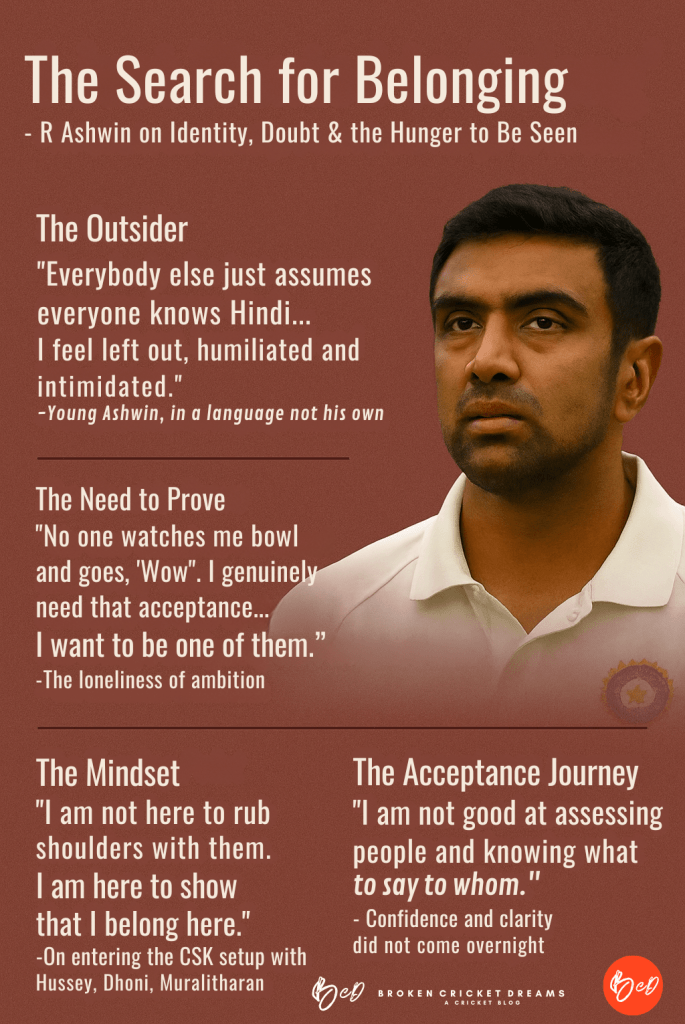
2. “Everybody else just assumes everyone knows Hindi and sets off speaking their own version of Hindi. I find it rude and alienating that no one makes an effort to talk to the one boy who doesn’t know their language…I feel left out, humiliated and intimidated.”
3. “No one watches me bowl and goes, ‘Wow’…I genuinely need that acceptance, though, to lose that feeling of being in awe all the time. I want to be one of them as soon as possible. So I’m always trying to analyze how they are looking at me. What is running through their heads? Do they think I am a proper cricketer or just a guy to make up the numbers.”
4. “I am not good at assessing people and knowing what to say to whom.”
5. “I am amazed that even Murali has self-doubt….These are inhuman expectations of him, but he doubts himself too, just like other humans.”
Life Lessons #1: External pressure, internal fears, and the desire to belong, they are all part of life. The key is to stay grounded in who you are and turn those doubts into positive energy.
Proving a Point, Over and Over Again
Whether it was the Ranji Trophy, the IPL, or the Indian time, Ashwin has had to prove himself over and over again. His interests in movies and engineering degree already made him a well-rounded person, and switching from a batter to an off-spinner made him a cricketing all-rounder. Resetting and performing repeatedly in different areas of life speaks to the strength of his mental resolve.
6. “Not for the first time, I find myself in a situation where nobody gives me a chance. I suspect nobody wants to give me a chance. My response is the only one I know: work harder, run harder, push harder.“
7. “Anirudha and I show up, we sign our contracts, and then VB gives us a glorious speech on what a huge opportunity this is. ‘You guys will rub shoulders with the likes of Michael Hussey, M.S. Dhoni, Matthew Hayden, and Muralidaran’…listen to it earnestly but also think to myself, ‘I am not here to rub shoulders with them, I am here to show that I belong here.'”
8. “It has been such a quick turnaround. From being a batter who bowled some seam-up, I am now an offspinner with one-and-a-half successful first-class seasons behind me.”
10. “One of the three streams offered to me, I pick computer engineering….I feel like I will die trying to balance studies and cricket. It feels like these four years of my life will never end…Every day is a hustle, trying to manage both college and cricket.”
Life Lesson #2: Challenges will come. And when they do, channel your inner R Ashwin and work harder, run harder, and push harder. In striving to prove a point, you may just discover excellence.
Always Asking, Always Evolving
Ashwin has kept evolving his game throughout the years. He has changed his action numerous times, invented new deliveries, and even became a T20 finisher.
But how did he get here? Ashwin evolved because he never stopped asking questions. From local bowlers to legends, he kept learning.
9. “It is during one of these [tennis ball] games that I come across SK. He has a beautiful and correct offspinner’s action, but the ball turns in weird directions and zips off the dusty surfaces…He is a bit of a terror in these matches. I am completely fascinated by what he does with the ball. So I start shadowing him. I take my bike and ride to wherever he is playing…I finally approach him to ask him how he does is. He is nice enough to show me that he flicks it with the middle finger and sends it out of the front of his hand when he wants to turn in the other way…In Madras, it is called the sodakku ball.”
11. “…Haydos’s company. I hesitate to speak with him; I wait for him to finish whatever he is doing and then introduce myself. He is extremely friendly. I ask him all the kinds of questions, and he patiently answers. I suspect he enjoys having conversations…How do you deal with pressure? How do you face Murali? How do you stand at slip for Shane Warne? I’ve watched you take some great catches; what is your mindset at slips?”
Influence of WV Raman and MS Dhoni
The most compelling moments in the book come from R Ashwin’s experiences with his mentor, WV Raman and his first early interactions with MS Dhoni. With Raman, you can vividly picture Ashwin honing his skills and elevating his craft. With Dhoni, you witness the foundation of a partnership that would shape Indian cricket for the next decade.
12. “Raman and I are made for each other. For the life of me, I can’t keep repeating the same thing. And Raman the coach comes up with something every day to help me keep discovering sping bowling to the fullest. One fine day, he tells me, run in 5 percent slower. Then another day, run in 10 percent faster.”
13. “…but Raman told me taking the new ball was the wrong call. And I told him, we had them nine down, trusted my seam attack, and they didn’t deliver…Raman said, ‘No, you’re wrong. Own up to your mistake. And do not come and tell me they didn’t deliver. If they didn’t deliver, you have a part in it.”
14. “When it comes to cricket, I am basically made of questions. MS doesn’t discourage me and answers every single question sincerely. He never brings up the optional nets either.”
15. “Each captain is different. Some can make donkeys run. Some people can buy wounded horses, treat them, train them, and make them run. But M.S. Dhoni will only make a racehorse run. He needs to be convinced you’re a racehorse before he makes you run. He will wait for a racehorse. If he doesn’t believe you’re a racehorse, he’ll probably give you time to become one, but he won’t make you run if you aren’t there yet.”
Life Lesson #3: Growth begins with curiosity. Ask questions. Stay open. The more you seek, the clearer your path becomes.
Indian Cricket Through Ashwin’s Eyes
Ashwin’s love for Indian cricket comes through in the way he speaks about his peers and predecessors.
16. “Tennis-ball cricket is a massive phenomenon in Madras. During the summer break, you can’t pass through a neighbourhood without witnessing at least one intense match going on in the sector ground. You don’t need a proper turf, a pitch or equipment for these games. It is a pure expression of love for the game and competition.”
17. “The other is Cheteshwar Pujara, who is only 15 and has already scored a triple-century in Under-14 cricket….There is an aura around him, an aura of thousands of runs.”
18. “And there are some ruthless players of spin going around…Shiv Sundar Das, Mithun Manhas, Halhadar Das, Robin Uthappa, Yere Goud, Rajat Bhatia, Sanjay Bangar…S. Bharat & Badri.”
19. “I, though, have seen the future of Tamil Nadu cricket and Indian cricket. His name is Dinesh Karthik. He is unlike any player I have seen in Chennai.”
20. “What makes this extra special for me is that Pravin Amre has stuck his neck out for me and overruled the other selectors because I batted in both of the morning sessions and actually scored some runs. This is what we had heard about Bombay: tough runs are valued there.”
Life Lesson #4: India’s cricketing soul doesn’t live in the big stadiums or in the IPL. It lives in the gullies and streets. That’s where toughness is built, where stories begin, and where Indian cricket comes to life.
Dreams Deferred, Dreams Passed Down
Finally, you get to learn about Ashwin’s family life. The sacrifice made by his parents, the dreams of his father, and how it came together with the 2011 World Cup final win. You also get to see Ashwin’s humor and his love for cinema.
21. “All those years ago, Appa traded his dreams for the job security provided by the Indian Railways, also his father’s employer. Ironically, now, a tardily running Indian Railways train is the way of his son’s, and I suspect his own renewed, dream.”
22. “Appa loves his cricket. He is a lower-divison league cricketer, a fast bowler. I am told he is a very good tennis-ball cricketer as well. My oldest memory of cricket is watching him take a wicket on a weekend. He bowled out somebody, sending the bail flying.”
23. “Thatha didn’t allow him to pursue cricket because he didn’t earn enough to raise the family and also provide for his cricketing needs. Appa doesn’t want the same to happen to me. His biggest worry is our orthodox extended family. Sometimes, even Thatha tells him cricket is not going to put food on my plate.”
24.”The movie Chennai 600028 is still fresh in our memories. It is also based on street cricketers. In our minds, we are in a movie.”
25. “Boy, I’m telling you, you’re a really really special cricketer,” Gary tells me…The kind of strides you made from 2009 to 2011 in every aspect of your game…See, everyone comes in here with what they’re good at and also their weaknesses. They continue to play to their strengths, and they try to hide their weaknesses, but very few come in with their strengths, evolve with their strengths, know what their weaknesses are, and work on those weaknesses.”
Life Lesson #5: Behind every dream fulfilled is a sacrifice quietly made. Sometimes, the dreams of one generation find life in the next. It truly does take a village to raise a child.
So, What Can We Learn from R Ashwin?
When I was younger, I liked R Ashwin, but the more I’ve seen him evolve, the more he’s become one of my favorite cricketers. Not just for the skill, but for how he thinks, adapts, and stays true to the game.
So, what did I learn from him?
Ask questions, Own your mistakes. Keep on evolving. Keep adapting. And above all, never stop loving what you do.
Let’s get right to it, here’s a review of I Have the Streets: A Kutti Cricket Story by R Ashwin and Sidharth Monga.
Is R Ashwin’s I Have the Streets: A Kutti Cricket Story Worth your time?
Absolutely. This is a must-read for cricket fans, especially those who have followed Ashwin but never understood how he became the cricketer he is today.
Given Ashwin’s public image as ‘The Scientist,’ I was expecting a book filled with technical breakdowns and tactical detail. What I found and what makes this book so special is how much it humanizes him.
Ashwin is not just a cutthroat competitor who is ready to run you out once you step out of the crease. He is just like any of us: a boy with a dream, a man with self-doubts.
Through his story, you see someone who loves the game deeply, questions everything, and constantly tries to better himself all while navigating health issues, isolation, and a bit of awkwardness.
It is not just a book about cricket. It is a story about belonging.
Read It For
Understanding a cricketer’s view of the Indian cricketing ecosystem from tennis ball matches, grade school cricket, all the way to the international stage
Ashwin’s early impressions of the likes of Pujara, Jadeja, Aniruddha Srikkanth, his awe for Laxmipathy Balandy, Dinesh Karthik, and the broken dreams of S Sharath
Learning how Ashwin got into the game with stories about his father to his memories of watching Tendulkar in Chennai
Mentorship with WV Raman and what practice Ashwin did to take his game to the next level
His playful nostalgia when describing his street cricket friends:
“Sai Kumar, the proper corporate guy. Vivek, a failed cricketer…Raj Kumar, the ‘Jacques Kallis’ from the Silver Foxes.”
You get to learn about local teams like Jolly Rovers and Alwarpet, how Ashwin found the carrom ball from local cricketer SK, how his views around the rules of the game evolved, his awkward interactions, his fitness struggles and burning CDs from an analyst to look at his own game. You learn about his batting development, evolution into a spinner, and changes in action.
The book has no fluff, it gets straight to the point moving from incidents to the incidents, season to season.
Don’t Read It For
A career biography. The story ends with the 2011 ODI World Cup win. If you were expecting dressing room insights about Indian cricket from 2011-2024, you won’t find them here. You will find some glimpses of his rise between 2009-2011, but this is more of a memoir than career in retrospect.
Rating: 4.5/5
⭐⭐⭐⭐⭐
Rating: 4.5 out of 5.
I Have The Streets Where to Buy, and Details
Title Name:I Have the Streets: A Kutti Cricket Story
Authors: Ravichandran Ashwin and Sidharth Monga, Foreword by Rahul Dravid
Publisher Summary: “Ravichandran Ashwin is arguably the greatest match-winner for India in Test cricket. The fastest man to 300 Test wickets, he was a part of the team that won the 2011 World Cup in the ODI format. In T20 cricket, he has won two IPL titles and a Champions League T20. He is a feisty offspinner and more than a handy batter. But that’s only half the tale.
This nuanced portrait delves deep to paint a candid picture of a cricketer’s life before cricket―his struggles with health issues as a child, a middle-class family’s unwavering fight and determination to give him the resources he needed for a professional career in the sport, and the little joys of growing up in a cricket-mad gully.
How does a champion sportsman view the world? What drives him on and off the field? One of the more articulate and thoughtful cricketers, in this book, R. Ashwin tells his story with Sidharth Monga.”
Publisher: Ebury Press (an imprint of Penguin Random House)
Release Date: January 7, 2025
Length: 173
Thank you all for reading! If you read the book, what were your thoughts?
RCB finally ended their IPL drought after 18 years. Now South Africa are chasing that glory moment of their own.
After both the women’s and men’s teams fell short in T20 World Cup Finals, the Proteas have one more chance to life an ICC trophy. But they’ll have to go through Australia.
For the neutral fan, it doesn’t get much better than this. South Africa vs Australia at Lord’s. Two teams raised on pace and bounce, now tested under England’s gloomy skies and swinging ball.
What more could you want from a World Test Championship final?
For South Africa, this is more than just a final. It’s the weight of decades.
Just as the the wounds of 1999 began to fade, fresh ones arrived in 2015 and then 2024, with both women’s and men’s team falling at the brink of glory.
And yet, here they are again. Will 21st time be the charm?
“This isn’t just a match. It’s 40 years of South African pain bottled into five days at Lord’s.”
Australia
For Australia, this is familiar territory. Another final, another title in sight. But there are some interesting underwritings for Australia as well.
This could be the last time we see the quartet of Smith, Starc, Hazlewood, Cummins, and Lyon take the field together in a major series or at least in a final.
Australia arrive with tons of experience: 772 Test caps across the squad, including 136 from Nathan Lyon alone. South Africa, on the other hand, only have 367 Test caps.
A team that knows how to win finals against one trying to believe that they can.
Not long ago, Marnus Labuschagne was averaging over 60 in Tests and was hailed as Steve Smith’s natural successor. Since 2023, that number has plunged to 31.54 with only 1 century. His recent first-class form is no better — scores of 23, 0 & 61, 0 & 4, and 23, the last two coming with Glamorgan in County.
Marnus returns to the country that brought him to limelight against the place of his birth. Can he rediscover his edge when it matters the most?
You simply cannot bet against Steve Smith here. Smith thrives in England: 2,255 runs at 55.00, including 8 centuries. His numbers against South Africa are more modest compared to his otherwise Bradman-esque standards (44.94 average with 2 tons).
Fun Fact:In England, Steve Smith has scored almost three times as many runs as the entire South African team combined.
Marco Jansen vs Cameron Green: The All-Round Battle
Jansen and Green represent different brands of modern-day Test all-rounders. Both have the height, Jansen brings more swing and lower order fight, while Green is a solid batter that bowls when he is required.
Extremely valuable to their sides, if either Jansen or Green get going, they can turn the match.
Rabada vs Head: Tempo vs Temperament
Travis Head can win a session on his own, but Rabada is known to strike frequently.
He takes wickets every 39.4 balls and has an average of 22.4. Already a South African great with 327 wickets, he will want to go the next level and win them the title. And don’t forget, he has a point to prove after his recent suspension.
And then there is Aiden Markram. He might just light up the final with a few of those beautiful cover drives even if his stay is brief.
Squad: Scott Boland, Matthew Kuhneman, Beau Webster
Final Thoughts and Predictions
Social media’s buzzing over Josh Hazlewood’s insane record in finals — 9 out of 9 wins. Can he make it a perfect 10?
This may be South Africa’s best shot at a global title. But under cloudy skies, on a Lord’s pitch that offers something every session, it’s hard to look beyond the Australians — especially that bowling unit.
Broken Dream?
Final Test for Nathan Lyon? His rival, R Ashwin retired a few months ago. This is a season of Test retirements, will this by Lyon’s final hurrah?
Prediction
Heart says South Africa, mind says Australia. But I’m going with my gut: South Africa will win a close match.
Rabada knocks over Khawaja early
Cameos from keepers Carey & Verreyne
Gritty knocks in the second innings by Bavuma & Khawaja
Jansen and Hazlewood use the swing, Jansen dazzles with all-round show
Steve Smith left stranded as the lone warrior
Australia have the experience, but you cannot count South Africa out. Test matches are won in moments, and the Proteas have waited a lifetime to create theirs.
That’s it from me. What are your predictions? Comment below or share on social media!