Imagine it is the 1940s. You are working at Bell Labs, one of the world’s premier research laboratories, an abode of inventions. Computers are at the beginning of their evolution, and programming still occurs on punched cards.
You work day and night in the week, and guess what? One error in the code and the program stops. Hard work down the drain. On the bright side, the machine detects and warns you that there is an error.
So as a brilliant scientist who has been a part of the Manhattan Project, what do you do? You work nights & weekends and develop an algorithm so that the machine can itself correct the errors, without the need for human intervention.
The year is 1950. You have published this paper and revolutionized computer science & information theory.
Now fast forward to the 2004. You are playing for the Indian national cricket team, one of the world’s premier cricketing nations, an abode of talent. Wicketkeeper batters are at the beginning of their evolution, and finishing limited over games is still at its infancy.
You work day and night on tours, and guess what? One poor series, and the selectors drop you. Hard work down the drain. On the bright side, selectors warn you that you have to play a different role in order to come back.
So as a budding young cricketer who has been a part of the 2004 U-19 World Cup, what do you do? You practice day in and day out, improve your technical faults, and comeback as a successful opener in swinging conditions to help India win a series in England in 2007.
A few months go by. Inconsistency creeps in. Dropped.
Lather, rinse, repeat.
The year is 2021. You have claimed your fame to glory in that Nidahas Trophy final and revolutionized the role of a finisher.
Your name is Karthik, Dinesh Karthik.
…
Dinesh Karthik’s story is not in the career averages or amount of runs scored. Neither is it in number of comebacks. It is in the way the comebacks were constructed. Over the years, inconsistency has decreased, reassurance has increased, and in his own words, he has managed to stay ‘relevant.’
In simple terms, he has perfected the art of self-correction.
Dinesh Karthik’s Initialization
Algorithms have improved vastly since the Hamming code days. Yet, there are three main components of a self-correcting algorithm: Initialization, self-calibration, and error correction.
Under-19 Days
On the back of good domestic form, Dinesh Karthik was selected for the 2004 U-19 World Cup. This team included future Indian nationals in Robin Uthappa, Suresh Raina, Shikhar Dhawan, Ambati Rayudu, and RP Singh. Following a decent domestic and India A season, he found himself in the national reckoning alongside Parthiv Patel as India were trying to find a permanent replacement to makeshift keeper in Rahul Dravid.
He would not bat in an ODI for another two years, but was picked for Tests against Australia, South Africa, Bangladesh, Pakistan, and Zimbabwe. After having a top score of only 46 in his first six Tests, he finally made a mark scoring 93 in the second innings against Pakistan. However, a loss of form and Dhoni’s memorable 148 at #3 in that Pakistan ODI series meant Karthik was briefly dropped from the Test side and traveled only as a reserve keeper for the next year.
One of the interesting traits of Karthik’s unusual career has been that when he is dropped in Tests, he finds a place in ODIs and vice versa. Later in his career, he was recalled in ODI & Test cricket based on his T20 form.
Case and point is 2006. Karthik enjoyed a good run in the limited overs although he was out of the Test side.
Although he would not get a game in the ODI World Cup, he played as a pure batter in the inaugural T20 World Cup with Dhoni behind the stumps. Low scores followed in the T20 World Cup, but he provided India with a bit of magic in the semi-final—a one handed diving catch to dismiss Graeme Smith.
Nasser Hussain on commentary summed up Dinesh Karthik’s entire career accurately in one sentence
“They say Dinesh Karthik is the two extremes—he drops dollies and he takes some spectacular catches.”
Error Correction Part I: Karthik’s Golden Year in Test Cricket
The year 2007 was DK’s best time in Test cricket.
By this time, it was clear that he could not make the XI based on his keeping skills alone. The Fab 4’s presence meant that the middle order was crowded. However, Sehwag & Gambhir had been dropped, which meant there was a slight opening.
Enter Dinesh Karthik 2.0—the opener. With Wasim Jaffer, he formed a brief yet formidable partnership.
In the third Test at Cape Town, the Jaffer-Karthik experiment paid dividend with a 153-opening partnership in the first innings. Karthik scored 63 as an opener and followed it up with 38* at #7.
In the tour of Bangladesh, he was given a permanent opening spot and returned with scores of 56, 22, and 129, his only Test century. Then, came India’s tour of England. Despite not scoring a hundred, scores of 60, 77, & 91 meantthat he ended up as India’s highest Test scorer—263 runs, 3 fifties, 518 balls faced to go along Jaffer’s 409 balls, which helped India successfully dent the new ball.
“It’s good story Dinesh Karthik. He began life as a dashing middle order batsman and wicketkeeper, and he has been transformed really into an opening batsman of substance.”
India historically won 1-0, India’s first victory on English soil in 21 years (a decade of horror shows the significance of that series victory).
Pushed back to the middle order after just 2 more Tests, he could only muster 157 runs in 11 innings with a best of 52 against Pakistan, Sri Lanka, and New Zealand. He would get another opportunity in Tests in 2010 before being dropped for another eight years.
On his come back against Afghanistan’s inaugural Test in 2018, he himself said in a press conference that in his earlier stint in Test cricket,
“I guess I wasn’t good enough before… I was not consistent enough.”
When he was out of favor in Tests in 2008, he did receive several opportunities in ODIs, scoring a few middling scores and featuring in India’s 2009 Champions Trophy squad. His best ODI innings of 79 runs came in 2010 with a 196-run partnership with Sachin Tendulkar during his historic double century.
14 innings later, with only 1 50+ score & 2 ducks, he was dropped—this time for three years.
Error Correction Part II: Dinesh Karthik, Journey To The Center Again
More competition, more errors, longer time to fix. Enter Dinesh Karthik 3.0—the middle order batter.
It took a 3-year hiatus before Karthik stormed back. In IPL 2013 as the #3 batter for Mumbai Indians, he amassed 510 runs, only behind Rohit Sharma for MI. The innings where his highest score that season of 86 was possibly his best IPL innings (so far).
This performance earned him a ticket on the 2013 Champions Trophy and his best ‘List A’ moment came in the warm-up games, when he scored two back to back centuries, scoring 106* & 146* batting at #6. This tournament is fondly remembered for the beginning of the Shikhar Dhawan-Rohit Sharma opening partnership, which meant Karthik did not get much of a chance with 51* against West Indies his best knock.
A few months later, India failed to qualify for the Asia Cup finals and Karthik’s 21* vs Afghanistan would be his final innings for yet another 3 years.
Let us take a slight detour like his career took around 2014.
What is your favorite part about watching Dinesh Karthik? For me, it has always been his unconventional demeanor, starting from his batting routine. The moment he arrives at the crease, it is pure theater. Walking in with urgency, rolling the gloves around, dancing from side to side, taking guard, moving his helmet, meditating on the side. Excitement and apprehension at the same time.
As a keeper he is always chirping and speaking to the bowler, most famously with his partnership in KKR with Varun Chakravarthy or with R Ashwin in Team India.
But surely, so much energy must definitely be a burden. A volcano ready to erupt if the energy is not channeled properly.
A Nervous Bundle of Energy
In order to come back to the Indian national side, DK needed to recalibrate.
In a Breakfast With Champions interview with Gaurav Kapur, he described the time with Abhishek Nayar as a ‘mental bootcamp.’ 40-lap swimming, 45-minute uphill runs, sweeping the house, visualizing match scenarios, and extreme fitness training pushed DK out of his comfort zone. He reflected that
“When you push yourself out of your comfort zone when nobody is watching you and there is no glory attached to it and you just do it quietly because somewhere in life you want to achieve something, overall in time it does help you.”
This experience added an extra dimension to DK’s wide array of skills. He was always a good player of spin, but once he was in a good head space post-Nayar, he literally reinvented his batting—the sweeps, laps, reverse sweeps, and swivel across the crease came with increased frequency.
Errors Correction III – Consistency in Domestic Cricket
While his 2013 comeback was largely on the backs of the IPL, the 2017 comeback was due to the weight of runs in domestic trophy. He was among the runs in Ranji Trophy and has been consistent in the Syed Mushtaq Ali Trophy for the past five years.
At the peak of his batting powers, DK was hitting the ball as nicely as anybody at that time. Sanjay Manjrekar stated that at that time, Dinesh Karthik and Hardik Pandya were the only two Indian batters who could time the ball from ball one.
By this time, the pattern was set. Another Champions Trophy, yet another come back. Although he did not make the XI, in the next few matches after the trophy he scored 50*, 48, 37, 64* in consecutive games across ODIs & T20Is. It was a signal that he had added consistency to his arsenal.
Accuracy Improvement – Dinesh Karthik, The Finisher
After grinding it out in domestic cricket and becoming a much more calm and mature individual, it was time for Dinesh Karthik 4.0 to enter—Dinesh Karthik, the finisher.
From after the 2017 Champions to before the 2019 Cricket World Cup, DK slowly grew into the finisher role, remaining not-out 20 times out of the 35 ODIs or T20Is he played in.
After 14 years of sharpening his skills, beast mode was finally unlocked in the Nidahas Trophy in Sri Lanka.
Short & sweet contributions in every game: 13* (6), 2* (2), 39* (25), 2* (2), and 29* (8). He could not be dismissed throughout the series.
The final was a night to remember. With Mustafizur’s wicket maiden in the 18th and a struggling Vijay Shankar at the other end, hope was all but lost.
The Night of the Final
Then comes in Dinesh Karthik. Rubel Hossain steams in and attempts a yorker. DK sits back and hits it over a long on for six. There is still life left in the game. Then came a heave for four and another one for six! Colombo crowd is going wild.
Couple of balls later, Karthik moves around crease and scoops it over fine leg—22 run over.
Final over, DK off strike, India need 12.
Wide, dot, 1,1, 4 (Shankar), Out. Five runs, one ball, one man. Over pitched delivery outside the off stump, DK times it with a full follow through. FLAT SIX. INDIA WIN! Captain Rohit Sharma said that DK was a bit upset being moved to #7, but he managed to channel the anger into good effect.
Given that India have not won a major ICC trophy since 2013, this memorable win stands at a high place for Indian fans. With 120 million and 211 millionviews for the 19th and 20th over respectively, this is easily the most watched cricket video (and possibly any sports video). Relive those moments below.
The Comeback Ends & The 2019 Cricket World Cup
He continued his Nidahas Trophy form in IPL 2018 with the Kolkata Knight Riders franchise, scoring 498 runs at 49.80 with a strike rate of 147.77.
However selection across formats would come back to haunt him. He would make another comeback in Test cricket, but scores of 4, 0, 20, 1, 0 would be the end of his Test career. He would be in and out of the limited overs side, sometimes batting at #4 in Asia Cup ODIS, and sometimes almost finishing T20Is in New Zealand.
A score of 97* in IPL 2019 followed as he narrowly made the cut in the World Cup squad.
The Russian Roulette selection among Dinesh Karthik, Kedhar Jadhav, Manish Pandey, Rishabh Pant, Vijay Shankar, and most infamously, Ambati Rayudu probably hurt all five and India in the 2019 Cricket World Cup semi-final. Surprisingly promoted to No. 5, he tried to stem the fall of wickets before Jimmy Neesham’s brilliant catch ended his ODI career.
Is There Another Comeback On The Horizon?
He was one of the casualties of India’s post-tournament analysis, even dropped from the T20I side, where he had reasonable success.
Post-COVID, he had a tough time at the 2020 IPL, averaging only 14.08, his second worst season. Although he took KKR to a playoff spot in 2018, he would relieve captaincy duties to Eoin Morgan for the remainder of 2020 and 2021.
Since then, he has been vocal about fighting for a place in one of the T20 World Cups in the next two years purely as a finisher. Still the best finisher in India alongside Ravindra Jadeja & Hardik Pandya, the real question is, will we see DK 5.0?
Commentary Stint and The T-Shirt Collection
Even though we do not know his cricketing career will pan out, there is already a brief glimpse into the future.
He has become a social media celebrity with his Sky Sports stint providing apt analysis, providing daily weather updates, and most famously, showing the world his enviable T-shirt collection.
Karthik’s Legacy: Did he underachieve or overachieve?
Representing your nation in one international tournament is is an honor. In a topsy-turvy career, Karthik has somehow managed to be a part of the 2007 ODI World Cup, 2007 T20 World Cup, 2009 Champions Trophy, 2013 Champions Trophy, 2017 Champions Trophy, and the 2019 ODI World Cup. Sprinkle a couple of Asia Cups in there as well.
There are two school of thoughts on Dinesh Karthik’s career. Did he fulfill his potential? Maybe. Maybe not.
From a glass half empty perspective, one can observe that as a gifted batter and a giant in domestic cricket, he could not make most of his opportunities and cement a place in the Indian national team. On the other hand, he never got an extended run in one format at a time, constantly playing in different roles and formats. Hence, the fact that we are still talking about him after 17 years is still an achievement.
DK’s career consisted of memorable high peaks in a relatively plateau of a career. Opening in England, twin List A tons in Champions Trophy warm ups, winning an IPL Trophy with Mumbai Indians and T20I World Cup in 2007, stumpings and catches galore, and giving fans the Nidahas Trophy Final to cherish, he has made his mark.
“Even if I don’t get the opportunity to play sport at the highest level, I want to be content with the fact that I have given it everything I have had. Not only on the field, but off the field.”
The Road Less Traveled By
Robert Frost wrote in his famous poem The Road Not Taken
Two roads diverged in a wood, and I— I took the one less traveled by, And that has made all the difference.
When India needed a wicketkeeper, Dinesh Karthik was a wicketkeeper. India needed an overseas opener, in came DK, the opener. When they needed a #4, he became a #4. Finally, when all the spots were filled, he became a specialist finisher.
Although he was an anomaly in the previous era, current Indian wicketkeepers might keep an eye on his career very carefully. It is likely that not all of KL Rahul, Rishabh Pant, Sanju Samson, Ishan Kishan, KS Bharat will get a constant run. So they should be prepared to be dropped and come back stronger, maybe with a different role.
Dinesh Karthik’s career might not have gone according to the original plan but his journey has been interesting nevertheless. He modified his approach, adapted to the circumstances, and always strived to improve his individual game.
What Can We Learn From Dinesh Karthik?
Numerous players were dropped at an early age and could never find a way to come back. Others could manage to comeback only briefly because they were pigeonholed to a single role. Karthik frequently took the road less traveled by, refined his old skills, while learning new ones at the go.
When he arrived in the international arena, he was a good player who had the potential to excel in three formats and don several roles. After years of repetitive self correction and recalibration, he has now developed his own unique niche—overs 16 to 20 as a T20 finisher, a position where he is the best. Power-hitters like Pollard, Russell, and Pandya might be better finishers in general but not many have the match awareness and can play the field as Karthik does in those end overs.
So what can we learn from Dinesh Karthik? Always be self-aware, prepare for the worst, focus on the process, wear nice shirts, be yourself, adapt to the surroundings, be ready for the opportunity, and provide energy to others around you.
I would love to finish this article with a bang, but what can I say—The finisher is not yet finished.
The Stats
Test: 26 matches, 1025 runs, 25.00 average, best of 129, 100s/50s – 1/7, 57 catches, 6 stumpings
ODI: 94 matches, 1752 runs, 30.20 average, best of 79, 50s-9, 64 catches, 7 stumpings
T20I: 32 matches, 399 runs, 33.25 average, 143.52 SR, best of 48, 14 catches, 5 stumpings
T20: 321 matches, 6221 runs, 27.40 average, 133.55 SR, best of 97*, 193 catches, 61 stumpings
IPL & Dinesh Karthik’s Career In a Nutshell
2004: ODI, Test debuts
2004-05: Tests only
2006: T20I debut, ODIs only
2007: ODI World Cup, Test opener, T20I World Cup (winner), Syed Mushtaq Ali winners (captain)
2008: 1 T20I, 3 Tests only, Delhi Daredevils
2009-2010: Mostly ODIs, some T20Is, 1 Test, Delhi Daredevils
2011: Kings XI Punjab
2012: Mumbai Indians
2013: ODIs only, Champions Trophy winner, Mumbai Indians (winners)
2014: ODIs only, Delhi Daredevils
2015: Royal Challengers Bangalore
2016: Gujarat Lions
2017: Champions Trophy, ODIs, Gujarat Lions
2018: T20Is, Nidahas Trophy, Test recall, ODI #4 battle, Kolkata Knight Riders (captain)
2019: T20Is, ODIs, ODI World Cup, dropped, Kolkata Knight Riders (captain)
2020: Kolkata Knight Riders (captain, 7 matches)
2021: Syed Mushtaq Ali winners (captain), Kolkata Knight Riders
“The lead up to the [2008 auctions], Dinesh Karthik the person was convinced the best player from Tamil Nadu, the biggest name from Tamil Nadu playing for the country…definitely CSK were going to pick me. The question was whether they were going to make me captain or not….It was the biggest dagger to my heart. It’s been 13 years and I am still waiting for that elusive call from CSK”
As acclaimed twentieth century writer Khalil Gibran once remarked, “Exaggeration is truth that has lost its temper.”
India’s improbable victory in the 4th Test sent social media into frenzy. There were claims of it being the ‘greatest Test team’ going around or the ‘best Indian Test team.’ Although there is subtle merit to these claims, I argue that this is just an over exaggeration of the ground reality.
How Good Are Team India?
There is no doubt that the Indian cricket team has flourished in the 21st century. With a thriving cricketing culture, robust recruitment setup throughout the country, monetary power in the hands of the BCCI with the advent of the IPL, and a prospering India A system, India has the greatest depth and resources available.
The rise of Mohammed Siraj, Washington Sundar, Shardul Thakur, Axar Patel, Suryakumar Yadav, and Ishan Khan across formats in less than six months attests to this claim.
Overseas Victories
India came back from 0-1 to seal the Border-Gavaskar series 2-1. Stories galore and the legend of this series will carry in the minds of fans forever. Similarly, a defeat in the third Test against England did not faze India. In the 4th Test, a 99-run deficit was overcome via valiant century by Rohit Sharma and memorable contributions in both innings by Shardul Thakur.
To give you an idea how far India have come along—This is India’s 4th victory in Australia & England since December (and 8th in Australia, England, South Africa since 2018). In the decade before, India’s only moments of glory in England & Australia were Headingly 2002, Adelaide 2003, England series 2007, and Perth 2008 (coincidentally Rahul Dravid contributing with 148, 233 & 72*, captain, and 93). So this 2-1 series victory (almost) should hold well with the Indian fans, especially after the suffering endured in the 2010s.
This Indian team is good. Really good. They have the spirit to come back from any circumstance, and they just never give up. The attitude instilled by Ravi Shastri-Virat Kohli is evident in the body language of each and every player.
However, is this team the best? I do not think so.
Collapse A Day Does Not Keep The Doctor Away
Team India is brilliant at comebacks, but why is there a need of comebacks in the first place?
The 2000s Australia team set the benchmark for Test greatness. Did you ever hear them coming from dire circumstances? Well, not much because they were so dominant, a comeback was not even necessary.
The same is true for the current World Test Championship winner, the New Zealand cricket team. When they win, they win emphatically.
If India are to instill their greatness in cricketing folklore, they must replicate their home dominance away as well.
Current Batting Side Does Not Fire In Unison
KL Rahul, Rohit Sharma, Cheteshwar Pujara, Virat Kohli, Rishabh Pant, and Ajinkya Rahane are all good batters individually, but they have rarely fired in unison.
When the top order bats at its best, the middle order collapses. When Pujara-Pant come together, the rest of the batters have already gone to the pavilion. Kohli is not back at his best yet and Rahane seems to have fallen off the charts altogether.
Even in the horrendous tours of 2011 and 2014, I do not remember performances like 36/9 or 78/10, let alone two. The batting collapses occur too frequently to be regarded as a modern great. What made the Sehwag-Dravid-Sachin-Laxman-Ganguly era great was their consistent overseas batting performances without having the caliber of fast bowlers at their disposals in the nets to practice with.
Now India finally has the bowling attack to take 20 wickets consistently, but a batting line up that is not even close.
Greatest Indian Bowling Attack
The reason India is succeeding away from home can be attributed to two factors: (1) comparatively lower standard of opposition, and (2) fast bowling unit.
Ishant Sharma, Mohammed Shami, Jasprit Bumrah, Mohammed Siraj, Bhuvneshwar Kumar, Shardul Thakur provide regular breakthroughs while Jadeja and Ashwin can play both as wicket-taking options and chief controller depending on the conditions.
Since the South Africa tour of 2018, Indian bowlers have taken all 20 wickets by pace on numerous occasions. Injury replacements are readily available as well.
So is India Good, Bad, or Just Okay?
The bowling attack? The best in their nation’s history. Their batting? Eh. Not so hot.
India might have one of the best line ups on paper but are definitely not the best Test team going around. Or at least just not performing to their full potential yet. The flaws in India’s team performance combined with miraculous comebacks and recency bias actually amplify the degree of their quality. India are so bad sometimes that it brings out the best in the team. Still a long way to go achieve dominance.
In other words, India are so bad that they are actually good. Think about it.
We bring to you the list of best Test matches over the past four years. Thrilling finishes galore! Who said Test matches are boring?
by Nitesh Mathur, 08/27/2021
West Indies’ 1-wicket victory against Pakistan and India’s comeback at Lord’s have added another couple of great matches in our memory banks. We have seen some exhilarating Test cricket in the past couple of years.
If there was ever any doubt on the quality of Test cricket, here are 18 matches that have revived Test cricket in the past 4 years.
Match Summary: Pakistan: 376 & 174/8 declared; West Indies: 247 & 202
Player of the Match: Roston Chase
The Tension
After 95 overs of resistance, with only 7 balls to go for a valiant draw, Shannon Gabriel heaves Yasir Shah and gets bowled. Roston Chase stranded on 101* (239) after batting for an epic 366 minutes. Strategic stroke or brain fade from Gabriel?
Pakistan’s first ever series win on West Indian soil as they claim the the series 2-1. Misbah-ul-Haq & Younis Khan retire in style in this famous “Mis-You” series.
In their first innings, Australia had collapsed from 161-1 to 202-10. In the second innings, they had 462 runs to chase or 140 overs to bat. And 140 overs they batted. The man of the hour was Usman Khawaja – 85 (175) & 141 (302), batting for a total of 766 minutes (around 13 hours) to give Australia one of their most savored draws.
Commentary/Winning Moment
“It was assumed that Australia would lose that Test match. What Australia was looking for…was a test of character” – Amazon Prime The Test
Significance
This was Australia’s first true moral victory since Steve Smith & David Warner were banned. Usman Khawaja had never truly solidified his place in the Australian XI, but this innings ensured his career would always be remembered due to this legendary knock.
Match Summary:New Zealand: 153 & 249; Pakistan: 227 & 171
Player of the Match: Ajaz Patel
The Tension
In a chase of 176, Pakistan collapsed in the most Pakistan fashion from 147/4 to 171/10. With a mandatory run-out of course. NZ somehow won by 4 runs. Ajaz Patel with a 5-fer on Test debut.
Commentary/Winning Moment
“And what a victory for the New Zealanders. They deserve it. WOOW! …It’s an unbelievable victory for New Zealand. You can see how much it means to them.” Commentary Video
Match Summary: South Africa: 235 & 259; Sri Lanka: 191 & 304/9
Player of the Match: Kusal Perera
The Tension
In a mammoth chase of 304, Sri Lanka were struggling at 110/5. What followed was a knock for the ages. Kusal Perera hit a miraculous 153* (200) with 12 sixes & 5 fours. The last wicket partnership between Perera & Vishwa Fernando was 78*, with only 6* (27) coming from Fernando’s bat.
Commentary/Winning Moment
“He’s done it! He absolutely does it. One of the greatest see from a Sri Lankan outside Sri Lanka…What a historical day at Durban.” Watch the winning moment here, a contender for the greatest Test match innings of all time.
Significance
Sri Lanka go on to win the series 2-0. First time anAsian team won a Test series in South Africa.
Match Summary: Australia: 179 & 246; England: 67 & 362/9
Player of the Match: Ben Stokes
The Tension
Despite being a wonderful series to watch all around, the thunder was stolen by Ben Stokes’ 135*, Jack Leach’s glasses, Nathan Lyon’s run out opportunity, and Tim Paine’s missed DRS review. A 76* (62) partnership for the final wicket. Oohs & Aahs. Reverse sweeps, scoops, and hoicks. Just a great day to be a cricket fan. One of the greatest innings of all time.
Commentary/Winning Moment
“Cut away. Cut away for 4. What an innings. What a player. Take a bow Ben Stokes. The Ashes well and truly alive because of one cricketer & that cricketer is Benjamin Stokes.” (Nasser Hussain) Entire Day 5 minute highlights
Significance
This series had so many moments. Stuart Broad 23 wickets & dismissed Warner 7 times. Steve Smith’s legendary masterclass was breathtaking. 774 runs, 3 tons, 3 fifties, best of 211, 110.57 average. Jofra Archer’s Test debut, Smith’s concussion, and Marnus Labuschagne’s entrance as cricket’s first concussion substitute—353 runs, 4 fifties at 51.00. Not a bad start, I say. Ideal beginning for the World Test Championship, a 2-2 Ashes series.
Match Summary: England: 204 & 313; Sri Lanka: 318 & 200/6
Player of the Match: Shannon Gabriel
The Tension
It was a Test match that went all the way to session 3 of Day 5, which became a common theme for Test matches post the COVID break. After Shannon Gabriel’s 9-fer & #1 all-round Jason Holder had given West Indies the advantage, they characteristically lost it on the final day. The Windies had collapsed for 27/3 in a chase of 200. Then an inspirational 95 by Jermaine Blackwood 2.0 brought WI back with the supporting cast of a hobbling John Campbell & the engine room—Roston Chase, Shane Dowrich, and Jason Holder.
Commentary/Winning Moment (None other than than Ian Bishop)
“Victory for the West Indies. A most significant moment for Jason Holder and his team. Great credit to their skill, their commitment. The West Indian people and world credit owes them a great debt…” Commentary Video
Significance
The coronavirus had hit and ravaged the world. Worldwide lockdown was in-effect and sports had closed its doors for months. Thanks to the West Indies & England cricket boards, players, the support staff, & essential works, cricket made a comeback via bio-bubbles.
Match Summary: New Zealand: 431 & 180/5 declared; Pakistan: 318 & 200/6
Player of the Match: Kane Williamson
The Tension
With a chase of 373 at hand in tough New Zealand conditions, Pakistan were 4/2 at tea on Day 4.One of those one-sided home victories for New Zealand again? Not this time. Not with Fawad Alam. With support from the ever dependable trio Azhar Ali, Mohammad Rizwan, and Faheed Ashraf, Alam scored 102over 6 and a half hours. Yet a Pakistan-esque collapsed followed after surviving 123.3 overs. Pakistan lost with only 4.4 overs to go. What a jumping catch by Santner as well for the last wicke.t. The drama.
Commentary/Winning Moment
“[Catch it] Oh he’s done it. He’s pulled a hander! Mitchell Santner has done it! Mitchell Santner has finished the game for New Zealand. Look at the scenes!” Commentary Video
Significance
Last match of the decade. Turning point for Test cricket. Brilliant rearguard effort despite the loss. And Fawad Alam. What a story. Dropped after 3 Tests despite scoring a 168 on debut. Criticized for scoring hard, ugly runs with a weird stance. Left out for a decade. . Grinded in domestic cricket. Runs after runs. Till he could be ignored no more. Has now scored 4 hundreds since his comeback. Patience is, indeed, the key to success.
India had won the 2018 series 2-1 on the back of Pujara’s toil – 521 (1258). Could they repeat the magic in 2021 with Warner & Smith?
It began with the 36 All-Out at Adelaide. Spectacular bowling performance from Australia. Then Rahane’s century & calm captaincy rejuvenated India at Melbourne. Show of resilience and immense mental strength followed from Vihari-Ashwin after the Pujara-Pant show to secure a draw in Sydney. Finally the young brigade breached the Gabba Fortress. Shubman Gill, Shardul Thakur, Washington Sundar, Mohammad Siraj, and Rishabh Pant the stars.
Commentary/Winning Moment
“Pujara, to a younger generation is just a curiosity. As the game moves more and more towards T20, which is the modern savior of our game, the word resilience starts to go out because there is no time for resilience. ” – Harsha Bhogle on Pujara in Amazon Prime’s The Test
Significance
The 2018 victory was the first instance an Asian team has won a Test series in Australia. The 2021 series? Arguably the best Test series since Ashes 2005—This series had everything—bowling excellence, centuries, youngsters, experience, banter, sledging, draws, collapses, and chases. Even with a so-called injured ‘third string,’ squad, whenever India were down, they came back with new hope & stars.
Match Summary: Sri Lanka: 135 & 359; England: 421 & 76/3
Player of the Match: Joe Root
The Tension
The Joe Root Vs Lasith Embuldeniya series. On paper, does not look too close, but the 1st Test was actually engrossing to watch. In chase of 74, England were 14/3 with Joe Root run out (the only way he can get out these days). Jonny Bairstow & Dan Lawrence took England home but the tension was high. 4 innings, 446 runs for Root, 15 wickets for Embuldeniya. Individual brilliance.
Commentary/Winning Moment
“Massive, massive. This is massive. England in a spot of bother.” (After Root’s dismissal) Commentary Video
Significance
Start of Root’s magical year; English fan stranded in Galle cheers from the fort; England won the series 2-0 to extend their overseas winning streak to 5 after they had won 3-1 in South Africa earlier. They would win another in Chennai before Axar Patel decimated England’s subcontinental dreams. (England had also won the 2018 tour of Sri Lanka 3-0 in this same timeframe).
Match Summary: Bangladesh: 430 & 223/8 declared; West Indies: 259 & 395/7
Player of the Match: Kyle Mayers
The Tension
Imagine that you are not sending your 1st XI to Bangladesh, a spin-heavy nation that has had an impeccable record in the past 5 years. No expectations before hand.Bangladesh would have been happy with their effort with centuries from Mehidy Hasan Miraz & Mominul Haque. They even declared in the second innings.
A successful chase of 395 runs followed in 127.3 overs with twodebutants, Kyle Mayers (40 & 210*) & Nkrumah Bonner (86)sealing it for the West Indies with a remarkable partnership of 216 runs. Fourth innings match-winning double century on debut in the subcontinent. Wow.
Commentary/Winning Moment (Ian Bishop Again)
“A win to warm the hearts of every West Indian wherever you are in the world! New heroes have emerged from the ashes..” Commentary Video
Significance
West Indies won the series 2-0 in Bangladesh with a depleted squad. The greatest chase of all-time?
Match Summary: India: 217 & 170; New Zealand: 249 & 140/2
Player of the Match: Kyle Jamieson
The Tension
Under difficult batting conditions and rain all around, both teams fought it out till the very end. The WTC Final was expected to be a boring draw two rains and bad light. Instead, it became a thriller that went deep into Day 6, final session. With a chase of 139, Latham-Conway had departed to spin trial by R Ashwin. Reversed DRS decision, maidens, and a dropped catch later. At 44/2, anything could have happened the way Ashwin was bowling. When the time came, the experienced duo Kane Williamson & Ross Taylor came together, soaked in the pressure, and after took New Zealand home safely.
First major victory for Kiwis in an ICC event. BJ Watling retires on a high, Taylor-Williamson finish, Jamieson shines, 6th Day finish, rain—what else do you need?
Memorable Moment: Kemar Roach & understudy Jayden Seales seal a 1-wicket victory in a tense finish; Both teams with a chance of victory at the end of the fourth session
Match Summary: Pakistan: 217 & 203; West Indies: 253 & 168/9
Player of the Match: Jayden Seales
The Tension
168 target. West Indies collapse to 16/3. After a classic 55 by Jermaine Blackwood, West Indies slip to 114/7. Pakistan needed 3 wickets. West Indies 54 runs. Then Kemar Roach came to the party and had to the take the responsibility of ‘batting with the tail.‘. Roach’s 30* and a valiant 17-run partnership between the mentor-protege pair, Roach-Jayden Seales guided West Indies to a memorable 1-wicket victory.
Match Summary: India: 217 & 203; England: 253 & 168/9
Player of the Match: KL Rahul
The Tension
Day 5, All Results possible. England Favorites. India, not known for their tailender run-machines, unleash Mohammad Shami (56*) & Jasprit Bumrah (34*). 89* partnership as India declared with 2 sessions to go. Then, the pacers fire in unison as India wreck England for 120.
Commentary/Winning Moment
“Unbelievable performance from India. They were up against it. England were favorites coming into Day 5. Kohli an his men have turned it all around.” Commentary Video
Significance
Victory at Lord’s. Another display of fighting it out and not giving up for Team India. Australia tour was not a fluke. This Indian team is on the rise.
Match Summary:India 345 & 234/7 declared; New Zealand 296 & 165/9
Player of the Match: Shreyas Iyer
The Tension
By Tea on Day 5, the main batters for New Zealand—Latham, Williamson, and Taylor had all departed. Somerville’s 36 (125) delayed what seemed inevitable for India. Little did India know that they would run into Test debutant Rachin (Rahul + Sachin) Ravindra—18* (91) & Ajaz Patel 2* (29) to hold out for a memorable draw.Add bad light to the drama as well.
Commentary/Winning Moment
“For a long period of time, New Zealand have struggled to find wins or draws in this country. There is a lot of respect between these two sides. Lot of respect between the skippers.” Commentary Video
Match Summary:New Zealand 328 & 169; Bangladesh 458 & 42/2
Player of the Match: Ebadot Hossain
The Tension
After Bangladesh took lead in the first innings, but Will Young-Ross Taylor had taken NZ to 136/2. In the next hour, 136/3, 136/4, 136/5, 154/6, 160/7, 160/8, 161/9, 169/10. The hour that changed it all feat Ebadot Hossain.
Commentary/Winning Moment
“There it is! Finds the gap and Bangladesh have finally conquered the World Test Champions. And have their first ever Test victory over New Zealand, home or away. It has taken 16 attempts against New Zealand but historic ground has now been broken.” Commentary Video
Significance
The greatest comeback of all time? World Test Champions, undefeated at home for a few years, against a team not known for winning overseas. The best part of all? Bangladesh dominated the entire Test and new heroes emerging—Mahmudul Hasan Joy, Mominul Haque, Najmul Hossain Shanto, Liton Das, Mehdiy Hasan Miraz, Ebadot Hossain. No Shakib Al Hasan, Tamim Iqbal, & Mahmudullah, and Mushfiqur Rahim only scoring 12 & 5.
Match Summary:Australia 416/8 declared & 265/6 declared; England 294 & 270/9
Player of the Match: Usman Khawaja
The Tension
England 3-0 down in the Ashes series. Very likely the series could have become 5-0. First innings, Australia scored 400+, courtesy Khawaja’s comeback century. England came out with a positive attitude, with Jonny Bairstow recording England’s first ton of the series. Khawaja followed with another ton, which set the Test beautifully for Day 5, fifth session. Last batter to go, Labuschagne and Steve Smith bowling leggies in tandem. Against Stuart Broad & jimmy Anderson. Mouthwatering stuff.
“Last ball…He’s done it! He’s survived it. England have survived it. They’ve batted out the day. They’ve batted a hundred and two overs.
Significance
Last shining moment for the Broad-Anderson duo? In terms of Test cricket, this week (starting on January 43rd, 2022) was the peak. NZ vs Bangladesh, Ashes 4th Test, and Ind vs SA 2nd Test, all classic thrillers.
Match Summary:India 202 & 266;South Africa 229 & 243/3
Player of the Match: Dean Elgar
The Tension
India had won the first Test of the series comfortably. This was India’s best chances to conquer South Africa. Successful overseas victories in Australia and England, an unparalleled depth, and a South Africa team at their lowest point. In a low scoring series, 202 & 266 were decent scores. Day 4, 240 monumental target for SA against a bowling line up of Bumrah-Shami-Thakur-Siraj-Ashwin, and what happens? Elgar takes body blows, does not hesitate, and makes a glorious 96*. No captain Kohli. India succumbs to defeat by 7 wickets.
Commentary/Winning Moment
“That’s it! History has been made at the Wanderers. and South Africa have fought back brilliantly! Take a bow, Dean Elgar….Fantastic effort, leading from the front. He’s worn a few on the body but hasn’t bothered him. Shown character and desire, grit & determination to get his team over the line. And set up the series beautifully.” Commentary Video
Significance
A win against India at Wanderers at last. First 200+ chase for SA in a decade. After losing the first Test of a series, this was truly a comeback of the ages. India missed their golden chance due to some tough cricket from the Proteas. Third Test, captain Kohli came back. Rishabh Pant scored 100*, but Keegan Petersen’s 72 & 82 meant that SA chased 212/3 yet again.
Match Summary:Australia 337/9 declared & 216/7 declared; England 297 & 245/9 declared
Player of the Match: Heather Knight
The Tension
Heather Knight’s Test, but Australia had the upper hand. After they declared for 216/7 in the 2nd innings, England took on the challenge for the chase of 257. At 218/3 with Nat Sciver & Sophia Dunkley, it seemed that England might win this. But Alana King, Beth Mooney’s catch, Sutherland’s bouncers, and a run out ensured England’s collapse. Last ball, full toss, England 245/9. The narrowest of draws.
Commentary/Winning Moment
“And it’s a full toss. It is a drawww! And it is one of the very best Test matches we have seen in women’s Ashes.
Significance
In Women’s Test cricket, this was a friendly reminder that Test cricket can flourish if given the chance and plenty of opportunities, both at the domestic and international level. With focus on the 4-day vs 5-day debate, this Test came at hte right time.
Why Are We Seeing Close Test Matches So Frequently?
For an away team to win a Test match, it takes an immense amount of effort and equal amount of fightback from the home team. Hence, winning an away Test usually means going deep into the 4th of 5th Day, which makes for an interesting viewing. On the other hand, home team in friendly bowling conditions mean Test matches can end within 3-4 days (even 2 days).
More away victories or draws means more close Test matches.
Dismal 2010s
What do you remember about Test cricket in the 2010s? Mitchell Johnson 2013, the advent of the Day-Night Test, Smith-Warner saga, South Africa’s blockathon in Delhi, and excellence from the South African team, Dale Steyn, Anderson-Broad, Boult-Southee, Starc-Hazlewood-Lyon-Cummins, Jadeja-Ashwin, Virat Kohli, Joe Root, Steve Smith, and Kane Williamson.
Above all, though, I remember disproportionate margins by which home teams won. India losing in England 0-4 (with RP Singh flying from Miami due to excessive injury list) & Australia 0-4 (2011). India came back to England with 1-3 (2014), and 1-4 (2018). Their record in South Africa and New Zealand, remains disastrous till today. England and Australia were either swept apart or struggled to make a mark in India or Bangladesh. Meanwhile, Pakistan had made UAE their fortress under Misbah-ul-Haq.
Post the 2010-12 England generation (think Alastair Cook Ashes 2010 & England victory 2-1 in India), except for South Africa, no other team seemed competitive overseas. Only Faf du Plessis’ Adelaide debut & England’s defiance via Matt Prior against New Zealand (2013) stretched to the end of Day 5.
From the list above, we can see that the tide is finally turning. Even in England’s disaster tour of India earlier this year (1-3), they won the first Test in Chennai.
Rise of Away Wins, Sporting Declarations, and Pakistan/West Indies
So why have we seen a resurgence of overseas victory?
It can be attributed to 4 factors – (1) Increase depth in cricket teams in general, (2) sporting declarations (#1, #2, #5, #8, #13, #15, #17), (3) captains like Virat Kohli focusing their resources and energy on Test cricket, (4) the rise of the West Indies/Pakistan.
One might argue that West Indies still have a dismal Test record. However, we can see that they made it in this list 3 times. They have definitely become a competitive force under Jason Holder although consistency is now needed. ‘Second tier Test’ teams like West Indies, Pakistan, Bangladesh, South Africa and Sri Lanka punching above their weights and winning overseas matches adds to the excitement (A Relegation-Promotion System in the World Test Championship might help out).
Anyway, here is to more great Test matches. Yes, live audience in Test cricket is decreasing and overkill of cricket/new formats might threaten Test Cricket, but as long as the cricket is good, Test matches will remain alive.
World Test Championship Final Review – Welcome to my 150th article! New Zealand lift the World Test Championship trophy via Jamieson, Conway, Williamson-Taylor show.
After two long, pandemic induced years, the inaugural World Test Championship has finally come to an end. The Kiwis are the world champions, and they thoroughly deserved it.
Traditional English rain, Dinesh Karthik’s meteorology/commentating debut, gritty Test match batting, tall and lanky fast bowlers, de Grandhomme’s hair, a reserve sixth day coming into play, BJ Watling’s retirement, a bit of Ashwin—we saw it all.
The run-rate might have been slow, but the tussle between the top two Test teams was intense. Bowlers bowling consistently in the channel & fighting it out. Great exhibition of Test cricket, ebb and flow throughout.
Here is the World Test Championship Final Review—Match summary, review of India and New Zealand’s key performers, a THANK YOU to our audience, WTC Prediction Results, 3-match Final Debate, Stats, and WTC XI!
Before we dive into “What Went Wrong For India” or “How did NZ Win,” let us discuss what made this Test match riveting. Amidst the rain when nobody expected a result, the fast bowlers from both team delivered.
Commentators had analyzed why Shami had been ‘unlucky’ in the last tour of England. Bowled beautifully but without any returns. Not anymore. In one of his later spells in the first innings, he changed the game. The BJ Watling bowled was the ball of the match. Ishant Sharma was at his consistent best. The way he bowled maidens after maidens to Devon Conway, which prompted an uncharacteristic loose shot, was brilliant. Even though Bumrah was not at his best, his final day spell almost brought India back if not for the Pujara drop.
R Ashwin will definitely go down as an all-time best. He has rediscovered himself of late, ending up as the highest wicket-taker in the WTC. Performed across all conditions, saved a Test match in Sydney, scored a century anplug 9 wickets in his home, Chennai, and kept India in the game in the 4th innings (10-5-17-2).
New Zealand – An All-Time Attack
What are the best all-time attacks? Think West Indies’ 1980s generation, Australia’s 2000s attack, Steyn-Morkel-Rabada-Philander for that one series, Anderson-Broad, and India now getting there.
Southee-Boult-Wagner-Jamiesonsurely rank among the top. Southee’s ball to dismiss Rohit Sharma was an epic change-up in his 4-fer. Boult chipped in with Pujara, Jadeja, Rahane, & Pant’s wickets. Wagner’s intensity was breathtaking and his setup of Rahane & Jadeja was magnificent. Jamieson took the wickets but his economy rate is what suffocated India. An economy of 1.40 after 22 overs in the 1st innings and 1.25 after 25 overs in the second took the steam out of the Indian batting. Add Colin de Grandhomme in these conditions, there was no respite on offer.
India
1. Rohit Sharma As an Overseas Test Opener: Great or Just OK?
Rohit Sharma was criticized for his Southee leave in the 2nd innings that had him LBW, just a few overs before close on the penultimate day.
Sharma has come into his own as a Test opener in the last couple of years. With 2679 runs in 39 Tests with 7-100s, 12-50s, and a best of 212, this looks like pretty decent career after a bumpy start.
The criticism comes from the lack of hundreds in recent overseas Tests.
Overall Record (last year): 44.83 average, 161 Vs England
Overseas Innings (last year): 26 (77) & 52 (98), 44 (74) & 7 (21), and 34 (68) & 30 (81) in the WTC Final
I think he did his job pretty well. Think Aakash Chopra 2003 or Joe Denly 2019rather than Sehwag-esque performance. Rohit tired the bowlers and took the shine off the new ball but has not been hitting those daddy hundreds fans at home have become accustomed to. Just the batters after him did not follow suit and NZ have four world-class bowlers to rotate through.
Shubman Gill has always looked calm, composed, and classy on the crease in his little career, but only 3 fifties in 15 innings with the best of 91 shows that Indian openers have a conversion problem.
2. The Pujara-Rahane Conundrum
Pujara
What can India do about Pujara & Rahane? Pujara’s 8 (54) & 15 (80) in the final does not inspire much confidence. His last three centuries came on that 2018 Australia tour. In this WTC cycle, he has hit nine fifties, played those against the pressure innings, taken some blows, and became a perfect foil to Pant in the Border-Gavaskar Trophy, but nothing in between.
Rahane
Rahane top-scored for India in the first-innings with a good-looking 49 (117) & briefly revived India with 15 (40). The concerning matter is his dismissals. First innings, Wagner had employed his troops into position. Short ball barrage was about to begin. First ball, Rahane top edges but safe. India 182-5. Next, another short ball, a lose pull, straight to the fielder. Rahane trapped. India collapse. 217-all out.
Second innings – same story. From 72-4 to 109. Good looking shots. Mini-revival after Pujara-Kohli were dismissed and Pant was dropped by Southee. Then out of the blue, he gets caught behind on the leg-side by Trent Boult. Just manages to get out in different ways.
Apart from his glorious overseas hundreds (& 96) or the twin tons in Delhi, there is not much to show. With KL Rahul, Hanuma Vihari, Abhimanyu Easwaran, and Mayank Agarwal in line, questions will be asked of the vice-captain.
Meanwhile Kohli’s hunt for his elusive 71st ton continues. His 44 was actually a good innings, but he did not convert either. When none of your middle order goes big, you are not going to win a Test, especially a final.
India 5/182 to 10/217 & 5/142 to 10/170. Ten wickets combined within 63 runs. New Zealand 5-162 to 10-249. 87 runs via Jamieson, Southee, & Boult.
That was the difference.
India has become a world-beater team with fast bowlers galore & growing depth over the past couple of years, but they have yet to counter the Sam Currans or Kyle Jamiesons.
New Zealand
1. Conway & Jamieson: Cricket Is A Piece of Cake
International cricket is a piece of cake for Devon Conway & Kyle Jamieson, isn’t it?
Conway
In the context of tough low-scoring match, a 70-run opening partnership between Latham and Conway was crucial. Conway’s 54 (153) was the highest score of New Zealand’s first innings. His mode of dismissal would concern him, but otherwise, pretty good start this.
3 Tests, 379 runs, 63.16 average, 1-100, 2-50s, best of 200 (at Lord’s debut)
3 ODIs, 225 runs, 75.00 average, 1-100, 1-50, best of 126
14 T20Is, 473 runs, 59.12 average, 4-50s, best of 99*
Jamieson
What about Jamieson, the man of the hour? He was literally head and shoulders above everyone. Rohit, Kohli, Pant among his first-inning wickets, 30-run 7th wicket partnership with a 21 (16), and finally breaking the game with Pujara-Kohli wickets on the final morning.
2. When The Time Comes, Kane Williamson & Ross Taylor Deliver
Kane Williamson & Ross Taylor are the two senior pros of the New Zealand batting lineup. Taylor has been there for 15 years, through unfortunate run-outs, tied finals, DRS decisions, captaincy controversies. In ICC knockouts, both have scored a few 30s and 40s, but never a match-changing innings.
Cometh the hour, cometh the men.
Williamson’s scratchy 49 (177) exuded his class. Despite not timing the ball and struggling, he stayed in the game and stitched the partnerships that got New Zealand to a respectable total.
In the fourth innings chase, the Kiwis were struggling at 44/2 in 20 overs. R Ashwin at the other end operating with his guile. Anything could have happened. The senior statesmen soaked in the pressure, with dot balls and maiden overs building.
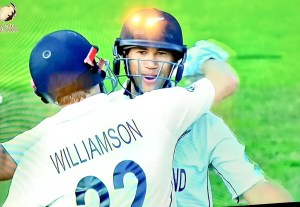
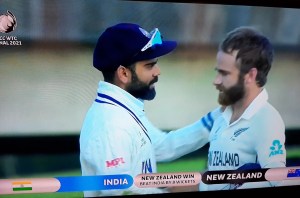
After surviving the rough patch, they rotated the strike. A few overs later, the singles & doubles turned into boundaries. Couple of dropped catches signaled the end. Finally, the moment came with Ross Taylor hitting the winning runs. A fairytale script. What’s more? An iconic picture of brothers-in-arm to cap it off.
3. Catches Win Matches Feat Tom Latham & Henry Nicholls
In the preview, we said to watch out for Tom Latham & Henry Nicholls, the New Zealand of the New Zealand team. Nobody ever talks about them, but they have been consistent performers in the last couple of years. With the bat, except for Latham’s 30, there was not much of note.
It is the fielding where these two came alive. Latham’s three catches and fielding efforts almost saved 35+ runs. Nicholls’ running backwards-diving catch off Pant was the moment of the match for me. India’s hopes ended with that catch.
And what about BJ Watling? Perfection behind the stumps in the first innings (no byes given) and kept wickets through injury in the second. The runs might not have come, but New Zealand’s greatest ever keeper retires on a high.
Little contributions, but in a close low-scoring affair, these moments makes the difference.
The Moment
Ecstasy. Team spirit. Absolute Joy.
Here are some of my takes from the final moment:
Tribute to the Legendary Commentating Crew
From a fan’s point of view, the commentating and analysis put this final on another level. The Sky Sports crew has always been amazing with Nasser Hussain & Michael Atherton, but Ian Bishop, Sunil Gavaskar, Kumar Sangakkara, Isa Guha, Simon Doull, and debutant Dinesh Karthik took it to another level.
Analyzing batting techniques, debating who won each session, and playful sledging at its very best. Mohammad Shami’s “chances created vs wickets” analysis was especially intriguing.
Here is a look from DK, the weatherman, on the first couple of days updating social media with regular Twitter & Instagram updates.
Before I move to the Prediction Results section of the article, a brief thank you to our viewers. We have reached our daddy hundred—the 150 is up!
I wanted to take a moment and thank all of you for the support. The Broken Cricket Dream blog began exactly 11 months ago, when the 1st Test between West Indies & England ended. What a chase that was.
The Broken Dreams
That game reminded me of the love of the sport, what I had been missing in the months right after the coronavirus hit. So the journey began, word by word, paragraph by paragraph, blog post by post. The goal of this platform was to share our own dreams, hopes, and love of the game with each other. We all have dreamt of being a cricketer at some point in time but life does not go to plan. That is okay though, things happen for the better. Here is a list of Broken Dreams by our fellow cricket lovers. For me, writing about cricket itself is a dream come true.
None of this would have been possible without our fans and followers. I thoroughly enjoy the discussions and little debates. Keep them coming. Love the interaction!
Anyway, 150 articles and 158,000 words later, Broken Cricket Dreams is still going strong and will continue to grow. We have now spread to several social media platforms. Feel free to check them out below. COMMENT BELOW of your thoughts on the WTC Final, your Broken Dreams, or any feedback!
If you want some encouragement and life lessons from cricket, check these out:
Like this content on this World Test Championship Final Review so far? SUBSCRIBE HERE to receive updates about new articles right in your inbox! If you are on social media, give us a follow in any of the social media outlets below:
World Test Championship Final Review – Prediction Results
The Comments
Andrew Williamson: “Just hoping the winner isn’t going to be Noah and his Ark. If there is enough play, I think New Zealand have the attack to trouble India, on what should be a track with a fair bit in it for the quicks. Kane or Taylor will have to go for NZ to succeed.”
Halsey Nim: “May need a sporting declaration somewhere along the way.”
Jonny: “Pujara vital for India (assume they bat first as NZ best chance is to put them in), Ashwin with important late runs, Boult to shine. Latham grinds out runs, Kane obs, BJ won’t want to fail. Indian wickets spread evenly. Kohli 100 2nd innings. NZ fall just short…”
The criteria is the player has to be the best at that position. Kane Williamson & Labuschagne both were excellent #3s, but I had to pick Labuschagne at the expense of the WTC winning captain. Labuschagne was the best batter in the WTC – most runs (1675), most hundreds (5), and fifties (9).
Jamieson & Labuschagne were the finds of this WTC cycle, so they walk in the XI.
Rohit Sharma just edges out Dean Elgar for the opening spot. I was tempted to go with Elgar since South Africa is a tougher place for openers, but with Karunaratne already at the top, I went with a left-right, defensive-aggressive combination. Both Root & Smith were excellent, but Smith’s iconic 774 runs in the Ashes puts him at the coveted #4 position.
Middle Order
The #5-7 spots were interesting. Ben Stokes’ Headingly show, relentless bowling spells, and 4 tons/6 fifties gives him the all-rounder spot. I initially had Rahane, the fifth highest scorer in the WTC and highest for India but instead, went with both Rishabh Pant and Mohammad Rizwan. Pant has mastered a couple of iconic chases, and Rizwan has been a revelation in the last year with his overseas rearguard innings. Quinton de Kock was also close behind in the keepers race.
Bowlers
Finally, the bowlers were the toughest to pick. My XI coincidentally had good batters as well. Mohammad Shami (40 wickets at 20.47), Josh Hazlewood (47 @ 20.54), Neil Wagner (35 @ 22.97), Jimmy Anderson (39 @ 19.51), Tim Southee (56 @ 20.82), Ishant Sharma (39 @ 17.75) had better averages, Anrich Nortje & Kemar Roach were brilliant throughout. I have not even talked about Trent Boult, Kagiso Rabada, Mitchell Starc, Nathan Lyon, and Shaheen Shah Afridi—all wonderful bowlers who had a decent couple of years without lighting the world on fire.
What an era to live in.
World Test Championship Combined XI
Dimuth Karunaratne (C)
Rohit Sharma
Marnus Labuschagne
Steve Smith
Ben Stokes
Rishabh Pant (WK)
Mohammad Rizwan
Ravichandran Ashwin
Kyle Jamieson
Pat Cummins
Stuart Broad
Tim Southee
For more World XIs, check out the articles below!
World Test Championship Statistics
Finally to cap it off, here are the statistics. Ashwin went up to #1, Rahane and Rohit Sharma remained at #5 & #6 respectively. Rahaen, Taylor, Watling, and Pant show up in the catches/dismissals section.
Most Runs
Most Wickets
Most Catches
Most Dismissals
Marnus Labuschagne – 1675
Ravichandran Ashwin – 67
Joe Root – 34
Tim Paine – 65
Joe Root – 1660
Pat Cummins – 70
Steve Smith – 27
Quinton de Kock – 50
Steve Smith – 1341
Stuart Broad – 69
Ben Stokes – 25
Jos Buttler – 50
Ben Stokes – 1334
Tim Southee – 56
Ajinkya Rahane – 23
BJ Watling – 48
Ajinkya Rahane – 1159
Nathan Lyon – 56
Ross Taylor – 21
Rishabh Pant – 41
World Test Championship Final Review – Statistics
Best Scores
Best Bowling Figures
David Warner – 335* (Vs Pakistan – Adelaide)
Lasith Embuldeniya – 7/137 (Vs England – Galle)
Zak Crawley – 267 (Vs Pakistan – Southampton)
Ravichandran Ashwin – 7/145 (Vs South Africa – Visakhapatnam)
“Start by doing what’s necessary. Then do what’s possible, and suddenly you are doing the impossible,” said Francis of Assisi about 800 years ago.
India women did just that, holding England to an improbable draw.
Women’s Tests A Rarity
Due to an increased fan following in women’s cricket since the 2017 ODI World Cup, recent emphasis has been on limited overs cricket, expansion of the game via T20 World Cup, and a potential game changer in Women’s Hundred.
Since resources have been spent in marketing the limited overs game, women’s Test cricket has disappeared in the background.
England play only one Test match every couple of years in the Ashes against Australia. Indian women had it even worse—they were playing their first test after 7 years and only their third in 15 years.
We did not know how it will pan out. Will India struggle with the lack of match practice? Will they remain unbeaten in Tests in England? How would teams cope with a used pitch?
Summary
Electing to bat first, England posted a solid 396/9 declared courtesy their senior players: Beaumont’s 66, captain Heather Knight’s 95, Nat Sciver’s 42, and debutant’s Sophie Dunkley’s 74.
Openers Smriti Mandhana & Shafali Verma would form a record 167-partnership, before India collapsed for 231. England enforced the follow-on with India 165 runs still behind & 135 overs still left in the game.
Rana-Bhatia’s Performance of the Ages
In the second innings, they started by doing the necessary. The top order repeated its fight with contributions from Verma, Raut, and Sharma before they collapsed from 171-2 to 199-7 in 73.3 overs. What’s more, India’s last recognized batter, Harmanpreet Kaur departed. With 50 overs still to go, little did anyone expect that India would survive.
Then they did what was possible. Stitch out partnerships. Play ball-by-ball. Stall the time. An hour later, Shikha Pandey departed after a fighting 18 (50).
What followed was a performance of a lifetime, a magnificent rearguard effort between Taniya Bhatia & Sneh Rana—104* (185) partnership. Suddenly, India were doing the impossible.
Rana scored 80* (154) & Bhatia provided ample support with 44* (88) to deny England a routine victory.
Patience, grit, determination on show. Bravo India women!
Debutants Dare to Dream
The experienced duo, Mithali Raj & Harmanpreet Kaur, scored a paltry 18 runs in 4 innings. To achieve the impossible, India’s youngsters were thrown in the deep end, similar to the Border-Gavaskar series in men’s cricket.
Not only did the newer generation star, Deepti Sharma, Pooja Vastrakar, Shafali Verma, Sneh Rana, and Taniya Bhatia were actually making their Test debuts for the India women team. Sophia Dunkley, whose 74* revived England from 251-6 to 396/9 declared, was debuting for England.
Shafali became the youngest women (17 years & 139 days) cricketer and second overall after Sachin Tendulkar to score fifties in both innings—96 & 63.
Promoted from #7 in the 1st innings to #3 in the 2nd, Sharma brought India back in the game with mature knocks of 29* & 54 to go along with 3/65.
Rana’s 4/131 & 80* Bhatia’s 44* saves India.
Vastrakar contributed with 1/53.
Ecclestone Bowls Herself To the Ground
The English bowlers were in the field for two and a half days!
Sophie Ecclestone took the bulk of the responsibilities, bowling 26 overs (out of 81.5) in the first innings and 38 (out of 121 overs) in the second. She ended up figures of 4-88 & 4-118.
Kudos to her for giving it her best shot. Can take some rest now. Already a T20 star, the 22-year old has the potential to be an all-time England great.
Time For 5-Day Tests In Women’s Cricket?
At the end of the 4th day, the captains shook hands with 12 overs to go. India were 179 runs ahead at 344/8.
Imagine a potential day 5—England’s target around 200 runs with 80 overs to go. All 4 results possible. Mouth-watering scenario, isn’t it? Well it isn’t entirely possible when you only have a 4-day Test.
Captain Heather Knight commented that the lack of 5th day “robbed of that finish,” and they would definitely be open for 5-day Tests. Mithali Raj had a more practical suggestion, “It’s a good idea to have a five-day Test but we actually have to start Test matches regularly.”
Why not combine both? Teams that traditionally play consistent Test cricket (Australia & England) should be allowed to experiment with 5-day Tests and pink-ball Tests. On the other hand, teams like India should not be searching for Test match opportunities every seven or eight years. Why not have one mandatory 4-day Test per bilateral series for teams like India, South Africa, and New Zealand? This way, more seasoned cricketers will get Test match experience and cricket boards will get the chance to focus on the marketing aspect of Women’s Test cricket.
Who knows, maybe a Women’s World Test Championship is just what is needed to provide context.
Like this content on this incredible chase from India women? SUBSCRIBE HERE to receive updates about new articles right in your inbox! If you are on social media, give us a follow in any of the social media outlets below:
While the IPL is in full swing in India, the Pakistan-South Africa series is catching the attention of many.
In the 3rd T20I, Pakistan chased down 204 runs with 9 wickets & 2 overs to spare, courtesy a 197-run partnership from Mohammad Rizwan & Babar Azam, who scored 122 (59). Earlier in the day, news broke that Azam also dethroned Virat Kohli as the #1 ICC ODI batsman after a mammoth 1258 days.
Add Fakhar Zaman’s brilliant 193 in the ODI series, Hafeez’s second coming, & the fast bowling line up, the question should be asked—Is the IPL really the best T20 tournament without Pakistani players?
The Fall of Pakistan Cricket
Pakistan dominated the Indo-Pak cricket rivalry in the 1990s, while India has crushed it in the 2010s. Only in the 2000s, did we have battle of equals.
For India’s tenacious Rahul Dravid, Pakistan had Younis Khan. Similarly, the elegance of Yousuf & Tendulkar, stability of Inzamam & Laxman/Ganguly, & exuberance of Afridi & Sehwag were on par with each other. The destructiveness of Shoaib Akhtar-Asif-Sami on one side matched the abilities of Irfan Pathan-Zaheer Khan-Kumble-Harbhajan on the other.
India narrowly won the 2004 Test series 2-1 & ODI series 3-2 held in Pakistan. Pakistan returned the favor next year with a 1-1 drawn Test series & 4-2 ODI victory held in India. Both memorable events.
Hence, the struggle of Pakistan cricket team over the last decade & lack of competitiveness in recent ICC tournaments has been disheartening. The new generation of Pakistan cricket is slowly making this a battle of equals again.
The New Generation of Pakistan Cricket Rises
Mohammad Rizwan is currently the best T20I batsman in the world (sorry Dawid Malan). Shaheen Shah Afridi can compete with the Rabadas & Bumrahs of the world. The leg spin of Shadab Khan & Usman Qadir with a line up of Afridi-Naseem Shah-Hasan Ali-Haris Rauf can send shivers down the opposition camp.
Babar Azam is the best player in the world. Period.
Each IPL team can benefit from Haider Ali & Faheem Ashraf’s power, experience of Mohammad Hafeez & Shoaib Malik, and the pace of discarded Mohammad Amir & Mohammad Hasnain.
“Imagine Babar-Kohli opening for RCB, Fakhar-Rohit hitting double centuries, & Bumrah-Shaheen bowling together at the death.”
With South African, Sri Lankan, & West Indian foreign contingent in the prime of their careers from 2007-2017, absence of Pakistani players in the IPL made sense.
It no longer does.
South Africa & Sri Lanka’s Eternal Transition Period
Kumar Sangakkara & Mahela Jayawardene once used to captain IPL teams. They are now the only Sri Lankan representation in IPL 2021 (as coaches) as no SL players were picked in the auction. Gone is the era of Malinga-Murali-Dilshan.
With an eternal transition process in South Africa, only Rabada-Nortje (and Ngidi to a certain extent) have risen to the occasion. Otherwise, AB De Villiers & Faf Du Plessis from an earlier generation are still carrying the South Africa baton. Similarly, lots of West Indians in the IPL are from the World Cup winning generation (Gayle, Narine, Pollard, Russell).
The lack of variety in foreign talent is hitting the brand of the IPL. It seems that only India & England are producing new talent year in & year out, with Australia & New Zealand close behind.
It is time for some more talent to flow in—Pakistani talent that is. On the flip side, BCCI’s reluctance to let Indians play abroad should also be reconsidered, but that is a story for another day.
Looking Back to IPL 2008
The inception of the tournament in 2008 is the perfect template to follow.
Rajasthan Royals benefitted from having Pakistan talent in their squad with Kamral Akmal, Younis Khan, & most importantly Sohail Tanvir, the maiden purple cap winner. The Knight Riders enjoyed the pace duo of Shoaib Akhtar & Umar Gul, who took a match-winning 4-fer. KKR also had Salman Butt & the ageless Mohammad Hafeez in their ranks.
Few others participated in the IPL as well—Shahid Afridi (Deccan Chargers), Shoaib Malik & Mohammad Asif (Delhi Daredevils), & Misbah-ul-Haq (Royal Challengers Bangalore).
IPL 2020 Was Ideal But There Is Still Time
IPL 2020 was the best opportunity for adding Pakistani players to the IPL auctions. The world was struggling from a pandemic, and the tournament was taking place at Pakistan’s adopted home ground, the UAE.
What better time to get Pakistan players in? Unfortunately, that did not happen.
There is still time.
Babar is 26, Rizwan 28, & Amir 29. It would be great to watch Mohammad Amir versus Virat Kohli once again, and there is enough love across the border to make it happen.