Who are the greatest English cricketers of them all?
England’s 150-year cricket history has ebbed and flowed between golden eras and long spells of frustration.
But much has changed in recent years. With new greats like Joe Root, Ben Stokes, Alastair Cook, Jimmy Anderson, and Stuart Broad cementing their legacies, and the World Cup triumphs of 2010, 2019, and 2022 redefining England’s white-ball identity, the landscape looks different now.
Which is why today, we are revisiting the legends of English cricket across formats and era— from Hobbs to Root, from Grace to Stokes— where every era left its own unforgettable mark.
Key Takeaways
Joe Root tops the list as the greatest English cricketer of all time, followed by legends like Ian Botham, Ben Stokes, Wally Hammond, James Anderson, Jack Hobbs, Alastair Cook, Graham Gooch, Kevin Pietersen, and Len Hutton rounding out the Top 10.
The Top 65 features a well-balanced mix: 10 all-rounders, 9 fast bowlers, 7 spinners, 5 wicketkeepers, and 34 specialist batters.
Era-wise, the list includes 26 players who featured after the year 2000, 22 players from the 1950–1990 era, and 17 pioneers from 1877 to 1950.
To bring more structure, today we introduce a simple yet comprehensive points-based ranking system designed to fairly compare the greatest across eras, formats, and roles.
Clutch innings, key spells, decisive contributions under pressure.
Big Stage Impact
20
Performances in World Cups, ICC finals, or major Test series like the Ashes.
Longevity
15
Sustained excellence across years; number of matches.
Versatility
10
Success across formats, roles, conditions (e.g., all-rounders).
Accolades
10
Major awards, ICC recognitions, Player of the Match/Series awards.
Leadership
5
Impact as captain, leading bowling attacks, building winning cultures or historic victories.
Bonus Points
Bonus
Points
What It Rewards
Era Bonus
5
For excelling in tougher eras (uncovered pitches, no World Cups, etc.).
Fielding/Wicketkeeping Bonus
3
Outstanding fielding, slip catching, or wicketkeeping achievements.
100-Test Bonus
2
Reward for longevity milestones (100+ Tests played).
For the Era bonus, pre-1950 players received +5, 1950-1975 got +4 (when more Tests were played), 1975-1990 players got +3 (when ODI cricket was introduced), 1990-2002 players got +2.
In an event of a tie, a player who played more Test matches won the tiebreaker.
The point system may still include a bit of subjectivity, but you can see my thought process with this ranking. It was difficult to differentiate between #17-35 since each player excelled in one area or the other.
Note: This ranking only considers performances in the international arena (Test, T20, ODI) and not in County Cricket, other domestic cricket, or franchise T20 leagues (even though FC stats will be provided for players from earlier eras).
Top 65 Greatest English Cricketers of All-Time (Ranked)
Honorable Mentions: Those Who Came Close
Players who had exceptional careers and moments but just missed the cut for the Top 65.
Those Who Just Missed Out (66-70): Keith Fletcher, Angus Fraser, Frank Tyson, Geoff Arnold, Douglas Jardine
Others Considered:
Matthew Hoggard, Mark Butcher, Matt Prior, Ashley Giles, Andy Caddick, Steve Harmison, Dominic Cork, Criag Kieswetter, Liam Plunkett, Simon Jones, Monty Panesar, Alex Hales, Ted Dexter, Robin Smith, Mike Hendrick, Fletcher, Maurice Leyland, TG Evans, Bob Taylor, Jack Russell, Stanley Jackson, Tim Bresnan, David Lloyd, Mark Wood, Chris Jordan, Graeme Hick, John Emburey, Fred Titmus, Chris Old, Mike Smith, Archie Maclaren, Alfred Shaw, Basil D’Oliveira
Possible Future Stars: Harry Brook, Jofra Archer, Ollie Pope, Sam Curran, Ben Duckett, Ollie Robinson
51-65: The Final Cut
Players who rose through the grind to leave their mark—not flawless, but unforgettable.
65. Mike Brearley (1976–1981, Middlesex) — 55 Points
Role: Batter (Captaincy Specialist)
Statistically not significant, Brearley makes the list on the back of his captaincy folklore. Mike Brearley led England through famous Ashes victories, maximizing the talents of those around him.
Matches: 39 Tests, 25 ODIs
Runs: 1442 (Tests), 510 (ODIs)
Hundreds: 0 (Tests), 0 (ODIs)
Player of Match Awards: 0
Player of Series Awards: 0
World Cup Winner? ❌
Captained England? ✅ (captained 31 Tests)
100 Tests? ❌
Notable Achievements: Legendary captain of England’s 1981 Ashes comeback; known for bringing the best out of Ian Botham. W/L ratio of 4.5 (only second to Douglas Jardine’s 9.00). Wisden Cricketer (1977).
Without Jason Roy, Australia would have won another ODI World Cup. Without Jason Roy, England’s white ball revolution would have been incomplete.
Role: Right-hand opening batter
Matches: 116 (ODIs), 64 (T20Is), 5 (Tests)
Runs: 4271 (ODIs), 1522 (T20Is), 187 (Tests)
Hundreds: 12 (ODIs)
Player of Match Awards: 15
Player of Series Awards: 1
World Cup Winner? ✅ (2019 ODI WC)
Captained England? ❌
100 Tests? ❌
Notable Achievements: 3rd Most Hundreds in ODI cricket for England, Key figure in 2019 World Cup winning team, set multiple ODI partnership records with Jonny Bairstow.
Notable Achievements: Captained England to historic 2005 Ashes victory, vital figure in England’s early 2000s resurgence, Wisden Cricketer (2003). Member of 2007 ICC Test Team of the Year
59. Marcus Trescothick (2000–2006, Somerset) — 71 Points
Role: Left-hand Opening Batter
A fearless and free-scoring opener, Marcus Trescothick set the tone for England’s resurgence in the early 2000s with his aggressive approach at the top of the order.
Matches: 123 (ODIs), 76 (Tests), 3 (T20Is)
Runs: 4335 (ODIs), 5825 (Tests), 166 (T20Is)
Hundreds: 12/14 (ODI/Tests), Average: 43.79/37.37
Player of Match Awards: 13
Player of Series Awards: 4
World Cup Winner? ❌
Captained England? ✅ (briefly in 2 Tests and 10 ODIs)
100 Tests? ❌
Notable Achievements: Key architect of 2005 Ashes win, multiple ODI centuries, dominant opening partnerships, Wisden Cricketer (2005)
57. Chris Woakes — 72 Points (2011–Present, Warwickshire)
Role: Right-arm Fast-Medium Bowling Allrounder
A quiet achiever in England’s rise to white-ball dominance, Woakes delivered crucial spells in the 2019 World Cup semifinal and final, while offering reliable lower-order runs and new-ball consistency across formats.
Matches: 48 Tests, 119 ODIs, 33 T20Is
Wickets: 130 (Tests), 166 (ODIs), 29 (T20Is)
Runs: 1861 (Tests), 1526 (ODIs)
Hundreds: 1 (Test)
Player of Match Awards: 10
Player of Series Awards: 3
World Cup Winner? ✅ ✅ (2019 ODI WC, 2022 T20 WC)
Captained England? ❌
100 Tests? ❌
Notable Achievements: 2019 World Cup semifinal – Player of the Match; consistent contributor in both white and red-ball cricket; one of England’s most trusted bowlers in recent years across conditions.
56. Moeen Ali (2014–Present, Worcestershire) — 73 Points
Role: All-Rounder (Left Arm Batter, Right Arm Off Spin)
England’s dynamic all-rounder across formats, Moeen Ali’s versatility and attacking flair made him a critical figure in both red-ball and white-ball revolutions. Part of England’s rise in limited overs cricket.
Matches: 138 (ODIs), 92 (T20Is), 68 (Tests)
Runs: 2355 (ODIs), 1229 (T20Is), 3094 (Tests)
Hundreds: 3/5 (Tests)
Wickets: 112 (ODIs), 53 (T20Is), 204 (Tests)
5-fers: 5 (Tests)
Player of Match Awards: 20
Player of Series Awards: 2
World Cup Winner? ✅✅
Captained England? ✅ (captained in 12 T20Is)
100 Tests? ❌
Notable Achievements: 6th highest Player of the Match awards for England, Member of 2019 World Cup and 2022 T20 World Cup winning squads, crucial all-format contributions. Wisden Cricketer (2015),
England’s premier off-spinner of the modern era, Graeme Swann combined attacking flair with relentless consistency, playing a pivotal role in England’s rise to the No.1 Test ranking.
Matches: 79 (ODIs), 60 (Tests), 39 (T20Is)
Wickets: 104 (ODIs), 255 (Tests), 51 (T20Is)
5-fers: 1 (ODIs), 17 (Tests)
Player of Match Awards: 9
Player of Series Awards: 3
World Cup Winner? ✅ (2010 T20 WC)
Captained England? ❌
100 Tests? ❌
Notable Achievements: Key bowler in England’s No. 1 Test team era, dominated 2009 and 2010–11 Ashes series, first English spinner to 50 T20I wickets. England’s fifth highest wicket-taker across formats, Wisden Cricketer (2010). Member of ICC Test Team of the Year (2010-11, 13) & 2011 ODI Team of the Year.
54. Adil Rashid (2009–Present, Yorkshire) — 74 Points
Role: Leg-Spinner
A world-class wrist spinner, Adil Rashid has been at the heart of England’s white-ball revolution, delivering consistently on the biggest stages including World Cup triumphs.
Matches: 19 (Tests), 132 (ODIs), 103 (T20Is)
Wickets: 60 (Tests), 207 (ODIs), 131 (T20Is)
Player of Match Awards: 11
Player of Series Awards: 3
World Cup Winner? ✅✅
Captained England? ❌
100 Tests? ❌
Notable Achievements: Crucial figure in England’s 2019 ODI World Cup and 2022 T20 World Cup victories; among England’s leading wicket-takers in white-ball cricket.
A tough, resilient opener, John Edrich combined immense patience with occasional ferocity, becoming one of England’s most reliable run-scorers during the 1960s and early 1970s.
Matches: 77 (Tests), 564 (FC)
Runs: 5,138 (Tests), 39,790 (FC)
Hundreds: 12/103 (Tests/FC), Average: 43.54
World Cup Winner? ❌
Captained England? ✅ (briefly captained one Test in 1971)
100 Tests? ❌
Notable Achievements: Scored 310* against New Zealand, crossed 100 first-class centuries milestone, key anchor in multiple Ashes campaigns, 1966 Wisden Cricketer.
A gritty, elegant craftsman, Graham Thorpe stood tall during a turbulent era for England, consistently delivering against top attacks around the world.Rest in peace.
Matches: 100 (Tests), 82 (ODIs)
Runs: 6744 (Tests). 2380 (ODIs)
Hundreds: 16 (Tests), Average: 44.66 (Tests)
Player of Match Awards: 10
Player of Series Awards: 2
World Cup Winner? ❌
Captained England? ❌
100 Tests? ✅
Notable Achievements: Stabilized England’s middle-order during the 1990s, key role in setting up the Vaughan-era resurgence, 1998 Wisden Cricketer
Career Stats (20)
Match-Winning (20)
Big Stage Impact (20)
Longevity (15)
Versatility (10)
Accolades (10)
Leadership (5)
Era Bonus (5)
Fielding Bonus (3)
100-Test Bonus (2)
Total
15
14
12
12
6
8
0
2
3
2
74
41-50: The Battle Hardened Greats
This tier includes battle-hardened leaders, early era greats, and players who quietly stitched together the spine of England’s teams — often without the spotlight, but never without impact.
Notable Achievements: England’s leading Test wicket-taker at retirement, dominated the 1953 Ashes, famous for mastery of the leg-cutter, Wisden Cricketer (1947)
49. Allan Lamb (1982–1992, Northamptonshire) — 75 Points
Role: Batter
A stylish, aggressive middle-order batsman, Allan Lamb was a pillar of England’s batting through the 1980s, shining brightly in high-pressure World Cup campaigns and major Test series. Lamb’s 45 (55) kept England close in the 1987 World Cup Final. So close, yet so far.
Matches: 79 Tests, 122 ODIs
Runs: 4,656 (Tests), 4,010 (ODIs)
Hundreds: 14 (Tests), 4 (ODIs)
Player of Match Awards: 14
Player of Series Awards: 2
World Cup Winner? ❌
Captained England? ✅ (briefly captained in 1990)
100 Tests? ❌
Notable Achievements: Key contributor to England’s run to the 1987 ODI WC Final, critical knocks during the 1986-87 Ashes, 1981 Wisden Cricketer.
48. Mike Gatting (1977–1995, Middlesex) — 75 Points
Role: Right-handed Middle-Order Batter
Gritty, resilient, and unafraid to take on the fastest bowlers of his time, Gatting helped England through a turbulent era with a combination of toughness and leadership.
Captained England? ✅ (led England to Ashes victory in 1986–87)
100 Tests? ❌
Notable Achievements: Captained England to their last Ashes victory in Australia for 24 years (1986–87), remembered for bravery against pace and playing a key part in England’s 1980s rebuild, Wisden Cricketer (1984)
One of cricket’s earliest true batting artists, Ranjitsinhji dazzled with elegance, introducing the leg glance and redefining batting technique for generations to follow.
Matches: 15 (Tests), 307 (First-Class)
Runs: 989 (Tests), 24,692 (First-Class)
Hundreds: 2 (Tests), 72 (First-Class)
World Cup Winner? ❌
Captained England? ❌
100 Tests? ❌
Notable Achievements: Revolutionized batting with innovation and wristy strokeplay; scored a century on Test debut against Australia; his fluid style left a lasting legacy on the game’s evolution, Wisden Cricketer (1897)
One of England’s most prolific and dependable batsmen between the wars, Hendren was known for his technical mastery, durability, and cheerful resilience at the crease.
Matches: 51 (Tests), 833 (FC)
Runs: 3525 (Tests), 57611 (FC) — second-most in history)
Hundreds: 7 (Tests), 170 (FC)
World Cup Winner? ❌
Captained England? ❌
100 Tests? ❌
Notable Achievements: Wisden Cricketer (1920), Scored over 57,000 first-class runs and 170 centuries; held England’s record for most Test appearances (51) until post-WWII; pivotal figure in stabilizing England’s batting during the interwar period.
Role: Right-handed Middle-Order Batter and Right-arm Medium-Fast Bowler (Allrounder)
Charismatic and controversial, Greig was a fierce competitor who inspired England with his leadership and impactful all-round performances in the 1970s.
Matches: 58 (Tests), 22 (ODIs)
Runs: 3599 (Tests), 269 (ODIs)
Wickets: 141 (Tests), 19 (ODIs)
Hundreds: 8 (Tests), 32 (FC)
5-fers: 4 (Tests), 45 (FC)
Player of the Series Awards: 1
World Cup Winner? ❌
Captained England? ✅ (led in 14 Tests, 1975–77)
100 Tests? ❌
Notable Achievements: Wisden Cricketer (1975), Consistently contributed with both bat and ball; captained England through a volatile era; known for his fighting spirit and adaptability in overseas conditions, especially against West Indies and Australia.
44. Tom Graveney (1951-1969, Gloucestershire & Worcestershire) — 76 Points
Role: Batter
A classical and elegant batsman, Tom Graveney combined grace with mountainous run-scoring, leaving behind one of the most prolific careers in English first-class history.
Matches: 79 (Tests), 515 (FC)
Runs: 4882 (Tests), 47793 (FC)
Hundreds: 11/122 (Tests, FC), Average: 44.37
Player of Match Awards: 1
Captained England? ✅ (captained 1 Test match)
100 Tests? ❌
Notable Achievements: 1953 Wisden Cricketer, Helped England regain the 1954-55 Ashes, Wisden Cricketer of the Year (1953)
43. Ian Bell (2004–2015, Warwickshire) — 76 Points
Role: Right-hand middle-order batter
England’s greatest cover driver.
Matches: 161 (ODIs), 118 (Tests), 8 (T20Is)
Runs: 5416 (ODIs), 7727 (Tests), 188 (T20Is)
Hundreds: 4 (ODIs), 22 (Tests)
Player of Match Awards: 13
Player of Series Awards: 3
World Cup Winner? ❌
Captained England? ❌
100 Tests? ✅
Notable Achievements: figure in multiple Ashes wins, ICC Champions Trophy finalist, among England’s most aesthetically pleasing batters, 2008 Wisden Cricketer, 2006 Emerging Cricketer of the Year.
One of the greatest spin bowlers England has ever produced, Hedley Verity’s immaculate control and devastating spells made him a giant of the pre-war era. Tragically passed away at the age of 38 as a prisoner of war.
A magician with the ball, Jim Laker’s pinpoint accuracy and variations culminated in one of Test cricket’s greatest feats — 19 wickets in a single match.
Matches: 46 (Tests), 450 (FC)
Wickets: 193 (Tests), 1,944 (FC)
5-Wicket Hauls: 9/127 (Tests/FC)
Captained England? ❌
100 Tests? ❌
Notable Achievements: 19 wickets in a single Test (Old Trafford 1956), cornerstone of England’s spin dominance in the 1950s, Wisden Cricketer (1952)
Career Stats (20)
Match-Winning (20)
Big Stage Impact (20)
Longevity (15)
Versatility (10)
Accolades (10)
Leadership (5)
Era Bonus (5)
Fielding Bonus (3)
100-Test Bonus (2)
Total
16
18
14
12
5
8
0
4
0
0
77
31-40: The Defining Performers
Players who created decisive moments and major contributions even if not consistent dominators.
40. Paul Collingwood (2001–2011, Durham) — 77 Points
Role: All-Rounder
England’s ultimate team man, Paul Collingwood’s gritty batting, sharp fielding, and occasional bowling made him a pillar in all formats.
Matches: 197 (ODIs), 68 (Tests), 36 (T20Is)
Runs: 5092 (ODIs), 4259 (Tests), 583 (T20Is)
Hundreds: 10/5 (Tests), Average: 40.56/35.36
Wickets: 111 (ODIs), 17 (Tests), 16 (T20Is)
5-fers: 1 (ODIs)
Player of Match Awards: 16
Player of Series Awards: 0
World Cup Winner? ✅
Captained England? ✅
100 Tests? ❌
Notable Achievements: 2010 T20 World Cup-winning captain, three-time Ashes winner, known for spectacular fielding, Wisden Cricketer (2007) & Member of 2010 ICC ODI Team of the Year
Pioneered the wicketkeeper-batter role. Become one of England’s most reliable and stylish run-scorers in the 1930s.
Matches: 47 (Tests), 593 (FC)
Runs: 2434 (Tests), 37248 (FC)
Hundreds: 8 (Tests), 102 (FC)
Dismissals: 74 (Tests), 417 (FC)
World Cup Winner? ❌
Captained England? ✅ (captained 1 Test match in 1939)
100 Tests? ❌
Notable Achievements: First Wicketkeeper to score 100 FC hundreds, Record holder for most Test centuries (8) by a designated keeper (stood for decades). Wisden Cricketer (1929)
Sharp, aggressive, and fiercely competitive, John Snow spearheaded England’s bowling attacks in the late 1960s and early 1970s, thriving in hostile conditions and big series.
Notable Achievements: Lead bowler in England’s famous 1970–71 Ashes triumph; remembered for devastating spells against Australia and West Indies; among the finest hostile quicks of his generation, Wisden Cricketer (1973)
37. Michael Atherton (1989–2001, Lancashire) — 78 Points
Role: Right-hand opening batter
A stoic and resilient opener, Michael Atherton embodied grit and determination, often leading England’s resistance against dominant oppositions in the 1990s.
One of the finest glovemen in cricket history, Alan Knott combined acrobatic wicketkeeping with vital lower-order batting during England’s 1970s successes.
35. George Lohmann (1886–1896, Surrey) — 79 Points
Role: Bowler
One of the deadliest seam bowlers in cricket history, George Lohmann dominated with relentless accuracy and unrivaled averages during the late 19th century.
Matches: 18 (Tests), 204 (FC)
Wickets: 112 (Tests), 1,841 (FC)
5-Wicket Hauls:9 (Tests), 152 (FC)
Captained England? ✅ (captained England twice)
100 Tests? ❌
Notable Achievements: Fastest to 100 Test wickets (in just 16 matches), lowest career Test bowling average (10.75), was a menace to the batters throughout the 1890s, 1889 Wisden Cricketer
34. Harold Larwood (1926–1933, Nottinghamshire) — 79 Points
Role: Right-arm fast bowler
The fearsome spearhead of the Bodyline series, Harold Larwood terrorized batsmen with raw pace and precision during one of the most controversial but impactful eras in cricket history.
33. Brian Statham (1951–1965, Lancashire) — 80 Points
Role: Right-arm fast bowler
The silent assassin of England’s pace attack, Brian Statham combined relentless accuracy with remarkable sportsmanship, becoming one of England’s most respected seamers.
30. Ray Illingworth (1958–1973, Yorkshire & Leicestershire) — 80 Points
Role: Right-arm Off-Spinner and Middle-Order Batter
One of England’s most influential captains, Illingworth combined sharp tactical acumen with steady all-round performances, leading England to a dominant era in the early 1970s.
Matches: 61 (Tests), 787 (FC)
Runs: 1836 (Tests), 24134 (FC)
Wickets: 122 (Tests), 2072 (FC)
Hundreds: 2 (Tests), 23 (FC)
Five-fors: 3 (Tests), 152 (FC)
World Cup Winner? ❌
Captained England? ✅ (Captain in 31 Tests, led famous 1970–71 Ashes series victory)
100 Tests? ❌
Notable Achievements: Wisden Cricketer (1960), Captained England to an unbeaten 27-Test run including winning the Ashes 1970–71 in Australia; contributed consistently with both bat and ball during his tenure; remembered as one of England’s most tactical and resilient leaders.
29. Bob Willis (1971–1984, Surrey & Warwickshire) — 80 Points
Role: Fast Bowler
A tireless and intimidating presence, Bob Willis spearheaded England’s attack with heart and pace, famously leading them to Ashes glory in 1981 with 29 wickets in the series.
Matches: 90 (Tests), 64 (ODIs)
Wickets: 325 (Tests), 80 (ODIs)
5-fers: 16 (Tests)
Player of Match Awards: 2
Player of Series Awards: 0
World Cup Winner? ❌
Captained England? ✅
100 Tests? ❌
Notable Achievements: Iconic 8/43 at Headingley 1981, over 300 Test wickets, vice-captain in pivotal Ashes moments, Wisden Cricketer (1978)
One of England’s most versatile and dynamic players, Jonny Bairstow has delivered match-winning performances across formats, redefining England’s aggressive batting identity.
Notable Achievements: Member of 2019 World Cup winning team, key figure in Bazball era, multiple match-winning innings in ICC tournaments. 2016 Wisden Cricketer, Member of 2018 ODI ICC Team of the Year & Test Team of the Year (2016, 2022)
24. Sir Andrew Strauss (2004–2012, Middlesex) — 82 Points
Role: Left Handed Opening Batter
A tactically sharp captain and solid opener, Andrew Strauss was central to England’s 2005 and 2010–11 Ashes triumphs.
Matches: 127 (ODIs), 100 (Tests)
Runs: 4205 (ODIs), 7037 (Tests)
Hundreds: 6 (ODIs), 21 (Tests)
Player of Match Awards: 9
Player of Series Awards: 8
World Cup Winner? ❌
Captained England? ✅
100 Tests?
Notable Achievements: Captained England to No. 1 Test ranking, captained Ashes victory in Australia (2010–11), 8 Player of the Series Awards, Wisden Cricketer (2005), Member of the 2009 ICC Test Team of the Year
22. Andrew Flintoff (1998–2009, Lancashire) — 84 Points
Role: Fast Bowling All Rounder
An explosive all-rounder, Andrew Flintoff captured the imagination of a generation with his power hitting, fiery pace, and larger-than-life charisma.Hope he recovers well from the horrific accident.
Matches: 141 (ODIs), 79 (Tests), 7 (T20Is)
Runs: 3394 (ODIs), 3845 (Tests), 76 (T20Is)
Hundreds: 3 (ODIs), 5 (Tests)
Wickets: 169 (ODIs), 226 (Tests), 5 (T20Is)
5-fers: 2 (ODIs), 3 (Tests)
Player of Match Awards: 20
Player of Series Awards: 7
World Cup Winner? ❌
Captained England? ✅
100 Tests? ❌
Notable Achievements: Player of the Series in 2005 Ashes, pivotal in England’s Test and ODI resurgence, 2004 Wisden Cricketer, ICC Cricketer of the Year (2005), ODI Cricketer of the Year (2004), Member of Test Team of the Year (2005-06), ODI Team of the Year (2004-06)
An adaptable and fiercely competitive cricketer, Alec Stewart’s flexibility across roles made him a cornerstone of England’s batting and leadership for over a decade.
A paragon of classical technique and gentlemanly spirit, Colin Cowdrey was the first cricketer to play 100 Tests and a bedrock of England’s batting for two decades.
Matches: 114 (Tests)
Runs: 7624
Hundreds: 22
Batsman of Match Awards: 1
Player of Series Awards: 0
World Cup Winner? ❌
Captained England? ✅
100 Tests? ✅
Notable Achievements: First player to reach 100 Tests, key architect of Ashes battles in the 50s and 60s, Wisden Cricketer (1956)
Notable Achievements: 2019 World Cup winner (key Super Over & keeping contribution), 2022 T20 World Cup winning captain, revolutionized England’s white-ball batting, Wisden Cricketer (2019). Member of ICC ODI Team of the Year (2016, 2018-19) & T20I Team of the Year (2021-22). Highest run scorer for England in the 2022 T20 World Cup.
One of England’s most graceful cricketers, Frank Woolley dazzled as a flowing batsman, brilliant fielder, and reliable bowler over a staggering career.
Matches: 64 (Tests)
Runs: 3283
Hundreds: 5
Wickets: 83
5-fer: 4
Captained England? ❌
100 Tests? ❌
Notable Achievements: 58959 Runs with 145 tons in FC cricket and 2066 wickets. Third Longest Career, Wisden Cricketer (1911)
15. Fred Trueman (1952–1965, Yorkshire) — 86 Points
Role: Right Arm Fast Bowler
“Fiery Fred” was England’s ultimate fast bowling force, revered for his aggression, consistency, and trailblazing wicket-taking.
Matches: 67 (Tests)
Wickets: 307
5-fers: 17
Captained England? ❌
100 Tests? ❌
Notable Achievements: First bowler to 300 Test wickets, dominant against top opposition, iconic figure of post-war English cricket, Wisden Cricketer (1953)
Role: Left-arm orthodox spinner, later opening batter
A timeless cricketing giant, Wilfred Rhodes starred as a bowler, batter, and all-rounder across one of the longest careers in cricket history.
Matches: 58 (Tests)
Runs: 2325
Hundreds: 2
Average: 26.96 (Bowling), 30.19 (Batting)
Wickets: 127
5-fers: 6
Captained England? ✅ (once)
100 Tests? ❌
Notable Achievements: Longest Test Career (30 years 315 days). Over 4,000 first-class wickets, opened both batting and bowling for England, Wisden Cricketer (1899)
Career Stats (20)
Match-Winning (20)
Big Stage Impact (20)
Longevity (15)
Versatility (10)
Accolades (10)
Leadership (5)
Era Bonus (5)
Fielding Bonus (3)
100-Test Bonus (2)
Total
15
15
16
15
8
8
3
5
2
0
87
Notable Achievements: Exceptional Test average for his era, key contributor to many Ashes triumphs, famed for adaptability under pressure
13. Stuart Broad (2007–2023, Nottinghamshire) — 87 Points
Role: Right Arm Pace/Left Arm Batter
Tall, aggressive, and unrelenting, Stuart Broad was the ultimate Ashes warrior and a relentless match-winner for England for over 15 years.Those Spells.
Matches: 167 (Tests), 121 (ODIs), 56 (T20Is)
Wickets: 604 (Tests), 178 (ODIs), 65 (T20Is)
5-fers: 20 (Tests), 1 (ODIs)
Runs: 3662 (Tests), 529 (ODIs), 118 (T20Is)
Hundreds: 1 (Test)
Player of Match Awards: 14
Player of Series Awards: 3
World Cup Winner? ✅
Captained England? ✅ (T20I captain and briefly Test captain)
100 Tests? ✅
Notable Achievements: Second-most wickets for England, Ashes hero (2015, 2019), devastating spells including 8/15 against Australia, Wisden Cricketer (2010), Selected in Test Team of the Decade, Selected as member of ICC Test Team of the Year (2009, 2011, 2012, 2014, 2015, 2023)
12. Herbert Sutcliffe (1924–1935, Yorkshire) — 88 Points
Role: Right-hand opening batter
A master of technique under pressure, Herbert Sutcliffe forged one of the most formidable opening partnerships and dominated tough batting conditions.
Matches: 54 (Tests)
Runs: 4555
Hundreds: 16, Batting: 60.73 Average
Captained England? ❌
100 Tests? ❌
Notable Achievements: Only player to score 16+ centuries with a 60+ Test average. Formed key opening partnership with Jack Hobbs, Wisden Cricketer (1920)
11. Sydney Barnes (1901–1914, Staffordshire) — 89 Points
Role: Right Arm Fast Bowler
A revolutionary, Sydney Barnes blended pace, swing, and seam to become arguably the most unplayable bowler of his time.Consider the greatest fast bowler of the twentieth century.
Matches: 27 (Tests)
Wickets: 189
5-fers: 24
Captained England? ❌
100 Tests? ❌
Notable Achievements: Record 189 wickets in just 27 Tests, regarded by contemporaries as the finest bowler in history, Wisden Cricketer (1910)
Career Stats (20)
Match-Winning (20)
Big Stage Impact (20)
Longevity (15)
Versatility (10)
Accolades (10)
Leadership (5)
Era Bonus (5)
Fielding Bonus (3)
100-Test Bonus (2)
Total
18
19
17
13
7
8
2
5
0
0
89
Top 10: The Titans of English Cricket
The absolute legends. Players who did not just succeed, they transformed the game for England for generations to come.
Role: Right-handed middle order batter, Part-Time Off Spin
A fearless maverick, Kevin Pietersen’s flamboyant strokeplay and game-changing innings lit up all formats for England. Possibly England’s greatest matchwinner.
Matches: 136 (ODIs), 104 (Tests), 37 (T20Is)
Runs: 4440 (ODIs), 8181 (Tests), 1176 (T20Is)
Hundreds: 9 (ODIs), 23 (Tests)
Wickets: 7 (ODIs), 10 (Tests), 1 (T20Is)
Player of Match Awards: 26
Player of Series Awards: 5
World Cup Winner? ✅
Captained England? ✅
100 Tests? ✅
Notable Achievements: 2005 Ashes hero, key performer in England’s 2010 T20 World Cup triumph, known for audacious stroke innovation. Member of ICC Test Team of the Year (2007-08), ODI Cricketer of the Year(2005, 06, 09), Wisden Cricketer (2006), ICC Emerging Player of the Year (2005), Player of the Tournament (2010 T20 WC), ICC ODI Cricketer of the Year (2005)
Role: Top Order Batter, Part-Time Right Arm Medium Pace
One of England’s most prolific run-scorers, Graham Gooch combined physical fitness and mental toughness to dominate bowling attacks for two decades. Took England to the 1992 ODI World Cup Final.
Notable Achievements: Wisden Cricketer of the Year (1980), Epic 333 against India, England’s leading scorer for years, captained England to a World Cup final (1992). 44,846 FC runs, 22,211 List A Runs.
Notable Achievements: England’s highest Test run-getter, captained England to series wins in India and Ashes triumphs, First England Batter to score 10,000 Test Runs, Wisden Cricketer (2012), ICC Test Cricketer of the Year (2011). Selected in ICC Test Team of the Decade. Member of ICC Test Team of the Year (2011-13, 2015 & 16).
The “Master,” Sir Jack Hobbs was a complete cricketer, blending unmatched technique, patience, and grace to dominate both Tests and first-class cricket.
Matches: 61 (Tests)
Runs: 5410
Hundreds: 15, Average: 56.94
World Cup Winner? ❌
Captained England? ✅
100 Tests? ❌
Notable Achievements: Wisden Cricketer of the Year twice (1909, 1926), Oldest batter to score a hundred (46 years, 82 days). Over 61,000 first-class runs (record), most centuries across all formats at retirement
5. Sir James ‘Jimmy’ Anderson (2003–Present, Lancashire) — 92 Points
Role: Right Arm Swing Pacer
The master of swing, Sir James Anderson redefined fast bowling longevity, precision, and skill well into his 40s. 704 Test wickets by a pacer, will never be overtaken I reckon.
Matches: 194 (ODIs), 188 (Tests), 19 (T20Is)
Wickets: 269 (ODIs), 704 (Tests), 18 (T20Is)
5-fers: 2 (ODIs), 32 (Tests)
Player of Match Awards: 13
Player of Series Awards: 5
World Cup Winner? ✅
Captained England? ❌
100 Tests? ✅
Notable Achievements: Highest wicket-taker among pace bowlers in history, 100+ Ashes wickets, backbone of England’s Test success for two decades, Wisden Cricketer (2009), Selected in Test Team of the Decade, Member of ICC Team of the Year (2010, 2011, 2013, 2017, 2022)
An elegant powerhouse, Wally Hammond combined stylish strokeplay with brute force and athleticism to dominate interwar cricket.
According to Wisden Cricketer’s Almanack, “the judgment of cricket history is that the greatest batsmen of the game has known are – in order of appearance, only – WG Grace, Jack Hobbs, Walter Hammond, and Don Bradman. Others may come close indeed to those four but do not quite take place with them.”
Matches: 85 (Tests)
Runs: 7249
Hundreds: 22, Average: 58.45
Wickets: 83
5-fers: 2
Captained England? ✅
100 Tests? ❌
Notable Achievements: 1928 Wisden Cricketer, Former highest Test run-scorer, prolific century maker, England captain, famed for batting records and slip fielding. Best of 336* in Tests, scored 50,551 FC runs along with 167 hundreds.
Role: All-Rounder (Left Hand Batter, Right Arm Medium Pace), Captain
A once-in-a-generation match-winner, Ben Stokes’ fierce spirit, iconic innings, and leadership have etched him into English cricket folklore.He can take superhuman catches, win World Cup finals and Ashes out of thin air, and can bowl 140 kph+ as well.
Matches: 114 (ODIs), 110 (Tests), 43 (T20Is)
Runs: 3463 (ODIs), 6719 (Tests), 585 (T20Is)
Hundreds: 5 (ODIs), 13 (Tests)
Wickets: 74 (ODIs), 210 (Tests), 26 (T20Is)
5-fers: 1 (ODIs), 4 (Tests)
Player of Match Awards: 19
Player of Series Awards: 5
World Cup Winner? ✅✅
Captained England? ✅
100 Tests? ✅
Notable Achievements: 2019 ICC Cricketer of the Year, 2022 ICC Test Cricketer of the Year, 2016 Wisden Cricketer, Selected in Test Team of the Decade. Member of ICC Test Team of the Year (2016, 17, 19, 22) & ODI Team of the Year (2017-19). Hero of the 2019 World Cup Final, 2022 T20 World Cup winner, Ashes miracle at Headingley 2019, current Test captain. Also, see Bazball.
Role: All-Rounder (Right Harm Batter/Right Arm Medium Pace)
Matches: 116 (ODIs), 102 (Tests)
Runs: 2113 (ODIs), 5200 (Tests)
Hundreds: 14 (Tests)
Wickets: 145 (ODIs), 383 (Tests)
5-fers: 27 (Tests)
Player of Match Awards: 19
Player of Series Awards: 4
World Cup Winner? ❌
Captained England? ✅
100 Tests? ✅
Notable Achievements: 1981 “Botham’s Ashes,” legendary performances with both bat and ball, England’s greatest match-winner for a decade, 1978 Wisden Cricketer
The calm in England’s chaos for over a decade, Joe Root piled on runs with grace and grit, becoming the heartbeat of the Test side and one of the most dependable batters the country has ever seen.He went from a consistent contributor to an all-time great post-2021.
Notable Achievements: Fifth-highest run-scorer in Test history, Player of the Series in 2019 Ashes, key contributor to England’s white-ball and Test success, Wisden Cricketer of the Year 2014, ICC Test Cricketer of the Year 2021. Member of ICC Test team of the Year (2014-16, 2021, 2023-24) & ODI Team of the Year (2018).
Ranking the greatest English cricketers across eras is both a celebration and a challenge. How do you weigh Sydney Barnes’ domination against Jimmy Anderson’s longevity? Or Jack Hobbs’ legacy against Joe Root’s modern mastery? Should WG Grace have been ranked much higher?
Every player on this list left an undeniable mark on England’s cricketing story — and shaped how the game is remembered today.
Together, they told the story of English cricket in all its triumphs and trials.
Who are your top English cricketers of all time? Which moments or players would make your personal list? Share your thoughts and memories in the comments — we’d love to hear your takes on the legends who shaped the game.
****
Most Prolific England Cricketers: Statistical Overview
Which England Cricketer Has taken the Most Wickets?
We first look at the top 10 wicket-takers across formats. Also listed below are the top few wicket-takers in each format for England.
Test: Jimmy Anderson (704), Stuart Broad (604), Ian Botham (383), Bob Willis (325), Fred Trueman (307), Derek Underwood (297), Graeme Swann (255), Brian Statham (252)
ODI: Jimmy Anderson (269), Darren Gough (234), Adil Rashid (207)
T20I: Adil Rashid (131), Chris Jordan (108), Stuart Broad (65), Mark Wood (54), Sam Curran (54), Graeme Swann (51), David Willey (51), Moeen Ali (51)
Top 10 Most Wickets by England Bowlers Across Formats
Player
Wickets
Jimmy Anderson
991
Stuart Broad
847
Ian Botham
528
Darren Gough
466
Graeme Swann
410
Bob Willis
405
Adil Rashid
398
Andrew Flintoff
392
Chris Woakes
385
Moeen Ali
366
Which England Cricketer Has Scored the Most Runs?
We first look at the top 10 run scorer across formats.
Test: Joe Root (12972), Alastair Cook (12472), Graham Gooch (8900), Alec Stewart (8463), David Gower (8231), Kevin Pietersen (8181), Geoffrey Boycott (8114), Michael Atherton (7728), Ian Bell (7727), Colin Cowdrey (7624), Wally Hammond (7249), Andrew Strauss (7037), Len Hutton (6971), Ken Barrington (6806), Graham Thorpe (6744), Ben Stokes (6719), Jonny Bairstow (6042)
ODI: Eoin Morgan (6957), Joe Root (6541), Ian Bell (5416), Paul Collingwood (5092), Jos Buttler (5074)
T20I: Jos Buttler (3535), Eoin Morgan (2458), Alex Hales (2074), Dawid Malan (1892), Jonny Bairstow (1671), Jason Roy (1522)
Top 10 Most Runs by England Batters Across Formats
Player
Runs
Joe Root
20406
Alastair Cook
15737
Kevin Pietersen
13779
Ian Bell
13331
Graham Gooch
13190
Alec Stewart
13140
Jonny Bairstow
11581
Jos Buttler
11516
David Gower
11401
Andrew Strauss
11315
Ben Stokes
10767
Marcus Trescothick
10326
Eoin Morgan
10115
England Cricket Records
Most Dismissals/Catches: Jos Buttler (503), Alec Stewart (451), Jonny Bairstow (361), Matt Prior (344), Joe Root (310), Alan Knott (285)
100 Test Club: Anderson (188), Broad (167), Cook (161), Root (152), Stewart (133), Bell (118), Gooch (118), Gower (117), Atherton (115), Cowdrey (114), Stokes (110), Boycott (108), Pietersen (104), Botham (102), Bairstow (100), Strauss (100), Thorpe (100)
Most Matches as Test Captain: Joe Root (64), Alastair Cook (59), Michael Atherton (54), Michael Vaughan (51), Andrew Strauss (50), Nasser Hussain (45), Peter May (41), Graham Gooch (34), David Gower (32), Ben Stokes (32), Mike Brearley (31), Ray Illingworth (31)
Most Matches as ODI Captain: Eoin Morgan (126), Alastair Cook (69), Andrew Strauss (62), Michael Vaughan (60), Nasser Hussain (56), Graham Gooch (50)
ICC Hall of Fame: Sydney Barnes, Ken Barrington, Ian Botham, Geoffrey Boycott, Denis Compton, Alastair Cook, Colin Cowdrey, Ted Dexter, Graham Gooch, David Gower, WG Grace, Tom Graveney, Wally Hammond, Jack Hobbs, Len Hutton, Alan Knott, Jim Laker, Harold Larwood, George Lohmann, Peter May, Wilfred Rhodes, Brian Statham, Herbert Sutcliffe, Fred Trueman, Derek Underwood, Bob Willis
Jimmy Anderson bowled over 40,000 balls in Test cricket over an international career encompassing 5 FIFA World Cups, 6 Harry Potter movies, 8 British Prime Ministers, 8 full-time England captains, 11 Taylor Swift albums, 20 ICC Men’s tournaments, formation of four independent nations, a worldwide recession, advent of generative AI, and a global pandemic. Sir Andrew Strauss debuted after him, retired before him, captained him, took slip catches for him, became the Director of England cricket, and stepped down between the ends of Anderson’s career.
Anderson has lived through the birth of T20 cricket and what feels like the death of Test cricket (joking, joking…or am I?).
Why I Will Always Remember Jimmy
I will always remember Jimmy Anderson because he made me fall in love with swing bowling.
I was just a six year old when I started following cricket – must have been around 2003-04. After the India-Australia Adelaide Test, I wanted to be a batter like Rahul Dravid. Just keep on defending balls and bat all day long.
By watching Anderson, I realized cricket was a lot more than just batting. In English conditions, he could really make the ball talk. When he bowled, cricket became a true battle between bat and ball, with ample swings & misses, the outside edges, and the oohs & aahs.
When I immigrated from India to the US, Jimmy Anderson was bowling. I finished elementary school. Jimmy Anderson? Still bowling. I graduated high school, college, graduate school, and now working. Anderson? Yep, still there.
Between Jimmy’s debut and retirement, we all grew up. I definitely did.
Let’s Talk About That Action, Shall We?
He had it all, in swing, out swing, late swing, reverse swing, wobble seam, a bit of pace, but most of all, the perfect swing bowling action.
Every cricket fan has copied Jimmy Anderson’s action at some point in their lives. The steady run up, slightly angling in, the swift movement of the shoulders, arms going behind the back, bit of a jump, the follow through, and then the celebration. It’s magic.
The Moments that Lifted Anderson from Good to Great
Anderson had several great moments and stories in his illustrious career. Magnificent deliveries to VVS Laxman, Brendon McCullum, and Michael Clarke to name a few, consistent performances against West Indies, South Africa, and Sri Lanka, the 7/43 vs New Zealand, Ashes victories, 2015 ODI WC debacle, and the Steyn vs Anderson debate. I picked a few other characteristics in his career that stood out to me.
– Bowling Partnership with Stuart Broad
1308 wickets among them. The top two highest wicket takers for fast bowlers. Anderson took 537 wickets when Broad was involved. Broad took 502 of his 604 with Anderson in it. When Broad had one of THOSE spells, Anderson kept it tight. When Anderson was on a roll, Broad kept it tight. A partnership to behold, a partnership for the ages that made England a fortress at home for a decade.
– 2014 & 2018 Battle vs Virat Kohli
Anderson was the highest wicket-taker of the 2014 Pataudi trophy with 25 wickets, a class apart.Kohli was caught behind by Anderson on 25 (34) in the2nd Test, and later was out on 39 (75), 0(2), and 7 (11)later.
In 2018, the battle continued but Virat Kohli had his redemption. Aside from couple of dropped catches, Kohli returned with scores of 149, 51, 97, 103, 46, 58, and 49with no dismissals from Anderson.
– The Ashes
117 wickets in the Ashes with 8 four-fers and 5 five-fers, Anderson left his mark in the Ashes.
– Anderson vs Mitchell Johnson
In this video, you see a different side of Anderson. At the peak of his powers, Mitchell Johnson sledges Anderson. In reply, Anderson takes a wicket the next ball and gives one back to Johnson!
– Success in Asia and India
His last two tours in India were remarkable. He took 8 wickets at 15.87 average in 2021and 10 wickets at 33.5 in 2024. In all, he took 92 wickets in Asia at 27.51. Not bad for one mocked as ‘Clouderson.’ He adapted and evolved with age.
Also fun fact, even though Anderson didn’t play an ODI match for about a decade, he is STILL the highest ODI wicket taker for England.
What Can We Learn From Jimmy Anderson?
Anderson’s longevity as a fast bowler will be marveled at for generations, but it was his swing bowling that set him apart. He developed this skill and kept refining it year after year until there was no match for him.
He utilized the English conditions like no other, kept himself fit for two decades, became a leader to the next generation, and was a great bloke all around. Rarely has someone come along who has single-handedly impacted England cricket, cricket as a whole, and the art form of fast bowling.
From the iPod 3rd generation to iPhone 15 Pro Max, from Beckham to Kane (Are the Euros coming home?); from the historic Volkswagen Beetle to self-driving Teslas, from Andrew Flintoff to Rocky Flintoff, and from Queen Elizabeth II to King Charles III, Anderson has seen it all.
Salute to you. There were never be another Jimmy Anderson.
Thank you for a special 20 years, I will cherish it forever.
****
What were your favorite Jimmy Anderson moments?
If you liked reading this tribute article, you may also like
“And in the end, it’s not the years in your life that count. It’s the life in your years.”
– Quote Attributed to Abraham Lincoln
This quote perfectly epitomizes Stuart Broad.
Stuart Broad has made each of his 6182 days in international cricket count. Ultra-competitive, yet also super fun to be around.
When Stuart Broad appealed, we saw the joy in him. When Broad took a wicket, we saw the joy in him. And when Broad talks about cricket, we still see the joy in him.
The all-time great has hung up his boots. Today, we look back at the highs, lows, and everything in between.
Although fast bowling was his true calling, his beginning wasn’t always that.
He started his youth cricketing career as an opening batter (which is why he still valued technique till end). Rising up the ranks, we was called up in the England U-19 & England A sides during 2005-06. A certain Jimmy Anderson had made the senior side, so there was a vacancy in the A team.
By 2007, he had made England’s ODI & T20I World Cup teams. A couple of years later, he had announced himself on the big stage at the Ashes when his 5-fer reduced Australia from 73/0 to 111/7.
8/15 (2015) – Best spell by a pacer since Glenn McGrath’s 8/24 in 2004
33454 – 5th Most balls bowled in career
Most wickets in the Ashes by an Englishmen (151)
Joint Most wickets against a single batter (20) – David Warner
Two hat-tricks
Timeline
2004 – Debuted in County Cricket at Leicestershire
2006 – T20I debut, ODI debut, Cricket Writers’ Club Young Cricketer of the Year
2007 – Test debut, Yuvraj Singh six sixes
2008 – Moved to Nottinghamshire, First Test 5–fer
2010 – T20 World Cup Winner, 169 vs Pakistan
2011 – Hat-trick against India, Kings XI Punjab IPL deal
2014 – Seelcted as captain of England’s T20 World Cup side
2015 – 8/15 spell against Australia
2016 – Hobart Hurricanes BBL deal, British honor – MBE
2023 – 600 Test wickets, Retirement
Stuart Broad and Jimmy Anderson: The Gift That Kept on Giving
Let’s be honest, England have not really been the most stable Test side in history.
That’s why the duo of Broad & Jimmy Anderson is so cherished by the English fans. They provided England with the stability they needed.
Amidst the 0-5 Ashes defeats, World Cup debacles, or Pietersen-Strauss drama, these two remained the only constants.
When Broad was out of form, Anderson swung it England’s way. When Anderson did not get the early breakthroughs, Broad produced one of those spells.
Although the talk of the decade was Steyn vs Anderson, Broad uncharacteristically went under the radar. But he didn’t mind. He actually flourished under Anderson’s wisdom and when his time came, he mentored the next generation of English bowlers.
A partnership that was bound to be. A partnership that kept on giving.
With his famous headband, he found a second wind. In 2022, he took 2/3 wickets in a team hat-trick (the second wicket was also due to him. His celebrappeal for LBW took de Grandhomme by surprise, after which he was run out).
He took almost 25% of his career wickets (151/602) in the Ashes, becoming the leading Ashes wicket-taker of-all time by an Englishmen. Therefore, it is no surprise that his greatest spell – 8/15 came against the Aussies as well.
4th Test at Nottingham in Ashes 2015, Australia sent into bat, and Broad did the rest. Every wicket due to pace and perfect line & length. He ended with figures of 9.3-5-15-8. Watch it here. One of the greatest modern day bowling spells.
From 2013 to 2023, if there is one batter that has been haunted by Stuart Broad, it has to be David Warner. The record across formats reads as follows:
63 innings, 556 runs scored in 934 balls, 68 fours, 3 sixes, and 20 wickets. That’s the joint 2nd of all-time only behind Ambrose-Mark Waugh (21).
When Warner had learned how to face Broad for a little while, Broad came around the wicket and became even more lethal.
Let’s talk about the elephant in the room—The Six Sixes.
Yuvraj Singh Six Sixes: Stuart Broad vs Yuvraj Singh
Amidst all the glory and the highs, there were some low points in his career too.
Yuvraj Singh, at his peak of his batting prowess, hit Broad out of the park the entire over. Yuvraj was angry at Flintoff, but Broad got the treatment.
The series had underlying murmurs of, “Is this Jimmy Anderson’s last Test series?” Or at least, if this will be his last Ashes.
There was no such news about Broad.
In fact, Broad was at his best. He developed an outswing to counter the threat of Smith-Labuschagne and became the leading wicket-taker for England in the process. Anderson, on the other hand, had an abysmal series with Woakes & Wood leading English revival.
I knew I wanted to leave the game loving cricketand lasting memories being a very enjoyable changing room, and I’ve got lots of friends. I’ve played a long time, and the body feels great. I could have carried on, but it’s just feels like the right time.
– Stuart Broad
His final day may well be on Jimmy Anderson’s 41st birthday. How the stars align.
Despite initially being remembered for being hit for six sixes against Yuvraj Singh, Broad constructed a career of greatness, consistency, and longevity. By the time he was done with the England T20I side, he not only was England’s highest wicket-taker, but also a T20 World Cup winner.
This is a quality of great personalities. They realize that everyday might not go as planned, but they continue to believe and march forward.
That’s exactly what Broad did. Marched forward for seventeen years. Improving till the very last series, where he developed an outswing during the offseason to help him get rid of Marnus Labuschagne & Steve Smith.
Broad’s retirement took me by surprise. I am a bit sad but realize that we will see him in the commentary box for years to come. I will always remember his smooth flying action, those spells & hat-tricks, and most importantly, the joy he got from playing cricket and winning the crucial moments. A true match-winner. So, what can we learn from Stuart Broad?
Keep learning, keep moving, mentor others, lift the group, and never back down. All that while having fun. That’s what Broad’s life and career teach me.
The Legacy
Nasser Hussain & Mike Atherton summed it up perfectly.
“An undeniably great cricketer….He’s the complete article. The fitness, the hunger, the competitiveness, the skill, and being very clever and bright.”
Broad was an expert at wearing various hats. The commentator & analyst. The viral tweeter. The all-rounder & swashbuckling batter. The celebrappeal. The great entertainer.
For over a decade, Stuart Broad was England cricket and England cricket was Stuart Broad. With Jimmy Anderson, he gave us memories to last a lifetime.
It has been real, Stuart Broad.
What an incredible journey. Brilliant, wonderful career. What a player. What a man.
Peace out and have a wonderful second innings.
Facts About Broad
Stuart Broad Height
6 ft 5 in
Stuart Broad Age
37 years
Stuart Broad Net Worth ($1 million)
$790,000 (Red ball Contract)
$17,600 (Test match fees)
In 2023, he played 8 Tests& in 2020, he played 9 Tests. With the contract and match-fees, he earned $900000+. With brand endorsements & sponsorship deals, his net worth is welll over millions of dollars.
Personal Life
Chris Broad (father)
Mollie King (Partner)
Frequently Asked Questions
How many wickets has Stuart Broad taken?
Broad has taken 845 international wickets, 602 in Test cricket.
How tall is Stuart Broad?
Broad is 6 ft, 5 inches tall.
Who hit Broad for six sixes?
Yuvraj Singh hit Stuart Broad for six sixes in the 2007 T20 World Cup.
Who is Stuart Broad’s father?
Chris Broad is Stuart Broad’s fagther.
What is Broad’s highest Test score?
169 is Broad’s highest test scores against Pakistan in 2010.
Muttiah Muralitharan (800), Shane Warne (792), Jimmy Anderson* (688), Anil Kumble (619), Stuart Broad* (600), Glenn Mcgrath (563), and Courtney Walsh (519) have taken the most wickets in Test cricket.
Today, we go in-depth and discuss the stats and characteristics of the highest wicket-takers in Test cricket. Here is the comprehensive list of the Top 26 cricketers with the most wickets in Test cricket.
26 bowlers have taken 350 or more wickets in Test cricket. From this, 17 bowlers have taken 400+ wickets, while only 7 have scaled the 500+ mountain.
18 fast bowlers, six off-spinners, and two leg-spinners make up the list of 26 highest wicket-takers in Test history. 23 of them are right-arm bowlers while three are left-arm bowlers.
Australia and India (4)have produced the most bowlers with 350+ Test wickets, while Sri Lanka, South Africa, West Indies, England, and New Zealand (3) are tied for second place.
Jimmy Anderson (688), Stuart Broad (589), Nathan Lyon (496), and Ravichandran Ashwin (474) are the only active cricketers on this list.
*still playing
Test Cricket Bowling Records: Top 25 Highest Wicket-Takers in Test Cricket History
Test cricket is one of the oldest and most revered forms of the game.
Through its long and storied history, some truly great bowlers have emerged, with many of them going on to become the greatest wicket-takers in Test cricket history. In this article, we’ll look at a list of the highest wicket-takers in Test cricket history, and what makes them among the best bowlers that ever played the game.
Let’s take a look.
1. Muttiah Muralitharan (Sri Lanka) – 800 Test Wickets
Years Played: 1992-2010
Test Matches Played: 133
Average: 22.72, Strike Rate: 55.04
5-fer/10-fer: 67/22
Muttiah Muralitharan, a Sri Lanka offspinner, is the leading wicket-taker in Test cricket. He achieved these feats throughout his career between 1992 and 2010 — his bowling average was a spectacular 22.72. With an unusual action, fear in his eyes, and skill on display, Murali regularly blew the opposition away.
James Anderson is probably the golden standard of swing bowling in Test cricket. He started playing bowling in 2003 and is still going strong. His longevity is one to admire, and his consistency one to emulate. We can just hope this journey continues for a few more Tests.
Anil Kumble was known for his accurate leg-spin skills. Fortitude and desire were the main elements in Kumble’s game. ‘Jumbo’ as he was referred to, was a mainstay for Indian cricket for more than a decade. He will always be remembered for the 10-fer vs Pakistan at the Feroz Shah Kotla.
Since starting his Test match career in 2007, England’s Stuart Broad has been regarded as a favorite by many.With Jimmy Anderson, Broad formed a formidable partnership for years to come. When he is in form, Broad’s spells are a joy to witness.
Australian quick bowler Glenn McGrath has become a cult figure with his length and his line. An iconic cricketer, he created a destructive combination with Shane Warne during Australia’s golden generation.
7. Courtney Walsh (West Indies) – 519 Test Wickets
Years Played: 1984-2001
Test Matches Played: 132
Average: 24.44, Strike Rate: 57.84
5-fer/10-fer: 22/3
Courtney Walsh, a West Indian Indian fast bowler, is well known for his longevity, speed, and precision. His fast-bowling relationship with Curtly Ambrose was an aggressive and intimidating experience.
In 2011 Nathan Lyon made his first appearance as Australia’s leading spin bowler. Lyon is known for his enduring tenacity and has been one of the iconic off-spinners of his generation.
9. Ravichandran Ashwin (India) – 474* Test Wickets
Years Played: 2011-
Test Matches Played: 92*
Average: 23.93, Strike Rate: 51.84
5-fer/10-fer: 32/7
Ravichandran Ashwin is the most successful spin-bowling all-rounder India has ever produced. His range of spinning deliveries has consistently earned him wickets and is one of the great thinkers of the game. In addition to his impressive bowling stats, Ashwin also boasts 5 Test centuries.
Dale Steyn was one of the most feared fast bowlers in Test cricket for over a decade, and his stats prove it. With an impressive strike rate of 42.38, Steyn consistently took wickets throughout his career to become South Africa’s most successful bowler since Allan Donald and Shaun Pollock. His ability to swing the ball both ways made him as dangerous as any bowler in the world.
Kapil Dev is considered by many to be India’s greatest-ever cricketer. Although not a traditionally fast bowler like Dale Steyn or Malcolm Marshall, Kapil had a great ability to extract bounce from any pitch and was capable of bowling long spells of accuracy with great success – something that often goes unrecognized.
Rangana Herath is one of the most successful spin bowlers to ever play Test cricket and was a mainstay in the Sri Lankan team since his debut in 1999. His ability to extract turn from even the driest of pitches made him one of the toughest bowlers to face, as did his commitment to bowling accurate line and length for long periods of time. In addition, Herath was also capable of picking up wickets in quick succession, making him a dangerous bowler in the fourth innings.
13. Sir Richard Hadlee (New Zealand) – 431 Test Wickets
Years Played: 1973–1990
Test Matches Played: 86
Average: 22.29, Strike Rate: 50.85
5-fer/10-fer: 36/9
Sir Richard Hadlee is one of the greatest all-rounders to grace the cricket field and was a regular in the New Zealand Test team from 1973 until 1990. A genuine fast bowler with great swing and accuracy, Sir Richard picked up 431 wickets over his career at an outstanding average of 22 – making him one of the most successful bowlers in Test cricket history.
14. Shaun Pollock (South Africa) – 421 Test Wickets
Years Played: 1995–2008
Test Matches Played: 108
Average: 23.11, Strike Rate: 57.84
5-fer/10-fer: 16/1
In spite of his relative lack of pace, Pollock was able to compensate with impeccable accuracy and line & length, and the result was 421 Test wickets at an impressive average of 23. His ability to swing the ball both ways, combined with his knack for picking up wickets in clusters, saw him play a crucial role in South Africa’s rise as a cricketing superpower.
Harbhajan Singh is one of India’s most famous spinners and was central to India’s famous series win over Australia on home soil in 2001. With 417 Test wickets under his belt and an economy rate of just under three runs per over, Harbhajan consistently proved himself to be a valuable asset for the Indian team. His ability to take wickets in clusters, combined with his sharp off-breaks and top spinners, made him one of the most successful spinners in Indian Test cricket history.
Wasim Akram is widely regarded as one of the greatest fast bowlers ever to have graced a cricket field and it is no surprise that he is also amongst the highest wicket-takers in Test cricket history with 414 scalps throughout his illustrious career. His ability to swing the ball both ways, combined with his nagging accuracy and excellent control made him a nightmare for batsmen all over the world. He is certainly a legend of the game.
18. Makhaya Ntini (South Africa) – 390 Test Wickets
Years Played: 1998–2009
Test Matches Played: 101
Average: 28.82, Strike Rate: 53.42
5-fer/10-fer: 18/4
Makhaya Ntini was one of South Africa’s most successful bowlers in Test cricket and a mainstay in the Proteas team since his debut in 1998. With Pollock, Kallis, Donald, and later Steyn, Morkel, Rabada, Ngidi, & Nortje, his influence on South Africa’s pace bowling cannot be understated.
Sir Ian Botham is undoubtedly one of the greatest all-rounders ever to play cricket. Along with Kapil Dev, Imran Khan, & Sir Richard Hadlee, these four formed the golden generation of all-rounders.
Apart from Malcolm Marshall & Dale Steyn, Waqar Younis is the other fast bowler with a bowling strike rate in the low forties. With the ability to break stumps at will and bowl deadly yorkers, he formed the perfect foil with Wasim Akram.
Tim Southee is one of New Zealand’s most successful bowlers in Test cricket and has been a mainstay in the Black Caps team since his debut in 2008. He is best known for his ability to swing the ball both ways, combined with his accurate line & length and good control. After 2014, it was the partnership of Southee-Boult that would plant the seeds for the 2021 World Test Championship victory.
Imran Khan is one of the greatest icons of Pakistan cricket. He holds the distinction of leading a nation to a World Cup victory…as well as leading a nation as a Prime Minister.
24. Daniel Vettori (New Zealand) – 362 Test Wickets
Years Played: 1997–2014
Test Matches Played: 113
Average: 34.36, Strike Rate: 79.59
5-fer/10-fer: 20/3
Daniel Vettori was New Zealand’s sole spin sensation in a land of fast bowlers, swing kings, and dibbly-dobbler specialists. Although his strike rate is a bit on the high side, it was the economy of 2.59 that helped the Kiwis to maintain control.
The final bowler on the 350+ Test wicket list is none other than Chaminda Vaas. Central to Sri Lanka’s rise into the upper echelons of Test cricket, Vaas became their most successful fast bowler.
The list of the highest wicket-takers in Test cricket history is a testament to the skill, determination, and excellence that each of these great players has shown throughout their careers.
Each bowler has left an indelible mark on the game, making them all true legends of the sport.
These bowlers have set a high standard for future generations to strive for and will undoubtedly be remembered as some of the greatest Test cricketers ever.
Who is your all-time favorite bowler in Test cricket?
Frequently Asked Questions
Who has taken the most wickets in Test cricket?
Muttiah Muralitharan has taken the most wickets in Test cricket (800).
Can Jimmy Anderson take 700 Test wickets?
Yes, Jimmy Anderson is currently on 685 wickets and will play the 5-match Ashes series against England at home. He may not play all the matches but should still get to the coveted 700-wicket mark.
Who has 4000 runs and 400 wickets in Test matches?
Kapil Dev is the only Indian player with 4000 Test runs and 400 Test wickets in Test history.
How many cricketers have taken 300 wickets or more in Test cricket?
37 bowlers have taken 300 or more wickets in Test cricket. From this, 26 have gone on to take 350 wickets, 17 have taken 400 wickets, and only 7 bowlers have taken 500+ Test wickets.
Who is the leading wicket-taker in Test for England?
Jimmy Anderson is the leader wicket-taker for England in Test cricket with 685 wickets to his name.
Famous French fashion designer Coco Chanel professed that “Simplicity is the keynote of all true elegance.”
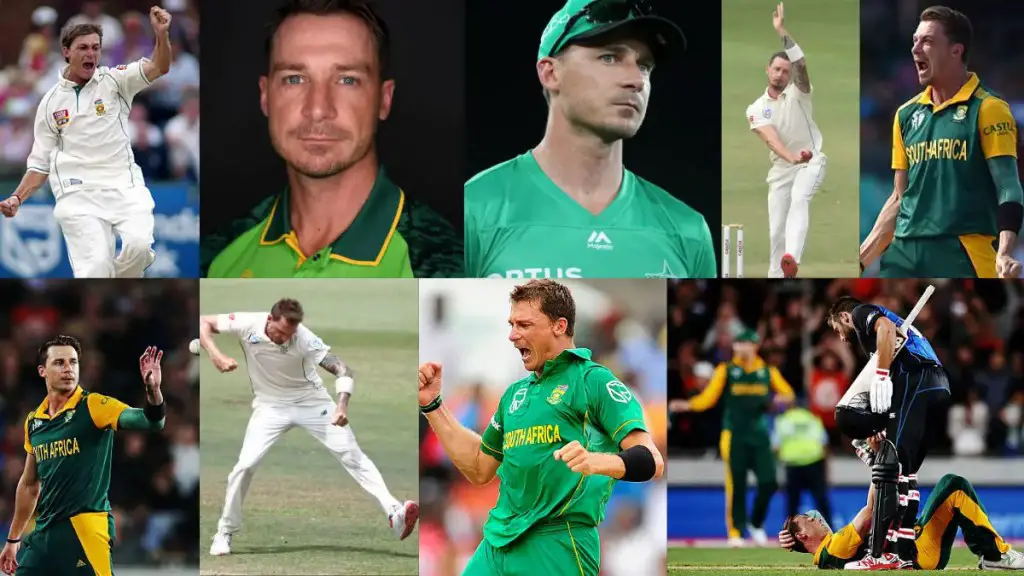
Simplicity and Intensity were the hallmarks of Dale Steyn’s illustrious career—ever smiling character with a popping veins-chainsaw celebration, a smooth, silky action that delivered lethal bouncers, a humble down-to-earth character who assumed the mantle of being the greatest fast bowler of his generation.
Hence, it was true to his character that he hung up his boots via an understated tweet. He signed off with a snippet from the Counting Crows rock band and summed up the end as “bittersweet, but grateful…It’s been 20 years of training, matches, travel, wins, losses, strapped feet, jet lag, joy, and brotherhood.”
Steyn was thrusted in the international arena after just seven first class games. He began his Test career on December 17, 2004 against England, debuting in the same match as the another-to-be legend, Abraham Benjamin de Villiers.
Both teams had great bowlers. On the opposite end—Steve Harmison, Simon Jones, Matthew Hoggard, and Andrew Flintoff (formed the core of the great 2005 Ashes series), while South Africa had the dependable duo of Shaun Pollock & Makhaya Ntini.
Then arrived a 21-year old boy in iconic fashion, going through the gates of Marcus Trescothick and breaking a 152-run opening partnership. In the 43rd over. Full and straight. Slight movement. He screamed. Crowd erupted.
Usually, one brilliant delivery in a match is good enough. However, the ball from Steyn’s debut that is remembered is that Michael Vaughan ball in the second innings. Good length, outswing, beats the bat, off stump rooted. Perfection.
Although South Africa eventually lost that match, they found someone would would win them the decade.
Dale Steyn Stats – Strike Rate Like No Other
Before we jump into his best hits, let us look over some numbers really quick.
We tend to focus on batting strike rate much more due to T20 cricket and increasing run-rates, but to understand what set Steyn apart, we need to understand bowling strike rate. Bowling strike rate is the number of balls taken per dismissal on average. The lower, the better.
Matches
Wickets
Best
Strike Rate
Average
5-fers
10-fers
Test (Overall)
93
439
7/51 (Innings) 11/60 (Match)
42.30
22.95
26
5
Test (Asia)
22
92
7/51 (Innings) 10/108 (Match)
42.9
24.11
5
1
Steyn in Tests
Matches
Wickets
Best
Strike Rate
Average
5-fers
Economy
ODI
125
196
6/39
31.90
25.95
3
4.87
T20I
47
64
4/9
15.80
18.35
2 (4-fers)
6.94
T20
228
263
4/9
19.20
22.00
4 (4-fers)
6.85
Steyn in ODIs and T20Is
To put this into perspective, for those with at least 100 Test wickets, Waqar Younis (43.4), Shoaib Akhtar, (45.7), and Allan Donald (47) are the only other contemporary fast bowlers who were close to Steyn’s SR. From an earlier era, Malcolm Marshall (46.7) was the best, while Kagiso Rabada (41.2), Anrich Nortje, and Pat Cummins (47.1) are in the race right now.
Records
Overall
(42.30) 6th Best Strike Rate of All-Time, 3rd Best post-World War I. Only Shane Bond (38.7) & fellow countrymen Kagiso Rabada (41.2) higher
3rd Fastest to 400 wickets, and the joint-fastest fast bowler to this mark alongside Sir Richard Hadlee (80 matches)
Most Test Wickets for South Africa, surpassing Shaun Pollock’s 421 wickets.
8th Highest Wicket-Taker of All-Time (Only Muralitharan, Warne, Anderson*, Kumble, McGrath, Broad, Walsh ahead. None had a strike rate below 51.9)
Individual
ICC Test Cricketer of the Year (2008)
ICC Test Team of the Decade (2020)
#1 Ranked ICC Test Bowler (2008-2014) – 78 wickets at 16.24 in the 2007/08 season.
IPL: Royal Challengers Bangalore, Deccan Chargers, Sunrisers Hyderabad
Other T20 Leagues: Cape Town Blitz (Mzansi Super League), Melbourne Stars, Islamabad United, Quetta Gladiators, Kandy Tuskers
My Favorite Steyn Memory
My favorite aspect about Steyn was his action. Just a joy to watch. Anytime any format if Steyn is bowling, I would turn my TV on.
You see, the Shoaib Akthars and Lasith Malingas are legends in their own rights, but emulating their actions is a convoluted task. The two pace bowlers with almost perfect actions that I tried to imitate in gully cricket were Brett Lee and Dale Steyn. Uncomplicated yet effective.
To be perfectly honest, I do not remember his specific bowling figures from the top of my head. He has bowled so consistently over the decades that you only remember his iconic wickets or spells. More often than not he probably took a 4-fer or a 5-fer. Most times, I was scared for my favorite batter in the opposite camp, and that is the beauty of Dale Steyn—the ability to send shivers in the opposite camp but in an awe-inspiring, charming kind of manner.
The Rise of Dale Steyn, Conqueror of All Conditions
It would be difficult to go through all of his 29 5-fers, so let us talk about the greatest hits from Steyn’s career. Dropped after his early debut, he made a comeback. Against New Zealand, he would get his first five-fer in 2006.
He had memorable spells against England, Australia, and New Zealand. He took 5 wicket hauls in every condition and situation. Either with helpful seaming conditions or reverse swing.
He has literally taken a 5-fer against every country he played against.
Best Figures (Overall) Against This Team
Best Figures In This Country
Australia
5/67
5/67
Bangladesh
5/63
4/48
England
5/51
5/56
India
7/51
7/51
New Zealand
6/49
3/49
Pakistan
6/8
5/56
South Africa
–
6/8
Sri Lanka
5/54
5/54
U.A.E.
–
4/98
West indies
6/34
5/29
Zimbabwe
5/46
5/46
The King of Asia
Steyn’s best figure was 7/51 at Nagpur in 2010, but it was his 5/23 in Ahmedabad (2008) that landed him in the lengdary fast bowling pantheon, when India were skittled out for 76 at home soil. His brilliant consistency in the 2008 series against India continued- 4/103 (Chennai), 5/23 & 3/91 (Ahmedabad), 3/71 (Kanpur).
In Sri Lanka, he lifted his game even more. 5/82 (2006), and beast mode in 2014 (5/54, 4/45, 2/69, 2/59). He even landed a 5/56 in Karachi (2007) and had a best innings of 4/48 in Bangladesh.
In limited overs, his record is decent as well although he did not play as many matches. 5 wickets in Nagpur against India in the 2011 World Cup, 4-0-17-4 figures while defending a thriller in the 2014 T20I World Cup, and a T20I economy of under-7 suggests he was a much better bowler than his T20 leagues returns suggest.
It would be grave injustice if I did not mention his batting. He was more than a useful down-the order player. Two Test fifties including a crucial 76 and a best of 60 in ODIs meant he was a better than a tailender, but not quite an all-rounder. Kemar Roach-esque batting abilities.
Steyn Vs AB De Villiers IPL
Another riveting memory is the 2012 IPL game between Deccan Chargers and Royal Challengers Bangalore at the Chinawamy. 24 runs in one over. The inside out shot was the best of them all and even got a wry smile from Steyn in appreciationg of ABD’s class.
The brilliance of that passage of play was two players at the top of their games in a pressure situation and for once, Steyn had lost to his fellow countrymen.
Which phase of Dale Steyn was the most memorable or heartbreaking for you?
The Injuries
Another miraculous part of Steyn’s journey was his career of two halves—with respect to injuries.
Usually a fast bowler succumbs to an injury early in their career and comes back stronger, more well built (like Pat Cummins). An injury in the middle of the career means lowering the pace and focusing on line & length (like Munaf Patel). Another extreme is Brett Lee or Shane Bond (always injured, played cricket in between without compromising speed).
Steyn completely escaped this phase and never lost control, momentum, or pace. However, the law of averages came back to bite him at the end of his career.
Injury. Rehabilitation. Few games. Repeat.
2013 (Groin Strain, Side Strain)
2014 (Rib Fracture, 3 Hamstring Strains)
2015 (Groin Strain)
2015-16 (Shoulder Injury)
2017 (Freak heel injury)
2019 (Shoulder Injury) after being selected into the ODI World Cup squad
Climbing the Peak
Although his goal was to lift a trophy with South Africa, there was always a personal goal—to go one past Shaun Pollock. After numerous injuries, he got back up on his feet and on Boxing Day 2018, he took his 422nd wicket to become the leading wicket-taker for South Africa.
It was probably fate that Shaun Pollock would be commentating on that exact moment. Watch the video below to relieve that moment and all of his major milestone wickets till then.
After his shoulder injury again just before South Africa’s 2019 campaign started (and derailed), he announced on 5 August 2019 he would retire from Tests to focus on limited overs cricket. He ended at 439 after going past 400 in 2014.
Loss of form, pandemic, and postponement of the T20 World Cups meant it was time to retire in the other formats as well.
Steyn goes past Shaun Pollock, thereby becoming the highest wicket-taker for South Africa in Test cricket.
Who Is Dale Steyn, The Person?
Now that we know how good Steyn is as a bowler, let us get an insight on who the person he truly is—what really makes Dale Steyn kick.He has a life outside cricket, ya know? Thankfully, his interviews, especially this ESPNCricinfo’s Cricket Monthly interview with Nagraj Gollapudi,provides us a glimpse into his life.
Dale Steyn was born in the small town of Phalaborwa in the Limpopo Province (borders Kruger National Park in South Africa). Maybe the natural environment around him had an effect of him since he became an out-doorsy kind of person. Skateboarding, surfing, and fishing are some of his favorite hobbies. He even flexed his acting muscles for a cameo role in a Drew Barrymore-Adam Sandler movie Blended.
The Inspiration
He is a natural athlete who competed at various sports from an early level. 100 meter sprints, long jump, triple jump, high jumps all prepared him for long spells of bowling in Test match arena. He wanted to be like “Allan Donald through the air, but I wanted to land the ball the way Polly landed.. I wanted to be a faster version of Shaun Pollock.“
The best of both worlds.
Steyn said that the “difference between a good fast bowler and a brilliant fast bowler is the wickets column.” He always backed himself to take wickets regardless of the condition and taking 5-fers in every Test playing nation was one of his goals. Here is his collection of souvenir cricket balls.
WOW!
Dale Steyn shows his collection of souvenir fifer balls 🔥
In order to rise to this level, he has had a lot of support from his coaches, Chris van Noordwyk, Vinnie Barnes, Geoff Clarke, and captains, Graeme Smith, AB De Villiers, and Hashim Amla.
Other Interesting Steyn Facts
There were couple of other cool snippets in there as well. Keeping his cool against dropped catches, facing the Kohlis and de Villiers, altercation with Michael Clarke, Tests vs ODIs, Tendulkar Vs Donald, and video analysis & field settings.
A fun fact is that his full run up is 19 meters, 21 steps, which helps him avoid bowling no-balls. Why is this important? Well because he once took a wicket on a no-ball early in the innings, and it cost his team dearly. The batter was Kumar Sangakkara and the innings became famous for the record 624 partnership with Mahela Jayawardene.
(If you want to learn how Steyn learned about cricket in the first place, hear it from the man himself. Interesting story).
Ian Smith on commentary. Grant Elliot. Superman. It hurt AB De Villers & Faf du Plessis. Definitely hurt Morne Morkel. Probably ended Vernon Philander’s career. We never saw Miller 1.0 again. The entire team. Devastated.
Now for a moment, let us put ourselves into Dale Steyn’s shoe. He dominated the world between 2008 and 2015. Responsibility for the last over of a World Cup semi-final rested on his shoulders (which would literally break a year later). South Africa’s history of collapses and chokes running in the background.
How must have it felt. Carrying the burden of the nation, the tag of the best fast bowler of the generation. One good ball, and you are in the legendary books. One bad ball, and you are scarred for life. Vettori squeezing a wide yorker, chaos in the field, overthrow chances. Steyn calm under pressure. Yet a half-volley in the small grounds of Auckland and Elliot did not miss his chance to glory.
Six. South Africa out. Steyn changed forever.
He reveals how he knew he was going to bowl the final over irrespective of Brendon McCullum’s expensive assault earlier in the innings. After all, he defended 7 runs in the 2014 T20 World Cup match against the same opposition. (He ended with 4-0-17-4 in Bangladesh. Wow). “This year was the hardest in dealing with that pain after the World Cup…We had our chances to win the game…Knowing that you have put four years’ hard work in, especially the last two years before the tournament, all you see is yourself holding the trophy. And then you don’t.”
The Downfall of the Great Era
With Steyn’s retirement, this is the close of one of the better chapters in South African cricket (Technically Faf and Tahir are still available for T20 World Cup selection, but have not been selected recently). All of them deserve a separate article.
Herschelle Gibbs was the architect of that 438 chase. Graeme Smith was the young leader who could bat with a broken hand. The pure class of Hashim Amla & AB De Villiers was unmatched. Faf’s leadership & resilience and once-in-a-generation-allrounder, Jacques Kallis, are often underrated. JP Duminy & Mark Boucher were the utility players every team needs for balance.
Steyn, Morkel, Philander, Rabada
Donald, Ntini, and Pollock passed on the baton to Morne Morkel, Dale Steyn, Vernon Philander, and Kagiso Rabada—possibly the greatest line up (if only for just a few Tests). Philander’s swing made him the second fastest to 50 wickets, while Morne’s height and action bamboozled one and all. Rabada will soon form his leagacy of his own, and Imran Tahir was the energy boost South Africa required.
Together, they conquered teams overseas and became the No. 1 Test Team of the decade, the only ones to really challenge the great 2000s Australia team consistently and win away from home in the 2010s.
The future of South Africa lies with Quinton de Kock, Rabada, Anrich Nortje, Aiden Markram, David Miller, Janneman Malan (100+ average in 9 ODIs by the way), Keshav Maharaj, and Tabraiz Shamsi. This is a pretty solid core, but it will take quite a few generations to reach the heights of Steyn’s South African team.
The Legacy of Dale Steyn
To answer this question, we must first ask ourselves what is great fast bowling?
Is it swinging it like Jimmy Anderson? Putting fear in the opposition’s heart like a Mitchell Johnson or Shoaib Akhtar? Delivering consistent line and lengths like Glenn McGrath & Shaun Pollock? Having a seamless action like Brett Lee? Bowling yorkers at will like a Mitchell Starc? Reverse swing like Waqar Younis?
Imagine all of these players. Package them into one. Add a tinge of humbleness with Sam Curran’s ability to make things happen. There you have it. Dale Steyn, the greatest Test pace bowler of all time.
The 1980s had Malcolm Marshall, Michael Holding, and the West Indies fast bowlers. The 1990s with was dominated by the Pakistan duo Waqar Younis and Wasim Akram. Kapil Dev, Imran Khan, Richard Hadlee all played stellar roles in this era as well. Steyn, Akhtar, and Lee a carried the baton to the next generation and made sure that “fast bowling is cool.” In the age of T20 cricket where sixes are hit on will, Steyn played his part in extending the beauty of pace bowling. The fact that Kagiso Rabada and Anrich Nortje have arrived on the scene has to be credited to senior bowlers like Steyn & Morkel.
He ends that interview with, “The moment I feel I can’t contribute anymore I will not hang on. And if I fall just short of 100 Test matches or five short of 500 Test wickets, that’s fine.”
Unfortunately, that his how it ended. 7 short of a 100 Tests and 61 short of 500 wickets. Legendary career nevertheless.
Dale Steyn Vs Jimmy Anderson – Let Us Settle The Debate
Both Anderson and Steyn are in awe of each other. Steyn describes Anderson as “a more skillful bowler…I am a fan,” in Sky Sports’ Lockdown special, while Anderson’s tribute tweet to his retirement was that Steyn was “The Best.”
Every generation, there are three to five great fast bowlers but maybe one all-time great. We should be grateful we had two. Jimmy Anderson, the greatest swing bowler in the history of Test cricket and Dale Steyn, the greatest pace bowler of all-time.
Let us appreciate both and cheer on Jimmy Anderson in whatever time he has left.
What Can We Learn From Dale Steyn?
Being at the top for over a decade requires immense discipline and fitness levels.
It is one thing to be a great fast bowler. Another to comeback with the same intensity. Not once, not twice. But thrice. My heart sank when his freak heel injury occurred, a sign that the end was near.
I just wanted him to bowl some more. Another Test. Just another spell. Maybe one more over.
Every good thing comes to an end, and so does his magnificent career. I am sure he will continue to inspire athletes around the world and mentor fast bowlers like he did in his career. We will all miss watching Dale Steyn dominate the best batting attacks around the world. I will miss that anger, speed, cartwheeling stumps, celebration, and of course, the action.
Life Lessons
Kids, if you are reading this and want to make a sports person your idol, there is no one better than the great Dale Steyn. So what can we learn from Dale Steyn?
Give it your all on the field and be a decent human being off it. Steyn might have shown plenty of emotions in intense situations, but outside the cricket ground, he is a super chill dude who likes to fish and stay away from conflict.
The truth is that being gifted alone cannot make you great. Simplicity. Honesty. Hard work. Discipline. Consistency. Longevity. Adaptability. You need all characteristics to work in sync.
Steyn was gifted. Not everyone can bowl at such high pace. If you are talented in a particular area and enjoy doing it, you should pursue it further. In order to convert the potential into actual realization, persevere and power through.
You will eventually find your away. Just like a Steyn outswinger that beat the bat and rattled the top of off stump.
Mathematician. Quizzer. History buff. CEO. Director. Storyteller. Writer. Public Speaker. Sports Administrator. Looking at the life of Joy Bhattarcharjya.
Dimuth Karunaratne provided stability to Sri Lankan cricket during a turbulent decade. As he retires after 100 Tests, we look back at his stellar career.
In The Alchemist, a young shepherd named Santiago from the Andalusian region of Spain leaves his simple life to chase a dream, which he calls his ‘Personal Legend.’ He embarks on a journey of self-discovery filled with unexpected twists and turns. Along the way, he learns several life lessons. One of my favorites is, “When…
Jimmy Anderson bowled over 40,000 balls in Test cricket over an international career encompassing 5 FIFA World Cups, 6 Harry Potter movies, 8 British Prime Ministers, 8 full-time England captains, 11 Taylor Swift albums, 20 ICC Men’s tournaments, formation of four independent nations, a worldwide recession, advent of generative AI, and a global pandemic. Sir…
Neil Wagner retires after one of the most iconic Test careers of all-time. There has never been someone like him, nor will there be another Neil Wagner.
What life lessons can we learn from Sachin Tendulkar on his 50th birthday? He represented hope, excellence, and discipline, and more for a billion people.
Longevity & consistency, breaking barriers, mentoring others, staying focused, and daring to dream—This is what Mithali Raj and Jhulan Goswami teaches me.
England Vs New Zealand 2021 Test Series Review – Short but good nevertheless.
Devon Conway & Will Young eased into Test cricket, New Zealand tried their options for the World Test Championship Final, and England lost some options as they gear up for the India series & the must awaited Ashes later this season.
Tim Southee – 7 wickets (1 match only) (best innings – 6/43, best match – 7/80, 11.42 average)
England Vs New Zealand 2021 Series Stats
Highlights
England
England’s batting continues to go down hill after the 1st test against India. They have now lost 4 and drawn 1 in the past five Tests (2 at home, 4 away). All the hopes and dreams after away series wins in South Africa and Sri Lanka are crashing down quickly.
The Batting: England’s Batting Averages Just Not Good Enough
One of the highlights of Kimber’s analysis was Rory Burns has been a stable cog in this English lineup despite the poor numbers. He scored a brilliant ton and almost carried the bat in this series, which increased his Test average to 33.23 with 3 hundreds and 9 fifties. Not the best stats after 25 Tests, but the Sibley-Rory partnership has done a decent job in the past couple of years. Well, not quite Strauss-Cook, but the standards have been so low recently that a Burns century should be rightly celebrated.
Zak Crawley’s scores in this series—2 & 2, 0 & 17. Not good enough for a #3 batter at home. I hope England persist with him but he needs to meet them halfway, nothing of note since that 267.
Ollie Pope looks like Ian Bell, bats like Ian Bell, but I hope he starts converting like Ian Bell. Beautiful 20s and 30s can only get you so far—think James Vince (22 & 20*, 19 & 23 this series).
The batting averages of England’s main batters are far from impressive. Joe Root’s overall average is great, but has been struggling at home for quite a while now.
Rory Burns (33.23), Dom Sibley (30.78), Zak Crawley (29.33), Joe Root (48.68), Ollie Pope (31.50), Jos Buttler (34.53), Ben Stokes (37.04).
Commentator Nasser Hussain did not mince any words in the post-series analysis, urging their batters to get back to basics and avoid funny techniques. The current England batters have the mindset that:
“Everyone else that has played the game in the history of the game. Viv Richards you were wrong. Everyone is wrong, we are right.”
Debutants Ollie Robinson & James Bracey had contrasting series. Although Robinson had a brilliant debut, both with the bat and bowl (highest wicket-taker for England in just 1 match), he was suspended from international cricket due to resurfacing controversial tweets. Poor Bracey had a tough debut series – 0, 0 & 8. Broken Dreams for both.
The senior fast bowlers were the only positives of the series. Mark Wood impressed…with the bat. He was among the wickets and consistently bowled his heart out as usual but his 41 & 29 in the 2nd Test showed England that the pitch does not contain any demons.
The old Stuart Broad showed up. In the 2nd Test, it seems that one of those spells was just around the corner. One of the bright lights in the series. Definitely got a couple more years left in him.
Jimmy Anderson was not as sharp this series, with just 3 wickets and averaging 68.66. Surpassed Alastair Cook as the most capped Test player for England-162 Tests. Take a bow.
New Zealand
The Debutants Star
In every series review, I highlight a couple of standout performers of the series. Guess what? In EVERY New Zealand series over the last year, Devon Conway has made the series headlines. T20I debut? Conquered. ODI debut? Check. Test debut at Lord’s? Double century and almost carries the bat. What else is there to say? 76.50 Test average, 75.00 ODI average, 59.12 T20I average. 1-200, 1-100, 4-50s in just 18 innings. Brilliant.
Will Young is continuing his good touch. Scored his maiden T20I fifty against Bangladesh recently and was picked in the 2nd Test after Williamson’s injury on the basis of a couple of centuries in County Cricket. Missed his century by 18 runs, but has finally found his feet in international cricket. He his here to stay.
Matt Henry, Ajaz Patel, and Neil Wagner all impressed with whatever chances they got.
Henry picked 3/78 & 3/36 to bag the player of the match in the 2nd Test
Ajaz Patel’s control and guile were impressive with figures of 2/34 & 2/25.
Neil Wagner bowled line and length more than his usual bouncers. Not unplayable but impactful for sure. Should edge Kyle Jamieson/Matt Henry for the WTC Final spot.
Senior Pros Provide Solid Support
Tim Southee is gearing up to the WTC Final with a superb series. After having re-invented himself in T20Is this year, he has found his swing, line, & length again.
Ross Taylor, one of New Zealand’s greatest, justified that tagline with a 80 in the 2nd Test. The beauty of that innings was he was nowhere close to his best. Stuart Broad was beating his edge right and left, but he survived and capitalized later on. In contrast, England’s batting collapsed to 76-7 and none of the batters had the will to fight it out like Taylor did.
Unfortunately for BJ Watling, he suffered a minor back injury on the eve of the 2nd Test and missed out. Hope he is ready for his swansong in the World Test Championship final.
In addition to Rory Burns’ 81 in the 2nd Test, the only criticism for New Zealand I could find would be the lack of conversion for three batters (Conway 80, Young 82, Taylor 80).
Awards
England
New Zealand
Emerging Player
Ollie Robinson
Devon Conway & Will Young
Surprise Package
Mark Wood, the batsman
Matt Henry & Ajaz Patel
Broken Cricket Dream
Ollie Robinson, Zak Crawley
BJ Watling
England Vs New Zealand 2021 Series Awards
Where Do They Go From Here?
New Zealand will be in the World Test Championship Final starting tomorrow.
Apart from the various leagues in the next few months which will keep the New Zealand players busy, the next international fixture is scheduled between 29th January-8th February 2022 for 3 ODIs & a T20I.
We billed this series as the “Final Before the (WTC) Final” and after overseas victories for both India (vs Australia) and England (Vs Sri Lanka), the series had hype for the right reasons.
Instead this series will be remembered for exactly the wrong reasons—Discussions about the pitches in Chennai & Pink Ball Test, rotation policy & England’s treatment of Moeen Ali, and hasty umpiring decisions (along with Kohli’s priceless reactions).
There were some good days for cricket as well with Ishant Sharma’s 100 Tests & 300 wickets, Joe Root’s 218, Anderson’s dream over, Foakes’ & Pant’s wicket-keeping, R Ashwin’s 100 & 9-fer, Ashwin’s 32 & Axar’s 27 wickets, Sundar’s 85* & 96*, Rohit Sharma’s masterclass, and Pant’s reverse sweep (to Anderson) in a brilliant 100.
Read till the end for my picks for the best moments,emerging players, controversies, and much more! COMMENT BELOW ON YOUR FAVORITE MOMENTS.
*Note: Underlined & Bolded links are videos. Underlined without bold are links to other articles.
Results – England Vs India
The reason why I did not enjoy this series as much was due to the lack of competitiveness. 227 runs, 317 runs, 10 wickets, and an innings victory was in complete contrast to the edge-of-the-seat stuff (last session draws/chases) in the Australia series.
India Ravichandran Ashwin – 189 runs (best of 106, average 31.50, 1 – 100)
Most Runs
Joe Root – 368 runs (best of 218, average 46.00, 100s/50s – 1/0)
Rohit Sharma – 345 runs (best of 161, average 57.50, 100s/50s -1/1
Most Wickets
Jack Leach – 18 wickets (best innings – 4/54, best match – 6/178, 28.72 average, strike rate 53.6)
R Ashwin – 32 wickets (best innings – 6/61, best match – 9/207, 14.71 average, 35.2 SR, 3 5-fers
India Vs England 2021 Test Series Stats
The Highlights
England
1. We Miss The Non-Converting Joe Root
At the beginning of 2021, Joe Root’s stats read 17-100s, 49-50s. After the Sri Lanka & India tours, his stats read 20-100s, 49-50s. His last 6 Test matches show:
228 & 1 (run-out), 186 & 11, 218 & 40
6 & 33, 17 & 19, 5 & 30
Notice something? He converted 3 daddy hundreds, and then followed it up with 3 middling Test matches (mainly due to the intelligent bowling of Axar and Siraj). Now, we should not be too harsh on Root. The law of averages surely catches up, he had additional stress of captaincy, and he even bowled his heart out including a 5/8.
Still, the Joe Root who scored consistent 60s & 70s might have been more than handy on this low scoring tour. The 50th 50 would be cherry on top of his personally successful season.
2. Batting Wins Matches
Catches win matches? Sure. Need to take 20 wickets to secure a Test victory? Maybe.
How about batting with scores of 178, 134 & 164, 112 & 81, and 205 & 135? Definitely Not. This is called batting yourself out of a Test series. Let us dig a bit deeper:
Pope 153 runs at 19.12 (best of 34), Sibley 134 at 16.75 (best of 87) – 4 Tests each
Burns 58 runs at 14.50 (best of 33), Bairstow 28 at 7.00 (best of 7, 3 ducks), Crawley 67 at 16.75 (best of 53) – 2 Tests each
For international level cricket, if your Top 5 comprises of these players, barely-in-form Root-Stokes, and Buttler/Foakes, then this is just not going to cut it.
Maybe a certain Joe Denly might have been able to weather the storm better. If not the centuries, at least the Denturies would have come.
3. Anderson, Foakes & Lawrence The Bright Stars
Let us take out the stats for the moment, and look at the bright side.
Winning a Test match is not easy. Winning away even harder. Hence, the 227 run victory in Chennai should be regarded as a huge accomplishment, regardless of the 3-1 margin. (The issue was not the score line. Rather, it was the way they lost the final 3 Test matches).
Jimmy Anderson’s 6/40 in Galle & 3/17 in Chennai should rest the ‘Clouderson’ and ‘poor away record’ claims. That 3/17 included one of the best overs of reverse swing you will ever see. A well set Shubman Gill was bowled through the gate, Rahane survived an umpires call appeal, and then carbon copy bowled. Does not get any better than that.
On the turning pitches, Ben Foakes’ keeping was absolutely magnificent. His split-second stumping of Rohit Sharma and Rishabh Pant in the 2nd innings of the 2nd Test were quite something. (His batting showed signs of defiance, but could not reach his heights of his debut). Finally with 73 on debut and 46 & 50 in the final Test, Dan Lawrence showed some signs of steel.
Finally Channel 4 coverage was a win-win situation for the fans.
India
1. Axar Patel Invokes His Inner Embuldeniya, R Ashwin – The Man of the Hour
Just like Embuldeniya troubled England prior to this tour, Axar was the concern this time around. Straighter one, bounce, turn, guile, he had it all.
The best part is that Axar was not even supposed to play this series if not for Jadeja’s injury. 27 wickets at 10.59 with 4 5-wicket hauls & 1-10 wicket haul (best inning – 6/38, best match 11/70). Even got the opportunity to take a five-wicket haul at his home with some crowd. Stuff of dreams.
R Ashwin has got to be the most intelligent player in international cricket. He has a YouTube channel, reads books in his free time, is an engineer, can mess with the batsmen due to the Mankad-threat, talks to the media about a ‘bad pitch’, walks the talk with a 106 on the Chennai turner, and bamboozles the batsmen with skillful bowling.
The dismissals of Ollie Pope (carrom ball, beats the bat, bowled) in the final Test have to be my moments of this series.
2. The Sharmas Come To The Party
Wonderful achievement by Ishant Sharma for his 100th Test & 300 wickets. Just rewards for a brilliant journey over the last decade. Although this series was spin-dominated, Ishant Sharma 4.0 still has several years to offer to Indian cricket.
Rohit Sharma went very much under the radar this time, but India’s series victory was in jeopardy without his contributions. 161 on a tricky pitch was the turning moment of the series, and he followed it up with patient 26, 66 & 25*, and 49. In these low scoring matches, runs on the board provided the cushion for the spinners to dominate.
3. India’s Big 3 Just Not Good Enough, Depth Covers the Spots
Just like many other well-wishers, I had predicted Virat Kohli to come back in this series with a tough 50 at the start and a a double century by the end. The tough 72 in the 2nd innings at Chennai definitely came, but nowhere near the elusive 71st international century. Here are the stats:
Virat Kohli: 172 runs at 28.66 (best of 72, 2-50s, 2 ducks)
Ajinkya Rahane: 112 runs at 18.66 (best of 67, 1-50, 1 duck)
Cheteshwar Pujara: 133 runs at 22.16 (best of 73, 1-50, 1 duck)
I do not remember so many ducks by these 3. Nor do I remember a series where none fired.
Apart from Rohit Sharma, Rishabh Pant, Washington Sundar, & R Ashwin all outscored the middle order stalwarts. Since India emerged victorious, the cracks are temporarily filled, but questions should be asked.
After that Melbourne innings, Rahane has not done enough. Pujara is doing fine and crucial to India’s line up, but is not converting to daddy hundreds at the moment.
Given India’s depth, is it time to breed in the next generation? Is it time to rotate home/away batsmen as India rotates fast bowlers/ spinners?
Also Read:
Controversies
Umpires
The umpiring decisions in the 2nd & 3rd Tests caught the attention of the public. It was not necessarily the decisions made, but the manner in which they were decided (Ben Stokes’ catch – on field out, but turned over quickly). A standard procedure & muting the umpires’ conversation may be the way to go forward here.
Pitch
By the end of the series, it was easily recognized that England’s lack of batting application led to their downfall, not the state of the pitches. However, 2-day & 3-day matches do not anybody a favor, either. The pink ball Test is supposed to get more public to watch the game, but most of these matches are ending in 3 or 4 days, which is counterintuitive. The first Test may have been the most balanced pitch, even though it was slow & attritional for the first day and a half.
Rotation Policy
Finally, the rotation policy. England’s rotation policy has possibly extended the careers of Broad & Anderson, given a chance to youngsters fighting for a national spot, and is important in the coronavirus era due to mental health. Rotation is not necessarily a bad thing, but how it was implemented in this series was dodgy.
Archer, Burns, & Stokes were rested for the series in Sri Lanka, while the rest of the squad stayed. However, Buttler left after one Test, Moeen Ali finally playing a Test only to go back home (due to miscommunication), Bairstow played the last two, Woakes left without playing, so on and so forth.
I cannot imagine how much the constant traveling & jet lag, inconsistency in selection & unsettled line-ups, and not having enough practice games might have impacted their minds. I can understand rotation between series, but during a series is a bit much.
And if this rotation was for the preparation for upcoming T20 World Cup & IPL, losing out to the WTC Final spot at home should seriously be questioned.
Awards
We like to spice things up with our own awards for the series. Here they are:
India made Ravichandran Ashwin, Ravindra Jadeja, Axar Patel (greatest understudy of all time), and Washington Sundar into world class all-rounders. England took a world class all-rounder in Moeen Ali and practically destroyed a budding career.
India
England
Emerging Player
Axar Patel
Dan Lawrence, Rotation Policy
Surprise Package
Lower Middle Order
Dom Bess’s Full Tosses; Joe Root’s 5-fer
Broken Cricket Dream
Shardul Thakur – Did not get a game after a 92 & 4-fer at Gabba Dreams Broken For Fans Wanting Ashwin to become the 4th player to do the double of 100 + 10-fer
Stuart Broad’s Asian Dream, Jonny Bairstow’s Test Career, Moeen Ali
India Vs England 2021 Test Series Awards
Where Do They Go From Here?
A 5 match T20I series & 3-match ODI series to follow, preparing for the upcoming T20I World Cup in India. Then, we will have the IPL, England will play a couple of test matches against the New Zealand at home, and finally India Vs New Zealand for the WTC final.
After England’s victory at Chennai, I declared that this English team could rival the 2010-2012 team due to the good mix of youth, experience, & abroad victories. I guess that was a bit premature.
Was this India Vs England 2021 Test series the ‘greatest story of all time’ like the India Vs Australia? Nope.
Was it as controversial as the South Africa Vs Australia scandalous ball tampering series? Not really.
At best, this was just a Meh kind of series. Had its moments, but did not capture the imagination of the next generation. Sums it up for the World Test Championship.
What did you think of the India Vs England 2021 Test Series? Let us know!
Subscribe for more below! Share with your friends as well! Here is our Facebook& Twitter pages.
Today we discuss Top 50 England Cricket Team players.
England’s rotation policy is well documented. Anderson and Broad have been preserved for more than a decade, while the Woods, Stones, Archers, and Currans rotate. Their bowling depth is quite vast.
After years of mediocre cricket, England’s rise post 2015 has been nothing short of marvelous. 2016 WT20 final, 2017 Champions Trophy semi-finals, winning it all in the 2019 World Cup, and the team to beat at the upcoming 2021 T20 World Cup. Their limited overs bench strength is quite something. In Tests, they have now won a record 6 in a row overseas.
Build FOUR England National Cricket Teams: 2 Test teams, an ODI, and a T20I XI so that (1) each team can field a team (wicketkeeper & 5 bowling options), and (2) a player is not repeated in any of the lists.
The Catch
Would you pick Ben Stokes for the Test team, ODI, or the T20I? How about Jofra Archer? Is Buttler more dangerous ODI middle-order batsman or a T20I opener?
Can you make all 4 teams balanced? The goal is that each team is just as good and competitive on the international stage. The ODI & T20I teams should be good enough for the World Cups and the Test teams for the World Test Championship.
England Cricket Team Players
*uncapped player
Test Team 1
1. Rory Burns
2. Dom Sibley
3. Zak Crawley
4. Joe Root (C)
5. Ollie Pope
6. Ben Foakes (WK)
7. Jofra Archer
8. Stuart Broad
9. Dom Bess
10. Jack Leach
11. James Anderson
Test Team 2
1. Haseeb Hameed
2. Keaton Jennings
3. Joe Denly
4. Dan Lawrence
5. Moeen Ali (C)
6. James Bracey* (WK)
7. Sam Curran
8. Craig Overton
9. Jake Ball
10. Mason Crane
11. Olly Stone
England Cricket Limited Overs Teams
ODI XI
1. Jason Roy
2. Jonny Bairstow (WK)
3. Eoin Morgan (C)
4. Ben Stokes
5. Jos Buttler (WK)
6. Sam Billings
7. Chris Woakes
8. David Willey
9. Adil Rashid
10. Mark Wood
11. Saqib Mahmood
T20I XI
1. Alex Hales
2. James Vince
3. Dawid Malan (C)
4. Tom Banton
5. Liam Livingstone
6. Ben Duckett (WK)
7. Lewis Gregory
8. Liam Dawson
9. Chris Jordan
10. Tom Curran
11. Reece Topley
*Notes:
I made sure Eoin Morgan and Alex Hales were in different teams (ouch).
David Willey narrowly missed out on that World Cup squad, but here, Archer plays for the Test team, while Willey makes the ODI XI. Best of both worlds.
Initially I had Sam Billings as a T20I finisher/captain, but had to fill a space in the ODIs (given Root was picked for the Test squad). Hence, Ben Duckett was added to the T20I XI.
Extended List of Prospects
These are just the 44 that are ready for the international level. Here is an extended list of players for the next decade. These players were either (1) selected for the 55-men ECB training squad when cricket returned from COVID, (2) have recently represented England Lions, or (3) were picked from the recent T10 League.
Youngsters to Watch Out (26 or Below): 48. Jamie Overton, 49. Tom Helm, 50. Tom Moores (WK), 51. George Garton, 52. Tom Abell, 53. Alex Davies (WK), 54. Phil Salt, 55. Pat Brown, 56. Henry Brookes, 57. Tom Kohler-Cardmore, 58. Will Jacks, 59. Sam Hain, 60. Brydon Carse
Ex-International Players Out of Favor(but still dominating T20 or County Circuits): 61. Luke Wright, 62. Liam Plunkett, 63. Samit Patel, 64. Adam Lyth, 65. Ravi Bopara, 66. Gary Ballance, 67. Steven Finn
Others:68. Ben Cox (WK), 69. Laurie Evans, 70. Richard Gleeson, 71. Sam Northeast, 72. Adam Hose, 73. Sam Wisniewski, 74. Daniel Bell-Drummond, 75. Joe Clarke*
*was named in Alex Hepburn rape trial and since been reprimanded. Doubt he will ever be selected for England
The Verdict
England’s ODI, T20I, and first string Test squad are stronger than India’s, but India’s second string Test squad AND depth of reserves is probably higher quality. I even had to pick Haseeb Hameed and Keaton Jennings for the second string Test opening (given that it has taken a decade for England to replace Strauss-Cook in their first string squad, it is no surprise I had trouble in this regard).
England has an abundance of pace bowlers, but the next generation of batsmen have not yet been groomed.
Now, a lot of India’s players (50-75) were the youngsters emerging from the recent U-19 World Cups and IPL 2020 (post-COVID). Since The Hundred was cancelled last year, the English public were robbed of watching exciting young talent. Who knows, after the 2021 edition of The Hundred, maybe England’s depth can overpower India.
What do you think of England cricket team players right now? What will your England XIs be?COMMENT BELOW!
If you like this, check out the rest of our World XIs with TwistsHere – Best Fielding XI, Best Commentators XI, and much more!
Joe Root Vs Lasith Embuldeniya. That’s it, that’s the end of the series review….
Just Kidding, but boy it felt like Root vs Embuldeniya, didn’t it? At one point in the 2nd Test, Embuldeniya was hitting sixes and the golden arm of Joe Root was called upon to take his wicket and clean up the tail.
Yet, this short two-Test series had several other actors and memorable moments. The 2-0 score line may not have been close, but the contest was enthralling, nevertheless.
Broad’s initial burst, Bess’s uncanny wicket taking ability, Dan Lawrence’s dazzling debut, Niroshan Dickwella’s high-five face slap, Leach and Embuldeniya’s brilliance, Sibley and Thirimanne’s revival, Dickwella’s sledging, Bairstow and Buttler’s solidity, Mathews and Root’s centuries, Dickwella’s 92, and of course, Jimmy Anderson being well…Jimmy Anderson (in Asia).
Read till the end for my picks for the best moments,emerging players, lookout for the India Vs England series, and much more! COMMENT BELOW ON YOUR FAVORITE MOMENTS.
*Note: Underlined & Bolded links are videos. Underlined without bold are links to other articles.
1. Joe Root, Jonny Bairstow, Jos Buttler: Critics Go Out The Window
Joe Root just does not like scoring 100s. Either 50s or daddy hundreds.
Do you all remember a few weeks ago in the India Vs Australia series, the commentators were discussing about the Big 3? That seems ages ago. In the preview article, I argued that
“Root is still a stellar player with an amazing record. The fact that England do not seem to need him as much as the other countries is a reflection of the strength of this English team, not the fall of a rising career. I hope he answers his critics with the bat.“
186, 228, 2/0, and 7 catches later, Joe Root has answered his critics in some style. He has gone from being criticized for his poor conversion-rate to becoming England’s #4 all time tally, surpassing Boycott, Pietersen, and Gower on the way (Suddenly, predictions of catching Tendulkar’s Test runs have opened since he is only 30).
2. The Rest of the Batting
Crawley had a horrid tour with the bat (4 innings, 35 runs at 8.75), Sibley with 62 runs in his 4 (including a 56* in his last innings), and Sam Curran at 7 a spot too high (2 innings, 13 runs at 6.5).
Bairstow (4 innings, 139 at 46.33) and Buttler (3 innings, 131 at 65.5) fared much better, while Dan Lawrence had little to show after his sparkling 73 on debut.
Bairstow at 3 again? Yes he is a good player of spin, but does he warrant a position in the squad? Several questions were asked pre-series.
With the struggles of Crawley and Sibley, Bairstow did a good repair job with 47 (93), 35* (65), 28 (73), 29 (28). A makeshift English #3 batsmen on foreign soil, successfully denting the new ball without converting it…Where I have I heard this before?Bairstow’s tour was so…Denly-esque.
3. Youth & Senior Pros Combine to Bamboozle Sri Lanka
Stuart Broad (3/34 at 11.33) & James Anderson (6/46 at 7.66): No Sign of Aging
Dom Bess (12/255 at 21.25) & Jack Leach (10/355 at 35.5): Here To Stay?
Stuart Broad’s resurgence in the past year or so has been heartening, and Anderson’s fitness just becomes better with age. Anderson’s home swing advantage has always clouded his greatness and longevity, but his 6/40 at Galle in the 2nd Test was as good as any.
Dom Bess himself admitted his bowling may not have deserved a 5-fer in the 1st Test. Maybe once or twice, you can call it a fluke but 5/30, 3/100, 4/49 along with a handy 32 with the bat shows he is willing to learn & improve his skills. Jack Leach’s numbers probably do not reflect his 110.5 overs worth of effort, but both of them are here to stay.
It is pretty clear that England are going to rotate Broad/Anderson, pick Mark Wood (tad unlucky this time around) for pace, and play both spinners for the upcoming India series (given Moeen Ali does not come back for Sam Curran).
Sri Lanka
1. Thirimanne & Angelo Matthews
Lahiru Thirimanne was our contender for the Broken Dream in our preview. Just look at his stats:
Average of 22.68 after 36 Tests, 1 century after a decade on the international scene
He came back with a solid 111 and 43 in this series, and has ‘extended’ his place in the side. Will take a few more consistent performances to cement his place. I was also looking forward to a Chandimal-Thirimanne-Mathews solid middle order foundation. Chandimal had a Bairstow-like with a 52 and a couple of 20s, while Mathews was Sri Lanka’s most run-getter including a hard-fought 71 and 110.
88 Tests, 6194 runs at 45.54, with 11 100s, best of 200*– Mathews is slowly approaching Sri Lanka’s Legend Status.
(SL Vs SA): 396 & 180, 157 & 211, (SL vs Eng): 381 & 126, 135 & 359
Notice a pattern yet? For England, Root scored a mammoth 426 with Bairstow-Buttler scoring 139 & 131 runs respectively. Sri Lanka had 5 scorers over 100 & Mathews/Thirimanne did convert, but there were just not enough match winning partnerships. Partnerships are the key to success. As we can see from the beginning of the South Africa tour, Sri Lanka have scored 350+ 3/8 times, but they have also collapsed 4/8 times.
Sri Lanka were not bad, but inconsistency in the other innings killed any chance they had.
4 innings, 119 overs, 15/415 at 27.66, best of 7/37, 1 5-fer, 1 10-fer
The reason why batting inconsistency hurt more this time around is because with Lasith Embuldeniya, Sri Lanka actually believed they could win.
In the first match, chasing a mere 74, England were down 14/3. Embuldeniya made it look like a landmine, but just there were just not enough runs on the board. He bowled tireless spells, opened the bowling, and even hit an aggressive 40 (37) in the 2nd Test to take the score from 78-8 to 126.
The name, the action, the wicket taking ability – have Sri Lanka finally found someone to carry the legacy of Muralitharan and Rangana Herath? Only time will tell.
4 – Ducks in a Row for Kusal Mendis (including SA series). His replacement, Ramesh Mendis, carried on the tradition and opened his account with a duck as well.
6 – Wins In a row for England in Sri Lanka. Huge accomplishment – Kudos! It is never easy to tour Sri Lanka at home and consistent results bode well. Oh yes. And England won without the likes of Jofra Archer, Ben Stokes, and opener Rory Burns.
8 – Short of a maiden hundred for Niroshan Dickwella. So close, yet so far.
13 – Wickets Away from Anil Kumble’s 619 for the 3rd highest wicket-taker EVER for Jimmy Anderson. GOAT.
We like to spice things up with our own awards for the series. Here they are:
Who would have been your Emerging Player? Surprise Player? Broken Cricket Dream? Let us know below WITH COMMENTS! Also please share and subscribe below!
Where Do They Go From Here?
Sri Lanka’s 2021 outlook looks filled. They will complete some of the WTC matches that were cancelled in 2020. They will host/tour Bangladesh, go to West Indies, & host Ireland for a Test match as well. Second part of the year will be focused on the T20I World Cup.
Busy Year for England this. 17 Test Matches on the cards (Maybe more if they qualify for World Test Championship Final). Next Up – India. 4 Tests, 5 ODIs, 3 T20Is from February 4th to March 27th (Add IPL, the Hundred, & World T20 World Cup in the mix as well). The series is key to the WTC finals. England currently at 4th but slowly inching up (Just 3% separates #4 England from #1 India).
Several questions on England vs India TV rights and squad selections as well. Bairstow, Curran, Wood rested for the first couple of Test matches, while Buttler flies home after the 1st one.
With India surprising expectations in Australia, will we see a similar triumph for England against favorites India?
Where do Sri Lankan cricket go from here? Would love to hear your thoughts in the comments section below!
Subscribe for more below! Share with your friends as well! Here is our Facebook& Twitter pages.