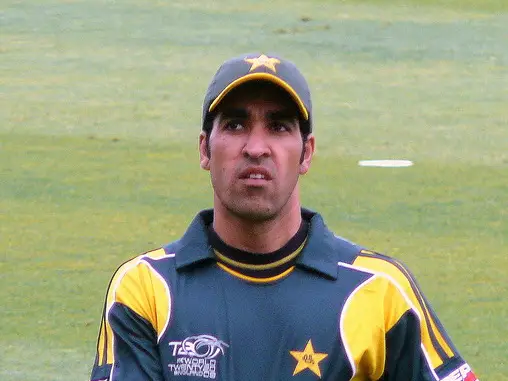
In I Have the Streets, R Ashwin doesn’t just tell his story, he reveals the person behind the player. Cricketers are people too, filled with desires, doubt, flaws, and fire.
There is so much to learn from Ashwin. And what better way to understand his mind than through his own words?
His story is one of self-doubt but also fierce self-belief, a touch of ego but with quiet confidence, a desire to disrupt, but also a willingness to learn. And above all, it’s grounded in a deep love for cricket from the streets of Chennai to the grandest stages in the world.
So here are 25 quotes from R Ashwin’s autobiography that offer a window into the mind behind the cricketer.
Right at the beginning of the book, you realize that Ashwin suffered from health issues as a child, which lingered into adulthood. At every stage, he faces self-doubts, fitness issues, social awkwardness, and a constant desire to fit in.
1. “I don’t eat much, but I play a lot. If I eat or drink too much, I vomit. If I run hard, I cough, which leads to vomiting. I play, I cough, I vomit and I continue playing. On an average, I have wheezing bouts twice a month. Each one lasts six or seven days.”
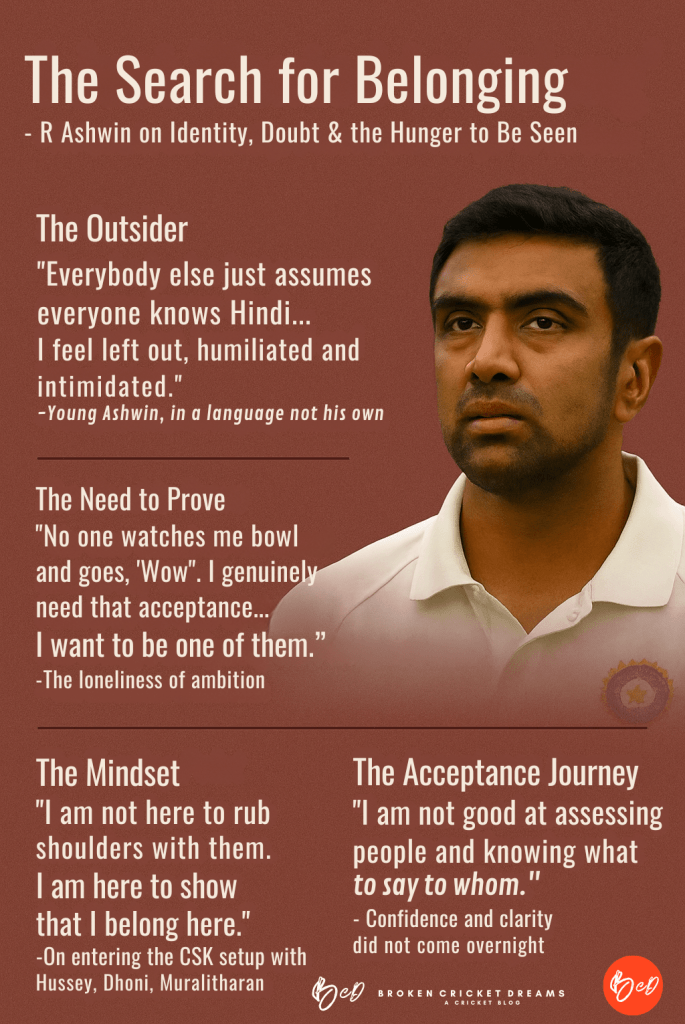
2. “Everybody else just assumes everyone knows Hindi and sets off speaking their own version of Hindi. I find it rude and alienating that no one makes an effort to talk to the one boy who doesn’t know their language…I feel left out, humiliated and intimidated.”
3. “No one watches me bowl and goes, ‘Wow’…I genuinely need that acceptance, though, to lose that feeling of being in awe all the time. I want to be one of them as soon as possible. So I’m always trying to analyze how they are looking at me. What is running through their heads? Do they think I am a proper cricketer or just a guy to make up the numbers.”
4. “I am not good at assessing people and knowing what to say to whom.”
5. “I am amazed that even Murali has self-doubt….These are inhuman expectations of him, but he doubts himself too, just like other humans.”
Life Lessons #1: External pressure, internal fears, and the desire to belong, they are all part of life. The key is to stay grounded in who you are and turn those doubts into positive energy.
Proving a Point, Over and Over Again
Whether it was the Ranji Trophy, the IPL, or the Indian time, Ashwin has had to prove himself over and over again. His interests in movies and engineering degree already made him a well-rounded person, and switching from a batter to an off-spinner made him a cricketing all-rounder. Resetting and performing repeatedly in different areas of life speaks to the strength of his mental resolve.
6. “Not for the first time, I find myself in a situation where nobody gives me a chance. I suspect nobody wants to give me a chance. My response is the only one I know: work harder, run harder, push harder.“
7. “Anirudha and I show up, we sign our contracts, and then VB gives us a glorious speech on what a huge opportunity this is. ‘You guys will rub shoulders with the likes of Michael Hussey, M.S. Dhoni, Matthew Hayden, and Muralidaran’…listen to it earnestly but also think to myself, ‘I am not here to rub shoulders with them, I am here to show that I belong here.'”
8. “It has been such a quick turnaround. From being a batter who bowled some seam-up, I am now an offspinner with one-and-a-half successful first-class seasons behind me.”
10. “One of the three streams offered to me, I pick computer engineering….I feel like I will die trying to balance studies and cricket. It feels like these four years of my life will never end…Every day is a hustle, trying to manage both college and cricket.”
Life Lesson #2: Challenges will come. And when they do, channel your inner R Ashwin and work harder, run harder, and push harder. In striving to prove a point, you may just discover excellence.
Always Asking, Always Evolving
Ashwin has kept evolving his game throughout the years. He has changed his action numerous times, invented new deliveries, and even became a T20 finisher.
But how did he get here? Ashwin evolved because he never stopped asking questions. From local bowlers to legends, he kept learning.
9. “It is during one of these [tennis ball] games that I come across SK. He has a beautiful and correct offspinner’s action, but the ball turns in weird directions and zips off the dusty surfaces…He is a bit of a terror in these matches. I am completely fascinated by what he does with the ball. So I start shadowing him. I take my bike and ride to wherever he is playing…I finally approach him to ask him how he does is. He is nice enough to show me that he flicks it with the middle finger and sends it out of the front of his hand when he wants to turn in the other way…In Madras, it is called the sodakku ball.”
11. “…Haydos’s company. I hesitate to speak with him; I wait for him to finish whatever he is doing and then introduce myself. He is extremely friendly. I ask him all the kinds of questions, and he patiently answers. I suspect he enjoys having conversations…How do you deal with pressure? How do you face Murali? How do you stand at slip for Shane Warne? I’ve watched you take some great catches; what is your mindset at slips?”
Influence of WV Raman and MS Dhoni
The most compelling moments in the book come from R Ashwin’s experiences with his mentor, WV Raman and his first early interactions with MS Dhoni. With Raman, you can vividly picture Ashwin honing his skills and elevating his craft. With Dhoni, you witness the foundation of a partnership that would shape Indian cricket for the next decade.
12. “Raman and I are made for each other. For the life of me, I can’t keep repeating the same thing. And Raman the coach comes up with something every day to help me keep discovering sping bowling to the fullest. One fine day, he tells me, run in 5 percent slower. Then another day, run in 10 percent faster.”
13. “…but Raman told me taking the new ball was the wrong call. And I told him, we had them nine down, trusted my seam attack, and they didn’t deliver…Raman said, ‘No, you’re wrong. Own up to your mistake. And do not come and tell me they didn’t deliver. If they didn’t deliver, you have a part in it.”
14. “When it comes to cricket, I am basically made of questions. MS doesn’t discourage me and answers every single question sincerely. He never brings up the optional nets either.”
15. “Each captain is different. Some can make donkeys run. Some people can buy wounded horses, treat them, train them, and make them run. But M.S. Dhoni will only make a racehorse run. He needs to be convinced you’re a racehorse before he makes you run. He will wait for a racehorse. If he doesn’t believe you’re a racehorse, he’ll probably give you time to become one, but he won’t make you run if you aren’t there yet.”
Life Lesson #3: Growth begins with curiosity. Ask questions. Stay open. The more you seek, the clearer your path becomes.
Indian Cricket Through Ashwin’s Eyes
Ashwin’s love for Indian cricket comes through in the way he speaks about his peers and predecessors.
16. “Tennis-ball cricket is a massive phenomenon in Madras. During the summer break, you can’t pass through a neighbourhood without witnessing at least one intense match going on in the sector ground. You don’t need a proper turf, a pitch or equipment for these games. It is a pure expression of love for the game and competition.”
17. “The other is Cheteshwar Pujara, who is only 15 and has already scored a triple-century in Under-14 cricket….There is an aura around him, an aura of thousands of runs.”
18. “And there are some ruthless players of spin going around…Shiv Sundar Das, Mithun Manhas, Halhadar Das, Robin Uthappa, Yere Goud, Rajat Bhatia, Sanjay Bangar…S. Bharat & Badri.”
19. “I, though, have seen the future of Tamil Nadu cricket and Indian cricket. His name is Dinesh Karthik. He is unlike any player I have seen in Chennai.”
20. “What makes this extra special for me is that Pravin Amre has stuck his neck out for me and overruled the other selectors because I batted in both of the morning sessions and actually scored some runs. This is what we had heard about Bombay: tough runs are valued there.”
Life Lesson #4: India’s cricketing soul doesn’t live in the big stadiums or in the IPL. It lives in the gullies and streets. That’s where toughness is built, where stories begin, and where Indian cricket comes to life.
Dreams Deferred, Dreams Passed Down
Finally, you get to learn about Ashwin’s family life. The sacrifice made by his parents, the dreams of his father, and how it came together with the 2011 World Cup final win. You also get to see Ashwin’s humor and his love for cinema.
21. “All those years ago, Appa traded his dreams for the job security provided by the Indian Railways, also his father’s employer. Ironically, now, a tardily running Indian Railways train is the way of his son’s, and I suspect his own renewed, dream.”
22. “Appa loves his cricket. He is a lower-divison league cricketer, a fast bowler. I am told he is a very good tennis-ball cricketer as well. My oldest memory of cricket is watching him take a wicket on a weekend. He bowled out somebody, sending the bail flying.”
23. “Thatha didn’t allow him to pursue cricket because he didn’t earn enough to raise the family and also provide for his cricketing needs. Appa doesn’t want the same to happen to me. His biggest worry is our orthodox extended family. Sometimes, even Thatha tells him cricket is not going to put food on my plate.”
24.”The movie Chennai 600028 is still fresh in our memories. It is also based on street cricketers. In our minds, we are in a movie.”
25. “Boy, I’m telling you, you’re a really really special cricketer,” Gary tells me…The kind of strides you made from 2009 to 2011 in every aspect of your game…See, everyone comes in here with what they’re good at and also their weaknesses. They continue to play to their strengths, and they try to hide their weaknesses, but very few come in with their strengths, evolve with their strengths, know what their weaknesses are, and work on those weaknesses.”
Life Lesson #5: Behind every dream fulfilled is a sacrifice quietly made. Sometimes, the dreams of one generation find life in the next. It truly does take a village to raise a child.
So, What Can We Learn from R Ashwin?
When I was younger, I liked R Ashwin, but the more I’ve seen him evolve, the more he’s become one of my favorite cricketers. Not just for the skill, but for how he thinks, adapts, and stays true to the game.
So, what did I learn from him?
Ask questions, Own your mistakes. Keep on evolving. Keep adapting. And above all, never stop loving what you do.
What do Aristotle, Socrates, René Descartes, Swami Vivekananda, Bertrand Russell, Immanuel Kant, Confucius, Dostoevsky, Jean-Jacques Rosseau, and Ravichandran Ashwin have in common?
These are the names of some of the greatest thinkers and philosophers of all time.
They didn’t just exist! They thought outside the box. Questioned the status quo. Changed the world.
And yes, you may have noticed that I subtly slipped in Ravichandran Ashwin’s name in there. Why, you may ask?
Because Ravichandran Ashwin is more than your average cricketer. He is different. He is also a thinker and has transformed into one of the most influential cricketers of this generation.
As Ashwin gets closer to his monumental 500th wicket, we look at 11 Moments which illustrates how Ravichandran Ashwin has changed the way YOU think about cricket.
Key Takeaways
Ashwin has taken 496 wickets at a bowling average of 23.79 and 51.4 strike rate. This includes 24 4-fers, 34 5-fers, and 8 10-wicket hauls in a match.
He has scored 3222 Test runs at 26.66 batting average. This includes 5 Test hundreds and 14 fifties.
His best figures are 7/59 (innings), 13/140 (match), and the highest score of 124.
Across formats, Ravichandran Ashwin has taken 724 international wickets and scored more than 4000 runs.
He is currently ranked at #2 for the Best All-Rounder in Men’s Test Cricket.
1. Desensitizing the Non-Strikers Run-Out
Let’s start with the elephant in the room—The non-strikers run-out or ‘Mankad’ as it was known in the pre-Ashwin era.
The most infamous moment was Ashwin vs Buttler. Watch the video below.
Ashwin’s involvement about the non-strikers run-out opened a conversation in cricket that was long overdue.
What do the laws of cricket say? Why does ‘Spirit of Cricket’ get selectively applied in this case? What can the bowlers do to gain advantage just like the batters when backing up?
There is still some way to go to desensitize the non-strikers run-out completely, but the bowlers are at least warning the batters more often (also a little bit of tension during the game is always fun).
2. Scoring Hundreds and Finishing Tense Chases in Test Cricket
These are significant scores. Ashwin has scored plenty of hundreds against the West Indies (both home & away) and also has had key contributions in South Africa, Australia, England, Bangladesh, and Sri Lanka. That is serious pedigree.
“I call him a scientist. He keeps discovering new things about himself. Be it bowling or batting. That is very nice for a cricketer. And that is why – the talent he has, he has maximized it over the years.”
My Favorite Ashwin Innings
My favorite Ashwin batting innings was the chase in the 2nd Test against Bangladesh in 2022. Chasing a target of 145, India had collapsed to 74/7 with Mehidy Hasan Miraz bamboozling the Indian batting.
Then came in the duo of Shreyas Iyer & Ravichandran Ashwin, constructing a counterattacking rearguard effort. By the end of it, Ashwin had scored the highest score in a fourth innings chase by a batter at #9 or below (42*) and stitched together the highest 8th wicket partnership in a successful fourth innings chase (71*) with Iyer.
3. Opening the Bowling in T20 Cricket Way Back in 2010
It was the 2010 IPL that brought Ashwin into the national contention.
Playing under captain MS Dhoni, Ashwin began opening the bowling and keeping things tight in the Powerplays.
Remember in those days, spinners opening the bowling was still a rare instance. Even Sunil Narine would debut a year later.
Ashwin ended up with the best economy (6.10) in the competition (for anyone bowling more than 6 overs in the whole IPL), CSK won the IPL for the first time, which started what would become a famed legacy, the Dhoni-Ashwin partnership began, and Ashwin (and India) was on his way to a glorious golden eighteen months.
4. Bowling that Final Ball with the Iconic Stop in the 2013 Champions Trophy Final
The golden age of Indian cricket in recent memory between 2007-2013 from the 2007 T20 World Cup to the 2013 Champions Trophy Final.
Oh yeah and there was the 2011 World Cup Final as well.
A six to win, four to tie. Wet conditions. Ashwin does a mini-pause, Tredwell starts to move, Ashwin spins the ball prodigiously.
A magnificent spell of 4-0-15-2 to drive India home in a famous victory.
5. Saving the Test at Sydney and Putting His Body on the Line
Border-Gavaskar Trophy 2020-21. We are never forgetting this, are we?
Third Test Day 5. Series in the balance. Rahane departs early.
Rishabh Pant & Cheteshwar Pujara are full flow. Pant departs on 97, Hazlewood bowls a jaffa to Pujara, Vihari suffers a hamstring injury.
Surely Australia is cruising to victory here? Think again.
Ashwin & Vihari come together to put together one of the greatest rearguard actions in recent Test history.
Ashwin had already been suffering back pains. Now the fast bowlers were bowling bouncers and targeted his rib cage. He suffered but stayed in the game. By the end of the day, he was pulling short balls for four.
6. Inventing New Deliveries and Experimenting with Bowling Action
“Methods, madness, and courage” are characteristics that drive Ashwin. In his own words,
“There is a method to my madness. People ask, ‘What is he doing? Why is he trying so many different things. It is a matter of perception.”
Method in the Madness
One of the things that sets him apart is the ability to take risks and always try out something new.
He began his career as an off-spinner and when T20 cricket demanded, he opened the bowling.
As leg spinners gained prominence in the 2010s and Ashwin was dropped from the limited overs side in 2017, he knew he had to do something different.
He changed his action, experimented with delivery strides, added the carrom ball in his arsenal of weapons, and even developed the leg spinner.
Ashwin has received a new lease of life with the Rajasthan Royals in the IPL. It jumpstarted his comeback into the Indian T20I side, but more than that, it is the manner in which has gone about his cricket at RR which is heartening to see.
This provided specialist finishers, Riyan Parag and Shimron Hetmyer, the extra few balls to finish off the innings.
Ravichandran Ashwin has become such a cult figure for out-of-the-box tactics that after Rohit Sharma retired himself during the double Super Over against Afghanistan, coach Rahul Dravid said, “Rohit retiring himself out was Ashwin-level thinking.”
9. Presence of Mind in the T20 World Cup Match Against Pakistan
Now let’s come to one of the most iconic moments in recent memory.
An India vs Pakistan match to cherish. In the 19th over, Virat Kohli played the shot heard around the world against Haris Rauf.
India were getting closer, but Hardik Pandya departed. A few balls later, Virat Kohli was on the non-strikers end.
Then came time for the finisher from the Nidahas trophy final, Dinesh Karthik. His comeback story and career revamp as a finisher had led to this one moment. But he was stumped when Nawaz bowled a wide one near outside his leg.
The Iconic Moment
Next ball, Ravichandran Ashwin is in. Nawaz attempts a similar delivery.
What does Ashwin do? HE LEAVES IT. I repeat, he leaves it! The audacity, brilliant! Wide ball called. Scores leveled.
Next ball, he just lifts the ball straight past the bowler for a four.
Calm, collected, champion. That is Ravi Ashwin for you.
The world is changing every day due to the internet and social media.
Cricket is also changing and players have to ensure they are planning for the future during their careers. We can already see the likes of Stuart Broad and Dinesh Karthik commentating before retirement. Others have put their hats into the coaching baskets.
Ashwin in his usual self, has done something slightly differently. He has started a YouTube channel! And not just any channel – the thoughtful interviews and Kutti stories have already garnered him 1.34 Million YouTube subscribers!
What is neat about this experience is the insights we are gaining from Ashwin about what happens inside the dressing room. The media is known for speculation and controversies, but Ashwin brings a more human, deeper side to the Indian cricket team. I hope more cricketers follow this path in the future.
Here is an interview series with Harsha Bhogle on India’s stories during ODI World Cups.
11. Never Backing Down
One characteristic I admire about Ravichandran Ashwin is his honesty and the ability to speak his mind regardless of the pressure.
We have already seen from a strategic point of view that he never backs down and keeps improving his skills.
Off the field as well, he doubles down on this personality trait. We can see from the press conference below (where he questions why journalists have a pre-determined view about Indian pitches) or the memorable sledge against Tim Paine that Ashwin will always be up for a fight.
12. From Engineering to Cricket
Not many athletes have dual careers at the beginning of their careers. Ashwin graduated with a BTech degree.
“My dad used to wake me up at 5:30…My mom wanted me to be an engineer. And I did it, because I actually struggled through it. I actually slogged my entire sweat out to actually do engineering and cricket. It used to be extremely hard. And extremely hard is an understatement.”
Along with family pressure, he also suffered a pelvis injury, which kept him out of cricket for a year in his peak high school years.
As a society, we judge and admire individuals after success has been achieved, but it is often the stories behind the scenes that helps us understand the true character of the individual.
13. Playing Cricket All Day Every Day
And finally, where there is cricket, there is Ashwin.
In modern-day cricket, there is barely any space for free time. There is always a World Cup, international cricket, or T20 leagues happening around the world.
But whenever Ashwin finds time, you can see him playing in the TNPL and other local matches.
Here is a hilarious clip of Ashwin reviewing a ball TWICE in the small ball because he was not satisfied with the discussion.
Classic Ashwin!
Final Thoughts – How Did Ravichandran Ashwin Change the Game of Cricket
Ravichandran Ashwin pioneered the retired out, made non-strikers run-out cool again, finished clutch matches in Test cricket, opened the batting in T20 cricket, put the body on the line to fight for his country, bowled off spin, leg spin, carrom ball, won World Cup matches on his own, started a YouTube channel, and even took two reviews on the same ball!
Ravichandran Ashwin is not just a cricketer. He transcends human nature. A true genius, thinker, philosopher, and scientist.
I’m glad to have watched Ravichandran Ashwin’s career unfold.
If this is not a story we should all appreciate, I don’t know what is.
Related Content on Some of Cricket’s Most Wonderful Stories
Mathematician. Quizzer. History buff. CEO. Director. Storyteller. Writer. Public Speaker. Sports Administrator. Looking at the life of Joy Bhattarcharjya.
Dimuth Karunaratne provided stability to Sri Lankan cricket during a turbulent decade. As he retires after 100 Tests, we look back at his stellar career.
In The Alchemist, a young shepherd named Santiago from the Andalusian region of Spain leaves his simple life to chase a dream, which he calls his 'Personal Legend.' He embarks on a journey of self-discovery filled with unexpected twists and turns. Along the way, he...
Jimmy Anderson bowled over 40,000 balls in Test cricket over an international career encompassing 5 FIFA World Cups, 6 Harry Potter movies, 8 British Prime Ministers, 8 full-time England captains, 11 Taylor Swift albums, 20 ICC Men’s tournaments, formation of four...
Neil Wagner retires after one of the most iconic Test careers of all-time. There has never been someone like him, nor will there be another Neil Wagner.
Longevity & consistency, breaking barriers, mentoring others, staying focused, and daring to dream—This is what Mithali Raj and Jhulan Goswami teaches me.
Ross Taylor is one of the all-time greats of our game. We discuss it all-his achievements, struggles, my favorite memories, and what we can learn from him.
Muttiah Muralitharan (800), Shane Warne (792), Jimmy Anderson* (688), Anil Kumble (619), Stuart Broad* (600), Glenn Mcgrath (563), and Courtney Walsh (519) have taken the most wickets in Test cricket.
Today, we go in-depth and discuss the stats and characteristics of the highest wicket-takers in Test cricket. Here is the comprehensive list of the Top 26 cricketers with the most wickets in Test cricket.
26 bowlers have taken 350 or more wickets in Test cricket. From this, 17 bowlers have taken 400+ wickets, while only 7 have scaled the 500+ mountain.
18 fast bowlers, six off-spinners, and two leg-spinners make up the list of 26 highest wicket-takers in Test history. 23 of them are right-arm bowlers while three are left-arm bowlers.
Australia and India (4)have produced the most bowlers with 350+ Test wickets, while Sri Lanka, South Africa, West Indies, England, and New Zealand (3) are tied for second place.
Jimmy Anderson (688), Stuart Broad (589), Nathan Lyon (496), and Ravichandran Ashwin (474) are the only active cricketers on this list.
*still playing
Test Cricket Bowling Records: Top 25 Highest Wicket-Takers in Test Cricket History
Test cricket is one of the oldest and most revered forms of the game.
Through its long and storied history, some truly great bowlers have emerged, with many of them going on to become the greatest wicket-takers in Test cricket history. In this article, we’ll look at a list of the highest wicket-takers in Test cricket history, and what makes them among the best bowlers that ever played the game.
Let’s take a look.
1. Muttiah Muralitharan (Sri Lanka) – 800 Test Wickets
Years Played: 1992-2010
Test Matches Played: 133
Average: 22.72, Strike Rate: 55.04
5-fer/10-fer: 67/22
Muttiah Muralitharan, a Sri Lanka offspinner, is the leading wicket-taker in Test cricket. He achieved these feats throughout his career between 1992 and 2010 — his bowling average was a spectacular 22.72. With an unusual action, fear in his eyes, and skill on display, Murali regularly blew the opposition away.
James Anderson is probably the golden standard of swing bowling in Test cricket. He started playing bowling in 2003 and is still going strong. His longevity is one to admire, and his consistency one to emulate. We can just hope this journey continues for a few more Tests.
Anil Kumble was known for his accurate leg-spin skills. Fortitude and desire were the main elements in Kumble’s game. ‘Jumbo’ as he was referred to, was a mainstay for Indian cricket for more than a decade. He will always be remembered for the 10-fer vs Pakistan at the Feroz Shah Kotla.
Since starting his Test match career in 2007, England’s Stuart Broad has been regarded as a favorite by many.With Jimmy Anderson, Broad formed a formidable partnership for years to come. When he is in form, Broad’s spells are a joy to witness.
Australian quick bowler Glenn McGrath has become a cult figure with his length and his line. An iconic cricketer, he created a destructive combination with Shane Warne during Australia’s golden generation.
7. Courtney Walsh (West Indies) – 519 Test Wickets
Years Played: 1984-2001
Test Matches Played: 132
Average: 24.44, Strike Rate: 57.84
5-fer/10-fer: 22/3
Courtney Walsh, a West Indian Indian fast bowler, is well known for his longevity, speed, and precision. His fast-bowling relationship with Curtly Ambrose was an aggressive and intimidating experience.
In 2011 Nathan Lyon made his first appearance as Australia’s leading spin bowler. Lyon is known for his enduring tenacity and has been one of the iconic off-spinners of his generation.
9. Ravichandran Ashwin (India) – 474* Test Wickets
Years Played: 2011-
Test Matches Played: 92*
Average: 23.93, Strike Rate: 51.84
5-fer/10-fer: 32/7
Ravichandran Ashwin is the most successful spin-bowling all-rounder India has ever produced. His range of spinning deliveries has consistently earned him wickets and is one of the great thinkers of the game. In addition to his impressive bowling stats, Ashwin also boasts 5 Test centuries.
Dale Steyn was one of the most feared fast bowlers in Test cricket for over a decade, and his stats prove it. With an impressive strike rate of 42.38, Steyn consistently took wickets throughout his career to become South Africa’s most successful bowler since Allan Donald and Shaun Pollock. His ability to swing the ball both ways made him as dangerous as any bowler in the world.
Kapil Dev is considered by many to be India’s greatest-ever cricketer. Although not a traditionally fast bowler like Dale Steyn or Malcolm Marshall, Kapil had a great ability to extract bounce from any pitch and was capable of bowling long spells of accuracy with great success – something that often goes unrecognized.
Rangana Herath is one of the most successful spin bowlers to ever play Test cricket and was a mainstay in the Sri Lankan team since his debut in 1999. His ability to extract turn from even the driest of pitches made him one of the toughest bowlers to face, as did his commitment to bowling accurate line and length for long periods of time. In addition, Herath was also capable of picking up wickets in quick succession, making him a dangerous bowler in the fourth innings.
13. Sir Richard Hadlee (New Zealand) – 431 Test Wickets
Years Played: 1973–1990
Test Matches Played: 86
Average: 22.29, Strike Rate: 50.85
5-fer/10-fer: 36/9
Sir Richard Hadlee is one of the greatest all-rounders to grace the cricket field and was a regular in the New Zealand Test team from 1973 until 1990. A genuine fast bowler with great swing and accuracy, Sir Richard picked up 431 wickets over his career at an outstanding average of 22 – making him one of the most successful bowlers in Test cricket history.
14. Shaun Pollock (South Africa) – 421 Test Wickets
Years Played: 1995–2008
Test Matches Played: 108
Average: 23.11, Strike Rate: 57.84
5-fer/10-fer: 16/1
In spite of his relative lack of pace, Pollock was able to compensate with impeccable accuracy and line & length, and the result was 421 Test wickets at an impressive average of 23. His ability to swing the ball both ways, combined with his knack for picking up wickets in clusters, saw him play a crucial role in South Africa’s rise as a cricketing superpower.
Harbhajan Singh is one of India’s most famous spinners and was central to India’s famous series win over Australia on home soil in 2001. With 417 Test wickets under his belt and an economy rate of just under three runs per over, Harbhajan consistently proved himself to be a valuable asset for the Indian team. His ability to take wickets in clusters, combined with his sharp off-breaks and top spinners, made him one of the most successful spinners in Indian Test cricket history.
Wasim Akram is widely regarded as one of the greatest fast bowlers ever to have graced a cricket field and it is no surprise that he is also amongst the highest wicket-takers in Test cricket history with 414 scalps throughout his illustrious career. His ability to swing the ball both ways, combined with his nagging accuracy and excellent control made him a nightmare for batsmen all over the world. He is certainly a legend of the game.
18. Makhaya Ntini (South Africa) – 390 Test Wickets
Years Played: 1998–2009
Test Matches Played: 101
Average: 28.82, Strike Rate: 53.42
5-fer/10-fer: 18/4
Makhaya Ntini was one of South Africa’s most successful bowlers in Test cricket and a mainstay in the Proteas team since his debut in 1998. With Pollock, Kallis, Donald, and later Steyn, Morkel, Rabada, Ngidi, & Nortje, his influence on South Africa’s pace bowling cannot be understated.
Sir Ian Botham is undoubtedly one of the greatest all-rounders ever to play cricket. Along with Kapil Dev, Imran Khan, & Sir Richard Hadlee, these four formed the golden generation of all-rounders.
Apart from Malcolm Marshall & Dale Steyn, Waqar Younis is the other fast bowler with a bowling strike rate in the low forties. With the ability to break stumps at will and bowl deadly yorkers, he formed the perfect foil with Wasim Akram.
Tim Southee is one of New Zealand’s most successful bowlers in Test cricket and has been a mainstay in the Black Caps team since his debut in 2008. He is best known for his ability to swing the ball both ways, combined with his accurate line & length and good control. After 2014, it was the partnership of Southee-Boult that would plant the seeds for the 2021 World Test Championship victory.
Imran Khan is one of the greatest icons of Pakistan cricket. He holds the distinction of leading a nation to a World Cup victory…as well as leading a nation as a Prime Minister.
24. Daniel Vettori (New Zealand) – 362 Test Wickets
Years Played: 1997–2014
Test Matches Played: 113
Average: 34.36, Strike Rate: 79.59
5-fer/10-fer: 20/3
Daniel Vettori was New Zealand’s sole spin sensation in a land of fast bowlers, swing kings, and dibbly-dobbler specialists. Although his strike rate is a bit on the high side, it was the economy of 2.59 that helped the Kiwis to maintain control.
The final bowler on the 350+ Test wicket list is none other than Chaminda Vaas. Central to Sri Lanka’s rise into the upper echelons of Test cricket, Vaas became their most successful fast bowler.
The list of the highest wicket-takers in Test cricket history is a testament to the skill, determination, and excellence that each of these great players has shown throughout their careers.
Each bowler has left an indelible mark on the game, making them all true legends of the sport.
These bowlers have set a high standard for future generations to strive for and will undoubtedly be remembered as some of the greatest Test cricketers ever.
Who is your all-time favorite bowler in Test cricket?
Frequently Asked Questions
Who has taken the most wickets in Test cricket?
Muttiah Muralitharan has taken the most wickets in Test cricket (800).
Can Jimmy Anderson take 700 Test wickets?
Yes, Jimmy Anderson is currently on 685 wickets and will play the 5-match Ashes series against England at home. He may not play all the matches but should still get to the coveted 700-wicket mark.
Who has 4000 runs and 400 wickets in Test matches?
Kapil Dev is the only Indian player with 4000 Test runs and 400 Test wickets in Test history.
How many cricketers have taken 300 wickets or more in Test cricket?
37 bowlers have taken 300 or more wickets in Test cricket. From this, 26 have gone on to take 350 wickets, 17 have taken 400 wickets, and only 7 bowlers have taken 500+ Test wickets.
Who is the leading wicket-taker in Test for England?
Jimmy Anderson is the leader wicket-taker for England in Test cricket with 685 wickets to his name.