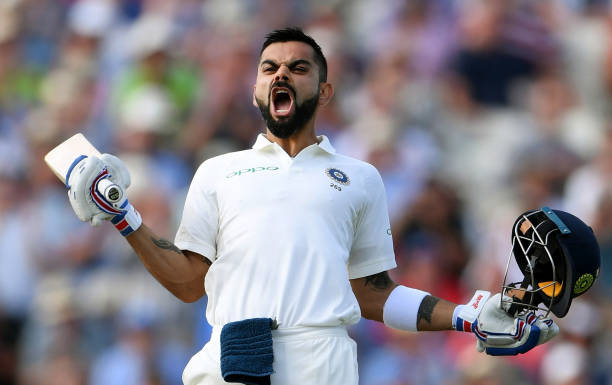
How many Test centuries has Virat Kohli scored? Who is Kohli’s favorite opponent?
How many Tests did India win while Kohli hits three figures?
All of these answers and much more. Here is your complete guide on Virat Kohli Test centuries.
Key Takeaways
Virat Kohli currently has 29 Test centuries. He is tied with Sir Donald Bradman and is #16 in the all-time Test centuries list.
His most successful year was 2018: 5 hundreds (5 fifties), 2017 – 5 (1), 2016 – 4 (2), and 2014 – 4 (2). On the other hand, Kohli had his worst Test century drought between 2020-2022 & 2011.
Kohli has scored 14 centuries in India, 6 in Australia, two each in South Africa, Sri Lanka, and West Indies, and one in New Zealand.
Kohli’s favorite Test opponent is Australia (8), England & Sri Lanka (5), and New Zealand, South Africa, West Indies (3), and Bangladesh (2).
He had a golden run during his captaincy. Virat Kohli scored 20 hundreds as a captain and only nine centuries as a non-captain.
Kohli has scored 15 hundreds in the second innings, 9 100s in the 1st innings, 3 100s in the 3rd innings, and only two hundreds in the 4th innings.
India won 13 Tests when Kohli scored a century, 9 in a drawn match, and 7 in a losing cause.
Vrat Kohli has won 8 player of the match awards in the 29 Tests he scored a century.
How many ODI centuries has Virat Kohli scored? Where did he score them? How many player of the match awards did Kohli win while scoring centuries?
Here is everything you need to know about Virat Kohli ODI centuries right here.
Key Takeaways
Virat Kohli currently has 47 ODI centuries, only second to Sachin Tendulkar’s record of 49 ODI centuries.
Kohli’s most successful year with ODI centuries was 2017: 6 hundreds (7 fifties), 2018 – 6 (3), 2018 – 5 (7), and 2012 – 5 (3). 2008, 2021, and 2020 were his least favorite years with zero centuries.
Kohli has scored 21 centuries in India, 6 in Bangladesh, 5 each in Australia & Sri Lanka, 4 in West Indies, 3 in South Africa, and one each in England, New Zealand, and Zimbabwe.
His favorite opponent is Sri Lanka (10), West Indies (9), and Australia (8).
Kohli won the player of the match awards in 29 out of the 47 ODIs he scored centuries in.
Virat Kohli has scored 21 hundreds at home, 21 away, and 5 neutral. Most importantly, Virat Kohli has scored 21 centuries while batting first and 26 centuries while chasing.
Kohli scored 21 centuries as captain and 26 centuries not as captain. In addition, India won 38 times Kohli scored a century, lost 7 times, and tied in one match.
Frequently Asked Questions – Virat Kohli ODI Centuries
How many centuries has Virat Kohli scored in ODI cricket?
Virat Kohli has scored 47 centuries in ODI cricket.
How many ODI hundreds has Virat Kohli scored against Pakistan?
Kohli has scored three hundreds against Pakistan – 183 vs Pakistan in 2012, 107 vs Pakistan in the 2015 ODI World Cup, and 122* vs Pakistan in the 2023 Asia Cup.
How many centuries has Virat Kohli scored in World Cups?
Kohli has scored two centuries (and six fities) in ODI cricket World Cups.
What is Virat Kohli’s highest score in ODI cricket?
Virat Kohli’s highest score in ODI cricket is 183* vs Pakistan in Mirpur (2012).
How many 150 scores does Kohli have in ODI cricket?
Kohli has scored 5 scores of 150+ in ODI cricket (183, 166*, 160*, 157*, and 154*)
2023 seems to be a watershed moment for franchise cricket leagues—SA 20, IL T20, MLC 2023, Zim Afro T10, and the revival of Global T20 Canada.
Feel like you can’t keep track anymore? Well don’t worry, we are here to help you.
Key Takeaways
There are 15 professional leagues in cricket, from which 13 are franchise leagues and two are domestic T20 competitions that attract a variety of overseas stars (Vitality Blast, Super Smash). From the 13 franchise leagues, two are T10, one is in the ‘hundred’ format, while the other 10 are twenty20 competitions.
In 2023, October is the only without any major cricket league competition since October 5 – November 19 is reserved for the 2023 ODI World Cup.
From November 23, 2022 to September 24, 2023, there were only 20 days where franchise cricket was not scheduled (December 5-12, March 19-30).
If we count all the date ranges for the 15 major T20 tournaments, there were 509 days of cricket (greater than 365 because several leagues are now overlapping with each other. Also domestic tournaments like the Vitality blast tend to be spread out longer with breaks. Actual cricket might not be played every day).
Cricket Leagues Calendar – By Season
November-February: Abu Dhabi T10, Big Bash League (BBL), Super Smash, Bangladesh Premier League (BPL), South Africa T20 (SA T20), International League T20 (ILT20)
February-May: Pakistan Super League (PSL), Indian Premier League (IPL)
May-July: The Vitality Blast (also good time for a World Cup window), TNPL
July-September: Major League Cricket, Global T20 Canada, The Hundred, Caribbean Premier League (CPL), Shpageeza Cricket League*, Road Safety World Series, Maharaja T20 Trophy
October: Window for world tournament (or…Champions League), Syed Mushtaq Ali Trophy
List of Cricket Leagues: Top 15 Franchise, T10, & T20 Competitions
*Note: The date ranges are either from last year or the upcoming 2023 season if it has not happened yet. We first start with the Abu Dhabi T10 league from November 2022.
18. Tamil Nadu Premier League (TNPL): June 12 – July 12
Country: India
Number of Seasons Played: 7 (2016-)
Number of Teams: 8
Days Played: 31
*regional T20 league
19. Karnataka Premier League (Maharaja Trophy T20): August 14 – August 30
Country: India
Number of Seasons Played: 8 (2009-)
Number of Teams: 6
Days Played: 17
*regional T20 league
20. Syed Mushtaq Ali Trophy: October 16 – November 6
Country: India
Number of Seasons Played: 15 (2006-)
Number of Teams: 38
Days Played: 22
*domestic T20 league, but gaining prominence over the years
List of Defunct Cricket Leagues
Euro T20 Slam, Mzansi Super League (South Africa), KFC Twenty20 Big Bash (Australia), Inter-Provincial Twenty20 (Sri Lanka), Stanford 20/20 (West Indies)
Final Thoughts
Leagues are propping everywhere, World Cups are now sandwiched between the leagues, and bilateral cricket is going nowhere.
The ODI Super League is now extinct (although Netherlands’ brilliance might force a rethink), the World Test Championship shows promise, but could be improved. The haphazard year-around schedule impacts logistics, mental health, injury management, and causes early retirements.
Until a stable international cricket calendar is formed, we will have to form the cricket calendar according to the franchise leagues, with the Indian Premier League in the center as the marquee event.
Frequently Asked Questions
How many T20 leagues are there in cricket?
There are 15 T20 leagues in cricket – 10 T20 franchise leagues, 2 T10 leagues, 1 ‘hundred’ ball tournament, and 2 domestic T20 competitions.
How many franchise leagues are there in cricket?
There are 13 franchise leagues in cricket (10 T20, 2 T10, and The Hundred).
How much money does it really take to host a Test match?
We have heard the claims that cricketing countries like New Zealand & South Africa ‘lose money’ while hosting a Test match. Well, how much money are they losing? Why are they losing so much money?
Don’t worry, I got you. Here is a research article on how much money it costs to host a Test match.
A 2-Test series can cost about $679,500-$2.3 million, while a 5-Test series Ashes may incur expenses ranging from $ 3.043 million to a whopping $7.3 million.
Hence, on average, it takes around $350,000-$1.4 million to host a Test match. The vast range is due to the choices made by the national board – whether to have 4-cameras or 16, whether to purchase the complete version of the DRS or just the Hawkeye, number of support staff, choices for hotels and flights, etc.
Factors that impact the cost of hosting a Test match include (but are not limited to) technology, the review system, player match fees, umpires’ fees, post-match awards, broadcasting & commentating team, security personnel, support staff, hotels, food, flights, busses, incidentals, and facilities.
*Note: Apart from the host cricket board, some of these expenses may be shared between sponsors, broadcasters, ICC, and state/ national governments.
Other articles in Cricket & Finances: Money, Money, Money!
How Much Money Does it take to Host a Test Match – The Top 9 Factors
It takes a village to host a Test match. This includes the players themselves, the commentators, ground staff, umpires, ball boys & girls, bus drivers, security personnel, administrators, ticket sellers, the media, and most importantly, the fans.
We take all these dimensions and come up with estimates for a 2-Test series and a 5-Test series.
We consider an Australia-England Test series for our 5-match estimates and teams like West Indies, Sri Lanka, and Pakistan for our 2-match estimates.
Note: All numbers are in $ USD. Also, some costs might be one-off cost to the host country (for example, ground covers, initial camera equipment, speed gun, stumps, cost of buying land & building the stadium, etc.). Some of these costs may be offset by themaintenance costs of the one-off items, and hence, should not impact the overall estimate range much.
*If you use any of our derivations and data, please link this article to avoid copyright issues.
1. Technology: $120,000-$2.6 Million
What Does it Include?
DRS (Hawkeye, Hotspot, Snicko, etc.), Cameras (4-16, SpiderCam), Stumps (Stump Mic, LED Stumps, Zing Bails), Bushnell Range Finder, and Speed Gun
Note: To cut costs, some boards may choose to only purchase Hawkeye with minimal cameras, while other nations might purchase a full set of DRS/camera setup.
2. Broadcasting & Commentators: $20,000-$1 million
What Does it Include?
This includes the salary of commentators, behind-the-scenes broadcasters.
According to various reports online, commentators can earn $1000-$5000 in match fees and around $50,000 per series. Some commentators even take home paychecks of up to a million dollars per year.
How Much will a 2-match Test series cost?
Minimum Cost: $20,000 ($1,000 match fee per Test for set of 10 commentators)
Maximum Cost: $750,000 ($50,000 series fee for set of 15 commentators)
How Much will a 5-match Test series cost?
Minimum Cost: $375,000 ($5,000 match fee per Test for set of 15 commentators)
Maximum Cost: $1 million ($50,000 series fee for set of 20 commentators)
Sky Sports signed 19 commentators for the 2023 Ashes season.
Note: The cost for technology, broadcasting, and commentators may be shared between the cricket board and broadcasting companies. This may also be negotiated in the various TV/streaming multi-year broadcasting deals.
3. Player Match Fees & Match Awards: $130,000-1 Million
What Does it Include?
This will only include the match fees for the players in the playing XI. We do not include yearly contracted salary for this calculation since that is a separate transaction between a player & its cricket board.
How Much will a 2-match Test series cost?
Minimum Cost: 126,500
Maximum Cost: $145,000
Calculation Method: Test Match Fees * 2 (number of Test) * 11 (number of players in the playing XI). With player of the match/series awards (plus many more nowadays), this cost will increase to $130,000-$160,000.
How Much will a 5-match Test series cost?
Minimum Cost: $687,500
Maximum Cost: $1 million
Calculation Method: Test Match Fees * 5 (number of Test) * 11 (number of players in the playing XI). If we add the award costs, this cost will increase to $700,000-$1,025,000.
Note, each board will pay each of their players separately, so we will not double count this value (i.e. we will only count the expense for the host team).
This includes umpires, video umpire, reserve umpire, and referee. Some online websites estimate umpires may earn around $5,000 match fees for Test cricket.
A team like West Indies may be responsible for arranging flights from island to island or countries like Australia or India, where distances between cities is more convenient by air.
For domestic travel, we assume host boards will pay for players from both teams involved.
This will total to about 45-80 members total (squad: 15 players, 5 net bowlers per team, 3-5 coaches, umpires & referees: 5-8, commentators: 10-20, miscellaneous/administrators: 1-10)
How Much will a 2-match Test series cost?
The current India-West Indies series takes place in Roseau & Port of Spain. For a 2-Test series, we consider one flight.
Note: These estimates may vary depending if the national boards consider business or economy class and how soon they book their tickets.
How Much will a 5-match Test series cost?
We will consider the 2021 Ashes for this scenario. We check current one-way prices for Brisbane-Adelaide (around $300), Adelaide-Melbourne ($100), Melbourne-Sydney ($100), and Sydney-Hobart ($125). This totals to about $625 per member of the flight.
Minimum Cost: $28,125: 45*625
Maximum Cost: 50,000: 80*625
Surprised by these numbers? Note, that even though West Indies might not be the richest cricket board, Caribbean is still a pretty exotic place for travel.
6. Buses: $42,000-$105,000
What Does it Include?
Buses includes hiring a couple of drivers, tips for the drivers, and the cost to rent a charter bus. Each team will have a separate bus and there will also be a bus for support staff. According to Gogo Charters, it costs about £ 456-613 ($588-790) per day per charter bus, plus a 10% tip. We will estimate this around $700 per bus for a total of $2100 for three buses.
7. Hotels, Food, & Incidentals: $200,000-$2 million
What Does it Include?
According to the U.S. Department of State Foreign Per Diem Rates, “The maximum lodging amount is intended to substantially cover the cost of lodging at adequate, suitable and moderately-priced facilities. The M&IE portion is intended to “substantially cover the cost of meals and incidental travel expenses such as laundry and dry cleaning.”
Cannot forget the dry cleaning and the laundry. Nobody wants stinky, smelly, and rainy tours.
For a reference, Adelaide’s Maximum Per Diem rate based on (1) Maximum Lodging Rate, (2) Meals & Incidentals is $324. Here is the estimate list for other Australian cities.
How Much will a 2-match Test series cost?
A two-Test series has a maximum of 10 days. However, we can consider one tour match, a couple days between each game, and a couple of days before/after the series for a total of 20 days.
The current Sri Lanka-Pakistan series is an 18-day affair for example. We will consider Galle’s per diem rate of $216 as an average (although it varies from city to city).
Minimum Cost: $194,400 (45 *$216*20)
Maximum Cost: $777,600 (80*216*20)
How Much will a 5-match Test series cost?
The 2023 Ashes takes place between June 16th and July 13th, totalilng 45 days (without any tour matches). To keep it simple, we will take 50 days and the $598 per diem estimate for London.
This may include security guards, pitch curators, groundsperson, cleaners, stadium food organizers, support staff, pavilion steward’s, etc.
According to Glassdoor, a security guard in London earns annually £ 24,070 ($31,028 USD), a security officer earns about £ 26,383 ($34,000), and an assistant groundsperson earns about £ 22,000 ($ 28,000). The director of security and people in higher positions may earn £ 50,000-100,000 ($65,000-100,000).
We estimate around 50-100 support staff & security personnel are needed to make a Test match happen. We will take £ 20,000 ($26,000) as an average. We will estimate 1-month salary (1/12) for the 2-Test series & 2-month salary (1/6) for 5-Test series.
Case Studies & Quotes: Cost of Hosting a Test Match
Our estimates match with the interviews and situations that we have already seen. Here is the result of rising cost of hosting a Test match and the uneven monopoly of the Big 3 in world cricket today.
Situation 1: The COVID Comeback Season
The pandemic caused England to go to great measures to restart cricket.
For the West Indies and Pakistan series, they paid these countries £ 500,000 ($644,628) for charter flights. In addition, the per day cost was £ 238,000 ($306,842), while the season cost was 10 million pounds. One quote caught my eye.
“The good thing is they are England, and they expected to receive 120 Million pounds in ‘broadcast revenue.'”
Situation 2: Cricket Ireland Cancels Test Series
Ireland cancelled their plan of playing a Test match against Bangladesh and played a T20I instead.
“With the expected cost of hosting a Test estimated at 1 million pounds ($US 1.14 million), Cricket Ireland has chosen to prioritise white ball cricket ahead of the T20 World Cups.”
“The Yorkshire chairman and chief executive, Colin Graves, had said the county would not bid to host an Ashes Test in 2013 or 2015 because, at a cost of £ 1-2 million, ‘it would represent too great a financial risk.’ ‘
– The Guardian
Situation 4: South Africa’s Problems Continue
South Africa will not be playing many Tests in the next FTP. They have, however, hosted a successful SA T20, which gives them hope fo a financial revival.
“CSA earns a tenth of the money on a Test that it will earn for a white ball match.”
– Firdose Moonda
Situation 5: Afghanistan vs West Indies match ends within 3 Days, Costs Money Nevertheless
“Take the Afghanistan v West Indies game in Lucknow. It finished in two and a half days, but all the people working on it have been booked for the five days. The grounds, the staff, the food, everything…it’s probably cost them US $200,000 to $300,000. Perhaps more. And if your yearly grant is to the tune of $ 4 million, that means you have spent close to 10% of your [yearly] budget on playing one Test match.”
According to ESPN Cricinfo, it cost the Zimbabwe cricket board $1 million to host a two-Test series against the West Indies.
“We do lost a lot of money – about $300,000-$400,000, to host a Test series. It’s money we don’t have.”
– Tavenga Mukuhlani, ZC Chairman
Situation 8: Playing Against India & the Big 3 the Only Hope (which is not sustainable)
“Unless it is against the Big 3, Cricket New Zealand loses about $700,000.”
– The Telegraph, Sydney Morning Herald
So, why do New Zealand, South Africa, & other countries lose money while hosting a Test series?
Expenses are only one part of the puzzle. Revenue is the other.
While the Big 3 has broadcasting profits on their sides, countries like Zimbabwe get as little as $1 million per season from sponsorship. A 2-Test series wipes out 20% of the annual reserves, and hence, they cannot afford to host Test matches.
The income, ticket sales, & sponsorship are not large income to balance the expenses of hosting a Test match.
Although New Zealand are a joy to watch in Test cricket and were also the winner of the inaugural WTC Final, they suffer from a similar economic fate.
What does the Future of Test Cricket Hold?
Revenue in cricket comes from (1) ticket sales, (2) broadcasting deals, (3) sponsorship deals, (4) ICC money, and (5) federal/state funding (depending on the country). While India is always on the net positive side due to their sheer volume of cricket fans, other countries unfortunately do not have similar infrastructure or fan following. Subsidizing Test cricket a part of a larger ICC Test fund has been suggested in the past, but is it enough?
Can Test cricket survive the rising costs? More importantly, will the ‘Middle 5’ – West Indies, South Africa, New Zealand, Pakistan, and Sri Lanka continue their investment in Test cricket?
Test cricket is actually thriving these days (See, Bazball), but the business model of Test cricket is dying.
Something needs to change quickly.
Otherwise, Test cricket started with the Ashes. It may also end in ashes.
If You Liked this, here are other Articles You Might Be Interested In
Where to Watch Major League Cricket 2023? MLC 2023 will be broadcasted on Willow TV (USA & Canada), Sports18 & JioCinema (India), Fox Cricket (Australia), A Sports & ARY Zap (Pakistan), SuperSport (South Africa), SportsMax (West Indies), SKY NZ (New Zealand), and BT Sport (UK).
In total 10 broadcasters from 9 countries have partnered with the Major League Cricket franchise tournament as their official partners.
For those who want to watch the MLC live in the USA, there are several options available. Willow TV is the official broadcaster for the tournament in the USA and will provide live coverage of all the matches. Cricket fans can also watch the MLC on Sling TV, which offers Willow TV as part of its sports package.
11 Major League Cricket (MLC) 2023 Official Broadcasters
Cricket enthusiasts in the United States are eagerly waiting for the first-ever Major League Cricket (MLC) tournament, which will take place from July 13 to July 30, 2023. The MLC will feature six teams and some of the biggest names in cricket, including international stars. Fans across the globe are excited to watch the MLC live and support their favorite teams.
If you are interested in Major League Cricket or content about cricket in America, do not miss out on these articles below:
Willow TV is the largest broadcaster of cricket in the United States and Canada, offering 24/7 HD coverage of overseas cricket events, including live and recorded matches, on all major television platforms and digital devices.
2. CBS Sports Network (USA)
MLC has pierced the barriers into USA broadcasting with some matches being broadcasted on CBS Sports Network. Note, you will still need a subscription to a cable or streaming provider to watch these matches (Also, CBS has exclusive rights on those matches, and these specific games will not be broadcasted on Willow TV).
How to Watch Major League Cricket in America?
You can watch MLC 2023 on Willow TV in the USA.
How to Watch Major League Cricket in Canada?
Similarly to the USA, MLC 2023 will be broadcoasted in Canada?
How Much does Willow TV Cost?
Current Offer: $55/Year (On Website), $60/Year or $10/month (Sling)
Can also sign up with TV provider (Optimum, Spectrum, Dish, Fios, Optimum.tv, xfinity)
As the anticipation for Major League Cricket 2023 continues to build, it’s clear that cricket fans around the globe will have plenty of options to tune in and catch all the action.
Whether you’re in the USA or Canada with WillowTV, India with Sports 18 & Jio Cinema, or with any of the other channels mentioned above, the thrill and excitement of this major cricket event will be at your fingertips. No matter where you are, rest assured that you won’t miss a single over.
Here’s to a thrilling season of cricket ahead in the USA!
Frequently Asked Questions
How Can I Watch Major League Cricket in the USA?
Major League Cricket has team up with WillowTV as the official broadcaster of this tournament. Folks in Canada can also watch MLC 2023 on WillowTV.
Where Can I Watch Major League Cricket in India?
Jio Cinema and Sports 18 are the official broadcasters of MLC 2023 in India.
Who has the most centuries in international cricket across formats?
Sachin Tendulkar (100), Virat Kohli (75), and Ricky Ponting (71) have the most centuries in international cricket across formats.
In cricket, the scoring a century is the landmark achievement that separates the good from the greats. In this brief overview, we’ll look into the top 10 cricketers with the most centuries across formats.
But here’s the real kicker: Can Virat Kohli break Sachin Tendulkar’s hundreds record? Let’s dive in and explore.
India – 3 (Tendulkar, Kohli, Dhoni), South Africa – 3 (Kallis, Amla, AB De Villers), and Sri Lanka – 2 (Kumar Sangakkara, Mahela Jayawardene) feature the most in this list.
Virat Kohli scores a century quicker than anyone else in the list (a century every 7.42 innings) followed by Sachin Tendulkar (7.82) and Hashim Amla (7.95).
Sachin Tendulkar (34357), Kumar Sangakkara (28016), and Ricky Ponting (27483) have scored the most runs along with their centuries while Hashim Amla (18672) and AB De Villiers (20014) have the least number of runs in this list.
Sachin Tendulkar (264), Ricky Ponting (217), and Kumar Sangakkara (216) have scored the most 50+ scores across formats.
Among the Fab Four Virat Kohli (75) leads the charge with Joe Root (46), Steve Smith (44), and Kane Williamson (41) bunched close together to each other. David Warner (45) and Rohit Sharma (43) are the other active players in the Top 21 list of most centuries list.
Cricket Batting Records (Test + ODI + T20I): Top 10 List of Most Century Makers Across Formats
The 100s/Innings is calculated by the number of innings played across formats divided by the number of international centuries. Be careful though, this number might be slightly skewed. For example, Sachin Tendulkar’s ratio is 7.82 innings per hundred, while Kohli’s ratio is 7.42 innings per century.
Sounds pretty close, right? However, if we dissect this further, Virat Kohli has 74 centuries in 450 Tests/ODIs at an absurd average of 6.08 innings per hundred. Since he has played more T20Is (107 innings) than others, his overall ratio is closer to Tendulkar.
Note: * denotes players that are still active in international cricket.
1. Sachin Tendulkar (100 – 51 Tests/49 ODIs), India
Matches/Innings: 664/782
100s/Innings:7.82 (One Hundred scored every 7-9 innings across format)
Here are the honorable mentions. These players all have scored 40 or more centuries in international cricket.
Rank
Country
Player (Hundreds)
Matches/Innings
100s/Innings
Runs
50+ Scores
11
England
Joe Root* (46)
322/419
9.11
18296
145 (46 – 100s, 99 – 50s)
12
Australia
David Warner* (45)
347/432
9.6
17262
131 (45 -100s, 86 – 50s)
13
Australia
Steve Smith* (44)
304/352
8
15060
114 (44 – 100s, 70 – 50s)
14
India
Rohit Sharma* (43)
441/461
10.72
17115
134 (43 – 100s, 91 – 50s)
15
West Indies
Chris Gayle (42)
483/551
13.12
19593
147 (42 – 100s, 105 – 50s)
16
Sri Lanka
Sanath Jayasuriya (42)
586/651
15.5
21032
145 (42 – 100s, 103 – 50s)
17
New Zealand
Kane Williamson* (41)
342/402
9.80
17142
133 (41 – 100s, 92 – 50s)
18
Pakistan
Younis Khan (41)
408/491
11.96
17790
124 (41 – 100s, 83 – 50s)
19
West Indies
Shivnarine Chanderpaul (41)
454/553
13.49
20988
166 (41 – 100s, 125 – 50s)
20
Australia
Matthew Hayden (40)
273/348
8.49
15066
109 (40 -100s, 69 – 50s)
21
New Zealand
Ross Taylor (40)
450/510
12.75
18199
133 (40 -100s, 93 – 50s)
Can Virat Kohli Break Sachin Tendulkar’s Record of Hundreds?
Yes, Virat Kohli can break Sachin Tendulkar’s record of most hundreds in cricket, given that he continues playing for a couple more years.
Currently, Virat Kohli is 25 short of Sachin Tendulkar’s world record, but he has also played 225 less innings. At Virat Kohli’s rate of one century every 7.43 innings, Virat Kohli can break Tendulkar’s hundred 100s record if he plays about 186 more innings.
Stas are just there to support the overarching idea, but Kohli looks refreshed since Asia Cup 2022 after three-year drought. He is back at his best with centuries in each format (as well as the IPL). One thing to consider though is overkill in cricket. On the other hand, Virat Kohli might go the AB De Villiers route and retire early due to way too much cricket.
Final Thoughts
These top 10 cricketers have left a significant impact on the sport with their exceptional performances and numerous centuries. Their contributions to the game command respect and admiration.
Now, all eyes will be on Virat Kohli.
We eagerly watch as his journey comes to an end in the next few years, with a question on everyone’s mind: Will he surpass Sachin Tendulkar’s monumental record, what do you say?
Frequently Asked Questions
Who has scored the most centuries in international cricket?
Sachin Tendulkar has the most centuries in international cricket (100). He has scored 51 centuries in Test cricket as well as 49 centuries in ODI cricket.
Which Indian cricketer has the most centuries in international cricket?
Sachin Tendulkar (100), Virat Kohli (75), and Rahul Dravid (48) have the most centuries in international cricket for India across formats.
Which team has the most centuries in international cricket?
India – 3 (Tendulkar, Kohli, Dhoni), South Africa – 3 (Kallis, Amla, AB De Villers), and Sri Lanka – 2 (Kumar Sangakkara, Mahela Jayawardene) are in the top of the list for the most centuries in international cricket.
Which cricketers have the highest batting averages in Test cricket? Sir Donald Bradman (99.94), Adam Voges (61.87), Graeme Pollock (60.97), George Headley (60.83), and Herbert Sutcliffe (60.73) have the Top 5 highest Test batting averages in cricket.
Batting average has been the historic indicator of batting excellence in Test cricket over the years. Steve Smith is the only modern cricketer flirting with the 60 average and is currently at #6 with 59.76. Can he end up at #2 of all-time by the end of his career?
While we are discussing Steve Smith, here is the list of the Top 20 highest batting averages in Test cricket!
There are 7 England cricketers, 4 Australians & West Indians each, 2 from South African & New Zealand, 1 Sri Lankan rank in the Top 20 highest averages of all-time in Test cricket. No Indian or Pakistani batter make the Top 20 as of 2023.
Comparing different eras is usually an issue of debate while discussing batting averages. 7 batters in the pre-1950s era, 6 batters in the 1940s-70s, 6 in the modern era (1995-present), and 1 from pre-1900s made this list.
We did not apply any filters on the amount of Test matches played. Jacques Kallis (166) & Kumar Sangakkara (134) played the highest number of Test matches while maintaining the high average, while George Tyldesley (14) and Daryl Mitchell (20) are at the lower end. Steve Smith, Daryl Mitchell, Kane Williamson, and Marnus Labuschagne are the only active cricketers in this list.
From the Fab 4, only Steve Smith (59.76) and Kane Williamson (54.89) are in the Top 20 of the highest batting averages in Test cricket. Joe Root (50.87) and Virat Kohli (48.72) are much further down the list. Overall, 17 cricketers average above 55.00 in Test cricket as of now.
List of Highest Test Batting Averages: From Don Bradman to Marnus Labuschagne
From Sir Donald Bradman to Marnus Labuschagne, which ones surprised you the most? Here were the Top 20 batters with the highest average in Test cricket.
If Steve Smith continues his spectacular run, could we be witnessing the journey of another legend who could make it to the top 3? Time will tell!
Frequently Asked Questions (FAQ)
Which cricketer has the highest batting average in Test cricket?
Sir Donald Bradman has the highest average in Test cricket (99.94). He is followed by Voges (61.87), Graeme Pollock (60.97), George Headley (60.83), and Herbert Sutcliffe (60.73).
What is Steve Smith’s Test average?
Steve Smith’s Test average is 59.76. He can end up at #2 of all-time.
Who are the greatest wicketkeepers in cricket history? Mark Boucher, Adam Gilchrist, and MS Dhoni are the greatest wicketkeepers across formats by sheer numbers. Rod Marsh, Ian Healy, Godfrey Evans, and Les Ames are some of the greatest keepers this game has ever seen.
Wicketkeeping has always been an integral part of cricket, and the role of a wicketkeeper is not limited to just catching the ball behind the stumps. Keepers play a vital role in the game by providing support to the bowlers, making crucial decisions, and contributing to the team’s overall performance. Over the years, cricket has seen some of the greatest wicketkeepers who have left a significant impact on the game.
Mark Boucher has the most dismissals in cricket across formats (998 dismissals) followed by Adam Gilchrist (905), and MS Dhoni (829).
MS Dhoni has the most stumpings in cross (195) followed by Kumar Sangakkara (139), and Romesh Kaluwitharana (101).
Australia (4) has the highest number of keepers in the Top 15 of the most wicketkeeper dismissal list followed by West Indies, South Africa, Pakistan (2), and India, England, New Zealand, Bangladesh, Sri Lanka. (1)
What Makes Wicketkeepers Valuable in Cricket?
The ranking of the greatest wicketkeepers in cricket is a topic of much debate among cricket fans and experts. However, most agree that the likes of Adam Gilchrist, Mark Boucher, and Kumar Sangakkara were some of the best wicketkeepers the game has ever seen.
Wicketkeepers are crucial to any team. Whether it is saving 20-30 runs behind the stumps every match, impacting DRS decisions, inflicting stumpings, or providing live commentary, they are always in the center of the action.
In this article, we will delve deeper into the topic of the greatest wicketkeepers in cricket and explore the skills and qualities that make a great wicketkeeper. We will also take a closer look at some of the most iconic wicketkeepers in the game’s history and analyze their performance and contributions to the sport.
Note: Although the likes of Rishabh Pant will go do as one of the greatest Test wicketkeeper batters, in this list, we only look at wicketkeeping stats alone.
Evolution of Wicketkeeping
Wicketkeeping has come a long way since the inception of cricket. The role of a wicketkeeper has evolved from being just a mere catcher behind the stumps to a crucial player in the team. Here are some key highlights of the evolution of wicketkeeping in cricket:
Early Days: In the early days of cricket, wicketkeeping was not a specialized role. Any player in the team could take up the role of a wicketkeeper. The gloves used by wicketkeepers were just simple leather gloves with no padding.
Growth of Wicketkeeping: As cricket evolved, the role of wicketkeeping became more specialized. The wicketkeeper became the primary catcher behind the stumps, and the gloves used by them evolved accordingly. The gloves were padded to protect the wicketkeeper’s hands from the impact of the ball.
Invention of Leg Guards: In the late 19th century, leg guards were invented to protect the wicketkeeper’s legs from the impact of the ball. The first leg guards were made of cane and had no padding. Later, the leg guards were made of leather and were padded to provide better protection.
Modern-Day Wicketkeeping: In modern-day cricket, wicketkeeping has become a specialized role. Wicketkeepers are not only expected to be good catchers but also good batsmen. The gloves used by wicketkeepers are highly padded, and the leg guards are also heavily padded to provide maximum protection. Wicketkeepers are also expected to be agile and quick on their feet to be able to move quickly to catch the ball.
The evolution of wicketkeeping in cricket has been a gradual process that has seen the role of the wicketkeeper become more specialized and crucial to the team’s success. The modern-day wicketkeeper is not just a catcher behind the stumps but also a valuable batsman and an agile player.
Greatest Wicketkeepers in Cricket History
Over the years, there have been many great wicketkeepers who have left their mark on the game. Here are some of the greatest wicketkeepers in cricket history.
Note: The Top 15 keepers are based on most dismissals across ODI, Test, and T20 cricket. Godfrey Evans and Les Ames are added in this list not based on the numbers but based on their keeping skills.
Years Played: 1946-1969 (Tests), 1939-1967 (First Class)
Tests: 173 Catches, 46 Stumpings
First Class: 816 Catches, 215 Stumpings (1031 Dismissals)
Godfrey Evans was an exceptional English cricketer, renowned for his agile wicketkeeping skills and aggressive batting, making him one of the greatest wicketkeepers in cricket history. ESPNCricinfo describes him as the “arguably the greatest wicketkeeper the game has ever seen.”
16. Les Ames (107 Dismissals, 74 Catches, 43 Stumpings)
Country: England
Years Played: 1929-1939 (Tests), 1926-1951 (First Class)
Tests: 74 Catches, 43 Stumpings
First Class: 703 Catches, 418 Stumpings (1121 Dismissals)
Les Ames, with his unbeatable wicketkeeping skills and powerful batting, was a true cricketing gem, lighting up the game like few others of his era.With 37248 first class runs and a mammoth 102 centuries, he was also one of cricket’s greatest keeper-batsmen.
Moin Khan brought an electrifying energy to the field with his nimble wicketkeeping and aggressive batting. Was a pivotal figure in Pakistani cricket during the 90s.
13. Mushfiqur Rahim (440 Dismissals, 342 Catches, 98 Stumpings)
Country: Bangladesh
Years Played: 2005-2023
Tests: 110 Catches, 15 Stumpings (125 Dismissals)
ODIs: 214 Catches, 53 Stumpings (267 Dismissals)
T20Is: 42 Catches, 30 Stumpings (72 Dismissals)
One of the Fab 5 of Bangladesh cricket, his energy behind the stumps was infectious. With Liton Das on the rise, the responsibility is slowly transitioning to the next generation.
*Note: At the back half of his career, McCullum would play as a specialist fielder due to injury issues and the introduction of Luke Ronchi & Tom Latham in the New Zealand setup.
Brendon McCullum is a legendary New Zealand cricketer. He was admired for his aggressive batting style and dynamic fielding abilities.
Jeffrey Dujon is a former West Indian cricketer who is widely regarded as one of the best wicketkeepers in cricket history. He played for the West Indies from 1981 to 1991 and was known for his excellent wicketkeeping skills. Dujon took 267 catches and 5 stumpings in his Test career.
7. Rod Marsh (479 Dismissals, 463 Catches, 16 Stumpings)
Country: Australia
Years Played: 1970-1984
Tests: 343 Catches, 12 Stumpings (355 Dismissals)
ODIs: 120 Catches, 4 Stumpings (124 Dismissals)
Rod Marsh is a former Australian cricketer who is considered to be one of the best wicketkeepers in cricket history. He played for Australia from 1970 to 1984 and was known for his excellent wicketkeeping skills. Marsh took 355 catches and 12 stumpings in his Test career.
5. Ian Healy (628 Dismissals, 560 Catches, 68 Stumpings)
Country: Australia
Years Played: 1988-1999
Tests: 366 Catches, 29 Stumpings (395 Dismissals)
ODIs: 194 Catches, 39 Stumpings (233 Dismissals)
Ian Healy is a former Australian cricketer who is widely regarded as one of the best wicketkeepers in cricket history. He played for Australia from 1988 to 1999 and was known for his excellent wicketkeeping skills. Healy took 366 catches and 29 stumpings in his Test career.
Kumar Sangakkara is a former Sri Lankan cricketer who is widely regarded as one of the best wicketkeepers in cricket history. His glasses and consistent presence was a key part in Sri Lanka’s domination.
*Note: Sangakkara switched regularly from keeper to fielder. Hence, his detailed Test, ODIs, and T20Is record show more catches then his overall Test catch record of 539
M.S. Dhoni is one of the most successful captains in Indian cricket history. He is also considered to be one of the best wicketkeepers in the world. And Dhoni’s stumpings are the best in the world, aren’t they?
2. Adam Gilchrist (905 Dismissals, 813 Catches, 92 Stumpings)
Country: Australia
Years Played: 1996-2008
Tests: 379 Catches, 37 Stumpings (416 Dismissals)
ODIs: 417 Catches, 55 Stumpings (472 Dismissals)
T20Is: 17 Catches, 0 Stumpings (17 Dismissals)
Adam Gilchrist is widely regarded as one of the best wicketkeepers in cricket history. He played for Australia from 1996 to 2008 and was known for his aggressive batting style. Gilchrist was a reliable wicketkeeper and took 905 catches and 37 stumpings in his career. Changed the way the wicketkeeper’s role was viewed.
1. Mark Boucher (998 Dismissals, 952 Catches, 46 Stumpings)
Country: South Africa
Years Played: 1997-2012
Tests: 532 Catches, 23 Stumpings (555 Dismissals)
ODIs: 403 Catches, 22 Stumps (425 Dismissals)
T20Is: 18 Catches, 1 Stumping (19 Dismissals)
Mark Boucher is a former South African cricketer who is considered to be one of the best wicketkeepers in cricket history. Had an unfortunate end to his career as a bail hit his eye.
These wicketkeepers have left their mark on the game and have set the standard for future generations. Their skills, dedication, and hard work have made them some of the greatest wicketkeepers in cricket history.
Final Thoughts
Their agility behind the stumps, exceptional catching prowess, and often underappreciated batting abilities, make them stand out in the cricketing pantheon.
I have developed a newfound respect for these players who donned the gloves and stood guard behind the wickets, often unsung heroes of many a match.
As a fan, I feel privileged to have witnessed some of these greats in action, while others, I have come to appreciate through stories, records, and old footage. The legacy they have left behind is not only inspiring for upcoming cricketers but also serves as a reminder for us fans about the richness and diversity of this beautiful game.
Frequently Asked Questions
Who is the greatest wicketkeeper in cricket history?
Mark Boucher, Adam Gilchrist, MS Dhoni, Ian Healy, Rod Marsh, Les Ames, and Godfrey Evans are among cricket’s greatest wicketkeepers.
Who has the most stumpings in cricket?
MS Dhoni has the most stumpings in cross (195) followed by Kumar Sangakkara (139), and Romesh Kaluwitharana (101).
Who has the most dismissals in cricket?
Mark Boucher has the most dismissals in cricket across formats (998 dismissals) followed by Adam Gilchrist (905), and MS Dhoni (829).
The ODI World Cup 2023 schedule have finally been announced!
The ICC Men’s Cricket World Cup 2023 is just around the corner and cricket fans all over the world are eagerly awaiting this grand event.
Scheduled to take place in India between 5 October and 19 November 2023, this will be the 13th edition of the tournament. With teams from all over the world competing for the coveted title, it promises to be an exciting tournament full of thrilling matches and nail-biting finishes. So, get ready for some serious cricket action as we bring you a complete guide to the 2023 ODI Cricket World Cup Schedule!
England and New Zealand play the first match of the 2023 ODI World Cup, marking the repeat of the iconic 2019 World Cup Final.
Some of the marquee matches are as follows: October 8 (India vs Australia), October 13 (Australia vs South Africa), October 15 (India vs Pakistan), October 22 (India vs New Zealand), October 23 (Afghanistan vs Pakistan), October 29 (India vs England), October 31 (Pakistan vs Bangladesh), and November 4 (Australia vs England)
India, Pakistan, and South Africa will play all 9 of their matches as Day-Night (D/N) matches. Bangladesh will play the least with 6 D/N matches.
India & England will play in 9 separate venues, while Pakistan will only play in five different venues.
If India make the semi-finals, they will play in Mumbai. However, if it is an India vs Pakistan match, then it will be held in Kolkata.
The World Cup will run from October 5, 2023-November 19, 2023.
Fixtures & Schedule: ICC 2023 ODI Cricket World Cup
*Note: Qualifier 1 & Qualifier 2 denotes the two teams that will qualify from the 2023 ODI World Cup Qualifier held in Zimbabwe. The six candidates at the moment are: Zimbabwe, Sri Lanka, Scotland, Netherlands, West Indies, and Oman.
India Fixtures Overview
Number of Day Night Matches: 9/9
Most Frequent Venue: None (each stadium used one for hosts India)
Shortest Gap Between Matches: 2 Days (between matches 1 & 2)
Longest Gap Between Matches: 6 Days (between matches 5 & 6)
ODI World Cup 2023 Schedule – India Team (Hosts)
vs Australia: October 8, 2023, Chennai (D/N)
vs Afghanistan: October 11, 2023, Delhi (D/N)
vs Pakistan: October 15, 2023, Ahmedabad (D/N)
vs Bangladesh: October 19, 2023, Pune (D/N)
vs New Zealand: October 22, 2023, Dharamsala (D/N)
vs England: October 29, 2023, Lucknow (D/N)
vs Qualifier 2: November 2, 2023, Mumbai (D/N)
vs South Africa: November 5, 2023, Kolkata (D/N)
vs Qualifier 1: November 11, 2023, Bengaluru (D/N)
Most Frequent Venue: Hyderabad, Chennai (twice each, back-to-back), Kolkata, Bengaluru (twice)
Shortest Gap Between Matches: 2 Days (between matches 4 & 5)
Longest Gap Between Matches: 7 Days (between matches 8 & 9)
ODI World Cup 2023 – Pakistan Team Schedule
vs Qualifier 1: October 6, 2023, Hyderabad (D/N)
vs Qualifier 2: October 12, 2023, Hyderabad (D/N)
vs India: October 15, 2023, Ahmedabad (D/N)
vs Australia: October 20, 2023, Bengaluru (D/N)
vs Afghanistan: October 23, 2023, Chennai (D/N)
vs South Africa: October 27, 2023, Chennai (D/N)
vs Bangladesh: October 31, 2023, Kolkata (D/N)
vs New Zealand: November 4, 2023, Bengaluru
vs England: November 12, 2023, Kolkata (D/N)
South Africa Fixtures Overview
Number of Day Night Matches: 9/9
Most Frequent Venue: Mumbai (twice, back-to-back)
Shortest Gap Between Matches: 2 Days (between matches 4 & 5, between matches 5 & 6)
Longest Gap Between Matches: 5 Days (between matches 1 & 2)
ODI World Cup 2023 – South Africa Team Schedule
vs Qualifier 2: October 7, 2023, Delhi (D/N)
vs Australia: October 13, 2023, Lucknow (D/N)
vs Qualifier 1: October 17, 2023, Dharamsala (D/N)
vs England: October 21, 2023, Mumbai (D/N)
vs Bangladesh: October 24, 2023, Mumbai (D/N)
vs Pakistan: October 27, 2023, Chennai (D/N)
vs New Zealand: November 1, 2023, Pune (D/N)
vs India: November 5, 2023, Kolkata (D/N)
vs Afghanistan: November 10, 2023, Ahmedabad (D/N)
Qualifier 1 Fixtures Overview
Number of Day Night Matches: 8/9
Most Frequent Venue: Hyderabad (twice, back-to-back), Lucknow
Shortest Gap Between Matches: 2 Days (between matches 1 & 2, between matches 5 & 6, between matches 8 & 9)
Longest Gap Between Matches: 7 Days (between matches 2 & 3)
ODI World Cup 2023 – Qualifier 1 Schedule
vs Pakistan: October 6, 2023, Hyderabad (D/N)
vs New Zealand: October 9, 2023, Hyderabad (D/N)
vs South Africa: October 17, 2023, Dharamsala (D/N)
vs Qualifier 2: October 21, 2023, Lucknow
vs Australia: October 25, 2023, Delhi (D/N)
vs Bangladesh: October 28, 2023, Kolkata (D/N)
vs Afghanistan: November 3, 2023, Lucknow (D/N)
vs England: November 8, 2023, Pune (D/N)
vs India: November 11, 2023, Lucknow (D/N)
Qualifier 2 Fixtures Overview
Number of Day Night Matches: 8/9
Most Frequent Venue: Lucknow (twice, back-to-back), Delhi (twice)
Shortest Gap Between Matches: 2 Days (between matches 6 & 7, between matches 8 & 9)
Longest Gap Between Matches: 4 Days (between matches 4 & 5)
ODI World Cup 2023 – Qualifier 2 Schedule
vs South Africa: October 7, 2023, Delhi (D/N)
vs Pakistan: October 12, 2023, Hyderabad (D/N)
vs Australia: October 16, 2023, Lucknow (D/N)
vs Qualifier 1: October 21, 2023, Lucknow
vs England: October 26, 2023, Bengaluru (D/N)
vs Afghanistan: October 30, 2023, Pune (D/N)
vs India: November 2, 2023, Mumbai (D/N)
vs Bangladesh: November 6, 2023, Delhi (D/N)
vs New Zealand: November 9, 2023, Bengaluru (D/N)
2023 ODI World Cup Knockout Matches
November 15, 2023, Kolkata (D/N)
November 16, 2023, Mumbai (D/N)
November 19, 2023, Ahmedabad
Final Thoughts
The ODI World Cup 2023 schedule promises to be a rollercoaster ride of emotions for cricket fans across the globe.
With the best teams battling it out on the field, we can hope that several matches are a nail-biting experience. The ODI Cricket World is more than just a sport. It is a unifying force that brings people together from all corners of the world.
Mark your calendars and get ready to witness history in the making as the world’s best cricketing nations compete for the ultimate prize- the ODI World Cup trophy!
Frequently Asked Questions
When will the India vs Pakistan match be in the 2023 ODI World Cup?
The much awaited India vs Pakistan match will take place on October 15, 2023 in Ahmedabad.
How many matches will be played in the 2023 ODI World Cup?
48 matches will be played in the 2023 ODI World Cup (45 group stage matches, 2 semi-finals, and one final).
When will the ICC 2023 ODI World Cup be played?
The 2023 ODI Cricket World Cup will be held between October 5, 2023 and November 19, 2023.
After West Indies lost to Zimbabwe and Netherlands in the 2023 ODI World Cup Qualifier, fans reacted around the world. Here are my honest thoughts on the state of West Indian cricket.
Events That Have Transpired During the 2023 ODI World Cup Qualifiers
West Indies are on the brink of exiting from the 2023 ODI World Cup Qualifiers.
First of all, let us not take anything away from Zimbabwe and Netherlands (as well as Scotland & Sri Lanka from the other group), who have been playing excellent cricket. Today, Logan Van Beek produced a Super Over performance of the ages, hitting 30 runs and taking two wickets.
However, West Indies has been below par. From dropped catches and misfields to over rate penalties, no ball calls, mindless bowling changes, and questionable strategies, things have not quite gone right for West Indies.
Over the last five years, though, they have descended into further depths. The West Indies cricket team
Failed to qualify for the 2017 Champions Trophy
Had to go through the 2018 ODI World Cup qualification
Performed shambolically at the 2019 ODI World Cup (won only 2/9)
Crashed out of the 2021 T20 World Cup Super 12 stage (won only 1/5)
Failed to get out of the first round itself in the 2022 T20 World Cup (won only 1/3)
Their fortunes in Test cricket wasn’t great either. In the latest edition of the World Test Championship, they ended up 8th/9th, winning 4 Tests & drawing 2 out of 13. They had similar fortunes in the inaugural edition of the WTC as well (won 3, drew 2, ended 8th/9th).
Their fortunes continued to plummet in the ODI Super League, where they only won 9 out of the 24 ODI matches. The men’s side are currently ranked 7th in T20I cricket, 8th in Test cricket, and 10th in ODI cricket. The women are ranked 6th each in T20I and ODI. If you have only won 7 Tests and 4 World Cup matches over the past 5 years, then there is plenty of room to introspect.
This isn’t the first time we are talking about the ‘Downfall of West Indies cricket,’ is it? Since the late nineties and early 2000s, they have faced a steady decline.
West Indies cricket used to produce the likes of Lord Baron Constantine, Sir Conrad Hunte, Sir Clyde Walcott, Sir Everton Weekes, Wes Hall, Andy Roberts, Michael Holding, Joel Garner, Lance Gibbs, Sir Gordon Greenidge, Desmond Haynes, Sir Clive Lloyd, Shivnarine Chanderpaul, Brian Lara, Curtly Ambrose, Courtney Walsh, George Headley, Malcolm Marshall, Brian Lara, Sir Vivian Richards, Sir Frank Worrell, Sir Garfield Sobers, Sunil Narine, Dwayne Bravo, Chris Gayle, Andre Russell, Marlon Samuels, Alvin Kallicharan, Rohan Kanhai, Ramnaresh Sarwan, Carl Hooper, Lawrence Rowe, Roy Fredericks, Vanburn Holder, Sir Charlie Griffith, Jackie Hendricks, Colin Croft, and Ian Bishop.
They still produce individual talent like Hetmyer, Pooran, and Hope, but it just does not feel the same anymore.
Every cricket fan is a West Indies cricket fan. The flair that the Caribbean brings to cricket is second to none. Folklore of the West Indian greats, the menacing fast bowling units, the dominating power of cricket.
I may just be overreacting. After all, these twin defeats came on the back of 8 consecutive victories (5 ODI, 2 Warm-Ups, 1 T20Is) and the charismatic Darren Sammy has just taken charge.
West Indies cricket fans can still take some hope from Afghanistan’s 2018 World Cup qualifier experience. Afghanistan was in a similar situation then but made an improbable comeback (also thanks to the rain Gods) and qualified for the 2019 ODI World Cup.
West Indies can still qualify with certain permutations going their way, but what have we learned? West Indies are no longer in the upper echelons of cricket or even mid-tier.
Sure, a Carlos Brathwaite magic moment, a Pooran innings, a Hope classic, or a Joseph hat-trick can win West Indies a few games here and there, but where is West Indies’ fortunes going in the long run?
When all seems to fail, West Indies produce tournament performances of champions – 2004 Champions Trophy, 2012 T20 World Cup, and 2016 T20 World Cup. 2016 U-19 World Cup. 2016 Women’s World Cup, but this time just feels different.
We can criticize franchise cricket and the IPL for all we like, but the Gayles, Bravos, and Pollards were product of this system and won the West Indies a couple of T20 World Cups. The Caribbean continues to produce exciting talent, no doubt. But they no longer produce great teams.
The transition is happening and something needs to change. Change very quickly that is.
Legacy of West Indies cricket is at stake. West Indies cricket as a whole is at stake.
Who knows, if the downfall continues, we may not even see the West Indies. We may, instead, see Antigua & Barbuda, Barbados, Jamaica, Leeward Islands, Guyana, Saint Kitts and Nevis, Trinidad and Tobago, and Windward Islands competing as separate nations.
The golden era of the last century is long gone. The great era of the 70s is gone. Even the time of Lara-Chanderpaul-Ambrose-Walsh is gone.
All that is left is memories.
I just hope that West Indies cricket does not end up becoming just a memory.