Unlike David Miller and Rassie van der Dussen, who remain in the international mix with flexible deals, Klaasen has been completely sidelined, a surprising call with the 2026 T20 World Cup and 2027 ODI World Cup in South Africa on the horizon.
Then again, nothing is ever truly surprising with South African cricket.
Their loss may be franchise circuit’s gain. So we ask—With his calendar now wide home, just how much more money can Klaasen earn in a year?
In 2024, Klaasen played 4 ODIs and 15 T20Is. At a rate of $1900 per ODI and $911 per T20I, he earned approximately $21,265 in match fees. Having retired from Test cricket in late 2023, Klaasen likely held a mid-level white-ball only contract worth between $145,000-221,000. In total, his annual earnings from Cricket South Africa (CSA) likely ranged from $166,000-$242,000.
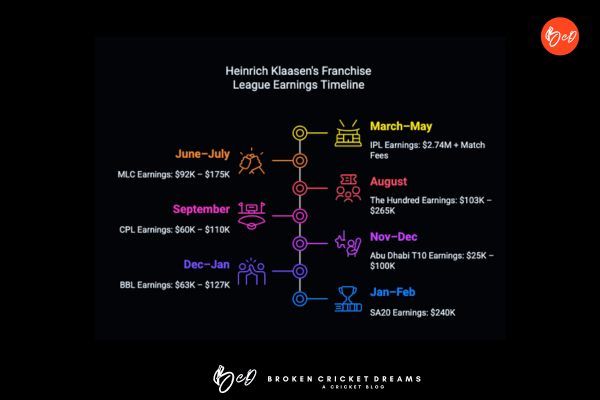
Klaasen is currently active in the SA20, IPL, and MLC. Without international duties, his calendar opens up to other leagues like an entire season of The Hundred (already signed), partial stints in the CPL and the BBL, and possibly a shorter league like the Abu Dhabi T10. Altogether, this could earn him an additional $251,600-$602,000 annually— 4% to 263% increase over his former CSA income, effectively replacing or even exceeding his lost national contract.
In total, Heinrich Klaasen’s earnings from franchise salaries alone will be about $3.5 million-$4.17 million.
Here are some new additions and salary changes in various franchise leagues this year.
The BCCI introduced match fees of about $9000 if a player is included in the Playing XII of an IPL match.
If Klaasen features in at least 10 matches, that is extra $90,000. If he plays all 14 league matches, that rises up to $126,000. If they go through the eliminator, qualifier, and the final, he can earn up to $153,000 extra with IPL match fees alone.
Klaasen was a third draft pick in 2023 at £75,000/$96,186. Third draft pick has increased to £78,500 this year.
Note: Not all franchise tournaments reveal the exact signing amount for an overseas signing/retained player, so we provide a range. Klaasen is a highly sought-after T20 player, so his actual salary may be closer to the higher end.
Heinrich Klaasen’s Current Franchise Contracts ($3.27-$3.57 Million)
Note: Klaasen is unlikely to play in the PSL due to scheduling conflict with the IPL (April–May) since he’s been retained by SRH for the next couple of seasons.
Also, Global T20 Canada is in doubt for 2025 and hence has not been considered in this list.
Projected Calendar (2025-2027)
So now, we are ready to build Klaasen’s projected calendar.
Since the ILT20, BPL, and Super Smash collides with his home tournament SA20, he will not be able to accommodate these leagues and will only have space to play the first half of the Big Bash. In addition, since June-September is action packed T20 season, there will probably not be enough time to take part in the T20 Blast.
Since Klaasen won’t be available for the whole BBL season, I reckon his draft price will closer to the Bronze ($100,000 AUD)-Silver ($200,000 AUD) range, which is $63,600-$127,200 USD. Similarly, for the CPL, where he may only be available for the first half, his salary range may be closer to $60,000-$110,000 rather than $130,000-$190,000.
As a fan, I hope the door has not closed on Klaasen’s return to internationals.
Franchise cricket now owns the calendar. The only real gap? October—which fittingly happens to be when the next ODI World Cup is scheduled.
With the 2026 T20 World Cup on the horizon and a home 2027 ODI World Cup, losing a player of Klaasen’s calibre would be a real shame.
At nearly 34, he is prioritizing his future. So are several others. Kane Williamson and Trent Boult have already taken this route. And I’m sure, many more will follow.
One thing is for certain: As franchises compete for top talent, player salaries will keep rising.
International cricket, though? It may already be on its deathbed.
For a Complete List of Franchise Salaries, you can check out the following:
Every sports fan hopes their heroes will keep going forever. But at some point, we all have to let go.
With MS Dhoni, that time has come—for the fans, for CSK’s team management, and sadly, for Dhoni himself.
***
From No. 3 in 2005 to No. 9 in 2025
Age should never be a barrier in selection.
Pravin Tambe debuted at 41 and played till he was nearly 48. Brad Hogg lasted till 46. And Faf du Plessis? Still the fittest cricketer around at 40.
So why are we questioning MS Dhoni all of a sudden?
This season, his batting has come under scrutiny more than once. Against RCB chasing 197 , Dhoni walked in at No. 9 with the score at 99/7 in the 16th over. The game was already gone.
For a player whose legend began with that148 at No.3 against Pakistan in 2005, it felt strange, almost uncomfortable, to see him bat so low.
“…his knees aren’t what they used to be. And he’s moving okay, but there’s still an attrition aspect to it. He can’t bat ten overs running full stick. So he will gauge on the day what he can give us.”
He is still lightning fast behind the stumps. He can still clear the ropes. But if he’s not fully fit, what message does that send for a league striving to be the most professional in the world?
***
And yet, the very next game made the discomfort even harder to ignore. We witnessed the bore of a game against the Delhi Capitals.
Enough time for a counterattack. But there was no intent. No pressure put on Delhi. Just a quiet 30* off 26.
Yes, the openers and middle order are out of form. But this version of Dhoni looked like a shadow of the old finisher, mistiming lower full-tosses and missing free hits.
Maybe it was a slow pitch. Maybe the lack of game time. Or maybe—just maybe—it’s time.
There is one more aspect we have not touched yet: The business perspective.
CSK is a franchise that understand brand value, and Dhoniis the brand. He fills the stadiums, drives social buzz, and brings new fans to the game.
But does it still make cricketing sense?
A few years ago, India only had a handful of finishers—Ravindra Jadeja, Hardik Pandya, Dinesh Karthik, and MS Dhoni. Retaining him made sense.
But things have changed. The IPL is now full of power hitting finishers: Shashank Singh, Ashutosh & Jitesh Sharma, Tim David, Rovman Powell, and plenty more. The supply of wicketkeepers is even higher. Gaikwad has already taken over the captaincy.
The league has moved forward. The question is—has CSK?
What does CSK want more? A winning team built on the next generation of heroes or to hold on Dhoni’s legacy so tightly that the glow of Dhoni’s greatness slowly dims?
“You either die a hero, or you live long enough to see yourself become the villain.”
Okay, that’s a bit too much. Dhoni will never be a villain. Not after everything he has done for Indian cricket. But the longer this drags, the more it risks leaving a sour taste on an otherwise glorious career.
The greatest finishers don’t just know how to close games. They know when to walk away.
The IPL 2023 win may have been the perfect send-off. But the past is the past. Dhoni still has a chance to finish this in his own way.
Don’t be surprised if he retires mid-season, like his sudden Test retirement in the middle of the 2014 Border-Gavaskar trophy. Or if he vanishes with a cryptic Insta story. That’s Dhoni.
He has always done things this way. This time, it will be no different.
But when it’s over, we will all come together. And we’ll cry.
Because legends do not fade quietly.
***
Bonus: What do the Fans Say?
In a poll I did on X, 69.7% of the people were of the opinion that MS Dhoni should retire.
Vote 👇
— Broken Cricket Dreams Cricket Blog (@cricket_broken) April 6, 2025
Here is a fan’s interview after the Delhi Capitals match. Even the greatest of fans are not happy.
Growing up in the 2000s, it felt like Australia won EVERYTHING in cricket—World Cups, Champions Trophies, the Ashes, Commonwealth, women’s, men’s, U-19—you name it.
Likewise, the USA, China, Russia, Great Britain, Australia, and France dominate the Summer Olympics. Every. Single. Time.
Why do these countries keep winning? And why doesn’t Djibouti rack up more medals? (For the record, Djibouti won a solitary bronze in 1988 Men’s Marathon).
The easy answers? These developed nations have better facilities, grassroots programs, and a robust ‘sporting culture’. But can we quantify this?
By applying Maslow’s Hierarchy of Needs to the economies of the 12 Test-playing cricket nations, 9 FIFA World Cup powerhouses, and six summer Olympic titans, I will create an economic hierarchy for international sports and uncover what it takes for a nation to consistently dominate the global stage. Here are the main questions I’m tackling today:
What is the minimum GDP per capita threshold required for a nation to achieve its first global sporting glory?
How rich must a country win to dominate one team sport?
At what economical threshold does a country go from a one-sport nation to a “sporting culture” like Australia, Russia, China, or the United States?
Let’s begin.
Key Takeaways
To secure its first major team sporting achievement or an Olympic medal, a nation must meet a minimum GDP per capita of $75-$250. Pakistan won an Olympic gold in field hockey in 1960, when their GDP per capita was just $82. Brazil’s GDP per capita was $235.6 in 1960 when they rose in football, India was at $296 in 1983, Sri Lanka – $776.2 (1996), and Afghanistan was at $560.6 when they qualified for the 2010 T20 World Cup.
To become a dominant ‘one-sport’ nation, the GDP per capita must rise to a minimum of $1000-$2500.
West Germany’s GDP increased from $1162.7 in 1960 to $5659.7 in 1974, by which team they had won two World Cups. When Argentina won again in 1986, they had amassed $3436.1 GDP per capita. Brazil reached $3298 by 1994.
Jamaica’s GDP per capita rose from $1632 in 1988 (two Olympic medals) to $5029.8 in 2008 (11 medals).
India’s GDP per capita rose from $544.1 in 2003 to $1021.9 in 2007 before they were able to launch the IPL.
When a nation reaches a minimum of $15,000 GDP per capita, a Global Hunger Index (GHI) < 5, and a poverty rate of less than 2%, they are able to rise to an Olympic and multi-team sport supergiant. China’s current GDP per capita is $13,870. They reduced their GHI from 13.4 in 2000 to <5 by 2016. Australia’s GDP per capita almost double from about $20,000 to $40,000 between 1999-2007, and currently have a GDP per capita of $67,980.
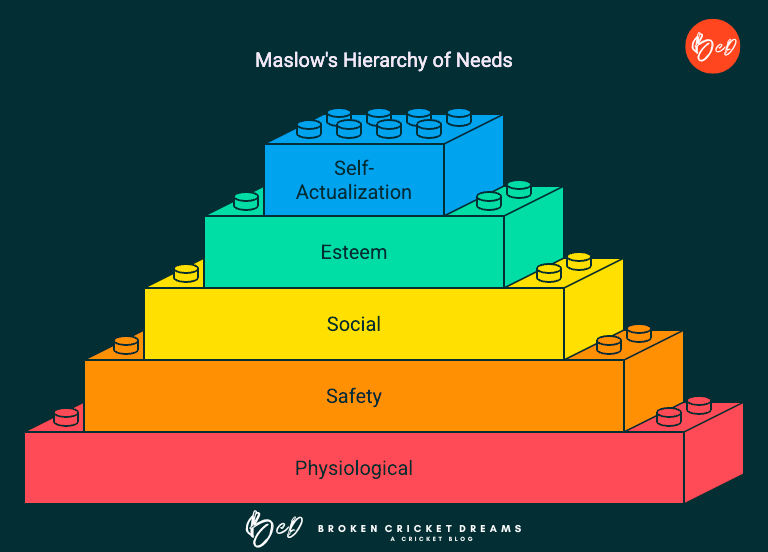
American psychologist, Abraham Maslow, proposed a model that distributed human behavior into five distinct levels:
Physiological Needs: Essentials like food, water, and shelter.
Safety: Security, financial stability, and health.
Love & Belonging: Relationships, intimacy, and connections.
Esteem: Self-respect, status, and recognition.
Self-Actualization: The pursuit of reaching one’s full potential.
The first two represent an individual’s ‘basic needs’, the next two are the ‘psychological needs,’ and the final level focuses on ‘self-fulfillment needs.’
My Theory on the Economics of Sports Dominance
The First Stage: Individual Triumphs
In a nation-state’s early stages, sporting success begins with individual pioneers who overcome socioeconomic hardships and limited infrastructure to achieve greatness. The only prerequisite is that the individual’s physiological needs are met during their physical growth. Think Milkha Singh’s story, rising against odds in post-Partition independent India to reach 4th in the 1960 Rome Olympics in the 400 meters.
The Second Stage: One-Sport Nations
As the nation progresses economically, it has the potential to become ‘one-sport’ nation based on cultural influences and accessible sports (for example, cricket in the British colonies, soccer globally). These teams often include athletes from both affluent and underprivileged backgrounds. Families meet Maslow’s safety needs, which enables the next generation to pursue sports. Think Pele’s Brazil in the 1960s or Sunil Gavaskar/Kapil Dev’s 1983 Indian cricket team).
The Third Stage: Middle Class Expands
Sustained economic growth strengthens the middle class, allowing nations to dominate in one sport and venture into others. By this stage, nations fulfill belonging and esteem needs, earning global respect among the sporting fraternity. Think China at the turn of the 21st century or India in the late 2000s.
The IPL in 2008 would not have been possible without India’s economic liberalization in 1991. Not only did the depth of Indian cricket increase drastically, the pool of business class citizens also increased—individuals who could afford to bet on the idea of the IPL.
This middle class and business growth also allowed India to form leagues like field hockey & Kabaddi and start winning individual Olympic medals in wrestling, badminton, gymnastics, shooting, etc.
The Fourth Stage: Cross-Sport Dominance
This can be a tricky transition phase for several nations due to population or limited resources. Dominating across multiple sports requires major investments across different sports, political will, and hosting global events. Before self-actualization, this can lead to a ‘Sleeping Giant’ phase. This is also the stage where nations typically begin excelling in women’s sports, as increased infrastructure and societal progress open doors for female athletes to thrive.
The All-Blacks from New Zealand may dominate rugby, the Kiwis and White Ferns are always competitive in cricket, and they win 10-20 Olympic medals every cycle, but with a population of 5 million, how much farther can they go?
The Fifth Stage: Self-Actualization
Decades of stability produce generations of affluent citizens, near-zero poverty, and world-class infrastructure. Athletes have the resources and environment to reach their full potential. Think the USA, USSR at the height of the cold war, China currently, Great Britain, Japan, and Australia.
Exceptions to the Rule
These conditions are the bare minimum necessary to be competitive. The reverse is not necessarily true. Economic stability does not guarantee sporting success.
For example, the men’s USA team still struggles to reach the Round of 16 after 40 years of investment, hosting the 1994 FIFA World Cup, and the MLS.
Adequate GDP per capita and strong sports culture does not guarantee success either. Mexico has a GDP per capita of ~ $13,360 and a bustling soccer scene. South Africa has a GDP per capita of $6,500 and a thriving cricket culture. Neither have won World Cups in these sports.
How much wealth it takes to win international sports.
Economic Trends of Various Sporting Teams (1960-Present)
We look at economies of the top countries who have played cricket, soccer, and achieved Olympic greatness.
Note: These countries also overlap with countries who tend to dominate field hockey, basketball, and ice hockey (except Finland). Baseball dominated countries (Cuba, Puerta Rico, Venezuela) golf & Winter Olympics (less accessible, high-end sports) are out of scope for this study.
Which Socioeconomic metrics do we look at and how were they collected?
We consider the following current socioeconomic stats:
GDP (Gross Domestic Product), population,GDP per capita, and if applicable, percentage of population under poverty, and Global Hunger Index (GHI).
GDP per capita can be skewed if there is high income inequality in the country. Hence, we also look at poverty rates and GHI to gauge a better picture of the population set.
Higher GDP and GDP per capita indicate stronger relative economy. Lower poverty rates and GHI levels reflect improved societal well-being.
Poverty rates are presented according to (1) World Bank’s 2017 data, where the extreme poverty line was defined as $2.15/day. Another poverty line, population under poverty (national) is presented if a nation’s self-defined poverty line is above the World Bank rate.
We source the current statistics from the IMF (International Monetary Fund) and the historical GDP per capita levels from the World Bank. The data is available from after 1960, when the World Bank started collecting this data. This coincides with the post-World War II era, when several nations became independent. World Cups were also beginning to take shape during this time.
Other Notes:
If GHI is not mentioned, that means the country is not analyzed by GHI (These are mostly first world countries that do not have hunger issues)
We combine results for Great Britain (Olympics), United Kingdom (GDP data), and England (1966 FIFA World Cup win, multiple cricket World Cup wins) under the same section.
I’ll use soccer instead of football for the rest of the article.
The sporting achievements listed are not an exhaustive list – just significant achievements spaced out to see trends in GDP.
All the sources we looked at are linked at the bottom of the article for your kind perusal.
Top 12 Richest Test Playing Cricketing Countries by GDP Per Capita
We begin by the 12 Test playing nations, ordered by 2025 GDP per capita.
For some countries, we also look at the GDP per capita at different points in their sporting history.
1. Ireland ($107,240)
Multi-sport nation
What was Ireland’s GDP per capita range at their first major sporting event?$2,516.9 (1974 Five Nations Rugby Union Championship, their first in the modern era, 10th since 1910). Their GDP per capita increased to $61,396.4 by the time they upset Pakistan in the 2007 ODI World Cup.
Ireland’s Current Socioeconomic Stats
GDP: $587.23 Billion
Population: 5.48 Million
GDP Per Capita: $107,240
Population Under Poverty (World Bank): 0.06% (2021)
Population Under Poverty (National): 14% (2021)
2024 Paris Olympic (Total Medals): 7
Most Popular Sports in Ireland: Gaelic Football, Rugby, golf, soccer, cricket
2. Australia ($67,980)
Global Sports Superpower
What was Australia’s GDP per capita at their first major sporting event?$8,252.7 (1978 Women’s ODI Cricket World Cup win)
Australia’s Current Socioeconomic Stats
GDP: $1.88 Trillion
Population: 27.67 Million
GDP Per Capita: $67,980
Population Under Poverty: 0.5% (2018)
2024 Paris Olympic (Total Medals): 53
Most Popular Sports in Australia: Australia Rules Football (AFL), Cricket, Rugby, Soccer, Tennis, Swimming
GDP Per Capita At a Glance
Year
GDP Per Capita
Significance
1963
$1967.2
Netball World Cup Win
1973
$4770.8
Women’s Cricket World Cup (CWC) Final
1975
$7003.8
Men’s CWC Final
1978
$8258.7
Women’s CWC Win
1987
$11651.3
Men’s CWC Win
1999
$20712.7
Men’s CWC Win
2007
$41051.6
3rd Consecutive Men’s ODI WC Win
2014
$62544.1
Women’s T20 WC Win
2023
$64820.9
Men’s CWC Win
3. United Kingdom ($54,280)
Global Sports Superpower
What was England’s GDP per capita at their first major sporting event?$1,987.6 (1966 FIFA World Cup)
UK’s Current Socioeconomic Stats
GDP: $3.73 Trillion
Population: 68.72 Million
GDP Per Capita: $54,280
Population Under Poverty: 0.2% (2021)
Great Britain 2024 Paris Olympic (Total Medals): 65
Most Popular Sports in the UK: Soccer, Cricket, Rugby, Tennis, Golf
GDP Per Capita At a Glance
Year
GDP Per Capita
Significance
1966
$1987.6
FIFA World Cup Win
1973
$3426.3
Women’s CWC Win
1979
$7804.8
Men’s CWC Final
1987
$13118.6
Men’s CWC Final
1992
$20487.2
Men’s CWC Final
2010
$39599
Men’s T20 WC Win
2019
$42662.5
Men’s ODI WC Win
4. New Zealand ($48,230)
Multi-sport nation
What was New Zealand’s GDP per capita at their first major sporting event? $12,330.9 (1987 Rugby World Cup)
NZ’s Current Socioeconomic Stats
GDP: $262.92 Billion
Population: 5.45 Million
GDP Per Capita: $48,230
Population Under Poverty:
2024 Paris Olympic (Total Medals): 20
Most Popular Sports in NZ: Rugby, Cricket, Netball, Soccer, Basketball
People tend to ask how New Zealand always ‘punches’ above their weights and make it to cricket World Cup semi-finals despite a population of 5.45 million?
Because they have the fourth highest GDP per capita and have most of the population above the poverty/GHI line, so individuals can focus on other worldly needs like sports.
GDP Per Capita At a Glance
Year
GDP Per Capita
Significance
1967
$2208.4
Netball WC Win
1987
$12330.9
RugbyWC Win
2000
$13641.1
Women’s CWC Win
2021
$49624.2
World Test Championship Win
5. West Indies ($19,823)
Multi-sport nation
West Indies teams from the 1975-1983 ODI World Cups, 2004 Champions Trophy, and 2012 & 2016 T20 World Cups included players from Guyana, Barbados, Jamaica, Trinidad & Tobago, and Saint Lucia
What was West Indies nations’ GDP per capita at their first major sporting event? (1975 World Cup)
What was Sri Lanka’s GDP per capita at their first major sporting event? $776.2 (Won the 1996 ODI World Cup)
SL’s Current Socioeconomic Stats
GDP: $74.59 Billion
Population: 22.4 Million
GDP Per Capita: $3,330
Population Under Poverty (World Bank): 0.96% (2019)
Population Under Poverty (National): 14.30% (2019)
Global Hunger Index: 11.3 (2024), 21.7 (2000)
2024 Paris Olympic (Total Medals): 0
Most Popular Sports in South Africa: Cricket, Volleyball, Athletics
GDP Per Capita At a Glance
Year
GDP Per Capita
Significance
1975
$279.8
Invited to CWC
1979
$230.8
Qualified for CWC
1996
$776.2
Won CWC
2007
$1578.6
ODI WC Runners-up
2014
$3971.9
T20 WC Win
8. India ($2,940)
One-Sport Dominant Nation, In-Transit to Become Multi-Sport Nation
What was Afghanistan’s GDP per capita at their first major sporting event?$296 (1983 ODI Cricket World Cup win)
India’s Current Socioeconomic Stats
GDP: $4.27 Trillion
Population: 1.45 Billion
GDP Per Capita: $2,940
Population Under Poverty (World Bank): 12.92 % (2021)
Global Hunger Index: 27.3 (2024), 38.4 (2000)
2024 Paris Olympic (Total Medals): 6
Most Popular Sports in India: Cricket, Field Hockey, Badminton, Kabaddi, Wrestling
GDP Per Capita At a Glance
Year
GDP Per Capita
Significance
1975
$161.1
Field Hockey WC Win
1983
$296
CWC Win
2003
$544.1
CWC Runners-Up
2007
$1021.9
T20 WC Win
2011
$1445.5
ODI WC Win
2024
$2700
T20 WC Win
(current USD $)
1983: $296
2003: $544.1
2007: $1021.9
2011: $1445.5
2013: $1432.8
2023: $2480.8
9. Bangladesh ($2,770)
One-Sport Dominant Nation
What was Bangladesh’s GDP per capita at their first major sporting event? $397.3 (Won the 1997 ICC Trophy and qualified for the 1999 ODI Cricket World Cup)
Bangladesh’s Current Socioeconomic Stats
GDP: $481.86 Billion
Population: 173.74 Million
GDP Per Capita: $2,770
Population Under Poverty (World Bank): 5.01% (2022)
Population Under Poverty (National): 18.7% (2022)
Global Hunger Index: 19.4 (2024), 33.8 (2000)
2024 Paris Olympic (Total Medals): 0
Most Popular Sports in Bangladesh: Cricket, Soccer, Kabaddi, Badminton
GDP Per Capita At a Glance
Year
GDP Per Capita
Significance
1997
$379.3
ICC Trophy Win
1999
$388
Qualified for CWC
2015
$1224.4
ODI WC Quarterfinals
10. Zimbabwe ($2,130)
One-Sport Dominant Nation
What was Zimbabwe’s GDP per capita at their first major sporting event? $716.8 (1975 Cricket World Cup – Had Kapil Dev not scored that 175*, we may be playing the ZPL)
Zimbabwe’s Current Socioeconomic Stats
GDP: $36.93 Billion
Population: 17.36 Million
GDP Per Capita: $2,130
Population Under Poverty (World Bank): 39.75% (2019)
Population Under Poverty (National): 38.30% (2019)
Global Hunger Index: 27.6 (2024), 35.3 (2000)
2024 Paris Olympic (Total Medals): 0
Most Popular Sports in Zimbabwe: Cricket, Soccer, Rugby, Athletics
GDP Per Capita At a Glance
Year
GDP Per Capita
Significance
1982
$1095.3
ICC Trophy Win, Qualified for 1983 WC
1995
$648
Hosted All-Africa Games
1999
$582
Best WC Show, 5 Wins
11. Pakistan ($1,590)
One-Sport Dominant Nation
What was Pakistan’s GDP per capita at their first major sporting event? $395.7 (1992 ODI Cricket World Cup Win)
Pakistan’s Current Socioeconomic Stats
GDP: $374.6 Billion
Population: 240.54 Million
GDP Per Capita: $1,590
Population Under Poverty (World Bank): 4.93% (2018)
Population Under Poverty (National): 21.9% (2018)
Global Hunger Index: 27.9 (2024), 36.6 (2000)
2024 Paris Olympic (Total Medals): 1
Most Popular Sports in Pakistan: Cricket, Field Hockey, Squash, Badminton
GDP Per Capita At a Glance
Year
GDP Per Capita
Significance
1960
$82
Field Hockey Olympic Gold
1979
$249.2
First CWC Semi-Finals
1992
$395.7
WC Win
1999
$418.2
WC Runners-Up
2009
$963.8
T20 WC Win
2017
$1519.2
Champions Trophy Win
2022
$1538.3
T20 WC Runners-up
12. Afghanistan ($410.93)
One-Sport Dominant Nation
What was Afghanistan’s GDP per capita at their first major sporting event?$560.6 (2010 – ICC Intercontinental Cup, ICC World T20 Qualifier Winners, qualify for 2010 T20 World Cup)
Afghanistan Current Socioeconomic Stats
GDP: $17.33 billion
Population: 42.17 Million
GDP Per Capita: $410.93
Population Under Poverty (World Bank): 34.9% (2023)
Population Under Poverty (National): 54.9% (2023)
Global Hunger Index: 30.8 (2024), 49.6 (2000)
2024 Paris Olympic (Total Medals): 0
Afghanistan’s Most Popular Sports: Cricket, Buzkashi
Since 1960, only the following countries have won the FIFA World Cup: Brazil, England, (West) Germany, Argentina, Italy, France, and Spain (Uruguay, Hungary, and Czechoslovakia are not considered here).
We will also explore Croatia, Portugal, and the Netherlands, who have been competitive.
1. Netherlands ($70,610)
Multi-Sport Nation
What was Netherland’s GDP per capita at their first major sporting event? $6,454.5 (1974 Finalists)
Current Socioeconomic Stats
GDP: $1.27 Billion
Population: 18.03 Million
GDP Per Capita: $70,610
Population Under Poverty (WB): 0.07% (2021)
Population Under Poverty (National): 14.5% (2021)
2024 Paris Olympic (Total Medals): 34
Most Popular Sports in Netherlands: Soccer, Cycling, Field Hockey
GDP Per Capita At a Glance
Year
GDP Per Capita
Significance
1974
$6450.5
FIFA World Cup (WC) Runners-up
1978
$11195.8
WC Runners-Up
2010
$51305.7
WC Runners-Up
2014
$53457.2
3rd Place
2. Germany ($57,910)
Global Sports Superpower
What was Germany’s GDP per capita at their first major sporting event? $1,162.1 (1960 – West Germany won the 1954 FIFA WC), $5,659.7 (1974)
Current Socioeconomic Stats
GDP: 4.92 Trillion
Population: 84.98 Million
GDP Per Capita: $57,910
Population Under Poverty (World Bank): 0.24% (2020)
Population Under Poverty (National): 16% (2020)
2024 Paris Olympic (Total Medals): 33
Most Popular Sports in Germany: Soccer, Tennis, Basketball, Handball
GDP Per Capita At a Glance
Year
GDP Per Capita
Significance
1966
$1870.8
FIFA WC Runners-Up
1974
$5659.7
WC Winners
1990
$22385.7
WC Winners
2003
$30711.1
Women’s FIFA WC Win
2008
$46386.3
Men’s Field Hockey Gold
2014
$48971.1
WC Winners
3. France ($49,530)
Global Sports Superpower
What was France’s GDP per capita at their first major sporting event? $9,311.9 (1984 Euro)
Current Socioeconomic Stats
GDP: $3.28 Trillion
Population: 66.3 Million
GDP Per Capita: $49,530
Population Under Poverty (World Bank): 0.06% (2021)
Population Under Poverty (National): 15.60% (2021)
2024 Paris Olympic (Total Medals): 64
Most Popular Sports in France: Soccer, Tennis, Rugby, Handball, Basketball
GDP Per Capita At a Glance
Year
GDP Per Capita
Significance
1986
$13430.5
FIFA WC 3rd Place
1995
$26791.8
Men’s Handball WC Win
1998
$24869.4
FIFA WC Win
2006
$36431.6
WC Runners-Up
2018
$41418.2
WC Winners
4. Italy ($41,710)
Multi-sports Nation
What was Italy’s GDP per capita at their first major sporting event? $1,718.5 (1968 UEFA Euro)
Current Socioeconomic Stats
GDP: $2.46 Trillion
Population: 58.96 Million
GDP Per Capita: $41,710
Population Under Poverty (World Bank): 0.81% (2021)
Population Under Poverty (National): 20.10% (2021)
2024 Paris Olympic (Total Medals): 40
Most Popular Sports in Italy: Soccer, Cycling, Tennis, Basketball, Volleyball, Formula 1
GDP Per Capita At a Glance
Year
GDP Per Capita
Significance
1970
$2111.7
FIFA WC Runners-up
1982
$7573.9
WC Win
1994
$19382.2
WC Runners-Up
2006
$33684.7
WC Win
2020
$32091.5
Euro Winners
5. Spain ($37,360)
Multi-sports Nation
What was Spain’s GDP per capita at their first major sporting event? $695 (1984 Euro)
Current Socioeconomic Stats
GDP: 1.83 Trillion
Population: 48.92 Million
GDP Per Capita: $37,360
Population Under Poverty (WB): 0.56%
Population Under Poverty (National): 20.4%
2024 Paris Olympic (Total Medals): 18
Most Popular Sports in Spain: Soccer, Basketball, Tennis, Cycling, Water Sports
GDP Per Capita At a Glance
Year
GDP Per Capita
Significance
1964
$695
Euro Win
1982
$5156
Hosted the FIFA WC
2005
$26451
Men’s Handball WC Win
2008
$35603.2
Euro Win
2010
$30658.7
WC Win
6. Portugal ($30,950)
One-Sport Dominant Nation
What was Portugal’s GDP per capita at their first major sporting event? $18,064.2 (2004 Euro Finalists)
Current Socioeconomic Stats
GDP: $319.93
Population: 10.34 Million
GDP Per Capita: $30,950
Population Under Poverty (WB): 0.23% (2021)
Population Under Poverty (National): 16.40% (2021)
2024 Paris Olympic (Total Medals): 4
Most Popular Sports in Portugal: Soccer, Futsal, Cycling
GDP Per Capita At a Glance
Year
GDP Per Capita
Significance
1966
$601.3
FIFA WC 3rd Place
2000
$11526.4
Futsal WC 3rd Place
2006
$19839.5
WC 4th Place
2016
$19980.3
Euro Win
7. Croatia ($25,080)
One-Sport Dominant Nation
What was Croatia’s GDP per capita at their first major sporting event? $5,712.6 (1998 FIFA WC Semi-Finals)
Current Socioeconomic Stats
GDP: $96.03 Billion
Population: 3.83 Million
GDP Per Capita: $25,080
Population Under Poverty (WB): 0.31% (2021)
Population Under Poverty (National): 18% (2021)
Global Hunger Index: < 5 (2024), 5.5 (2000)
2024 Paris Olympic (Total Medals): 7
Most Popular Sports in Croatia: Soccer, Basketball, Handball, Water Polo
Year
GDP Per Capita
Significance
1998
$5712.6
FIFA WC 3rd Place
2018
$15460.4
WC Runners-Up
2022
$18466.1
WC 3rd Place
8. Argentina ($12,050)
One-Sport Dominant Nation
What was Argentina’s GDP per capita at their first major sporting event? $3282.1
Current Socioeconomic Stats
GDP: $574.2 Billion
Population: 47.64 Million
GDP Per Capita: $12,050
Population Under Poverty (World Bank): 0.61% (2022)
Population Under Poverty (National): 39.20% (2022)
Global Hunger Index: 6.6 (2024), 6.6 (2000)
2024 Paris Olympic (Total Medals): 3
Most Popular Sports in Argentina: Soccer, Polo, Field Hockey
GDP Per Capita At a Glance
Year
GDP Per Capita
Significance
1978
$3282.1
FIFA WC Win
1986
$3436.1
WC Win
2014
$12233.1
WC Runners-Up
2022
$13935.7
WC Win
9. Brazil ($10,820)
One-Sport Dominant Nation. In-Transit to Become a Multi-Sports Nation
What was Brazil’s GDP per capita at their first major sporting event? $235.3 (1958 & 1962 FIFA World Cups)
Current Socioeconomic Stats
GDP: $2.31 Trillion
Population: 213.32 Million
GDP Per Capita: $10,820
Population Under Poverty: 3.5% (2022)
Global Hunger Index: 6.6 (2024), 11.7 (2020)
2024 Paris Olympic (Total Medals): 20
Most Popular Sports in Brazil: Soccer, Volleyball, Basketball, Martial Arts, Futsal
The combined Summer/Winter Olympics tally leaderboard are as follows: United States (3095 medals), Soviet Union (1204), Great Britain (1014), France (961), Germany (960), China (804), Italy (799), Sweden (690), Australia (619), Japan (618), Canada (578), Norway (576), Russia (542), Hungary (540), etc. These countries also happen to be the most developed countries.
On the other end of the spectrum, the following countries only have 1 Olympic medal: Guyana, Iraq, Senegal, Barbados, Paraguay, Sudan, Virgin Islands, Netherlands Antilles, Gabon, Togo, Burkina Faso, Mauritius, Samoa, Tonga, Djibouti, Cape Verde, Dominica, Turkmenistan, Eritrea, Montenegro. You get the point.
Burkina Faso would send its first Olympian in the 1972 Munich Olympics, when its GDP per capita was $99.6. In 1988, they sent 6 athletes ($301.1). When Djibouti won its bronze in 1988, it had a GDP per capita of $878.9.
1. USA ($89,680)
Global Sports Superpower
Current Socioeconomic Stats
GDP: $30.3 Trillion
Population: $338.29 Milllion
GDP Per Capita: $89,680
Population Under Poverty: 1.25% (2022)
2024 Paris Olympic (Total Medals): 126
Most Popular Sports in USA: American Football, Basketball, Baseball, Ice Hockey, Golf, Track and Fields, Tennis, Soccer
GDP Per Capita At a Glance
Year
GDP Per Capita
Significance
1960
$2999.9
71 Olympic Medals
1984
$17121.2
174 Medals
1991
$24342.3
Women’s WC Win
2002
$37997.7
Men’s WC Reaches its first Quarter Finals
2019
$65604.7
Women’s 4th WC Win
2. China ($13,870)
Global Sports Superpower
Current Socioeconomic Stats
GDP: $19.53 Trillion
Population: 1.41 Billion
GDP Per Capita: $13,870
Population Under Poverty: 0% (2021)
Global Hunger Index: < 5 (2024), 13.4 (2000)
China’s Global Hunger Index Trends
Year
GHI
Olympic Medals
2000
13.4
58
2008
7.2
100
2016
< 5
70
2024
< 5
91
2024 Paris Olympic (Total Medals): 91
Most Popular Sports in China: Table Tennis, Badminton, Swimming, Martial Arts, Basketball
GDP Per Capita At a Glance
Year
GDP Per Capita
Significance
1984
$250.7
32 Olympic Medals
2000
$959.4
58 Medals
2008
$3468.3
100 Medals, Hosted Olympics
2022
$10408.7
15 Medals at Winter Olympics (China’s Best Show)
3. Japan ($35,610)
Global Sports Superpower
Current Socioeconomic Stats
GDP: $4.39 Trillion
Population: 123.26 Million
GDP Per Capita: $35,610
Population Under Poverty: 0.73% (2013)
2024 Paris Olympic (Total Medals): 45
Most Popular Sports in Japan: Baseball, Sumo Wrestling, Soccer, Martial Arts
GDP Per Capita At a Glance
Year
GDP Per Capita
Significance
1960
$508.7
18 Medals
1982
$9780
Baseball World Cup Runners-up
2006
$35991.5
World Baseball Classic Win
2011
$48760.1
Women’s WC Win
2020
$40040.8
58 Medals, Hosted Olympics
4. Republic of Korea ($37,670)
Global Sports Superpower
*South Korea
Current Socioeconomic Stats
GDP: $1.95 Trillion
Population: 51.68 Million
GDP Per Capita: $37,670
Population Under Poverty: 0% (2021)
2024 Paris Olympic (Total Medals): 32
Most Popular Sports in South Korea: Soccer, Baseball, Archery, Golf, Taekwondo
GDP Per Capita At a Glance
Year
GDP Per Capita
Significance
1982
$1992.5
Baseball World Cup Win
1988
$4748.6
Hosted Olympics, 33 Medals
2002
$13165.1
FIFA WC 4th Place
2005
$19402.5
Baseball WC Runners-up
5. Canada ($55,890)
Global Sports Superpower
Current Socioeconomic Stats
GDP: $2.33 Trillion
Population: 41.7 Million
GDP Per Capita: $55,890
Population Under Poverty: 0.25% (2019)
2024 Paris Olympic (Total Medals): 27
Most Popular Sports in Canada: Ice Hockey, Lacrosse, Soccer, Basketball, Baseball, Athletics
GDP Per Capita At a Glance
Year
GDP Per Capita
Significance
1976
$8838.9
Hosted Summer Olympics, 11 Medals
1984
$13930.5
44 Medals, Canada’s Best Show
2002
$24256
Ice Hockey Olympic Gold
2010
$47560.7
Hosted Winter Olympic Medal, 26 Medals
2015
$43594.2
Hosted Women’s FIFA WC
6. Russia/USSR ($15,080)
Global Sports Superpower
Current Socioeconomic Stats
GDP: $2.2 Trillion
Population: 145.63 Million
GDP Per Capita: $15,080
Population Under Poverty (WB): 0.18% (2021)
Population Under Poverty (National): 12.10% (2010)
2020 Tokyo Olympic as ROC (Total Medals): 71
Most Popular Sports in Russia: Soccer, Ice Hockey, Gymnastics, Figure Skating
GDP Per Capita At a Glance
Year
GDP Per Capita
Significance
1990 (USSR)
~$9200
USSR Dissolves
1996 (Russia)
$2643.9
Russia Re-enters the Olympics, 89 Medals
2016
$8663.2
56 Medals
Final Thoughts and Future Work
In the future, it would be interesting to analyze countries that dominate less accessible sports like golf or sports in the Winter Olympics. Also nations like Sweden, Norway, Belgium, Uruguay, Czech Republic, Hungary, and Mexico were out of scope for this study, but would be interesting to look at in the future.
Another way to go is to look at the understood how America’s economy is able to support multiple flourishing sports league (NFL, College Football, College Basketball (Men’s/Women’s), NBA, MLS, etc.)
Also, why aren’t Ireland better at cricket? I was surprised to see that they are financially a lot more stable than other nations. The next step would be to look at social policies and government investments to study how countries can start winning consistently at an international stage after they have satisfied the bare minimum economic conditions.
In any case, thank you all for reading. Appreciate y’all! Comment below on what you think!
And please, share, subscribe to our social media channels (X, Facebook) and other platforms (Substack, Medium)
Niccolò Machiavelli argued in his famous political treatise, The Prince, that it is “much safer to be feared than to be loved.”
The BCCI has taken that philosophy to heart, wielding its soft power in ways that are gradually eroding trust in cricket.
The Champions Trophy may just be the tipping point.
The Accusations
Since cricket’s resumption after the financially and mentally taxing COVID-induced break, the BCCI has increasingly dictated terms. Subtle but significant decisions across the last four ICC tournaments have raised serious concerns.
2021 T20 World Cup: India’s last two matches were scheduled against Scotland and Namibia, conveniently positioned as the final group-stage fixtures—providing them the best chance to boost their NRR if needed.
Champions Trophy: On the flip side, in a format where an opening loss is nearly fatal, India starts against Bangladesh while their toughest fixture—New Zealand—is left until the end.
2024 T20 World Cup: Matches in the Caribbean were scheduled to suit Indian prime-time television, not local fans. It was decided ahead of the tournament that if India qualify for the 2024 T20 WC semi-final, they would get to play in Guyana irrespective of group stage standings.
Travel Disparities: In the same tournament, Sri Lanka had to face airplane delays and four flights at four venues, while India stayed in one location and had gap between their Sunday to Sunday matches.
And now, India are playing all their matches in the same venue at Dubai while South Africa take a trip from Pakistan to Pakistan via the UAE.
I am not claiming that this is outright corruption or that ICC tournaments are rigged. Far from it.
But, these are not mere coincidences either. It raises serious concerns about the independence of fixtures, and that independence is what keeps sport fair and compelling to watch.
South Africa flew out to Dubai from Karachi after playing England. Then flew back to Lahore barely 12 hours after landing in Dubai.
Ironically, it is Team India, one of the greatest ODI sides in modern history, that is suffering from this loss of trust.
Let’s take a look at the squad:
Virat Kohli – The greatest ODI Player of all time.
Rohit Sharma – Legendary opener, three double centuries, including a 264-run masterpiece.
Shreyas Iyer – Resolved India’s #4 conundrum and as Abhishek AB on Twitter mentioned, the only #4s with a 100+ SR and 50+ average.
KL Rahul – The finest #5 batter of this generation.
Shami – India’s best ICC ODI bowler.
– 54 batters have scored 1500+ runs at No.4 in ODIs. – Only 7 of them averaged 50+ at this position. – But among them, just one has a 100+ strike rate.
Besides the core, you have the all-rounder engine room of Axar Patel, Hardik Pandya, and Ravindra Jadeja. They can be the insurance policy and arrest the slide when wickets fall early or provide the finishing touch. On the field, they can stall opposition with economical spells, timely wickets, catches, and game-changing run-outs.
If the opposition somehow manages to get through these eight, then they pray that they do not run into ICC #1 Shubman Gill, the guile of Varun Chakravarthy, or Kuldeep Yadav’s artistry. The likes of Rishabh Pant are carrying drinks, and Jasprit Bumrah, Yashasvi Jaiswal, Abhishek Sharma, Tilak Verma, and Sanju Samson are not even in the squad.
Since 2011, India has lost just seven ICC ODI World Cup and Champions Trophy matches out of 51. England lost six in the 2023 World Cup alone.
Yet, because of the UAE-Pakistan hosting fiasco, even die-hard cricket fans are now questioning the seriousness of this tournament. Heck, Peter Della Penna is not even watching the tournament at all!
I haven't watched a single ball of this Champions Trophy, first time I've not watched a major ICC event since 2005. I can't exactly call it a boycott. I just can't watch it seriously with a straight face when the thumb is so blatantly on the scales for one team vs all others. https://t.co/ZIZWqhsI3S
— Peter Della Penna (@PeterDellaPenna) March 5, 2025
The Needless UAE Debate
This Indian side is one of the most balanced ODI sides in recent memory. However, the focus in the last couple of weeks has diverted to an unnecessary debate. Nasser Hussain & Mike Atherton claimed that India had an ‘undeniable advantage.’
Rassie van der Dussen pointed out that “If you can stay in one place, stay in one hotel, practice in the same facilities, play in the same stadium, on the same pitches it’s definitely an advantage. I don’t think you have to be a rocket scientist to know that.”
(Side note: As someone who has been stranded a bazillion times in the Dallas Fort Worth airport, I can relate to David Miller’s frustrations. Once, I almost landed at my destination only for the plane to turn sent back to Dallas due to a tornado warning, forcing me to sleep in the airport — I get it, David. Flights have a way of ruining a good night’s sleep or an entire weekend, but that’s a whole other story.)
When the Nasser Hussain’s of the world question India’s authority, the whole world erupts. Journalists, fans, cricketers all weigh in, and the Indian Newtonian brigade swiftly respond with their equal and opposite stingers.
As CricBlog argues, India only playing in the UAE isn’t really that much of an advantage as critics claim.
Frankly, they could have broken the 400 barrier in the flat pitches of Pakistan. This team would have dominated anywhere.
The point isn’t whether India needs these advantages — it’s that they exist at all.
And dude, these players are accustomed to playing double Super Overs on a Sunday night into Monday morning for IPL matches, squeezing interviews and sponsorship committments, getting a few of hours of sleep, and traveling to another city for a game just 36 hours later. The kind of relentless schedule and travel is the reality for today’s IPL generation of professional athletes.
Hypocrisy, Thy Name is India
As William Shakespeare most certainly did not say, “Hypocrisy, Thy Name is India.”
The BCCI’s stance on cricketing relations with Pakistan is simple: “We refuse to play bilateral cricket Pakistan due to geopolitical reasons. We will not play them at all (well, of course, except in the cases of money, TV rights, and yep that’s about it, money).
When ICC tournaments were held every four years, I could understand the financial weight India-Pakistan matches carried, but with these tournaments happening every year now, the matches no longer hold the same significance. And honestly, they have become predictably boring.
The argument always has been, the ICC earnings from these encounters would be reinvested into grassroot cricket and growth of the game worldwide. Growth of cricket, my foot!
In a Big-3 led 10-team World Cup sport, the ICC’s exploitation of India-Pakistan is just a cash cow, stripping ICC fixtures of their independence and adding logistical burden for every other nation. As Jarrod Kimber rightly exclaimed on this point, “Can we just grow up as sport?”
Mohammed Shami admits that playing all their Champions Trophy matches in Dubai has been an advantage for India 🗣️ pic.twitter.com/5FrE3fPmAf
In school, sometimes a new kid arrives and gets all the attention. In the cricket world, India is the new (financial) kid. And they also happen to be the smartest student in the room.
Social media is already pandering to Indian audiences due to the views and monetization. Not only has the tune of the high level administrators become more rosy towards India, but YouTube channels of Pakistani cricketers, podcasts from Australia and England — EVERYbody caters to Indian audiences.
Is that a bad thing? No, can actually be pretty entertaining to be honest.
Nobody questions the BCCI anymore. Everyone just quietly wants to be friends with them and take a piece of the pie.
Remember in 2003 when teams accused Ricky Ponting of playing with a “spring bat”? How could a team be so good (and slightly arrogant). Well, India is that team now, and the BCCI is that board.
The ICC-B team, also known as the BCCI, need to clean up their image.
We love the cricketers.
Let us enjoy the cricket too. I will end it with the complete quote from Machiavelli:
“It is much safer to be feared than loved because….love is preserved by the link of obligation which, owing to the baseness of men, is broken at every opportunity for their advantage; but fear preserves you by a dread of punishment which never fails.”
On the day when the cricketing world was consumed by the overhyped dullness known as the India-Pakistan non-rivalry, the retirement of legendary writer Ian Chappell almost went unnoticed.
Chappell, cricket’s voice of reason, officially retired from writing at the age of 81.
His final piece for ESPNCricinfowas titled, “The time has come to put down the pen and pack away the computer” and In theMid-Day, it was even more blunt, “That’s it folks, I’m done.”
Ian Chappell has called time on his journalistic career. After writing his first column in November 1973, his last piece appears in today’s @mid_day. Well played, Chappelli. pic.twitter.com/MsvgWE0QYO
For someone who had shaped so many of my views on cricket, it felt like an end of an era. Here is what Ian Chappell meant to me.
Carrying Cricket’s Moral Burden
Chappell wrote for nearly 50 years — writing tribute articles, analyzing batting techniques, recalling lovely cricket stories, reviewing World Cups and Test Series, and much more.
But what will I miss the most?
Without a doubt, I will miss his “Doom and Gloom” cricket articles. You can get a gist of these articles by the titles themselves:
It felt as if Chappell was carrying cricket’s burden on his own shoulders.
Throughout his career, he served as one of cricket’s two moral fulcrums, calling out administrators and shedding light on the game’s deeper issues. (The other one being, Michael Holding).
You may agree with his views, you may not. But what you cannot deny is that Chappell never shied away from using his voice.
He called it how he saw it and did not bow down to the tactics of regulation media.
How Ian Chappell’s Writing Style Influenced My Own Writing
As Mama Bear from Goldilocks would say, Chappell’s articles were never too long, nor too short, they were “just right.”
He did not fill his posts with flowery language or movie quotes. He got straight to the point.
I never realized that I admired Ian Chappell until I reflected upon my own style of writing.
Over the years, I have been drawn to Harsha Bhogle’s command of language, George Dobell’s simplicity, Andrew Fidel Fernando’s satirical ingenuity, Melinda Farrell’s insightful interviews, and Jarrod Kimber’s versatility in content creation.
Little did I realize, though, that Chappell’s approach had subtly influenced my own writing style and ideas. Here are a few examples:
Chappell did it all — radio, newspaper, TV, published books. To excel in one career in remarkable achievement. He did it in two. Don’t forget, he had earlier scored over 5,000 Test runs, 14 centuries, averaged 48.07 in the new ODI format, and enjoyed a nearly 20-year first-class career.
To build a legacy across separate careers spanning generations is a story that deserves accolades. His influence on Australian cricket and cricket media was second to none.
If cricket ends up collapsing in the future due to the Big 3 takeover, imbalance of formats, influx of T20 leagues, overkill of cricket, incompetence of the ICC, or corruption— All I can say is that Ian Chappell warned us.
I will leave y’all with this quote from Chappell’s final Cricinfo article:
“A justifiable part of writing is, it’s all your own work — it might be rubbish, but at least it’s your rubbish.”
Ian Chappell, ESPNCricinfo
It wasn’t rubbish at all, Ian. Each and every word was well worth it.
Thoughts and ideas live forever. Your legacy lives on. You have changed cricket for the better. What a spectacular journey it has been. Happy Retirement.
“The ICC is widely regarded as an event management company. They should add ‘and not a very good one.'”
“Creating a balance between the financial rewards of T20 and the need to full test players in longer contests in a big challenge. The question is, do the administrators have a duty of care to talented kids of the future so they have the opportunity to experience the thrill of Test cricket?“
“An international schedule that has lately flourished like a mushroom in the dark is now resembling a block of Jarlsberg cheese with its trademark holes.”
We have had an incredible Test season, so let’s take a break, shall we?
Nope! The ICC has decided to squeeze in another irrelevant tournament in mid-February, right in the middle of a bazillion T20 leagues, just to make more money!
Even with the return of the ODI tri-series and the India-Pakistan hosting drama, keeping up with all the cricket has been exhausting.
Why not spice things up?
I just love musicals. So here is a Champions Trophy 2025 preview paired with a song that perfectly captures the essence of each team.
To get the full experience, take a moment and listen to all these performances. Feel the music.
1. Afghanistan – “Time to Defy Gravity”, Wicked
Defying Gravity Lyrics
“Something has changed within me, something is not the same.
I am through with playing by the rules of someone else’s game.
Too late for second guessing, too late to go back to sleep.
It’s time to trust my instincts, close my eyes, and LEAP.
It’s time to try defying gravity. I think I’ll try defying gravity. Kiss my goodbye, I’m defying gravity…And you can’t pull me down.
I’m through accepting limits ’cause someone says they’re so. Some things I cannot change, but till I try, I’ll never know.
Too long I’ve been afraid of losing love I guess I’ve lost…..”
…Everyone Deserves a Chance to FLY! And if I am flying solo, at least I am flying FREE.”
Interpretation for Afghanistan’s Chances in Champions Trophy 2025
The amount of talent in Afghanistan’s grass root cricket is unparalleled. From the depths of Division V cricket in 2008 all the way to the T20 World Cup semi-final in 2024, their rise has been heartwarming. A team outside of the top 10 taking giant strides is a beautiful story in the world of sport, let alone cricket.
But now Afghanistan, it is time to jump to the next level. It’s time to Leap and Defy Gravity.
No Mujeeb, No Ghazanfar, No Naveen-ul-Haq. No Qais. And yet, they boast an XI of
1. Rahmanullah Gurbaz (WK), 2. Ibrahim Zadran, 3. Rahmat Shah, 4. Hashmatullah Shahidi (C), 5. Azmatullah Omarzai, 6. Gulbadin Naib, 7. Mohammad Nabi, 8. Rashid Khan, 9. Naveed Zadran, 10. Fazalhaq Farooq, 11. Noor Ahmad with talented players like Sediquallah Atal waiting on the sidelines.
The complete ODI unit. All bases covered, multiple stars, and the heart of it all, the ever passionate Rashid Khan.
Afghanistan cricket, you really deserve a chance to fly.
2. India – “The Winner Takes it All”, Mamma Mia
Mamma Mia Lyrics
“I don’t wanna talk about things we’ve gone through,
Though it’s hurting me, Now it’s history.
I’ve played all my cards And that’s what you’ve done too. Nothing more to say, no more ace to play.
The winner takes it all. The loser’s standing small. Beside the victory, That’s her destiny.
…But I was a fool, playing by the rules. The winner takes it all, the loser has to fall.”
Interpretation for India’s Chances in Champions Trophy 2025
Let’s take a moment and appreciate Meryl Streep’s greatness in that clip.
In any case, India won a T20 World Cup last year, but the scars of the ODI World Cup Final have never really healed. The mention of November 19th sends shivers down all Indian cricket fans’ spines even to this day. India know more so than any other team in the last decade that “the winner takes it all,” and indeed, “the loser has to fall”—2017 Champions Trophy Final, 2019 ODI World Cup semi-final, 2023 ODI World Cup Final.
No Bumrah, an injury prone Shami, a Kohli that is low on confidence, and an inexperienced Rana, no Siraj, no Jaiswal, and none of the hundred other players India keep producing.
And guess what? India still go in as favorites. Watch out for Shreyas Iyer, the antidote to the #4 achilles heels. With KL-Axar-Jadeja-Hardik following and Arshdeep-Kuldeep-Varun, India have multiple X-factors (and Rohit-Gill themselves are doing pretty well themselves with recent centuries).
So team India, though it still hurts, the 2023 WC Final is now history. Time to forget, forgive, and win an ICC ODI Trophy.
Interpretation for England’s Chances in Champions Trophy 2025
Eoin Morgan’s retirement anniversary is circulating on social media. You don’t really know what you had until it is gone. The likes of Eoin Morgan, Jason Roy, Liam Plunkett, Moeen Ali changed the way England play limited overs cricket. The clutch game awareness of Ben Stokes and Alex Hales would later seal the deal with the 2022 T20 World Cup.
Since then? 7th in the ODI World Cup, an abysmal 4-10 record, and have lost every ODI series since then: Twice against West Indies and one each against Australia & India.
Not all hope is lost though. Joe Root is back and they possess a ruthless fast bowling squad of Carse-Atkinson-Archer-Wood-Overton-Mahmood. They have the ingredients, but something needs to change in their belief and gameplay.
Otherwise, all that will be left is memories of an ancient time when England were good.
4. South Africa – “I Dreamed a Dream”, Les Miserable
I Dreamed A Dream Lyrics
“I dreamed a dream in time gone by when hope was high and life worth living. I dreamed that love would never die. I dreamed that God would be forgiving.
Then I was young and unafraid. And dreams were made and used and wasted….
..But the tigers come at night with their voices soft as thunder. As they tear your hope apart as they turn your dream to shame.
And still I dream he’ll come to me…But there are dreams that cannot be and there are storms we cannot weather.
I had a dream my life would be so different from this hell I’m living. So different now from what it seemed now life has killed the dream I dreamed.”
Interpretation for South Africa’s Chances in Champions Trophy 2025
So near, yet so far has been the story for the Proteas in ICC tournaments. Historically, tigers have come at night, teared their hopes, and killed their dreams. Every. Single. Time.
With the women going past the semi-finals in the T20 World Cup, we thought the monkey is off the back. And yes, the semi-final monkey is gone. But now they have Finals horrors—Two Women’s T20 World Cup finals, one men’s T20 World Cup final, and now an U-19 women’s WC final (with a WTC Final on the horizon).
They have a good combination of youth and experience this time around. Bavuma-Rassie-Markram-Miler-Klaasen-Shamsi-Maharaj-Rabada-Ngidi form the core of the side with in-form Ryan Rickleton, Tony de Zorzi, Stubbs, and Jansen to support.
Interpretation for New Zealand’s Chances in Champions Trophy 2025
The Kiwis have made it a habit to steal other teams’ stars during ICC tournaments. And yet, they somehow end up falling short and are never enough.
This side looks different. The 2015-2023 generation is basically all gone. No Guptills, Southees, or Boults.
They are coming off a convincing tri-series win. With a new captain in Mitchell Santner, Kane Williamson rolling out centuries for fun, Will O’Rourke, the new six and a half foot giant in NZ’s armory, and the ultimate all-rounder in Glenn Phillips, NZ are the dark horse yet again.
They have the talent, but are not a polished unit yet. Babar and Shaheen are not in the greatest of forms, they have conceded 350+ runs recently, and they have even puled Faheem Ashraf out of thin air. But guess what? Fakhar-Rizwan are in form, they have successfully chased 350+, and they have found Salman Agha at #5.
As a non-Big 3 nation, they have to holler just to be heard in the world of cricket. However, this is the best chance they have had in years. They have the home crowd to bank. It’s time to take your shot, Pakistan.
7. Bangladesh – “Stayin’ Alive”, Saturday Night Fever
Stayin’ Alive Lyrics
“Whether you’re a brother or whether you’re a mother, You’re stayin’ alive, stayin’ alive.
Look out for Towhid Hridoy, a retiring Mahmudullah, the all-round greatness of Mehidy Hasan Miraz, and the fast bowling wealth Bangladesh have recently have found.
8. Australia – “So Long, Farewell”, Sound of Music
So Long, Farewell Lyrics
“So long, farewell. Auf Wiedersehen, good night.
I hate to go and leave this pretty sight.
…I am glad to go, I cannot tell a lie…goodbye!”
Interpretation for Australia’s Chances in Champions Trophy 2025
This is not a picture of Liesl, Friedrich, Louisa, Kurt, Brigitta, Marta, and Gretl from the Sound of Music.
Rather, it is a picture of Marcus Stoinis (retired), Mitchell Starc (personal reasons), Pat Cummins, Josh Hazlewood, and Mitchell Marsh (injured) bidding adieu to the Champions Trophy.
Kusal Mendis and Charith Asalanka are scoring centuries. Wellalage and Theekshana are bamboozling the Australian batters.
West Indies have a 4-2 record in ODIs against England in the last two years. Shai Hope is an ODI legend, Evin Lewis has made a marvelous comeback, Motie-Forde-Jayden Seales are the next gen. Sherfane Rutherford-Hetmyer-Pooran form a formidable middle order.
Brian Bennett scores a 169 in an ODI. Sikandar Raza keeps winning T20 matches around the world, and they have the accuracy of Blessing Muzarabani-Ngarava to keep them competitive.
And yet, none of these four proud cricketing nations will compete in the Champions Trophy. I hope we don’t forget these teams, and the ICC keeps growing the game of cricket.
Since 2008-09, Pakistan fans have been deprived of watching cricket at home.
Pakistan cricket has been on the outside looking in all these years. However, now, the fog has been lifted. I hope this is a turning point in Pakistan cricket, and they host a memorable tournament.
Bonus 2 : For the Cricket Fans: “A Million Dreams”
A Million Dreams Lyrics
“They can say, they can say it all sounds crazy.
They can say, they can say I’ve lost my mind…We can live in a world that we design.
‘Cause every night I lie in bed, the brightest colors fill my head
A million dreams are keeping me awake. I think of what the world could be, the vision of the one I see.
….However big, However small, let me be a part of it all. Share your dreams with me.“
Interpretation
And finally, for the fans.
The amount of cricket has been increasing and the quality has been decreasing. The Champions Trophy feels like yet another meaningless tournament played in an almost forgotten format.
Regardless of this disillusion, we all are pure cricket fans deep down. So let’s hope that the cricket in the Champions Trophy is enthralling and the billion dreams continue to keep fans awake around the world.
Other Musicals That Did Not Make it in the Final Cut
At the end of the The Dark Night, Commissioner James Gordon reluctantly declares that the late Harvey Dent, was “not the hero we deserved, but the hero we needed.” He instead casts Batman as the villain to preserve hope and peace in the crime-ridden streets of Gotham.
Sri Lankan cricket, too, needed a hero in an era of turbulence. The past decade for Sri Lanka hasn’t been all that great, it’s been pretty bleak to be completely honest.
Amidst this time of inconsistency and decline, Sri Lanka found a steady presence in Dimuth Karunaratne. Now that Karunaratne has decided to hang up his boots after his 100th Test, it’s time to reflect back on a stellar career.
The Never-Ending Transition After the Golden Generation
Until not too long ago, it felt like Sri Lanka were in a never-ending transition cycle.
Between 2007 to 2015, Sri Lanka advanced to the semi-finals of six ICC tournaments, finished as the runners up on four occasions, and finally clinched the 2014 T20 World Cup. Their worst performance? A quarter-final exit. Yeah, digest that.
As the golden generation—Jayasuriya, Dilshan, Sangakkara, Jayawardene, Samaraweera, Kulasekera, Vaas, Malinga, and Muralitharan—faded into the history books, it was time for the next generation to step up. Angelo Mathews, Dinesh Chandimal, Kusal Perera, and Lahiru Thirimanne were expected to carry the mantle with the legend of Herath hanging around for seasoned support.
This didn’t exactly go to plan. While the next-gen delivered a few memorable moments, they were usually in and out of the squads and their performances have often fallen short of expectations.
In seven ICC tournaments since 2015, Sri Lanka has yet to make it past the Group stage (Super 10s/Super 12s in T20 World Cups) and even crashed out of the group stage in the 2016 & 2018 Asia Cups!
The situation in Test cricket was just as grim. Between 2015 and the beginning of the WTC in July 2019, Sri Lanka lost 24 Tests and only won 19. In comparison, they had won 30 Tests and only lost 23 Tests in the nine years prior (2006-14).
A nation once celebrated for producing one gem after another had hit rock bottom. It began to feel as though the Pearl of the Indian Ocean had lost its luster.
That’s where Karunaratne comes in, the one who bridged the gap between two generations. Karunaratne debuted alongside Sangakkara-Mahela-Samaraweera-Mathews and helped Sri Lanka make the transition.
Karunaratne’s first few years were not terrible, but they were definitely not a Kamindu Mendis-esque start either.
“I went to the middle with so many expectations, and I got out for a duck first innings. I thought I’d lost all the hard work I ever did in just a moment. I was only there as an injury replacement, so I thought I’d never play for Sri Lanka again.“
He would further showcase his talent with a 85 in Sydney (where another opener named David Warner would also score 85 incidentally).
In his early years, he had several glittering starts, but only a few fifties, and even fewer tons, Averages of 22, 28.62, 42.83, 36.61, and 29.29 from 2012 through 2016 didn’t do justice to his talent, and he was dropped after two years. However, his recall to the side was a turning point with the 152 at Christchurch becoming one of his career highlights.
“There are two – my maiden hundred against New Zealand. It was the first match I was playing after getting back into the team…That was a really tough hundred for me, against a great New Zealand attack…Then there’s my hundred at the SSC, against Jadeja and Ashwin. That was a pitch that took extreme turn.”
2017 was the year that everything seemed to come together with his batting: 126 vs Bangladesh, 97 & 141 vs India, and 196 vs Pakistan in the UAE.
Asia was conquered.
After Christchurch & Sydney, his celebrated overseas performances would include 103 in Johannesburg (2021) and 107 at Bengaluru (2022).
Now let’s talk about the stats. He scored most runs as an opener for Sri Lanka (7129), comfortably ahead of Jayasuriya’s 5932 and ended as Lanka’s 4th highest Test run scorer ever.
But since no 2017, no opener dominated Test cricket as Karunaratne did. Since 2017, he tops all the charts as opener: Most Runs, most balls faced, most minutes batted, most 50+ scores, most 100s, and even most 4s!
During this period, Dimuth Karunaratne inevitably holds the other batting records
— Broken Cricket Dreams Cricket Blog (@cricket_broken) February 9, 2025
Openers in the last ten years have struggled across almost all conditions, averaging in the lower 30s. Even Sir Alastair Cook’s averages declined in the latter part of his career due to the challenging conditions.
To end up as the most prolific opening batter for your country is no joke. To be the best in the world for a decade is a next level feat altogether.
Instability and the Constant Revolving Door
Every Sri Lanka squad announcement for ICC tournaments after 2015 felt like a luck of the draw. Multiple players would be dropped, Tharangas and Kapugederas would magically make comebacks after years of absence, and new captains would be selected.
Sri Lanka’s Test openers in the last ten years were a revolving door as well: Tharanga, Thirimanne, Nissanka, Kusal Mendis, Vithanage, Kaushal Silva, Dickwella, Dilruwan Perera, Kusal Perera, Udawatte, Samarawickrama, Oshada Fernando, Gunathilaka.
To put Karunaratne’s accomplishments in perspective, he would play 157 innings as an opener after 2015. Kaushal Silva was the next best with 43 innings.
The player switcheroo would in ODI cricket even as late as 2019.
On the eve of the 2019 ODI World Cup, Upul Tharanga and a few others were dropped, while Karunaratne was recalled as a specialist captain. He had last played an ODI in the 2015 ODI World Cup, but selectors had a good reason to get Karunaratne back into the blue & yellow jersey:
“We saw in South Africa how Dimuth was able to unite the team, and have everyone playing together. That was what was important to us at this time.
Sri Lanka ended as 6th in the 2019 ODI World Cup and their shock win against favorites England kept the World Cup alive. 2019 would also see one of the greatest Test victories of all time with Kusal Perera’s 153*, where Sri Lanka became the first Asian country to win a Test series in South Africa:
“It’s the biggest highlight. Captaincy was never something I’d chased….It’s one of my favorite chapters of my career.”
Karunaratne led with humility and quiet confidence, captaining Sri Lanka in 30 Tests with 12 wins and 6 draws.
Karunaratne retires yes, but tomorrow, the world will go on. Parades won’t be blocking the streets, trains will not stop, the stock market will not crash, and people will continue to go about their business as usual.
In the large scheme of things, nothing much has changed. However, in the small country of Sri Lanka, Karunaratne’s contribution made a monumental difference and will never be forgotten. And that is all that matters.
“When people reminisce about cricket, they think about Tests. We’re still talking about Don Bradman’s records, how many double centuries he’s scored, in how many innings. Whatever happens to me from here, there might be a list that goes up on a Test broadcast, and my son or my grandchildren will see that. I’ve got that record for life, and beyond. That’s worth a lot to me.“
Karunaratne had dreamed of playing 100 Tests and scoring 10,000 runs. Unfortunately the 10,000 runs did not happen (and may not ever happen again for Sri Lanka given how Test cricket is going for tier two nations, but that’s a different story), but he can hold his head high for all that he has accomplished.
What Can We Learn from Dimuth Karunaratne?
Author Bryant McGill once stated,
“I’ll take reliability and dependability over talent any day of the week.”
Did Karunaratne spark a white-ball revolution like Eoin Morgan? Did he redefine Test cricket mentality like Kohli or embrace the audacity and do whatever Ben Stokes is doing with Bazball? No, Karunaratne was an unassuming, yet effective leader.
Did he have batting mannerisms like Elgar or Smith, an aura like Cook or Khawaja, or the swagger like Warner or Rohit? No. But he was unquestionably reliable, dependent, and consistent, exactly what Sri Lankan cricket needed at that time.
In an era of uncertainty, Sri Lanka could always rely on Dimuth. He may not have been a superstar, but in the era of uncertainty, Sri Lanka didn’t need any more superstars.
So indeed, Karunaratne was the hero Sri Lanka needed, not the one they deserved. Karunaratne can take pride in the fact that he has left Sri Lankan cricket in a better place.
What will he be doing next? He has now moved his base to Australia and will spend time honing his coaching skills. Do not be surprised if he returns to Sri Lanka to serve his country once again in different roles. For Karunaratne, team always comes first, and he will continue to serve Sri Lankan cricket for as long as he can.
I will leave you with his emotional goodbye in the 2nd Test against Australia, in which he ended his speech with,
I am beginning to wonder if the 29-year-old Abhimanyu Easwaran will ever get a game for Team India.
Despite India’s top order struggling in the 2024-25 Border Gavaskar Trophy, Easwaran remained on the sidelines.
Jaiswal & KL Rahul had their moments, Rohit Sharma had to ‘opt out’ of the fifth Test due to poor form, Gill was in & out, and even Padikkal got a game. Dhruv Jurel and Nitish Kumar Reddy were also handed opportunities for other roles, but Easwaran never got a look-in.
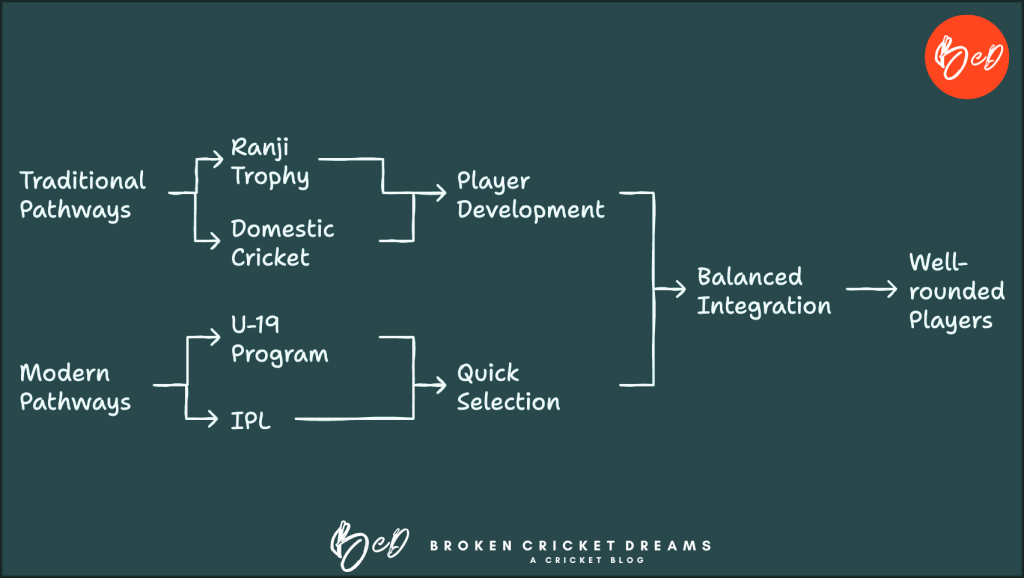
This raises a larger question—Does domestic cricket still matter in India team’s national selection? Has the Ranji Trophy lost its influence, with the India U-19 setup and IPL now serving as the primary pathways to the top?
I looked at Ranji Trophy stats from the last 35 years to see what patterns I can find in the evolution of national selection.
Easwaran came into the spotlight in the 2018-19 Ranji season when he top scored for Bengal with 861 runs. Since then, he has been on the fringes, consistently scoring in the various first-class tournaments, and has also performed well in the India A tours to South Africa and Bangladesh.
BGT 2024-25 was the third time since 2021 that Easwaran has been selected as a ‘standby’ or a reserve opener. This year, he was coming off the back of four consecutive centuries across Duleep, Irani, and Ranji trophies, but still did not get a game.
And it is the not the case that India’s top order has no vacancies. In the last couple of years, Ruturaj Gaikwad, Yashasvi Jaiswal, Ishan Kishan, Devdutt Padikkal, and Prithvi Shaw all leapfrogged him for the reserve Test opener spot due to performances in other formats and the IPL.
Shahbaz Nadeem was the top wicket-taker in the 2015-16 Ranji season (51 wickets), 2016-17 season (56), 3rd highest in 2021-22, and 6th highest wicket-taker in 2022-23. He played only 2 Tests.
Mayank Agarwal had to score the most runs by any Indian in a domestic season (2141 runs) in 2017-18 to make his way to the national team.
Between 2020-23, Sarfaraz Khan scored over 3500 runs batting at #5 at an average of 106.07.
IPL Fast-Track Vs Ranji Grind: Which Opens the Door To Team India?
The traditional pathway was going through domestic cricket, but has the Ranji Trophy and domestic cricket lost its significance?
Is the route through the U-19 program, followed by success in the IPL, now the preferred path over spending 3-4 seasons grinding in domestic cricket?
Let’s go back 25 years to see how Indian cricket has evolved.
Mohammad Kaif & Virat Kohli Pave the Way
Mohammad Kaif’s U-19 triumph in 2000 revolutionized Indian cricket forever. Kaif, Yuvraj Singh, Reetinder Sodhi, Venugopal Rao, Ajay Ratra would all go on to represent Team India.
Eight years later, Virat Kohli followed suit, earning a national call-up soon after leading India to U-19 World Cup glory. Ravindra Jadeja was the vice-captain in that U-19 side.
Since 2008, the IPL has also propelled relatively unknown domestic players to glory. Jasprit Bumrah had begun in Gujarat’s domestic circuit, but it was Mumbai Indians’ scouting lead by coach John Wright, that brought him into the limelight in 2016.
Let’s look at a more recent case, Nitish Kumar Reddy. Reddy made his way to the Andhra FC team after becoming player of the tournament in the 2017-18 Vijay Merchant Trophy (U-16 cricket). His breakthrough came at the 2023 IPL auction, and after impressing in the 2024 IPL, Reddy was elevated to the national squad (and ended up becoming India’s best batter in the BGT).
As the India U-19 system and IPL evolved, a clear pathway emerged—players identified at the U-19 level were fast-tracked to IPL auctions, and those who proved themselves over a season or two often found a route to the national team.
The U-19 & IPL Pathway Express: Gill, Jaiswal
Yashasvi Jaiswal’s inspirational journey is a prime example: He made his FC debut in 2019 and took Mumbai cricket by storm by becoming the youngest double centurion in List A cricket. However, it was his standout performance at the 2020 U-19 World Cup, where he was the player of the series & the highest run scorer, that caught everyone’s attention.
He was then be picked by the Rajasthan Royals in the IPL. After a couple of middling seasons, he took the 2023 IPL by storm scoring 625 runs including a 13-ball 50.
This lead to his Test call-up in the West Indies, where he scored a scintillating 171 and hasn’t looked back since. His 2024 Test season was an all-timer: 1478 runs at 54.74 with 3 hundreds and 9 fifties. Jaiswal has played 19 Tests already, but has only played 16 other first-class matches.
Dhruv Jurel was India’s vice-captain in the same U-19 WC, who also followed a similar path to the India Test cap through the Rajasthan Royals. Before Jaiswal, Rishabh Pant (2016 U-19 WC), Shubman Gill, and Prithvi Shaw (2018) all took a comparable route.
Pujara & Rahane, The Last Warriors of The Ranji Selection Era
Cheteshwar Pujara and Ajinkya Rahane were perhaps the last prototypes of consistent select based upon domestic performances.
Like Jaiswal, Pujara was the player of the tournament and the highest run scorer of the 2006 U-19 WC. However, before breaking into the India Test squad in 2010, he was prolific in the domestic circuit. He was the fifth highest run-scorer in 2006-07 (595 runs at 59.5), the highest run-scorer in the 2007-08 season (807 runs at 73.36), 3rd highest in 2008-09 (906 runs at 82.36 including a 302), and scored 554 runs at 79.14 in the 2009-2010 (5 matches) before being selected for India.
Ajinkya Rahane was the second-highest run-scorer in both the 2008-09 and 2009-10 Ranji seasons. He would make his international debut two years later (He got a break in T20 & ODI cricket two years before Test cricket, weirdly enough).
Fun fact: Gautam Gambhir played in the 2007-08 season and was #3 run-scorer (730 runs at 91.25) despite already being in the national team.
The Toils of Domestic Cricket Feat Agarwal, Sarfaraz
Times have changed. The journeys for Mayank Agarwal & Sarfaraz Khan have been tougher.
Agarwal also came through from the U-19 system (2010) and was fast-tracked to the IPL, but talent didn’t convert to runs.
To get back into national contention, Mayank Agarwal had to break the door down.
And boy, did he dominate, finishing as the top scorer in both the 2017-18 Ranji and Vijay Hazare Trophies. With 2,141 runs across formats, he set a record for the most runs by an Indian in a single domestic season. His breakthrough finally came in the 2018 Border-Gavaskar Trophy (Listen to Harsha Bhogle talk about Agarwal’s journey).
Sarfaraz faced an equally challenging route. A member of India’s 2014 and 2016 U-19 squads, his early IPL stint failed to impress. He then turned to domestic cricket, amassing 928 runs in 2019-20, 982 in 2020-21 (leading all batters), and averaging 106.07 from 2020-23. His relentless run-scoring, capped by a double century in the 2024 Irani Cup, finally earned him a Test debut—five years after his purple patch began.
Suryakumar Yadav’s had to wait until he was almost 31 to get an international debut.
Since 2021, he has become one of the greatest T20I players of all-time, racking up over 2500 T20I runs and four centuries. Although Yadav has extensive FC experience under his belt, it was his T20 form, that propelled his selection to the 2023 ODI World Cup teams and a Test debut.
Shreyas Iyer’s T20I & ODI form, along with his IPL credentials, got him his break in Test cricket in 2021.
*To Shreyas Iyer’s credit, he did score a record 1321 runs in the 2015-16 season, top scoring the Ranji charts (next highest was 879 runs). Coincidentally, Suryakumar Yadav was #4 on the list with 788 runs (SKY was the 4th highest scorer in the 2011-12 season)
Finally, we come to KL Rahul, the most enigmatic batter of our generation.
KL Rahul was the 2nd highest scorer in the Ranji Trophy in 2013-14 (1033) and the 4th highest run scorer in 2014-15 (1033) before breaking into the IPL teams. He was destined as the next big thing in Indian cricket and was handed a debut in 2014.
A decade later, he only averages 33.57 in Test cricket despite playing 58 Tests. For someone of his talent, that is not great returns.
Here is how his cricket season works: Rahul tops the charts in the IPL (659, 593, 670, 626, 616, 274, 520 since 2018) -> Gets selected for T20I/ODI -> India play an overseas Test and need a quick replacement for an opener, #3, or keeper, and Rahul is called in to fill the gap. He scores some beautifully looking 50s, an amazing match-winning hundred, and several low scores, before he is dropped at the end of the season.
Lather, rinse, repeat.
KL Rahul got his break due to the Ranji Trophy, but it is his IPL & ODI form keep that keep bringing him back to the Test arena (to be fair, KL Rahul did look really good in the 2024-25 BGT).
Why Comebacks are Nearly Impossible for Ranji Stalwarts
As a counterpoint to KL Rahul are the stories of Karun Nair, Hanuma Vihari, KS Bharat, and Abhinav Mukund.
Comebacks are nearly impossible for Ranji stalwarts.
It takes 3-6 years for a player to grind in domestic cricket to earn a national call-up. Then, they are made to carry drinks for a year or two, finally getting a chance in a tough overseas Test. If they do not deliver immediately, they’re dropped after two games—never to be seen again.
In the last 5 years, #ViratKohli has played 69 innings.
🚨 Averages of all batters who have played 69 innings in the last 5 years
Virat Kohli’s last eight innings read after the Perth 100 read: 7, 11, 3, DNB, 36, 5, 17, 6. Being dismissed in a similar manner, averaging about 30 in the last 5 years, and yet, he will most likely still survive the axe. Different standards for different players.
Hanuma Vihari and How Not to Treat Cricketers
Hanuma Vihari began his journey with 841 runs at 93.44 with 3 tons (including a 201*) in the 2013-14 season.
Vihari had been carried around since 2018 in England, Australia, West Indies, New Zealand, and back to Australia as an understudy to Cheteshwar Pujara. At that Sydey Test, he put his body on his line to draw a famous Test.
AfterSydney, Vihari only received 4 opportunities spread across three series at #3 when Pujara was initially dropped:
20 (53) & 40*(84) in Johannesburg
58 (128) in Mohali (vs Sri Lanka)
31 (81) & 35 (79) in Bengaluru
20 (53) & 11 (44) in Birmingham
For a player transitioning from #6 to #3, those are respectable figures, especially since he was mostly played in overseas conditions.
Now begins the difficult part.
Back in the domestic cricket, his returns has been below-par: 490 runs at 35.00 in 2022-23, 522 runs at 40.15 in 2023-24, and 250 runs at 27.77 in the current season.
After churning runs in the domestic circuit, Mukund was called up to the West Indies series and scored decent knocks of 48 & 62 in six innings.
Then, came the 0-4 horror tour of England. He scored 49 (88) at Lord’s, 12 (32), 0 (1), and 3 (41) in the next three innings before being dropped…for the next six years.
After scoring heavily in Ranji between 2015-2017, he was recalled in 2017. His score? 0 (8), 16 (32), 12 (26), and 81 (116) at Galle. Mukund never played international cricket again.
KS Bharat Fiasco
KS Bharat was Wriddhiman Saha’s understudy and the next Test wicket-keeper in line, at least for home Tests. He had been carrying drinks for about 4 years.
Once India believed Bharat was ready, Saha was ‘forced’ to retire. 12 innings to his name, Bharat hasn’t been effective with the bat averaging 20.09, but was solid with the gloves.
In any case, it looks like India has made a decision to go forward with the trio Rishabh Pant, Dhruv Jurel, and KL Rahul.
India lost the final year of Saha and never groomed Bharat properly.
The Lesson?
These players end up becoming overseas scapegoats.
By the time a player finally breaks into the national XI—after years of grinding in domestic cricket and warming the bench—they’ve lost valuable game time and likely the form that got them there in the first place.
Once a player is dropped, unless they have a Robin Uthappa & DK 2014 season, Agarwal’s 2017 season, or Sarfaraz’s 5 years, it is extremely difficult for them to be noticed again.
Easwaran has been scoring in domestic cricket for seven years without getting a game. Fellow India A opener, Priyank Panchal, now 34, might never get an international cap despite bossing the better part of the last decade in the domestic circuit.
This made me wonder? How did India’s golden generation of the 2000s make it to the national team before IPL & U-19 cricket setups matured?
The 90s: Beginning of the End
Gautam Gambhir had great back-to-back 2001-02 (565 runs at 70.62) & 2002-03 seasons (833 runs at 75.72, Top Scorer) before getting an ODI debut in 2003 and Test debut in 2004.
Virender Sehwagscored a 78 (56) at #5 in the 1998/99 Deodhar Trophy and was the sixth highest run-scorer in the Duleep Trophy that year. The next year, he continued to make runs at the Duleep Trophy including season-best 274 and was the seventh highest run-scorer in the 2000-2001 season (Five of the players above him were Mongia, Laxman, Vikram Rathour, Yuvraj, and Kaif).
Dravid consistently performed in Ranji from 1991-1995 (380 runs at 63.33 in 1991/92, 586 runs at 83.71 in 1992-93, 644 runs at 80.5 in 1993-94, 191 runs in one innings in 1994-95) along with a wonderful India A series against England A in 1995 before getting an international debut.
Sachin Tendulkar was a schoolboy genius. Rare case, never really happens anymore.
VVS Laxman, after having an indifferent start to his Test career as an opener between 1996-99, Laxman went back to his roots and broke all records in domestic cricket (601 runs at 203.66 in 1997-98, 754 runs at 83.77 in 1998-99, and a mammoth season of 1415 runs at 108.84 in 1999-2000. Next best in that 1999/2000 season scored 1075 runs).
Sourav Ganguly scored 439 runs at 73.16 in 1990 before a brief ODI debut. After a couple of middling seasons back in Ranji, he scored 722 runs at 80.22 in 1993/94. A double century in one 1994/95 Ranji game and a 171 in the Duleep Trophy got him his break for the England tour of 1995.
The Bowlers
Anil Kumble impressed in Karnataka debut in 1989, got a few games in U-19 first class tours, and got the national selection in 1990 ODI series against Sri Lanka and Test debut a few months later in England.
Harbhajan Singh did a little bit of everything: Coming up from Punjab U-19s, he performed well in the 1997-98 Ranji Trophy & Duleep Trophy, the 1998 U-19 WC before getting the Test debut in 1998.
Most of the fan favorites from the 2000s also had to toil in domestic cricket, but 2-3 consecutive season of runs was good enough to take them to the next level.
Not anymore.
The 2004 U-19 Generation
Between the Laxmans and the Jaiswals, came the Shikhar Dhawans.
Every now and then, comes a generation with several great players at once. This was absolutely the case with the 2004 U-19 side, who became the fringe players for the next decade: VRV Singh, RP Singh, Suresh Raina, Robin Uthappa, Dinesh Karthik, Ambati Rayudu, Shikhar Dhawan, and to a lesser extent, Faiz Fazal.
These players would be the transition between first-class, U-19, and the IPL. They saw it all—U-19, India A, early international debuts, being dropped, first class toil, inaugural IPL, back to internationals, back to being dropped.
Fun Fact: Robin Uthappa (912) and Dinesh Karthik (884), two of the earliest picked in the national side post 2004, were the top two scorers in the 2014-15 season and used the domestic season to break their way back to the national side.
How Did Australia Find Konstas and McSweeney?
In this season of the Sheffield Shield, Konstas scored 471 runs at 58.87 with two tons. McSweeney scored 291 runs at 97.00 in just four innings.
He had earlier scored 3 tons last summer at 40.94.
Overall though, McSweeney averages 36.31 in FC cricket, while Sam Konstas averages 39.57.
Australia backs players in form and throws them straight into the action. In India, with so much depth, a player often gets their chance five years after their peak.
Final Verdict: Is Domestic Cricket Still Relevant?
Indian selectors are not necessarily wrong with their selection policies. The idea of the ‘X-factor’ is important and the selections of Jaiswal, Pant, Bumrah, and Reddy have largely been inspirational picks.
However, what message is being sent to players next in line? That they should continue to toil for years and other youngsters will most likely continue to jump them in line?
Domestic cricket has essentially now become a ladder for IPL auctions rather than Indian selection. From the stats below, we can see that post the Covid-break, players who performed in domestic cricket like Rajat Patidar, Shams Mulani, R Sai Kishore, Manav Suthar, and Vijaykumar Vyshak were scouted and got gigs in the IPL auction. If they perform in the IPL, they can get fast-tracked to the next level.
There should be a system in place so a domestic player gets a chance before an IPL star does. Otherwise, grassroots will always be grassroots.
Ranji Trophy Back in the News?
Post the BGT debacle, Indian team changed internal rules and also are changing policies regarding domestic cricket. Will we see Rohit, Virat and Pant back in action in Ranji Trophy? Does that do the Indian team any good with the international calendar crowding all space?
Good to see that domestic cricket is getting the attention it deserves, but I am not sure if this is the way to go.
Hopefully, it is not another Broken Cricket Dream.
****
Thank you all for reading and following along. Appreciate the support!
Reference: Recent Ranji Trends Stats
For your kind reference, here are the list of the top run-scorers and wicket-takers in the last decade (divided up by the Covid-induced break since there was no 2020-21 Ranji season).
The likes of Jalaj Saxena, Dharmendrasinh Jadeja, Kumar Kartikeya have been among the wickets, but will this translate to the next level? Only time will tell.
South Africa are in the World Test Championship (WTC) Finals. This must mean only one thing—Test cricket is in grave danger, and its security & stability is in question.
Hence, we must yet again summon the saviors of World Cricket—The Body of Infinite Greed, also known as the Big 3 (India, Australia, England) to pull us from this misery!
According to The Age, there has been talks of more cricket among the three nations as frequent as “twice every three years.” A record 837,739 members attended the recently concluded BumrahBorder-Gavaskar Trophy, fourth-most in Australia and most for a non-Ashes Test series. So more of these marquee series must be the solution to save Test cricket.
Australia, England, India and the International Cricket Council’s new chair Jay Shah are in talks to split Test cricket into two divisions so the big three nations can play each other more often in series like the Border-Gavaskar blockbuster #AUSvINDhttps://t.co/rK91zhcFHH
Whenever cricket is in danger, the Big 3 have come together for the greater good.
In 2007, when India and Pakistan were knocked out of the 16-team ODI World Cup and destroyed ICC’s finances, a revolutionary decision of a 10-team ODI World Cup came into being. Visionaries!
When Netherlands defeated England in the 2009 T20 World Cup or India suffered three indifferent T20 World Cup campaigns between 2009-2012, the ICC decided to add an extra ‘First Round’ barrier for the Associates (who had already arrived at the World Cup with a grueling qualifying campaign).
Now that India and the Bazballers, England have been knocked out of the WTC Finals, it is time to reduce the WTC to 3 teams.
Proposed World Test Championship (WTC) Grouping
Solution: To ‘save’ Test create, the International Cricket Circus Council (ICC) shall ratify the creation of a two-tiered Test Championship without relegation and promotion.
In Group 1, there will be three teams—England, Australia, India.
Each series will consist of a minimum of 5 Tests (at least 20 Tests per team in the cycle).
Group 2 will contain the rest of 9 teams.
Each series will consist of a maximum of 2 Tests.
The winner of Group 1 will compete in the World Test Championship Final in a 3-match Test series (with one match each at the Lord’s, Wankhede, and the MCG).
The loser of Group 1 will play the winner of Group 2 for unofficial brownie points that has no consequence.
This proposal will have multiple benefits. For example, Australia’s burden to be morally correct all the time will be taken away from them since they will now automatically skip the Afganistan, Zimbabwe, and Bangladesh tours.
Similarly, India will not have the shame of losing 0-3 to New Zealand at home if they never play the Kiwis again.
What is a Possible Calendar for Group 1?
There has been a lack of Test matches between India, Australia, and England recently. Even an expansion to a 5-match Border-Gavaskar Trophy just doesn’t seem enough.
2025/26: 🏴 Tour of 🇦🇺 2025: 🇮🇳 Tour of 🏴 2024/25: 🇮🇳 Tour of 🇦🇺 2024: 🏴 Tour of 🇮🇳 2023: 🇦🇺 Tour of 🇮🇳 2023: 🇦🇺 Tour of 🏴 2022: 🇮🇳 Tour of 🏴 (5th Test) 2021/22: 🏴 Tour of 🇦🇺 2021: 🏴 Tour of 🇮🇳 2021: 🇮🇳 Tour of 🏴…
— Broken Cricket Dreams Cricket Blog (@cricket_broken) January 5, 2025
Here is a possible 2-year cycle with the holy grail of world cricket, the IPL, in the center. You know, there are not enough English & Australian cricketers in the IPL, so they may even expand the number of teams in the future.
Month/Year
Fixture
Nov-Feb
England Tour of India (5 Tests)
Mar-June
16-Team IPL
Jul-Aug
India Tour of England (5 Tests)
Aug-Sept
IPL in England (The Hundred)
Oct
ICC Trophy (ODI World Cup/Champions Trophy/T20 World Cup)
Nov-Jan
India Tour of Australia (5 Tests)
Nov-Jan
IPL in Australia (The Big Bash League)
Feb
ODI Tri-Series (Ind-Aus-Eng)
Mar-June
18-Team IPL
Jul-Aug
The Ashes: Australia Tour of England (5 Tests)
Aug-Sept
IPL in England (The Hundred)
Oct
ICC Trophy (ODI World Cup/Champions Trophy/T20 World Cup)
Nov-Feb
Australia Tour of India (5 Tests)
What about the format and detailed calendar of Group 2? Have I given it any thought you ask?
Yes, I have but that’s not important. Who cares about Sri Lanka, Pakistan, South Africa, West Indies, Afghanistan, Zimbabwe, Ireland anyway?
(You didn’t even notice that I totally skipped over New Zealand & Bangladesh, did ya?)
In any case, let’s skip that and march towards a more important discussion—the India-Pakistan non-rivalry, whose sole purpose is to enhance the pockets of the ICC.
In addition to the annual ICC Trophies, an annual Asia Cup is to be held in an undisclosed neutral location until one week before the trophy in whatever two weeks you can find in the cricketing calendar.
The unbiased randomized groups will be as follows:
Group 1: India, Pakistan
India-Pakistan will play 3 matches.
Winner of Group 1 goes to the Finals
Group 2: Sri Lanka, Bangladesh, Afghanistan, Nepal, Hong Kong, UAE
Each team plays against each other once
Winner of this group plays the loser of Group 1 in a Playoffs match for the second finalist spot.
We Must Preserve the Bumrahs of the World
Bumrah’s breakdown on the last day of the BGT series was disheartening to see. We must preserve the Bumrahs, Cummins, and Stokes’ of this world.
England have tried, tested, and failed with the rest, rotation, and retirement policy (see, Jimmy Anderson).
Ensuring the calendar only consists of the IPL and playing only two teams (with frequent breaks) will save these great cricketers.
(The Rabadas of the world are less important in the larger scheme of things, so we do not consider the non-Big 3 case).
But How will the West Indies earn money without England or India Touring?
The BCCI will not leave others behind, don’t worry. As Anurag Thakur said in 2016,
“The BCCI is against the two-tier Test system because the smaller countries will lose out and the BCCI wants to take care of them.”
Such an empathetic organization, the BCCI. So, how can the BCCI help them?
I have a brilliant idea: The 3-day Red Carpet Auction tour.
Let’s take the CPL for example (Caribbean IPL). This will be a star-studded three-day extravaganza where (1) the CPL auction is televised and marketed like never before to make money for the broadcasting companies, (2) CPL cricketers are paid hefty checks to skip Test cricket, and (3) Indian cricketers get a paid holiday to the Caribbean.
This will enrich the WICB without them having to pay millions of dollars to host Test cricket!
Alright, maybe this last idea was way off the charts.
Final Thoughts
This was meant to be a satirical article, but I think Jay Shah might actually take this as a serious proposal.
Jokes aside, the main issue is that preserving marquee series like the BGT and the Ashes, while trying to expand Test cricket. Cricket cannot claim to be a serious international sport with only 3 prospering countries.
Several former cricketers have welcomed the two-tiered system and more matches among the ‘top teams.’ Vaughan has been a proponent of a two-tiered system and recently penned an article with some interesting thoughts: A two-tiered system will save Test cricket. Here’s why.
(Side Note: Why wouldn’t he? Vaughan was commenting on the BGT tour even though he wasn’t from Australia or India. Former cricketers get contracting gigs by broadcasting companies. They won’t earn the same and stay relevant if they instead covered the Zimbabwe-Afghanistan series). Resources need to be distributed not only in hosting the matches, but also for higher quality broadcasting, commentating, umpiring, and standardized technology across the globe.
In all reality, a proper unbiased two-tiered system might never happen as articulated by Michael Holding:
Test cricket over the last few months has been nothing short of exhilarating.
Yes, the BGT was awesome, but NZ’s victory against India, England in Pakistan, young South Africa’s resurgence, Sri Lanka’s rise, Rahmat Shah & Rashid Khan’s heroics were the moments that made Test cricket really special over the last year.
Yes, we must preserve Test cricket. But we must preserve it for all.
If You’re Actually Wondering How I Would Actually Solve Problems in Cricket, Check out the following:
375 articles and four and a half years later, we are going back to our roots. Thanks to diplomat and cricket enthusiast—Michael Appleton to get me inspired and thinking on these lines again from this tweet:
To every 🏴 🇦🇺 🇮🇳 fan/journalist/former/current player complaining about the format of the WTC: I have a deal for you!
If you’re prepared to give up the five-match Test series that your three countries play, I can design a WTC in which everyone plays everyone the same amount!
That original article explored how to reduce the imbalance of the Big 3 (India, England, Australia) in WTC scheduling, but still keep the ‘marquee’ series like The Ashes or Border-Gavaskar Trophy. However, it was a bit too unrealistic.
Later, I would research how much money it takes to host a Test match and realized that finances are the root of almost all problems in the world of cricket. In all sense of the phrase—It’s the economy, stupid.
Today, I will try to put all of these ideas together and form a combined thesis towards a World Test Championship (WTC) system that (1) can realistically work in today’s world, (2) is financially viable, (3) includes equidistribution of Tests for every team, (4) implements two Test windows, and (5) come up with a realistic value for a Test match fund.
Part I: Solving the Equal Matches Per Team Problem
One of the major issues in the current iteration of the WTC is the imbalance of the number of Tests each team plays. This is due to the influence of the Big 3 as well as the high cost to host a Test.
Current World Test Championship Table
Here are the number of matches each team will play in the 2023-25 WTC cycle:
22 – England
19 – India, Australia
14 – New Zealand, Pakistan
13 – Sri Lanka, West Indies
12 – South Africa, Bangladesh
We can see that the Big 3 play 5-10 Tests more than each nation. This is mainly due to the ‘marquee’ series like Ashes (Aus-Eng), BGT (Aus-Ind), and Ind-Eng.
How can we keep the drama of the marquee series alive but ensure an equal footing for each team?
Solution: Sweet 17—One Match Sacrifice Required by The Big 3
To resolve this issue, we will introduce the two-tiered relegation promotion system.
Each tier will consist of six teams including Zimbabwe, Ireland, and Afghanistan (I mean, why give out Test status when you’re not going to have Afghanistan and Ireland play on a regular basis). We will show this by example with the current Top 6 rankings in the current WTC table.
Tier 1: India, Australia, England, South Africa, New Zealand, Sri Lanka
Tier 2: Pakistan, West Indies, Bangladesh, Ireland, Zimbabwe, Afghanistan
The Constraints
Once we had this framework, the next question was what is the ideal number of matches each team in Tier 1 can play so that (1) there are no two-Test series, (2) each of the six teams plays each other once, (3) there is an equal amount of home and away matches, (4) India-Australia-England get to keep their ‘marquee’ series, and (5) most importantly, each team plays the same number of games.
I treated this challenge as a Sudoku puzzle. And boy was this a tough challenge! (Photos of my scribbling with my earlier attempts are at the bottom of the article for your kind perusal).
20-matches? Too many. 16 matches? Not enough to satisfy all the constraints.
17? Ahh, there’s the goldilocks zone!
Here is the solution I came up with:
Each team plays two 4-Test series and three 3-Test series, for a total of 17 matches each.
The 17 Tests are going to be divided in 7-home, 7-away, and 3-neutral Tests, where each of the Big 3 get to host one neutral series.
The 7-home and 7-away matches will consist of exactly one 4-Test series and one 3-Test series.
Altogether, Tier 1 will consist of exactly 50 Tests.
Top 2 teams will compete in a 3-Test final series at a neutral venue (taking the total to 53 Tests).
The crux? India-Australia and the Ashes have to sacrifice the 5-Test series. I tried adding a 5-4-3 solution (one 5-match series, one 4-match, and one three match series, but it would require NZ-SL to play 5 Tests or the Ashes to be reduced to 3 Tests).
Two 4-match series worked out just right for everybody.
Tier 1 WTC Schedule Breakdown
IND
AUS
ENG
SA
NZ
SL
IND
X
4
4
3
3
3
AUS
4
X
4
3
3
3
ENG
4
4
X
3
3
3
SA
3
3
3
X
4
4
NZ
3
3
3
4
X
4
SL
3
3
3
4
4
X
Total
17
17
17
17
17
17
Legend
Home, Away
Neutral
Ind vs SL in Australia
Aus vs NZ in England
Eng vs SA in India
You can interpret the above table as follows: India hosts England (4 Tests) & New Zealand (3), play away tours to Australia (4 Tests) & South Africa (3), and finally play a 3-Test neutral series against Sri Lanka.
Tier 2 WTC Schedule Breakdown
Each team plays two 3-Test series and three 2-Test series, for a total of 12 matches each.
For this example, since Pakistan is in this tier, the UAE will be chosen as the neutral venue for all neutral matches.
Tier 2 will consist of exactly 36 Tests.
Top 2 teams will compete in a 3-Test final series at a neutral venue (taking the total to 39 Tests).
PAK
WI
BAN
ZIM
IRE
AFG
PAK
X
3
3
2
2
2
WI
3
X
3
2
2
2
BAN
3
3
X
2
2
2
ZIM
2
2
2
X
3
3
IRE
2
2
2
3
X
3
AFG
2
2
2
3
3
X
Total
12
12
12
12
12
12
Home, Away
Neutral
Pak vs Afg in UAE
WI vs Ire in UAE
Ban vs Zim in UAE
At the end of the WTC cycle, the bottom two teams from Tier 1 will be relegated to Tier 2, while both finalists from Tier 2 will be promoted to Tier 1.
Is it Too Much Test Cricket?
No.
Including the final series for both tiers, there will be a total of 92 Test matches in two years.
The first three iterations of the WTC had 61, 70, and 70 matches respectively. 92 here includes 12 Tests each for Zimbabwe, Afghanistan, Ireland and the two final series, which is pretty balanced overall.
The compromise for equal games for each team is that the Big 3 will play 3-5 Tests less than the usual, while the mid-tier teams will play 3-5 more Tests than usual.
In this model, we are asking South Africa, Sri Lanka, and New Zealand to host one 4-Test series in a two-year cycle, but do they have the money? Probably not (and that is why we are also having the neutral Tests hosted in India, England, Australia, or the UAE—countries that can afford it).
We had estimated last year that it takes a mammoth $350,000-$1.4 million to host a Test match and studied why teams like NZ & SA lose money while hosting a Test.
On the other of the spectrum, a series like Ashes can incur costs anywhere from $3-7 million. The cost depends on various factors such as technology, review system, support personnel, hotels, travel, security, etc. One quick example is Australian broadcasting using an 80-camera system for the BGT 2024-25 series.
Higher quality, but comes with higher costs.
Cost Estimation: So, How Much Money is Needed to Sustain a Fair WTC?
To estimate the cost of hosting the WTC, we will first presume that the Tests hosted by Big 3 as well as the two final series (3 Tests each) will be on the higher end of the hosting costs.
India, England, and Australia will each host 8 Teams (7 home + 1 neutral) for a total of 24 matches. The 6 Tests for the two final series will make it about 30 high-quality expensive Tests and 62 Tests on the lower end.
The 62 Tests will cost anywhere from $21.7 million-$86.8 million, while the 30 Tests will take about $70-210 million. Overall, a 92-Test WTC will cost somewhere between $91.7-296.8 million.
Where Will Get the Money From?
The ICC recently mentioned a possible $15 million Test match fund in the form of $10,000 minimum Test fee as well as a ‘touring fee’. That is a step in the right direction, but more targeted funding is needed.
In our WTC model, we are asking SA, SL, and NZ to host about 4 Tests more than they usually do and Afg, Zim, and Ireland to host 5 Tests each more than they usually do. That is about 27 extra Tests, which totals to $9.45 million-$37.8 million.
The ICC had a total surplus of $912 million as of December 2022 and have an estimated $200-$325 million profits in each of the last couple of years. Subsidizing the World Test Championship (WTC) with about 5-15% of their annual profits could solve the money problem.
If $17.5 million can be used to fund seven cricketers in a tournament that lasts less than 60 days, then surely $17.5 million could be found from somewhere (ICC + IPL + BCCI + sponsors) to fund six countries and Test cricket so it exists for the next 60 years.
The money in cricket exists. Just needs to be redistributed properly so that all interested parties are happy.
Note, from the current rankings, Tier 1 countries would include Australia, South Africa, and New Zealand. All of these 3 countries are located in the southern hemisphere and hence, will host all their home Tests in the November-January window, including the coveted Boxing Day Test.
West Indies, England, and Ireland will host both their home test series between the June-August window.
Meanwhile, subcontinental nations (India, Pakistan, Bangladesh, UAE) can be more flexible and host one home series in each window.
Solution: Two 2-Hemisphere Test Match Windows
Here is how a potential two year cycle could look with the two separate windows without overcrowding the international calendar. We try to schedule Test cricket during peak summer times in each hemisphere to gain the most attention.
Test Match Window 1 Matches (November – January)
Tier 1
India in Australia (4 Tests), South Africa in Australia (3 Tests), India vs Sri Lanka in Australia (3 Tests)
Sri Lanka in South Africa (4 Tests), India in South Africa (3 Tests)
South Africa in New Zealand (4 Tests), England in New Zealand (3 Tests)
England in India (4 Tests), England vs South Africa in India (3 Tests)
Australia in Sri Lanka (3 Tests)
Tier 2
Bangladesh in Pakistan (3 Tests)
Afghanistan in Zimbabwe (3 Tests), Pakistan in Zimbabwe (2 Tests)
West Indies in Bangladesh (3 Tests)
Ireland in Afghanistan* (3 Tests)
West Indies vs Ireland in UAE (2 Tests), Bangladesh vs Zimbabwe in UAE (2 Tests)
Test Match Window 2 Matches (June – August)
Tier 1
Australia in England (4 Tests), Sri Lanka in England (3 Tests), Australia vs New Zealand in England (3 Tests)
New Zealand in India (3 Tests)
New Zealand in Sri Lanka (4 Tests)
Tier 2
Zimbabwe in Ireland (3 Tests), Bangladesh in Ireland (2 Tests)
Pakistan in West Indies (3 Tests), Zimbabwe in West Indies (2 Tests)
Bonus: Will West Indies Never Play India or Australia Again in this Model?
I know what you might be thinking.
If India, Australia, or England never relegate and West Indies never get promoted…are the days of the mighty West Indies versus the Australians and Indians over? 60 years of legacy down the drain?
Not quite. We have an addendum for this scenario as well.
One Optional Friendly Series Between the Two Tiers
If both teams agree (and there is space in the international calendar), an optional 1 to 3-match friendly Test series can be played between a country of the first and second tier. In our example, we may have:
India vs Afghanistan
Australia vs Zimbabwe (This is never going to happen, is it?)
Australia vs Pakistan
England vs Ireland
South Africa vs Zimbabwe
New Zealand vs West Indies
Sri Lanka vs Bangladesh
This can serve as (1) a practice tour (India playing Zimbabwe on way to their South Africa series), (2) a promotional event (India-Pakistan one-off Test in UAE), or (3) an actual friendly series to encourage lower-ranked countries to stay serious about Test cricket.
Final Thoughts
Is it the perfect plan?
No. In fact, there is never such a thing as a ‘perfect plan.’
But we can continue to strive for a more perfect system, can’t we?
At least it is good to see that World Test Championship (WTC) is taking flight. 4 years ago, not many took this as a serious competition or offered solutions. Now there is plenty of debate, which is good to see.
In 2020, I was quixotic with my outlook on cricket. Thought anything was possible.
In 2021, I was hopeless, doubting the system at every stage.
By the time we reached 2024, I became practical. And as we approach 2025, I have become a little more realistic.
Hopefully, this solution is actually realistic for the ICC and others in charge of cricket to consider.
****
Thank you all for reading! Comment below (or on social media about your thoughts and suggestions).
PS: Here is some bonus work on trying to find the ideal number of matches each team should play.