The ECB have managed to get approval from the 18 counties and the MCC for a ‘direction of travel’ (whatever that means) as a next step towards privatizing The Hundred. This will change the revenue model currently in place between the ECB & the Counties.
This made me wonder why the ECB had come up with The Hundred in the first place and why they are now moving towards privatizing the tournament.
Are all County clubs struggling financially? If yes, how bad are their situations?
I wanted to get to the bottom of this. So I researched all 18 Counties’ (and MCC’s) Annual Reports & Financial Accounts.
Here is what I found out after perusing through about 617 pages of annual reports.
Key Takeaways
Surrey (£ 8 Million – 2023), Lancashire (£ 2.4 Million – 2022), and Warwickshire (£ 1.3 Million – 2023) saw the most profit in a year, while Yorkshire (£ 7 Million Loss – 2023), Hampshire (£ 1.3 Million – 2022), and Gloucestershire (£ 1.2 Million – 2023) had the largest losses.
I separated the Counties in three categories based on their current financial health status.
Several teams highlighted inflation, rising interest rates, and rising energy costs as points of concerns looking at the future.
Although Test cricket is usually costly to host and results in losses for most cricket boards, County Clubs benefit when they host Ashes Tests (and ODIs). Membership soars, tickets are sold out, and the general interest in the County game increases. That is why many Counties experienced a boost in 2023 (except for Yorkshire).
The Counties below are arranged by the profit/loss in their latest released financial statements (not their overall reserves). We have summarized quotes from annual reports, factors contributing to growth, future outlook & concerns, etc. to provide a holistic view of the club. We made our financial health assessments as follows:
Green: Annual profits (mostly) for two years in a row and surplus reserves.
Yellow: (1) Recent annual losses but overall surplus reserves, (2) recent profits but negative reserves, or (3) concerns from the treasurer/CEO/chair in their written statements despite positive financials.
Red: Annual losses for two years in a row as well as negative reserves.
If debts and loan repayments were called out in the report, we mention it. However, other important metrics like detailed balance sheet and long-term debt analysis for each County is a deep dive for another day. (All the sources are linked at the end of each section if you are interested to learn more).
*Note: Results are presented from the club’s most recent Annual Report. Some clubs have already released their 2023 reports (that covers both 2023 & 2022 financial reports) while some others have only released 2022 reports (that cover 2022 & 2021 financial reports). The reports are sourced at the end of each section.
**The annual total represents the total comprehensive income for the club after taxation.
1. Surrey (£ 8 Million Profit)
Division: Division One
Home Ground: The Oval
Financial Health Status:Green
Assessment: Positive annual returns pushed their reserves even higher, but they are expecting a tough 2024.
Surrey’s 2-Year Profit/Loss
Year
2023
2022
Annual Total
+ £ 7,999,000
– £ 1,332,000
Total Reserves
+ £ 29,200,000
+ £ 21,167,000
Treasurer’s Report Summary
“We have delivered an excellent financial performance in 2023 and look forward to continuing growth over the medium term. In the short term however, we expect a difficult year in 2024. We have a Friday start in our Test match, and an IT20 not an ODI.”
Positive Highlights from Surrey’s Annual Report
Membership grew by 18,739
Men’s Ashes Test (Sold Out), India vs Australia WTC Final (Sold Out)
Women’s Ashes IT20 (20,000 tickets)
Strong T20 Vitality Blast Attendance
Financial Concerns for Surrey County Cricket Club
Inflation, Increases in Rent
Overheads expenses increased by £6,300,000 compared to 2022
Staffing Increase Costs (recovery from COVID staff reduction)
Assessment: The Ashes helped boost Warwickshire’s 2023 return. Financial growth moving in the right direction for the club.
Warwickshire’s 2-Year Profit/Loss
Year
2023 (10/01/2022-12/31/2023)
2022 (09/30/2021-09/30/2022)
Annual Total
+ £ 1,310,068
+ £ 123,791
Total Reserves
+ £ 8,783,073
+ £ 7,233,214
*Note: + £ 277,600 revaluation reserve was added to the + £ 1,310,068 for a total growth of + £ 1,588,069 in the 15-month period.
Chief Operating Officer’s Report Summary
“In summary, revenue for 2023 was substantially higher than in 2022, principally driven by hosting the men’s Ashes Test match. Costs were also substantially higher in 2023 primarily due to the increase in Major Match day (MMDs) staging fees paid to the English and Wales Cricket Board (ECB) and the additional 3 months salary costs…”
Positive Highlights from Warwickshire’s Annual Report
Men’s Ashes Test
Catering and hospitality revenues (driven by the Ashes Test)
T20 Blast and Hundred ticket revenue increases
Partnership revenue increases
Financial Concerns for Warwickshire County Cricket Club
Expenses increase (cost of sale, administrative cost, overhead costs)
Inflation
Operating EBITDA decreased 6%
*Year ending on 31st December, 2023 (Note: Warwickshire changed their annual report date from 30th September to December so had 15-months to account for in this latest report instead of just the 12).
Assessment: Although 2022 was not as profitable as 2021, the club retains its massive surplus.
Nottinghamshire’s 2-Year Profit/Loss
Year
2022
2021
Annual Total
+ £ 689,623
+ £ 1,331,476
Total Reserves
+ £ 6,726,973
+ £ 6,037,335
Treasurer’s Report Summary
“Although there were some positive and negative movements in comparison tour budget for the year, the end result was closely aligned to our forecasts. he continued generation of surpluses has ensured the club continues to meet all of its debt repayments, minimising any interest charges accrued…”
Positive Highlights from Nottinghamshire’s Annual Report
Hosted Test, T20I
“Larger-than-forecast number of membership subscriptions
Strong catering and retail return on Day 5 of Test match
“Successful staging of The Hundred…to a significantly better level than in 2021.”
Financial Concerns for Nottinghamshire County Cricket Club
Scheduling concerns (Friday start to Test match caused hospitality and Day 4 financial concerns)
3 home Vitality Blast games in five days
Rising electricity prices, rising national minimum wage
Assessment: From the financial statements, Somerset is growing and has ample surplus. However, the annual report suggests that the board of directors are wary of challenges that may impact them in this straining economy.
Somerset’s 2-Year Profit/Loss
Year
2022
2021
Annual Total
+ £ 399,328
+ £ 149,087
Total Reserves
+ £ 10,231,772
+ £ 9,833,700
Financial Review Summary
“…the year…represented a return to something resembling a more ‘normal’ year, although operations were negatively impacted by challenges emanating from the legacy of the pandemic…We are well positioned financially to absorb potential economic shocks over the coming months and to take advantage of opportunities that we are proactively seeking out, as we operate in an economic, political and cricketing landscape of rapidly-changing variables and volatility.“
Positive Highlights from Somerset’s Annual Report
Surplus in these two years meant that ‘debt levels remain manageable’
+ £ 540,562 resulting from membership subscriptions and match receipts
Strong year by the commercial team as it relates to business partners and sponsors
Financial Concerns for Somerset County Cricket Club
Inflation, conflict in Europe, rising interest rates
Assessment: Durham has benefitting from external events to add to their surplus and recent profits.
Durham’s 2-Year Profit/Loss
Year
2023
2022
2021
Annual Total
+ £ 1,531,190
+ £ 333,033
+ £ 1,560,754
Total Reserves
+ £7,888,727
+ £ 6,357,537
+ £ 6,024,504
*Note: In 2023, £ 285,756 was the profit for 2023, while £ 1,531,190 was the total comprehensive income for 2023 (including £ 1,245,434 was the revaluation of tangible fixed assets)
Chairman’s Review Summary
“With our events business performing strongly and the strong financial management of the last few years continuing, I am delighted to report a profit of £333,0333 in the current financial year as we look to continue strengthening our financial position for the challenges ahead…The key business risks affecting the group are considered to relate to staging of international cricket and the share of money we receive that is generated through the ECB…Failure to stage international cricket beyond this date would have a financial impact on the group through lost turnover.”
BusinessLive Article Summary
According to BusinessLive, who had access to Durham’s 2022 Annual Reports and financial statements, they quoted Chairman Lord Botham as follows:
“Current year turnover has risen to £ 8,048,739 as a result of the Durham Cricket Events business performing strongly over the year.”
*In 2021, the turnover was + £ 7,108,908
Positive Highlights
Plans of building a hotel on site
Concerts & events provide financial boost
Two fixtures two host (in 2026 & 2028)
Food and beverage income almost doubled
Potential Concerns
Average number of employees decreased by 16 (135 to 119)
*Year ending on 30th September, 2022
Note: I could not initially find Durham’s annual reports, so had to rely on the Business Live article. Special thanks to Reuben Herbert and Graham Smith for sending me Durham’s updated financials and pointing me in the right direction!
They should still publish accounts at Companies House.
“Middlesex Cricket can today announce that for the financial year ending November 2023, the Club has recorded a profit after tax of £ 131,000...After such an extended period of posting significant losses, to turn the business around a time when the game is under financial pressure is a credit to everyone involved.
“After two years of extremely heavy losses caused by the pandemic and the pension scheme deficit, in 2022 we began the slow journey back to financial stability…The net assets of the Club that were less than £ 200K at the start of the year have now been exhausted. What this means is that making a profit in the year ahead is non-negotiable and that our activities and ambitions must be focused on meeting this target.“
Positive Highlights from Middlesex’s Annual Report
ECB county partnership agreement fees increased
Member subscriptions, ground receipts, sponsorships, hospitality/events saw an uptick
Financial Concerns for Middlesex County Cricket Club
Wages and salaries cost increased
Insurance, social security, pension costs, etc. increased
Assessment: Not as much of a surplus as some of the bigger clubs, but they have been profitable and are slowly moving return to normal from the financial consequences of the pandemic.
Northamptonshire’s 2-Year Profit/Loss
Year
2023
2022
Annual Total
+ £ 110,164
– £ 1,474
Total Reserves
+ £ 1,361,920
+ £ 1,251,716
Directors’ Report Summary
“Post pandemic the club benefitted as the local community looked to enjoy life again. Season ticket sales, gate income, and conference & events revenue not only recovered, but far exceeded pre-pandemic levels.”
Positive Highlights from Northamptonshire’s Annual Report
Hosted T20I vs India (Sold Out)
Financial Concerns for Northamptonshire County Cricket Club
Increasing energy costs (now investing in solar panels to counter costs)
Assessment: An excellent two years means Derbyshire has accumulated a bit of surplus for themselves.
Derbyshire’s 2-Year Profit/Loss
Total
2023
2022
Annual Total
+ £ 70,000
+ £ 138,000
Total Reserves
+ £ 3,087,000
+ £ 3,017,000
Finance Director Summary
“From a financial results point of view, it has been another very good year for the Club, showing a strong income and expenditure performance and an improvement in the long-term balance sheet position…Looking ahead to 2024 and beyond there are a number of challenges we face which will inevitably make future years more difficult financially.”
Positive Highlights from Derbyshire’s Annual Report
Sponsorship, Advertising, Hospitality
Conference and Events
Financial Concerns for Derbyshire County Cricket Club
Inflation
“Commercial sponsorship is proving difficult across England….we will have to work hard to ensure we don’t see a drop in this income.”
Assessment: Although Worcestershire have a decent surplus for five years running, the losses in 2019 and 2022 were far greater than the minimal profits made in 2020, 2021, and 2023 respectively.
Worcestershire’s 5-Year Profit/Loss
Year
2023
2022
2021
2020
2019
Annual Total
+ £ 13,340
– £ 203,287
+ £ 8,477
+ £ 21,635
– £ 81,810
Total Reserves
+ £ 2,184,117
+ £ 2,170,801
+ £ 2,374,044
+ £ 2,365,567
+ £ 2,343,977
*Note: Worcestershire documents 5-year profit/loss on their annual reports rather than 2-year profit/loss as other clubs.
Accounts Commentary Summary
“There has been an uplift in revenue across nearly all sectors of our operations…Financial sustainability remains a paramount concern for the Club, as well as for other venues not hosting Test matches or The Hundred. It is imperative that we generate sufficient profits to ensure debt repayment. A strategic focus for 2024 will be the development of new revenue streams beyond cricket and the expansion of existing operations.”
Positive Highlights from Worcestershire’s Annual Report
15% increase in match ticket sales (both red & white ball games)
Catering Department delivers profit of £282,000
2 Music concerts
Financial Concerns for Worcestershire County Cricket Club
Assessment: Although Kent is in the profits over the last couple of years and have ample reserves, the chair of the board voiced his concern in the seismic shift that County Cricket is facing and what this uncertainty implies for the club.
Kent’s 2-Year Profit/Loss
Year
2023
2022
2021
Annual Total
– £ 469,448
+ £ 6,488
+ £ 282,235
Total Reserves
+ £ 6,986,301
+ £ 7,455,751
+ £ 7,449,232
Chair’s Report Summary
“Two of the High Performance Review’s conclusions – structure and schedule – presented an existential threat to both our Club and the essential fabric of the county game…There is no question that Sir Andrew did a high quality piece of of work in the context of his brief. He has come up with many good ideas and the game has gained useful insights from subject experts across sport. However, it was when suggesting a County game structure and schedule that had the sole purpose of improving the England teams, the matters became more vexed…Reducing County Cricket in Kent to five home Championship games, five T20s and potentially one or two 50 over games would have rendered the Club completely irrelevant. Four days of cricket a month throughout the season would have meant that we became invisible.“
Positive Highlights from Kent’s Annual Report
Development of media and marketing
New ‘state-of-the-art ticketing system’
Digital match day streaming service grew
Stable ticket sales
Financial Concerns for Kent County Cricket Club
“Inflation, labour shortages, rising interest rates, and higher energy prices”
The Hundred’s negative impact on T20 Vitality Blast crowds (due to change of schedule)
Assessment: From a five year outlook, we can see that Leicestershire has had 4 years of losses. Since surplus are still in a relatively healthy condition, I went with a ‘Yellow’ financial rating for them.
Leicestershire’s 2-Year Profit/Loss
Year
2023
2022
2021
Annual Total
– £ 440,112
– £ 320,341
+ £ 482,892
Total Reserves
+ £ 2,109,609
+ £ 2,549,723
+ £ 2,870,064
The past 5-year annual total summary for Leicestershire are as follows:
“Encouragingly the reliance on the central funding dropped from 78% to 65% during the year. However we must continue to reduce this number and become more self-sufficient. This will remain one of our key targets during during the short and medium terms.”
Positive Highlights from Leicestershire Annual Report
Facilities and commercial revenue grew
Increased hospitality
Record numbers for T20 attendance
Financial Concerns for Leicestershire County Cricket Club
Assessment: Losses for consecutive years, but still holding onto decent reserves.
Essex’s 2-Year Profit/Loss
Year
2022
2021
Annual Total
– £ 378,983
– £ 508,226
Total Reserves
+ £ 2,336,488
+ £ 2,715,471
Essex’s Notes to the Accounts Summary
“Based on current forecasts, total cash outflows exceed total cash inflows in the forecasted period to December 2024. The Club is actively looking to address this loss and cashflow situation to avoid having to sell part of its investment portfolio to cover this shortfall. These matters indicate that a material uncertainty exists that may cast significant doubt over the ability of the Club to continue as a going concern.”
Positive Highlights from Essex’s Annual Report
Matches, commercial activity, and membership resulted in the most profit for Essex
Financial Concerns for Essex County Cricket Club
Buildings (net – £ 690,254) and cricket operations (net – £ 435,987) resulted in the most net loss in 2022
Assessment: Massive positive reserves but the direction of annual losses are not going in the right direction.
Glamorgan’s 2-Year Profit/Loss
Year
2023
2022
Annual Total
– £ 528,294
– £ 39,248
Total Reserves
+ £ 9,767,471
+ £ 10,295,765
Chair’s Report Summary
“The club is reporting a reasonable financial outcome for the year…2024 will be a challenging year financially and the club has had to reduce its cost base in order to produce a budget with a similar EBITDA to 2023.”
“…It is worth remembering that the game of cricket is undergoing generational change as the rise of Indian cricket and the Indian Premier League has the potential to shift the old order and orthodoxies. While this process will undoubtedly be disruptive and challenging, it will also potentially provide opportunities for individual clubs to reset their financial, strategic, and operational activities onto a more positive and sustainable basis. Rest assured that the Board will work to ensure that Glamorgan is positioned to take advantage of these trends as they develop.”
Positive Highlights from Glamorgan’s Annual Report
International stadium
International match staging agreement with the ECB till 2031
“Stable financial position with minimal debt”
Hundred team/host based in Wales
Financial Concerns for Glamorgan County Cricket Club
“Adverse macro-economic environment in which we currently operate” (ex: higher interest rates)
Assessment: Similar to Glamorgan, two consecutive years of losses (and 2023 was way worse than 2022) is a bit of concern, but overall, they are still holding up well.
Sussex’s 2-Year Profit/Loss
Year
2023
2022
Annual Total*
– £ 735,616
– £ 39,418
Total Reserves
+ £ 8,461,170
+ £ 9,196,873
Note: In the annual report, both Sussex Cricket Limited and Sussex Cricket Foundation’s earnings have been reported. We only state SCL’s profit/loss (since it is based on membership, matches, etc.)
*Even though Sussex had + £443,929 operating profit in 2022, the total comprehensive income was – £ 39,418. Similarly in 2023, they had an operating loss (- £ 121,918) but an even larger total comprehensive loss (-£ 735,616)
Treasurer’s Report Summary
“Income decreased 5.6% in FYE 2023 while expenditure increased 2.8%.”
Assessment: Two consecutive years of losses (Losses for 2023/2024 almost doubled), but they do not have the luxury of reserves like Sussex & Glamorgan.
Gloucestershire’s 2-Year Profit/Loss
Total
2024
2023
Annual Total
– £ 1,190,000
– £ 570,000
Total Reserves
+ £ 1,790,000
+ £ 2,980,000
*Year ending on 31st January, 2024
Treasurer’s Report Summary
“This year has been a challenging year financially for a number of reasons and there is no doubt it is disappointing to be reporting a second consecutive financial deficit…Fundamentally, our finances have been impacted by the fixed nature of the majority of our central funding and the fact the growth of the business has not kept up with the rate of inflation…”
Positive Highlights from Gloucestershire Annual Report
Hosting England v Ireland (Men), Hosting Women’s Ashes ODI
Second fastest growth of any county in terms of ticket sales (although it still fell short of expectations)
Cheltenham Cricket Festival
Sponsorship and BS7 Gym
Financial Concerns for Gloucestershire County Cricket Club
Assessment: Things are not looking that great for Hampshire, who are on the verge of becoming one of the first County teams to sell shares to IPL team owners.
Year
2022
2021
Annual Total
– £ 1,346,883
– £ 1,535,292
Total Reserves
+ £ 2,440,783
+ £ 3,787,666
Group Strategic Report Summary
“The Group will look to consolidate its position as a leading leisure destination and international cricket stadium, although the Directors anticipate that a return to significant levels of profitability is unlikely in 2023 and 2024 given the poor allocation of international cricket in this period.”
Positive Highlights from Hampshire’s Annual Report
Hotel and events saw a rise in operating profit
Men’s Ashes in 2027, Women’s Ashes in 2031
Financial Concerns for Hampshire County Cricket Club
Net debt at 31st December, 2022 is approximately £ 61,423,363.
Assessment: Despite an Ashes season, Yorkshire reported devastating losses in 2023. Financial (and social) overhaul is required at Yorkshire.
Yorkshire’s 2-Year Profit/Loss
Year
2023
2022
Annual Total
– £ 7,050,776
– £ 2,169,332
Total Reserves
– £ 9,106,154
– £ 2,054,488
Chair’s Statement Summary
“The 2023 financial statements presented to you are very clear—it was an Ashes year for us, which should have been productive and profitable, but in the event there was a huge trading loss for the Club. The reasons behind this are explained throughout the financial statements but 2023 was definitely Yorkshire’s ANNUS HORRIBILIS!“
“The Hundred continues to generate significant income for the Club.”
Positive Highlights from Yorkshire’s Annual Report
Hosted Ashes at Headingley (provided £ 18.2 million revenue)
Membership numbers increased
New investment to come in
To host Men’s Test again India in 2025 along with some other T20Is
“The conversations around the Hundred are potentially extremely beneficial for us”
Vitality Blast sales increased 14%
Financial Concerns for Yorkshire County Cricket Club
More staffing in the executive team
Cost of running a stadium
Rising Interest rates
Cricket Disciplinary Committee investigation, legal and professional fees, settlement of employment claims, governance, EDI plans, etc.
No major capital investment
Restructuring of County Age Group pathway
Hosting and Administrative costs for Ashes
“It should be noted, however, that the costs of hosting the match, which include a staging fee payable to the ECB, stewarding and security, and the cost of delivering hospitality packages, were proportionally higher too, totalling £ 3.3 m.”
19. Bonus: Marylebone Cricket Club, The MCC (£ 7.7 Million Profit)
Financial Health Status:Green
Assessment: The MCC are doing really great at the moment on all accounts.
Year
2023
2022
Annual Total
+ £ 7,735,000
+ £ 2,849,000
Total Reserves
+ £ 82,916,000
+ £ 75,181,000
MCC Committee Report Summary
“We continue to evaluate the potential to own and manage a Hundred franchise based at Lord’s. It is anticipated that the ECB will put in place a new financial model from the start of the 2025 season and subject to more detail on the structure and economics of the tournament, we believe that owning a Hundred franchise could have a positive impact on all four of the Club’s objectives
“On the commercial side, income surpassed previous records across Retails, Tours of Lord’s, the Indoor Cricket Centre, Marketing and Advertising, Events and Experiences, shown within Catering and Hospitality, whilst performing strongly, was around 10% lower than the record World Cup year of 2019.”
Other Positive Highlights from MCC’s Annual Report
Lord’s Test, Women’s T20I, and the Hundred saw 500,000 spectators at Lord’s
Financial Concerns for the MCC
High Inflation, rising Employment Costs, rising energy costs
In the past five years, the ECB have made strides to bring financial stability and increase their standards in Test cricket (after success in the white ball game).
It is evident with Yorkshire and Hampshire, for example, that things need to change. However, we also found that not all County teams are struggling. In fact, a majority are doing just fine and many of them have bounced back from the days of the pandemic.
With the IPL increasing its influence around the world, international schedule tightening, number of freelance players increasing towards the growing franchise leagues, County cricket and ‘traditional’ old school cricket is definitely under threat.
Will ECB’s new financial model change things up for the better or the worse? Will it help all the Counties or only some?
Only time will tell.
What do you think? Let me know below!
Thanks for reading. Hope you enjoyed reading this and learned something new. Cheers!
****
Financial Glossary
Here are some of the definitions of terms we have used in the analysis above. The definitions are derived from various sources like Investopedia.
EBIDTA: Earnings before interest, taxation, depreciation, and amortization
Fair Value Reserve: Represents cumulative revalution gains and losses in respect of historic investment properties.
Operating Profit: Total earning from its core business functions for a given period. An operating loss occurs when core business income ends up being lower than expenses.
Total Comprehensive Income: Includes net income and unrealized income (ex: hedge/derivative financial instruments, transaction gains, etc.)
Also Read
If you liked this in-depth research article, you may also like the following articles:
The women’s victory fueled social media with calls for Full Membership to Scotland. That made me wonder—What exactly are all the criteria to become a full member?
Full Member Criteria: What Do The Official ICC Documents Say?
According to ICC’s website, Clause 2.1 outlines 22 conditions that need to be satisfied to even apply for full membership.
You read that correctly, twenty-two. Here are some of the major highlights.
Have appropriate structure for both men’s and women’s cricket
Generate a minimum of 10% of their own total revenues for four years prior to applying
A debt to equity ratio of not more than 2:1 in the past four years
Features on the Men’s ODI Ranking table
Should have qualified for 3 Men’s ODI & T20 WC in past eight years
Have defeated at least one Full Member in the Top 10 in a Men’s Cricket World Cup, World Cup Qualifier, or the T20 World Cup
Have won at least four times against two or more Full Members in bilaterals in the past 8 years
Have participated in at least one Women’s WC (ODI or T20) in the past 4 years or feature in the women’s ODI ranking table
Have participated in two editions of the U-19 WC in the past 8 years
Have domestic structure (Men’s 50-over and 20-over competitions with List A status and at least 3 teams)
Have ‘satisfactory’ women’s pathway structures and junior men’s pathway structures in place
Have ‘sustained and sufficient pool of players’ in senior men’s, women’s, and U-19 men’s teams
Have ‘strong domestic participation levels’ and ‘evidence of significant growth’ in the past 8 years
Have 2 ICC accredited venues
Has talent/coaching/umpire/curator development programs over the past 4 years
Once they fulfill all the conditions, boards can write to the ICC with an ‘intent to apply’ and complete the written application after which there will be a preliminary assessment, reviews, and even a possible inspection.
How Did Afghanistan Qualify?
I know what you must be wondering. How in the world did Afghanistan qualify (and not lose their status) after the Taliban takeover, where higher education was banned for girls?
At the very end of the document, the ICC conveniently slips in Clause 3.5, which states
“In its sole discretion, and where the Applicant is able to demonstrate exceptional circumstances justifying its inability to satisfy one or more of the applicable Membership criteria, the Membership Committee may recommend the acceptance of the application notwithstanding the fact that the Applicant does not satisfy all of the relevant Membership criteria.”
Scotland now meet more of the ICC full member performance criteria than two current ICC full members.
— Andrew Nixon (@andrewnixon79@mastodon.world) (@andrewnixon79) May 5, 2024
Full Membership No Longer Equals Test Status
Growing up, I always had the impression that Full Membership = Test Status, but the word ‘Test’ does not even appear once on the ICC Membership Criteria document.
“Full Members are the governing bodies for cricket of a country recognised by the ICC, or nations associated for cricket purposes, or a geographical area, from which representative teams are qualified to play official Test matches (12 Members).”
“Associate Members are the governing bodies for cricket of a country recognised by the ICC, or countries associated for cricket purposes, or a geographical area, which does not qualify as a Full Member, but where cricket is firmly established and organised (94 Members).”
Hence, Full Membershipmeans there is a pathway to Test status, but nowhere does it claim that playing Test cricket is a necessity for Full Members.
Should Newer Full Members Even Play Test Cricket?
Okay, a slight digression. Should newer full members even play Test cricket?
As Ireland have found out, it is not cheap to host Test cricket. In fact, it causes more financial strain to the national boards. Ireland won their first Test seven years after their Test status, but scheduling Test matches? Well, that’s a whole another matter.
Cricket Ireland famously cancelled a Test against Bangladesh and replaced it with a T20 series because they would lose a million pounds for that one Test.
I am all for a ‘Test fund’ that was proposed a decade ago, innovations in Test cricket, or a two-tiered World Test Championship with relegation & promotion, but forcing a cricket board to play Test cricket can bring down the financial situation of the entire sport in the country.
"We should give the Scotland men's team Test Status" is a pretty weird reaction to the Scotland women's team qualifying for a T20 World Cup to be honest. https://t.co/ve8eb7dQZt
Apart from finances, Ireland’s elevation to Test status did more harm than good.
Irish cricketers used to be considered domestic players and therefore, the golden generation – Boyd Rankin, Paul Stirling, Tim Murtagh, etc. played as domestic cricketers in the County circuit. However, post 2017, they have had to sign up as overseas players which County teams may be reluctant to do.
If Scotland does accept to play Test cricket, adjustments would need to be made in County Cricket rules.
Show Me the Money
If not Test cricket, what is Full Membership all about?
*Top 8 Teams (non-India) include England ($41.33 million), Australia ($37.53 million), Pakistan ($34.51 million), New Zealand ($28.38 million), West Indies ($27.50 million), Sri Lanka ($27.12 million), South Africa ($26.24 million), and Bangladesh ($26.74 million).
Ireland ($17.64 million), Zimbabwe ($17.64 million), and Afghanistan ($16.82 million) relatively earn less but a larger chunk than the Associate nations.
Currently $67.16 million is divided among 94 Associate Members. On average, each Associate member gets about $714,468, which is substantially less than what Ireland and Afghanistan now receive.
If a cricket board receives Full Membership, then they are ensured a small piece of the annual funding pie. What’s more? They will get regular FTP matches against the top teams helping them improve further. ICC already earns enough money from World Cups that they have surplus to distribute to their members. Adding two more members and changing the redistribution of wealth will not change much.
Should Scotland and Netherlands Receive Full Member Status?
Let’s get back to the heart of the topic, should countries like Scotland and Netherlands receive Full Member Status?
In 2000, Bangladesh were gifted Full Membership and Test status after winning the 1997 ICC Trophy, defeated Kenya in 1998, and defeating Scotland & Pakistan in the 1999 ODI World Cup. Meanwhile, Bangladesh’s Women’s Team only made their international debut in 2007 and gained ODI status in 2011 (qualified for the 2014 T20 WC as hosts, qualified for the 2022 ODI WC), much after they were elevated to Full Status.
I argue that Scotland and Netherlands have already done much more than Bangladesh ever did prior being elevated to Full Member Status.
Scotland in ICC Tournaments
Let’s look at Scotland. The men’s team has already defeated the likes of England & West Indies, featured in multiple World Cups, have a growing women’s team, and have a couple of solid venues.
Timeline
Here is a quick timeline of their recent past. Scotland have perhaps suffered more than any other team with the curtailed 10-team World Cup format, narrowly losing out on two consecutive ODI World Cups despite playing extremely good cricket.
1992: Becomes an independent cricket Associate Member
1997: Ends 3rd in the ICC Trophy and qualifies for the 1999 ODI World Cup
2004: Wins the ICC Intercontinental Cup
2012: Defeats Bangladesh in a T20 match
2017: Defeats Zimbabwe in an ODI match
2018: Defeat Afghanistan, UAE, Nepal, Hong Kong, (and tied against Zimbabwe), *lost against West Indies due to DLS/rain
2018: Defeats England by 6 runs after scoring 371
2022: Defeats West Indies in the T20 World Cup
2022: Scotland women team get ODI status
2023: Defeat West Indies, Zimbabwe, Ireland, UAE, Oman but fall one spot short of the 10-team ODI World Cup
2024: Scotland women qualify for the T20 World Cup
World Cup Records
ODI WC: Qualified for the 1999 (0/5), 2007 (0/3), 2015 (0/6)
*Note: Scotland have featured in 4/5 U-19 World Cups in the last 8 years.
*NR – No Result
Netherlands in ICC Tournaments
Timeline
Netherlands have had a dream couple of years and even qualified for the 2023 ODI World Cup. They have defeated South Africa, England, and West Indies, and their women’s team even reached the quarterfinals in 1997.
1988: Women’s team qualify for the 1988 ODI World Cup
1994: Men’s team ends 3rd in the ICC Trophy and qualifies for the 1996 ODI World Cup
1997: Women’s team qualify for the quarterfinal
2001: Wins the ICC Trophy
2003: Defeats Namibia in the 2003 ODI World Cup
2006: Get ODI status
2007: Women play a Test match against South Africa
2009: Defeats England in the T20 World Cup
2010: Defeats Bangladesh in the ODI World Cup
2014: Chased 193 in 13.5 overs against Ireland to qualify for the Super 10s
It’s clear that these two countries have done more than Bangladesh and Afghanistan for over three decades now (and are doing better than Zimbabwe has been in recent years).
Sure, there may be a checkbox here or there that these two cricket boards may not have hit, but they have done almost everything right.
Dear ICC, it is my honest request. I plead with you to give Scotland and Netherlands Full Membership.
If that means, use Clause 3.5, wave some hands, and give out some funds, then why not?
If not now, when? Take the chance.
It’s time for the European Cricket Dream. Let’s make it happen.
If you like these kinds of in-depth deep dives on finances and administration of cricket, check out the following:
This will help us provide an insight into the workings of the ICC and help us answer questions like:
How much does it cost the ICC to host a World Cup?
How much revenue does the ICC make from global tournaments?
Why has there been a recent influx in World Cups?
I read this 39 page document so you don’t have to.
Let me break it down for you.
Key Takeaways
The ICC earned about 95.59% of their annual revenue from ICC events in 2022 ($412,862,000 out of $431,929,000). In 2021, ICC events contributed to 93.38% of their annual income ($432,146,000 out of 462,767,000).
On the flip side, ICC events contributed the organization 75.27% of their expenditures in 2022 ($168,262,000 out of $223,554,000) and only 70.37% in 2021 ($96,510,000 out of $137,160,000).
The ICC has been profitable with total comprehensive income of $208,375,000 in 2022 and $325,607,000 in 2021 respectively. Adding prior years surplus and general reserves, ICC had a total surplus of $912,999,000 as of 31st December, 2022.
In 2021-2022, senior Men’s ICC tournaments added a profit (+ $602,968,000) to the ICC, while senior Women’s ICC tournaments (– $15,160,000) and U-19 ICC tournaments for both men & women combined (– $7,011,011) led to losses.
The ‘Advance to Full Members’ was $693,331,000 in 2022 and $513,331,000 in 2022 & 2021 respectively, while ‘Advance Allocated to Associate Member’s was $89,716,000 and $66,275,000 in the same period.
Total Revenue Generated from ‘Commercial’ ICC Events (2021-2022)
Now we look at the 2021-2022 tournament breakdown.
ICC Event
Revenue
Expenses
Total Income
2021 World Test Championship (WTC) Final
$36,318,000
$12,469,000
+ $23,849,000
2021 T20 World Cup (Men’s)
$383,624,000
$65,699,000
+ $317,925,000
2022 U19 World Cup (Men’s)
$13,822,000
$19,028,000
– $5,206,000
2022 ODI World Cup (Women’s)
$24,316,000
$35,025,000
– $10,709,000
2022 T20 World Cup (Men’s)
$354,795,000
$84,589,000
+ $270,206,000
Value in Kind* (2021)
$12,204,000
$12,204,000
$0
Value in Kind (2022)
$19,929,000
$19,929,000
$0
Total
+ $845,008,000
– $248,943,000
+ 596,065,000
*Definition in the glossary at the bottom of the article
This table reveals quite a bit of information. What have we learned here?
The ICC takes a hit financially while hosting the Women’s World Cup and U-19 World Cups.
The 2021 ICC Men’s T20 World Cup was the most profitable tournament for the ICC in the last couple of years.
It would be interesting to see how much the 2023 Men’s ODI World Cup earned when the next round of financials come out.
Total Revenue Generated from ‘Pathway’ ICC Events (2021-2022)
But wait, there is more.
ICC also helps fund the global and regional tournaments. They are not considered ‘commercial’ events.
ICC Event
Expenses
2021 ODI World Cup Qualifier (Women’s)
$2,208,000
2021 T20 World Cup Regional Qualifiers (Women’s)
$1,518,000
2021 T20 World Cup Regional Qualifiers (Men’s)
$1,794,000
2021 CWC League 2 (Men’s)
$314,000
2022 Women’s Championship
$30,000
2022 Commonwealth Games Qualifier (Women’s)
$257,000
2022 T20 World Cup Regional Qualifiers (Women’s)
$695,000
2022 U19 T20 World Cup Qualifier (Women’s)
$828,000
2022 U19 World Cup Qualifier (Men’s)
$977,000
2022 T20 World Cup Qualifier (Men’s)
$1,138,000
2022 CWC Challenge League (Men’s)
$1,549,000
2022 T20 Regional’s Qualifier’s (Men’s)
$1,902,000
2022 CWC League 2 (Men’s)
$2,315,000
Total
– $15,525,000
We can clearly see that these pathway tournaments do not earn ICC big profits.
In essence, they virtually treat these global and regional qualifiers as investments for the growth of the game.
Long Term View: How Has Net Income from ICC Tournament’s Changed Over the Years?
Have you wondered why we have had an influx of ICC tournaments in recent times?
Let’s jog back our memories. In men’s senior tournaments alone, we have had:
2024 T20 World Cup
2023 ODI World Cup
2023 World Test Championship Final
2022 T20 World Cup
2021 T20 World Cup
2021 World Test Championship Final
2019 ODI World Cup
The clear and simple answer is: ICC tournaments (especially senior men’s tournaments) contribute majority of the earnings to the ICC.
We can see from this chart, that there were peaks during 2007, 2011, 2015, and 2019, when the Men’s ODI World Cup took place (2007 had both the ODI and the T20 World Cup in the same year).
Even though the ODI format has received criticism in recent times, it is here to stay as the ODI World Cup generates a lot of wealth for the ICC (both the 2017 ODI Women’s World Cup and the Champions Trophy did very well financially).
On the other hand, we can see that the ICC took a hit in 2008 & 2018, two years when no major men’s ICC tournament took place. 2020 was an aberration due to the COVID, but the +$384,000 they did earn was due to the profitability of the Women’s T20 World Cup that broke barriers.
Why Did the ODI World Cup Shrink to 10 Teams?
According to this chart from ICC’s 2007/08 Annual Report, we can see that most of ICC’s money comes from these events. Even in 2007, ICC earned 93.66% of their revenue through events. Most of their costs are distribution of funds to the Members.
If cricket is to grow around the world, the ICC needs to be profitable year after year.
And here lies the double-edged sword of running an international sporting organization. We have often criticized the ICC for shrinking the participation in ODI World Cups, skewed formatting, and India-Pakistan games scheduled for the sole reason of financial gain.
But that profit is necessary for them to invest in the women’s game, U-19 cricket, and regional tournaments around the world because these tournaments provide no financial incentives.
In simple terms—the more money ICC earns from men’s tournaments, the more they can distribute to their members (How that distribution occurs is a deep dive for another day).
****
What do you all think? Is there a better solution for ICC to increase their profits than shoving multiple ICC tournaments in a short period of time?
Thanks for reading! Here is some bonus content for you cause I felt like it today.
Other Observations: ICC World Cup Costs in the Earlier Days
Cricket tournaments have become more professional over the years.
Now it takes multi-million dollars to host an ICC event which includes breakthrough commercial deals. Only a couple of decades ago, it did not take as much money to host a world tournament (and the inflation was lower).
Total Comprehensive Income: “Comprehensive income is the sum of a company’s net income, as recorded on their income statement, and unrealized income (or ‘other comprehensive income’).”
Value in Kind: “Sponsorship received in forms of goods and/or services rather than money.”
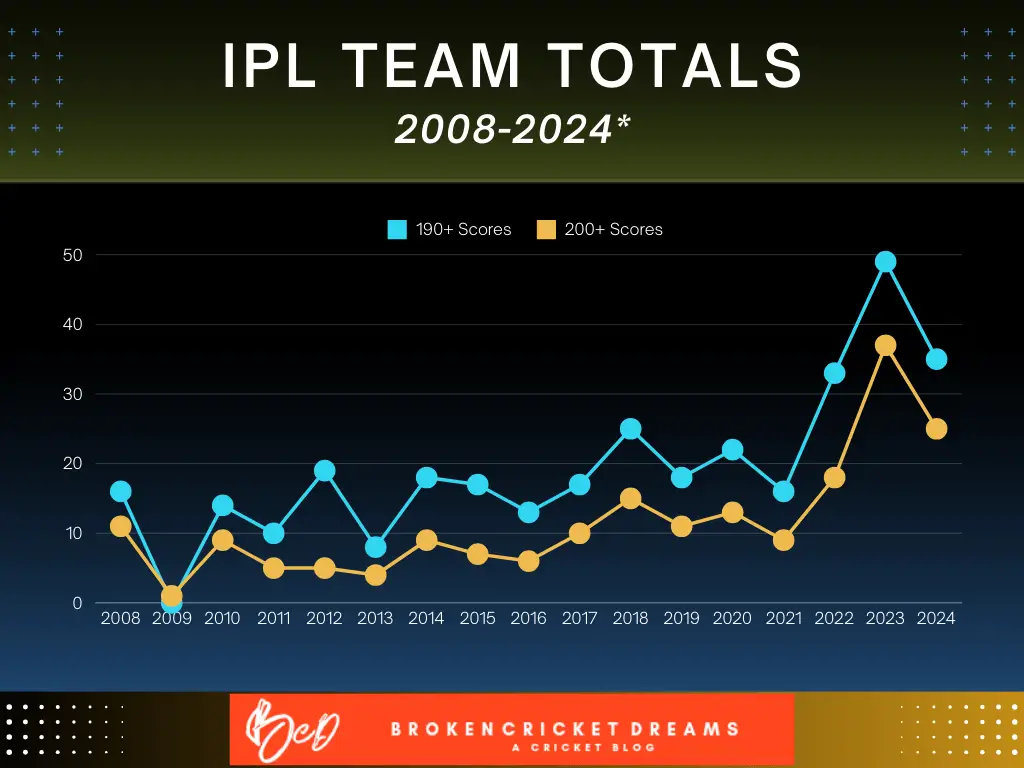
The rise in run rate is alarming. Just look at the graphic below.
In 2009, there was only one solitary 200+ score and zero other 190+ scores.
By the team we got to 2023, there were 49 190+ scores, which included 37 200+ scores. This year, we have already had 35 190+ scores including 25 200+ scores and eight 250+ scores.
12 Rules That Will Help Bring the Balance Back to the Bowlers
But don’t worry.
I got you.
I bring to you 12 rules that will change the game for good and bring the bowlers back to life!
*Note: This is Satire. Take this Seriously at your own risk.
1. For Every No-Ball, We Need a No-Bat
A bowler oversteps by a millimeter, it is called a no-ball. A bowler bowls wide behind the batter or misses the wide line by a fine margin, it is called a wide.
So, we propose the ‘No-Bat.’ If a batter at the non-strikers end leaves their crease by a millimeter, have them run without a bat. It is mandatory to dive for every run. Let them work for it.
AndAlso subtract two runs per violation. Why not?
2. Smaller the Boundary, Wider the Stumps
Boundaries are getting smaller by the day. Let’s do this—The shorter the boundary, the wider the stumps.
At the 90 meter MCG boundaries, we play with the regular three stumps. At the Chinnaswamy, increase the wicket to 6 stumps.
3. Each Bowler will get a customized Ball suited to their Strengths
These days, bats are getting bigger. Batters work with manufacturers to get customized bats.
So why do bowlers play with the same standardized balls?
Each bowler should get to pick their favorite balls and stop the match in the middle to switch balls whenever they feel like it.We want Duke balls, SG, Kookaburra, old balls, new balls, used balls, tape balls, tennis balls, red balls, white balls, pink balls, the complete lot!
4. No Cap on Bowlers Quota
If Jos Buttler can carry the bat and play the 20 overs, let’s give Sunil Narine the opportunity to open the bowling and end with figures of 10-3-42-7.
5. Batters can only play 24 Balls Maximum
On the flip side, if Jasprit Bumrah is limited to 24 balls, KL Rahul should be limited to just 24 balls (Oh wait…that might actually be a good thing for the batting team…You get my point)
6. Batters Can Only Hit 2 Aerial Shots Per Over
There are only 2 bouncers allowed per over for the bowler. There should only be 2 aerial shots attempted per over for the batter.
7. If Batters Can Switch Hit Without Notice, Bowlers should be able to Switch Bowl Without Notice
Kevin Pietersen and David Warner are allowed to switch hit and take advantage of every corner of the ground. No problem with the that, hats off to them.
Allow the great scientist, Ravichandran Ashwin, to start his line up around the wicket, change to over the wicket, dance around the umpire, and change his action from right arm off-leg spinner to left arm wrist spinner.
8. More Sponsorship for the Bowlers
Umm…this is not satire. Bowlers should actually receive more sponsorship.
9. Flatter the Pitch, Lesser the Overs
At the beginning of each innings, a pitch report should be conducted where experts take their magnifying glasses and lay down flush on the pitch to count the number of cracks and blades of grass. That number should be given to the Duckworth-Lewis-Sterns of the current era.
They will come up with a formula to reduce the number of overs from the maximum of 20. Flatter the pitch, more overs are reduced.
10. If Dew is Present, Batters Will Play with Gloves Dipped in Oil
Too easy to chase these days when dew is present.
At the first sign of dew, umpires will give the batters special gloves dipped in oil for the remainder of the match.
11. Let’s add a bowling Powerplay, where all 15 players in the Squad are on the Field
Batters get a Powerplay to encourage strokeplay in the first six.
Bowlers should get a 4-over Bowling Powerplay where the rest of the squad, coaches, team management, and Jonty Rhodes come out to the field and cover every inch of the ground.
17 years since it’s inception, the Indian Premier League has taken world cricket by storm. Today we reflect upon the best IPL players to have ever played in the league.
Over a hundred players were considered in this rankings. Suresh Raina edges MS Dhoni for the top spot with AB de Villiers, Sunil Narine, David Warner, and Virat Kohli following closely.
Top 15 Greatest IPL Cricketers of All-Time: Undisputed Legends of the League
Notable Achievements: First Player to 5000 IPL Runs, 7 consecutive seasons with 400+ runs, has scored the most runs in IPL playoffs
For the first decade of the tournament, Suresh Raina was synonymous with the tournament. Mr. IPL, as he was often called, he took the tournament by force.
If you want to understand the impact Suresh Raina had on the IPL, just watch his 87 (25) against KXIP, which he scored during the Powerplay. ‘Chinna Thala’ to CSK fans, he kept the batting line up together for the Haydens & Husseys up top and the Dhonis & Jadejas to follow.
A handy spinner at the Chepauk and one of the best fielders India ever produced.
Notable Achievements: Most Number of Sixes Between 16-20 Overs, Second Most Wins as IPL Captain
When the IPL began way back in 2008, not many would have anticipated MS Dhoni to be as closely associated as we now know it. The boy from Ranchi is the ‘Thala’ to CSK fans.
MS Dhoni can finish games with his monstrous sixes, transform Shardul Thakur to become the Lord, take a dad’s army and win the IPL, and can win matches by ‘bits and pieces’ players.
He may be one of the best hitters of the IPL, but he is most definitely, the best captain the IPL has ever produced.
Notable Achievements: In IPL 2016, ABD scored 687 runs at 52.84 average and an astonishing SR of 168.79, which included one century and six fifties
AB De Villiers’ assault against Dale Steyn is perhaps the most eye catching batting in the IPL.
Countrymen, both at their peaks, battled against each other in a close game. AB de Villiers was the clear winner, sweeping & reverse swatting Steyn. In that game, de Villiers went from a great batter to a legendary one.
One of the few overseas players loved across all of India.
Notable Achievements: MVP IPL 2018, Best SR in 2018 (189.89), Economy Rate of 6.74, IPL career batting SR of 160.79
The cricket world has not seen as versatile of a player as Sunil Narine.
The first mystery spinner to consistently be a threat across multiple seasons, his economy rate suffocated the opposition.
Second highest wicket taker in IPL 2012 & 2014, Narine was one of the central cogs to KKR’s IPL triumphs.
After being called for illegal action in international cricket, Narine’s effectiveness temporarily decreased. However, he bounced off as a pinch hitter and a decent bowler. The 105-run partner with Chris ‘LynnSanity’ Lynn in the Powerplay is one of the iconic moments in all the IPLs.
Notable Achievements: Orange Cap Winner (2015, 2017, 2019). Boasts an average of 41.51 in IPL cricket
After arriving at Sunrisers Hyderabad, David Warner was a completely different beast.
From 2014 onwards, Warner scored 528, 562, 848, 641, 692, and 548 runs respectively in consecutive season.
Leading Sunrisers Hyderabad to a victory in 2016 having to go through the Eliminator, Qualifier, and the Finals has to be the highlight of his IPL career. He scored 93*(58) in the Qualifier and 69 (58) in the Final.
Unfortunate in the way he was removed from SRH after creating a lasting legacy.
Notable Achievements: Purple Cap (2011). Took 28, 22, and 20 in IPL 2011-13 respectively as well as 24 wickets in 2015.
In a world starting to love the six fest in T20 cricket, Lasith Malinga made pace, yorkers, and dot balls sexy.
One of the moments of the tournament was the IPL 2019 Final. 9 needed in the final over, Malinga kept it tight before delivering a slower yorker to outfox Shardul Thakur and win the tournament for the Mumbai Indians yet again.
Notable Achievements: Leading Run Scorer in all of the IPL, Most Hundreds in the IPL (7), Orange Cap Winner (2016) and scored the most runs in a single IPL season ever (973)
Virat Kohli’s 2016 season is the single greatest individual performance in any cricket league around the world.
With four centuries and 973 runs, Kohli lead RCB to the finals only to come agonizingly short by 8 runs in a high score chase.
A constant fixture for RCB over the years, forming great partnerships with Gayle, de Villiers, Faf du Plessis, and Maxwell, Kohli established himself as the premier Indian batter in the competition.
Notable Achievements: Purple Cap Winner (2013, 2015)
Constantly competing with his friend, Kieron Pollard, for the most T20 franchise wins in history, Bravo developed his skill as a canny medium pacer in the IPL.
He could bowl at the death or the middle overs and was a handful with his batting cameos as well.
One of the few players to win the IPL for both the Mumbai Indians and the Chennai Super Kings.
Notable Achievements: 5-Time IPL Winning Captain, Has a Hat-Trick in the IPL
Emerging Player award winner of IPL 2009 with DC, Rohit Sharma would fulfill his potential as a batter and as a captain.
Changed the trajectory of the MI franchise, created a legacy, and was the ideal opener till 2017.
Although the runs have dried up in the last seven years, he remains as shrewd as ever as a leader in the side. Will be interesting to see how he performs under the captaincy of Hardik Pandya.
Notable Achievements: MVP (2011), Orange Cap (2011, 2012), Most Sixes in a Season (2011, 2012, 2013, 2015), Most IPL Sixes of All-time (357), Highest Individual Score (175*)
An injury substitute changed the history of RCB forever. In 2011, Gayle came as a substitute and became the orange cap holder.
With Virat Kohli & AB de Villiers, RCB formed one of the great IPL top orders.
It is safe to say that Chris Gayle took the IPL to another level.
Notable Achievements: MVP (2015, 2019), Most Sixes in IPL 2019. The best IPL strike rates in all of IPL (175.55). Dre Russ has hit more sixes (200) than fours (153)
Muscular built like a NFL superstar, Andre Russell has changed power-hitting in cricket. Even mistime hits go into the second tier.
Dre Russ is the complete package as a boundary rider and a death bowling specialist. KKR has preserved him (and Narine) even though his knee doesn’t function every now and then.
Teams: Rajasthan Royals, Royal Challengers Bangalore, Chennai Super Kings
Years Played: 2008-2020
IPL Wins: 2008, 2018
Notable Achievements: MVP (2008), Player of the Final (2018)
Shane Watson was one of the first international stars of the IPL. Out of favor from the international side, Watson’s 2008 all-round performance took RR to the inaugural win.
At the end of his career with CSK, his playoff and finals performance in IPL 2018 was one of IPL’s most memorable stories.
Notable Achievements: Part of the most IPL winning campaigns
Ambati Rayudu was the backbone of the middle order (and sometimes as an opener) for both the great IPL franchises, Mumbai Indians & Chennai Super Kings.
MI provided Rayudu the opportunity to bounce back after his ICL ban, while CSK provided the perfect farewell after he was no longer considered in international cricket.
Teams: Royal Challengers Bangalore, Pune Warriors India, Sunrisers Hyderabad
Years Played: 2011-
IPL Wins: 2016
Stats: 162 Matches, 170 Wickets, 32 Catches
Notable Achievements: Purple Cap Winner (2016, 2017)
The only bowler apart from Dwayne Bravo to win two Purple Caps in the IPL.
SRH showed the world that strong bowling wins tournaments, and Bhuvneshwar Kumar lead this effort for them. At the height of his IPL career, Bhuvneshwar spearheaded both the swing department and the death bowling.
Known for his leadership, Gambhir led from the front in 2012 with 590 runs. Along with Robin Uthappa & Manish Pandey, formed a top order to take KKR to great heights.
Back at Delhi after KKR stint, he took the courageous decision to drop himself midway through the IPL after a patch of poor form.
KKR has still not reached the heights that Gambhir took them to all these years later.
Teams: Mumbai Indians, Royal Challengers Bangalore, Pune Warriors India, Rajasthan Royals, Chennai Super Kings
IPL Wins: 2014, 2021
Stats: 205 Matches, 4952 Runs
Notable Achievements: Orange Cap Winner (2014)
If Gambhir scored the bulk of the runs in KKR’s 2012 triumph, it was Robin Uthappa who was a class apart in 2014.
It took Uthappa a while to find his feet in the IPL with different teams, but he had three brilliant phases.
In IPL 2010, he was the finisher of the tournament. Then he scored lots of runs at KKR, and finally ended his career at CSK after playing a couple of eye-catching innings.
One of the most talented batters India has ever produced, KL Rahul is always among the runs. Yet he finds himself under scrutiny from time to time for his strike rate and captaincy.
Expect him to rise in the list and win trophies over the next decade.
Teams: Kings XI Punjab, Kolkata Knight Riders, Chennai Super Kings, Mumbai Indians
Years Played: 2008-
IPL Wins: 2014
Stats: 183 Matches, 181 Wickets
Notable Achievements: 3rd Highest Wicket-Taker in IPL History
For 10 months, you forget that Piyush Chawla is younger than Kohli, Russell, Narine, DK, and whole lots of other players. Enter IPL time, Chawla is on another level, one of the most consistent wicket-taker of the league.
In 2023, he ended up picking 22 wickets, his highest haul in a season.
Notable Achievements: 3rd Highest Wicket-Taker in IPL History
Suryakumar Yadav has made the #4 position his own at the Mumbai Indians.
Started his career with quick cameos at KKR but has produced 300+ seasons every year since 2018. In 2023, he scored 605 runs at 43.21 average and an astonishing 181.14 SR.
Probably one of India’s greatest T20 finisher, Dinesh Karthik had to redevelop his game over the years.
His first success was with the MI, batting at #3. Later, he developed as a dependable #5 batter-captain-keeper at KKR before becoming a full-time finisher (and commentator) during his time at RCB.
Notable Achievements: Three 500+ run seasons (2019, 2020, 2022)
Honorable Mentions:
Those Who May Make This List in the Future: Shubman Gill, Shreyas Iyer, Rinku Singh, Tilak Verma, Ruturaj Gaikwad, Ishan Kishan, Yashasvi Jaiswal, Nicholas Pooran, Axar Patel, Venkatesh Iyer, Varun Chakravarthy, Shivam Dube, Prithvi Shaw, Heinrich Klaasen, Aiden Markram, Anrich Nortje, Shimron Hetmyer
Unluckly to Miss Out: Kane Williamson, Saurabh Tiwary, Rahul Tripathi, Trent Boult, RP Singh, Pragyan Ojha, Glenn Maxwell, Brendon McCullum, Krunal Pandya, Manish Pandey, Harshal Patel, Sandeep Sharma, Mohit Sharma, Mayank Agarwal, Wriddhiman Saha, Parthiv Patel, Nitish Rana, Hashim Amla, Siddharth Kaul, R Vinay Kumar, Zaheer Khan, Kuldeep Yadav, Siddharth Trivedi, Rahul Dravid, Chris Morris, Sachin Tendulkar, Sanath Jayasuriya, Virender Sehwag, Ben Stokes, Andrew Symonds, James Faulkner, Mitchell Johnson, Mike Hussey, Matthew Hayden, Murali Vijay, Andrew Tye, Rahul Tewatia, Jonny Bairstow, Morne Morkel, Albie Morkel, Nitish Rana, Subramanian Badrinath, Rajat Bhatia, Dale Steyn, Manvinder Bisla, Yuvraj Singh, Sohail Tanvir, Laxmipathy Balaji, Kumar Sangakkara
Let’s discuss the most valuable IPL cricketers—with a twist.
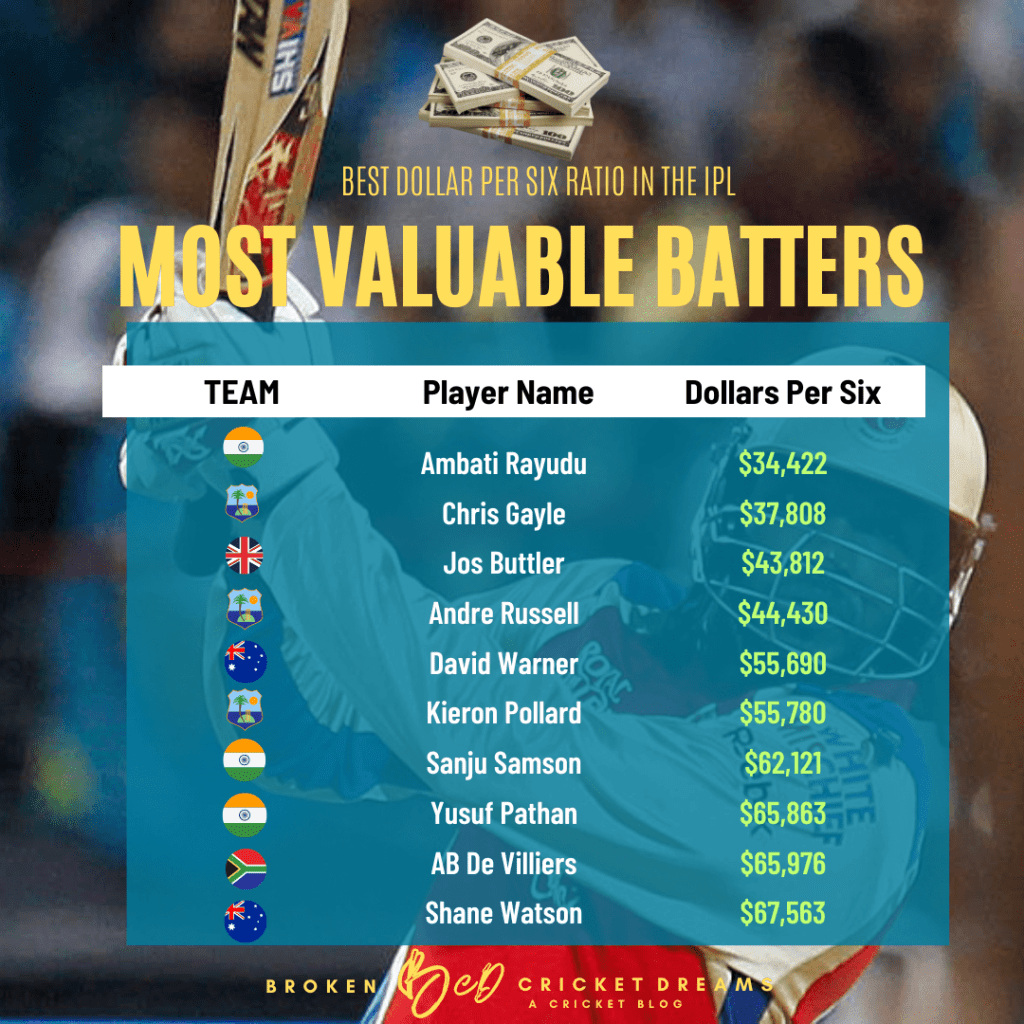
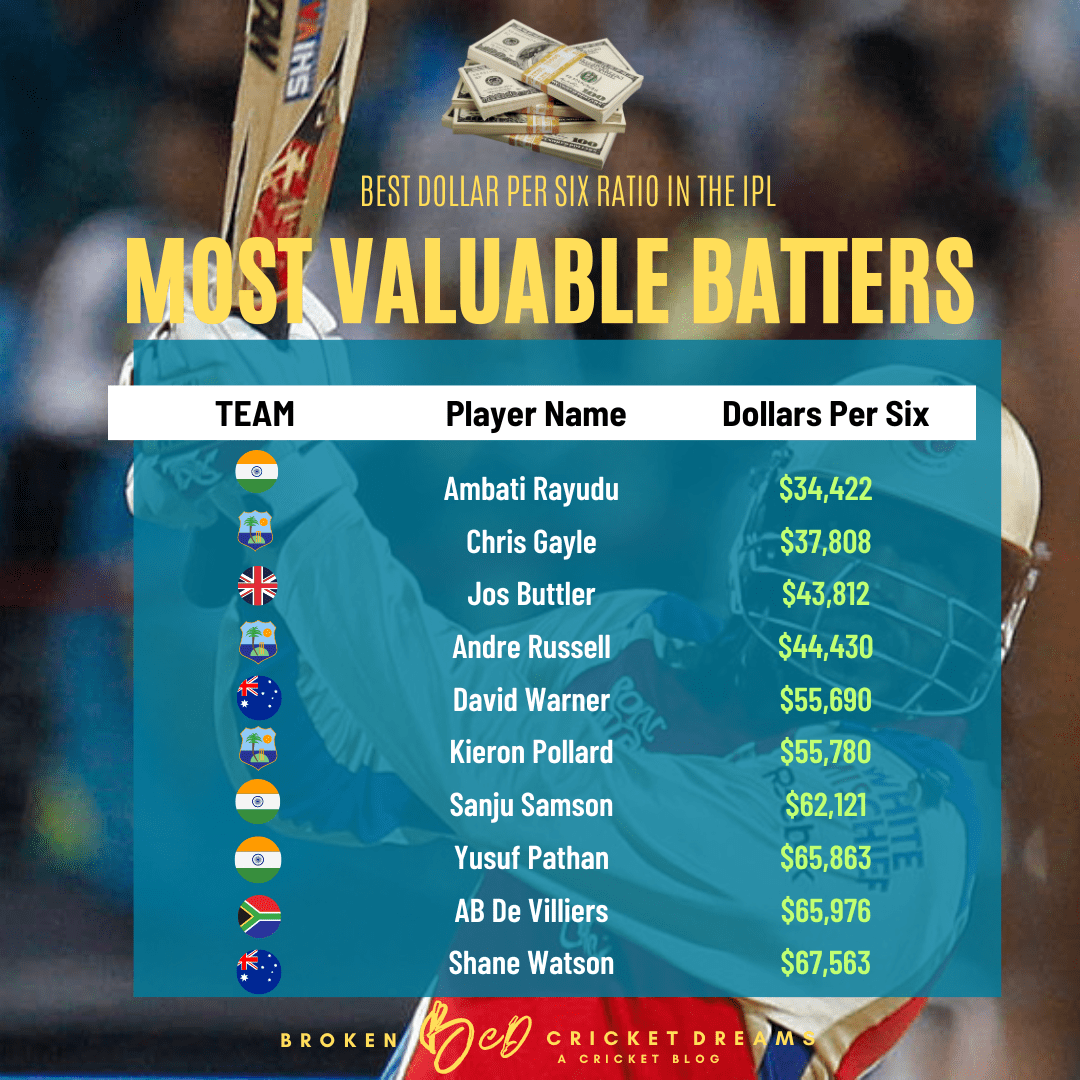
In the 17 years of the Indian Premier League (IPL), which batter has provided the best return on investment in terms of hitting sixes? The #1 batter on this list may surprise you!
Let’s find out.
Key Takeaways
Chris Gayle (357), Rohit Sharma (257), AB De Villiers (251), MS Dhoni (239), and Virat Kohli (234) have hit the most sixes in the IPL.
Ambati Rayudu ($34,442), Chris Gayle ($37,808), Jos Buttler ($43,812), and Andre Russell ($45,430) have the best ratios of dollar per six in IPL history, while Rohit Sharma ($116,381), MS Dhoni ($119,280), and Virat Kohli ($120,470) have been the most expensive buys per six in this list.
Andre Russell is just a beast in the frequency of sixes he hits. He takes approximately 6.74 balls per six, that is almost one per over! Russell is comfortably ahead of the other two West Indians on this list—Chris Gayle (9.34), Kieron Pollard (10.39) who are then followed by AB de Villiers (13.56), Yusuf Pathan (14.18), Jos Buttler (14.58), and Shane Watson (14.78).
Chris Gayle (2.53), KL Rahul (1.54), and AB De Villiers (1.48) have the best ratio for the most sixes per innings.
Most Sixes in IPL Career
To begin our analysis, here is the list of players with the most number of sixes hit in the IPL.
Player
Innings
Sixes
Chris Gayle
142
357
Rohit Sharma
143
257
AB de Villiers
170
251
MS Dhoni
218
239
Virat Kohli
229
234
David Warner
176
226
Kieron Pollard
171
223
Suresh Raina
200
203
Andre Russell
96
193
Shane Watson
141
190
Sanju Samson
148
182
Robin Uthappa
197
182
Ambati Rayudu
187
173
KL Rahul
109
168
Glenn Maxwell
120
158
Yusuf Pathan
154
158
Jos Buttler
95
149
Yuvraj Singh
126
149
Shikhar Dhawan
218
148
Honorable Mentions: Faf du Plessis – 145, Dinesh Karthik – 139, Nitish Rana – 131, and Brendon McCullum – 130 miss out).
Top 19 Most Valuable Six Hitters in the Indian Premier League (IPL)
*Note: We have limited our analysis to the top 19 six hitters in the IPL (cutoff of 148 sixes).
Ambati Rayudu may probably be one of the steals of the IPL auctions!
Because Rayudu was an uncapped player for early part of his IPL career, his IPL salary was comparatively low to his contemporaries. He was a clutch player for both MI & CSK over the years and was worth every penny.
However, take this list with a grain of salt. The fact that Rohit Sharma, MS Dhoni, and Virat Kohli end at the bottom of the list is due to the fact that they were retained almost every time. We are only comparing dollars per six here, but these three provided their IPL franchises a lot more value—Leadership, Fours, Runs, Orange Caps, IPL Titles, brand value, fan loyalty, match winning performances, and much more.
Thanks for reading, until next time.
Please do share ahead with your cricket loving friends!
After all, he was fifteen days away from his 38th birthday. How long could he possibly bowl his bloody bouncers on flat pitches through the dead heat in the middle of Day 3?
Well probably till he was 82 or somethin’. Wagner could likely continue to bowl his heart out if his team needed him to till the very day he died.
Because that is what Wagner did.
What Made Wagner Special?
Did Wagner swing it like Southee? No.
Did he bend it like Boult? Nope.
Was he as fast as Shoaib? As scary as Murali? As consistent as McGrath?
No, No, and No.
So what made Wagner special? One word—Grit. Author Travis Bradberry’s quote can be applied to perfectly sum up Wagner’s character:
“Grit is that ‘extra something’ that separates the most successful people from the rest. It’s the passion, perseverance, and stamina that we must channel in order to stick with our dreams until they become reality.”
Surely he has grit. After all, he famously said, “Unless they carry me off a stretcher, I am going to try and do everything I can.”
You can’t help but love Neil Wagner. He is a fighter. He is a warrior.
Wagner could swing it just enough. He was ultra scary for short periods of time. He could crank up his speeds for a few spells in a Test. And boy, was he consistent with those short ball spells used to trap set batters.
The fact that he could combine these multiple skill sets together over long periods of time is what set him apart.
The Journey of a Thousand Miles
Although Wagner in his own words did not think of himself as the “most talent or most gifted bloke,” he was exactly the type of character that the team needed. One that would give it his all regardless of the conditions or the circumstances of the match.
Partially due to the quota system, Wagner never got his big break in South African cricket. So he decided to leave his home nation to find a better opportunity in England. Although he had a couple of decent seasons in the County circuit, this did not work out either. It was coach Mike Hesson who sought Wagner’s services in New Zealand.
It featured perhaps New Zealand’s best fast bowling unit—Tim Southee, Trent Boult, Neil Wagner, and Kyle Jamieson.
Four versatile bowlers that played their own roles beautifully. Statistically speaking, Southee, Boult, and Wagner are definitely in the Top 5 of New Zealand’s all time bowling list (If you take Vettori out of the list, Hadlee-Southee-Boult-Wagner are clearly NZ’s Top 4 fast bowlers).
In Test cricket, Wagner is New Zealand’s
5th Highest Wicket-Taker (260)
5th Best Figures in an Innings (7/39 vs West Indies)
In an era of T20 dominance, Wagner ended up playing 205 first class matches, including 64 Tests. Although he played 116 List A matches and 86 domestic T20s, he never played a single limited over international.
Neil Wagner’s Greatest Moments
As a fast bowler, Neil Wagner was involved in multiple great battles.
Two characters that just never back down. Wagner kept bowling bouncers, Wade kept taking the blows and later pulled and hooked Wagner. And the leg slip setup to Steve Smith in that series was just wonderful to watch. A great diving caught and bowled later in the series as well.
Another memorable moment was the 1-run win against England in 2023. What an ending.
What Will I remember the Most?
The roar of a tiger. The expressions. The perfect team man.
His energy and the whole vibe. It felt like he simultaneously played for the fun of the game like like an innocent child but also played with the seriousness as if his life depended on it.
What did Neil Wagner teach me?
Wagner taught me to never back down in the face of adversity. Win or lose, but give it every ounce of energy you got. He taught me to tackle problems from different perspectives and keep innovating. He taught me to encourage others while learning from them at the same time.
And most importantly, he taught me to stay true to who you are.
Humility, character, determination. That’s what Neil Wagner was all about.
I will leave you with another quote, this time from the legendary basketball player, Larry Bird.
“I’ve got a theory that if you give 100% all of the time, somehow things will work out in the end.”
Larry Bird
Neil Wagner gave his 100% all the time, both on and off the field.
And at the end of the day, things did work out for him in the end.
Neil Wagner, Legend.
Neil Wagner Retirement Video
Do watch Neil Wagner’s emotional retirement press conference.
Ross Taylor, BJ Watling, and Neil Wagner, three of the stalwarts of NZ’s WTC Final victory have stepped off the international scene. The transition period is real. Only Southee, Boult, and Williamson left now. Let’s appreciate them while we can.
It’s 3 o’clock. Just 15 minutes to go. School is about to end. Yet another day in the third grade comes to a close.
The bell rings.
Jimmy and his friends scream from the bottom of their lungs. The sprint out the door. They catch the bus and go home.
Jimmy does his homework, completes his chores, watches cartoons, and goes to sleep.
One day goes by. Then another. And another.
The same cycle repeats.
20 years later, Jimmy becomes a successful banker.
Jimmy Anderson, Financial Analyst
****
Michael is one of the most popular students at his university.
He has an INSANE daily schedule.
He wakes up at 4 AM, studies for his midterms, eats breakfast, and goes to marching band practice swiftly at 6:30.
It’s 9 AM now, which means it is lecture time.
He focuses on his classes, finishes his homework during lunch, peruses world history brooks at the library, and takes a short break for some delightful coffee.
At 3 PM, he goes to his entrepreneurship club. To finish off his day, he decides to volunteer at the Food Bank.
He later catches the 9 PM train while he studies some more before he reaches home and crashes on his couch at 10:30 PM.
10 years later, Michael gets a coveted job at the United Nations headquarters.
Michael Jordan, US Policy Analyst, Diplomat in Training.
****
Roger is a doctor.
Serena is an engineer.
Rafael is a lawyer.
Novak is a successful businessman.
Roger spends his entire life in Switzerland. Serena spends her entire life in the United States.
Rafael spends his entire life in Spain, and you guessed it—Novak spends his entire life in Serbia.
Roger Federer, Serena Williams, Novak Djokovic, and Rafael Nadal never cross paths in their entire lives.
****
We can have our endless debates—Who was the greatest of all-time? Michael Jordan? LeBron James? Or was it Kobe Bryant?
We can have our mindless fan wars. Kohli vs Rohit vs Dhoni.
We can have our arguing, fighting, and grappling. We can have our podcasts, pre-match analysis, post-match analysis, stories & tributes, the numbers game, and the statistical predictions.
But for once, just once, imagine if this all went away on a whim.
Imagine a world without sports.
Just imagine and think—can be just take a step back for once, reflect, and be grateful for what we do have?
What does sports means to you? How would life have been different without it? Comment Below.
If you like these types of articles, you may like:
Who are the greatest South African cricketers of all-time?
With the passing of Mike Procter, the Proteas family lost another legend. Today we explore the list of greatest cricketers this African nation has produced.
Let’s dive right in.
Key Takeaways
Jacques Kallis, Dale Steyn, AB De Villiers, Graeme Pollock, Barry Richards, Graeme Smith, Hashim Amla, Mike Procter, and Allan Donald have been judged as the Top 10 South African Cricketers of All-Time.
We included several players whose careers coincided with South African’s international isolation due to apartheid (1970-1990), namely Graeme Pollock, Barry Richards, Mike Procter, Clive Rice, Eddie Barlow, Jimmy Cook, Kepler Wessels, Peter Kirsten, David Richardson, Garth le Roux, Ken McEwan and Vintcent van der Bijl.
By the Numbers: The Most Prolific South African Cricketers
Some of the criteria we used to compile this list includes: Most Wickets/Runs in International Cricket*, international caps, ICC Hall of Fame status, World Cup performances, captaincy record, fielding & keeping record, anecdotes (especially for players in the early twentieth century), and match winning performances.
*We considered also considered first class stats for the pre-1990s eras.
Top 10 Most Wickets by South African Bowlers Across Formats: Which South African Cricketer Has taken the Most Wickets?
We first look at the top 10 wicket-takers across formats. Also listed below are the top few wicket-takers in each format for South Africa.
Test: Dale Steyn (439), Shaun Pollock (421), Makhaya Ntini (390), Allan Donald (330), Morne Morkel (309)
ODI: Shaun Pollock (387), Alland Donald (272), Jacques Kallis (269), Makhaya Ntini (265), Dale Steyn (194)
*Does not include wickets taken for World XI teams
Top 10 Most Runs by South African Batters Across Formats: Which South African Cricketer Has Scored the Most Runs?
We now move on to the batting side of things.
Test: Jacques Kallis (13206), Hashim Amla (9282), Graeme Smith (9253), AB de Villiers (8765), Gary Kirsten (7289)
ODI: Jacques Kallis (11550), AB de Villiers (9427), Hashim Amla (8113), Herschelle Gibbs (8094), Graeme Smith (6989)
T20I: Quinton de Kock (2277), David Miller (2227), JP Duminy (1934)
Player
Runs
Centuries
Jacques Kallis
25422
62
AB de Villiers
19864
47
Hashim Amla
18553
55
Graeme Smith
17224
37
Herschelle Gibbs
14661
35
Gary Kirsten
14087
34
Quinton de Kock
12347
28
Faf du Plessis
11136
23
Mark Boucher
10289
6
Hansie Cronje
9279
8
Other South African Records
Here are some other stats that will help us give us a complete picture.
Most Dismissals/Catches Combined: Mark Boucher (988), Quinton de Kock (550), AB de Villiers (475), Jacques Kallis (334), David Richardson (317)
The 100-Test Club: Jacques Kallis (165), Mark Boucher (146), Hashim Amla (124), Graeme Smith (116), AB de Villiers (114), Shaun Pollock (108), Gary Kirsten (101), Makhaya Ntini (101)
Most Matches as Test Captain: Graeme Smith (108), Hansie Cronje (53), Faf du Plessis (36), Shaun Pollock (26), Dean Elgar (18)
Most Matches as ODI Captain: Graeme Smith (149), Hansie Cronje (138), AB de Villiers (103), Shaun Pollock (92), Kepler Wessels (52)
List of South African Players in the ICC Hall of Fame: Allan Donald, Aubrey Faulkner, Jacques Kallis, Graeme Pollock, Shaun Pollock, Barry Richards
Top 51 Greatest South African Cricketers of All-Time (Ranked)
Without further ado, here is the complete list of the 50 greatest South African cricketers of all-time. Enjoy!
Note: Basil D’Oliveira is not considered since he played international cricket for England. He was born in South Africa and moved to England in 1966.
51. Colin Bland (1961-1966)
Role: Batter
Matches: 21 (Test), 131 (FC)
Runs: 1669 (Test), 7249 (FC)
Hundreds: 3 (Test), 13 (FC)
Catches: 10 (Test), 51 (FC)
Colin Bland revolutionized fielding with unmatched athleticism and set an example for future Protea teams.According to ESPNCricinfo, “Colin Bland will go down in cricket history as one of the greatest cover fielders.” With such greatness, I had to put him in this list.
Role: All-Rounder (Left Handed Batter, Right Arm Off Spinner)
Matches: 46 (Test), 199 (ODI), 81 (T20I)
Runs: 2103 (Test), 5117 (ODI), 1934 (T20I)
Hundreds: 6 (Test), 4 (ODI)
Wickets: 42 (Test), 69 (ODI)
JP Duminy specialized in playing cameos in pressure situations down the order. Played a key part in the monumental 414 chase against Australia at Perth in the 4th innings, stitching a 111-run partnership with AB de Villiers.kepp
Fanie de Villiers, a force to be reckoned with in South African cricket during the 1990s, claimed 85 Test scalps and 121 ODI dismissals with his precise bowling
Jock Cameron, a cricketing stalwart of the early 20th century, distinguished himself with his masterful wicketkeeping skills and gritty batting. Once in a 1929 County cricket match, he took six catches and also had one stumping.
Kepler Wessels, a true pioneer in South African cricket, won hearts with his gutsy batting, shrewd leadership, and the sheer joy he brought to the game, playing a key part in the nation’s cricketing resurgence while charming fans with his infectious spirit and love for the sport. Played for both Australia and South Africa.
*Only South African statistics shown. Overall, he played 40 Tests & 109 ODIs.
First South African to play 50 Tests. A constant force behind the stumps much like Boucher in the 2000s. Holds the South African record for joint most dismissals (26) in a 5-Test series.
One of the most classical batters in South African history, producing some of the slowest innings of all-time. Noted for carrying the bat and batting for nine hours for a 105 against Australia.
A specialist limited over batter, Miller will go down as perhaps the greatest #6 ODI batter of all-time along with Michael Bevan, Jos Buttler, and MS Dhoni.
At #6, Miller scored 2718 runs, 3 centuries, and twenty 50+ scores at an average of 40.56 & 104.78 SR. When in form, Killer Miller is just a sight to watch.
*He might rise up the list by the end of his career.
Not many people can boast that they changed their field of expertise. Jonty Rhodes definitely did. With his iconic diving catches and flying run outs, he captured audiences worldwide.
Daryll Cullinan, renowned for his elegant batting, showcased his prowess in memorable matches like his 275 against New Zealand in 1999, and his crucial knocks against Sri Lanka and England, solidifying his reputation as a key figure in South African cricket during the 90s.
Brian McMillan, a key figure in South African cricket during the 1990s, played pivotal roles in memorable matches such as the 1992 World Cup and the historic readmission series, showcasing his all-round skills with both bat and ball
Garth le Roux, a fearsome fast bowler, struck fear into batsmen with his raw pace and hostile deliveries, making him a formidable force in South African cricket during the 1980s, and leaving a lasting impact with his aggressive bowling style and crucial wicket-taking ability.
*His entire career was during South Africa’s isolation
Herbie Taylor, a cricketing legend of the early 20th century, was celebrated for his elegant batting style and astute captaincy, leading South Africa with distinction and leaving an enduring legacy as one of the country’s finest batsmen and leaders on the cricket field.
Jimmy Sinclair, a cricketing pioneer of the late 19th and early 20th centuries, captivated audiences with his exceptional batting and laid the foundation for South African cricket’s rich heritage.
Oneof the premier left handed batters of the 2010s, Elgar’s leadership ensured that South Africa had one world class senior batter during their transition period. One word comes to mind when watching Elgar bat, tenacity. Ready to take body blows and challenge the world.
Vernon Philander gave the South African bowling an edge like never before. They have always had pace, seam, and bounce. Philander’s ability to swing it both wayswas exactly what the Proteas needed to complement Steyn & Morkel.
Role: All-Rounder (Left Handed Batter, Left Arm Medium Pacer)
Matches: 41 (Test), 179 (FC)
Runs: 2516 (Test), 11289 (FC)
Hundreds: 1 (Test), 26 (FC)
Wickets: 123 (Test), 534 (FC)
5-fers: 5 (Test), 24 (FC)
Trevor Goddard, a cricketing stalwart of the 1950s and 1960s, was a formidable all-rounder celebrated for his left-arm spin bowling and solid batting, playing a pivotal role in South African cricket history with his match-winning contributions and leadership on the field, earning him a revered status among fans and peers alike.
A late entrant on the international stage, he grabbed his opportunity with both hands. His epic at Adelaide, blockathon at Delhi, and captaincy towards the end of his career, was the highlight of his career. Still plies his trade around the world after re-inventing himself as a swashbuckling T20 opener.
Bruce Mitchell, a luminary of South African cricket during the 1930s and 1940s, captivated audiences with his elegant stroke play and strategic brilliance, amassing over 3,000 Test runs at an impressive average of 48.88.
If you search hard enough, Imran Tahir is probably still playing somewhere around the world and running around the ground with his infectious celebration. Completed South Africa’s bowling attack in the 2010s. One of the greatest spinners to play for South Africa and definitely the greatest leg spinner.
Matches: 3 (Test), 4 (ODI), 270 (FC), 286 (List A)
Runs: 107 (Test), 67 (ODI), 21143 (FC), 10639 (List A)
Hundreds: 64 (FC), 24 (ODI)
Jimmy Cook, a stalwart of South African cricket during the apartheid era, demonstrated exceptional resilience and skill, dominating domestic cricket with his prolific run-scoring and earning widespread admiration despite being denied international opportunities due to the country’s sporting isolation.
Top 25 Greatest South African Cricketers of All-Time: Absolute Greats
We are halfway there…
25. Quinton de Kock (2012-)
Role: Wicketkeeper Batter
Matches: 54 (Test), 155 (ODI), 80 (T20I)
Runs: 3300 (Test), 6770 (ODI), 2277 (T20I)
Hundreds: 6 (Test), 21 (ODI), 1 (T20I)
Dismissals: 232 (Test), 226 (ODI), 92 (T20I)
A child prodigy that fulfilled his potential. After Graeme Smith retired, Quinton de Kock fit straight through. Even though his Test and ODI careers did not last as long as people would have wanted, he provided plenty of memories. He always got his best out against India and his swivel sixes is still one of the sweetestshots in cricket.
One ofthe top bowlers of the current era. Alongside Jasprit Bumrah, Rabada is a complete bowler across formats. If he stays fit, he has the potential to break Steyn’s record of 439 Test wickets.
Dudley Nourse, a cricketing legend of the mid-20th century, captivated audiences with his elegant batting style and remarkable consistency, leaving an enduring legacy as one of South Africa’s finest batsmen, whose contributions during the pre- and post-war era remain etched in cricketing folklore.
He served in the Middle East during the World War.
Peter Pollock, a pace bowling sensation of the 1960s and 1970s, showcased his fiery pace and lethal accuracy, leaving a lasting impact on South African cricket with his ability to dismantle batting lineups, epitomizing the spirit of aggression and skill on the field.
For every Michael Jordan, there is a Scottie Pippen. The height and constant line and lengthmade him a threatening bowler. Combined with Steyn, the duo destroyed plenty of batting line ups around the world.
Eddie Barlow, the dynamic all-rounder of South Africa in the 1960s and 1970s, left an indelible mark with memorable performances like his 114 against Australia in 1966 and his vital contributions in the series against England in 1965
Gary Kirsten, a prolific batsman of the modern era, distinguished himself with his exceptional technique and unyielding determination, playing a pivotal role in South African cricket’s resurgence in the 1990s and early 2000s. He produced memorable performances such as his monumental 275 against England in 1999 and 188* in an ODI, solidifying his status as one of the nation’s cricketing icons.
Coached India to 2011 World Cup victory to furthercement his name in history.
Makhaya Ntini, a relentless fast bowler, broke barriers as the first black African cricketer to play for South Africa, leaving an indelible mark with his raw pace, fierce competitiveness, and memorable performances, inspiring a generation of young cricketers and symbolizing the transformation of South African cricket.
Aubrey Faulkner, a cricketing pioneer of the early 20th century, mesmerized audiences with his remarkable all-round abilities, excelling as a stylish batsman and a cunning spin bowler, leaving an enduring legacy as one of South Africa’s greatest cricketers and a trailblazer for generations to come.
Hugh Tayfield, a spin bowling maestro of the 1950s, spun his way into cricketing history with his impeccable accuracy and cunning variations, amassing a record-breaking tally of wickets for South Africa and etching his name among the pantheon of cricketing legends.
Mark Boucher is perhaps the most prominent figure behind the stumps in modern cricket. For 15 years, he almost played every match for the Proteas and was a constant force. He had moments with the bat as well such as sealing the 434 chase against Australia in 2006.
Role: All-Rounder (Left Handed Batter/Right Handed Medium Pacer)
Matches: 49 (Test), 171 (ODI)
Runs: 1906 (Test), 3576 (ODI)
Hundreds: 4 (Test), 2 (ODI)
Wickets: 80 (Test), 192 (ODI)
5-fers: 1 (Test), 6 (ODI)
If you look purely from career stats, Klusener might not be able to compete with the rest of South Africa’s great all-rounders. However, his 1999 World Cup heroics pushes him up. This was the closest South Africa were to a World Cup win.
281 runs at 140.5 average and 122.17 SR to go along with his 17 wickets and 4 player of the match performances. Pioneered the finisher and power hitting role in ODI cricket.
Herschelle Gibbs was quite the character. The dynamic between the strokemaker Gibbs & gritty Smith helped them become a strong partnership over the years. Gibbs had several moments of his own- The Six Sixes in the 2007 ODI World Cup, 175 in that iconic 434 chase, (oh yeah, and dropping Steve Waugh in the 1999 World Cup).
Clive Rice, a dominant force in South African cricket during the apartheid era, showcased exceptional leadership and all-round skills, symbolizing resilience and determination, and leaving a lasting legacy as a true cricketing icon.
Top 10 Greatest South African Cricketers of All-Time: Undisputed Legends
Time for the Final 10!
10. Allan Donald (1991-2003)
Role: Fast Bowler
Matches: 72 (Test), 164 (ODI), 316 (FC)
Wickets: 330 (Test), 272 (ODI), 1216 (FC)
5-fers: 20 (Test), 2 (ODI), 68 (FC)
Allan Donald took South African fast bowling to new heights. Handed off the baton to the likes of Shaun Pollock, Ntini, and provided a template for Steyn to follow. Action, pace, celebration, Donald had it all.
According to ESPNCricinfo, Mike Procter was “probably one of the most natural talents the game has ever seen.” Set the tone for great right handed fast bowling all-rounders to come from this region of the world.
One of the most elegant opening batters of all-time. He had all the ingredients—Time, Placement, Finesse. Fastest to 3000, 4000, 6000, and 7000 ODI runs.
One of the greatest left-handed openers of all-time, certainly in the Top 3 of the 21st century. Not theprettiest stroke player, it was his grit, courage, and leadership that differentiated Smith from the rest. Playing with a broken hand, Smith earned the respect of themighty Australians and the rest of the cricketing fraternity.His captaincy led South Africa to a new era after the match fixing crisis.
A cricketing genius known for his sublime batting, international cricket missed out on one of the great talents. Played only 4 Tests but showed what he could do with 2 hundred, 2 fifties, and average of 72.57. Otherwise racked up 28358 runs with the best score of 356.
One of the most elegant left handers of his time, Graeme Pollock played the last of his 23 Tests at the age of 26. Scored a magnificent 274 in the same test as Richards’ 140. South Africa declared for 622/8 and won by an innings and 129 at Durban against Australia. Little did they know that this was their last international series.
Opened the bowling for over a decade and built partnerships with Donald, Ntini, and later Steyn. Solid batter down the order as well and captained South Africa to the 1998 Commonwealth Gold, still one of the only victories to their name.
The most versatile batter of the modern age. He had the technical abilities to score 33 (220) and 43 (297) and the destructiveness to score the fastest hundred.One of the original stars of the IPL. Unfortunate to not lift a World Cup and retired from international cricket during his prime.
The most prolific South African Test fast bowler and arguably the best fast bowler of all-time. He had the perfect action, the rhythm, the speed, and that iconic celebration. The heart of the South African Test team that won around the world between 2008-2015. Freak injuries curtailed his career but his passion came through with multiple comeback attempts.
Simply the Greatest. Jacques Kallis is a name synonymous with consistency, hardwork, and discipline. His batting numbers themselves push him into legendary status but it was his fast bowling that provided South Africa the balance they needed.
Honorable Mentions: List of Players that were considered
Honorable Mentions: Ken McEwan, Albie Morkel, Paul Adams, Cyril Vincent, Anrich Nortje, Vincent van der Bilj, Herbert Taylor, Alan Courie, Basil D’Oliviera, Frank Roro, Eric Petersen, Hylton Ackerman Sr, Henry Fotheringham, Ken McEwan, Stephen Jefferies, Denys Hobson, Ray Jennings, Jock Cameron, Denis Lindsay, Dave Richardson, Jimmy Sinclair, Herbie Taylor, Jackie McGlew, Temba Bavuma, Neil McKenzie, Ashwell Prince, Chris Morris, Wayne Parnell, Charl Langeveldt, Keshav Maharaj, Andre Nel, David Richardson, Nicky Boje
Note: “Frank Roro is widely considered the first great black African cricketer” according to ESPNCricinfo although he did not play international cricket.
List of South African Players in World Cup Squads
One key aspect of picking South Africa’s greats was looking at their tournament history and squads.
South Africa won the 1998 Commonwealth Games, 1998 Champions Trophy, and the ICC Test Mace (2013-2015). They were also semi-finalists in the 1992, 1999, 2007, 2015, and 2023 ODI World Cups along with the 2009 & 2014 T20 World Cups.
Here are the complete squads of those tournaments (except for the Test mace).
1998 Champion Squads
1998 Champions Trophy: Hansie Cronje (C), Mark Boucher (WK), Dale Benkenstein, Nicky Boje, Derek Crookes, Daryll Cullinan, Alan Dawson, Steve Elworthy, Jacques Kallis, Gary Kirsten, Makhaya Ntini, Shaun Pollock, Jonty Rhodes, Pat Symcox
1998 Commonwealth Games: Shaun Pollock (C), Mark Boucher (WK), Alan Dawson, Andrew Hudson, Dale Benkenstein, Derek Crookes, Henry Williams, Herschelle Gibbs, Jacques Kallis, Makhaya Ntini, Michael Rindel, Nicky Boje, Paul Adams, Steve Elworthy
ODI World Cups
1992 ODI CWC: Kepler Wessels (C), David Richardson (WK), Tertius Bosch, Hansie Cronje, Allan Donald, Omar Henry, Andrew Hudson, Peter Kirsten, Adrian Kuiper, Brian McMillan, Meyrick Pringle, Jonny Rhodes, Mark Rushmere, Richard Snell
1999 ODI CWC: Hansie Cronje (C), Mark Boucher (WK), Gary Kirsten, Herschelle Gibbs, Jacques Kallis, Daryll Cullinan, Dale Benkenstein, Shaun Pollock, Jonty Rhodes, Allan Donald, Derek Crookes, Alan Dawson, Lance Klusser, Steve Elworthy, Nicky Boje
2007 ODI CWC: Graeme Smith (C), Mark Boucher (WK), AB de Villiers (WK), Loots Bosman, Herschelle Gibbs, Andrew Hall, Jacques Kallis, Justin Kemp, Charl Langeveldt, Andre Nel, Makhaya Ntini, Robin Peterson, Shaun Pollock, Ashwell Prince, Roger Telemachus
2015 ODI CWC: AB de Villiers (C), Quinton de Kock (WK), Hashim Amla, Kyle Abbott, Farhaan Behardien, Faf du Plessis, JP Duminy, David Miller, Morne Morkel, Wayne Parnell, Aaron Phangiso, Vernon Philander, Rilee Rossouw, Dale Steyn, Imran Tahir
2023 ODI CWC: Temba Bavuma (C), Quinton de Kock (WK), Heinrich Klaasen (WK), Keshav Maharaj, Gerald Coetzee, Reeza Hendricks, Marco Jansen, Aiden Markram, David Miller, Andel Phehlukwayo, Kagiso Rabada, Tabraiz Shamsi, Lizaad Williams, Rassie van der Dussen, Sisanda Magala*, Anrich Nortje*
*replaced due to injury
T20 World Cups
2009 T20 WC: Graeme Smith (C), Mark Boucher (WK), Yusuf Abdulla, Johan Botha, AB de Villiers, JP Duminy, Herschelle Gibbs, Jacques Kallis, Albie Morkel, Morne Morkel, Justin Ontong, Wayne Parnell, Robin Peterson, Dale Steyn, Roelof van der Merwe
2014 T20 WC: Faf du Plessis (C), Quinton de Kock (WK), Hashim Amla, Farhaan Behardien, AB de Villiers, JP Duminy, Beuran Hendricks, Imran Tahir, David Miller, Albie Morkel, Morne Morkel, Wayne Parnell, Aaron Phangiso, Dale Steyn, Lonwabo Tsotsobe
Final Thoughts
The rich tapestry of South African cricket is woven with the extraordinary contributions of countless remarkable players spanning different eras.
From the pioneering feats of Jimmy Sinclair and Herbie Taylor to the modern-day brilliance of stars like AB De Villiers and Dale Steyn, each player has left an indelible mark on the sport, shaping its history and inspiring generations.
Through their skill, resilience, and unwavering passion, these cricketing icons have not only entertained fans but also united a nation, showcasing the transformative power of sport in South Africa and beyond.
Frequently Asked Questions (FAQ) – Greatest South African Cricketers of All-Time
Who are the greatest South African cricketers of All-Time?
Jacques Kallis, Dale Steyn, AB De Villiers, Greame Pollock, Barry Richards, Graeme Smith, Hashim Amla, Mike Procter, and Allan Donald were judged as the Top 10 Greatest South African Cricketers of All-Time.
Which cricket talent did South Africa lose out during their international cricket isolation due to apartheid?
Some great players like Graeme Pollock, Barry Richards, Mike Procter, Clive Rice, Eddie Barlow, Jimmy Cook, Kepler Wessels, Peter Kirsten, David Richardson, Garth le Roux, Vincent van der Bijl, and Ken McEwan lost out on some or all of their careers in the isolation era.
In 1918, US President Woodrow Wilson gave a speech in the US Congress that would be regarded as the “Fourteen Points.” It proposed potential resolutions to end the ‘Great War’ (World War I), outlined how the world could move towards peace and prevent future wars, and was a key factor during the Treaty of Versailles.
Now I know what you may be thinking. What kind of comparison is this? Cricket is not war!
It definitely isn’t, but we can all agree that cricket has its share of problems.
Yesterday, the West Indies and England reminded us how special Test cricket truly is. The ebbs and flows, last day drama, the inspiration of an injured Shamar Joseph and Jack Leach fighting for their countries, the comeback of Tom Hartley, the camaraderie between the teams, and much, much more.
It reminded me why I started watching cricket in the first place, and I would love more of days like yesterday.
Hence, without further ado, here are my Fourteen Points to help preserve Test cricket, reduce the conflicts in the current cricketing calendar, and help fuel the growth of cricket in smaller nations.
A Test match fund shall be formed from ICC’s annual budget to support the endeavors of Test cricket around the world. This budget shall, at a minimum, include match fees (players, support staff, ground staff, umpires, administrators), minimum set of cameras to support the DRS (decision review system), miscellaneous finances (hotel, food, and travel), advertising & marketing costs, and all such costs which shall be deemed necessary and proper for carrying into execution a proper Test match. The distribution of the budget shall be approximately proportional to the number of Tests a cricketing nation hosts per year.
How will it work?
In 2015, the Test Match fund was pondered, where the ICC would offer $12.5 million to the non-Big 3 Test playing countries to support Test matches over a few years.
This idea, however, never materialized. In our research, we found that it takes anywhere from $350,000-$1.4 million to host just a single one Test match, which is often a burden on the smaller nations. If a team hosts 2 three-match Test series in a year, that could incur a cost ranging from $2 million-$8.5 million per year.
Potential Problems
Even at the lower estimates, $2 million for 12 Test playing nations would cost the ICC about $24 million per year. That is a lot of money.
This will be a huge effort on the part of the ICC, which may require additional sponsorships, broadcast rights expansions, etc.
To start off this process, the ICC Test match fund could be piloted among the cricketing nations who are losing money to host a Test(ex: New Zealand, South Africa, Sri Lanka, West Indies, Pakistan, etc.).
Who Said What?
“Unless the boards change the economic model, I don’t think Test cricket will thrive outside of the Big 3.”
An adequate minimum Test match fees shall be established to players across all nations for both women’s & men’s Test cricket, the monetary value of which should be updated every two years based on inflation and market economics. Boards are free to provide additional bonuses to their players.
How Will it Work?
Currently, India pays its men’s Test players $18,800 per Test, Australia pays about $12,500-$17,725 USD per Test, and England pays its players around $17,600. On the other hand, a New Zealand men’s Test match fee is about $6,600 USD.
The ICC will need to setup a committee and decide what a decent minimum Test match fee is and then work with each of the cricket boards to split duties on minimum fees.
For example, if we decide that $ 17,600 (like England) is a good enough Test match fee and NZ cricket board are already paying their players $6,600, then the ICC would jump in and make up the deficit of $11,000 per Test per player. Hence, the Big 3 may not need support from the ICC (and will be allowed to pay their players bonuses on top of the minimum fee), but the ICC would need to help the other countries out.
Potential Problems
Once again, we are asking ICC to bear a potentially high cost, but does the ICC even have this much money?
If not, how can they bring in more money? If this causes the ICC to host more World Cups and tournaments, then this will crowd the already crowded cricket calendar. We do not want to create more issues to solve one problem.
“We’ve got to figure out a way for them [other countries] to be incentivized to play international and particularly Test cricket. That requires transparency from all cricket boards around the world to try to figure out how to pay the players the best way they can.”
– Usman Khawaja
“…Similarly to save Test wicket they should introduce standard match fee for all the boards, so that all players of Test cricket nations can have the same match fee.”
Mohammad Hafeez
III. Introduction of Test Match Windows
Two Test match windows, one each for the Northern & Southern hemispheres respectively, shall be implemented for three months of the year.
How Will it Work?
A few people have suggested having 3-month window where only Test cricket is played. However, I think this is an incomplete solution since the Northern and Southern hemispheres have different seasons for cricket.
What could happen is from May-July, there should be a window to play Tests in England, West Indies, and the subcontinent nations while December-February should have a window for Test cricket in New Zealand, South Africa, and Australia. In these windows, we may simultaneously see the Ashes, Ind-SA Tests, and NZ-Pak Tests for example. So the focus of the fan base is solely on Test cricket.
Now we cannot stop franchise cricket for six months, so what can be done?
We can customize the window per nation. For example, when a country is hosting or touring for Test cricket within those two larger windows, they are not allowed to host a franchise league. This will help avoid clashes that we are seeing with South Africa and the SA20. On the flip side, leagues like the BBL can benefit because the BBL will have all their international players to choose from.
Potential Problems
This will definitely cause backlash by the franchises because prime time will be taken away from them.
For example, this rule would mean The Hundred cannot be scheduled in the summer months when Test cricket takes priority. This is the time that students have vacations, the weather is decent, and there is time to spend with family. The broadcasters may also suffer due to lower television ratings.
Who Said What
A 3 month dedicated window for Test cricket every year for both the men & women’s teams is the only way to protect the greatest format .. no other cricket but Test around those 3 months .. the other 9 months for all the leagues ICC events .. 👍👍
The bilateral ODI series shall be abolished from the cricket calendar.
How Will it Work?
As simple as, no more bilateral ODI series.
Don’t worry, I am not advocating the ‘Death of ODI cricket’ or anything like that. We saw in the 2023 ODI World Cup that fans still enjoy ODI cricket albeit in a smaller dose. Removing ODI bilaterals will provide space in the calendar to accommodate Test cricket, franchise leagues, and qualification matches (more on this, a few sections later).
Potential Problems
Loss of sponsorships and advertising revenues for host countries.
V. Abolishment of the Bilateral T20I Series
The bilateral T20I series shall be abolished from the cricket calendar.
How Will it Work?
Read point IV. Same as above.
This year, India will only have the 3-match T20I series against Afghanistan and the IPL to choose its players for the World Cup. The franchise tournaments will be enough to assess the player pool for T20 World Cups.
VI. Transformation of the two-year World Test Championship cycle into a Concentrated Test World Cup
Every four years, the league of Test nations shall assemble to play in a Test World Cup during the two 3-month Test windows. The top eight ranked teams shall compete, four winners proceed to a round-robin semi-final, and the Top 2 compete in the Best of 3 final series at a pre-determined venue.
How Will it Work?
Four 3-match series will occur for the Top 8 ranked teams during the first six months of the year in two different neutral countries (ex: Aus v WI (#1 v#8), Ind v SL (#2 v #7), Eng v Pak (#3 v #6), SA v NZ (#4 v #5)).
The four winners will then play 6 Tests in a round-robin format in the ‘Final Stage’ of this Test World Cup. The Top 2 teams will then play a 3-match series for the World Cup Final.
Note: During this Test World Cup year, regular bilateral Test series will not take place since this will take place during the Test windows.
Potential Problems
The teams that did not qualify in the Top 8 or lost in the first stage may not play much Test cricket that year.
Who Said What
"The only effort that's been made to try to keep it relevant, I think has made it worse!" 📉@markbutcher72 believes the introduction of the World Test Championship has contributed to the decline of Test cricket.
VII: Two-Tiered Test League with Relegation & Promotion
Relegation and Promotion shall be established in Test cricket that will feed into the Test Match World Cup. Teams will be promoted and relegated at the end of every two-year cycle.
How Will it Work?
The 12-Test playing nations will be divided into two brackets (#1-6 in Bracket A and #7-12 in Bracket B). At the end of each two-year league, the bottom two of Bracket A will be demoted to Bracket B and vice-versa.
The top eight-teams (all 6 teams in Bracket A and top 2 of Bracket B) will compete in the Test World Cup.
Potential Problems
Since we are proposing Test match windows, some windows may have too much Test cricket if that’s even possible.
VIII: 4-Day 3 Match Series instead of 2 Tests
The two-match Test series shall no longer be in existence. If for some reason, due to calendar conflicts, financial reasons, or unforeseen circumstances, there is only space for 15-20 days, then a three-match four-day Test series shall take place with the approval of the cricket boards of the interested parties.
How Will it Work?
If the Test match fund and calendar problems are solved with the above solutions, then there will not be a need for a 2-Test series (since teams will have enough money to host Tests).
However, if the situation arises that only 2-Tests are possible, then instead a 3-match 4-day Test series should take place. This will only add two days to the overall match time and maybe an additional week for the overall tour.
Potential Problems
This could result in too many draws if multiple teams agree on this approach.
Who Said What
“I’m not sure whether it’s changing it to four-day Test matches, so you can have an extra day to make sure that you play that third Test match.”
IX. Advertising Revenue and ICC Funding for County Cricket, Sheffield Shield, Ranji, and other domestic four-day tournaments.
The cricket boards will have to allocate their respective annual budgets to the betterment of domestic cricket. This includes, but is not limited to, advertising, recruiting, providing better facilities, etc. The ICC shall subsidize cricketing boards with a poor financial situation.
How Will it Work?
Franchise cricket is popular because the best players play in these leagues and sponsorship/TV revenue is high. On the other hand, County Cricket is shown on some YouTube channels, if at all.
The ICC should have a mandate to oversee that cricket boards are actively publicizing domestic cricket. This could be done by providing boards additional capital for domestic tournaments, having free to air channels, or by marketing domestic tournaments on social media channels.
Potential Problems
This could take additional manpower and resource, which will increase the costs of all parties involved.
X: Mandatory Practice Games with Similar Pitches
Each visiting team will be provided at least one practice match (for a 3-Test series) and two practice matches (for a series with 4 or more Tests). An impartial inspector from the ICC shall monitor practice pitches to ensure they are closely aligned with the pitches that the series will offer.
How Will it Work?
I have no problems with India coming up with rank turners or South Africa’s bounce troubling batters. I do, however, have a problem with multiple Tests finishing within two to three days and the lack of practice matches.
England have gone to India for a 5-match Test series without a practice match!
What should happen are at least 2 mandatory practice 4-day matches on pitches with similar conditions. If India plan on putting up rank turners, they need to make rank turners for these practice matches. If the series will have a variety of surfaces (for example, Dharamsala and Chennai), then the two practice matches need to have different surfaces. The ICC need to get involved as the impartial spectator to ensure consistency in pitches.
Potential Problems
This could mean longer tours for visiting teams and time away from home.
XI. Revival of the ODI Super League, Revamping of Qualification Systems & ICC Rankings
The ODI & T20 World Cup qualification systems shall be revamped and the ODI Super League shall be revived. No country, with the exception of the host nation, will be guaranteed a place in an ICC tournament. The space provided by the abolishment of bilateral series will be replaced by qualifying rounds that feed into the ODI Super League and World Cup qualifications.
How Will it Work?
The ODI Super League shall be revived for the benefit of ‘Associate’ nations like the Netherlands and Scotland.
Unlike the first edition of the ODI Super League, the Super League will be divided into a few groups (for example, 18-team Super League with 3 groups of 6). Every few months, a country will hold a Qualification round to play some of the matches. After a couple of rotations, each team in the group have played against each other twice (at least 10 matches per team before the World Cup).
These matches will be all be a part of World Cup qualification. No additional friendly bilateral games.
Potential Problems
Scheduling could be a problem with the various franchise leagues going around.
XII. Staggered ODI & T20 World Cups every 2 years, Removal of the ICC Champions Trophy
Each ICC World Cup tournament for both men’s & women’s cricket shall be held every four years, staggered by two years for the format. The Test World Cups will occur in the years there is no bilateral World Cups.
How Will it Work?
There are too many World Cups happening now. T20 World Cups in 2021 & 2022, an ODI World Cup in 2023, and another T20 WC coming up in 2024.
That’s an overkill. Rather, we can have ODI World Cups in 2027, 2031, 2035, etc. while T20 World Cups are hosted in 2029, 2033, 2037, etc. – also every four years. Then there will be space for the Test World Cup in 2028, 2032, 2036, etc.
This should also be implemented in the women’s game (One idea could be to stagger all 4 – 2027 Men’s ODI, 2028 WODI, 2029 – MT20, 2030 – WT20, etc.).
Potential Problems
Players might retire earlier if they know they cannot make it to the next ICC tournament.
XIII. Maximum Leagues Cap for Nationally Contracted Players
If a player is nationally contracted by their national cricket boards, they are limited to a maximum of three leagues (IPL, domestic league, and one other) per year or four leagues per year (if no IPL contract provided) or risk being fined their match fees. If a player does not have a national contract, they are not obligated to follow this limit.
How Will it Work?
We can come up with a compromise so that nationally contracted players can play a maximum of 3 leagues per year (including the IPL), any 4 leagues (if no IPL deals), and no restrictions if without a contract.
If Test windows and minimum Test match fees is implemented, then this should benefit both international cricket and the players themselves.
Potential Problems
Players may not sign the national contract at all and be franchise freelancers if that benefits them in the long run.
XIV: Re-Establish Champions League, Limit Expansion of the IPL
The Indian Premier League (IPL) shall not expand beyond the three-month window it is currently provided. The franchises are free to invest in other leagues around the world and a one-month window will be allocated for an annual Champions League.
How Will it Work?
It is clear that IPL franchises are starting to own stakes in other leagues. In the past, the Champions League did not provide value because a single player would have conflicts over multiple franchise but end up playing for their IPL teams.
If the IPL team starts doing year long contracts (for example, the same player plays for MI, MI Cape Town, MI NY, etc.), then there shouldn’t be a conflict of interest as before.
Potential Problems
For yet another competition to be in the cricket calendar, the IPL has to stop at the 10 teams, 3-month format. If the IPL is any longer, international cricket may cease to exist.
Final Thoughts
I was trying to write this article for a couple of weeks but for some reason, couldn’t find the words and ideas. But on a day where Shamar Joseph and Tom Hartley created history and Test cricket came to life, the idea just magically flowed through.
Much like Woodrow Wilson’s Fourteen points and the League of Nations (precursor to the United Nations), I fully expect the ICC to not pay attention to any of this and lead to major chasms in cricket in the coming years (much like the US themselves did not join the League of Nations, thereby weakened it, and ultimately were not able to prevent World War II).
This article may sound a bit quixotic in nature, but we have to start somewhere, don’t we? The world can only change if conversations begin.
The future of cricket is at stake. Will the ICC do something about it?
What are your thoughts? I want to know, comment below! How would you solve the problems that cricket faces today?
Related Articles
If you like reading about potential solutions to problems in cricket, do read the following: