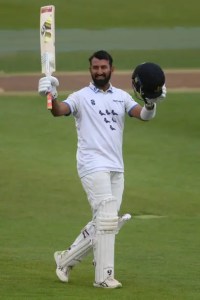
Today we will discuss the salary of a Major League Cricket player in the USA.
When it comes to professional sports in America, we often think of baseball, basketball, and football as the top dogs.
But there’s a new player in town that’s been gaining international attention: Cricket. Major League Cricket has been making waves in the sports world, especially with the growing popularity of T20 cricket. However, there’s one question on every cricket fan’s mind: just how much do these players make?
MLC Cricketer Salary – By the Numbers
The average salary of a Major League Cricket player (MLC) is $60,526 (maximum 19 players in squad with a purse of $1.15 million).
The average salary for a domestic Major League cricketer is $39,375 ($315,000 purse for a total of 8 domestic players). The average salary for an overseas MLC cricketer is $92,200 ($830,000 for nine overseas slots).
About $320,000 from the $1.15 million will be spent on the ten domestic players. Hence, $830,000 is remaining in the purse of each team to sign the nine overseas players. Note, that this amount may be skewed. According to a Daily Mail report, Jason Roy has been offered 300,000 pounds ($372,000) on a 2-year contract ($186,000/year). This means that LA Knight Riders, who signed Jason Roy, will be left with about $644,000 for their remaining 8 overseas signing (for an average of $80,500 per overseas player).
Major League Cricket (MLC) – How Much Was Each Draft Pick?
The Major League Cricket (MLC) draft was held earlier this year in the NASA Space Center in Houston.
The draft picks ranged from $10,000 (8th round pick) to $75,000 (1st round pick). Rookies were drafted in the 9th round (reportedly around $2,500) and an additional tenth player will be picked for each team following the Minor League Cricket (MiLC) season preceding the MLC.
Draft Pick
Salary Amount
Round 1
$75,000
Round 2
$65,000
Round 3
$50,000
Round 4
$40,000
Round 5
$35,000
Round 6
$25,000
Round 7
$15,000
Round 8
$10,000
MLC 2023 Draft Picks – Salary of Major League Cricket Player
1. First Round Draft Pick ($75,000)
Harmeet Singh (Seattle Orcas), Andries Gous (Washington Freedom), Steven Taylor (MI New York), Corey Anderson (San Francisco Unicorns), Ali Khan (Los Angeles Knight Riders), Rusty Theron (Texas Super Kings)
2. Second Round Draft Pick ($65,000)
Shehan Jayasuriya (Seattle Orcas), Mukhtar Ahmed (Washington Freedom), Hammad Azam (MI New York), Liam Plunkett (San Francisco Unicorns), Unmukt Chand (Los Angeles Knight Riders), Calvin Salvage (Texas Super Kings)
3. Third Round Draft Pick ($50,000)
Shubham Ranjane (Seattle Orcas), Obus Pienaar (Washington Freedom), Ehsan Adil (MI New York), Tajinder Singh (San Francisco Unicorns), Jaskaran Malhotra (Los Angeles Knight Riders), Lahiru Milantha (Texas Super Kings)
4. Fourth Round Draft Pick ($40,000)
Cameron Gannon (Seattle Orcas), Saurabh Netravalkar (Washington Freedom), Nosthush Kenjige (MI New York), Chaitanya Bishnoi (San Francisco Unicorns), Nitish Kumar (Los Angeles Knight Riders), Milind Kumar (Texas Super Kings)
5. Fifth Round Draft Pick ($35,000)
Aaron Jones (Seattle Orcas), Saad Ali (Washington Freedom), Monank Patel (MI New York), Carmi Le Roux (San Francisco Unicorns), Corne Dry (Los Angeles Knight Riders), Sami Aslam (Texas Super Kings)
6. Sixth Round Draft Pick ($25,000)
Nauman Anwar (Seattle Orcas), Dane Piedt (Washington Freedom), Sarbjeet Singh Ladda (MI New York), Brody Couch (San Francisco Unicorns), Ali Sheikh (Los Angeles Knight Riders), Cameron Stevenson (Texas Super Kings)
7. Seventh Round Draft Pick ($15,000)
Phani Simhadri (Seattle Orcas), Sujith Gowda (Washington Freedom), Shayan Jahangir (MI New York), David White (San Francisco Unicorns), Saif Badar (Los Angeles Knight Riders), Cody Chetty (Texas Super Kings)
8. Eighth Round Draft Pick ($10,000)
Angelo Perera (Seattle Orcas), Justin Dill (Washington Freedom), Kyle Phillip (MI New York), Smit Patel (San Francisco Unicorns), Shadley Van Schalkwyk, Zia Shahzad (Texas Super Kings)
9. Ninth Round Draft Pick ($2,500)
Matthew Tromp (Seattle Orcas), Akhilesh Bodugum (Washington Freedom), Saideep Ganesh (MI New York), Sanjay Krishnamurthi (San Francisco Unicorns), Bhaskar Yadram (Los Angeles Knight Riders), Saiteja Mukkamalla (Texas Super Kings)
10. Overseas Signings ($60,000-$372,000)
The exact amounts for the overseas signings have not been disclosed yet. These are estimates based on reports and the purse allocated to each team.
Anrich Nortje, Wanindu Hasaranga, Marco Jansen, Glenn Phillips, Adam Milne (Washington Freedom)
Aaron Finch, Marcus Stoinis (San Francisco Unicorns)
Quinton de Kock, Wayne Parnell, Dasun Shanaka, Sikandar Raza (Seattle Orcas)
In conclusion, Major League Cricket players in the USA will be making a decent amount of money from MLC, a league that lasts only three weeks.
The average salary for a professional cricketer in the league ranges from $25,000 to $75,000, with the top players earning considerably more. While it may not match the salary of some of the top athletes in America, it is impressive for a sport that’s still finding its footing in the country.
As a fan of the sport, it’s exciting to see the potential for growth and success in Major League Cricket, and I can’t wait to see what the future holds for these talented athletes. With cricket’s popularity on the rise, it’s not a stretch to say that the league’s players could one day be just as well-compensated as their counterparts in football and baseball.
What is the average salary for a Major League Cricket (MLC) player in the USA?
The average salary of a Major League Cricket (MLC) player is $60,526. Each MLC team has a purse of $1.15 million for 19 players total (10 domestic, 9 overseas).
Is Major League Cricket (MLC) the richest cricket league in the world?
No, the Indian Premier League (IPL) is the richest cricket league in the world. The MLC is the seventh richest cricket league in the world (based on average player salary).
How much money does Unmukt Chand earn in Major League Cricket (MLC) in the USA?
Unmukt Chand was picked for $65,000 as he was a second-round pick for the LA Knight Riders in the MLC player draft.
Who was the most expensive player in the MLC draft?
Harmeet Singh, Andries Gous, Steven Taylor, Corey Anderson, Ali Khan, and Rusty Theron were the most expensive players. They each earned $75,000 as the first draft picks.
Discussing the richest cricket boards is common in the world of cricket today.
Dwaine Pretorius becomes the latest to retire from internationals to focus on T20 leagues. He follows Colin de Grandhomme, Trent Boult, Martin Guptill, and several others in becoming free agents. The SA 20 league, aka IPL in South Africa, has gained a lot of attention in being the ‘final hope’ for South African cricket. But why is that South African, New Zealand, and West Indies cricketers in particular are leaving international cricket?
It all boils down to the money. Today, we discuss the richest cricket boards in Part 4 of our series, Cricket & Finances. Here is quick overview:
The BCCI (Board of Control for Cricket in India) is the richest cricket league in the world with an estimated $2 billion annual revenue. The BCCI is followed by the ECB (England & Wales Cricket Board) at $368 Million, and CA (Cricket Australia) at $270 Million in annual revenue. The CSA (Cricket South Africa) has revenues of $46 million, NZC (New Zealand Cricket) is at $42 million, and CWI (Cricket West Indies) is at $28 million. Those are not bad numbers, but exploring a bit in-depth, we see that CSA had a total comprehensive loss of $11.6 million, NZC suffered a loss of $4.6 million, and CWI incurred a loss of $10 million.
World’s Richest Cricket Boards (Lowest to Highest)
We looked at the financial statements and Annual Reports of each of these respective boards to come up with the revenue, expenditure, and total surplus/loss.The ranking of the national cricket board is displayed with the (annual revenue) and partners/sponsors.
*all figures are in $US dollars.
12. Zimbabwe Cricket – ZC ($5.5 Million)
Revenue:$5,520,442
Total Operating Costs:$6,953,991
Total Deficit:–$1,239,606 (LOSS)
Total Comprehensive Income (after surplus on lands and buildings): – $1,192,166
Is Zimbabwe Cricket profitable?No, Zimbabwe Cricket (ZC) is not profitable with a deficit of $1.1 million in 2020.
Based on Annual Reports & financial statements ending on 31 December 2020.
Partners
Banaqua, Swift, Zimpharm, Dandemutande, A May, Ihsan, Swift, Windmill Pvt Ltd
Is Afghanistan Cricket Board profitable?Yes, Afghanistan Cricket Board (ACB) is marginally profitable with a surplus of $390,000 in 2019 (breakeven).
*Note: This is based on the 2019 Annual Report, published in 2020. US withdrawal of Afghanistan occurred around August 2021. No new annual reports have been published since then.
Highlights from the 2019-20 Annual Report
“Afghanistan Cricket Board as the owner of the league spent around $369,000 for the implementation of the Shpageeza Cricket League (SCL).
The distribution of revenue for ACB was as follows:
84% ICC Distribution
9% Government
4% Marketing
3% Shpageeza
Partners
Main Sponsor:Partner with ACB
National Team Sponsor:Super Cola
Official NFT:Rario
Cloth Manufacturing Partner:TYKA
IT Partner:Afghan Telecom
Other Partners:Asian Cricket Councial, ICC
SCL Sponsor: Etisalat
Main Jersey Sponsor:Diva Group
Medical Partner:Blossom Health Care
Beverage Partner:Habib Gulzar Limited
Umpires Jersey Sponsor:RTA Sports
Other Sponsors:Kam Air, Dafa News, Madava Hospital, Tayyab Yasir Limited, Refai Shaheen Construction Company
Retained earnings at the end of the financial year:310,166 ($333,000)
Based on Annual Reports & financial statements ending on 31 December 2021.
Is Cricket Ireland profitable?No, Cricket Ireland is not profitable with a deficit of 1,230,869 Euros ($1.3 Million). On the other hand, in 2020, the Cricket Ireland was profitable with a surplus of 1,537,632 Euros ($1.65 Million).
Partners
Main Sponsors & Men’s Shirts Rights Holder:ITWConsulting
Official Ireland Women’s Team Partner & Official Technology Partner:Hanley Energy
Official Airline Partner:Turkish Airlines
Official sponsor of Inter-Provincial Series:Test Triangle
Official IT Services Partner:Techfynder
Official Currency Exchange Partner:ClearCurrency
Official Partners:Amul, O’Neills, Ulster University, Tildenet, Club Travel, La Manga Club, ICC, Sport Ireland, Sport Northern Ireland, The Hope Foundation, Federation of Irish Sport, Arachas Insurance, Mansfield Sports Group
Total Revenue:7,994,291,865 SL Rupee ($22,022,843)
Total Expenses:5,883,380,298 SL Rupee ($16,207,659)
Net Surplus:2,138,726,491 SL Rupee ($5,891,809)
Total Comprehensive Income (after assets, taxes, actuarial gain, etc.): 2,478,605,198 SL Rupee ($6,8282,113)
Is Sri Lankan Cricket Board profitable? Yes, Sri Lankan Cricket Board (SLCB) is profitable with a surplus of 2,478,605,198 SL Rupee ($6,8282,113) in 2021.
Based on Annual Reports & financial statements ending on 31 December 2021.
Highlights from the 2021 Annual Report
The distribution of SLCB’s revenue was as follows:
Total Income: PKR Rs. 6,330,842,117 ($27, 665,780)
Total Expenses:PKR Rs. 7,086,927,287 ($31 Million)
Total Deficit: -PKR 756,085,170 (-$3.3 Million) (LOSS)
Is Pakistan Cricket Board profitable? No, Pakistan Cricket Board (PCB) is not profitable with a deficit ofPKR 756,085,170 (-$3.3 Million) in the 2020-21 season.
Based on Annual Reports & financial statements ending on 30 June 2021.
*PKR Rs. denotes Pakistan Rupees
Commercial Partners
Men’s team:Pepsi, TCL, Parkview City
Women’s team: Pepsi
Commercial Partner:Trans Group
Broadcast & Live Streaming Partner: Ary Zap, Willow, Sony, Etisalat, Fox Sports, Flow Sports, SkySport, Sky Sports, ICC TV, SuperSport
Is the Bangladesh Cricket Board profitable? Yes, the Bangladesh Cricket Board (BCB) was profitable in 2020 with a surplus of BDT 832,68,87,010 ($79.2 Million)
Based on AnnualGeneral Meeting 2021, which summarized CWI’s financial statements from 2020.
*BDT – Bangladesh Taka
Highlight from the 2017-2020 BCB Activity Report
“In the six years between 2011 and 2016 the Board had earned US $33.32 million in media, team sponsor, and other rights while in just three years from 2017 to 2020, the BCB’s earnings stood at approximately US $29 million from the same sources.”
Total Revenue:$66,401,000 NZD ($42, 217, 755.80 USD)
Total Expenditure:$46,496,000 NZD ($29,604,000 USD)
Total Surplus: $792,000 NZD ($504,000 USD)
Total Comprehensive Deficit (after Unrealized Loss and Valuation of Foreign Currency Hedging): – $6.7 Million NZD (- $4.26 Million USD)(LOSS)
Is New Zealand Cricket profitable?No, New Zealand Cricket (NZC) is not profitable with a net deficit of $ 6.7 Million NZD ($ 4.26 Million USD) in 2021.
Based on the 2021-22 Annual Report and corresponding financial statements for fiscal year ending on 31 July 2022.
Highlight from the 2021-22 Annual Report
ICC Women’s World Cup 2022 – Surplus of $2.6 Million NZD ($ 1.653 Million USD)
$1.8 Million NZD ($1.14 Million USD) provided to support NZC’s High Performance Center.
“Over 95% of all NZC revenue is derived from our teams’ participation in these FTP and ICC events…”
NZCB Commercial Partners
Official Broadcast Partner:SparkSport
International Broadcast Partner:Pitch
Major Bank & Official Bank:ANZ
Official Vehicle Provider:Ford
Official Hotel Supplier:Accor
Official Supplier:Air New Zealand
Official Clothing Sponsor:Canterbury of New Zealand
Official Sports Drink:Powerade
Official Sponsor of NZ Cricket Umpires:G.J. Gardner Homes
Official Car Rental Partner:Hertz
Partner of the BLACKCAPS and WHITE FERNS (3 -year Deal): KFC
Official Radio & Digital Partner:MediaWorks
Official Partners:Gillette, Les Mills, Dulux, Asahi Beverages NZ
Funding Partners:Sports NZ, New Zealand Community Trust, Perry Foundation, Southern Trust
Total Revenue:778, 353,000 Rands ($45,767,156 USD)
Total Expenses:995,624,000 Rands ($58,492,910 USD)
Total Comprehensive Loss: -197,874,000 Rands ($-11,625,097 USD) (LOSS)
End of Year Balance (After adding up previous years’ savings):272 Million Rands ($16 Million)
Is Cricket South Africa profitable? No, Cricket South Africa was not profitable in 2021-22 with a net deficit of -197 Million South African Rands (loss of $11.625 Million US dollars).
Based on the 2021-22 Integrated Report and corresponding financial statements for fiscal year ending on 30 April 2022.
Highlights from the Integrated Report 2021-22
“The curtailment of the planned four T20 matches against India due to Covid-19 pandemic severely impacted CSA’s results, with a -R 250 Million (- $14.7 Million USD). This revenue loss was mitigated to a certain extent by committed cost reductions through all business areas, resulted in a reported loss of R198 Million ($11.6 Million USD).”
“CSA does not own cricket stadiums, so proceeds generated by these venues are shared, with CSA receiving 20% and stadium operators (CSA members) receiving 80%.”
Revenue Division
53% Broadcast Rights: 413 Million SA Rands ($24 Million)
33% ICC distribution: 256 Million SA Rands ($15 Million USD)
4% Sponsorships (Professional), 2% Sponsorships (Amateur): 52 Million SA Rands ($3 Million USD)
Is Cricket Australia profitable? Yes, Cricket Australia (CA) is profitable with a net surplus of $ 10.7 million AUD ($7.4 million USD) in 2021. Hence, Cricket Australia is on #3 in the richest cricket boards in the world.
Based on the 2021-22 Annual Report and Statement of Comprehensive Income for fiscal year ending on 30 June 2022.
Partners
Broadcast Partners:Fox Sports, Seven West Media, ABC Radio, Macquarie Radio Network, Sports Entertainment Network
International Broadcast Partners:Sony, Fox Sports Asia, beIN, BT Sport, Supersport, Kwese Sports, Sports Max, Flow Sports, Willow, ATN, SKY Network Television, National Broadcasting Corporation of Papua New Guinea
Total Comprehensive Income:$20,751,000 Pounds ($25,229,066 USD)
Is the England & Wales Cricket Board profitable? Yes, England & Wales Cricket Board (ECB) is profitable. According to the 2021-22 Financial Statements, the ECB had a net surplus of $20.7 million pounds ($25.2 million US dollars). Hence, the ECB is the 2nd among the richest cricket boards on the planet.
Based on the 2021-22 Financial Statements for fiscal year ending on 31 January 2022.
Is the Board of Control for Cricket in India profitable? Yes, the Board of Control for Cricket in India (BCCI) is profitable with a net surplus of INR 529 Crore ($64.8 million US dollars). Furthermore, the profit has grown to an estimated $2 billion as of 2022.
Based on the 2016-17 Financial Statements for fiscal year ending on 31 March 2017.
Although official documents were limited to 2017, we investigated further based on Twitter data and media reports from reputable sources. For example, the infographic by Forbes India shows the mammoth growth in BCCI’s net worth between 2014 & 2018. BCCI’s net worth is shown to be INR 11,916.8 crore ($1.224 billion US dollars).
Since then, BCCI’s rise has been exponential. Here are some of the highlights of major rights and sponsorships, including the mammoth $6.2 billion IPL media rights between 2023-2027.
In conclusion, about $1.24 billion revenue will be achieved annually by the IPL media right alone. The ICC revenue and all of the other sponsorships will make up another billion (and will change everywhere as the negotiations with each sponsor changes). The BCCI is easily #1 on the list of the world’s richest cricket boards.
*Note: The estimated Revenue for ICC’s broadcasting income from the 2023 ODI World Cup is about $533.29 Million, from which $58.23-116.47 million is expected to be taxed by the Indian government.
Partners
India’s sponsors and partners are as follows:
Team Sponsor:BYJU’S: The Learning App
Official Broadcaster:Star Sports ($944 Million)
Title Sponsor:Mastercard
Official Partners:Dream11, Hyundai, Ambuja Cement, Killer Jeans(Kewal Kiran Clothing)
The only profitable cricket boards are the BCCI, ECB, CA, Bangladesh Cricket Board (BCB), and Sri Lankan Cricket Board (SLCB).
This is the concerning aspect. If the national body is not profitable, they have to cut back on salaries, systems, and leagues. This is exactly why South Africa are hoping that the SA20 league generates so much revenue that the surplus can raise players’ salaries and keep them in the domestic circuit.
How Do Cricket Boards Earn Money?
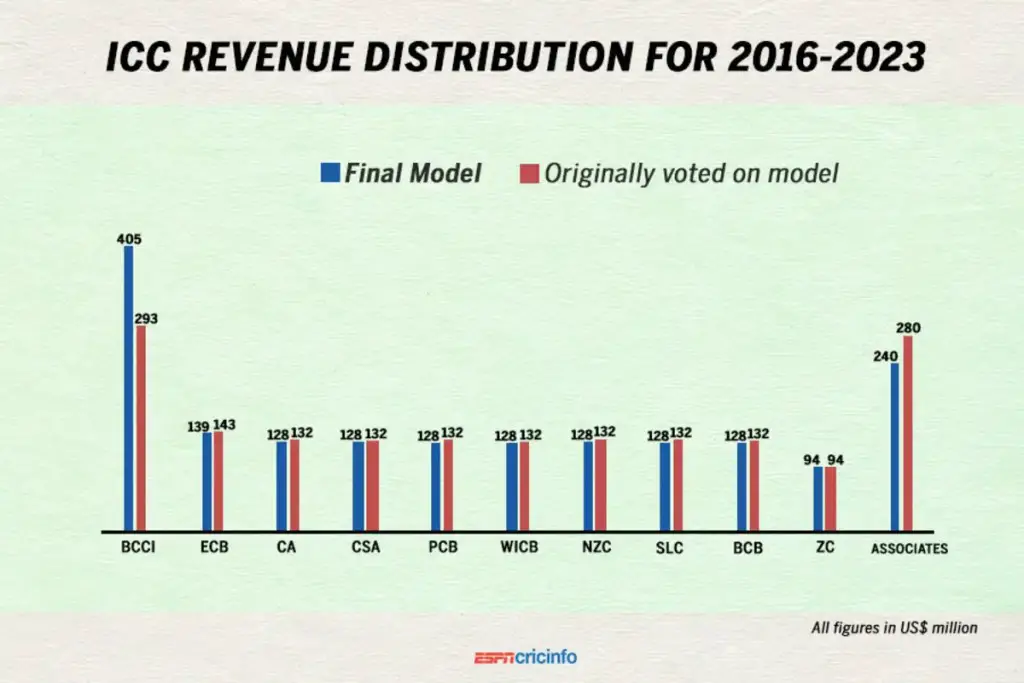
Cricket boards earn money in a variety of ways—ICC revenue, media rights, sponsorships, ticket sales, etc. Here is a visual from ESPNCricinfo illustrating the2016-2023 revenue distribution from the ICC to the top cricketing nations.
The SA20 Auction caught everyone’s attention this week, which leads to the logical question, “What are the Richest Cricket Leagues, and where does SA20 league rank?” Here is a quick answer.
The Indian Premier League is the richest cricket league in the world. As per the 2022 Mega Auction & Retention, the IPL paid its players a whopping $116,339,000 combined for its 234 players who play for their ten franchise teams in a three-month season. The upcoming UAE International T20 & SA20 rank behind at #2 & #3 in terms of player salaries, while the Abu Dhabi T10 League is at #10 with a $2,500,000 combined salary for about 100 players.
Times are changing, T20 cricket is becoming infused with money, and different leagues are popping left and right. The SA20 Auction threw Tristan Stubbs and co into stardom, the UAE international T20 League will be a game changer, and the Big Bash is trying to attract overseas talent in their much-hyped Draft while keeping domestic stars like David Warner.
Richest Cricket Leagues (Lowest to Highest)
Players now have choices, but maybe too many choices.As many as six leagues are scheduled between November & February. That is a daunting stat.
So, in Part III of our new series, Cricket & Finances, we try to help these players out & distinguish which leagues pay their players the most. We also cover the minimum salaries, average wages, total team salary cap, number of players a league can take, and the window it occupies in the cricket calendar.
Make Sure to Read the Earlier Content on Cricket & Finances
How The Overall Cost Was Calculated:For leagues where all the information is public (like IPL auction player by player cost), each player’s cost was added for the total.For leagues where only partial information was available, thefranchise’s maximum purse/salary cap was multiplied by the number of teams in that particular league.
*Note: This article covers individual player salaries, not tournament prize money.
11. Abu Dhabi T10 League ($2,500,000)
Abu Dhabi T10 League Average Cricketer Salary:$25,000
Minimum Wage:$5,000
Maximum Amounts:$50,000-$100,000
*$50,000 is the minimum amount paid for the highest category of player in the draft. However, to attract certain cricketers, the actual amounts may be higher.
Calendar Window:November-December
Salary Cap Estimate (Per Team): $400,000-$600,000
Number of Teams: 6
Total Players: 100-110 (16-18 players per team)
10. Lanka Premier League ($3,000,000)
Lanka Premier League (LPL) Average Cricketer Salary:$30,000
Maximum Amounts:$72,897 (BDT 80 Lakh) – Local Players, $80,000 – Overseas Players
Calendar Window:January-February
Salary Cap Estimate (Per Team): $371,000-$943,000
Number of Teams: 7
Total Players: 127 Players (as of BPL 2024)
*The BPL have suffered due to payments and franchise trouble in the last couple of years. In the earlier years, the BPL paid its foreign players up to $200,000 making it more lucrative than even the BBL. Now, the board has taken over the league instead of franchises.
Pakistan Super League (PSL) Average Cricketer Salary:$66,667
Minimum Wage:$7,500
Maximum Amounts:$170,000
Calendar Window:February-March
Salary Cap Estimate (Per Team): $1.2 Million
Number of Teams: 6
Total Players: 108 (18 per team)
Ramiz Raza has proposed changing the current drafts system (Platinum, Diamond, Gold, Silver, Emerging categories) to the auction formatand increase thesalary cap from $950,000 to $1.5 million. The salary cap is currently at $1.2 Million. Watch out for the PSL. This is a fast-rising league and will survive.
Indian Premier League (IPL) Average Cricketer Salary:$497,175
Minimum Wage:$26,000
Maximum Amounts:$2,133,000
Calendar Window:March-June
Salary Cap Estimate (Per Team): $11 Million (Rs. 90 crore)
Number of Teams: 10
Total Players: 234 (20-30 Per Team)
The mind-numbing thing to think about is that each IPL franchise has a larger salary cap space & auction purse is more than most other cricket leagues. Here are the details from the IPL 2022 Mega Auction.
Final Thoughts: The IPL is now having considerable influence in T20 leagues around the world. The same business groups are now buying stakes in foreign franchise leagues. This includes teams like Trinbago Knight Riders, MI Cape Town, MI Emirates, Dubai Capitals, etc.
Which are the Richest Cricket Leagues in the World?
Which is the richest cricket league in the world?
The Indian Premier League (IPL) is the richest cricket league in the world with an average player salary of $497,175.
What are the Top 5 richest cricket leagues in the world?
The Top 5 richest cricket leagues in the world (by average player salary) are the Indian Premier League (IPL), UAE International T20 League, SA T20 League, the Big Bash, and the Hundred.
How much money does each T20 league give their players?
T20 leagues contribute the following amount to their cricketers combined: 1. Indian Premier League ($116, 339,000) 2. UAE International T20 ($15,000,000) 3. SA T20 League ($13, 421, 200) 4. Big Bash League ($10,000,000) 5. The Hundred ($9,000,000) 6. Pakistan Super League ($5,700,000) 7. Bangladesh Premier League ($4,800,000) 8. Caribbean Premier League ($4,500,000) 9. Lanka Premier League ($3,000,000) 10. Abu Dhabi T10 League ($2,500,000) All prices above in $US Dollars.
How much money can a cricketer earn from each T20 league?
Average cricketer salaries per T20 league is as follows: 1. Indian Premier League ($497,175) 2. UAE International T20 ($138,889) 3. SA T20 League ($133,000) 4. Big Bash League ($75,000) 5. The Hundred ($75,000) 6. Pakistan Super League ($53,000) 7. Caribbean Premier League ($50,000) 8. Bangladesh Premier League ($40,000) 9. Lanka Premier League ($30,000) 10. Abu Dhabi T10 League ($25,000) All prices above in $US Dollars.
Technology in cricket has often been an area of debate. Ten pieces of technology have fundamentally changed how the game is played:
(1) The DRS, (2) Hawkeye, (3) Virtual Eye,(4) Snickometer, (5) Ultra-Edge, (6) Hotspot (7) LED stumps, (8) Spidercam, (9) Bushnell (sporting optics), and (10) Stump Mic.
Today, we look at several aspects of these technologies: Cost, impact, and history.
Why Do We Need Think About Technology in Cricket?
Let’s rewind our clocks to 21st March, 2018.
ICC World Cup Qualifiers in Zimbabwe. Scotland vs West Indies. A spot in the World Cup on the line.
Over 31.4, Ashley Nurse to Richie Berrington: Berrington is adjudged LBW out by the umpire, but it would have definitely gone down the leg side.
There was no DRS.
Couple of overs later, rain arrived. West Indies beat Scotland by 5 runs (DLS method). Heartbreak for Scotland.
Jason Holder later said in the post-match presentation:
“That’s beyond my control. I think it’s a question for the ICC. At the beginning of the tournament, they set up the rules, and those rules are the rules we played with. It’s cricket. Sometimes it goes for you, sometimes it goes against you.”
– Jason Holder
Landscape of Cricket is Changing
In a tournament as important as the World Cup Qualifiers, there should be no excuse that technology is not used (not all games were televised either, but that is a separate issue).
So, why was DRS not used? It’s because implementing technology in cricket is expensive and not all cricket boards & broadcasters have that kind of money.
Cricket is going where the money is going. Franchise cricket is taking over the cricket calendar and players now have various choices in how to earn money (as they should).
Recently, in our Finances in Cricket section, we have explored:
We will now explore how money is utilized from the administration side of things. For example, how much money is needed to host a Test match as compared to limited over matches & franchise leagues?
However, in order to answer this question, we must first understand the economics of technology used. Let’s begin our exploration.
Technology in cricket is used predominantly for three reasons—Ball Tracking, Edge Detection, and Infrared Imaging.
The reason for the high costs for these technologies are as follows: (1) initial installation costs of the technology itself, (2) additional camera setup, (3) maintenance & staff costs to ensure the technologies run smoothly.
1. DRS (Decision Review System): $20,000-60,000 Per Day
What is the Full Form of DRS? What Does DRS Stand For?
DRS stands for Decision Review System.
The Decision Review System is the entire toolkit utilized via broadcasters to assist umpires during a cricket match. The DRS primarily helps in LBW decisions (ball tracking) & faint nicks (edge detection/hot spot).
How Much Does DRS Cost?
Minimum Cost: $12,000-15,000 per day (4 camera system)
Maximum Cost: $60,000-100,000 per day
Test Match Estimate: $300,000-$500,000 per Test ($600,000 – $2.5 million for a Test series depending on the amount of Tests and the technologies used).
World Cup 2023 Estimate: $2.8 million-$4.8 million (48 ODI matches)
Currently, a complete system of DRS costs approximately $100,000 per day. Hence, a full five-day Test match would cost around $500,000 and a five-match Ashes series will cost around $2.5 million. It was estimated that the 2021-22 full-package Big Bash league would cost around $2 million AUD ($1, 333, 600 USD) at an average of $32,787 AUD ($21,862 USD) per match for the 61 matches.
According to a Cricbuzz report, the Bangladesh Premier League in 2019 bought a DRS package without Snicko, Ultra-edge, and Hotspot for $75,000 per match (Just the Ball-tracking technology and ultra motion replays) and a full-package would have cost them $100,000 per match.
Currently, a team captain can review a decision up to two unsuccessful DRS decisions. In Test matches, the reviews are reset after 80 overs.
Impact/Features:
DRS has certainly impacted cricket for the positive. Although it has taken a few years to evolve, the DRS has definitely helped cricket in getting rid of the howlers (recall, 2008 Sydney Test).
It has also provided cricket yet another strategic aspect (think Headingly 2019 – Tim Paine Review). Finally, the DRS has changed the dynamics of the game. For example, spinners have drastically benefitted in LBW decisions since the beginning of the review system.
The most common DRS technology used is for Ball-Tracking purposes. Hence, the majority of DRS costs goes in the implementation of Hawk-eye.
2. Hawkeye
How Much Does Hawkeye Cost?
Hawkeye has been used in multiple sports—Tennis, Rugby, Gaelic Football, Soccer, NASCAR, etc.
In Gaelic Football, it was estimated that the installation cost of Hawkeye is 250,000 pounds ($317,600). It would take them a further 500,000 pounds ($635, 200) to run it the entire season.
With Hawk-eye, cricket broadcasters have data like never before.
In 2013, ESPNCricinfo integrated Hawkeye data with their live score coverage. This included addition of features such as: (1) Pitch Map, (2) Ball Speeds, (3) Beehive (trajectory of the ball), (4) variable bounce, and (5) Wagon Wheel.
Virtual Eye is the other ball-tracking company based in New Zealand.
How Does Virtual Eye Work?
According to Virtual Eye (also known as Eagle Eye), they utilize the “high-frame rate cameras” to “track the centre of the ball in every frame…[Their] software then calculates the precise ball track in 3D space and predicts the path once the release, bounce, and impact points are known.”
Impact/Features:
Similar to Hawkeye, Virtual Eye provides (1) Wagon Wheels, (2) Pitch Maps, (3) Six Distances, (4) 3D Flyovers, and (5) ball tracking.
In the BPL report, they paid for $75,000 instead of $100,000 and missed out on Hotspot, Snicko-meter, and Ultra-Edge.
It is known that Hotspot costs around $10,000. However, due to concerns with the technology (silicone tape/other bat coatings could fool the system), it has not been used unanimously in the DRS packages over the years.
4. Snicko-meter (Real-time Snicko – RTS)
How Much Does Snicko-meter Cost?
Real-Time Snicko (RTS) can cost around £2,500 ($3430.50).
How Does Snicko-meter Work?
The snicko-meter utilizes the stump mic and measures sound waves (via an oscilloscope).
The technology is made effective with split-screen display (one showing the waves in the snicko-meter & the other displaying slow motion camera). This ensures the sound corresponds to the nick of the bat.
Ultra-edge is Hawkeye’s version of the Snicko. After the 2015 testing with MIT (Massachusetts Institute of Technology) in Boston, USA, it was accepted by the ICC. In particular, Ultra-edge can differentiate between the sounds of clothing, bat, and pad.
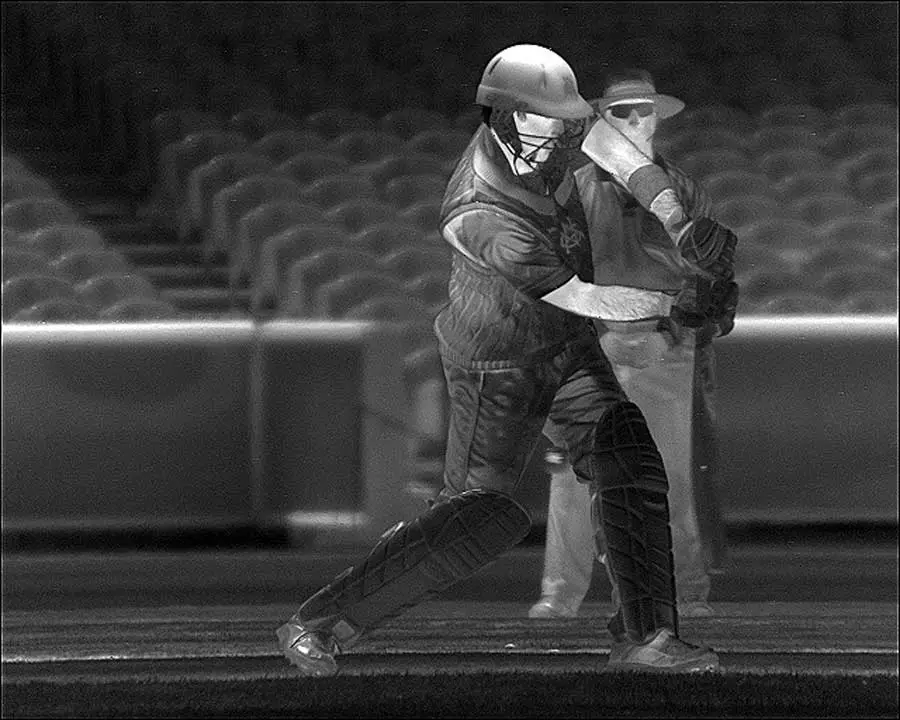
With a four-camera setup, Hotspot uses infrared thermal imaging technology to detect where the ball hits.
Impact/Features:
The pros of HotSpot was that it could catch even the faintest of edges. However, the inventor himself had doubts of the validity of the HotSpot during the 2013 Ashes since coating on bat can prevent HotSpot to be displayed.
In addition, it has been suggested that HotSpot has not been preferred in India since it is a military technology.
Is one possible faint nick worth $10,000 per match?
There are other technologies that have enhanced the level of cricket broadcasting over the past decade: Helmet cameras, Stump Mics, LED Stumps, SpiderCam, etc. These technologies are not necessarily part of the DRS and, we may not have all the cost information.
Although I could not find the exact cost of the Spidercam, I bet this can cost the broadcasting companies upwards of hundreds of thousands or even a few million dollars.
How does the Spidercam Work?
The Spidercam tries to offer a ‘bird-eye’s view’ on the cricket ground. It is made possible with a cable suspended camera system. This helps the camera move in multiple directions.
On Amazon, Bushnell range finder for golf costs anywhere from $100-300. For professional sporting equipment, it may be a bit more expensive.
How does the Bushnell Work?
A range finder is used to measure distances of remote objects and has been used in the military and golf.
Watch this videoof Simon Doull explaining in a Cricbuzz discussion that the range finder plots from the “middle of the ground to the grandstand and tiers of the grandstand. It’s not where the ball might have landed.”
Impact/Features:
With T20 cricket, displaying the distance of sixes has become central to broadcasting needs.
10. Stump Mic
Impact/Features:
Stump microphones are placed near the stumps and pick up sounds like edges (important for snicko & Ultra-edge to work) as well as sledges & Rishabh Pant singing spider man main theme song.
Bonus
PitchVision
Their catch phrase is “technology used in the highest level of the game is now available for everyone to use.”
2008 – DRS is first experimented in the India-Sri Lanka Test series. Virtual Eye technology made an error in Virender Sehwag’s dismissal. Dilshan was given not out due to lack of evidence. Doubts crept in.
2009 – Review system started to be officially implemented in Test matches (with agreement from both teams)
2018 – ICC Women’s World Twenty20 first ICC T20 World Cup to feature the DRS
Who Pays for These Technologies?
In the early days of the DRS, the broadcasters of the home team used to take most of the responsibility of these costs.
Now, the payment is usual divided between the home team cricket board & the broadcasters. However, as the review system gets further uniformed around the world (especially with World Cups and major tournaments), the ICC has started to bear some of the responsibility and subsidize the overall cost.
Final Thoughts
Although cricket might not have as much broadcasting prowess as other sports like American football, but it is certainly in the right direction. I hope more independent companies can chime in as well, which may help reduce the costs. The competition may also drive better products.
I also hope that the ICC can make uniform regulations and can cover the costs, especially in major tournaments like the World Cup Qualifiers.
What is the difference between Ultra-edge & snickometer in cricket?
Ultra-edge is Hawkeye’s version of the snicko.
What does DRS stand for?
DRS stands for Decision Review System.
Why is Hotspot technology not used in cricket anymore?
HotSpot technology is not used in cricket anymore due to doubts about the validity of the technology. Bat coating & silicone tape can hide the image detection on Hot Spot.
Today we rank the salary of cricketers (men) from each Test playing nation.
Trent Boult’s shock yet understandable decision to leave the New Zealand contract has put the cricket world into frenzy. This begs the question of how much do cricketers from each country earn from a national contract.
The salary of cricketers in Australia from central contracts and match fees is the most lucrative between $362,500-1.75 million with England & India close behind with salary up to $1.5 million & 1.295 million respectively. Afghanistan, $20,000-40,000 and Zimbabwe at $4,000-90,000 rank at the bottom of the spectrum. New Zealand, South Africa, and West Indies players earn somewhere in the middle, which is why several of them have to go to England, Australia, and India to ply their trade to earn a bit more.
We present a complete breakdown of the earnings and rank each nation’s central contract strength from lowest to highest.
Salary of Cricketers from Each Nation – The Complete List (Lowest to Highest)
For the sake of this analysis, we will only consider the 12 Test playing nations.
How Did We Calculate the Estimated Salary Ranges?
We have done a bit of research based on annual reports, press releases, and trusted sources from each national board. We arrived at estimates for player salaries based on retainer central contracts and match fees. Brand endorsements, sponsorships, team/board bonuses, and match awards are not taken into consideration.
All of our sources are listed below each nation’s analysis for your reference.
Afghanistan Cricket National Contract Estimated Salary
Estimated Salary Range:$20,000-$40,000 (which may vary depending on the contract grade)
In 2023, government changed hands in Afghanistan. According to the Guardian, their cricket board paid the players around $1,000-$3,500 monthly salary.
Highest Paid Afghanistan Player Breakdown: England captain Rashid Khan earns around $2.2-3.36 million annually excluding sponsorships, match awards and bonuses:
$2.14 million (INR 18 Crore): IPL
$40,000: Afghanistan central contract
$29,953 (£22,800 – £2,850/match): ICC World Cup match fees
The variability depends on the number of leagues Rashid Khan plays in a year subject to availability. In the past, Rashid Khan has also played in the following leagues:
$340,000 (ILT20), $164,216 (£125,000, The Hundred), $220,893 ($340,000 AUD, BBL), $110,000 (SA20), $75,000 (MLC), $160,000 (CPL), and $80,000 (BPL)
*Note: Match fees is not publicly disclosed for Afghanistan cricket.
Afghanistan Cricket Board Annual Report Analysis
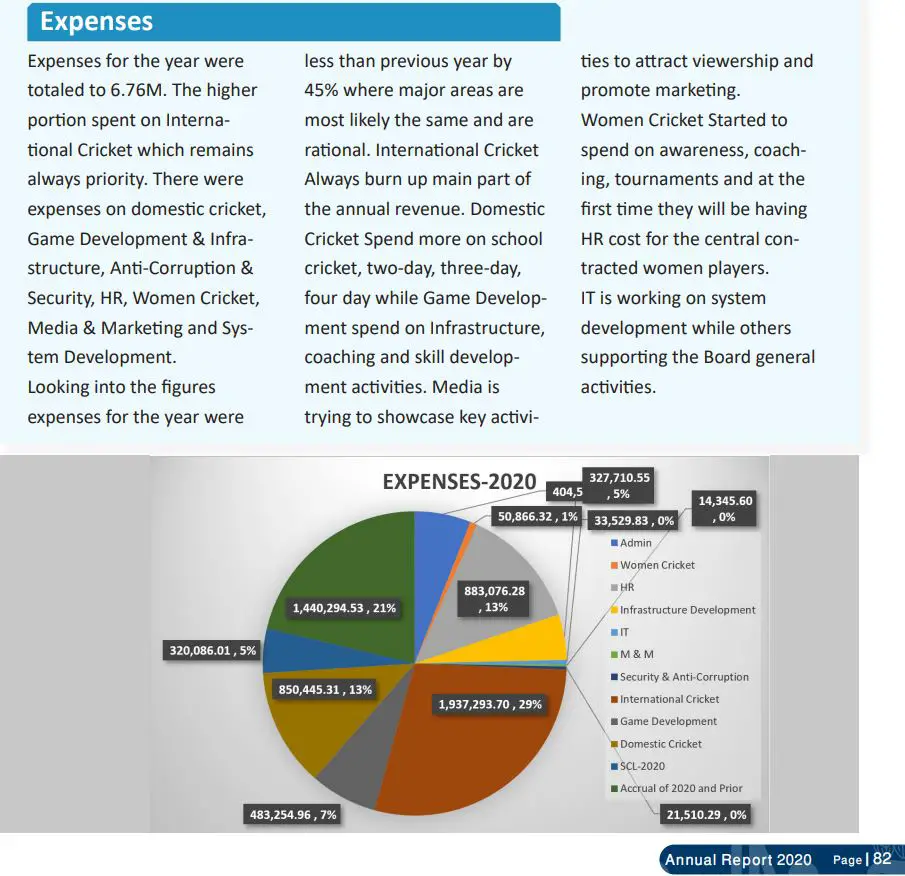
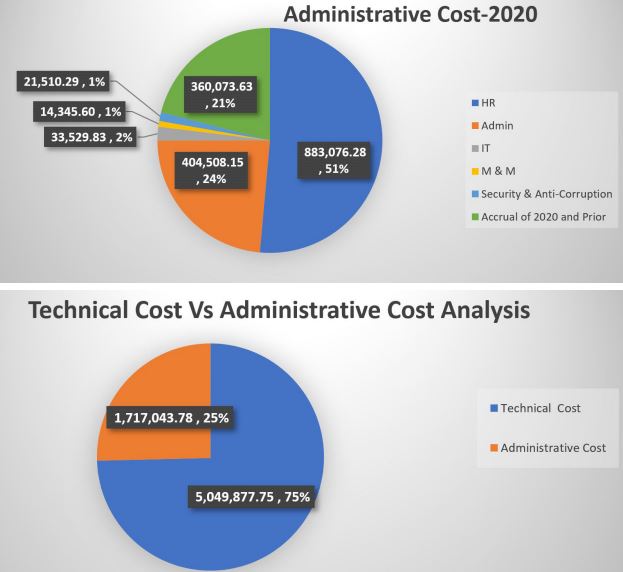
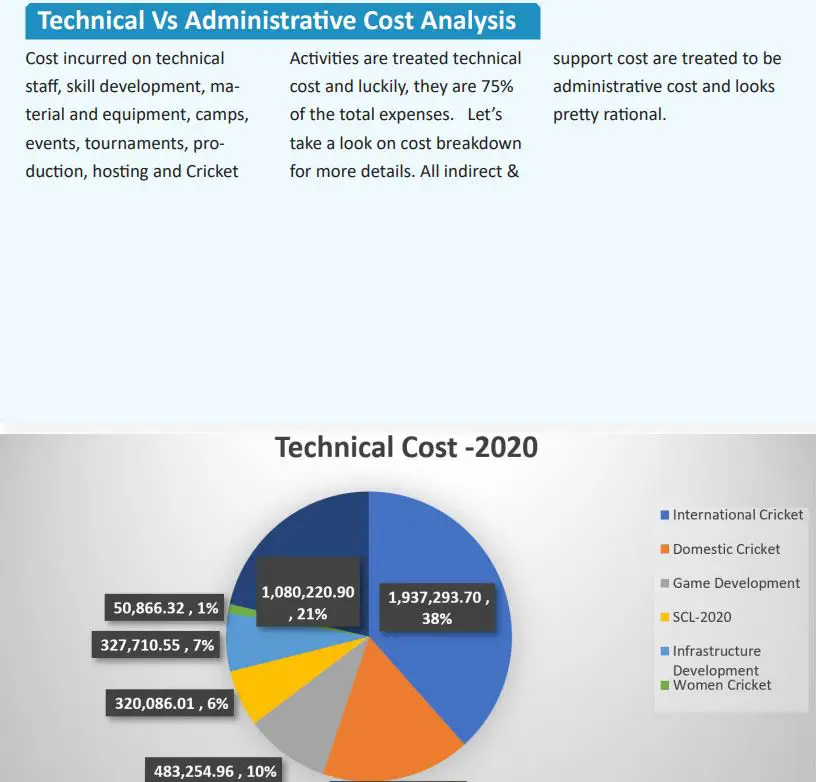
Since data is not widely available on Afghanistan central contracts, we make an educated estimate based on their annual report. As per ACB’s 2020 Annual report, the ACB had a revenue of $7.15 million and expenses around $6.76 million (images attached below). From the expenses, $1.71 million was administrative cost, while $5.05 million was technical cost.
Around $1.937 million was spent on international cricket, $1.44 million accrual of 2020 (or prior) overall, and $ 883,000 was spent on HR activities. Although it is not stated what portion of this money was allocated for player salaries, we can estimate that around $1 million were spent on salaries of players, coaches, support staff, etc. Currently, there are 34 centrally contracted players (listed below). Hence, we came up with the above estimate for the Afghanistan cricketer salary.
List of Afghanistan Centrally Contracted Cricketers
Grade A: Rashid Khan, Najibullah Zadran, Mohammad Nabi
Match fees information is not available for Afghanistan cricket.
*Note: The annual report is from 2020, prior to the Taliban takeover. No official data is available since the political situation changed in Afghanistan. For example, 25 centrally contracted women’s cricketers were added in 2020 and several development programs started. This is, most likely, no longer the case.
According to Zimbabwe’s 2020-21 Annual Report, they had allocated $659,827 for statutory obligations and salaries, $788,891 for salaries in domestic cricket, and $1,620,326 for HR-related activities in international cricket.
Highest Paid Zimbabawe Player:Sikandar Raza plays in multiple leagues around the world. His annual income before sponsorships can range from $122,000-$516,000 depending on how many T20 leagues he plays in.
In 2023, he was picked up for the IPL for $57,123 (50 Lakh INR)
He has also played in MLC, the Hundred, PSL, and ILT20. Since his draft signing price was not publicly available, we take the average salary of these tournaments: $60,526 (MLC), $117,000 (Hundred), $77,206 (PSL), $138,888 (ILT20), which totals about $393,620.
Raza played 16 ODIs and 11 T20Is in 2023, adding about $21,600 in match fees.
In 2017, Graeme Cremer was the highest earned Zimbabwe cricketer (from central contracts & match fees only), estimated around $90,000.
Zimbabwe Cricket National Contract
Based on Cricket Monthly, in 2017 Zimbabwe’s players earned:
Top Tier:$66,000
Middle Tier:$48,000
Bottom Tier:$36,000
What Are Match Fees for Zimbabwean Cricketers?
Test:$2,000
ODI: $1,000
T20I: $500
Estimated Match Fees: Between November 2021 and October 2022 (between the two consecutive T20 World Cups), Zimbabwe played a total of 15 ODIs ($15,000), and 16 T20Is ($8,000).
Zimbabwe cricket has faced lots of contract negotiation issues over the years, but it seems like not much as changed since 2013. In 2013, ESPNCricinfo reported Zimbabwean domestic cricketer’s salary as follows:
Highest Paid Irish Player Breakdown (2023):Josh Little was picked up in the IPL 2023 auction for about $500,000 (4.4 Crore INR). He also played 14 ODIs and 14 T20Is in 2023, earning about $21,700 in match fees.
Altogether, his annual on-field salary was in the range of $600,000-$800,000 in 2023.
He has also had stints in the Hundred, MLC, CPL, and PSL, which could potentially add a further $100,000-$300,000 if was available for all tournaments in a season.
Ireland Cricket National Contract
Central Contract: $75,000
According to Ireland’s 2019 Directors’ Report and Financial Statements, the wages and salaries amounted to $3.7 million (3,690,196 euros), from which $1.57 million (1,557,584 euros) was allocated for high performance player contracts & match fees distributed among 25 centrally contracted players.
What Are Match Fees for Irish Cricketers?
ODI: $1,100
T20I: $450
Estimated Match Fees: Between November 2021 and October 2022 (between the two consecutive T20 World Cups), South Africa played a total of 9 ODIs ($9,900), and 22 T20Is ($9,900).
A player who played all three formats in this time period would have earned $19,800 in match fees alone.
Maximum Possible Salary:$211,950 (Top Tier Contract + 3-format Maximum Match Fees)
Minimum Possible Salary:$54,950 (Bottom Tier Contract + T20Is only)
Highest Paid Bangladesh Player Breakdown (2024): In 2024, Mustafizur Rahman earned around $390,000-$410,000 excluding sponsorships, match awards and bonuses:
$240,000 (2 Crore INR): IPL
$58,800: Bangladesh Central Contract
$49,122 (60 Lakh BDT): BPL
$43,200: Match Fees (4 ODIs, 15 T20Is)
In 2017, Shakib Al Hasan was the highest earned Bangladesh cricketer (from central contracts & match fees only), estimated around $140,000.
Bangladesh Cricket National Contract
Grade A+: $98,400 (BDT 12,000,000 BDT)
Grade A: $79,200 (9,600,000 BDT)
Grade B: $58,800 (7,200,000 BDT)
Grade C: $39,600 (4,800,000 BDT)
What Are Match Fees for Bangladesh Cricketers?
Test:$6,600 (800,000 BDT)
ODI: $3,300 (400,000 BDT)
T20I: $2,000 (250,000 BDT)
Estimated Match Fees: Between November 2021 and October 2022 (between the two consecutive T20 World Cups), Bangladesh played a total of 10 Tests ($70,000), 12 ODIs ($42,000), and 17 T20Is ($39,950).
A player who played all three formats in this time period would have earned $151,950 in match fees alone.
Estimated Average Range: $72,300–145,350 (with some players with higher salaries due to negotiations)
Highest Paid Pakistan Player Breakdown: Captain Babar Azam earned around $756,385 million annually excluding sponsorships, match awards and bonuses:
~$277,985 USD ($420,000 AUD): BBL
~$220,000: PSL
$190,800: Pakistan Central Contract
$67,600: Match Fees (5 Tests, 17 ODIs, 4 T20Is)
In 2017, Sarfaraz Ahmed was the highest earned Bangladesh cricketer (from central contracts & match fees only), estimated around $270,000.
Pakistan Cricket National Contract
Category A: $190,800 (54 Million PKR)
Category B: $127,200 (36 Million PKR)
Category C: $63,600 (18 Million PKR)
Category D: $31,800 (9 Million PKR)
This overhauls the earlier contract system based on red ball – $56,400 (12,600,000 PKR) vs white ball – $51,600 (11,400,000 PKR) split.
What Are Match Fees for Pakistani Cricketers?
Test:$4,500 (1,200,000 PKR)
ODI: $2,300 (650,000 PKR)
T20I: $1,500 (420,000 PKR)
Estimated Match Fees: Between November 2021 and October 2022 (between the two consecutive T20 World Cups), Pakistan played a total of 7 Tests ($26,600), 9 ODIs ($20,700), and 24 T20Is ($41,640).
A player who played all three formats in this time period would have earned $88,940 in match fees alone.
Pakistani players named in PCB central contracts 2022-23 will be paid 838,000 PKR per Test match, 515,000 PKR for an ODI and 372,075 PKR for a T20i match. There is 10% increase in salaries.
Maximum Possible Salary: $351,000 (A1 Contract + 3-format Maximum Fees)
Minimum Possible Salary: $65,000 (D3 Contract + ODI Player Only)
Highest Paid Sri Lanka Player Breakdown:Matheesha Pathirana earned around $1.6-$1.82 million annually excluding sponsorships, match awards and bonuses:
$1.55 Million (INR 13 Crore): IPL
$50,000-$100,000: SL National Contract
$72,000: Match Fees (18 T20Is in 2024)
$10,000-$100,000: SA20 (Wildcard Pick)
In 2017, Angelo Matthews was the highest earned Sri Lankan cricketer (from central contracts & match fees only), estimated around $320,000.
Sri Lanka Cricket National Contract and Player List
A1: $100,000, A2: $80,000, A3: $70,000
B1: $65,000, B2: $60,000, B3: $55,000
C1: $50,000, C2: $45,000, C3: $40,000
D1: $35,000, D2: $30,000, D3: $25,000
*there are additional bonuses for team victories against top opponents ($150,000 for series victory vs #1 team, $125, 000 vs #2 team, etc. till $30,000 bonus for series win vs #7 team)
What Are Match Fees for Sri Lankan Cricketers?
Test:$7,500
ODI: $5,000
T20I: $4,000
Estimated Match Fees: Between November 2021 and October 2022 (between the two consecutive T20 World Cups), Sri Lanka played a total of 10 Tests ($75,000), 8 ODIs ($40,000), and 17 T20Is ($136,000).
A player who played all three formats in this time period would have earned $251,000 in match fees alone.
In 2017, Faf Du Plessis was the highest earned South African cricketer (from central contracts & match fees only), estimated around $440,000.
South African Cricket National Contract
Top Tier: $363,000
Medium Tier: $221,000
Bottom Tier: $145,000
What Are Match Fees for South African Cricketers?
Test:$6,925
ODI: $1,900
T20I: $911
Estimated Match Fees: Between November 2021 and October 2022 (between the two consecutive T20 World Cups), South Africa played a total of 10 Tests ($69,250), 13 ODIs ($24,700), and 13 T20Is ($11,843).
A player who played all three formats in this time period would have earned $105,793 in match fees alone.
“The cricketers are in South Africa’s highest tax-paying band, 45% and 45% of a million US dollars is a lot more than 45% of a million Rand. So if money is what matters, then it all adds up.”
In 2017, Jason Holder was the highest earned West Indian cricketer (from central contracts & match fees only), estimated around $270,000.
West Indies Cricket National Contract (2017)
Top Tier: $140,000
Mid Tier: $120,000
Bottom Tier: $100,000
According to CWI’s 2021 Financial Statements, overall international retainers added to $2,248,583 and match fees amounted to $3,454,310. Including captain’s allowances, players insurance, injury payments, incentives, franchise retainers, etc., the total payment to players totaled a whopping $8,758,878.
Overall, WI have 18 contracted players for the men’s team & 19 for the women’s respectively. Assuming the men & women early equally, on average retainer + match fee is about $236,726.43 per West Indian cricketer.
What Are Match Fees for West Indian Cricketers?
Test:$5,750
ODI: $2,300
T20I: $1,735
Estimated Match Fees: Between November 2021 and October 2022 (between the two consecutive T20 World Cups), West Indies played a total of 7 Tests ($40,250), 21 ODIs ($48,300), and 24 T20Is ($41,640).
A player who played all three formats in this time period would have earned $130,190 in match fees alone.
Estimated Match Fees: Between November 2021 and October 2022 (between the two consecutive T20 World Cups), New Zealand played a total of 9 Test matches ($59,400), 13 ODIs ($32,500), and 14 T20Is ($22,498).
A New Zealander men’s cricketer playing all three formats would have earned up to $114,398 in match fees in the 2021-22 season. Hence, Trent Boult is trying to make the most of this match fee while giving up his $300,000+ retainer.
We look at Rishabh Pant’s 2024 season. In 2025, he has only played 6 Tests so far and not featured much in limited overs cricket.
In 2017, Virat Kohli was the highest earned Indian cricketer (from central contracts & match fees only), estimated around $1,000,000.
What are Match Fees for Indian Cricketers?
For a player in the XI for these formats, an Indian player earns
Test: Rs. 15 Lakh ($18,800)
Test Cricket Initiative Scheme: Rs. 30 Lakh ($37,600) if the player plays more than 50-75% of Tests in a season.
ODI:Rs. 6 Lakh ($7,524)
T20I: Rs. 3 Lakh ($3,762)
*However, the fee is deducted 50% if the player is in the squad but not playing in the XI. The corresponding figures are $9,400 (Tests), $3,762 (ODIs), and $1,881 (T20Is).
Estimated Match Fees: Between November 2021 and October 2022 (between the two consecutive T20 World Cups), India played a total of 8 Test matches ($150,400), 18 ODIs ($135,432), and 35 T20Is ($131,670).
For someone who played all three formats and every game in this time period, that player had the potential to earn up to $417,502 in match fees on top of their annual contract.
Maximum Possible Earnings: $1.51 million (Full Contract + Maximum Fees for 3-format player)
Minimum Possible Earnings: $349,500 (White Ball Only + 1-format ODI player only)
Highest Paid England Player Breakdown:Jos Buttler earns around $3.5-$3.85 million annually excluding sponsorships, match awards and bonuses:
$1.88 Million (INR 15.75 Crore): IPL
$1.04 Million (£800,000): England central contract
~$500,000 (SA20)
$260,930: £200,000: The Hundred
$165,000: Match Fees (15 ODIs, 15 T20Is)
In 2017, Joe Root was the highest-paid cricketer from England (from central contracts & match fees only), estimated around $1,380,000.
England Cricket Central Contracts
Full Contract (Max): $1.125 million (£925,000)
*Between 2016-2021, contracts were separated based on formats (figures below)but now aredivided between central contracts, increment contracts, and pace bowling development contracts.
Red Ball Only: $790,000 (£650,000)
White Ball Only:$300,000-365,000 (£250,000-300,000)
What Are Match Fees for England Cricketers?
Tests:$17,600 (£14,500)
White Ball: $5,500 (£4,500)
Estimated Match Fees: Between November 2021 and October 2022 (between the two consecutive T20 World Cups), England played a total of 15 Tests($264,000), 9 ODIs ($49,500), and 13 T20Is($71,500).
For someone who played all three formats and every game in this time period, that player had the potential to earn up to $385,000 in match fees on top of their annual contract.
Maximum Salary Estimate: $1.75 million (Negotiated Contract + All 3-formats Maximum Match Fees)
Minimum Salary Estimate: $362,500 (Minimum Contract + Home Test matches only)
Highest Paid Australian Player Breakdown: Australian captain Pat Cummins earns around $3.6-4.5 million annually excluding sponsorships, match awards and bonuses:
$2.14 million (INR 18 Crore): IPL
$1.2-2 Million ($2-3 Million AUD): Australian central contract
$159,150: Match Fees (7 Home Tests, 2 Away Test, 2 ODIs, 7 T20Is)
In 2017, Steve Smith was the highest earned Australian cricketer (from central contracts & match fees only), estimated around $1, 470,000.
Australia Cricket National Contract
Minimum Contract: $300,000
Average Contract: $951,000
It is reported that players like David Warner and other prominent Australian cricketers may earn upwards of $1.5 million based on the final negotiations. The average men’s Australian cricketer is earning around $600,000.
What are Match Fees for Australian Cricketers?
For a player in the XI for these formats, an Australian player earns
Home Test Fees: $12,500 USD ($18,000 AUD)
Away Test Fees: $17,725 USD ($25,000 AUD)
ODI Fees: $4,800 USD ($7,000 AUD)
T20I Fees: $3,800 USD ($5,500 AUD)
Estimated Match Fees: Between November 2021 and October 2022 (between the two consecutive T20 World Cups), Australia played a total of 10 Test matches (5 Home – $62,500, 5 Away – $88,625), 14 ODIs ($67,200), and 17 T20Is ($64,600).
A player who played all formats during this time period could have earned match fees alone up to $282,925.
How much do cricketers earn per year? – Men’s Edition.
On average domestic first-class cricketers earn $85,000 per year, an international cricketer might earn anywhere from $200,000-$2 million (depending on contract tier and nationality), and T20 freelance cricketers earn per year in the range of $700,000-$1.7 million.
This is a start to our new series on Finances in Cricket. Why?
Well because international cricket is at its fulcrum of its continental divide. The tectonic plates comprising of international cricket, T20 leagues, and World Cups are about to crash and massive seismic activity is going to take place in the next decade or so.
At the heart of the matter is the professionalization of cricket, and individual cricketers now having choices. Today we explore seven templates for cricketers to make a professional career in today’s world and analyze how much these cricketers earn per year on average.
Cricket is no longer in the 1990s, where playing at the international level was the only feasible way to earn a sustainable living with maybe an additional County contract.
We have identified seven different types of players and how much does each type of cricketer earn. These types are:
First Class Players Only (Ranji, County, Sheffield Shield)
Test Player + County contract (ex: Cheteshwar Pujara)
All 3 format player + IPL contract (ex: David Warner)
2 formats + IPL (ex: Ben Stokes, Quinton de Kock)
Fringe national player + 2/3 franchise leagues per year (ex: Sam Billings)
Only T20 circuit (ex: Imran Tahir/Tim David)
TNPL/KPL + IPL Deal (ex: Varun Chakravarthy)
Note the seventh type of player is a rare edge case – those who get selected for the IPL without any domestic or international experience (for ex, Pravin Tambe & TNPL stars like Varun Chakravarthy).
Cricketer Salaries
1. How Much Do First Class Cricketers Earn Per year?
County Cricket Average Annual Salary
Minimum: $29,000, $19,500 for rookies
Average; $125,000
How the County Cricket Contract Structure Works
The minimum wage for a County Cricketer is about 24,000 pounds per year ($29,000)and for rookie signings, close to 16,000 pounds per year ($19, 500).
However, actual salaries for more experienced players and overseas signings are probably much higher. For example, in its 2021-22 Annual Report, Kent County spent 2.1 million pounds ($2.5 million) on wages in 2021, provided to 20 cricketers.
This averages to an estimate of about $125,000 per year for a County cricketer.
*Note: The average County salary may vary drastically from county to county based on funding, crowd attendance, etc.
How the Indian Domestic Cricket Pay Structure Works
The structure for Indian domestic cricket is quite interesting. Indian first-class players are paid per day rather than on a contract basis. Hence a day of Ranji Trophy game or a Syed Mushtaq Ali T20 is worth the same amount.
I am pleased to announce the hike in match fee for domestic cricketers.
Before 2021, all players earned about Rs 35,000 ($440/day) and Rs. 17,500 ($220/day). However, the new Indian domestic salary structure is now dependent on seniority as follows:
Number of Career Matches Played
Salary (if selected in the XI)
Salary (if in reserves)
1-20
Rs 40,000 ($500)
Rs 20,000 ($250)
21-40
Rs 50,000 ($630)
Rs 25,000 ($315)
41+
Rs 60,000 ($750)
Rs 30,000 ($375)
Indian Domestic Player Salaries
A Ranji Trophy league game is usually 4-day games and knockout matches are 5-day games. Hence, the amount of money a player is paid per Ranji Trophy league match is as follows:
1-20 matches: $2,000 (in the XI), $1,000 (Reserves)
21-40 matches; $2,520 (XI), $1,260 (Reserves)
41-60 matches: $3,000 (XI), $1,500 (Reserves)
For knockout matches, the corresponding amount is $2,500 ($1,250 – reserves), $3,150($1,575), and $3,750 (1,875) for the three brackets respectively.
Total Domestic Season Salary
Due to the pandemic disruption, some of the formats were tweaked or tournaments were cancelled altogether. However, we can look back at the 2018-19 season to see how a regular season would look like:
Tournament
League Games
Knockouts
Maximum Days Played
Ranji Trophy
8 (4-day)
3 (5-day)
47
Syed Mushtaq Ali Trophy (New format)
5
4
9
Vijay Hazare Trophy
8
3
11
Duleep Trophy
2 (4-day)
1 (5-day)
13
Deodhar Trophy
2
1
3
Irani Cup
1 (4-day)
4
Total
25 matches (55 days)
13 (32 days)
87 days
*Note, the Duleep Trophy (India Blue, India Red, India Green) & Deodhar Trophy (India A, India B, India C) does not include all players, and some of these Indian players might already be on a national contract.
Hence, an experienced player (41+ matches) who has played all 87 days of cricket, can earn up to $65, 250 per season. Of course, that means each of their teams would need to get to the final in these six tournaments, which will be a rare occurrence.
On the other hand, a reserve inexperienced player (less than 20 career matches), who does not get selected for Duleep, Deodhar, and Irani Trophy will receive pay for about 45 days per year. That player can earn about $11,000 per season.
However, an average Indian domestic cricketer is somewhere in the middle. The average player might play all of the Ranji league games, SMAT, and the Vijay Hazare Trophy and may have 21-40 matches in his career. Such a player may earn around $28,630 per season.
According to cricket.com.au, the average retainer salary of domestic Australian cricketer who plays all formats is 198,000 Australian dollars ($145,000).
NZ domestic players earn via an annual Retainer salary plus match fees.
The retainers range from 27,000-53,000 NZ dollars ($17,000-$33,000 USD). The match fees are 1,650 NZD per Plunkett Shield (first class) game, 800 for Ford Trophy (List A), and 575 NZD for T20 Super Smash.
The Plunkett Shield consists of 8 matches per season, 10-12 matches for Ford Trophy, and 10-12 matches for the T20 Super Smash. Hence, a player can earn between 26,950-29,700 NZD ($17,000-$18,700 USD) in match fees.
Hence, the minimum a player can earn is around $34,000 while the maximum is around $51,700.
Prototype Player: Cheteshwar Pujara – Test cricketer only, plays in County Cricket in the off season
Cheteshwar Pujara Estimated Annual Salary: $1-1.5 million
Cheteshwar Pujara was demoted from Grade A to Grade B list for the current 2021-2022 season. Grade B pays around 3 crore rupees ($381,000) annually.
In addition, match fee for an Indian Test cricket is about 15 lakh rupees ($19,000). If Pujara plays, on average, 10 Tests per year, then he would earn around $190,000 from match fees.
It is not clear how much Pujara received as an overseas signing for Sussex.
However, since the salary cap is around $2.45 million and the minimum wage for a county player is around $29,000, we can estimate a range of Pujara’s salary. Since there are around 24 cricketers in the squad, if we assume around 10 Sussex cricketers are on minimum wage, 10 more who earn around $50,000, then Pujara might be receiving somewhere between $400,000-$1,000,000 as an overseas signing
Adding it all up, Pujara’s salary is about $1-1.5 million.
3. How much do three format players earn per year?
Prototype Player: David Warner – Plays all 3 formats at the international level & the Indian Premier League (IPL)
David Warner Estimated Annual Salary: $2 million
In the latest rounds of Australian contracts, David Warner earned about 1.5 million AUD ($1 million USD) along with match fees as follows:
Home Test Fees: $18,000 AUD ($12,500 USD)
Away Test Fees: $25,000 AUD ($17,275 USD)
ODI Fees: $7,000 AUD ($4,800 USD)
T20I Fees $5,500 AUD ($3,800 USD)
Since the 2021 T20 World Cup (including the T20 WC), David Warner has played 10 Tests (5 home, 5 away), 5 ODIs, and 10 T20Is. This amounts to a total of $210,875 in match fees.
In any addition, as a prominent three format player, he was picked at the IPL by Delhi Capitals in the 2022 IPL auction for Rs. 6.25 crore ($791,000).
If we add the national contract, match fees, and IPL deal, then David Warner earns an estimated $2 million per year.
Stokes has already played 12 Tests this year with 3 more to come against South Africa next month. Although he hasn’t played many T20Is recently, England are scheduled to play 7 T20Is vs Pakistan, 3 vs Australia, and at least 5 T20Is in the 2022 T20 World Cup for a total of 15 T20Is.
Combining the Test and T20I fees, Stokes could earn about $346,500 in match fees this year.
Prototype Player: Sam Billings – Not nationally contracted player (reserve player). May IPL & 1-2 other most popular leagues to compensate
Estimated Annual Salary: $700,000-800,000
Sam Billings has been carrying drinks for England since the inception of the Earth. For someone who is always a substitute, never a permanent – how much does he actually earn?
Most famously, he had to drive 500 miles in Australia from the Big Bash as a reserve player in England’s Ashes tour of Australia. He has always been in and out of the squad, but with England’s enviable limited overs depth and with Ben Foakes & Jonny Bairstow already in Tests, he does not get much game time. In his own words,
“It would be a very Sam Billings thing to do to drive nine hours to run the drinks”
– Sam Billings
Already 31 years old, Billings has only played 3 Tests, 25 ODIs, and 37 T20Is. Being a reserve player means, he usually travels with the squad, thereby missing out on T20 leagues that happen during this time. Moreso, Billings got removed from the 2021-2022 ECB contract.
This year, he has played 3 Tests, 4 T20Is, and zero ODIs for a total match fee of $74, 800. For a player like him, he has to compensate via multiple streams of income. He just signed a contract extension with Kent, which by our own averages amounts to about $125,000.
T20 League Salaries
Finally, Sam Billings plays in the most popular T20 leagues around the world:
IPL – He was picked by KKR for Rs 2 crore ($250,000) in IPL 2022 auctions
PSL – Islamabad United – Bilings was picked in the Silver Category of the draft – Pakistan Rs. 2.4 million ($10,500)
He has played an essential part at Sydney Thunder and is most likely to be a part of the new lucrative overseas draft, which will feature four categories: Platinum – $AUD 340,000 ($236,000), Gold – $AUD 260,000 ($181,000), Silver – $AUD – 175,000 ($121,000), and Bronze – $AUD 100,000 ($70,000).
In total, Billings may earn around $400,000-$650,000 in leagues alone. All in all, Sam Billings’ estimated annual income is around $700,000-800,000 when streams of income are combined.
6. How much do IPL cricketers earn per year on average?
Protype Player: Varun Chakravarthy – Surprise player, rags to riches stories (rare cases), usually sprout up from the Tamil Nadu Premier League (TNPL) and the Karnataka Premier League (KPL)
Minimum: $26,250
Maximum: $1-2 million
The IPL is a volatile market for salaries.
In the IPL 2022 auction, 204 players were sold for Rs. 54,580 lac total, for an average price of Rs. 267.55 lac ($337,000). KL Rahul was retained for a whopping Rs 17 crore ($2.1 million) per season, while the lowest player was sold at Rs. 20 lacs ($25,000) per season.
Chakravarthy himself was retained by KKR for Rs 8 crore ($1 million). His rise is accredited to the 2018 TNPL season, which resulted in his purchase by KXIP in IPL 2022. Since then, he has made a name for himself in IPL 2021 at KKR and was subsequently selected for the Indian national team for the 2021 T20 World Cup.
Tamil Nadu Premier League salary ranges from Rs. 1-5 lac ($1,250-$6,315) depending on domestic and international experience.
7. How much do T20 leagues freelance cricketers earn per year?
Prototype Player: Tim David, Imran Tahir, Rilee Rossouw (before international comeback) – Unlike Sam Billings, players in this category might not be in the national radar at all and may have the freedom to play in T20 leagues all year around.
Estimated Annual Salary: $1.7 million
Tim David
IPL: 8.25 crore ($1 million)
PSL: $130,000 (Platinum category)
Hundred: $36,000-$150,000
CPL: $20,000-$160,000
Big Bash: $70,000-$250,000
In addition, players like Rossouw have also played in the Bangladesh Premier League (salaries range from $20,000-$150,000) and the Lanka Premier League ($10,000-$60,000).
With the UAE International T20 league and other smaller leagues sprouting up, this salary will inevitably rise as the number of leagues will grow (quality may decrease, though).
The list goes on and on. Cricket is changing fast. If you blink, you’ll miss what is happening.
Where do all these issues stem from? The issue involves MONEY.
In this series, we will research and investigate it all. How much money does each cricket board earn, who are the richest cricketers, how are resources divided in international tournaments, how much money it takes to host Test cricket, etc., but today we focus on the central issue – how much do different types of cricketers earn per year?
Player salaries matter because that dictates the choices that players will make.
Even though Cricket Australia offers hefty contracts to their national players, especially to top tier players like David Warner, Steve Smith, and Aaron Finch, this innate structure is being threatened by the money in franchise leagues.
It is rumored that the UAE International T20 league will be the second most lucrative league after the IPL, and they are offering around $450,000 for Australian players to poach them from the Big Bash League, that is held during the same time.
If top Australian players do not opt for the Big Bash, who will? This may create conflict between the players and the national board, which can result in a messy standoff. Australian cricket could lose money, which would jeopardize the national contracts.
For the other players like New Zealand & South Africa, playing in foreign leagues is not an option but a necessity. They do not get paid nearly enough to afford a decent living.
Finally, in an age of T20, players like Pujara and solely domestic/Test players are squeezed out. County cricket offers another stream of income, but with separation of formats a possibility, maybe an international First-Class franchise league may be an idea to think about.
First class cricketers earn anywhere between $30,000-$145,000 per year depending on the nation, with an average of about $85,000.
How much does Ben Stokes earn?
Ben Stokes earns around $1.5 million (excluding captaincy bonuses, IPL deals, and other endorsements).
What is Cheteshwar Pujara’s salary?
Cheteshwar Pujara’s annual estimated salary is around $1-1.5 million.
What is David Warner’s salary?
David Warner earns about $2 million annually from his national contracts, match fees, and IPL deals alone.
How much do County Cricketers earn?
County cricketers earn a minimum wage of 24,000 pounds ($29,000). However, county teams have a salary cap of $2-3 million. Hence experienced players and overseas signings may be signed around $400,000-$1,000,000. Therefore, the average salary of a County cricketer may be estimated to be around $125,000.
How much do Indian domestic Ranji Trophy players earn?
Indian first-class domestic players earn based on their experience. Salaries may range from $11,000 for inexperienced players on the reserve squad, while experienced players who play most of the matches may earn up to $65,000.