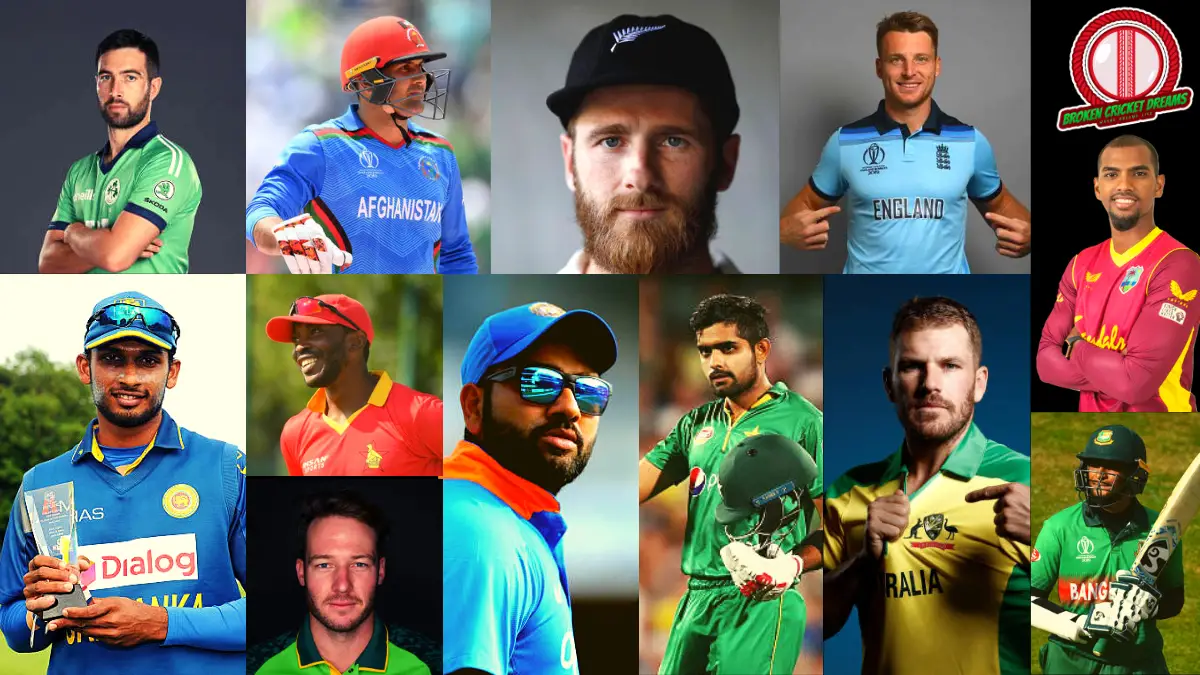
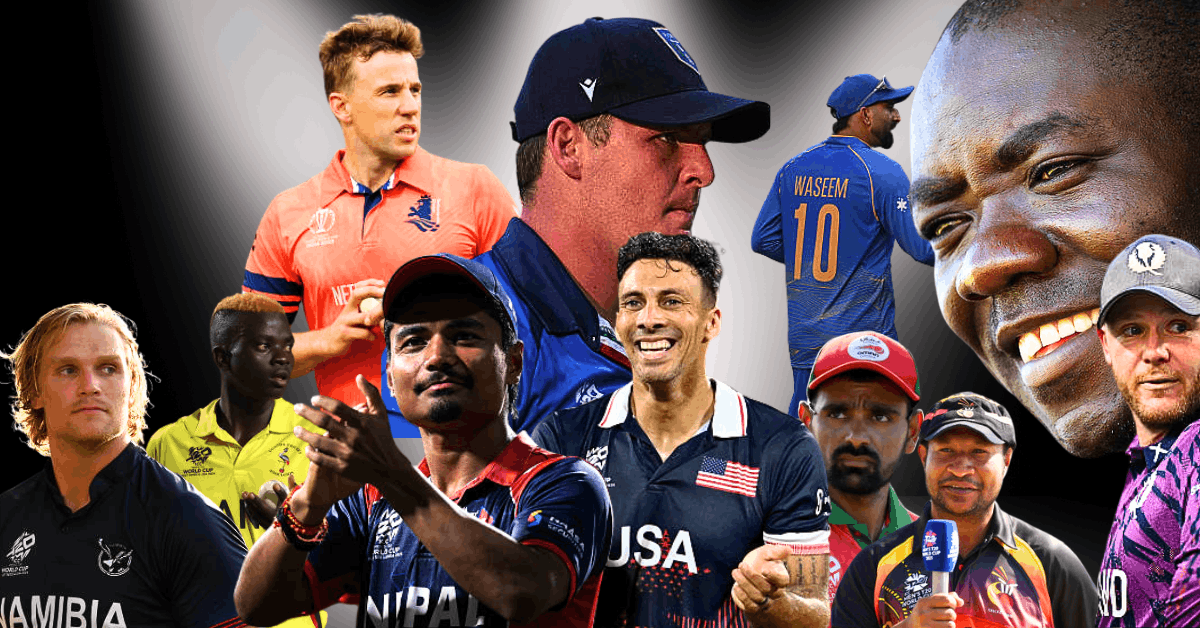
Which 10 Teams Will Play in the 2023 ICC ODI Cricket World Cup Qualifier? Ireland, Nepal, Netherlands, Oman, Scotland, Sri Lanka, UAE, USA, West Indies, and Zimbabwe will compete in the 2023 ICC ODI Cricket World Cup Qualifier.
Get ready for an exhilarating journey as we dive into our complete guide to the 2023 ICC ODI Cricket World Cup Qualifier!
This article will provide you with an in-depth look at the ten teams competing for a coveted spot in the upcoming World Cup. We’ll explore their squads, examine the schedule and fixtures, and offer a comprehensive preview of what’s in store for cricket fans worldwide.
Let’s begin!
2023 ICC ODI World Cup Qualifier Teams: Road to the 2023 ICC Men’s Cricket World Cup
32 teams began their journey for 10 spots for the 2023 ODI World Cup.
Teams played in the ODI Super League, World Cup League 2, Challenge League, and Qualifier Play-off (from the Challenge League) to get to the qualifiers. Here’s a quick summary of the road to the 2023 World Cup Qualifier.
ODI Super League: Ranked 1-13 (Top 7 teams plus hosts India qualified directly for the World Cup, Bottom 5 in the World Cup Qualifier)
New Zealand, England, Bangladesh, India (hosts), Pakistan, Australia, Afghanistan, South Africa qualify directly for the 2023 ICC ODI World Cup.
West Indies, Sri Lanka, Ireland, Zimbabwe, Netherlands will have to compete in the ICC World Cup Qualifier.
League 2: Ranked 14-20 (Top 3 qualify for this ICC World Cup qualifier, Bottom 4 play the Qualifier Play-Off)
Scotland, Oman, Nepal qualify directly for the World Cup qualifier.
Namibia, United States, United Arab Emirates, Papua New Guinea had to go through the Qualifier Play-off.
Challenge League: Ranked 21-32 (Top 2 qualify for the Qualifier Play-Off)
Canada, Jersey qualify for the Qualifier play-off.
Other Teams: Singapore, Denmark, Malaysia, Vanuatu, Qatar, Hong Kong, Kenya, Uganda, Jersey, Bermuda, Italy (eliminated)
Qualifier Play-Off
United States & United Arab Emirates qualify for the World Cup qualifiers.
Namibia, Canada, Jersey, Papua New Guinea eliminated.
What is the Format for the 2023 ICC Cricket World Cup Qualifier?
Ten teams are divided in two groups of five.
The group stage will be in round-robin format and top three of each group will qualify for the Super Six stage.
Each team will play three matches in the Super Six stage (will play teams who were in the other Group Stage) and the Top 2 teams in the Super Six stage will qualify for the World Cup.
There will be a final on 9 July, 2023 but will have no impact on qualification.
How Many Matches Will be Played in the 2023 ODI World Cup Qualifier?
34 matches will be played in the 2023 ICC ODI World Cup qualifiers.
This includes 9 Super 20 group matches, nine Super-Six matches, four place play-off games, and one final.
Where will the 2023 ICC ODI Cricket World Cup Qualifier be played?
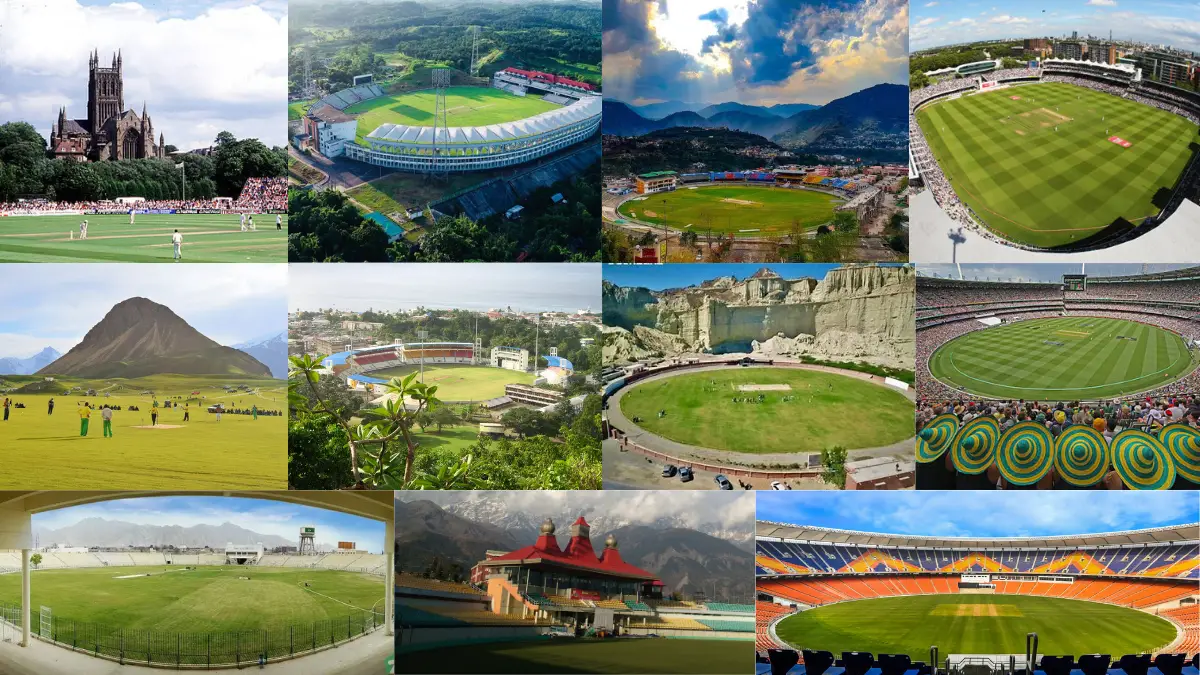
The 2023 ICC ODI World Cup Qualifier will be held in Zimbabwe. 4 venues will host the qualifier, two each in Harare and Bulawayo.
The four stadiums where the 2023 ICC ODI Cricket World Cup Qualifier is to be played are Harare Sports Club (Harare), Takashinga Sports Club (Harare), Queens Sports Club (Bulawayo), and Bulawayo Athletic Club (Bulawayo).
Matches in Group A will be played in Harare, while matches in Group B will be played in Bulawayo.
The Super Sixes will be played in Harare Sports Club and Queens Sports Club. The 7th Place Play-off & 9th Place Play-off will be held at Takshinga Sports Club.
How They Got Here: #1 in Qualifier Play-Off (League 2 Ranking: #5)
Captain: Monank Patel (WK)
Squad: Aaron Jones, Ali Khan, Jessy Singh, Nosthush Kenjige, Sushant Modani, Saiteja Mukkamalla, Saurabh Netravalkar, Abhishek Paradkar, Nisarg Patel, Kyle Phillip, Shayan Jahangir, Gajanand Singh, Steven Taylor, Usman Rafiq
Prediction: Should make the Super Six given their recent rise. Might give a run for their money in the Super Six, but they will probably not make the Top 2.
Squad: Mark Adair, Curtis Campher, Gareth Delany, George Dockrell, Graham Hume, Josh Little, Andy McBrine, Barry McCarthy, Peter Moor (WK), Paul Stirling, Harry Tector, Loran Tucker (WK), Ben White, Craig Young
Prediction: Also one of the favorites, but may end up #3-4 in Super Six due to the tough competition
How They Got Here: #1 in League 2 (Direct Qualification)
Captain: Richie Berrington
Squad: Matthew Cross (WK), Alasdair Evans, Chris Greaves, Hamza Tahir, Jack Jarvis, Michael Leask, Tomas Mackintosh, Christopher McBride, Brandon McMullen, George Munsey, Adrian Neill, Safyaan Sharif, Chris Sole, Mark Watt
Prediction: Just like Ireland, will be in the running for the Top 2 spot but may not make it
ICC ODI Cricket World Cup Qualifier Fixtures & Schedule – Group Stage (June 18, 2023 – June 27, 2023)
Date
Team 1
Team 2
Group
Venue
June 18, 2023
Zimbabwe
Nepal
A
Harare Sports Club (Harare)
June 18, 2023
West Indies
USA
A
Takashinga Sports Club (Harare)
June 19, 2023
Sri Lanka
UAE
B
Queens Sports Club (Bulawayo)
June 19, 2023
Ireland
Oman
B
Bulawayo Athletic Club (Bulawayo)
June 20, 2023
Zimbabwe
Netherlands
A
Harare Sports Club (Harare)
June 20, 2023
Nepal
USA
A
Takashinga Sports Club (Harare)
June 21, 2023
Ireland
Scotland
B
Queens Sports Club (Bulawayo)
June 21, 2023
Oman
UAE
B
Bulawayo Athletic Club (Bulawayo)
June 22, 2023
Nepal
West Indies
A
Harare Sports Club (Harare)
June 22, 2023
Netherlands
USA
A
Takashinga Sports Club (Harare)
June 23, 2023
Oman
Sri Lanka
B
Queens Sports Club (Bulawayo)
June 23, 2023
Scotland
UAE
B
Bulawayo Athletic Club (Bulawayo)
June 24, 2023
Zimbabwe
West Indies
A
Harare Sports Club (Harare)
June 24, 2023
Nepal
Netherlands
A
Takashinga Sports Club (Harare)
June 25, 2023
Ireland
Sri Lanka
B
Queens Sports Club (Bulawayo)
June 25, 2023
Oman
Scotland
B
Bulawayo Athletic Club (Bulawayo)
June 26, 2023
Zimbabwe
USA
A
Harare Sports Club (Harare)
June 26, 2023
Netherlands
West Indies
A
Takashinga Sports Club (Harare)
June 27, 2023
Scotland
Sri Lanka
B
Queens Sports Club (Bulawayo)
June 27, 2023
Ireland
UAE
B
Bulawayo Athletic Club (Bulawayo)
ICC ODI Cricket World Cup Qualifier Fixtures & Schedule – Super Sixes Stage (June 29, 2023 – July 7, 2023)
Date
Team 1
Team 2
Venue
June 29, 2023
A2
B2
Queens Sports Club (Bulawayo)
June 30, 2023
A3
B1
Queens Sports Club (Bulawayo)
July 1, 2023
A1
B3
Harare Sports Club (Harare)
July 2, 2023
A2
B1
Queens Sports Club (Bulawayo)
July 3, 2023
A3
B2
Harare Sports Club (Harare)
July 4, 2023
A2
B3
Queens Sports Club (Bulawayo)
July 5, 2023
A1
B2
Harare Sports Club (Harare)
July 6, 2023
A3
B3
Queens Sports Club (Bulawayo)
July 7, 2023
A1
B1
Harare Sports Club (Harare)
ICC ODI Cricket World Cup Qualifier Fixtures & Schedule – Playoff Stage
Date
Playoff
Venue
June 30, 2023
7th Place Playoff Semi-Final
Takashinga Sports Club (Harare)
July 2, 2023
7th Place Playoff Semi-Final
Takashinga Sports Club (Harare)
July 4, 2023
7th Place Playoff
Takashinga Sports Club (Harare)
July 6, 2023
9th Place Playoff
Takashinga Sports Club (Harare)
ICC ODI Cricket World Cup Qualifier Fixtures & Schedule – The Final
Date
Final
Venue
July 9, 2023
TBD vs TBD
Harare Sports Club (Harare)
ICC ODI Cricket World Cup Qualifier – FAQs
Which teams will play in the 2023 ICC ODI Cricket World Cup Qualifiers?
Ireland, Nepal, Netherlands, Oman, Scotland, Sri Lanka, UAE, USA, West Indies, and Zimbabwe will compete in the 2023 ICC ODI Cricket World Cup Qualifier.
Where is the 2023 ICC ODI Cricket World Cup held?
The 2023 ICC ODI Cricket World Cup is held in Zimbabwe. It will be hosted in Harare and Bulawayo with four different stadiums in total (two in each city).
How many teams will qualify from the ODI World Cup Qualifiers to the main draw of the World Cup?
Only two teams will qualify for the 2023 ICC ODI World Cup to be held in India in October.
Which teams are favorites to qualify for the World Cup?
West Indies, Sri Lanka, Ireland, Scotland, and Zimbabwe are the favorites to get the two sports for the 2023 ODI World Cup.
Photo Credits: Original photo by Johan Rynners (ICC/ICC via Getty Images)
Are you curious to learn how many World Cups has Australia won? Here’s a quick answer—Australia has won a mammoth 26 World Cups & ICC tournaments across formats!
Welcome to our comprehensive guide on Australia’s exceptional cricketing achievements.
Last week, Australia defeated India to complete the only remaining trophy on their cabinet—The 2023 World Test Championship.
In this article, we’ll dive into the complete list of ICC trophies won by the mighty Aussies, including their World Cup triumphs in both Men’s and Women’s cricket, T20I victories, ODI successes, and U-19 accomplishments.
So, whether you’re an avid cricket fan or simply curious about Australia’s prowess on the pitch, we’ve got you covered with all the fascinating details. Let’s dive in and explore the rich legacy of Australian cricket!
Key Takeaways
Australia has won a total of 26 world tournaments in cricketout of 65 tournaments, a whopping 40%! (14 Under-19 World Cups, 12 Men’s ODI World Cups, 12 Women’s ODI World Cups, 8 Men’s T20 World Cups, 8 Women’s T20 World Cups, 8 Champions Trophies, 2 World Test Championships, and 1 Commonwealth Games). They have been in the finals on 34 occasions (52.3 %).
Australian women have lifted the trophy 14 times, the senior men’s side has won on 9 occasions, and the Under-19 men’s side has won a total of 3 times. This includes 7 Women’s ODI World Cup (1978, 1982, 1988, 1997, 2005, 2013, 2022), 6 Women’s T20 World Cups (2010, 2012, 2014, 2018, 2020, 2023), 5 Men’s ODI World Cup (1987, 1999, 2003, 2007, 2015), 3 Under-19 Men’s ODI World Cups (1988, 2002, 2010), 2 Champions Trophies (2005, 2009), 1 Commonwealth Gold (2022), 1 Men’s T20 World Cup (2021), and 1 World Test Championship (2023).
Meg Lanning has been Australia’s most successful captain, winning ICC trophies on six occasions (2014, 2018, 2021, 2023 T20 World Cups, 2022 Commonwealth Gold, 2023 ODI World Cup) followed by Ricky Ponting – 4 (2003, 2007 ODI World Cups, 2006 & 2009 Champions Trophy).Sharon Tredrea, Belinda Clark, and Jodie Fields have won two World Cups each as well.
The Australian cricket team has been 8 runners-up times. This includes twice each in the Women’s ODI World Cup (1973, 2000), Men’s ODI World Cup (1975, 1996), and Under-19 World Cup (2012, 2018), and once each in Men’s T20 World Cup (2010) and Women’s T20 World Cup (2016).
Fun Fact: In finals they have won, Australia’s favorite opposition has been England (8 times) followed by New Zealand (5), India (4), Pakistan (3), West Indies, and South Africa (2). They have won World Cups in almost every cricketing country – India, New Zealand, Australia, South Africa, England, West Indies, Sri Lanka, Bangladesh, and the UAE.
Australia’s cricketing prowess is nothing short of extraordinary, with a total of 26 world tournament victories and 8 runner-up finishes. Their impressive trophy cabinet boasts 7 Women’s ODI World Cups, 6 Women’s T20 World Cups, 5 Men’s ODI World Cups, 3 Under-19 Men’s ODI World Cups, 2 Champions Trophies, 1 Commonwealth Gold, 1 Men’s T20 World Cup, and 1 World Test Championship.
These remarkable achievements showcase the Australian cricket team’s consistent dominance on the international stage, making them a force to be reckoned with.
As we celebrate their cricketing legacy, we eagerly anticipate what the future holds for this exceptional team and the exciting milestones they are yet to conquer!
Australia’s World Cup Wins – Frequently Asked Questions (FAQ)
1. How Many times has Australia won the Cricket World Cup and other ICC trophies?
Australia have won 26 world tournaments in cricket. This includes 7 Women’s ODI World Cup (1978, 1982, 1988, 1997, 2005, 2013, 2022), 6 Women’s T20 World Cups (2010, 2012, 2014, 2018, 2020, 2023), 5 Men’s ODI World Cup (1987, 1999, 2003, 2007, 2015), 3 Under-19 Men’s ODI World Cups (1988, 2002, 2010), 2 Champions Trophies (2005, 2009), 1 Commonwealth Gold (2022), 1 Men’s T20 World Cup (2021), and 1 World Test Championship (2023).
2. How many times has Australia’s men team won the Cricket World Cup across formats?
Australia men’s cricket team has won five ODI cricket World Cups (1987, 1999, 2003, 2007, 2015). They have also won one T20 cricket World Cup (2021) and one World Test Championship (2023). In addition, they have also won 2 ICC Champions Trophy and 3 Under-19 World Cups.
3. How many cricket World Cups has Australia women’s team won across formats?
Australia women’s cricket team has won 7 ODI cricket World Cups (1978, 1982, 1988, 1997, 2005, 2013, 2022), 6 T20 World Cups (2010, 2012, 2014, 2018, 2020, 2023), and one Commonwealth Gold (2022).
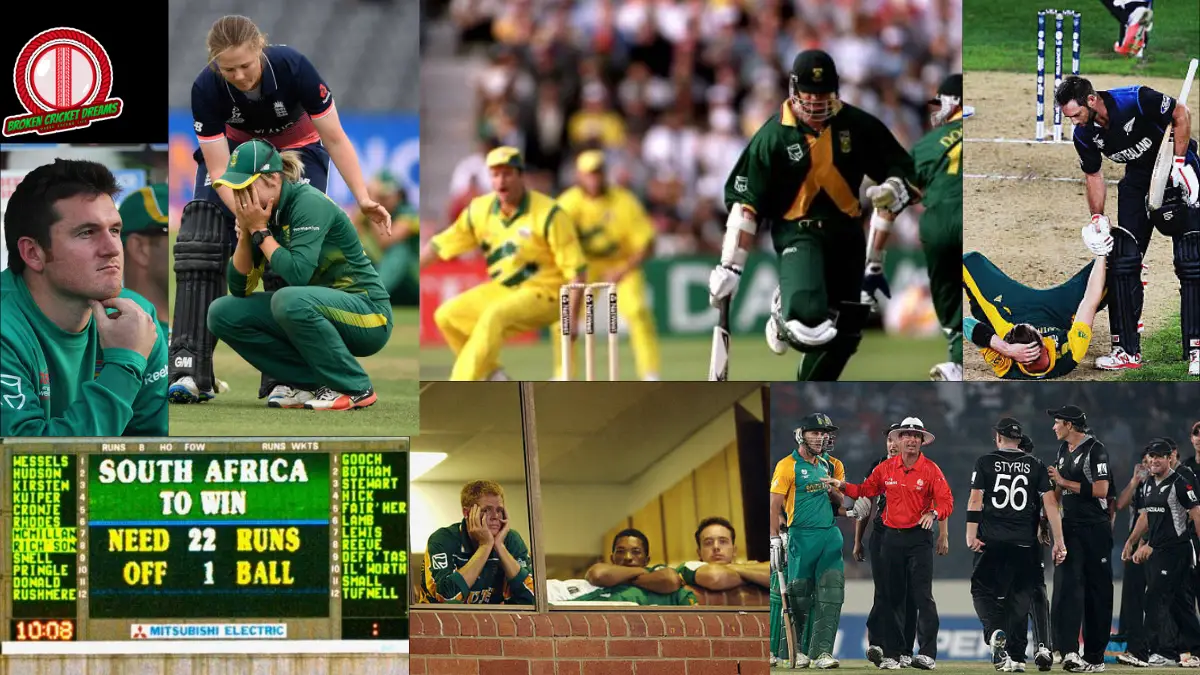
South Africa World Cup Chokes, a phrase we have often heard before, maybe too often.
I personally do not like the ‘choker’ term, but there is a reason why the Proteas have earned this tag—rain interruptions, inexplicable collapses, internal politics, dropped catches & runouts, mathematical errors, and sometimes they just don’t show up on the big day. So, to refresh your memories, here is the List of Top 21 South Africa World Cup Chokes & Heartbreaks—Men & Women Combined.
Top 21 List of South Africa World Cup Chokes
Here is the complete list of South Africa’s heartbreaks.
The heartbreaks of all heartbreaks. 8 runs needed in 1 over, 1 wicket remaining. Lance Klusener, in the form of his life, hits two fours. 1 run needed in 4 balls. Klusener – 31*(14). Surely, Proteas has one foot in the finals. Unfortunately, not enough feet as Klusener calls for a panic run, Allan Donald ball watches, runs late, and gets run out. Match Tied. The tie breaker? The Super Six match between Australia and South Africa, which Australia won, most famously known for Steve Waugh’s comment to Herschelle Gibbs, “You just dropped the World Cup.”Waugh went on to make a century and Australia won that clash.
Well on the field, you cannot really blame South Africa. With the bat, Faf-ABD-Miller got South Africa to a massive total in a, wait for it, rain curtailed game. NZ had less overs to chase, Baz went all out, Grant Elliot played the innings of his life, and Dale Steyn was on his feet at the end.Rain had arrived when SA were cruising at 216/3 in 38 overs. They got 281 in 43, but NZ magnificently chased 299 (DL).
What’s the fuss with DL method? Or the DLS vs VJD methods? Well, long, long time ago these rules did not exist. 22 needed in 13. Anyone’s game. Rain intervened for a short 10-minute break. Next thing you know, South Africa need 22 runs in 1 ball. Explain that.
Virat Kohli, Axar Patel, and Shivam Dube had scratched up to 176 after being 3/34. South Africa kept coming back with Maharaj’s wickets, Quinton de Kock’s run out, and brilliant fielding throughout. On the batting front, Stubbs-de Kock manufactured a comeback after being down 2/12. Surely, they had the belief this time. They had held their nerve in all of their close matches so far. Then, came Klaasen’s historic knock. He blew Axar Patel’s away and was on a 51*(23). One of the best innings in a World Cup Final. 27 was needed of 28, 6 wickets in hand. Then, Hardik Pandya dismissed Klaasen with a wide one and Jasprit Bumrah did what Bumrah always does. Kept it tight, didn’t give anything away, and bowled a gem of a delivery to dismiss Jansen. Arshdeep came in and Maharaj got stuck. At the end, the last hope, Miller skied a wide one and Suryakumar Yadav took the catch of the final. The Proteas short by 7 runs. Short , once again.
Myburgh, Max O’Dowd, Colin Ackermann, Tom Cooper, and Scott Edward’s little contributions took Netherlands to 158/4. Quick start by the Proteas but regular wickets and THAT CATCH by former South African cricketer, Roelof van der Merwe meant SA could only get to 145/8.From top of the group to crashing out. They only needed to win one game of the last two and they failed. The No-Result vs Zimbabwe will pinch them as well.“
6. 2003 World Cup Group Stage Exit (Math/DL Method)
1, 0, 0, 5 wides, 1, SIX!, 0, RAIN. Match Tied. South Africa eliminated in the group stage at a home world cup.
Murali bowling to Klusener-Boucher. Last ball-Dot. Reason? South Africa management had miscalculated the DL method and stayed at 229. Had they taken a single, SA would have qualified for the next round.
When asked captain Shaun Pollock in the post-match presentation whether there was any confusion over DL calculations, Pollock replied with “Yeah, Boucher was given a message of 229.”
“So for the second time in a row, South Africa exited with a Tied game. South Africa and the public couldn’t believe it. One run the difference between success and failure.”
In a chase of 157, South Africa were 109/3 with Laura Wolvaardt at 61*. South Africa finally believed after Australia had dominated throughout on the back of Beth Mooney’s 74*. In comes Schutt. Wolvaardt departs. Despite Chloe Tryon’s best efforts, South Africa still fell 19 runs short.
Chasing 299, South Africa were 209/6 in 39.3 overs. They had a mini-collapse earlier, but Annerie Dercksen started to provide Laura Wolvaardt much needed support. They were behind the rate, but the match could have gone down the wire.
But it was not to be. After Dercksen’s dismissal and Wolvaardt’s century, back-to-back wickets meant that they collapsed and lost by 52 runs.
Earlier, there were dropped catches, which took India to a competitive 298. 3rd World Cup Final loss in a row.
New Zealand came out aggressive, and South Africa were a bit loose in the field. No balls, wides, misfields, and great display of batting from Halliday, Kerr, and Bates got the White Ferns to 159. However, Wolvaardt & Brits started positively getting to 51/0 in 6.4 overs. Without another 108 runs needed in 80 balls with 10 wickets in hand, they were right in it. Then, Brits lost her wicket, Tahuhu bowled a 1-run over, and pressure got to Wolvaardt. Amelia Kerr took both Laura & Anneke’s wickets in the same over, and South Africa never recovered.
To beat the great Australian team in the semi-finals, and still lose their 2nd consecutive Finals (3rd including Men’s) will surely hurt.
Meg Lanning gets Australia to 134/5. Runs on the board, but still chaseable with South Africa’s solid batting order. But then, rain intervened. Again. And now they needed 98 in 13 overs, much more challenging with the higher required rate.Laura Wolvaardt played a gem of a knock 41* (27) and brought it down to 19 off 6, but unfortunately, no Carlos Brathwaite moment for them.
South Africa scored a competitive 218. South Africa defending their last over – Dropped dot ball, 1, Wicket, Four. Another last over heartbreak. The difference between the sides? Extras.4 given by England and 25 by South Africa.
Small total to chase, good partnership. All looking good. Then some harsh fighting on the field, a run-out, and the collapse. Perfect ingredients for the ideal South African choke.
From 108-2 in 24 overs to 172 all out in the small chase of 222.
4 wins out of 5. Net Run Rate of +0.739. Temba Bavuma unites the team after Quinton de Kock sits out. Surely, nothing can stop them now? Nope. England & Australia both won 4/5 and had an EVEN BETTER net run rate. The Stoinis-Wade partnership in the low scoring first match hurt South Africa.
In their final match against England, they had scored 189/2 and won against the great English side. Even that wasn’t enough as they had to restrict England to 131 to get their NRR high enough.
India won this one comfortably. South Africa could only get to 116 in chase of 154. Had they got 10 more runs, they would have qualified to the semi-finals of the inaugural T20 World Cup, but lost out due to NRR yet again.
South Africa could only score 101, while England’s stalwarts Sarah Taylor, Charlotte Edwards, and Heather Knight breezed through the chase in 16.5 overs.
Why are South Africa called ‘Chokers’ in world cricket? South Africa have failed to qualify due to rain & nerves in 1992, 1999, 2007, 2011, and 2015 ODI World Cups along with 2007, 2009, 2014, and 2022 T20 World Cups, 2014, 2022 Women’s T20 World Cup and 2000, 2017, and 2022 Women’s ODI World Cups.
Comment below on your thoughts about South Africa World Cup Chokes and Heartbreaks! Also, feel free to checkout some of our other recent articles.
Is there a thing such as the best ODI World Cup format?
Ireland Vs England, 3rd ODI. What a game yesterday. Twin centuries by the seniors Paul Stirling and Andy Balbirnie with ample support from Harry Tector and the evergreen Kevin O’Brien, Ireland chased 329 against the World Cup holders, albeit without the likes of Stokes, Butler, and Archer.
That certainly does not take anything away from Ireland and breathes life into the new ODI Super League. So it is ideal to reflect on the ODI World Cup Super League (WSL) and current World Cup format now.
Does the ODI Super League and the World Cup provide enough exposure to grow cricket worldwide?
In a scathing review of the 2019 Cricket World Cup (CWC) format, the late Martin Crowe wrote an article proposing an innovate format where the teams and audience both benefit while the game still grows. The 40-over World Cup would consist of a pre-tournament qualifier, a two group conference based competition involving 18 teams, followed by a best of three semi-final and a Grand Finale. Although we provide another solution, this is a good template to reference.
As a whole, I think the ODI Super League is a good idea. The top 13 teams in the world play a total of 8 three-match series (4 home/ 4 away) for a total of 24 games. The top 7 sides, along with the next World Cup hosts, qualify automatically for the World Cup, while the bottom five along with 5 associate play a qualifying tournament for the final two spots. This sounds a balanced format, unlike the World Test Championships, but the WSL still has major flaws.
Currently, the 12 test-playing nations are permanent ODI members, while the next 8 teams have temporary ODI status, with only one, the Netherlands qualifying for the ODI Super league.
In what world does this make any sense? If anything, the teams with temporary ODI status should have more exposure to the game so they can prove that they deserve the status. If only one out of the 8 teams is given a chance, it is likely that the one team will get better while the others lose their ODI status and eventually, their respective golden generations.
Finally, the qualifying tournaments in cricket do not provide any value. More often then not, the Associate Teams battle out the qualifiers, where several good teams miss out due to D/L method or a couple of tight games. Even Test-playing nations like Zimbabwe and Ireland missed out on the 2019 World Cup. Simply, the system is rigged against the Associate and lower-ranked nations.
What Should Happen
The current World Cup Super League should be expanded to all 20 teams, and the qualifying tournament should be eliminated altogether. More games should be allocated to the league so each team gets to play an equal number of opponents in each ranking tier (Tier 1: Rank 1-7, Tier 2: Rank 8-14, Tier 3: Rank 15-20). At the end of the four-year period, the top 15teams qualify for the world cup automatically.
ODI World Cup Format
Group Stage: 3 Groups, 5 Teams Each – Top 3 from group qualify to the next round (30 games)
Super 9s: 3 groups, 3 Teams Each – Groups contain teams that have not played each other earlier (9 games)
Semis + 3rd Place Play-off: Top 3 + 4th ranked team from Super 9s (3 games)
Grand Finale: 1 game
Benefits:
Each team plays at least 4 games, so neither do we see a repeat of the 2007 World Cup where both India/Pakistan were eliminated prematurely, nor do we see several one-sided affairs.
15 teams participate – the game grows
Each match is meaningful
Tournament is 43 matches long, five less than current format. Not quite Martin Crowe’s 18-team vision, but still a valid proposal.
Conclusion
The argument for the 2019 World Cup was that it would be competitive. At the end, only about 10 out the 48 games were close, it took Sri Lanka upsetting England 2 weeks in the tournament for the world cup to open up, and the 4-pre tournament favorites made the semi-finals. If we could just detach ourselves from that final, we could sum 2019 CWC in one word— Predictable.
Meanwhile, Ireland chased 300+ vs England (2011) and West-Indies (2015), Scotland upset England on the eve of the World Cup, and Afghanistan’s rise is a shining example. What else do the Associate nations need to do?
What is your ideal ODI world cup format? Please comment below and don’t forget to share and subscribe for more!
Create an All-time XI with the twist that you can pick only one player from each World Cup. Since we have 12 world cups to choose from, we will create a XI with a 12th player. There are multiple players who have shined in each of cricket’s finest ODI tournament, but who do you pick-the best batsman, bowler, player of the series, or the inspirational captain?
The catch:
How would you go about choosing between Martin Crowe and Wasim Akram in ’92, Lance Klusener and Shane Warne in ’99, or more recently between Kane Williamson, Rohit Sharma, Mitchell Starc, and the infallible Ben Stokes in 2019? Whatever it is, this is bound to be a fun ride.
Before we reveal our XI, let’s refresh our memory with relevant statistics regarding the highest run-scorer, wicket taker, player of the series, and captain of the winning team from each cricket world cup.
World Cup – Year
Most runs (runs scored)
Most Wickets (wickets taken)
Player of the series
Winning Captain
1975
Glenn Turner (333)
Gary Gilmour (11)
N/A
Clive Lloyd
1979
Gordon Greenidge (253)
Mike Hendrick (10)
N/A
Clive Lloyd
1983
David Gower (384)
Roger Binny, Ashantha de Mel (18)
N/A
Kapil Dev
1987
Graham Gooch (471)
Craig McDermott (18)
N/A
Allan Border
1992
Martin Crowe (456)
Wasim Akram (18)
Martin Crowe
Imran Khan
1996
Sachin Tendulkar (523)
Anil Kumble (15)
Sanath Jayasuriya
Arjuna Ranatunga
1999
Rahul Dravid (461)
Geoff Allott, Shane Warne (20)
Lance Klusener
Steve Waugh
2003
Sachin Tendulkar (461)
Chaminda Vaas (23)
Sachin Tendulkar
Ricky Ponting
2007
Matthew Hayden (659)
Glenn McGrath (26)
Glenn McGrath
Ricky Ponting
2011
Tillakarante Dilshan (500)
Shahid Afridi, Zaheer Khan (21)
Yuvraj Singh
Mahendra Singh Dhoni
2015
Martin Guptill (547)
Mitchell Starc, Trent Boult (22)
Mitchell Starc
Michael Clarke
2019
Rohit Sharma (648)
Mitchell Starc (27)
Kane Williamson
Eoin Morgan
ODI World Cup Statistics
Our All Time XI:
Graham Gooch (1987)
Sachin Tendulkar (2003)
Kane Williamson (2019)
Martin Crowe (1992)
MS Dhoni (2011) – WK
Clive Lloyd (1979) – Captain
Arjuna Ranatunga (1996)
Lance Klusener (1999)
Kapil Dev (1983)
Mitchell Starc (2015)
Glenn McGrath (2007)
Glenn Turner (1975)
Honorable Mentions: Matthew Hayden, Ricky Ponting, Wasim Akram, Kumar Sangakkara (most World Cup dismissals and 4 centuries in 2015)
Note, we chose MS Dhoni at the expense of Yuvraj Singh in order to have a wicket-keeper in the side. We decided not to factor great finals’ innings like Ben Stokes in 2019 and Adam Gilchrist in 2017…’Great World Cup Innings’ would have to wait till a later post.
In any case, choosing from the great 1975-1983 West Indian and 1999-2015 Australian sides was always going to be a difficult task anyway…
Agree? Disagree? In any case, let us know in the comments below what your ideal Cricket World Cup XI would be.
For more articles in our series World XIs – With Twists, check this page out!
Stay tuned for new fantasy teams, and please share and subscribe below!