Four years ago I was really excited when the idea of the World Test Championship came out. I mean, it was partially a reason for me to start this blog.
However, with the recent overseas wins of NZ in India, SA in Bangladesh, and Bangladesh in Pakistan—that hope has rekindled.
Therefore, this is a good time for us to revisit the WTC alternative points table algorithm my friend and I had created four years ago to create a more balanced system. For this WTC cycle, I analyzed each of the 51 Test matches and 578 completed sessions one-by-one so you don’t have to.
Before we start, he is a quick refresher on how our alternative points table worked.
Our WTC points table algorithm (1) distributes points on a session-by-session basis rather than an all-or-nothing system for a Test match, (2) includes Home/Away points for both wins & draws, and (3) includes a bonus to reward massive victories (Test match net run rate equivalent).
Points are calculated as follows:
2 points per session won, 1 point per session Tied
There are 15 maximum sessions in a Test (3 sessions per day), so 30 points maximum per Test for the session-by-session category
The details of the algorithm used to decide who won each session is outlined in the original article and is left as an exercise to the reader.
Bonus: 2 * (Number of Sessions Remaining)
Example: If the Test finishes at the end of Day 4, the winning team would get 6 bonus points – (2 * (3 sessions remaining))
Home/Away
Away wins and away draws would be awarded more points.
16 – Home Win, 8 – Home Draw
24 – Away Win, 12 – Away Draw
The maximum points a team could earn per Test is outlined below (Example: 24 – away win points + 30 session points = 54 total if the team won all the sessions).
Points
Win
Draw
Loss
Maximum Points Possible (Per Match)
Home
16
8
0
46
Away
24
12
0
54
Average*
20
10
0
50
Home & Away Points
Finally, since each team plays a different number of matches, we will take a percentage determined by (total points earned)/(maximum points possible*).
The maximum points possible will be determined by (number of matches played * 50), where we choose 50 because it is the average between 46 & 54 and would hence, weight away wins & draws more.
I coded this algorithm in R & Python and double checked the calculations by hand for the session-by-session analysis.
🇦🇺 BEAT 🏴 by 2 wickets, Birmingham 🇦🇺 BEAT 🏴 by 43 runs, Lord’s 🇮🇳 BEAT 🌴 by inn & 141 runs, Roseau 🇵🇰 BEAT 🇱🇰 by 4 wickets, Galle 🇵🇰 BEAT 🇱🇰 by inn & 222 runs, SSC 🇳🇿 BEAT 🇧🇩 by 4 wickets, Mirpur 🇮🇳 BEAT 🇿🇦 by 7 wickets, Cape Town 🌴 BEAT 🇦🇺 by 8 runs, Brisbane 🏴 BEAT 🇮🇳… pic.twitter.com/b55YlIHHzZ
— Broken Cricket Dreams Cricket Blog (@cricket_broken) November 10, 2024
Key Takeaways
45% (23/51) WTC matches in this cycle so far have been won by away teams.
England (79) & India (76) won the most sessions so far, while Australia (47) have tied the most sessions. West Indies (24) & Bangladesh (29) have had the least session wins in this cycle of the WTC so far
We have had a spectacular run of dramatic overseas victories. Each team has had at least one overseas win:
South Africa 1-0 in West Indies & 2-0 in Bangladesh
Australia won 2 Tests each in England & New Zealand
Bangladesh won in Pakistan 2-0
Pakistan won 2-0 in Sri Lanka
Sri Lanka won 2-0 in Bangladesh and a Test in England
England won one Test each in India & Pakistan
The India vs South Africa Test at Cape Town was the shortest Test ever, lasting only 5 sessions.
South Africa won all 9 out of 9 sessions in the recent 2nd Test vs Bangladesh and received the maximum possible 54 points for the Test in our points system.
WTC 2023-2025 Alternative Points Table – Results
Here is our alternative WTC 2023-25 points table at a glance.
Team
Total Points
AverageMax Points Possible*
BCD Percentage
Actual WTC Percentage
Australia
379
600
63.17%
62.50%
India
410
700
58.60%
58.33%
South Africa
233
400
58.25%
54.17%
Sri Lanka
239
450
53.11%
55.56%
New Zealand
277
550
50.36%
54.55%
England
411
950
43.26%
40.79%
Pakistan
206
500
41.2%
33.33%
Bangladesh
162
500
32.4%
27.50%
West Indies
122
450
27.11%
18.52%
*Note: We have added the same over-rate deductions as the current WTC table does (19 for England, 10 – Australia, 8 – Pakistan, 3 – Bangladesh 2 – India)
Observations
Our points table heavily rewards South Africa, who have dominated 3 overseas Tests (1 vs WI, 2 vs Bangladesh).
Sri Lanka are close by with 3 overseas Tests wins as well (2 vs Bangladesh, 1 vs England) but they lost points to Pakistan at home. Similarly, NZ had a good show vs Bangladesh & India away, but lost convincingly 0-2 against Australia (home) & Sri Lanka (away)
The interesting point our points table highlights is showcasing how close a Test match or Test series was. For example, the 2-2 Ashes translates into 132-118 in favor of Australia (due to overseas wins and draw).
In addition, no two Test series are alike.
The Pakistan-Bangladesh 2-Test series (where Pakistan batted well initially and even declared) resulted in 84-24 points in favor of Bangladesh. This series was closer than the SA-Ban series (101-7 in favor of SA), where SA completely decimated Bangladesh.
Appendix: WTC 2023-25 Match By Match Break Down
If you want to look at the particular series or team, here is a table of content organized by home team for easier access:
In The Alchemist, a young shepherd named Santiago from the Andalusian region of Spain leaves his simple life to chase a dream, which he calls his ‘Personal Legend.’
He embarks on a journey of self-discovery filled with unexpected twists and turns.
Along the way, he learns several life lessons. One of my favorites is,
“When you want something, all the universe conspires in helping you achieve it.”
– Paul Coelho, The Alchemist
****
New Zealand Lift the 2024 T20 Women’s World Cup
Just like Santiago, today we celebrate Sophie Devine’s incredible journey. After 14 long years, the universe has conspired to help Sophie Devine finally lift the T20 World Cup Trophy, this time as captain.
Remember, the White Ferns narrowly missed out on World cup glory in the inaugural 2009 and 2010 T20 World Cup editions.
What Happened in the 2010 T20 World Cup Final, You Ask?
14 years ago, the Boot Happened.
The Boot? Yes, the boot.
Specifically, Ellyse Perry’s boot.
5 runs needed in the final ball, 4 runs for a Super happen. Watch what happens yourself.
Sophie hit a crisp straight drive, only to be denied by Ellyse Perry.
She was stranded on 38*, just one hit away from a World Cup.
Sophie Devine must have been devastated. Unfortunately, it was not meant to be. In her own words,
“I have had nightmares about that Ellyse Perry right boot. Think we were so close in that match.”
Her love for sports came through her dad, who was also her first coach. She grew up playing all sorts of different sports but cricket & field hockey took center stage as she entered university.
She became the White Ferns captain in 2020 during the form of her life and the 2024 T20 World Cup was to be her last T20 tournament as captain.
“It’s Only Those Who are Persistent, and Willing to Study Things Deeply, who Achieve the Master Work.”
Devine wasn’t always the power-hitting batter we now come to think of.
She actually burst onto the scene as a young 17-year old bowler who batted at #11.
In T20Is, she wouldn’t play a major match-winning innings until she was promoted to #4 in 2010, scoring 35 & 48 against Australia. She would score her first fifty in 2012. Devine didn’t even play a single ODI between 2010 and 2013. She would make an ODI comeback in 2013 and score her first ODI hundred, a magnificent 145, that too in a World Cup.
With the ball, she brought her best to the T20 World Cups – 3/18 and 4/22 (semi-final) in 2016, and 3/18 in the 2020 T20 World Cup.
Her evolution in turning herself into a dependable top order batter and one of the greatest all-rounders the world has ever seen is a testament to the hard work and dedication she put in to hone her craft.
Santiago found help in his journey—a merchant under whose tutelage he learned trade skills, a Gypsy who interpreted his dreams, an Englishman who knew alchemy, the love of his life in Fatima that gave him direction, a tribal chief, and many others who guided him along the way.
****
Devine similarly had a cast of members she could depend upon in the 2024 World Cup.
She embraced herself as one of the self-proclaimed ‘grandmas’ of the team. Alongside Devine were Suzie Bates, who became the most capped women’s player across formats (and fun fact, she also represented NZ in the 2008 Olympics as a basketball player) and Lea Tahuhu, once the fastest women bowler in the world.
They also had a cast of up and coming players such as Eden Carson, Georgia Plimmer, Brooke Halliday, Rosemary Mair, and a 24-year old Amelia Kerr who already has eight years of international cricket, an ODI double century, and (now) 188 international wickets to her name.
“The secret of life, though, is to fall seven times and to get up eight times.”
The senior trio must have known deep in their hearts that 2024 was their final chance.
Sophie Devine & Suzie Bates had fallen 8 consecutive times, and this was to be Tahuhu’s 5th T20 World Cup as well. Their recent T20 World Cup record didn’t ooze much confidence.
And there must have been some doubts creeping in as well.
After all, the White Ferns were coming off a 10-match losing streak.
Tahuhu’s economy in the previous 5 matches before the WC hovered between 8-12.5. Bates hadn’t made a half-century for 12 straight games even as an opener. Apart from two fifties, Devine had nothing to show with the bat with scores of 17, 0, 9, 5, 12, 4, and 5 in the entirety of 2024.
In any case, even after falling for eight times and the losing streak, they got up for a 9th time.
And as it would turn out, 9th time was the charm for Devine & Bates.
“Sometimes There is No Way to Hold Back The River”
So, how did the White Ferns manage to win the T20 World Cup against all odds?
Devine’s 57* and Mair’s 4/19 against India set the tone, but the World Cup victory was definitely a team effort.
Amelia Kerr’s historic all-round effort while limping in the final, en route to becoming the player of the tournament, was superhuman. Halliday’s impetus in the final, Tahuhu’s 1-run over that caused South Africa’s collapse, Eden Carson’s semi-final performance (and her interviews), the find of Georgia Plimmer, the spinners’ contribution, Gaze’s gaze behind the stumps, and Maddy Green’s catching, it all added up in the end.
No New Zealand batter made the Top 4 run scorer list (Bates & Plimmer were NZ’s best with 150 runs each at joint #5). With the ball, Kerr was #1 (15 wickets), with plenty of support from Mair (10) and Carson (9).
Fielding was a hallmark of New Zealand’s campaign in an otherwise low catching standard for a World Cup. Bates (7 catches), Maddy Green (6), and Devine (5) dominated the catching charts.
Devine doesn’t necessarily like the cringy ‘Devine intervention’, but this time, maybe it was divine intervention.
Sometimes, what is bound to happen will happen. Sometimes there is no way to hold back the river.
37-year-old Suzie Bates. 35-year-old Sophie Devine.
Two legendary players of New Zealand cricket have won the World Cup, What a day in Cricket ♥️ pic.twitter.com/WYpE8KzXkU
What Can We Learn from Sophie Devine and the White Ferns?
After narrowly missing on the 2010 T20 World Cup win and consecutive World Cup defeats, Devine and Bates never gave up. Sometimes the universe does conspire to reward those who refuse to quit.
I’ll leave you with a final Alchemist quote,
“People are capable, at any time in their lives, of doing what they dream of.”
– Paul Coelho, The Alchemist
It doesn’t matter whether you are beginning your career or are towards the close. It is never too late to dream. Keep on dreaming even if it looks like the hope is fading away.
This is a remarkable victory, one of the greatest in New Zealand’s sporting history for sure. Remember though, more than winning, the journey is important, as it was in both Santiago & Devine’s cases. In Devine’s own words,
“I have played for 17-18 years now. It [World Cup win] will be something that will come with so much loss and hard times but also incredible memories and people along the way.”
– Sophie Devine
And why not end it with my favorite clip of the 2024 T20 World Cup?
The 2024 T20 World Cup is around the corner and only question is in everyone’s mind—Can the mighty Australians be defeated?
In 8 T20 World Cups so far, they have won six, were runners-up and semi-finalists in the other two. West Indies & England are the only other two winners, although India & South Africa have upped their credentials recently in the shortest international format.
The World Cup has been moved from Bangladesh to the UAE, and Scotland are the newest entrants in the Women’s T20 World Cup.
The format? 10 Teams, 2 Groups of 5 followed by semi-finals and a final:
Group A: Australia, India, New Zealand, Pakistan, Sri Lanka
Group B: Bangladesh, England, Scotland, South Africa, West Indies
I went through all 150 players’ ESPNCricinfo profile pages and accumulated this data so you don’t have to. Without further ado, here is a quick snapshot of what you can expect in the Women’s 2024 T20 World Cup.
Key Takeaways
Bangladesh & Scotland are fielding the youngest units (averaging the age of 25), while Sri Lanka (30) and West Indies (29) have the oldest average age.
Australia has the most experienced squad averaging about 66 matches per player, while Scotland has the least experience, averaging 33 matches per player.
India has the highest total number of runs scored (13,820) followed closely by Australia (12,163), England (11,769), and New Zealand (11,376).
West Indies and Sri Lanka have the highest total number of wickets taken (592 each), while Scotland (261), Bangladesh (302), Pakistan (389), and India (421) have the lowest.
Australia have won each of their last 10 T20Is, England has won 9/10, and New Zealand has lost all 10 out of 10.
Here is a quick statistical glance at each team separated by groups.
Table of Contents
Jump to the preview of the team you want to look into or predictions at the very bottom.
2024 T20 Women’s Cricket World Cup: The Ultimate Preview
*Note: The average T20I experience and average age are rounded up.
1. Australia T20 World Cup Preview
World Cup History: SF, Won, Won, Won, Runners-Up, Won, Won, Won
Last 10 Matches (Most Recent First): WWWWWWWWWW
Group Stage Opponents (In Order): SL, NZ, Pak, Ind
Australia Team Characteristics
Average T20I Experience
66 Matches (980 among 15 players)
Average Age
28
Total T20I Runs
12,163
Total T20I Wickets
568
# of Left Handed Batters in Top 8
2
# of Bowling Options
12 (7 Right Arm Pace, 2 Off Spin, 2 Leg Spin, 1 Left Arm Spin)
# of Keeping Options
2
Strengths
The Australian all-rounders are the envy of the world: Ellyse Perry, Tahlia McGrath, and Ash Gardner to name a few. Key to Australia’s bowling strategies, they are also the engine room. Time and time again, rescuing Australia or providing the big finishes. And in case any of them have to be left of the XI, Annabel Sutherland is waiting in the wings. Amazing depth!
Weaknesses
Will the lack of Meg Lanning leave a whole in the middle order? Also, how will Healy take the pressure of T20 World Cup captaincy? Also the heat in the UAE has been a talking point leading up to the makeshift World Cup in the UAE.
Look Out for
With the Ball: Sophie Molineux. Her spin will be crucial to keeping the run rate down in UAE conditions.
With the Bat:Phoebe Litchfield. This 21-year old future star is averaging 42.5 and striking at 158.38 in her 10 inning T20I career so far.
World Cup History: Round 1*, Round 1, Round 1, Round 1, Round 1
Last 10 Matches: LWWLLLLLLL
Group Stage Opponents: Sco, Eng, WI, SA
*qualified for the first time in 2014
Bangladesh Team Characteristics
Average T20I Experience
42 (619 among 15 players*)
Average Age
25
Total T20I Runs
4,944
Total T20I Wickets
302
# of Left Handed Batters in Top 8
1
# of Bowling Options
9 (4 Right Arm Pace, 3 Leg Spin, 1 Left Arm Spin, 1 Off Spin)
# of Keeping Options
1
Fun Fact: 2 Debutants in the Squad
Strengths
Sultana is carrying some form from the Asia Cup—48*(59), 62*(37), and 32 (51).
Weaknesses
After the Asia Cup, Bangladesh made five changes to the World Cup squad with Rumana Ahmed, Rubya Haider, Ishma Tanjim, Sabikun Nahar, and Shorifa Khatun dropped. Unsettled squad is not a good sign going to a world cup. Also the noise outside of cricket may affect the players. With the revolution in Bangladesh and the WC moved out from Bangladesh to the UAE, things are all over the place for the Tigers currently.
Look Out for
With the Ball:Jahanara Alam, one of the faster bowlers in women’s cricket, can she make use of the UAE pitches to the fullest?
With the Bat:Nigar Sultana. Captain will have to lead from the front if Bangladesh has any chance.
Expected Starting XI: 1. D Akter, 2. M Khatun, 3. Mostary, 4. Sultana (WK), 5. Nehar, 6. S Akter, 7. R Moni, 8. R Khan, 9. N Akter, 10. Alam, 11. S Khatun
World Cup History: Won, Round 1, Runners-Up, Runners-Up, SF, Runners-Up, SF, SF
Last 10 Matches: LWWWWWWWWW
Group Stage Opponents: Ban, SA, Sco, WI
England Team Characteristics
Average T20I Experience
60 (890 Matches Among 15 Players)
Average Age
26
Total T20I Runs
11,769
Total T20I Wickets
474
# of Left Handed Batters in Top 8
1
# of Bowling Options
12 (3 Right Arm Pace, 1 Left Arm Pace, 2 Left Arm Spin, 4 Off Spin, 2 Leg Spin)
# of Keeping Options
2
Strengths
Momentum. England have won 9 out of their 10 recent T20Is, although they lost the most recent one against Ireland—A team that did not qualify for the T20 World Cup. Another strength is the core experience in Danni Wyatt, Heather Knight, Amy Jones, and Nat Sciver-Brunt.
Weaknesses
The lower middle order has not had much of an opportunity.
Look Out for
With the Ball:Sophie Ecclestone and Lauren Bell. Ecclestone has been at her economical best this year: 4.75, 7.5, 4.25, 3.88, 4.75, 9.0, 8.5, 6.25, 4.0, 7.5. Bell has taken 2 wickets or more in six of her last T20Is.
With the Bat: Sophia Dunkley is the next big player in England cricket. She has already proved her credentials in ODIs. Can he make her name in the shortest format?
Injury News
Squad: Heather Knight (C), Maia Bouchier, Sophia Dunkley, Bess Heath (WK), Amy Jones (WK), Danni Wyatt, Alice Capsey, Charlie Dean, Danielle Gibson, Sarah Glenn, Freya Kemp, Nat Sciver-Brunt, Lauren Bell, Sophie Ecclestone, Linsey Smith
World Cup History: SF, SF, Round 1, Round 1, Round 1, SF, Runners-Up, SF
Last 10 Matches: LWWWWW(NR)LWW
Group Stage Opponents: NZ, Pak, SL, Aus
India Team Characteristics
Average T20I Experience
64 (959 Matches Among 15 Players)
Average Age
27
Total T20I Runs
13,820
Total T20I Wickets
421
# of Left Handed Batters in Top 8
3
# of Bowling Options
12 (3 Right Arm Fast, 1 Left Arm Spin, 1 Leg Spin, 7 Off Spin)
# of Keeping Options
2
Strengths
The opening pair. Mandhana is striking at 122.82 at an average of 45 this year with fifties, while Shafali is averaging 36.16, striking at 132.72, and has 3 fifties, including an 81.
Weaknesses
Potentially unsettled batting order. In the last few matches, India have had a flexible middle order, which can both be a good or bad thing. Finalizing Rodrigues & Deepti Sharma’s batting position will do India a world of good. Deepti’s finish in the Hundred final was one for the ages.
With the Ball:Radha Yadav. This tournament might be one for left arm spinners in the UAE, and Radha Yadav is no exception.
With the Bat:Jemimah Rodrigues. She has already played a T20Is at the age of 24. Strike rate is at the lower end of 114.26, but is averaging 30.5 with 11 fifties, the glue that keeps the batting order together.
World Cup History: Runners-Up, Runners-Up, SF, Round 1, SF, Round 1, Round 1, Round 1
Last 10 Matches: LLLLLLLLLL
Group Stage Opponents: Ind, Aus, SL, Pak
New Zealand Team Characteristics
Average T20I Experience
60 (891 Matches Among 15 Players)
Average Age
27
Total T20I Runs
11,376
Total T20I Wickets
549
# of Left Handed Batters in Top 8
1
# of Bowling Options
13 (8 Right Arm Fast, 3 Off Spin, 1 Left Arm Spin, 1 Leg Spin)
# of Keeping Options
1
Strengths
Suzie Bates. One of the greatest of all-time, Bates has given NZ decent this year: 43, 38, 16, 16, 33, 34, 19. Can she convert and play the match winning innings?
Weaknesses
New Zealand has been in complete disarray recently. Have not qualified for the semi-finals in the last 3 T20 World Cups and have lost all of their last 10 T20Is. The experienced Sophie Devine isn’t standing up consistently with the bat. Apart from the two fifties this year, she has scores of 17,0,9,5,12,4, and 5.
Look Out for
With the Ball:Amelia Kerr. Just watch her googlies. Talent for the ages.
With the Bat:Amelia Kerr. Also has a 232 in her name in ODI cricket. Can do everything.
Squad: Sophie Devine (C), Isabella Gaze (WK), Maddy Green, Georgia Plimmer, Suzie Bates, Brooke Halliday, Amelia Kerr, Eden Carson, Fran Jones, Leigh Kasperek, Jess Kerr, Rosemary Mair, Molly Penfold, Hannah Rowe, Lea Tahuhu
11 (4 Right Arm Fast, 1 Left Arm Fast, 2 Leg Spin, 2 Left Arm Spin, 2 Off Spin)
# of Keeping Options
2
Strengths
The Top 4. In the 3 matches Pakistan has won in their 10 matches, they have chased 87, chased 107 against UAE without loss (Feroza 62*, Ali 37*), and put up 181 against South Africa (Ali 45, Amin 28, Dar 29, Sana 37*).
Weaknesses
Apart from Sadia Iqbal (who has 24 wickets this year), there are no other standout performers: Nida Dar (13), Sana (7), Sandhu (7), Hassan (7), Baig (6).
Look Out for
With the Ball:Nida Dar. The stalwart is no longer the captain, but still the heart of the team. Has scored a few 20s recently, but can she convert it to 40s or 50s?
With the Bat:Sadia Iqbal. Another left arm spinner to look out for. Has taken 42 wickets in the last two years. Her bowling strike rate this year is 14.5, down from 22 and 24 in the previous two years.
World Cup History: Qualified for the first time in 2024
Last 10 Matches: WWLWWWLW(NR)(NR)
Group Stage Opponents: Ban, WI, SA, Eng
Scotland Team Characteristics
Average T20I Experience
33 (494 Matches Among 15 Players)
Average Age
25
Total T20I Runs
5,024
Total T20I Wickets
261
# of Left Handed Batters in Top 8
0
# of Bowling Options
12 (6 Right Arm Fast, 1 Left Arm Fast, 1 Leg Spin, 4 Off Spin)
# of Keeping Options
1
Strengths
Rising confidence led by the in-form captain, Kathryn Bryce. Scotland is coming off a win against Pakistan in the warm-up matches, a win against England, and most importantly, qualifying for the first time. Also, their schedule is in increasing difficulty: Bangladesh, WI, SA, and England. They may be favorites against Bangladesh and if they can surprise West Indies, you just never know.
Weaknesses
Lack of left handers in the batting order and no left-arm spin options..
Look Out for
With the Ball:Abtaha Maqsood, the leg spinner. Has been consistently among the wickets in the last 3 years, taking 9,10, and 9 wickets respectively. Her economy in 2023 was a miserly 4.86.
With the Bat:Saskia Horley. Across formats, Horley has been in tremendous form, scoring 100, 71, and 43 in ODIs, and following it up with a 48 in the T20 warm-up against Pakistan.
World Cup History: Round 1, Round 1, Round 1, SF, Round 1, Round, SF, Runners-Up
Last 10 Matches: WLWL(NR)WLLLL
Group Stage Opponents: WI, Eng, Sco, Ban
South Africa Team Characteristics
Average T20I Experience
52 (772 Matches Among 15 Players)
Average Age
27
Total T20I Runs
8,733
Total T20I Wickets
352
# of Left Handed Batters in Top 8
0
# of Bowling Options
11 (6 Right Arm Fast, 2 Left Arm Spin, 2 Leg Spin, 1 Off Spin)
# of Keeping Options
2
Strengths
South Africa’s batting order is one of the bests in the world. Starting from the captain, Wolvaardt-Brits all the way down to Kapp-Luus-Tryon. Annerie Dickerson who scored 44*(23) in her last outing, might not even start since Kapp is back.
Weaknesses
Lack of left handers in the batting order.Also, how will South Africa cope without Shabnim Ismail?
Look Out for
With the Ball:Marizanne Kapp. As the tournament approaches the latter part, Kapp’s importance increases. Her ability to set the tone with economical spells up front can set the tone for South Africa.
With the Bat:Chloe Tryon. One of the best finishers in the game and a complete all-rounder, watch out for Tryon if matches get close.
The lower middle order. While Gunaratne-Samarawickrama-Athapaththu, and Dilhari make up a strong Top 4, if they were to collapse, Sri Lanka would have a tough time coming back into the game.
Look Out for
With the Ball:Udeshika Prabodhani. With 80 wickets at 22.41 average, it is a pretty impressive accomplishment for a left arm medium.
With the Bat: Cannot look past Chamari Athapaththu. In Asia Cup, she had scores of 119*(69), 49*(35), 63 (48), and 61 (43).
Ash Gardner & Georgia Wareham are both cleared after they suffered concussions due to a clash in warm up drills.
Darcie Brown has recovered from foot stress fracture.
Broken Dreams
Final T20 World Cup for the likes of Ellyse Perry, Alyssa Healy, Nida Dar, Heather Knight, Stefanie Taylor, and Harmanpreet Kaur?
Stalwart Jess Jonassen was left out of the squad even though Healy mentioned there was a small window of hope of her comeback if things change a few days before the World Cup.
Kate Cross and Tammy Beaumont, England legends and mainstays in the ODI squad, have been left out of the T20 World Cup squad. Shabnim Ismail had already retired, marking a few years of transition to come in women’s cricket.
BCD’s 2024 T20 World Cup Predictions
Finally, let’s get to the predictions!
Category
Team/Player
Winner
England
Runners Up
South Africa
Broken Dreams
India, Australia, Another Heartbreak for South Africa?
Most Runs
Laura Wolvaardt
Most Wickets
Sophie (Molineux & Ecclestone)
Player of the Tournament
Sophie Ecclestone
Surprising Factor
Scotland Wins At Least One Match, Sri Lanka Get to #3 in the Group
****
Thank you for reading! Comment below, what are your predictions for this T20 World Cup?
If you like reading about Women’s Cricket, you may also like:
That got me thinking—How expensive is it to watch cricket around the world?
To conduct this analysis, I went through the checkout process and attempted to buy tickets for different types of matches in the first 10 Test playing nations.
If you would like to listen to an engaging conversational AI generated podcast about this article, check this out.
Key Takeaways
England & Australia are the most expensive places to watch cricket (they also have the most opportunities to watch along with India). Ticket prices can range from $185-1400 in a season for England to watch a couple of days of Tests, a few County matches, a few Hundred & Vitality Blast games, and 2-3 limited over internationals.
On the other hand, in Bangladesh, Sri Lanka, and Zimbabwe, a fan can watch matches for as low as $1 USD and can watch several games in a season for about $100 on the higher end.
Watching domestic cricket is completely FREE in India, New Zealand, and South Africa (both List A & 4-day). All you need to do is show up at the stadium (So GO, what are you waiting for?)
Cost of Watching Cricket: Most Expensive Places to Watch Cricket Around the World
We will provide ranges and consider a few different categories (if data is available):
Limited Over Internationals (LOI) – both men’s & women’s
Test Matches
Domestic Competitions
Franchise Leagues
For the sake of the cost comparison, we will be looking at General Admission ticket for Adult guests (in some countries like England, ‘members’ of the club receive discounted prices given that they have paid the annual membership fee). This analysis does not include member prices, bundles, or other discounts (or service/handling fees & taxes).
Note: These are ballpark ranges. Ticket prices may vary based on the match (for example, knockout and Finals matches may be more expensive) and the stadium.
If a spectator in England watched 2 days of a men’s Test, 5 County games, 1 men’s international, 2 Vitality Blast matches, 2 Hundred matches, 1 ODI cup, one women’s international, and 1 Women’s Hundred match in a season, they would spend (on tickets alone) between $260-$504 depending on the stadium and up to $1393.3 if they only chose premium seating.
Monthly Cost of Living: $1929
Average Monthly Net Salary: $3288.55
Annual Inflation Rate: 2.5%
Estimated Monthly Savings: $1359.55
Percent of Savings Spent on Cricket (Live): 4.54%-34.16%
*These economic numbers are for the United Kingdom as a whole, not just England.
Type of Match
General Admission Ticket Price (Adult)
Premium Tickets
A Day of a Test
£38-85 ($50.6-113.1)
£95-145 ($126.6-192.9)
Men’s LOI
£20-40 ($26.6)
£135 ($179.9)
Women’s LOI
£5-10 ($6.7-13.3)
£65 ($86.6)
County
£6-15 ($8.0-20.0)
£23 ($30.6)
Vitality Blast
£15-25 ($20-33.3)
£150 ($199.5)
The Hundred
£11 ($14.7)
£35 ($46.6)
One Day Cup
£5-20 ($6.7-26.6)
£37 ($49.2)
*These are ticket prices for non-members
How Did We Estimate the Ticket Price Range?
The international costs above are estimated from the upcoming England-Zimbabwe Test, India-England Women T20I series, and the men’s South Africa-England series, while the domestic costs are a ballpark number based on perusing several County’s websites.
Note: The prices for domestic price tickets in England vary vastly based on the County/stadium. For example, Kia Oval is at the more expensive side: £15-20 for County Championship matches, £32-40 for Vitality Blast, £40-85 for a men’s T20I, £18-30 for a women’s T20I, and £85-145 for a Test match.
Other Costs: Car Parking (£5+), Guided Tours: (£0-30), Full Season Membership (£240-270), Food, Drinks, Concessions (varies)
Where To Buy Tickets: Tickets can be purchased on the County, stadium, or ECB website. For international matches, you have to enter a ballot and hence, may not be guaranteed a ticket if there is high demand.
If a cricket fan in Australia went to watch 2 days of a men’s Test, 1 ODI, 1 Sheffield Shield match, 2 BBL matches, one women’s international, and 1 WBBL match in a season, they would spend (on tickets alone) at least $180 AUD ($122.6 USD)and as much as $900 $(613 USD) if they chose the premium seating.
Monthly Cost of Living: $1,944
Average Monthly Net Salary: $3,819.73
Annual Inflation Rate: 3.5%
Estimated Monthly Savings: $1875.73
Percent of Savings Spent on Cricket (Live):2.2%-10.89%
Day 4 Tickets: For the Boxing Day Test MCG, the General Admission has a starting price for $30 with reserve stands as high as $85.
Type of Match
General Admission Ticket Price (Adult)
Premium Tickets/Lounge/SkyDeck
A Day of a Test
$30 AUD ($20.4 USD)
$170 AUD ($115.8 USD)
Men’s LOI
$30 ($20.4)
$170 ($115.8)
Women’s LOI
$20 ($13.6)
Domestic Cricket
$10 ($6.8)
Franchise Cricket(BBL)
$27.5 ($18.7)
$165 ($112.4)
WBBL
$10 ($6.8)
*Note: For some Tests (for example, Adelaide BGT, there are ‘Twilight Adult’ prices if the entry is after 5 PM at a discounted price of $22.5).
Watching 2 days of a Test, 2 SuperSmash matches, a men’s limited overs game, and a women’s limited over game can cost anywhere between $109 to $160 in a season.
Monthly Cost of Living: $1782
Average Monthly Net Salary: $3156.96
Annual Inflation Rate: 3.1%
Estimated Monthly Savings: $1,374.96
Percent of Savings Spent on Cricket (Live):1.96%-2.81%
Type of Match
General Admission Ticket Price (Adult)
Premium Tickets
A Day of a Test
$45 NZD ($28 US)
$70 NZD ($43.6)
Men’s LOI
$35 ($21.8)
$65 ($40.5)
Women’s LOI
$20 ($12.5)
Domestic Cricket
FREE
SuperSmash
$15 ($9.4)
*Note: A Test Match Pass (all 5 days) can be purchased, which ranges from $145-220 NZD.
Entry to Plunkett Shield (first class) and Ford Trophy (List A) are free.
Two days of a men’s Test, 1 Men’s ODI, 1 Women’s ODI, and 2 SA20 matches in Bangladesh would cost a spectator somewhere in the range of $44-89 in one season.
Monthly Cost of Living: $974
Average Monthly Net Salary: $1446.04
Annual Inflation Rate: 4.9%
Estimated Monthly Savings: $472.04
Percent of Savings Spent on Cricket (Live):3.1%-6.3%
In India, watching 2 days of a men’s Test, 1 ODI, 2 IPL matches, 1 women’s international, and 1 WPL match in a season, would cost (on tickets alone) between $30-140 on the lower end and about $294 on the higher end over a season. Keep in my end, that or certain IPL teams like RCB, tickets can go as high as $634 alone!
Monthly Cost of Living: $423
Average Monthly Net Salary: $633.49
Annual Inflation Rate: 4.6%
Estimated Monthly Savings: $210.49
Percent of Savings Spent on Cricket (Live): 14.25%+
*This is a bit skewed since population of India has widespread economic disparity. Those who can probably afford to purchase tickets are the only ones that would purchase those premium/VIP tickets.
Type of Match
General Admission Ticket Price (Adult)
Premium/VIP
A Day of a Test
INR 125-200 ($1.5-2.4)
INR 1000-2000 ($12-24)
LOI
INR 750 ($9)
INR 10000 ($119.8)
Women’s International
FREE*
INR 150 ($1.8)
Domestic Cricket
FREE
IPL
INR 700-5000 ($8.4-60)
INR 5000-52938 ($59.9-$634.4)
WPL
INR 100-500 ($1.2-6)
As per Hindustan Times, “Pricing is decided as per demand and supply, affordability, culture, and the eagerness of the people to pay” when it comes to IPL prices. Hence, there is a wide range in IPL tickets depends on which player/teams are playing and when the ticket has been purchased.
Here are some other notes:
Non-international matches are free to attend.
*The entry to women’s Test between India & South Africa was free, while the T20Is were priced for INR 150.
Long story short, watching sports can be a fun and expensive experience.
Final Thoughts
The main thought of writing this article was to answer the question, “Is cricket affordable for the common man?”
With rising cost of living standards around the world and mobile/TV accessibility of cricket, are boards doing enough to incentivize followers to go to the ground?
In general, cricket is not as expensive as other sports. However, if Test cricket is to survive, £95 Day 4 tickets is probably not going to help.
If the trend continues, cricket will become only an elitist game. It began as an elitist game, but do we want to keep it that way?
If you are interested in cricket & finance, consider checking out the following:
Umpires bringing out their light meters out is a common sight in England’s overcast conditions.
We cannot control the weather. So, how can we fix this?
Several proposals have come up over the years: Better Drainage systems (see Sri Lanka), pink ball all the time (especially England), and earlier starts in the day for late-summer months.
All are good ideas, but let’s consider another idea that has been vaguely mentioned—A covered or ‘retractable’ stadium.
Remember that one stadium where the Shahid Afridi hit 12 runs in one ball? Yep, that’s the one.
Key Takeaways
In one of our previous analysis, “How Much Money Does It Take to Host a Test Match?,” we estimated that it takes about $350,000-$1.4 million per 5-day Test depending on the technology used i.e. about $70,000-$280,000 per day of cricket.
It takes about $100-$150 million to add a retractable roof in a stadium (although in some cases the expenses ballooned up to $300 million). For maintenance & repairs, a future budget between $20-30 million needs to be kept aside.
It would take about 357-4,286 days of rain affected matches for the cost of the retractable roof to recover*
In England’s 2024 home season (men’s), six days were rain-affected, one of which was washed out and 5 others were affected by bad light. In 2023, 9 Tests & 5 ODIs were impacted by rain, five of which were no results or complete wash outs. At least 2-5 Hundred matches were marred by rain as well.
The 2024 T20 World Cup had 8 rain-affected games with four abandonments, while the 2019 ODI WC in England had 3 washouts, 4 reduced matches, and one two-day semi-final contest.
*If the roof is only used for international cricket and no other sport
The NFL cannot afford to lose millions of advertising dollars due to weather or unnecessary delays, so they are more inclined to pick stadiums with a covered roof.
Rick Schlesigner, the CEO of Brewers said that he is “very pleased with the roof.” As of 2018, the roof had been used 4,014 times and had “delivered its promise to fans.”
What About Maintenance?
Building the stadium is only a part of the equation, recurring repair & maintenance costs is the other. Brewers’ have estimated that future repairs, maintenance, ironworkers, engineers, roofers will cost about $37.1 million.
Building NFL stadiums is already a costly endeavor. According to Constructive Dive, the overall construction cost for the SoFi Stadium in Los Angeles cost a record $5.5 billion (most expensive stadium ever built), Mercedes-Benz Stadium in Atlanta was about $1.5 billion, and the U.S. Bank Stadium in Minneapolis was about $1.2 billion.
Similar, the owner of the MLB team, New York Mets, estimated that it would take them $800 million to add a retractable roof, while it would have only costed $125 million if it were to be installed during construction.
Here are a few examples of stadiums from different sports and how much their construction cost for a covered stadium. This is not an exhaustive list by any means.
Although cricket was a pioneer in adopting technologies like Hawkeye, it is way behind in architectural investment and innovation.
Archibald Stadium – Carrier Dome ($26.85 Million)
Sport: College Football
Location: Syracuse, New York
Capacity: 40,000
In 1980, Carrier Dome at Syracuse University was one of the first covered domes and the largest collegiate dome. It cost about $27 million back then. The dome was later renovated in 2021 for $118 million.
Huntington Bank Field, Cleveland Browns ($2.4 Billion – Proposed)
Sport: NFL
Location: Cleveland, Ohio
Capacity: 70,000
The proposed $2.4 billion investment for the dome would be split between public and private financing, making the $1.2 billion allocated for private investment as the largest private per capita stadium investment in the country.
This stadium will utilize ethylene tetrafluoroethylene (ETFE), essentially a plastic-see through roof. This is based of other stadiums that have used ETFE like the Allianz Arena in Munich, Dunedin’s Forsyth Barr Rugby stadium (cost around $200 million overall), Las Vegas bowl, and Bejing.
The ‘Big O’ Montreal Stadium ($875 Million – Proposed)
Sport: Olympics Stadium
Location: Montreal, Canada
Capacity: 73,000
*Note: The 1976 Olympic stadium is getting a makeover with the roof itself costing $875 million. The replacement roof will not be retractable, but will be translucent to allow for sunlight.
In most cases, the city that hosts the stadium is responsible for paying for any stadium, construction, and repair costs.
Influx of private partnership is helping alleviate some of the costs that the local government gets burdened with.
Due to the complex funding structure, the planning and construction process can go through political interference, red tape, delays, and budget overruns.
How Will A Retractable Stadium in Cricket Impact Playing Conditions?
Playing conditions play a major role in cricket.
Will the amount of swing decrease in England? Do we want natural elements to go out of the game?
To find out how much money cricket lost to rain, we first figured out how many days were affected by rain.
We will consider the last three home seasons for the England’s men’s team as well the last few ICC tournaments.
England Home Season (Men’s)
*Note: W/O denotes complete wash out. N/R denotes No Result
2024 Season
Rain Affected/Wet Outfield
Bad Light
3rd T20I v Pak (W/O) 3rd Test v WI, Day 2 1st Test vs SL, Day 2 1st Test vs SL, Day 3 3rd Test vs SL, Day 3
1st Test vs WI, Day 1 1st Test vs SL, Day 1 2nd Test vs SL, Day 3 3rd Test vs SL, Day 1 Day 2 Day 3
2023 Season
Rain Affected/Wet Outfield
Ashes 1st Test, Day 3 1st Test, Day 5 2nd Test, Day 1 2nd Test, Day 3 3rd Test, Day 3 4th Test, Day 4 4th Test, Day 5 (W/O) 5th Test, Day 4 5th Test, Day 5 Ire v Ban, 1st ODI (N/R) Ire v Ban, 2nd ODI(45-over ODI) Ire v Eng, 1st ODI (W/O) Ire v Eng, 3rd ODI (N/R) NZ v Eng, 2nd ODI (34-over ODI)
*Note: Not many matches were affected by Bad Light in 2023, most of the interruptions were all rain/wet outfield related.
2022 Season
Rain Affected/Wet Outfield
Bad Light
1st Test* v Ind, Day 2 Day 3 Day 5 (W/O) 2nd Test* v Ind, Day 1 5th Test v Ind, Day 1 Day 2 Day 3 1st Test v NZ, Day 3 2nd Test v NZ, Day 2 3rd Test v NZ, Day 1 Day 3 Day 5 2nd ODI v SA (29-over ODI) 3rd ODI v SA (N/R) 1st Test v SA, Day 1 3rd Test v SA, Day 1 (W/O) Day 2 (W/O)
1st Test v Ind, Day 2 2nd Test v Ind, Day 4 3rd Test v Ind, Day 3 4th Test v Ind, Day 3 3rd Test v SA, Day 3 SA, Day 4
*Note: We exclude these matches from our calculations since the 1st 4 Tests of the Pataudi Trophy were held in 2021
ICC & Other Tournaments
2024 T20 World Cup
2024 (M): Match 6 (N/R), Match 23 (W/O), Match 30 (W/O), Match 33 (W/O), Match 34 (10-over), Match 44 (11.2-over DLS), Match 50 (17-over DLS), Match 52 (19-over DLS)
2023 (W): Match 18 (8.2-over DLS)
ODI World Cup
2023 (M): Match 35 (25.3-Overs DLS)
2022 (W): Match 5 (27-over), Match 20 (20-over), Match 23 (N/R), Aus-WI SF (45-over)
2019 (M): Match 7 (41-over), Match 11 (W/O), Match 16 (W/O), Match 18 (W/O), Match 21 (48-over), Match 22 (40-over DLS), Match 25 (49-over), Ind-NZ SF (2 days)
2017 (W): Match 6 (W/O), Match 21 (24-over DLS), Ind-Aus SF (42-over)
The Hundred
2024 (W): Match 21 (W/O), Match 32 (N/R)
2024 (M): Match 21 (N/R), Match 29 (44-balls), Match 30 (N/R), Match 32 (30-balls)
2023 (W): Match 2 (W/O), Match 3 (W/O), Match 6 (W/O), Match 7 (W/O), Eliminator (N/R)
2023 (M): Match 2 (40-balls), Match 6 (N/R), Match 7 (W/O), Match 11 (NR), Match 18 (90-balls)
2022 (M/W): None
Note: We only consider England’s home season and The Hundred. County Championship, Royal One Day Cup, and the T20 Vitality Blast lose a number of matches.
For a sport that seems to be struggling financially on a larger scale, adding a retractable roof in cricket is, in most cases, a bad idea.
Of course, we cannot build a retractable in every stadium. However, countries that can afford and/or have a dire need may be able to afford this on a case-by-case basis.
For example, the Wankhede, Eden Gardens, or the Narendra Modi Stadium in India, SSC in Sri Lanka, Lord’s in England (in case they host the WTC Final for the next 100 years), and the MCG in Australia for some of the larger occasions.
Richer leagues like the NFL & MLB may help subsidize the cost of ultra-expensive stadiums in the USA. With IPL’s growing wealth, the BCCI may be able to help subsidize these types of stadium enhancements around the world as well. Who knows.
What do you think?
Anyway, retractable roofs in cricket are just one part of the alternative. We will do deep dive into how drainage systems work in cricket and other sports at a different time.
“First problem in solving any problem is recognizing there is one.”
– Will McAvoy, The Newsroom
England cricket is having a mid-life crisis for about a decade now.
Although The Hundred is at the heart of that conversation, we should recognize that the larger issues that plague English cricket are finances and scheduling.
Today, we look at how scheduling has changed for first-class counties over the past 50 years and excavate some patterns.
Let’s dive right in.
Key Takeaways
The Vitality T20 blast is currently at a 133-match season. When it began in 2003 (as the Twenty20 Cup), it was only a 48-match tournament and reached its peak with a 151-match season during 2010-11.
Back in 1962, each County team played between 28-32 matches for a total of 254 three-day matches. 50 years later, The County Championship has become a 126 four-day match affair, where each team plays 14 matches.
48.92% of the 1987 first class season was County Championship matches (204/417), whereas only 34.05% of the 2024 season is County matches (126/370).
In 1975, there were 25 days of international cricket (5 Tests). By the time we got to 2010, the English home season had 51 days of international cricket.
In other news, Tymal Mills has criticized the scheduling of the T20 Blast since international players will most likely miss the final. The finals is slated for September 14th, the same week England-Australia T20Is will take place.
These are all valid issues. However, why is it that the English domestic cricket schedule is scrutinized all the time, but the Indian domestic system is not?
Mainly weather.
English Weather and Summer Break
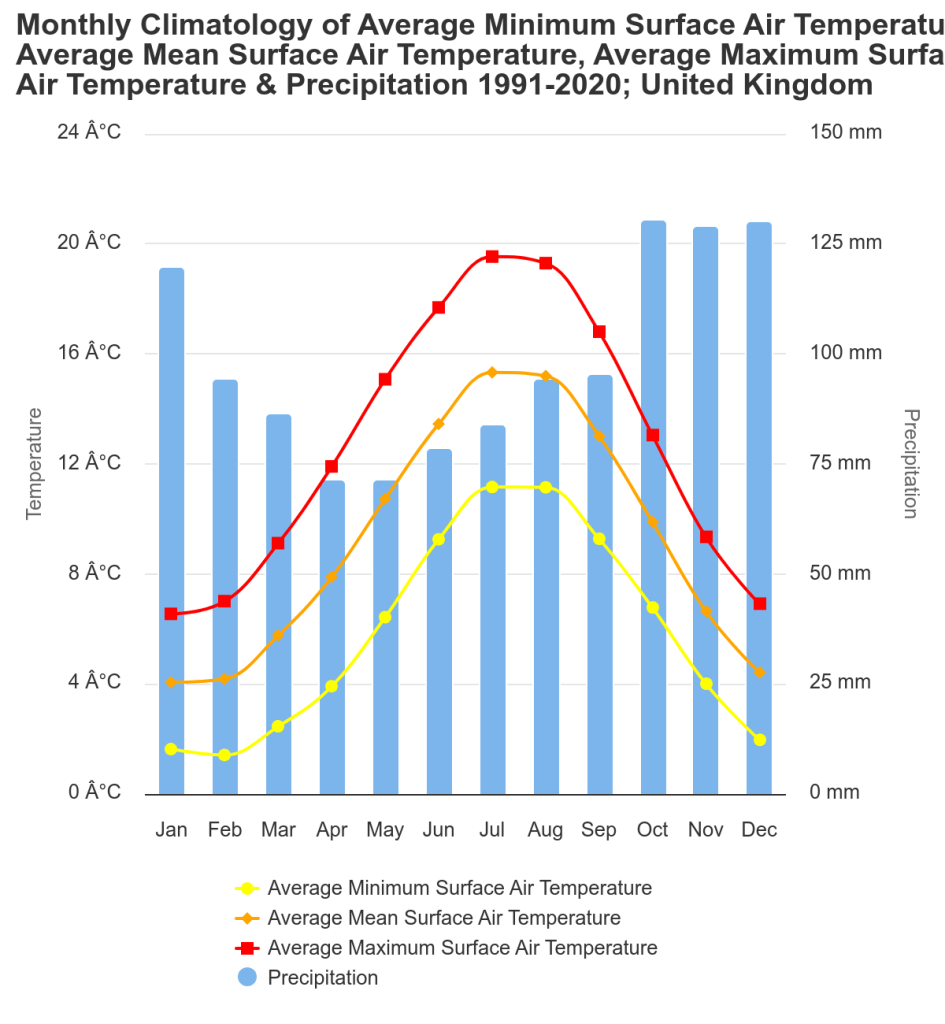
According to the climate portal of the World Bank Group, average precipitation in the UK increases dramatically between September and October from about 90 mm to 130 mm.
May is the driest month, while July is the hottest month.
Attention Spans are Getting Shorter
With AI taking over the world and everybody glued to their phones, it is no surprise that attention spans are getting shorter.
Students in the UK usually have a summer break from mid-July to late August, and schools go back in session around September. That’s not all—The Wimbledon takes place between the end of June & mid-July with the English Premier League following in mid-August.
The challenge for English domestic cricket is to simultaneously capture the attention of the public and escape from rain. Trying to fit international cricket, County Championship, and 3 separate limited over tournaments within 3-4 months and with the same group of players is nigh impossible and borderline, insane.
Indian cricket has the luxury to host the IPL between March-May and still have the Ranji Trophy & their Test between October-February. The rest of the year, India can host bilaterals and other tournaments like the Duleep Trophy, Syed Mushtaq Ali, etc.
English Domestic Season in a Nutshell
The modern English domestic season mainly consists of the following four types of tournament:
County Championship (first class), ODI Cup (List A), T20 Blast (domestic T20), experimental (currently, The Hundred)
For this analysis, we have looked at the schedules of County Championship, T20 Blast, The Hundred,Benson & Hedges Cup, Gillette Cup, Royal London One Day Cup, Sunday League, Bob Willis Trophy, and England’s international schedules.
*Note: Competitions involving National/minor counties, universities, MCC exhibition matches, and and tournaments such as Gentleman vs Players (ran from 1806-1963) are not considered in this analysis.
How Does the Current 2024 Domestic Season Look Like?
In theory, a three-format English cricketer who plays all possible matches in domestic cricket and The Hundred can play a maximum of 125 days of cricket at home given there is no overlap. That is 68.30% of the 183 total days between April 1st and September 30th.
2024 Season (Current Format with the Hundred)
Total Domestic Matches: 370
Max Days of Internationals: 37
Max Day of Domestic Cricket Per County: 88 (56 first class, 32 limited overs)
County Championship: 14 Matches (4 day per match)
Royal One Day Cup: 8
Vitality T20 Blast: 14
The Hundred: 10
International Home Season Breakdown
May 22-May 30: 4 T20Is vs Pakistan (4 maximum days of cricket)
July 10-July 28: 3 Tests vs West Indies (15 maximum days of cricket)
August 21-September 10: 3 Tests vs Sri Lanka (15)
September 11-September 29: 3 T20Is, 5 ODIs (8)
Competition
Type
Matches
Date Range
County Championship
First-Class
126
5 Apr-29 Sept
One Day Cup
50 Overs
77
30 May-14 Sept
T20 Blast
20 Overs
133
24 Jul-22 Sept
The Hundred
100 Balls
34
23 Jul-18 Aug
County Championship (1948-2024)
Before 1988, all County Championship Matches were played as 3-day games. After 1993, all matches became 4-day affairs and between 1988-1992, it was a mix of 3 and 4 day games.
Here are some additional notes:
In 1992, Durham was added as the 18th team in the County Championship. Before 1988, we have 17 teams and 18 teams after.
Between 1960-1962, a team could play a maximum of 32 first class games or a maximum of 96 days of cricket (since County was only 3 days back then).
Between 1988-1991, each team played sixteen 3-day matches (120 matches total) and six 4-day matches.
In comparison, a player in the 2024 County Championship could play a maximum of 14 first class games or a maximum of 56 days of first class cricket (4-day).
The ‘cricketing days’ column is the (number of matches) * (3 or 4) depending if it is a 3-day or 4-day match. This does not represent the actual days played since multiple County matches may overlap on a single day.
Years
Total Matches
Cricketing Days
Matches Per Team
1948-1949
221
663
26
1950-1959
238
714
28
1960-1962
254
762
Mix of 28/32
1963-1968
238
714
28
1969-1971
204
612
24
1972-1976
172
516
20
1977-1982
187
561
22
1983-1987
204
612
24
1988-1991
187
628
22
1992
198
628
22
1993-1999
152
608
17
2000-2016
144
576
16
2017-2019
126
504
14
2020*
46 (Bob Willis Trophy)
184
–
2021
126 (+1 BW Trophy)
508
14
2022-2024
126
504
14
Note*: In 2020, the County Championship was cancelled, and only the Bob Willis Trophy took place.
“There’s never really been a perfect schedule…I thought it worked well when T20s were on Friday nights and there seemed to be a regularity in the season, but I also liked a little bit of B&H & Gillette Cup!”
Between 2003-2019, the format of the T20 Blast, formerly known as the Twenty20 Cup, changed a staggering 7 times ranging from 48-matches to 151-matches.
The Early Years (2003-2009)
The early years had a pretty decent number of matches gradually increasing from 48 to 97.
(Side note: There is no direct correlation between an earlier end date for the T20 Blast and number of rained out matches as we can see from 2007-2008).
Year
Matches
Finals Date
Rained Out Matches
2003
48
19th July
0
2004
52
7th August
4
2005
79
30th July
11
2006
79
12th August
2
2007
79
4th August
19
2008
97
26th July
20
2009
97
15th August
3
Twenty20 Cup (2003-2009)
The Expansion and T20 Blast Scheduling Overkill (2014-2020)
The 2010s were when the scheduling problem amplified not only in the English domestic scene, but also internationally.
The domestic schedule could theoretically afford the increase from 97 games in 2009 to 151 in 2010 since the Gillette Cup & Sunday League ended and morphed into a single ECB 40 competition, but it realistically made the domestic schedule even more complex.
Year
Matches
Finals Date
Rained Out Matches
2010
151
14th August
5
2011
151
27th August
23
2012
97
25th August
20
2013
97
17th August
1
2014
133
23rd August
12
2015
133
29th August
9
2016
133
20th August
15
2017
133
2nd September
16
2018
133
15th September
12
2019
133
21st September
24
2020*
97
4th October
12
T20 Blast (2010-2020)
Post The Hundred (2021-2024)
Year
Matches
Finals Date
Rained Out Matches
2021
133
18th September
13
2022
133
16th July
6
2023
133
15th July
2
2024
133
14th September
10
T20 Blast (2021-2024)
The Hundred
The reason The Hundred has become a point of contention is not necessarily due to the new format created of out of the whim.
Rather, it goes back to attention span. Late July to mid-August is a coveted window in the English domestic calendar.
The Hundred being scheduled during this valuable time slot means that T20 Blast matches becomes a secondary tournament. Furthermore, Test series are delayed to September, where there is a higher likelihood of being affected by rain or bad light. In addition, some rounds of the T20 Blast and the Royal One Day occur during this time, which means County teams have to find a second XI to field their teams (since most marquee players would be at The Hundred).
Year
Starting Date
Ending Date
2021
23rd July
18th August
2022
1st August
27th August
2023
3rd August
3rd September
2024
21st July
21st August
The Hundred (2021-2024)
T20 Vitality Blast Attendance
In 2003, the Vitality Blast begun with an attendance of about 257,759. Over the years, the attendance has ebbed and flowed and has slightly dipped since the inception of the 100-ball competition:
The Hundred is not the first time England cricket is pioneering a new format. They started with 65 overs back in the early 1960s, created a 40-over tournament that built the backbone of England’s 2009 WC winning squad, and are now experimenting with 100-ball cricket.
Here is a brief timeline:
2014-2024: Royal London One Day Cup
2021-2024: The Hundred
2010-2013: ECB 40
1972-2002: Benson & Hedges Cup (55-overs first few years, then 50 overs)
1969-2009: Sunday League/National League/NatWest Pro40 (50, 45, then 40 overs)
By 1975, the modern English domestic season was established, and ODI cricket had taken its root in England. This was an interesting season because it also had an Ashes series and the inaugural ODI World Cup.
Max Days of Internationals: 25
Max Days of Domestic Cricket Per County: 88 (60 first class, 28 limited overs)
County Championship: 60 (20 matches)
Sunday League: 16
Benson & Hedges Cup: 7
Gillete Cup: 5 (Knockout format)
County Championship
Gillete Cup, Sunday League, Friends Provident Trophy
International Home Season
10 July 1975-3 September 1975: 4-Test Ashes (20 days max)
ODI World Cup: 5 Matches Max (3 Group, semi-final, and final)
2010 Season (Inaugural ECB40, Expansion of T20 Blast)
Total Domestic Matches: 424
Max Days of Home International Cricket: 51
Max Days of Domestic Cricket Per County: 96 (64 first class, 32 limited overs)
County Championship: 64 (16 matches)
T20 Blast: 18
ECB 40: 14
International Home Season
May 27-June 6: 2 Tests vs Bangladesh (10)
June 22-July 3: 5 ODIs vs Australia (5)
July 8-July 12: 3 ODIs vs Bangladesh (3)
July 29-August 26: 4 Tests vs Pakistan (24)
September 5-September 7: 2 T20Is vs Pakistan (2)
September 10-September 22: 5 ODIs vs Pakistan (5)
Note: Prior to the home season, 2010 T20 World Cup occurred between April 30-16 May in the West Indies, and England were the winners. They played 7 matches during this campaign.
Max Days of Domestic Cricket Per County: 95 (57 first class, 38 limited overs)
County Championship: 56 (14 matches)
1 tour Match
Vitality T20 Blast: 17
One Day Cup: 11
The Hundred: 10
International Home Season
June 1-4: 1 Test vs Ireland (4-Day Test)
One tour Match took place
June 16-July 31: 5-Test Ashes vs Australia (25)
August 30-September 15: 4 T20Is, 4 ODIs vs New Zealand (8)
2 Tour matches
September 20-26: 3 ODIs vs Ireland (3)
*Note: The ICC World Test Championship took place between 7-11th June at the Oval.
Competition
Type
Matches
Date Range
County Championship
First-Class
126
6 Apr-29 Sept
One Day Cup
50 Overs
77
1 Aug-16 Sept
T20 Blast
20 Overs
133
20 May-15 July
The Hundred
100 Balls
34
1 Aug-27 Aug
Final Thoughts
From the ECB point of view, I get it. More limited over matches means more attendance, and in the long term, better financial stability (hopefully), but is the overkill of cricket really worth it?
“We all recognise that the Twenty20 Cup has been a startling success…Yet I would make a plea to the ECB and the administrators around the counties who smell a golden goose…Cricket is not good at this. At international level, look at the congested schedules that are exhausting players and spectators alike. Short-term greed will backfire.“
– Vic Marks
That was 2003, when the Twenty20 Cup was only 48 matches, and The Hundred did not exist. 21 years later with the proliferation of franchise leagues and ICC tournaments every year, the situation has become even worse.
The ECB continued with the same 133-match format for the T20 Blast even after The Hundred. Maybe there is a case to go back to 2005-07 format, where 79-matches were played throughout or abolish The Hundred altogether.
Is there a Solution to England’s Schedule Woes?
Is there a solution?
Probably, but that is beyond the scope of this article (I have a ‘truly marvelous’ solution to this issue, but the margins are too narrow to contain it).
However, little changes can go a long way.
For starters, as Adam Collins argues on his podcast, scheduling September Test matches earlier in the day or adding lost overs to the beginning of the next day can be a start.
Does Test cricket in the UK start too late in September?
🗣️ "Surely it's 10:30 starts? Why are we starting a Test match in September at 11?" – @collinsadam
Remember, today’s goal was not to solve England’s domestic scheduling problem. Rather, it was to realize that this is the main problem for England’s administration to solve.
****
Thank you all for reading!
What do you all think about how to resolve the domestic English schedule? Comment below, would love to know your thoughts!
If You Like Reading about Problems & Solutions in Cricket, you may enjoy