Currently, there are at least 34 cricket stadiums in USA (including grounds, parks, etc.), two of which have been certified by the International Cricket Council (ICC) and 24 local cricket grounds are being used by Minor League Cricket teams. Additionally, five more upcoming stadiums are currently being planned.
These stadiums are located all across the US, from California to Florida, North Carolina to Texas, and Georgia to name a few. Their sizes range from large-scale venues with plenty of seating space to small grassy fields that are more intimate in size.
In the United States, cricket has gained more popularity in recent years, leading to the development of cricket stadiums in various parts of the country. This article will discuss how many cricket stadiums are in the United States, which ones they are, and what kind of events they host. Read on to discover more about cricket stadiums in America!
At present, there are at least two international-level cricket stadiums in the United States, with plans to expand the number up to five to ten in the near future.
These include:
Central Broward Regional Park Stadium Turf Ground in Lauderhill, Florida (10000 seating capacity, ICC status for ODI & T20 cricket)
Church Street Park in Morrisville, North Carolina (3500 permanent seating with potential expansion to 5000 seats)
AirHogs Stadium in Grand Prairie, Texas (7000 seating capacity with a potential expansion to 20000 seats)
Smart Choice Moosa Stadium in Pearland, Texas (near Houston)
Indianapolis World Sports Park in Indianapolis, Indiana
Leo Magnus Cricket Complex, ‘Woodley’ Park in Los Angeles, California
Each of these stadiums has its own unique history and features that make it an exciting place to watch cricket. Most of them host domestic and international matches, as well as tournaments and development programs for the sport itself.
Upcoming Cricket Stadiums in the USA
Apart from existing cricket stadiums, there are also four upcoming venues in plan — each with varying seating capacities and location.
Marymoor Park in Redmond, Washington
Santa Clara County Fairgrounds in San Jose, California
An upcoming proposed stadium in Orange County, California
New York Oval. in New York
Marine Park in Brooklyn, Spring Creek Park in Queens, or Aqueduct Racetrack in Queens (Shortlisted locations for a possible major cricket stadium in the New York area)
It is expected that the stadiums in the Bay Area and Washington may each seat around 10,000-20,000 spectators with a cost of $30 million combined.
Historic & Smaller Cricket Grounds in the United States
Apart from the major stadiums, there are also numerous smaller cricket grounds in the United States. These grounds have been used by Minor League clubs and other clubs for generations as well as hosting various tournaments over time.
Philadelphia Cricket Club Ground in Wissahickon Heights, Philadelphia, Pennsylvania
Belmont Cricket Club Ground in Elmwood, Philadelphia, Pennsylvania
Young America Cricket Club Ground in Stenton, Philadelphia, Pennsylvania
Germantown Cricket Club Ground in Manheim, Pennsylvania (earlier in Nicetown)
Merion Cricket Club Ground in Haverford, Pennsylvania
Boca Raton Cricket Club Ground in Boca Raton, Florida
Brian Piccolo Park in Cooper City, Fort Lauderdale, Florida
St. George’s Club Ground in Bloomingdale Road, Manhattan, New York
Red House Cricket Ground in Harlem, New York
*Citi Field in New York
*Minute Maid Park in Houston, Texas
*Dodger Stadium in Van Nuys, Los Angeles, California
*Note, the Cricket All-Stars tournament featuring Shane Warne, Sachin Tendulkar, Shoaib Akthar, etc. took place at famous baseball grounds—Citi Field, Minute Maid Park, and Dodger Stadium.
Minor League Cricket is a new franchised cricket league in the United States, which was founded in 2019. It currently has 26 teams, most of which have their own home cricket parks.
Handy line up 🏏
World Cup winner Former fastest 100 world record holder U19 World Cup winner and captain USA first IPL player S&C coach 🤣
I am very fortunate and grateful at the same time that I get coach and support all the players.
Established in 2007, the Central Broward Regional Park Stadium in Lauderhill is the biggest cricket stadium in the United States. It has two pitches and offers seating for up to 10,000 fans. Every Spring it hosts the American college cricket tournament and is also home to the Ft. Lauderdale Lions of Minor League Cricket.
The Moosa Stadium in Pearland, Texas was established in 2015 and is a rising cricket stadium. It provides seating for up to 2,500 fans with the potential for further expansion. It is the home of Lone Star Athletics.
The AirHogs Stadium in Grand Prairie, Texas is a professional baseball stadium that has been transformed into a cricket ground. It offers seating for up to 7,000 spectators and has the potential for further expansions. This ground has become quite popular with local cricket enthusiasts.
The Indianapolis World Sports Park was built with an investment of $5 million and it hosted the 2015 ICC T20 World Cup Americas Division One qualification tournament.
The Leo Magnus Woodley Park is a sporting complex established in 1978 and named after Jamaican cricketer, Leo Magnus. It comprises five cricket fields (Marder, Severn, Wong, Woodley and Wright) and is home to the Hollywood Master Blasters and Socal Lashings of Minor League Cricket. Historically, it was the home of the Hollywood Cricket Club.
Founded in 1854, Philadelphia Cricket Club Ground is the oldest cricket club in the USA, while Germantown Cricket Club is the second oldest surviving cricket club in the United States. The Belmont Cricket Club (1874-1914), home to one of America’s greatest cricketers, Bart King, was one of the great clubs in American cricket.
The stadiums listed above host a variety of events for both spectators and players.
These include domestic and international matches, tournaments, camps and academies to help with cricket development in the US. The following is a list of some of the events hosted at US cricket stadiums:
International Matches & CPL
A total of 27 ODI matches (12 Moosa, 15 Ft. Lauderhill) and 14 T20I matches (all Ft. Lauderhill) international matches have been hosted by the US.
New Zeland, Sri Lanka, India, West Indies, Bangladesh, Ireland, Papua New Guinea, Scotland, Nepal, Oman, Namibia, and the USA have all played here. Ft. Lauderhill has been used as one of West Indies’ home venue in bilateral series.
Minor League Cricket began in 2020 as the precursor to Major League Cricket, USA’s much anticipated T20 franchise competition. 27 teams took place in the inaugural tournament with Silicon Valley Strikers emerging as the winner.
National Championships and Other tournaments
These tournaments are organized by US cricket associations and involve women’s, men’s, U-19, and other teams from different states across the country.
Apart from major leagues, regional club tournaments, tape ball cricket, and college cricket also occur on a regular basis.
4. Major League Cricket and 2024 T20 World Cup to Take Place Across USA’s Top Cricket Stadiums
In 2023, Major League Cricket (MLC) is set to take place between July 13th and 30th.
The Grand Prairie Stadium in Dallas is the main location with franchises from Dallas, Los Angeles, San Francisco, Seattle, New York City, and Washington D.C. The following year in 2024, the 20-team T20 World Cup will be jointly hosted by the United States and West Indies.
5. Conclusion – The Growing Popularity of Cricket in America
Cricket is quickly gaining popularity in the United States, with more people becoming aware of and involved in the game.
The US Cricket Association has advocated for the expansion of cricket in America, resulting in cricket stadiums located across the country, academies and clubs to help players hone their skills.
Stadiums such as Church Street Park & Moosa Stadium are paving the way for even more growth. The upcoming 2024 T20 World Cup and Major League Cricket will bring even more attention to the sport, and with continued growth, cricket will become an increasingly popular sport in America.
Maybe the future even holds a partnership with Minor League Baseball stadiums similar to the conversion of the Texas Airhogs stadium.
5. Frequently Asked Questions (FAQ) – Cricket Stadiums in USA
How many cricket stadiums in the USA?
Currently, there are at least 33 cricket stadiums in the USA. Two stadiums are ICC certified, 5 are in the planning phase, while the rest are park and local grounds.
Which cricket stadiums will host the 2023 Major League Cricket?
The Airhogs stadium in Dallas, Texas will be the host of the inaugural Major League Cricket held between July 13-30.
How many teams participate in Minor League Cricket in the USA?
26 teams compete in Minor League Cricket (MiLC) in the United States.
How many teams will compete in the 2023 Major League Cricket in the USA?
Six franchises from from Dallas, Los Angeles, San Francisco, Seattle, New York City, and Washington D.C. will compete in the 2023 Major League Cricket (MLC).
Discussing the richest cricket boards is common in the world of cricket today.
Dwaine Pretorius becomes the latest to retire from internationals to focus on T20 leagues. He follows Colin de Grandhomme, Trent Boult, Martin Guptill, and several others in becoming free agents. The SA 20 league, aka IPL in South Africa, has gained a lot of attention in being the ‘final hope’ for South African cricket. But why is that South African, New Zealand, and West Indies cricketers in particular are leaving international cricket?
It all boils down to the money. Today, we discuss the richest cricket boards in Part 4 of our series, Cricket & Finances. Here is quick overview:
The BCCI (Board of Control for Cricket in India) is the richest cricket league in the world with an estimated $2 billion annual revenue. The BCCI is followed by the ECB (England & Wales Cricket Board) at $368 Million, and CA (Cricket Australia) at $270 Million in annual revenue. The CSA (Cricket South Africa) has revenues of $46 million, NZC (New Zealand Cricket) is at $42 million, and CWI (Cricket West Indies) is at $28 million. Those are not bad numbers, but exploring a bit in-depth, we see that CSA had a total comprehensive loss of $11.6 million, NZC suffered a loss of $4.6 million, and CWI incurred a loss of $10 million.
World’s Richest Cricket Boards (Lowest to Highest)
We looked at the financial statements and Annual Reports of each of these respective boards to come up with the revenue, expenditure, and total surplus/loss.The ranking of the national cricket board is displayed with the (annual revenue) and partners/sponsors.
*all figures are in $US dollars.
12. Zimbabwe Cricket – ZC ($5.5 Million)
Revenue:$5,520,442
Total Operating Costs:$6,953,991
Total Deficit:–$1,239,606 (LOSS)
Total Comprehensive Income (after surplus on lands and buildings): – $1,192,166
Is Zimbabwe Cricket profitable?No, Zimbabwe Cricket (ZC) is not profitable with a deficit of $1.1 million in 2020.
Based on Annual Reports & financial statements ending on 31 December 2020.
Partners
Banaqua, Swift, Zimpharm, Dandemutande, A May, Ihsan, Swift, Windmill Pvt Ltd
Is Afghanistan Cricket Board profitable?Yes, Afghanistan Cricket Board (ACB) is marginally profitable with a surplus of $390,000 in 2019 (breakeven).
*Note: This is based on the 2019 Annual Report, published in 2020. US withdrawal of Afghanistan occurred around August 2021. No new annual reports have been published since then.
Highlights from the 2019-20 Annual Report
“Afghanistan Cricket Board as the owner of the league spent around $369,000 for the implementation of the Shpageeza Cricket League (SCL).
The distribution of revenue for ACB was as follows:
84% ICC Distribution
9% Government
4% Marketing
3% Shpageeza
Partners
Main Sponsor:Partner with ACB
National Team Sponsor:Super Cola
Official NFT:Rario
Cloth Manufacturing Partner:TYKA
IT Partner:Afghan Telecom
Other Partners:Asian Cricket Councial, ICC
SCL Sponsor: Etisalat
Main Jersey Sponsor:Diva Group
Medical Partner:Blossom Health Care
Beverage Partner:Habib Gulzar Limited
Umpires Jersey Sponsor:RTA Sports
Other Sponsors:Kam Air, Dafa News, Madava Hospital, Tayyab Yasir Limited, Refai Shaheen Construction Company
Retained earnings at the end of the financial year:310,166 ($333,000)
Based on Annual Reports & financial statements ending on 31 December 2021.
Is Cricket Ireland profitable?No, Cricket Ireland is not profitable with a deficit of 1,230,869 Euros ($1.3 Million). On the other hand, in 2020, the Cricket Ireland was profitable with a surplus of 1,537,632 Euros ($1.65 Million).
Partners
Main Sponsors & Men’s Shirts Rights Holder:ITWConsulting
Official Ireland Women’s Team Partner & Official Technology Partner:Hanley Energy
Official Airline Partner:Turkish Airlines
Official sponsor of Inter-Provincial Series:Test Triangle
Official IT Services Partner:Techfynder
Official Currency Exchange Partner:ClearCurrency
Official Partners:Amul, O’Neills, Ulster University, Tildenet, Club Travel, La Manga Club, ICC, Sport Ireland, Sport Northern Ireland, The Hope Foundation, Federation of Irish Sport, Arachas Insurance, Mansfield Sports Group
Total Revenue:7,994,291,865 SL Rupee ($22,022,843)
Total Expenses:5,883,380,298 SL Rupee ($16,207,659)
Net Surplus:2,138,726,491 SL Rupee ($5,891,809)
Total Comprehensive Income (after assets, taxes, actuarial gain, etc.): 2,478,605,198 SL Rupee ($6,8282,113)
Is Sri Lankan Cricket Board profitable? Yes, Sri Lankan Cricket Board (SLCB) is profitable with a surplus of 2,478,605,198 SL Rupee ($6,8282,113) in 2021.
Based on Annual Reports & financial statements ending on 31 December 2021.
Highlights from the 2021 Annual Report
The distribution of SLCB’s revenue was as follows:
Total Income: PKR Rs. 6,330,842,117 ($27, 665,780)
Total Expenses:PKR Rs. 7,086,927,287 ($31 Million)
Total Deficit: -PKR 756,085,170 (-$3.3 Million) (LOSS)
Is Pakistan Cricket Board profitable? No, Pakistan Cricket Board (PCB) is not profitable with a deficit ofPKR 756,085,170 (-$3.3 Million) in the 2020-21 season.
Based on Annual Reports & financial statements ending on 30 June 2021.
*PKR Rs. denotes Pakistan Rupees
Commercial Partners
Men’s team:Pepsi, TCL, Parkview City
Women’s team: Pepsi
Commercial Partner:Trans Group
Broadcast & Live Streaming Partner: Ary Zap, Willow, Sony, Etisalat, Fox Sports, Flow Sports, SkySport, Sky Sports, ICC TV, SuperSport
Is the Bangladesh Cricket Board profitable? Yes, the Bangladesh Cricket Board (BCB) was profitable in 2020 with a surplus of BDT 832,68,87,010 ($79.2 Million)
Based on AnnualGeneral Meeting 2021, which summarized CWI’s financial statements from 2020.
*BDT – Bangladesh Taka
Highlight from the 2017-2020 BCB Activity Report
“In the six years between 2011 and 2016 the Board had earned US $33.32 million in media, team sponsor, and other rights while in just three years from 2017 to 2020, the BCB’s earnings stood at approximately US $29 million from the same sources.”
Total Revenue:$66,401,000 NZD ($42, 217, 755.80 USD)
Total Expenditure:$46,496,000 NZD ($29,604,000 USD)
Total Surplus: $792,000 NZD ($504,000 USD)
Total Comprehensive Deficit (after Unrealized Loss and Valuation of Foreign Currency Hedging): – $6.7 Million NZD (- $4.26 Million USD)(LOSS)
Is New Zealand Cricket profitable?No, New Zealand Cricket (NZC) is not profitable with a net deficit of $ 6.7 Million NZD ($ 4.26 Million USD) in 2021.
Based on the 2021-22 Annual Report and corresponding financial statements for fiscal year ending on 31 July 2022.
Highlight from the 2021-22 Annual Report
ICC Women’s World Cup 2022 – Surplus of $2.6 Million NZD ($ 1.653 Million USD)
$1.8 Million NZD ($1.14 Million USD) provided to support NZC’s High Performance Center.
“Over 95% of all NZC revenue is derived from our teams’ participation in these FTP and ICC events…”
NZCB Commercial Partners
Official Broadcast Partner:SparkSport
International Broadcast Partner:Pitch
Major Bank & Official Bank:ANZ
Official Vehicle Provider:Ford
Official Hotel Supplier:Accor
Official Supplier:Air New Zealand
Official Clothing Sponsor:Canterbury of New Zealand
Official Sports Drink:Powerade
Official Sponsor of NZ Cricket Umpires:G.J. Gardner Homes
Official Car Rental Partner:Hertz
Partner of the BLACKCAPS and WHITE FERNS (3 -year Deal): KFC
Official Radio & Digital Partner:MediaWorks
Official Partners:Gillette, Les Mills, Dulux, Asahi Beverages NZ
Funding Partners:Sports NZ, New Zealand Community Trust, Perry Foundation, Southern Trust
Total Revenue:778, 353,000 Rands ($45,767,156 USD)
Total Expenses:995,624,000 Rands ($58,492,910 USD)
Total Comprehensive Loss: -197,874,000 Rands ($-11,625,097 USD) (LOSS)
End of Year Balance (After adding up previous years’ savings):272 Million Rands ($16 Million)
Is Cricket South Africa profitable? No, Cricket South Africa was not profitable in 2021-22 with a net deficit of -197 Million South African Rands (loss of $11.625 Million US dollars).
Based on the 2021-22 Integrated Report and corresponding financial statements for fiscal year ending on 30 April 2022.
Highlights from the Integrated Report 2021-22
“The curtailment of the planned four T20 matches against India due to Covid-19 pandemic severely impacted CSA’s results, with a -R 250 Million (- $14.7 Million USD). This revenue loss was mitigated to a certain extent by committed cost reductions through all business areas, resulted in a reported loss of R198 Million ($11.6 Million USD).”
“CSA does not own cricket stadiums, so proceeds generated by these venues are shared, with CSA receiving 20% and stadium operators (CSA members) receiving 80%.”
Revenue Division
53% Broadcast Rights: 413 Million SA Rands ($24 Million)
33% ICC distribution: 256 Million SA Rands ($15 Million USD)
4% Sponsorships (Professional), 2% Sponsorships (Amateur): 52 Million SA Rands ($3 Million USD)
Is Cricket Australia profitable? Yes, Cricket Australia (CA) is profitable with a net surplus of $ 10.7 million AUD ($7.4 million USD) in 2021. Hence, Cricket Australia is on #3 in the richest cricket boards in the world.
Based on the 2021-22 Annual Report and Statement of Comprehensive Income for fiscal year ending on 30 June 2022.
Partners
Broadcast Partners:Fox Sports, Seven West Media, ABC Radio, Macquarie Radio Network, Sports Entertainment Network
International Broadcast Partners:Sony, Fox Sports Asia, beIN, BT Sport, Supersport, Kwese Sports, Sports Max, Flow Sports, Willow, ATN, SKY Network Television, National Broadcasting Corporation of Papua New Guinea
Total Comprehensive Income:$20,751,000 Pounds ($25,229,066 USD)
Is the England & Wales Cricket Board profitable? Yes, England & Wales Cricket Board (ECB) is profitable. According to the 2021-22 Financial Statements, the ECB had a net surplus of $20.7 million pounds ($25.2 million US dollars). Hence, the ECB is the 2nd among the richest cricket boards on the planet.
Based on the 2021-22 Financial Statements for fiscal year ending on 31 January 2022.
Is the Board of Control for Cricket in India profitable? Yes, the Board of Control for Cricket in India (BCCI) is profitable with a net surplus of INR 529 Crore ($64.8 million US dollars). Furthermore, the profit has grown to an estimated $2 billion as of 2022.
Based on the 2016-17 Financial Statements for fiscal year ending on 31 March 2017.
Although official documents were limited to 2017, we investigated further based on Twitter data and media reports from reputable sources. For example, the infographic by Forbes India shows the mammoth growth in BCCI’s net worth between 2014 & 2018. BCCI’s net worth is shown to be INR 11,916.8 crore ($1.224 billion US dollars).
Since then, BCCI’s rise has been exponential. Here are some of the highlights of major rights and sponsorships, including the mammoth $6.2 billion IPL media rights between 2023-2027.
In conclusion, about $1.24 billion revenue will be achieved annually by the IPL media right alone. The ICC revenue and all of the other sponsorships will make up another billion (and will change everywhere as the negotiations with each sponsor changes). The BCCI is easily #1 on the list of the world’s richest cricket boards.
*Note: The estimated Revenue for ICC’s broadcasting income from the 2023 ODI World Cup is about $533.29 Million, from which $58.23-116.47 million is expected to be taxed by the Indian government.
Partners
India’s sponsors and partners are as follows:
Team Sponsor:BYJU’S: The Learning App
Official Broadcaster:Star Sports ($944 Million)
Title Sponsor:Mastercard
Official Partners:Dream11, Hyundai, Ambuja Cement, Killer Jeans(Kewal Kiran Clothing)
The only profitable cricket boards are the BCCI, ECB, CA, Bangladesh Cricket Board (BCB), and Sri Lankan Cricket Board (SLCB).
This is the concerning aspect. If the national body is not profitable, they have to cut back on salaries, systems, and leagues. This is exactly why South Africa are hoping that the SA20 league generates so much revenue that the surplus can raise players’ salaries and keep them in the domestic circuit.
How Do Cricket Boards Earn Money?
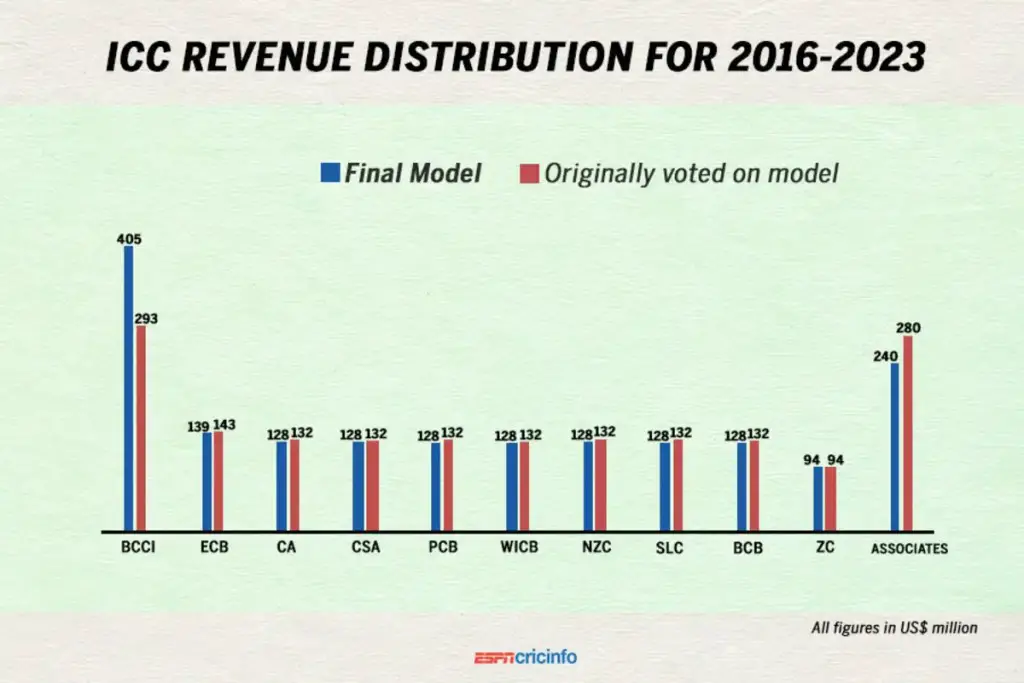
Cricket boards earn money in a variety of ways—ICC revenue, media rights, sponsorships, ticket sales, etc. Here is a visual from ESPNCricinfo illustrating the2016-2023 revenue distribution from the ICC to the top cricketing nations.
— Broken Cricket Dreams Cricket Blog (@cricket_broken) October 2, 2022
Now, calls have come for his axe on the eve of the 2022 T20 World Cup following his horrid series against India where he scored 0(4), 0(7), and 0(8) while Hendricks sat on the sidelines. Although he led South Africa courageously in the 2021 T20 World Cup and handled Quinton de Kock during tough times, an average of 23.54 with 116.49 strike rate is way below par for a modern T20 opening batter.
Although Bavuma has rightly faced criticism, there has been lots of slander and accusations that he is only in the XI to fulfill the quota. We will explore this and debunk some myths.
Quota System in South African Cricket: The Complete Guide
*Disclaimer: I am trying to learn about this from an outsider’s point of view. Hence, this research is conducted through official documents from the South African cricket board with the hope of an unbiased analysis.
“Transformation is defined as a process describing the establishment of a sport system focused on the principles of Human capital development, equitable resource distribution, elimination of all inequalities, increased access to participation opportunities, skill and capability development at all levels and in all areas of activity, empowerment of the individual, respect for each other, fair and just behavior, innovation to give South Africa a competitive edge in world sport.”
In the SA cricket board’s 2021 Integrated Report, they further elaborate that “Transformation is about improved access, fair opportunity and support for all South Africans, within and beyond the boundaries of the cricket field.”
Key Points on Quota & Selections
The document provides an insight into how transformation targets play an part in South African cricket’s selection. Here is a brief summary with quotes from the official document. Some interesting finds.
“It is expected that the selection committee will play its role in ensuring that transformation is aggressively achieved at all levels without compromising the principle of selecting the best team based on current form and the pitch or game conditions.
“When selection between two players is debatable and neither is a clear choice (e.g. both have similar track records and ability), where relevant, preferencemust be given to the player of colour.“
“In measuring our transformation progress, the panel will be measured on a season average basis rather than on a match-by-match basis.”
“Special attention must be given to the development and the creation of opportunities to play black African cricketers at all levels”
“We acknowledge that transformation ins not progressing as fast as it could.”
South African Cricket Transformation Target: The Rules
The South Africa cricket reservation targets must be met as per the Eminent Persons Group (EPG) scorecard projections. By the latest transformation targets, on average about 6 players of color, including 2 black African cricketers should be in the playing XI.
Not only that, but the transformation target is also implemented all throughout South Africa’s cricketing system, from age-level groups to senior internationals.
Here is a truncated version of the projections for the men’s cricket team for the next decade.
Quota Projections
Team (Men’s)
Forecast December 2022 % Black African
Forecast December 2026% Black African
Forecast December 2030 % Black African
Senior International Team
24%
28%
32%
South Africa A/Emerging/U-19
27-29%
32-33%
34-35%
SA School & Colts
31%
35%
37%
U-17 National Camp
31%
35%
37&
Team (Men’s)
Forecast December 2022 % Generic Black
Forecast December 2026% Generic Black
Forecast December 2030 % Generic Black
Senior International Team
50%
56%
60%
South Africa A/Emerging/U-19
50-55%
56-60%
60-64%
SA School & Colts
52%
57%
62%
U-17 National Camp
52%
58%
62&
So, how does the South Africa cricket team reservation work?
For South Africa’s senior men team, in 2022, 24% of the players should be Black Africans while 50% overall should be colored.
This means about 2-3 Black African players and 5-6 colored members should be in the XI, while the corresponding figures are 3-4 Black African and 7-8 colored in the squad of 15.
By 2030, the figures will rise to 32% and 60% respectively i.e. the South African XI may need to have an average of 7 colored players (3-4 Black Africans).
Interesting Observations
One thing to note is that consistently in junior level cricket, the transformation target percentages are a lot higher than the international requirement. This definitely sheds a light on the focus of changing the system from the grassroots level and hoping to have an impact in the international level down the road.
The SA20 has no transformation targets (this could be a cause of conflict in the future. If the homegrown South African T20 league does not have transformation requirement since it is in the franchise model, why should the other parts of SA cricket have it? This may have been a factor in no interest for Bavuma in the SA20 auction).
What Happens if Transformation Targets are not Fulfilled by South African Cricket?
According to South African cricket’s Integrated Report 2020/21, here is what happens if guidelines are not followed.
Risks: “Non-adherence to CSA undertakings with the Minister of Sport, Arts, and Culture on transformation in cricket can lead to a withdrawal of privileges accorded to National Federations.“
Required Actions to Improve Performance: “Tranche payments linked to performance; CSA monitoring and evaluation to improve access and redress.”
To demonstrate how detailed the transformation targets are, here are the results from the 2020/21 selection report statistics.
Women’s Team
The Senior Women had an “on-field Black demographic representation of 48% against CSA target of 50%.” In particular,
Women’s Team
Target (2018-19)
Actual (2018-19)
Target (2019-20)
Actual (2019-20)
Black African
27%
26%
24%
20%
Black
54%
47%
54%
47%
Among the 154 selections for the women’s team, the proportions were
Women’s ODIs: 45 White, 22 Black African, 8 Colored, 13 Indian
Women’s T20Is: 35 White, 21 Black African, 4 Colored, 6 Indian
Men’s Team
The Proteas Men met their Black African player target for EPG 2020 – but did not meet is Black target.
Men’s Team
Target (2018-19)
Actual (2018-19)
Target (2019-20)
Actual (2019-20)
Black African
25%
22%
22%
23%
Black
60%
49%
50%
44%
South African Contracted Players
From the 16 nationally contracted players, the proportion is: 8 White, 2 Colored, 4 – Black African, 2 – Indian. 116 selections (62%) of all the 187 selections came from these contracted players. The other 71 selections (38%) came from 16 non-contracted – 10 White, 3 Colored, 3 Black African, 0 Indian. In particular,
Men’s T20I: 59 White, 24 Black African, 17 Colored, 10 Indian
So Where Does South Africa’s 2022 T20 World Cup Squad Stand?
So let’s get back to the question at the beginning. Where does Temba Bavuma fit in this conversation?
The World Cup squad has 3 Black Africans, 8 White, and 7 Colored players.
Black African: Temba Bavuma, Lungi Ngidi, Kagiso Rabada
Colored: Reeza Hendricks, Wayne Parnell
Indian: Keshav Maharaj, Tabraiz Shamsi
White: Quinton de Kock, Heinrich Klassen, Aiden Markram, David Miller, Anrich Nortje, Rilee Rossouw, Tristan Stubbs, Marco Jansen
Can South Africa Afford to Drop Temba Bavuma?
In short, yes…if they play both Lungi Ngidi & Kagiso Rabada.
South Africa’s quota concern for the upcoming world cup is NOT Temba Bavuma. Instead, it may be how to balance the bowlers.
With Quinton de Kock-Rilee Rossouw-Aiden Markram-David Miller-Tristan Stubbs, South Africa have a very stable and explosive core of batters. Since no adjustment can be made in the middle order, SA will have to fit all their colored players in the bowling line up. For example, in the India vs South Africa ODI, they went with a bowling line up Parnell, Maharaj, Rabada, Shamsi, and Ngidi (which is all good for now since they are in decent form).
In conclusion, regardless of SA’s choice to play Bavuma or Hendricks, the quota is not impacted. However, with Parnell, Ngidi, and Rabada almost certainties, Nortje & Jansen might be in the sidelines.
None of this actually matters since the first tenet of the transformation goals is to select the best team on the day and the targets will be calculated on average at the end of the season.
Should South Africa Drop Temba Bavuma?
It is never a good sign to drop a captain on the eve of a World Cup, so Bavuma should still be in the squad for sure. However, it may still be good to give Reeza Hendricks some game time since he was in red-hot form.
It may be worth dropping Bavuma down the order and play him as an insurance policy to stem the flow of wickets in case of a collapse rather than as an opening batter.
2015 World Cup Semi-Final, Kyle Abbott, & Vernon Philander
The quota system is South African cricket came into focus on March 24, 2015. South Africa crashed out of the World Cup due to Grant Elliot heroics.
Thriller of a game, but so near, yet so far for the Proteas yet again.
In the days to come, news came of the internal politics. Although SA had been fielding up to 5 players of color in the early matches (Amla, Duminy, Philander, Tahir, Behardien). However due to injuries, only 3 players were fielded including in the Quarter Finals, where South Africa crushed Sri Lanka by 9 wickets.
Instead of going with an unchanged XI, Vernon Philander (injured in the prior couple of games) replaced Kyle Abbott, who had a good tournament till that point. Later, it was revealed that the South African administrators called the coach/captain and interfered with the selection process.
This broke the team apart and unraveled the heights of the 2007-2015. Kyle Abbott took a Kolpak deal, while Philander retired early. Philander, himself is quoted that there are no hard feelings between him and Abbott.
“When I go to Durban, I have a beer with Kyle. There are no hard feelings between us two. But the point is: Cricket SA must sort out their stuff. What happened was a knock to both of us.”
Where Does South African Cricket Go from Here?
Kevin Pietersen’s exodus to England had already signaled for things to come due to unofficial quotas in the early days. However, South African cricket’s success had hidden the internal conflicts under the carpet.
The Khaya Zondo case revealed that several black African cricketers were picked, but only to ‘make up the numbers and carry the drinks.’ Michael Holding in his conversation with Makhaya Ntini expressed in the SJN hearings how secluded Ntini felt. Kagiso Rabada has been over bowled and not rested/rotated because he ticks the boxes and is really good.
From Faf du Plessis’ “we don’t see color,’ to AB de Villiers’ captaincy hesitations to the SJN hearings, Black Lives Matters, kneeling, etc., the matter is more complex than it seems from the outside.
Is the Transformation Quota System the way to go for South African cricket?
South Africa is not the only country to combat this issue. In the United States, Affirmative Action & India’s reservations with the Mandal Commission have similarly been implemented and received backlash at some point or time or another.
In my own analysis, I did not like treating human beings as statistics and separating them by categories. I am sure as the years go by the implementation will become less strict as equal opportunities would create more organically grown diverse players.
So, is the quota system the best way to go for South African cricket?
I’m not in the best way to answer that, but in order to reverse the prejudice of centuries of discrimination, systematic and grassroots changes are indeed needed.
What do you think about the quota system in South African cricket?
Sources and Further Reading on Quota System in South African Cricket
Frequently Asked Questions (FAQ) – Quota System in South African Cricket
What is the quota system in South African?
As of 2022, 2 players of black African ethnicity and 6 colored players need to be fielded in the XI (on average).
Does South Africa cricket team have reservation policy?
Yes, the South African cricket team has a reservation policy to meet transformation targets. The men’s South African team has a target of 22% Black African and 20% Black cricketers in their squads and XIs.
The SA20 Auction caught everyone’s attention this week, which leads to the logical question, “What are the Richest Cricket Leagues, and where does SA20 league rank?” Here is a quick answer.
The Indian Premier League is the richest cricket league in the world. As per the 2022 Mega Auction & Retention, the IPL paid its players a whopping $116,339,000 combined for its 234 players who play for their ten franchise teams in a three-month season. The upcoming UAE International T20 & SA20 rank behind at #2 & #3 in terms of player salaries, while the Abu Dhabi T10 League is at #10 with a $2,500,000 combined salary for about 100 players.
Times are changing, T20 cricket is becoming infused with money, and different leagues are popping left and right. The SA20 Auction threw Tristan Stubbs and co into stardom, the UAE international T20 League will be a game changer, and the Big Bash is trying to attract overseas talent in their much-hyped Draft while keeping domestic stars like David Warner.
Richest Cricket Leagues (Lowest to Highest)
Players now have choices, but maybe too many choices.As many as six leagues are scheduled between November & February. That is a daunting stat.
So, in Part III of our new series, Cricket & Finances, we try to help these players out & distinguish which leagues pay their players the most. We also cover the minimum salaries, average wages, total team salary cap, number of players a league can take, and the window it occupies in the cricket calendar.
Make Sure to Read the Earlier Content on Cricket & Finances
How The Overall Cost Was Calculated:For leagues where all the information is public (like IPL auction player by player cost), each player’s cost was added for the total.For leagues where only partial information was available, thefranchise’s maximum purse/salary cap was multiplied by the number of teams in that particular league.
*Note: This article covers individual player salaries, not tournament prize money.
11. Abu Dhabi T10 League ($2,500,000)
Abu Dhabi T10 League Average Cricketer Salary:$25,000
Minimum Wage:$5,000
Maximum Amounts:$50,000-$100,000
*$50,000 is the minimum amount paid for the highest category of player in the draft. However, to attract certain cricketers, the actual amounts may be higher.
Calendar Window:November-December
Salary Cap Estimate (Per Team): $400,000-$600,000
Number of Teams: 6
Total Players: 100-110 (16-18 players per team)
10. Lanka Premier League ($3,000,000)
Lanka Premier League (LPL) Average Cricketer Salary:$30,000
Maximum Amounts:$72,897 (BDT 80 Lakh) – Local Players, $80,000 – Overseas Players
Calendar Window:January-February
Salary Cap Estimate (Per Team): $371,000-$943,000
Number of Teams: 7
Total Players: 127 Players (as of BPL 2024)
*The BPL have suffered due to payments and franchise trouble in the last couple of years. In the earlier years, the BPL paid its foreign players up to $200,000 making it more lucrative than even the BBL. Now, the board has taken over the league instead of franchises.
Pakistan Super League (PSL) Average Cricketer Salary:$66,667
Minimum Wage:$7,500
Maximum Amounts:$170,000
Calendar Window:February-March
Salary Cap Estimate (Per Team): $1.2 Million
Number of Teams: 6
Total Players: 108 (18 per team)
Ramiz Raza has proposed changing the current drafts system (Platinum, Diamond, Gold, Silver, Emerging categories) to the auction formatand increase thesalary cap from $950,000 to $1.5 million. The salary cap is currently at $1.2 Million. Watch out for the PSL. This is a fast-rising league and will survive.
Indian Premier League (IPL) Average Cricketer Salary:$497,175
Minimum Wage:$26,000
Maximum Amounts:$2,133,000
Calendar Window:March-June
Salary Cap Estimate (Per Team): $11 Million (Rs. 90 crore)
Number of Teams: 10
Total Players: 234 (20-30 Per Team)
The mind-numbing thing to think about is that each IPL franchise has a larger salary cap space & auction purse is more than most other cricket leagues. Here are the details from the IPL 2022 Mega Auction.
Final Thoughts: The IPL is now having considerable influence in T20 leagues around the world. The same business groups are now buying stakes in foreign franchise leagues. This includes teams like Trinbago Knight Riders, MI Cape Town, MI Emirates, Dubai Capitals, etc.
Which are the Richest Cricket Leagues in the World?
Which is the richest cricket league in the world?
The Indian Premier League (IPL) is the richest cricket league in the world with an average player salary of $497,175.
What are the Top 5 richest cricket leagues in the world?
The Top 5 richest cricket leagues in the world (by average player salary) are the Indian Premier League (IPL), UAE International T20 League, SA T20 League, the Big Bash, and the Hundred.
How much money does each T20 league give their players?
T20 leagues contribute the following amount to their cricketers combined: 1. Indian Premier League ($116, 339,000) 2. UAE International T20 ($15,000,000) 3. SA T20 League ($13, 421, 200) 4. Big Bash League ($10,000,000) 5. The Hundred ($9,000,000) 6. Pakistan Super League ($5,700,000) 7. Bangladesh Premier League ($4,800,000) 8. Caribbean Premier League ($4,500,000) 9. Lanka Premier League ($3,000,000) 10. Abu Dhabi T10 League ($2,500,000) All prices above in $US Dollars.
How much money can a cricketer earn from each T20 league?
Average cricketer salaries per T20 league is as follows: 1. Indian Premier League ($497,175) 2. UAE International T20 ($138,889) 3. SA T20 League ($133,000) 4. Big Bash League ($75,000) 5. The Hundred ($75,000) 6. Pakistan Super League ($53,000) 7. Caribbean Premier League ($50,000) 8. Bangladesh Premier League ($40,000) 9. Lanka Premier League ($30,000) 10. Abu Dhabi T10 League ($25,000) All prices above in $US Dollars.
Technology in cricket has often been an area of debate. Ten pieces of technology have fundamentally changed how the game is played:
(1) The DRS, (2) Hawkeye, (3) Virtual Eye,(4) Snickometer, (5) Ultra-Edge, (6) Hotspot (7) LED stumps, (8) Spidercam, (9) Bushnell (sporting optics), and (10) Stump Mic.
Today, we look at several aspects of these technologies: Cost, impact, and history.
Why Do We Need Think About Technology in Cricket?
Let’s rewind our clocks to 21st March, 2018.
ICC World Cup Qualifiers in Zimbabwe. Scotland vs West Indies. A spot in the World Cup on the line.
Over 31.4, Ashley Nurse to Richie Berrington: Berrington is adjudged LBW out by the umpire, but it would have definitely gone down the leg side.
There was no DRS.
Couple of overs later, rain arrived. West Indies beat Scotland by 5 runs (DLS method). Heartbreak for Scotland.
Jason Holder later said in the post-match presentation:
“That’s beyond my control. I think it’s a question for the ICC. At the beginning of the tournament, they set up the rules, and those rules are the rules we played with. It’s cricket. Sometimes it goes for you, sometimes it goes against you.”
– Jason Holder
Landscape of Cricket is Changing
In a tournament as important as the World Cup Qualifiers, there should be no excuse that technology is not used (not all games were televised either, but that is a separate issue).
So, why was DRS not used? It’s because implementing technology in cricket is expensive and not all cricket boards & broadcasters have that kind of money.
Cricket is going where the money is going. Franchise cricket is taking over the cricket calendar and players now have various choices in how to earn money (as they should).
Recently, in our Finances in Cricket section, we have explored:
We will now explore how money is utilized from the administration side of things. For example, how much money is needed to host a Test match as compared to limited over matches & franchise leagues?
However, in order to answer this question, we must first understand the economics of technology used. Let’s begin our exploration.
Technology in cricket is used predominantly for three reasons—Ball Tracking, Edge Detection, and Infrared Imaging.
The reason for the high costs for these technologies are as follows: (1) initial installation costs of the technology itself, (2) additional camera setup, (3) maintenance & staff costs to ensure the technologies run smoothly.
1. DRS (Decision Review System): $20,000-60,000 Per Day
What is the Full Form of DRS? What Does DRS Stand For?
DRS stands for Decision Review System.
The Decision Review System is the entire toolkit utilized via broadcasters to assist umpires during a cricket match. The DRS primarily helps in LBW decisions (ball tracking) & faint nicks (edge detection/hot spot).
How Much Does DRS Cost?
Minimum Cost: $12,000-15,000 per day (4 camera system)
Maximum Cost: $60,000-100,000 per day
Test Match Estimate: $300,000-$500,000 per Test ($600,000 – $2.5 million for a Test series depending on the amount of Tests and the technologies used).
World Cup 2023 Estimate: $2.8 million-$4.8 million (48 ODI matches)
Currently, a complete system of DRS costs approximately $100,000 per day. Hence, a full five-day Test match would cost around $500,000 and a five-match Ashes series will cost around $2.5 million. It was estimated that the 2021-22 full-package Big Bash league would cost around $2 million AUD ($1, 333, 600 USD) at an average of $32,787 AUD ($21,862 USD) per match for the 61 matches.
According to a Cricbuzz report, the Bangladesh Premier League in 2019 bought a DRS package without Snicko, Ultra-edge, and Hotspot for $75,000 per match (Just the Ball-tracking technology and ultra motion replays) and a full-package would have cost them $100,000 per match.
Currently, a team captain can review a decision up to two unsuccessful DRS decisions. In Test matches, the reviews are reset after 80 overs.
Impact/Features:
DRS has certainly impacted cricket for the positive. Although it has taken a few years to evolve, the DRS has definitely helped cricket in getting rid of the howlers (recall, 2008 Sydney Test).
It has also provided cricket yet another strategic aspect (think Headingly 2019 – Tim Paine Review). Finally, the DRS has changed the dynamics of the game. For example, spinners have drastically benefitted in LBW decisions since the beginning of the review system.
The most common DRS technology used is for Ball-Tracking purposes. Hence, the majority of DRS costs goes in the implementation of Hawk-eye.
2. Hawkeye
How Much Does Hawkeye Cost?
Hawkeye has been used in multiple sports—Tennis, Rugby, Gaelic Football, Soccer, NASCAR, etc.
In Gaelic Football, it was estimated that the installation cost of Hawkeye is 250,000 pounds ($317,600). It would take them a further 500,000 pounds ($635, 200) to run it the entire season.
With Hawk-eye, cricket broadcasters have data like never before.
In 2013, ESPNCricinfo integrated Hawkeye data with their live score coverage. This included addition of features such as: (1) Pitch Map, (2) Ball Speeds, (3) Beehive (trajectory of the ball), (4) variable bounce, and (5) Wagon Wheel.
Virtual Eye is the other ball-tracking company based in New Zealand.
How Does Virtual Eye Work?
According to Virtual Eye (also known as Eagle Eye), they utilize the “high-frame rate cameras” to “track the centre of the ball in every frame…[Their] software then calculates the precise ball track in 3D space and predicts the path once the release, bounce, and impact points are known.”
Impact/Features:
Similar to Hawkeye, Virtual Eye provides (1) Wagon Wheels, (2) Pitch Maps, (3) Six Distances, (4) 3D Flyovers, and (5) ball tracking.
In the BPL report, they paid for $75,000 instead of $100,000 and missed out on Hotspot, Snicko-meter, and Ultra-Edge.
It is known that Hotspot costs around $10,000. However, due to concerns with the technology (silicone tape/other bat coatings could fool the system), it has not been used unanimously in the DRS packages over the years.
4. Snicko-meter (Real-time Snicko – RTS)
How Much Does Snicko-meter Cost?
Real-Time Snicko (RTS) can cost around £2,500 ($3430.50).
How Does Snicko-meter Work?
The snicko-meter utilizes the stump mic and measures sound waves (via an oscilloscope).
The technology is made effective with split-screen display (one showing the waves in the snicko-meter & the other displaying slow motion camera). This ensures the sound corresponds to the nick of the bat.
Ultra-edge is Hawkeye’s version of the Snicko. After the 2015 testing with MIT (Massachusetts Institute of Technology) in Boston, USA, it was accepted by the ICC. In particular, Ultra-edge can differentiate between the sounds of clothing, bat, and pad.
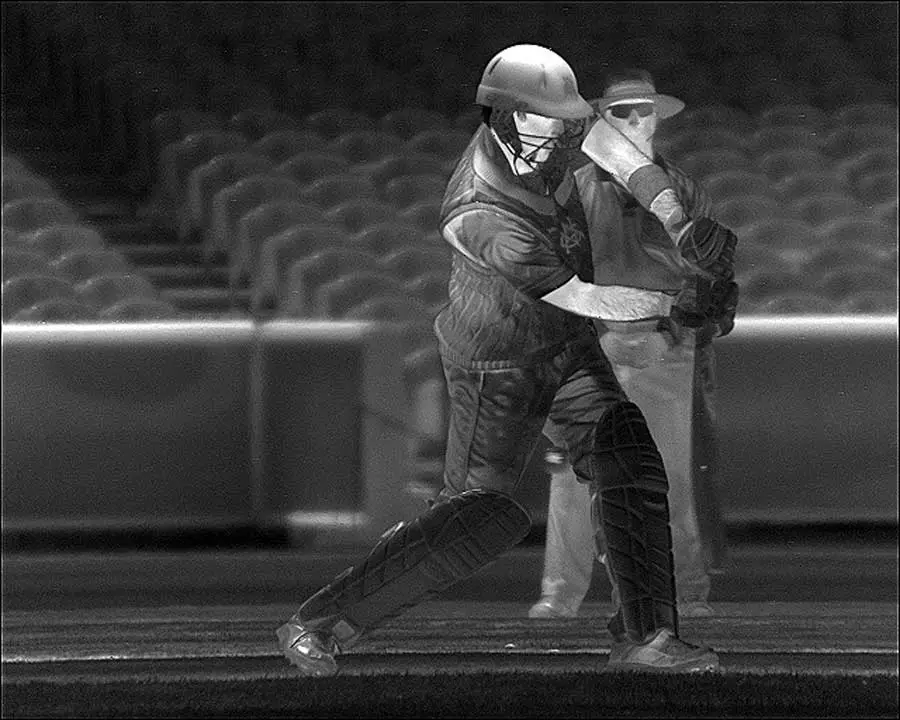
With a four-camera setup, Hotspot uses infrared thermal imaging technology to detect where the ball hits.
Impact/Features:
The pros of HotSpot was that it could catch even the faintest of edges. However, the inventor himself had doubts of the validity of the HotSpot during the 2013 Ashes since coating on bat can prevent HotSpot to be displayed.
In addition, it has been suggested that HotSpot has not been preferred in India since it is a military technology.
Is one possible faint nick worth $10,000 per match?
There are other technologies that have enhanced the level of cricket broadcasting over the past decade: Helmet cameras, Stump Mics, LED Stumps, SpiderCam, etc. These technologies are not necessarily part of the DRS and, we may not have all the cost information.
Although I could not find the exact cost of the Spidercam, I bet this can cost the broadcasting companies upwards of hundreds of thousands or even a few million dollars.
How does the Spidercam Work?
The Spidercam tries to offer a ‘bird-eye’s view’ on the cricket ground. It is made possible with a cable suspended camera system. This helps the camera move in multiple directions.
On Amazon, Bushnell range finder for golf costs anywhere from $100-300. For professional sporting equipment, it may be a bit more expensive.
How does the Bushnell Work?
A range finder is used to measure distances of remote objects and has been used in the military and golf.
Watch this videoof Simon Doull explaining in a Cricbuzz discussion that the range finder plots from the “middle of the ground to the grandstand and tiers of the grandstand. It’s not where the ball might have landed.”
Impact/Features:
With T20 cricket, displaying the distance of sixes has become central to broadcasting needs.
10. Stump Mic
Impact/Features:
Stump microphones are placed near the stumps and pick up sounds like edges (important for snicko & Ultra-edge to work) as well as sledges & Rishabh Pant singing spider man main theme song.
Bonus
PitchVision
Their catch phrase is “technology used in the highest level of the game is now available for everyone to use.”
2008 – DRS is first experimented in the India-Sri Lanka Test series. Virtual Eye technology made an error in Virender Sehwag’s dismissal. Dilshan was given not out due to lack of evidence. Doubts crept in.
2009 – Review system started to be officially implemented in Test matches (with agreement from both teams)
2018 – ICC Women’s World Twenty20 first ICC T20 World Cup to feature the DRS
Who Pays for These Technologies?
In the early days of the DRS, the broadcasters of the home team used to take most of the responsibility of these costs.
Now, the payment is usual divided between the home team cricket board & the broadcasters. However, as the review system gets further uniformed around the world (especially with World Cups and major tournaments), the ICC has started to bear some of the responsibility and subsidize the overall cost.
Final Thoughts
Although cricket might not have as much broadcasting prowess as other sports like American football, but it is certainly in the right direction. I hope more independent companies can chime in as well, which may help reduce the costs. The competition may also drive better products.
I also hope that the ICC can make uniform regulations and can cover the costs, especially in major tournaments like the World Cup Qualifiers.
What is the difference between Ultra-edge & snickometer in cricket?
Ultra-edge is Hawkeye’s version of the snicko.
What does DRS stand for?
DRS stands for Decision Review System.
Why is Hotspot technology not used in cricket anymore?
HotSpot technology is not used in cricket anymore due to doubts about the validity of the technology. Bat coating & silicone tape can hide the image detection on Hot Spot.
How much do cricketers earn per year? – Men’s Edition.
On average domestic first-class cricketers earn $85,000 per year, an international cricketer might earn anywhere from $200,000-$2 million (depending on contract tier and nationality), and T20 freelance cricketers earn per year in the range of $700,000-$1.7 million.
This is a start to our new series on Finances in Cricket. Why?
Well because international cricket is at its fulcrum of its continental divide. The tectonic plates comprising of international cricket, T20 leagues, and World Cups are about to crash and massive seismic activity is going to take place in the next decade or so.
At the heart of the matter is the professionalization of cricket, and individual cricketers now having choices. Today we explore seven templates for cricketers to make a professional career in today’s world and analyze how much these cricketers earn per year on average.
Cricket is no longer in the 1990s, where playing at the international level was the only feasible way to earn a sustainable living with maybe an additional County contract.
We have identified seven different types of players and how much does each type of cricketer earn. These types are:
First Class Players Only (Ranji, County, Sheffield Shield)
Test Player + County contract (ex: Cheteshwar Pujara)
All 3 format player + IPL contract (ex: David Warner)
2 formats + IPL (ex: Ben Stokes, Quinton de Kock)
Fringe national player + 2/3 franchise leagues per year (ex: Sam Billings)
Only T20 circuit (ex: Imran Tahir/Tim David)
TNPL/KPL + IPL Deal (ex: Varun Chakravarthy)
Note the seventh type of player is a rare edge case – those who get selected for the IPL without any domestic or international experience (for ex, Pravin Tambe & TNPL stars like Varun Chakravarthy).
Cricketer Salaries
1. How Much Do First Class Cricketers Earn Per year?
County Cricket Average Annual Salary
Minimum: $29,000, $19,500 for rookies
Average; $125,000
How the County Cricket Contract Structure Works
The minimum wage for a County Cricketer is about 24,000 pounds per year ($29,000)and for rookie signings, close to 16,000 pounds per year ($19, 500).
However, actual salaries for more experienced players and overseas signings are probably much higher. For example, in its 2021-22 Annual Report, Kent County spent 2.1 million pounds ($2.5 million) on wages in 2021, provided to 20 cricketers.
This averages to an estimate of about $125,000 per year for a County cricketer.
*Note: The average County salary may vary drastically from county to county based on funding, crowd attendance, etc.
How the Indian Domestic Cricket Pay Structure Works
The structure for Indian domestic cricket is quite interesting. Indian first-class players are paid per day rather than on a contract basis. Hence a day of Ranji Trophy game or a Syed Mushtaq Ali T20 is worth the same amount.
I am pleased to announce the hike in match fee for domestic cricketers.
Before 2021, all players earned about Rs 35,000 ($440/day) and Rs. 17,500 ($220/day). However, the new Indian domestic salary structure is now dependent on seniority as follows:
Number of Career Matches Played
Salary (if selected in the XI)
Salary (if in reserves)
1-20
Rs 40,000 ($500)
Rs 20,000 ($250)
21-40
Rs 50,000 ($630)
Rs 25,000 ($315)
41+
Rs 60,000 ($750)
Rs 30,000 ($375)
Indian Domestic Player Salaries
A Ranji Trophy league game is usually 4-day games and knockout matches are 5-day games. Hence, the amount of money a player is paid per Ranji Trophy league match is as follows:
1-20 matches: $2,000 (in the XI), $1,000 (Reserves)
21-40 matches; $2,520 (XI), $1,260 (Reserves)
41-60 matches: $3,000 (XI), $1,500 (Reserves)
For knockout matches, the corresponding amount is $2,500 ($1,250 – reserves), $3,150($1,575), and $3,750 (1,875) for the three brackets respectively.
Total Domestic Season Salary
Due to the pandemic disruption, some of the formats were tweaked or tournaments were cancelled altogether. However, we can look back at the 2018-19 season to see how a regular season would look like:
Tournament
League Games
Knockouts
Maximum Days Played
Ranji Trophy
8 (4-day)
3 (5-day)
47
Syed Mushtaq Ali Trophy (New format)
5
4
9
Vijay Hazare Trophy
8
3
11
Duleep Trophy
2 (4-day)
1 (5-day)
13
Deodhar Trophy
2
1
3
Irani Cup
1 (4-day)
4
Total
25 matches (55 days)
13 (32 days)
87 days
*Note, the Duleep Trophy (India Blue, India Red, India Green) & Deodhar Trophy (India A, India B, India C) does not include all players, and some of these Indian players might already be on a national contract.
Hence, an experienced player (41+ matches) who has played all 87 days of cricket, can earn up to $65, 250 per season. Of course, that means each of their teams would need to get to the final in these six tournaments, which will be a rare occurrence.
On the other hand, a reserve inexperienced player (less than 20 career matches), who does not get selected for Duleep, Deodhar, and Irani Trophy will receive pay for about 45 days per year. That player can earn about $11,000 per season.
However, an average Indian domestic cricketer is somewhere in the middle. The average player might play all of the Ranji league games, SMAT, and the Vijay Hazare Trophy and may have 21-40 matches in his career. Such a player may earn around $28,630 per season.
According to cricket.com.au, the average retainer salary of domestic Australian cricketer who plays all formats is 198,000 Australian dollars ($145,000).
NZ domestic players earn via an annual Retainer salary plus match fees.
The retainers range from 27,000-53,000 NZ dollars ($17,000-$33,000 USD). The match fees are 1,650 NZD per Plunkett Shield (first class) game, 800 for Ford Trophy (List A), and 575 NZD for T20 Super Smash.
The Plunkett Shield consists of 8 matches per season, 10-12 matches for Ford Trophy, and 10-12 matches for the T20 Super Smash. Hence, a player can earn between 26,950-29,700 NZD ($17,000-$18,700 USD) in match fees.
Hence, the minimum a player can earn is around $34,000 while the maximum is around $51,700.
Prototype Player: Cheteshwar Pujara – Test cricketer only, plays in County Cricket in the off season
Cheteshwar Pujara Estimated Annual Salary: $1-1.5 million
Cheteshwar Pujara was demoted from Grade A to Grade B list for the current 2021-2022 season. Grade B pays around 3 crore rupees ($381,000) annually.
In addition, match fee for an Indian Test cricket is about 15 lakh rupees ($19,000). If Pujara plays, on average, 10 Tests per year, then he would earn around $190,000 from match fees.
It is not clear how much Pujara received as an overseas signing for Sussex.
However, since the salary cap is around $2.45 million and the minimum wage for a county player is around $29,000, we can estimate a range of Pujara’s salary. Since there are around 24 cricketers in the squad, if we assume around 10 Sussex cricketers are on minimum wage, 10 more who earn around $50,000, then Pujara might be receiving somewhere between $400,000-$1,000,000 as an overseas signing
Adding it all up, Pujara’s salary is about $1-1.5 million.
3. How much do three format players earn per year?
Prototype Player: David Warner – Plays all 3 formats at the international level & the Indian Premier League (IPL)
David Warner Estimated Annual Salary: $2 million
In the latest rounds of Australian contracts, David Warner earned about 1.5 million AUD ($1 million USD) along with match fees as follows:
Home Test Fees: $18,000 AUD ($12,500 USD)
Away Test Fees: $25,000 AUD ($17,275 USD)
ODI Fees: $7,000 AUD ($4,800 USD)
T20I Fees $5,500 AUD ($3,800 USD)
Since the 2021 T20 World Cup (including the T20 WC), David Warner has played 10 Tests (5 home, 5 away), 5 ODIs, and 10 T20Is. This amounts to a total of $210,875 in match fees.
In any addition, as a prominent three format player, he was picked at the IPL by Delhi Capitals in the 2022 IPL auction for Rs. 6.25 crore ($791,000).
If we add the national contract, match fees, and IPL deal, then David Warner earns an estimated $2 million per year.
Stokes has already played 12 Tests this year with 3 more to come against South Africa next month. Although he hasn’t played many T20Is recently, England are scheduled to play 7 T20Is vs Pakistan, 3 vs Australia, and at least 5 T20Is in the 2022 T20 World Cup for a total of 15 T20Is.
Combining the Test and T20I fees, Stokes could earn about $346,500 in match fees this year.
Prototype Player: Sam Billings – Not nationally contracted player (reserve player). May IPL & 1-2 other most popular leagues to compensate
Estimated Annual Salary: $700,000-800,000
Sam Billings has been carrying drinks for England since the inception of the Earth. For someone who is always a substitute, never a permanent – how much does he actually earn?
Most famously, he had to drive 500 miles in Australia from the Big Bash as a reserve player in England’s Ashes tour of Australia. He has always been in and out of the squad, but with England’s enviable limited overs depth and with Ben Foakes & Jonny Bairstow already in Tests, he does not get much game time. In his own words,
“It would be a very Sam Billings thing to do to drive nine hours to run the drinks”
– Sam Billings
Already 31 years old, Billings has only played 3 Tests, 25 ODIs, and 37 T20Is. Being a reserve player means, he usually travels with the squad, thereby missing out on T20 leagues that happen during this time. Moreso, Billings got removed from the 2021-2022 ECB contract.
This year, he has played 3 Tests, 4 T20Is, and zero ODIs for a total match fee of $74, 800. For a player like him, he has to compensate via multiple streams of income. He just signed a contract extension with Kent, which by our own averages amounts to about $125,000.
T20 League Salaries
Finally, Sam Billings plays in the most popular T20 leagues around the world:
IPL – He was picked by KKR for Rs 2 crore ($250,000) in IPL 2022 auctions
PSL – Islamabad United – Bilings was picked in the Silver Category of the draft – Pakistan Rs. 2.4 million ($10,500)
He has played an essential part at Sydney Thunder and is most likely to be a part of the new lucrative overseas draft, which will feature four categories: Platinum – $AUD 340,000 ($236,000), Gold – $AUD 260,000 ($181,000), Silver – $AUD – 175,000 ($121,000), and Bronze – $AUD 100,000 ($70,000).
In total, Billings may earn around $400,000-$650,000 in leagues alone. All in all, Sam Billings’ estimated annual income is around $700,000-800,000 when streams of income are combined.
6. How much do IPL cricketers earn per year on average?
Protype Player: Varun Chakravarthy – Surprise player, rags to riches stories (rare cases), usually sprout up from the Tamil Nadu Premier League (TNPL) and the Karnataka Premier League (KPL)
Minimum: $26,250
Maximum: $1-2 million
The IPL is a volatile market for salaries.
In the IPL 2022 auction, 204 players were sold for Rs. 54,580 lac total, for an average price of Rs. 267.55 lac ($337,000). KL Rahul was retained for a whopping Rs 17 crore ($2.1 million) per season, while the lowest player was sold at Rs. 20 lacs ($25,000) per season.
Chakravarthy himself was retained by KKR for Rs 8 crore ($1 million). His rise is accredited to the 2018 TNPL season, which resulted in his purchase by KXIP in IPL 2022. Since then, he has made a name for himself in IPL 2021 at KKR and was subsequently selected for the Indian national team for the 2021 T20 World Cup.
Tamil Nadu Premier League salary ranges from Rs. 1-5 lac ($1,250-$6,315) depending on domestic and international experience.
7. How much do T20 leagues freelance cricketers earn per year?
Prototype Player: Tim David, Imran Tahir, Rilee Rossouw (before international comeback) – Unlike Sam Billings, players in this category might not be in the national radar at all and may have the freedom to play in T20 leagues all year around.
Estimated Annual Salary: $1.7 million
Tim David
IPL: 8.25 crore ($1 million)
PSL: $130,000 (Platinum category)
Hundred: $36,000-$150,000
CPL: $20,000-$160,000
Big Bash: $70,000-$250,000
In addition, players like Rossouw have also played in the Bangladesh Premier League (salaries range from $20,000-$150,000) and the Lanka Premier League ($10,000-$60,000).
With the UAE International T20 league and other smaller leagues sprouting up, this salary will inevitably rise as the number of leagues will grow (quality may decrease, though).
The list goes on and on. Cricket is changing fast. If you blink, you’ll miss what is happening.
Where do all these issues stem from? The issue involves MONEY.
In this series, we will research and investigate it all. How much money does each cricket board earn, who are the richest cricketers, how are resources divided in international tournaments, how much money it takes to host Test cricket, etc., but today we focus on the central issue – how much do different types of cricketers earn per year?
Player salaries matter because that dictates the choices that players will make.
Even though Cricket Australia offers hefty contracts to their national players, especially to top tier players like David Warner, Steve Smith, and Aaron Finch, this innate structure is being threatened by the money in franchise leagues.
It is rumored that the UAE International T20 league will be the second most lucrative league after the IPL, and they are offering around $450,000 for Australian players to poach them from the Big Bash League, that is held during the same time.
If top Australian players do not opt for the Big Bash, who will? This may create conflict between the players and the national board, which can result in a messy standoff. Australian cricket could lose money, which would jeopardize the national contracts.
For the other players like New Zealand & South Africa, playing in foreign leagues is not an option but a necessity. They do not get paid nearly enough to afford a decent living.
Finally, in an age of T20, players like Pujara and solely domestic/Test players are squeezed out. County cricket offers another stream of income, but with separation of formats a possibility, maybe an international First-Class franchise league may be an idea to think about.
First class cricketers earn anywhere between $30,000-$145,000 per year depending on the nation, with an average of about $85,000.
How much does Ben Stokes earn?
Ben Stokes earns around $1.5 million (excluding captaincy bonuses, IPL deals, and other endorsements).
What is Cheteshwar Pujara’s salary?
Cheteshwar Pujara’s annual estimated salary is around $1-1.5 million.
What is David Warner’s salary?
David Warner earns about $2 million annually from his national contracts, match fees, and IPL deals alone.
How much do County Cricketers earn?
County cricketers earn a minimum wage of 24,000 pounds ($29,000). However, county teams have a salary cap of $2-3 million. Hence experienced players and overseas signings may be signed around $400,000-$1,000,000. Therefore, the average salary of a County cricketer may be estimated to be around $125,000.
How much do Indian domestic Ranji Trophy players earn?
Indian first-class domestic players earn based on their experience. Salaries may range from $11,000 for inexperienced players on the reserve squad, while experienced players who play most of the matches may earn up to $65,000.