Unlike David Miller and Rassie van der Dussen, who remain in the international mix with flexible deals, Klaasen has been completely sidelined, a surprising call with the 2026 T20 World Cup and 2027 ODI World Cup in South Africa on the horizon.
Then again, nothing is ever truly surprising with South African cricket.
Their loss may be franchise circuit’s gain. So we ask—With his calendar now wide home, just how much more money can Klaasen earn in a year?
In 2024, Klaasen played 4 ODIs and 15 T20Is. At a rate of $1900 per ODI and $911 per T20I, he earned approximately $21,265 in match fees. Having retired from Test cricket in late 2023, Klaasen likely held a mid-level white-ball only contract worth between $145,000-221,000. In total, his annual earnings from Cricket South Africa (CSA) likely ranged from $166,000-$242,000.
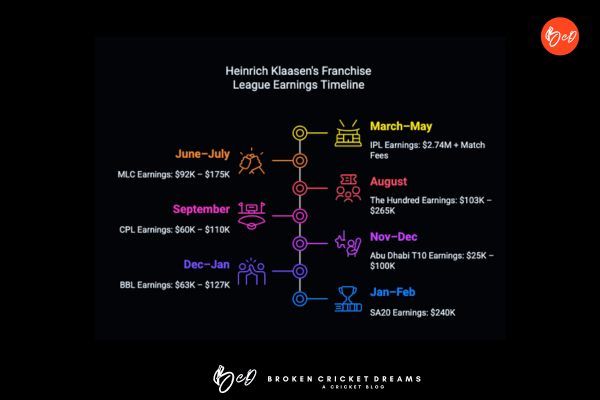
Klaasen is currently active in the SA20, IPL, and MLC. Without international duties, his calendar opens up to other leagues like an entire season of The Hundred (already signed), partial stints in the CPL and the BBL, and possibly a shorter league like the Abu Dhabi T10. Altogether, this could earn him an additional $251,600-$602,000 annually— 4% to 263% increase over his former CSA income, effectively replacing or even exceeding his lost national contract.
In total, Heinrich Klaasen’s earnings from franchise salaries alone will be about $3.5 million-$4.17 million.
Here are some new additions and salary changes in various franchise leagues this year.
The BCCI introduced match fees of about $9000 if a player is included in the Playing XII of an IPL match.
If Klaasen features in at least 10 matches, that is extra $90,000. If he plays all 14 league matches, that rises up to $126,000. If they go through the eliminator, qualifier, and the final, he can earn up to $153,000 extra with IPL match fees alone.
Klaasen was a third draft pick in 2023 at £75,000/$96,186. Third draft pick has increased to £78,500 this year.
Note: Not all franchise tournaments reveal the exact signing amount for an overseas signing/retained player, so we provide a range. Klaasen is a highly sought-after T20 player, so his actual salary may be closer to the higher end.
Heinrich Klaasen’s Current Franchise Contracts ($3.27-$3.57 Million)
Note: Klaasen is unlikely to play in the PSL due to scheduling conflict with the IPL (April–May) since he’s been retained by SRH for the next couple of seasons.
Also, Global T20 Canada is in doubt for 2025 and hence has not been considered in this list.
Projected Calendar (2025-2027)
So now, we are ready to build Klaasen’s projected calendar.
Since the ILT20, BPL, and Super Smash collides with his home tournament SA20, he will not be able to accommodate these leagues and will only have space to play the first half of the Big Bash. In addition, since June-September is action packed T20 season, there will probably not be enough time to take part in the T20 Blast.
Since Klaasen won’t be available for the whole BBL season, I reckon his draft price will closer to the Bronze ($100,000 AUD)-Silver ($200,000 AUD) range, which is $63,600-$127,200 USD. Similarly, for the CPL, where he may only be available for the first half, his salary range may be closer to $60,000-$110,000 rather than $130,000-$190,000.
As a fan, I hope the door has not closed on Klaasen’s return to internationals.
Franchise cricket now owns the calendar. The only real gap? October—which fittingly happens to be when the next ODI World Cup is scheduled.
With the 2026 T20 World Cup on the horizon and a home 2027 ODI World Cup, losing a player of Klaasen’s calibre would be a real shame.
At nearly 34, he is prioritizing his future. So are several others. Kane Williamson and Trent Boult have already taken this route. And I’m sure, many more will follow.
One thing is for certain: As franchises compete for top talent, player salaries will keep rising.
International cricket, though? It may already be on its deathbed.
For a Complete List of Franchise Salaries, you can check out the following:
In 1918, US President Woodrow Wilson gave a speech in the US Congress that would be regarded as the “Fourteen Points.” It proposed potential resolutions to end the ‘Great War’ (World War I), outlined how the world could move towards peace and prevent future wars, and was a key factor during the Treaty of Versailles.
Now I know what you may be thinking. What kind of comparison is this? Cricket is not war!
It definitely isn’t, but we can all agree that cricket has its share of problems.
Yesterday, the West Indies and England reminded us how special Test cricket truly is. The ebbs and flows, last day drama, the inspiration of an injured Shamar Joseph and Jack Leach fighting for their countries, the comeback of Tom Hartley, the camaraderie between the teams, and much, much more.
It reminded me why I started watching cricket in the first place, and I would love more of days like yesterday.
Hence, without further ado, here are my Fourteen Points to help preserve Test cricket, reduce the conflicts in the current cricketing calendar, and help fuel the growth of cricket in smaller nations.
A Test match fund shall be formed from ICC’s annual budget to support the endeavors of Test cricket around the world. This budget shall, at a minimum, include match fees (players, support staff, ground staff, umpires, administrators), minimum set of cameras to support the DRS (decision review system), miscellaneous finances (hotel, food, and travel), advertising & marketing costs, and all such costs which shall be deemed necessary and proper for carrying into execution a proper Test match. The distribution of the budget shall be approximately proportional to the number of Tests a cricketing nation hosts per year.
How will it work?
In 2015, the Test Match fund was pondered, where the ICC would offer $12.5 million to the non-Big 3 Test playing countries to support Test matches over a few years.
This idea, however, never materialized. In our research, we found that it takes anywhere from $350,000-$1.4 million to host just a single one Test match, which is often a burden on the smaller nations. If a team hosts 2 three-match Test series in a year, that could incur a cost ranging from $2 million-$8.5 million per year.
Potential Problems
Even at the lower estimates, $2 million for 12 Test playing nations would cost the ICC about $24 million per year. That is a lot of money.
This will be a huge effort on the part of the ICC, which may require additional sponsorships, broadcast rights expansions, etc.
To start off this process, the ICC Test match fund could be piloted among the cricketing nations who are losing money to host a Test(ex: New Zealand, South Africa, Sri Lanka, West Indies, Pakistan, etc.).
Who Said What?
“Unless the boards change the economic model, I don’t think Test cricket will thrive outside of the Big 3.”
An adequate minimum Test match fees shall be established to players across all nations for both women’s & men’s Test cricket, the monetary value of which should be updated every two years based on inflation and market economics. Boards are free to provide additional bonuses to their players.
How Will it Work?
Currently, India pays its men’s Test players $18,800 per Test, Australia pays about $12,500-$17,725 USD per Test, and England pays its players around $17,600. On the other hand, a New Zealand men’s Test match fee is about $6,600 USD.
The ICC will need to setup a committee and decide what a decent minimum Test match fee is and then work with each of the cricket boards to split duties on minimum fees.
For example, if we decide that $ 17,600 (like England) is a good enough Test match fee and NZ cricket board are already paying their players $6,600, then the ICC would jump in and make up the deficit of $11,000 per Test per player. Hence, the Big 3 may not need support from the ICC (and will be allowed to pay their players bonuses on top of the minimum fee), but the ICC would need to help the other countries out.
Potential Problems
Once again, we are asking ICC to bear a potentially high cost, but does the ICC even have this much money?
If not, how can they bring in more money? If this causes the ICC to host more World Cups and tournaments, then this will crowd the already crowded cricket calendar. We do not want to create more issues to solve one problem.
“We’ve got to figure out a way for them [other countries] to be incentivized to play international and particularly Test cricket. That requires transparency from all cricket boards around the world to try to figure out how to pay the players the best way they can.”
– Usman Khawaja
“…Similarly to save Test wicket they should introduce standard match fee for all the boards, so that all players of Test cricket nations can have the same match fee.”
Mohammad Hafeez
III. Introduction of Test Match Windows
Two Test match windows, one each for the Northern & Southern hemispheres respectively, shall be implemented for three months of the year.
How Will it Work?
A few people have suggested having 3-month window where only Test cricket is played. However, I think this is an incomplete solution since the Northern and Southern hemispheres have different seasons for cricket.
What could happen is from May-July, there should be a window to play Tests in England, West Indies, and the subcontinent nations while December-February should have a window for Test cricket in New Zealand, South Africa, and Australia. In these windows, we may simultaneously see the Ashes, Ind-SA Tests, and NZ-Pak Tests for example. So the focus of the fan base is solely on Test cricket.
Now we cannot stop franchise cricket for six months, so what can be done?
We can customize the window per nation. For example, when a country is hosting or touring for Test cricket within those two larger windows, they are not allowed to host a franchise league. This will help avoid clashes that we are seeing with South Africa and the SA20. On the flip side, leagues like the BBL can benefit because the BBL will have all their international players to choose from.
Potential Problems
This will definitely cause backlash by the franchises because prime time will be taken away from them.
For example, this rule would mean The Hundred cannot be scheduled in the summer months when Test cricket takes priority. This is the time that students have vacations, the weather is decent, and there is time to spend with family. The broadcasters may also suffer due to lower television ratings.
Who Said What
A 3 month dedicated window for Test cricket every year for both the men & women’s teams is the only way to protect the greatest format .. no other cricket but Test around those 3 months .. the other 9 months for all the leagues ICC events .. 👍👍
The bilateral ODI series shall be abolished from the cricket calendar.
How Will it Work?
As simple as, no more bilateral ODI series.
Don’t worry, I am not advocating the ‘Death of ODI cricket’ or anything like that. We saw in the 2023 ODI World Cup that fans still enjoy ODI cricket albeit in a smaller dose. Removing ODI bilaterals will provide space in the calendar to accommodate Test cricket, franchise leagues, and qualification matches (more on this, a few sections later).
Potential Problems
Loss of sponsorships and advertising revenues for host countries.
V. Abolishment of the Bilateral T20I Series
The bilateral T20I series shall be abolished from the cricket calendar.
How Will it Work?
Read point IV. Same as above.
This year, India will only have the 3-match T20I series against Afghanistan and the IPL to choose its players for the World Cup. The franchise tournaments will be enough to assess the player pool for T20 World Cups.
VI. Transformation of the two-year World Test Championship cycle into a Concentrated Test World Cup
Every four years, the league of Test nations shall assemble to play in a Test World Cup during the two 3-month Test windows. The top eight ranked teams shall compete, four winners proceed to a round-robin semi-final, and the Top 2 compete in the Best of 3 final series at a pre-determined venue.
How Will it Work?
Four 3-match series will occur for the Top 8 ranked teams during the first six months of the year in two different neutral countries (ex: Aus v WI (#1 v#8), Ind v SL (#2 v #7), Eng v Pak (#3 v #6), SA v NZ (#4 v #5)).
The four winners will then play 6 Tests in a round-robin format in the ‘Final Stage’ of this Test World Cup. The Top 2 teams will then play a 3-match series for the World Cup Final.
Note: During this Test World Cup year, regular bilateral Test series will not take place since this will take place during the Test windows.
Potential Problems
The teams that did not qualify in the Top 8 or lost in the first stage may not play much Test cricket that year.
Who Said What
"The only effort that's been made to try to keep it relevant, I think has made it worse!" 📉@markbutcher72 believes the introduction of the World Test Championship has contributed to the decline of Test cricket.
VII: Two-Tiered Test League with Relegation & Promotion
Relegation and Promotion shall be established in Test cricket that will feed into the Test Match World Cup. Teams will be promoted and relegated at the end of every two-year cycle.
How Will it Work?
The 12-Test playing nations will be divided into two brackets (#1-6 in Bracket A and #7-12 in Bracket B). At the end of each two-year league, the bottom two of Bracket A will be demoted to Bracket B and vice-versa.
The top eight-teams (all 6 teams in Bracket A and top 2 of Bracket B) will compete in the Test World Cup.
Potential Problems
Since we are proposing Test match windows, some windows may have too much Test cricket if that’s even possible.
VIII: 4-Day 3 Match Series instead of 2 Tests
The two-match Test series shall no longer be in existence. If for some reason, due to calendar conflicts, financial reasons, or unforeseen circumstances, there is only space for 15-20 days, then a three-match four-day Test series shall take place with the approval of the cricket boards of the interested parties.
How Will it Work?
If the Test match fund and calendar problems are solved with the above solutions, then there will not be a need for a 2-Test series (since teams will have enough money to host Tests).
However, if the situation arises that only 2-Tests are possible, then instead a 3-match 4-day Test series should take place. This will only add two days to the overall match time and maybe an additional week for the overall tour.
Potential Problems
This could result in too many draws if multiple teams agree on this approach.
Who Said What
“I’m not sure whether it’s changing it to four-day Test matches, so you can have an extra day to make sure that you play that third Test match.”
IX. Advertising Revenue and ICC Funding for County Cricket, Sheffield Shield, Ranji, and other domestic four-day tournaments.
The cricket boards will have to allocate their respective annual budgets to the betterment of domestic cricket. This includes, but is not limited to, advertising, recruiting, providing better facilities, etc. The ICC shall subsidize cricketing boards with a poor financial situation.
How Will it Work?
Franchise cricket is popular because the best players play in these leagues and sponsorship/TV revenue is high. On the other hand, County Cricket is shown on some YouTube channels, if at all.
The ICC should have a mandate to oversee that cricket boards are actively publicizing domestic cricket. This could be done by providing boards additional capital for domestic tournaments, having free to air channels, or by marketing domestic tournaments on social media channels.
Potential Problems
This could take additional manpower and resource, which will increase the costs of all parties involved.
X: Mandatory Practice Games with Similar Pitches
Each visiting team will be provided at least one practice match (for a 3-Test series) and two practice matches (for a series with 4 or more Tests). An impartial inspector from the ICC shall monitor practice pitches to ensure they are closely aligned with the pitches that the series will offer.
How Will it Work?
I have no problems with India coming up with rank turners or South Africa’s bounce troubling batters. I do, however, have a problem with multiple Tests finishing within two to three days and the lack of practice matches.
England have gone to India for a 5-match Test series without a practice match!
What should happen are at least 2 mandatory practice 4-day matches on pitches with similar conditions. If India plan on putting up rank turners, they need to make rank turners for these practice matches. If the series will have a variety of surfaces (for example, Dharamsala and Chennai), then the two practice matches need to have different surfaces. The ICC need to get involved as the impartial spectator to ensure consistency in pitches.
Potential Problems
This could mean longer tours for visiting teams and time away from home.
XI. Revival of the ODI Super League, Revamping of Qualification Systems & ICC Rankings
The ODI & T20 World Cup qualification systems shall be revamped and the ODI Super League shall be revived. No country, with the exception of the host nation, will be guaranteed a place in an ICC tournament. The space provided by the abolishment of bilateral series will be replaced by qualifying rounds that feed into the ODI Super League and World Cup qualifications.
How Will it Work?
The ODI Super League shall be revived for the benefit of ‘Associate’ nations like the Netherlands and Scotland.
Unlike the first edition of the ODI Super League, the Super League will be divided into a few groups (for example, 18-team Super League with 3 groups of 6). Every few months, a country will hold a Qualification round to play some of the matches. After a couple of rotations, each team in the group have played against each other twice (at least 10 matches per team before the World Cup).
These matches will be all be a part of World Cup qualification. No additional friendly bilateral games.
Potential Problems
Scheduling could be a problem with the various franchise leagues going around.
XII. Staggered ODI & T20 World Cups every 2 years, Removal of the ICC Champions Trophy
Each ICC World Cup tournament for both men’s & women’s cricket shall be held every four years, staggered by two years for the format. The Test World Cups will occur in the years there is no bilateral World Cups.
How Will it Work?
There are too many World Cups happening now. T20 World Cups in 2021 & 2022, an ODI World Cup in 2023, and another T20 WC coming up in 2024.
That’s an overkill. Rather, we can have ODI World Cups in 2027, 2031, 2035, etc. while T20 World Cups are hosted in 2029, 2033, 2037, etc. – also every four years. Then there will be space for the Test World Cup in 2028, 2032, 2036, etc.
This should also be implemented in the women’s game (One idea could be to stagger all 4 – 2027 Men’s ODI, 2028 WODI, 2029 – MT20, 2030 – WT20, etc.).
Potential Problems
Players might retire earlier if they know they cannot make it to the next ICC tournament.
XIII. Maximum Leagues Cap for Nationally Contracted Players
If a player is nationally contracted by their national cricket boards, they are limited to a maximum of three leagues (IPL, domestic league, and one other) per year or four leagues per year (if no IPL contract provided) or risk being fined their match fees. If a player does not have a national contract, they are not obligated to follow this limit.
How Will it Work?
We can come up with a compromise so that nationally contracted players can play a maximum of 3 leagues per year (including the IPL), any 4 leagues (if no IPL deals), and no restrictions if without a contract.
If Test windows and minimum Test match fees is implemented, then this should benefit both international cricket and the players themselves.
Potential Problems
Players may not sign the national contract at all and be franchise freelancers if that benefits them in the long run.
XIV: Re-Establish Champions League, Limit Expansion of the IPL
The Indian Premier League (IPL) shall not expand beyond the three-month window it is currently provided. The franchises are free to invest in other leagues around the world and a one-month window will be allocated for an annual Champions League.
How Will it Work?
It is clear that IPL franchises are starting to own stakes in other leagues. In the past, the Champions League did not provide value because a single player would have conflicts over multiple franchise but end up playing for their IPL teams.
If the IPL team starts doing year long contracts (for example, the same player plays for MI, MI Cape Town, MI NY, etc.), then there shouldn’t be a conflict of interest as before.
Potential Problems
For yet another competition to be in the cricket calendar, the IPL has to stop at the 10 teams, 3-month format. If the IPL is any longer, international cricket may cease to exist.
Final Thoughts
I was trying to write this article for a couple of weeks but for some reason, couldn’t find the words and ideas. But on a day where Shamar Joseph and Tom Hartley created history and Test cricket came to life, the idea just magically flowed through.
Much like Woodrow Wilson’s Fourteen points and the League of Nations (precursor to the United Nations), I fully expect the ICC to not pay attention to any of this and lead to major chasms in cricket in the coming years (much like the US themselves did not join the League of Nations, thereby weakened it, and ultimately were not able to prevent World War II).
This article may sound a bit quixotic in nature, but we have to start somewhere, don’t we? The world can only change if conversations begin.
The future of cricket is at stake. Will the ICC do something about it?
What are your thoughts? I want to know, comment below! How would you solve the problems that cricket faces today?
Related Articles
If you like reading about potential solutions to problems in cricket, do read the following:
Today we will discuss the salary of International League T20 (ILT20) player in the UAE.
The league has generated enormous hype due to the salary they pay their players. Will this threaten to collapse the international cricket calendar.
How much do these players make? Can the ILT20 compete with the IPL?
ILT20 Salary – By the Numbers
The average salary of an International League T20 (ILT20) player is $138,888 (maximum 18 players in the squad with a maximum purse of $2.5 million). Hence, the maximum salary cap for the entire ILT20 was $15 million for a maximum of 108 players, divided among 6 teams.
Each team has allocated a purse ranging from $1.5 million (minimum wage bill) up to $2.5 million (maximum wage bill) to acquire their 18 players (maximum 12 overseas players). The maximum wage bill includes a $500,000 loyalty or signing-on bonus as well as a $500,000 bid purse per team that can be distributed among the players on top of their wage slots.
The maximum an ILT20 player can earn is up to $450,000 ($340,000 is the maximum wage and another $110,000 can come from the signing on bonus).
Zee Entertainment Enterprises signed a ten-year $100-$120 million deal with the Emirates Cricket Board (ECB) for the media broadcasting rights.
The International League T20 (ILT20) – How Much Was Each Wage Slot?
The second season of the ILT20 will run from 19 January-17 February 2024 in the UAE. This time around, these matches have been granted official List A status. In any case, here are the wage slots for the 18-men squad in the ILT20 league.
Wage Slots
Salary Amounts (Minimum)
Slot 1
$340,000
Slot 2
$260,000
Slot 3
$220,000
Slots 4-5
$140,000
Slot 6
$100,000
Slots 7-8
$60,000
Slots 9-10
$40,000
Slots 11-12
$20,000
Slots 13-18
$10,000
ILT20 Retained Players and Squads – Salary of International League T20 Player
Another reason the ILT20 has garnered interest is because of its overseas player limit. The ILT20 has instilled a limit of nine overseas players in the XI. This is much more extreme than the 4-5 we see in the other teams.
This is how the teams stack up:
1. Abu Dhabi Knight Riders
Retained Players: Sunil Narine, Andre Russell, Joe Clarke, Charith Asalanka, Sabir Ali, Ali Khan, Matiullah Khan, Marchant de Lange
Squad: Laurie Evans, Sam Hain, Michael Pepper, Alishan Sharafu, Ravi Bopara, Brandon McMullen, David Willey, Adhitya Shetty, Josh Little, Sabir Ali, Matiullah Khan, Jake Lintott
2. Desert Vipers
Retained Players: Wanindu Hasaranga, Alex Hales, Tom Curran, Colin Munro, Sherfane Rutherford, Luke Wood, Matheesha Pathirana, Rohan Mustafa, Sheldon Cottrell, Dinesh Chandimal, Gus Atkinson* (withdrawn), Ali Naseer
Squad: Azam Khan, Adam Hose, Michael Jones, Bas de Leede, Shadab Khan, Aryan Lakra, Karthik Meiyappan, Tymal Mills, Shaheen Shah Afridi
3. Dubai Capitals
Retained Players: Joe Root, Sikandar Raza, Rovman Powell, Dushmantha Chameera, Raja Akifullah Khan
Squad: Vritya Aravind, Sam Billings, Rahul Chopra, Max Holden, Rahmanullah Gurbaz, Sadeera Samarawickrama, David Warner, Mohammad Mohsin, Dasun Shanaka, Roelof van der Merwe, Akif Raja, Nuwan Thurshara, Andrew Tye, Mark Wood, Haider Ali
4. Gulf Giants
Retained Players: Shimron Hetmyer, Chris Jordan, James Vince, Jamie Overton, Chris Lynn, Aayan Khan, Sanchit Sharma, Richard Gleeson, Carlos Brathwaite, Rehan Ahmed, Gerhard Erasmus
Squad: Jordan Cox, Jamie Smith, Usman Khan, Aayan Afzal Khan, Dominic Drakes, Karim Janat, Mujeeb Ur Rahman*, Saurabh Netravalkar, Sanchit Sharma, Zuhaib Zubair
*Mujeeb is banned from ILT20 for a season or two due to a breach in contract
5. MI Emirates
Retained Players: Kieron Pollard, Dwayne Bravo, Nicholas Pooran, Muhammad Waseem, Daniel Mousley, Trent Boult, Zahoor Khan, Fazalhaq Farooqi, Jordan Thompson, Will Smeed, McKenny Clarke, Andre Fletcher
Retained Players: Chris Woakes, Junaid Siddique, Mark Deyal, Joe Denly, Tom Kohler-Cadmore, Muhammad Jawadullah
Squad: Basil Hameed, Johnson Charles, Martin Guptill, Kusal Mendis, Sean Williams, James Fuller, Lewis Gregory, Nilansh Keswani, Daniel Sams, Dilshan Madushanka, Qais Ahmad, Chris Sole, Mahesh Theekshana, Mark Watt
Cricket is at a breaking point. We have said this time and time again.
We are now at an extremely crucial juncture in cricket’s history. Not only is international cricket competing with franchise leagues for a spot in the calendar, the T20 leagues themselves are at odds with each other.
The SA20, ILT20, BBL, BPL, and New Zealand’s Super Smash are all competing for top talent between December and February, after which the PSL and IPL take over. Which leagues will survive?
We do not know, but international cricket may not. Test cricket (outside of the Big 3), definitely, will not.
Related Cricket Content
Cricket and Finances Articles
For other content on Finances in Cricket, do read:
2023 seems to be a watershed moment for franchise cricket leagues—SA 20, IL T20, MLC 2023, Zim Afro T10, and the revival of Global T20 Canada.
Feel like you can’t keep track anymore? Well don’t worry, we are here to help you.
Key Takeaways
There are 15 professional leagues in cricket, from which 13 are franchise leagues and two are domestic T20 competitions that attract a variety of overseas stars (Vitality Blast, Super Smash). From the 13 franchise leagues, two are T10, one is in the ‘hundred’ format, while the other 10 are twenty20 competitions.
In 2023, October is the only without any major cricket league competition since October 5 – November 19 is reserved for the 2023 ODI World Cup.
From November 23, 2022 to September 24, 2023, there were only 20 days where franchise cricket was not scheduled (December 5-12, March 19-30).
If we count all the date ranges for the 15 major T20 tournaments, there were 509 days of cricket (greater than 365 because several leagues are now overlapping with each other. Also domestic tournaments like the Vitality blast tend to be spread out longer with breaks. Actual cricket might not be played every day).
Cricket Leagues Calendar – By Season
November-February: Abu Dhabi T10, Big Bash League (BBL), Super Smash, Bangladesh Premier League (BPL), South Africa T20 (SA T20), International League T20 (ILT20)
February-May: Pakistan Super League (PSL), Indian Premier League (IPL)
May-July: The Vitality Blast (also good time for a World Cup window), TNPL
July-September: Major League Cricket, Global T20 Canada, The Hundred, Caribbean Premier League (CPL), Shpageeza Cricket League*, Road Safety World Series, Maharaja T20 Trophy
October: Window for world tournament (or…Champions League), Syed Mushtaq Ali Trophy
List of Cricket Leagues: Top 15 Franchise, T10, & T20 Competitions
*Note: The date ranges are either from last year or the upcoming 2023 season if it has not happened yet. We first start with the Abu Dhabi T10 league from November 2022.
18. Tamil Nadu Premier League (TNPL): June 12 – July 12
Country: India
Number of Seasons Played: 7 (2016-)
Number of Teams: 8
Days Played: 31
*regional T20 league
19. Karnataka Premier League (Maharaja Trophy T20): August 14 – August 30
Country: India
Number of Seasons Played: 8 (2009-)
Number of Teams: 6
Days Played: 17
*regional T20 league
20. Syed Mushtaq Ali Trophy: October 16 – November 6
Country: India
Number of Seasons Played: 15 (2006-)
Number of Teams: 38
Days Played: 22
*domestic T20 league, but gaining prominence over the years
List of Defunct Cricket Leagues
Euro T20 Slam, Mzansi Super League (South Africa), KFC Twenty20 Big Bash (Australia), Inter-Provincial Twenty20 (Sri Lanka), Stanford 20/20 (West Indies)
Final Thoughts
Leagues are propping everywhere, World Cups are now sandwiched between the leagues, and bilateral cricket is going nowhere.
The ODI Super League is now extinct (although Netherlands’ brilliance might force a rethink), the World Test Championship shows promise, but could be improved. The haphazard year-around schedule impacts logistics, mental health, injury management, and causes early retirements.
Until a stable international cricket calendar is formed, we will have to form the cricket calendar according to the franchise leagues, with the Indian Premier League in the center as the marquee event.
Frequently Asked Questions
How many T20 leagues are there in cricket?
There are 15 T20 leagues in cricket – 10 T20 franchise leagues, 2 T10 leagues, 1 ‘hundred’ ball tournament, and 2 domestic T20 competitions.
How many franchise leagues are there in cricket?
There are 13 franchise leagues in cricket (10 T20, 2 T10, and The Hundred).