Back in 2022, I was at the University of Iowa finishing my PhD when I noticed a force quietly taking over campus: Caitlin Clark.
Over the next couple of years, Clark reshaped women’s college basketball: Viewership exploded with her jaw-dropping 3 pointers, every game was sold out (unfortunately before I could get a ticket), and Iowa reached the Final Four one season and finished as NCAA championship runners-up the next.
After graduation, she was picked up by the WNBA for a whopping…$78,000, far below the value she brought to the league.
Women’s cricket is entering a similar era. India’s World Cup victory has sparked excitement and optimism that the sport may finally see professional growth and meaningful investment.
But as momentum builds, the finances become increasingly important. In my previous article on The Economics of Women’s Cricket, we explored how each cricketing nation is investing in the women’s cricket. In this article, we broaden the scope and ask:
How wide is the gender pay gap across major sports?
Where does cricket sit within that debate?
And most importantly: are women cricketers earning a livable wage that supports a basic standard of living in their countries?
Will the Clark effect translate to cricket? Let’s find out.
Key Takeaways
Nat Sciver-Brunt earns an estimated $931,978 per year, one of the highest for a women’s cricketer (without sponsorships). However, that is less than the highest paid women in tennis, golf, and other sports where players are making $4-10 million annually.
Rishabh Pant and Pat Cummins (~$4-4.5 Million) are among the highest paid cricketers, but their annual salaries are not as competitive as Stephen Curry ($59.6M) or Shohei Ohtani ($70M).
The average international women’s cricketer in Australia, India, England, and New Zealand earns about $100,000-$200,000 a year, while players in Pakistan, Sri Lanka, Bangladesh, and Zimbabwe earn between $2,000-$12,000 per year.
Tennis was the pioneer in pushing for pay parity with the US Open offering equal prize money for both men & women in 1973.
When the gender pay debate comes up, there are usually two sides of the debate.
Revenue-proportional pay: Athletes should earn proportional to the amount of money they generate for the league.
Investment-driven growth: Paying athletes fairly strengthens the league, improves quality, and drives revenue over time.
To understand pay in women’s cricket, I’ll compare league revenue, player salaries, and recent investments across team sports like basketball and soccer, and individual sports like tennis and golf.
We also look at Gross National Income (GNI) per capita with Atlas method, a social marker that determines the average income based on GDP, currency exchange rates, inflation, etc. (including income earned outside of the country).
For example, we will be looking at several leagues in the US. It’s good to keep in mind that the GNI of the United States is $83,660 (2024) so we can see how athletes salaries fare in comparison.
League by League Revenue and Salary Breakdown
I read over 110 articles to bring you salary and revenue information from different sports all in one sports.
*Note: Although the NFL is the most profitable league in the US sports market ($20.24 billion), we do not consider it in our analysis since there is no women equivalent of the NFL.
1. Basketball
Pay Disparity:Extremely High
NBA: National Basketball Association, WNBA: Women’s National Basketball Association
The average NBA salary ($11.9M) is over 116 times higher than the average WNBA salary ($102,249).
Even the lowest-paid NBA player makes more than 4 times the highest paid WNBA athlete.
The NBA generates approximately $28.9 million per player, while the WNBA revenue player generates $1.22 million per player.
NBA vs WNBA at a Glance
Category
NBA
WNBA
Founded
1946
1996
Estimated Salary Range
$1.16-$55.76 Million
$66,000-$250,000
Average Salary
$11.9 Million
$102,249
League Revenue
$13 billion (2024)
$180-200 Million (2023)
Salary as % of League Revenue
0.09% (11.9M/13B)
0.05% ($102K/190M)
Number of Teams
30
13
Number of Games/Team
82
34
Average Attendance
18,834/match 22.2 million (total)
10,986/match 3.14 million (total)
Highest Paid Athlete (Men): $59.6 million (Stephen Curry), $304 Million (Jaylen Brown for 5-year contract)
Highest Paid Athlete (Women): $252,450 (Jackie Young on contract extension), $249,244 (Kelsey Mitchell)
The WNBA has secured a $2.2 billion deal for the next 11 years, averaging $200 million/year, up from the current deal of $60 million/year.
According to Sportico, the NBA is projected to hit $14.3 billion revenue in the 2025/26 season.
Revenue Per Player:
NBA: $28.9 million = ($13 billion league revenue)/(30 teams x 15 players per standard roster
WNBA: $1.22 million = ($190 million)/(13 x 15)
Bottom Line: While salaries remain far below NBA levels, rising media deals and growing brand valuation suggest the WNBA’s momenum may finally be shifting.
In 2022, the US Women’s team won a historic equal-pay settlement of $22 million in 2022, divided among 30 players on the USWNT roster (~$733,333 per player).
The USWNT, USMNT (Men’s National Team) CBA came to an agreement to pool FIFA prize money and split it equally (after 10% to US soccer for youth programs). The US Women’s Team has won 4 FIFA World Cups and 5 Olympic golds, while the men have not made it past the quarter-finals in recent history.
According to Forbes, top USWNT players like Alex Morgan and Megan Rapinoe earned around $7 million in 2023, combining on-field and off-field earnings. In contrast, the top male players like Kylian Mbappe, Cristiano Ronaldo, and Lionel Messi earn around $120 million annually.
MLS: $2.86 million = $2.23B/(30 teams x 26 players)
NWSL: $223,000 = $75M/(14 x 24)
Note: MLS has 20 players on the roster with up to 10 supplemental players. Similarly, NWSL has 22 minimum players with up to 4 supplemental players.
Bottom Line: Although NWSL salaries are lower than MLS salaries, the disparity in league salary is nowhere near as extreme as basketball. Culturally, women’s soccer is more popular and the US women’s national team has made strides in pay parity (though other national soccer teams may still face wide gaps).
ATP: Association of Tennis Professionals, WTA: Women’s Tennis Associations
The median earnings for male professional tennis players ($22,362) is lower than for female players ($75,888). This is due to over 1000 professional men players compared to about 550 women.
The prize money for Grand Slams and other tournaments are largely equal.
Highest Paid Athlete (Men): $20.3 million (Jannik Sinner, $47.3 million total with off-court earnings), $13.3 million (Carlos Alcaraz, $48.3 million with off-court earnings)
Highest Paid Athlete (Women): $12.4 million (Aryna Sabalenka, $15 million with off-court), $12.2 million (Coco Gauff, $25 million with off-court)
Prize money for this year’s Roland-Garros will total EUR 49.6m, up 12.3 per cent on 2022. With the aim of ensuring a more even distribution between players, the tournament organisers have significantly increased the prize money for first-round losers in the women’s and men’s… pic.twitter.com/3HC75KlnIP
In 1973, the US Open became the first Grand Slam to offer equal prize money for both men & women ($25,000 then) after movement driven by Billie Jean King. The other Grand Slams would take a quarter of a century to make the same move: 2001 (Australian Open), 2006 (French Open), 2007 (Wimbledon).
Australian Open offered equal pay in 1984 and reverted to paying the men more in 1996 before going back in 2001.
In 2024, 28 men & 15 women earned at least $2 million. In his career, Novak Djokovic has won more than $190.2 million in prize money alone. Roger Federer is said to have breached the $1 billion mark.
2023 French Open total prize money was $56.8 million (€ 49.6 million). The winner of a Grand Slam, like the US open is about $2.5 million whereas even a first-round loss can yield $100,000.
According to Forbes, the world’s top ten highest paid tennis players made an estimated $285 million (the record was $343 million during the height of Federer-Nadal-Djokovic-Serena Williams).
The US Open’s revenue in 2024 was about $559.6 million. About 3.2 million fans attended the Grand Slams in 2025 (1.1 million – US, 1 million – Australian, 650,000 – French, 550,000 – Wimbledon)
Bottom Line: Prize money in professional tennis is far more balanced than most other sports. While off-court earnings still have large gaps, equal Grand Slam payouts show that both men & women have more equitable financial opportunities for this individual sport.
The average PGA salary (~$1.48M) is nearly seven times the median LPGA salary (~$213K).
Although women golfers are earning up to $6M in recent times, the highest paid male golfers are earning between $60-90M.
PGA vs LPGA at a Glance
Category
PGA
LPGA
Founded
1929
1950
Estimated Salary Range
$6,000-$92 million
$2,300-$6 Million
Average Salary
$1.48 million (2021)
$213,159 (Median 2024)
Winning Prize Money
$4.3 million (US Open) $3.6 million (The Masters) $3.3 million (PGA Championship) $3.1 million (Open Championship)
$2.4 Million (US Open) $487,500 (The Annika)
Highest Paid Athlete (Men): $92 million (Jon Rahm, $102 million including off-course earnings), $67 million (Scottie Scheffler)
Highest Paid Athlete (Women): $4.5 million (Nelly Korda, $12.5 million with off-course)
Growth Trend and Recent Landmark Changes
Tiger Woods’ career earnings total about $120 million with Rory McIlroy closing in at $108 million.
According to Reuters, LIV golf, backed by Saudi funding, has invested about $5 billion over the last couple of years. The organization reportedly offered players like Jon Rahm $300 million to defect from the PGA Tour.
PGA, in response, upped the 2025 season prize money to $366.9 million. Combined with other tournaments, PGA golfers have an opportunity to play for $700 million in a year.
The total prize money for the ladies’ US Open was a $12 million purse and the Memorial PGA tournament was about $20 million. Other tournaments like the Chevron Championship, Evian Championship, and the AIG Women’s Open had a total purse around $8-10 million.
CBS and NBC renewed a 9-year media rights contract in 2022 for about $700 million.
The LPGA is currently in negotiations for a media deal that will put all North American golf matches live on TV. More investment like the ones with FM, U-NEXT deal in Japan is around the corner.
Bottom Line: Despite being around since the 1950s, the gap between top male and female golfers remain among the widest in professional sports.
National Professional Fastpitch (also known as the Women’s Pro Softball League) ran from 2004-2021. The average season salaries were around $3,000.
Although MLB players earn high average salary ($4.66M), they also play the most games (162), which brings their amount per match down to about $28,800.
Bottom Line: Softball players earn a fraction of their MLB counterparts, but the landscape is improving. AUSL is a major upgrade from the now defunct National Professional Fastpitch in terms of investment and support. Meanwhile, the men still have the potential to earn substantial amounts of money both on and off the field.
The NHL and Rogers Communications announced a $11 billion media rights deal in Canada. The NHL also has 7-year deals with Disney & Turner Sports around $200-400 million.
The PWHL signed deals with Fox, Paramount, and other networks.
Premier Hockey Federation, the precursor to the PWHL, paid its players an average of $45,000-$60,000 with top salaries reaching $80,000.
Bottom Line: The pay disparity may look extreme, but PWHL is a new league and is growing rapidly. Only time will tell if it succeeds, but it will take a lot to match a 100-year old NHL league.
UFC fighter Rousey said in 2019, “How much you get paid should have something to do with how much money you bring in. I am the highest paid fighter not because Dana or Lorenzo wanted to do something nice for the ladies. They do it because I bring in the highest numbers. They do it because I make them the most money. I think the money that they make should be proportionate to the money they bring in.”
College Sports, Law Suits, and Miscellaneous
College sports in the US is a separate altogether, but with NIL (Name, Image, and Likeness), college athletes have started to get paid. However, now we are seeing disparity in college pay as well. Men’s basketball players earned an average of $171,272, while the women earned about $16,222 in 2024.
After tennis in 1972, several other individual sports followed equal prize money. By 2004, volleyball and skating offered equal prize money. By 2019, skiing, snowboarding, biking, and even the World Surf League announced equal prize money for both female & men competitors.
IPL: Indian Premier League, WPL: Women Premier League
The average IPL salary (~$460K) is higher than the highest-paid WPL player ($415K) with IPL players earning on average 5.5 times more than their WPL counterparts.
The revenue per player is approximately $2.7-$3.8 million in the IPL compared to about $816K in the WPL.
Even in the lower-tier cricket nations (Pakistan, Sri Lanka, Bangladesh, Zimbabwe), where salaries are lower, player earnings are still significantly above their countries’ GNI.
Category
IPL
WPL
Founded
2008
2023
Salary Range
$24,000-$3.2 Million
$12,000-$415,000
Average Salary
$459,743 (2023)
$82,522 (2023)
League Revenue
$691.3 Million (5761 Crore INR)
$71.86 Million (637 Crore INR)
Salary as % of League Revenue
0.067%
0.11%
Number of Teams
10
5
Number of Games/Team
14
8
Average Attendance
26,000/match
9,000-13,000/match
Highest Paid Athlete (IPL): $3.21 Million (Rishabh Pant)
The average salary for a WBBL player is $30,812 while the average BBL salary is $110,312. The Women’s Hundred pays around $38,077, while the men’s Hundred pays around $75,440 on average.
Men’s vs Women’s Salaries in Cricket (Country By Country Breakdown)
Australia, England, New Zealand, and India now have equal match fees for both men & women. West Indies has signed a MOU to create a pathway for equal match fees by 2027.
Note that match fees is not the same as equal salary, but it is still a step in the right direction. Match fees is how much a player is paid per match. However, women cricketers do not play as much volume of cricket (for example, NZ have equal match fees for Test cricket but the White Ferns have not played a Test in ages).
Bottom Line: Since 2017, women’s cricket has gained momentum through increased visibility, equal match fees, and the emergency of women’s franchise leagues, important steps toward professionalizing the sport. However, more needs to be done in the lower-tiered country to diminish the gap within women’s cricket. Finally, even though men’s cricketers earn high salaries, it is nowhere in comparison to the MLB or the NBA.
For the highest paid cricketers, we looked at franchise league earnings along with match fees and central contracts. Here is an example of how we calculated Pooran and Klaasen’s earnings.
Country
Men
Women
Australia
$3.6-$4.5 Million (Pat Cummins)
$831,951 (Ash Gardner)
England
$3.5-$3.85 Million (Jos Buttler)
$931,978 (Nat Sciver Brunt)
New Zealand
~$2.29 Million (Daryl Mitchell)
$435,755 (Amelia Kerr)
India
$4-$4.4 Million (Rishabh Pant)
$757,420 (Smriti Mandhana)
West Indies
$3.1-$4.1 Million (Nicholas Pooran)
$269,200 (Deandre Dottin)
South Africa
$3.5-$3.9 Million (Heinrich Klaasen)
$400,000-$480,000 (Marizanne Kapp)
Sri Lanka
$1.6-$1.8 Million (Matheesha Pathirana)
$226,741 (Chamari Athapaththu)
Pakistan
~$750,000 (Babar Azam)
N/A
Bangladesh
$390,000-$410,000 (Mustafizur Rahman)
$17,000-$20,000 (Nigar Sultana)
Ireland
$600,000-$800,000 (Josh Little)
$60,000-$100,000 (Gaby Lewis)
Zimbabwe
$122,000-$516,000 (Sikandar Raza)
N/A
Afghanistan
$2.2-$3.36 million (Rashid Khan)
N/A
Final Thoughts
Women in sports continue to earn far less than their male counterparts, but times are changing. Investment and visibility towards women’s sport is increasing, and so are their salaries.
Caitlin Clark may not get a paycheck close to Steph Curry’s at the moment, but the impact of athletes like Caitlin Clark & Angel Reese, Billie Jean King & Serena Williams, and of course, Harmanpreet Kaur leading India to victory is reshaping the landscape and pushing world sports closer to fair pay.
In I Have the Streets, R Ashwin doesn’t just tell his story, he reveals the person behind the player. Cricketers are people too, filled with desires, doubt, flaws, and fire.
There is so much to learn from Ashwin. And what better way to understand his mind than through his own words?
His story is one of self-doubt but also fierce self-belief, a touch of ego but with quiet confidence, a desire to disrupt, but also a willingness to learn. And above all, it’s grounded in a deep love for cricket from the streets of Chennai to the grandest stages in the world.
So here are 25 quotes from R Ashwin’s autobiography that offer a window into the mind behind the cricketer.
Right at the beginning of the book, you realize that Ashwin suffered from health issues as a child, which lingered into adulthood. At every stage, he faces self-doubts, fitness issues, social awkwardness, and a constant desire to fit in.
1. “I don’t eat much, but I play a lot. If I eat or drink too much, I vomit. If I run hard, I cough, which leads to vomiting. I play, I cough, I vomit and I continue playing. On an average, I have wheezing bouts twice a month. Each one lasts six or seven days.”
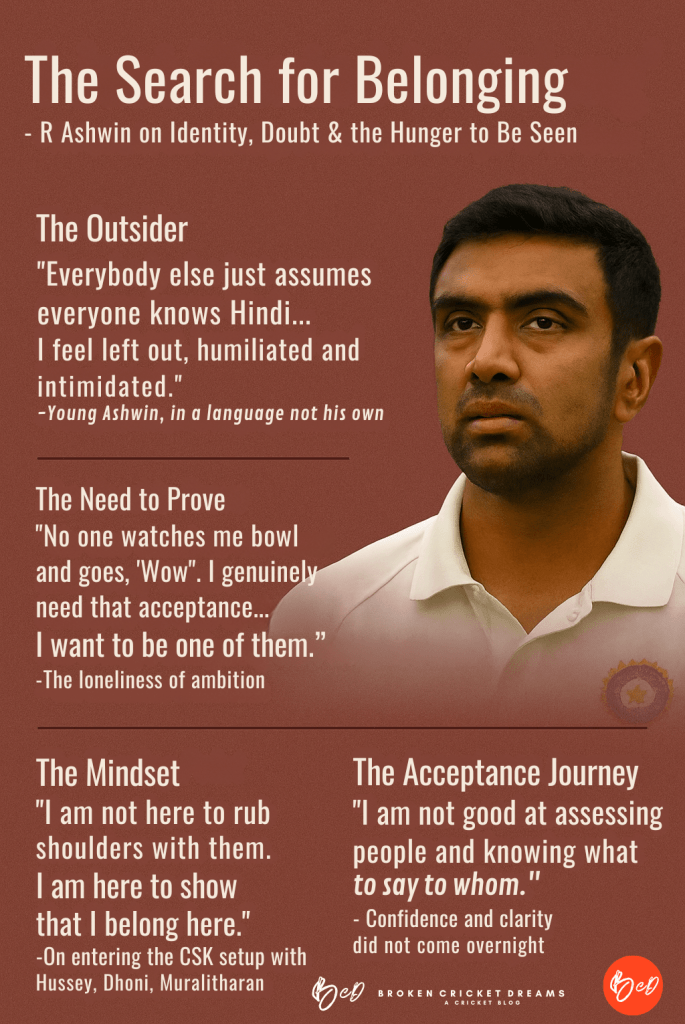
2. “Everybody else just assumes everyone knows Hindi and sets off speaking their own version of Hindi. I find it rude and alienating that no one makes an effort to talk to the one boy who doesn’t know their language…I feel left out, humiliated and intimidated.”
3. “No one watches me bowl and goes, ‘Wow’…I genuinely need that acceptance, though, to lose that feeling of being in awe all the time. I want to be one of them as soon as possible. So I’m always trying to analyze how they are looking at me. What is running through their heads? Do they think I am a proper cricketer or just a guy to make up the numbers.”
4. “I am not good at assessing people and knowing what to say to whom.”
5. “I am amazed that even Murali has self-doubt….These are inhuman expectations of him, but he doubts himself too, just like other humans.”
Life Lessons #1: External pressure, internal fears, and the desire to belong, they are all part of life. The key is to stay grounded in who you are and turn those doubts into positive energy.
Proving a Point, Over and Over Again
Whether it was the Ranji Trophy, the IPL, or the Indian time, Ashwin has had to prove himself over and over again. His interests in movies and engineering degree already made him a well-rounded person, and switching from a batter to an off-spinner made him a cricketing all-rounder. Resetting and performing repeatedly in different areas of life speaks to the strength of his mental resolve.
6. “Not for the first time, I find myself in a situation where nobody gives me a chance. I suspect nobody wants to give me a chance. My response is the only one I know: work harder, run harder, push harder.“
7. “Anirudha and I show up, we sign our contracts, and then VB gives us a glorious speech on what a huge opportunity this is. ‘You guys will rub shoulders with the likes of Michael Hussey, M.S. Dhoni, Matthew Hayden, and Muralidaran’…listen to it earnestly but also think to myself, ‘I am not here to rub shoulders with them, I am here to show that I belong here.'”
8. “It has been such a quick turnaround. From being a batter who bowled some seam-up, I am now an offspinner with one-and-a-half successful first-class seasons behind me.”
10. “One of the three streams offered to me, I pick computer engineering….I feel like I will die trying to balance studies and cricket. It feels like these four years of my life will never end…Every day is a hustle, trying to manage both college and cricket.”
Life Lesson #2: Challenges will come. And when they do, channel your inner R Ashwin and work harder, run harder, and push harder. In striving to prove a point, you may just discover excellence.
Always Asking, Always Evolving
Ashwin has kept evolving his game throughout the years. He has changed his action numerous times, invented new deliveries, and even became a T20 finisher.
But how did he get here? Ashwin evolved because he never stopped asking questions. From local bowlers to legends, he kept learning.
9. “It is during one of these [tennis ball] games that I come across SK. He has a beautiful and correct offspinner’s action, but the ball turns in weird directions and zips off the dusty surfaces…He is a bit of a terror in these matches. I am completely fascinated by what he does with the ball. So I start shadowing him. I take my bike and ride to wherever he is playing…I finally approach him to ask him how he does is. He is nice enough to show me that he flicks it with the middle finger and sends it out of the front of his hand when he wants to turn in the other way…In Madras, it is called the sodakku ball.”
11. “…Haydos’s company. I hesitate to speak with him; I wait for him to finish whatever he is doing and then introduce myself. He is extremely friendly. I ask him all the kinds of questions, and he patiently answers. I suspect he enjoys having conversations…How do you deal with pressure? How do you face Murali? How do you stand at slip for Shane Warne? I’ve watched you take some great catches; what is your mindset at slips?”
Influence of WV Raman and MS Dhoni
The most compelling moments in the book come from R Ashwin’s experiences with his mentor, WV Raman and his first early interactions with MS Dhoni. With Raman, you can vividly picture Ashwin honing his skills and elevating his craft. With Dhoni, you witness the foundation of a partnership that would shape Indian cricket for the next decade.
12. “Raman and I are made for each other. For the life of me, I can’t keep repeating the same thing. And Raman the coach comes up with something every day to help me keep discovering sping bowling to the fullest. One fine day, he tells me, run in 5 percent slower. Then another day, run in 10 percent faster.”
13. “…but Raman told me taking the new ball was the wrong call. And I told him, we had them nine down, trusted my seam attack, and they didn’t deliver…Raman said, ‘No, you’re wrong. Own up to your mistake. And do not come and tell me they didn’t deliver. If they didn’t deliver, you have a part in it.”
14. “When it comes to cricket, I am basically made of questions. MS doesn’t discourage me and answers every single question sincerely. He never brings up the optional nets either.”
15. “Each captain is different. Some can make donkeys run. Some people can buy wounded horses, treat them, train them, and make them run. But M.S. Dhoni will only make a racehorse run. He needs to be convinced you’re a racehorse before he makes you run. He will wait for a racehorse. If he doesn’t believe you’re a racehorse, he’ll probably give you time to become one, but he won’t make you run if you aren’t there yet.”
Life Lesson #3: Growth begins with curiosity. Ask questions. Stay open. The more you seek, the clearer your path becomes.
Indian Cricket Through Ashwin’s Eyes
Ashwin’s love for Indian cricket comes through in the way he speaks about his peers and predecessors.
16. “Tennis-ball cricket is a massive phenomenon in Madras. During the summer break, you can’t pass through a neighbourhood without witnessing at least one intense match going on in the sector ground. You don’t need a proper turf, a pitch or equipment for these games. It is a pure expression of love for the game and competition.”
17. “The other is Cheteshwar Pujara, who is only 15 and has already scored a triple-century in Under-14 cricket….There is an aura around him, an aura of thousands of runs.”
18. “And there are some ruthless players of spin going around…Shiv Sundar Das, Mithun Manhas, Halhadar Das, Robin Uthappa, Yere Goud, Rajat Bhatia, Sanjay Bangar…S. Bharat & Badri.”
19. “I, though, have seen the future of Tamil Nadu cricket and Indian cricket. His name is Dinesh Karthik. He is unlike any player I have seen in Chennai.”
20. “What makes this extra special for me is that Pravin Amre has stuck his neck out for me and overruled the other selectors because I batted in both of the morning sessions and actually scored some runs. This is what we had heard about Bombay: tough runs are valued there.”
Life Lesson #4: India’s cricketing soul doesn’t live in the big stadiums or in the IPL. It lives in the gullies and streets. That’s where toughness is built, where stories begin, and where Indian cricket comes to life.
Dreams Deferred, Dreams Passed Down
Finally, you get to learn about Ashwin’s family life. The sacrifice made by his parents, the dreams of his father, and how it came together with the 2011 World Cup final win. You also get to see Ashwin’s humor and his love for cinema.
21. “All those years ago, Appa traded his dreams for the job security provided by the Indian Railways, also his father’s employer. Ironically, now, a tardily running Indian Railways train is the way of his son’s, and I suspect his own renewed, dream.”
22. “Appa loves his cricket. He is a lower-divison league cricketer, a fast bowler. I am told he is a very good tennis-ball cricketer as well. My oldest memory of cricket is watching him take a wicket on a weekend. He bowled out somebody, sending the bail flying.”
23. “Thatha didn’t allow him to pursue cricket because he didn’t earn enough to raise the family and also provide for his cricketing needs. Appa doesn’t want the same to happen to me. His biggest worry is our orthodox extended family. Sometimes, even Thatha tells him cricket is not going to put food on my plate.”
24.”The movie Chennai 600028 is still fresh in our memories. It is also based on street cricketers. In our minds, we are in a movie.”
25. “Boy, I’m telling you, you’re a really really special cricketer,” Gary tells me…The kind of strides you made from 2009 to 2011 in every aspect of your game…See, everyone comes in here with what they’re good at and also their weaknesses. They continue to play to their strengths, and they try to hide their weaknesses, but very few come in with their strengths, evolve with their strengths, know what their weaknesses are, and work on those weaknesses.”
Life Lesson #5: Behind every dream fulfilled is a sacrifice quietly made. Sometimes, the dreams of one generation find life in the next. It truly does take a village to raise a child.
So, What Can We Learn from R Ashwin?
When I was younger, I liked R Ashwin, but the more I’ve seen him evolve, the more he’s become one of my favorite cricketers. Not just for the skill, but for how he thinks, adapts, and stays true to the game.
So, what did I learn from him?
Ask questions, Own your mistakes. Keep on evolving. Keep adapting. And above all, never stop loving what you do.
I am beginning to wonder if the 29-year-old Abhimanyu Easwaran will ever get a game for Team India.
Despite India’s top order struggling in the 2024-25 Border Gavaskar Trophy, Easwaran remained on the sidelines.
Jaiswal & KL Rahul had their moments, Rohit Sharma had to ‘opt out’ of the fifth Test due to poor form, Gill was in & out, and even Padikkal got a game. Dhruv Jurel and Nitish Kumar Reddy were also handed opportunities for other roles, but Easwaran never got a look-in.
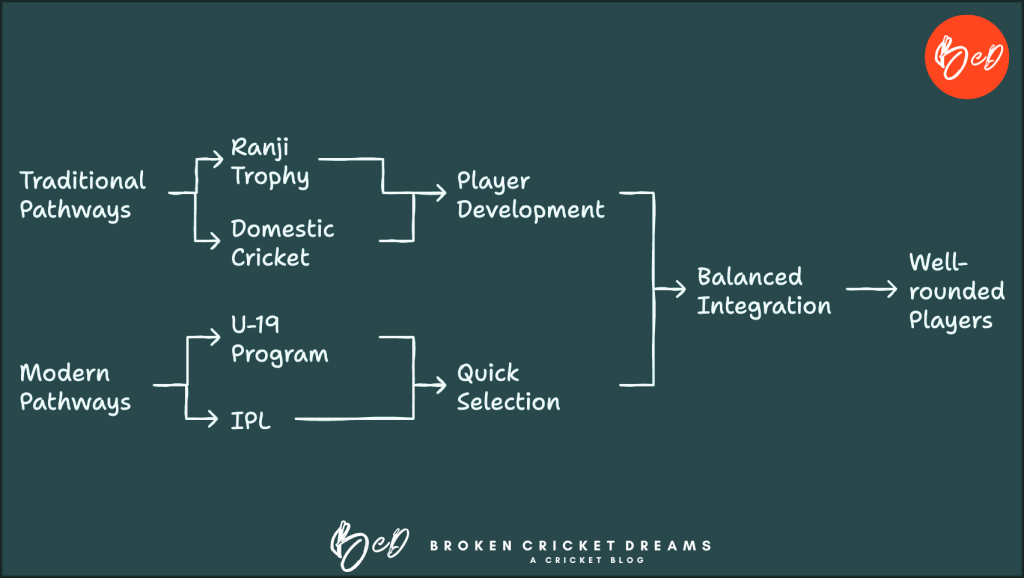
This raises a larger question—Does domestic cricket still matter in India team’s national selection? Has the Ranji Trophy lost its influence, with the India U-19 setup and IPL now serving as the primary pathways to the top?
I looked at Ranji Trophy stats from the last 35 years to see what patterns I can find in the evolution of national selection.
Easwaran came into the spotlight in the 2018-19 Ranji season when he top scored for Bengal with 861 runs. Since then, he has been on the fringes, consistently scoring in the various first-class tournaments, and has also performed well in the India A tours to South Africa and Bangladesh.
BGT 2024-25 was the third time since 2021 that Easwaran has been selected as a ‘standby’ or a reserve opener. This year, he was coming off the back of four consecutive centuries across Duleep, Irani, and Ranji trophies, but still did not get a game.
And it is the not the case that India’s top order has no vacancies. In the last couple of years, Ruturaj Gaikwad, Yashasvi Jaiswal, Ishan Kishan, Devdutt Padikkal, and Prithvi Shaw all leapfrogged him for the reserve Test opener spot due to performances in other formats and the IPL.
Shahbaz Nadeem was the top wicket-taker in the 2015-16 Ranji season (51 wickets), 2016-17 season (56), 3rd highest in 2021-22, and 6th highest wicket-taker in 2022-23. He played only 2 Tests.
Mayank Agarwal had to score the most runs by any Indian in a domestic season (2141 runs) in 2017-18 to make his way to the national team.
Between 2020-23, Sarfaraz Khan scored over 3500 runs batting at #5 at an average of 106.07.
IPL Fast-Track Vs Ranji Grind: Which Opens the Door To Team India?
The traditional pathway was going through domestic cricket, but has the Ranji Trophy and domestic cricket lost its significance?
Is the route through the U-19 program, followed by success in the IPL, now the preferred path over spending 3-4 seasons grinding in domestic cricket?
Let’s go back 25 years to see how Indian cricket has evolved.
Mohammad Kaif & Virat Kohli Pave the Way
Mohammad Kaif’s U-19 triumph in 2000 revolutionized Indian cricket forever. Kaif, Yuvraj Singh, Reetinder Sodhi, Venugopal Rao, Ajay Ratra would all go on to represent Team India.
Eight years later, Virat Kohli followed suit, earning a national call-up soon after leading India to U-19 World Cup glory. Ravindra Jadeja was the vice-captain in that U-19 side.
Since 2008, the IPL has also propelled relatively unknown domestic players to glory. Jasprit Bumrah had begun in Gujarat’s domestic circuit, but it was Mumbai Indians’ scouting lead by coach John Wright, that brought him into the limelight in 2016.
Let’s look at a more recent case, Nitish Kumar Reddy. Reddy made his way to the Andhra FC team after becoming player of the tournament in the 2017-18 Vijay Merchant Trophy (U-16 cricket). His breakthrough came at the 2023 IPL auction, and after impressing in the 2024 IPL, Reddy was elevated to the national squad (and ended up becoming India’s best batter in the BGT).
As the India U-19 system and IPL evolved, a clear pathway emerged—players identified at the U-19 level were fast-tracked to IPL auctions, and those who proved themselves over a season or two often found a route to the national team.
The U-19 & IPL Pathway Express: Gill, Jaiswal
Yashasvi Jaiswal’s inspirational journey is a prime example: He made his FC debut in 2019 and took Mumbai cricket by storm by becoming the youngest double centurion in List A cricket. However, it was his standout performance at the 2020 U-19 World Cup, where he was the player of the series & the highest run scorer, that caught everyone’s attention.
He was then be picked by the Rajasthan Royals in the IPL. After a couple of middling seasons, he took the 2023 IPL by storm scoring 625 runs including a 13-ball 50.
This lead to his Test call-up in the West Indies, where he scored a scintillating 171 and hasn’t looked back since. His 2024 Test season was an all-timer: 1478 runs at 54.74 with 3 hundreds and 9 fifties. Jaiswal has played 19 Tests already, but has only played 16 other first-class matches.
Dhruv Jurel was India’s vice-captain in the same U-19 WC, who also followed a similar path to the India Test cap through the Rajasthan Royals. Before Jaiswal, Rishabh Pant (2016 U-19 WC), Shubman Gill, and Prithvi Shaw (2018) all took a comparable route.
Pujara & Rahane, The Last Warriors of The Ranji Selection Era
Cheteshwar Pujara and Ajinkya Rahane were perhaps the last prototypes of consistent select based upon domestic performances.
Like Jaiswal, Pujara was the player of the tournament and the highest run scorer of the 2006 U-19 WC. However, before breaking into the India Test squad in 2010, he was prolific in the domestic circuit. He was the fifth highest run-scorer in 2006-07 (595 runs at 59.5), the highest run-scorer in the 2007-08 season (807 runs at 73.36), 3rd highest in 2008-09 (906 runs at 82.36 including a 302), and scored 554 runs at 79.14 in the 2009-2010 (5 matches) before being selected for India.
Ajinkya Rahane was the second-highest run-scorer in both the 2008-09 and 2009-10 Ranji seasons. He would make his international debut two years later (He got a break in T20 & ODI cricket two years before Test cricket, weirdly enough).
Fun fact: Gautam Gambhir played in the 2007-08 season and was #3 run-scorer (730 runs at 91.25) despite already being in the national team.
The Toils of Domestic Cricket Feat Agarwal, Sarfaraz
Times have changed. The journeys for Mayank Agarwal & Sarfaraz Khan have been tougher.
Agarwal also came through from the U-19 system (2010) and was fast-tracked to the IPL, but talent didn’t convert to runs.
To get back into national contention, Mayank Agarwal had to break the door down.
And boy, did he dominate, finishing as the top scorer in both the 2017-18 Ranji and Vijay Hazare Trophies. With 2,141 runs across formats, he set a record for the most runs by an Indian in a single domestic season. His breakthrough finally came in the 2018 Border-Gavaskar Trophy (Listen to Harsha Bhogle talk about Agarwal’s journey).
Sarfaraz faced an equally challenging route. A member of India’s 2014 and 2016 U-19 squads, his early IPL stint failed to impress. He then turned to domestic cricket, amassing 928 runs in 2019-20, 982 in 2020-21 (leading all batters), and averaging 106.07 from 2020-23. His relentless run-scoring, capped by a double century in the 2024 Irani Cup, finally earned him a Test debut—five years after his purple patch began.
Suryakumar Yadav’s had to wait until he was almost 31 to get an international debut.
Since 2021, he has become one of the greatest T20I players of all-time, racking up over 2500 T20I runs and four centuries. Although Yadav has extensive FC experience under his belt, it was his T20 form, that propelled his selection to the 2023 ODI World Cup teams and a Test debut.
Shreyas Iyer’s T20I & ODI form, along with his IPL credentials, got him his break in Test cricket in 2021.
*To Shreyas Iyer’s credit, he did score a record 1321 runs in the 2015-16 season, top scoring the Ranji charts (next highest was 879 runs). Coincidentally, Suryakumar Yadav was #4 on the list with 788 runs (SKY was the 4th highest scorer in the 2011-12 season)
Finally, we come to KL Rahul, the most enigmatic batter of our generation.
KL Rahul was the 2nd highest scorer in the Ranji Trophy in 2013-14 (1033) and the 4th highest run scorer in 2014-15 (1033) before breaking into the IPL teams. He was destined as the next big thing in Indian cricket and was handed a debut in 2014.
A decade later, he only averages 33.57 in Test cricket despite playing 58 Tests. For someone of his talent, that is not great returns.
Here is how his cricket season works: Rahul tops the charts in the IPL (659, 593, 670, 626, 616, 274, 520 since 2018) -> Gets selected for T20I/ODI -> India play an overseas Test and need a quick replacement for an opener, #3, or keeper, and Rahul is called in to fill the gap. He scores some beautifully looking 50s, an amazing match-winning hundred, and several low scores, before he is dropped at the end of the season.
Lather, rinse, repeat.
KL Rahul got his break due to the Ranji Trophy, but it is his IPL & ODI form keep that keep bringing him back to the Test arena (to be fair, KL Rahul did look really good in the 2024-25 BGT).
Why Comebacks are Nearly Impossible for Ranji Stalwarts
As a counterpoint to KL Rahul are the stories of Karun Nair, Hanuma Vihari, KS Bharat, and Abhinav Mukund.
Comebacks are nearly impossible for Ranji stalwarts.
It takes 3-6 years for a player to grind in domestic cricket to earn a national call-up. Then, they are made to carry drinks for a year or two, finally getting a chance in a tough overseas Test. If they do not deliver immediately, they’re dropped after two games—never to be seen again.
In the last 5 years, #ViratKohli has played 69 innings.
🚨 Averages of all batters who have played 69 innings in the last 5 years
Virat Kohli’s last eight innings read after the Perth 100 read: 7, 11, 3, DNB, 36, 5, 17, 6. Being dismissed in a similar manner, averaging about 30 in the last 5 years, and yet, he will most likely still survive the axe. Different standards for different players.
Hanuma Vihari and How Not to Treat Cricketers
Hanuma Vihari began his journey with 841 runs at 93.44 with 3 tons (including a 201*) in the 2013-14 season.
Vihari had been carried around since 2018 in England, Australia, West Indies, New Zealand, and back to Australia as an understudy to Cheteshwar Pujara. At that Sydey Test, he put his body on his line to draw a famous Test.
AfterSydney, Vihari only received 4 opportunities spread across three series at #3 when Pujara was initially dropped:
20 (53) & 40*(84) in Johannesburg
58 (128) in Mohali (vs Sri Lanka)
31 (81) & 35 (79) in Bengaluru
20 (53) & 11 (44) in Birmingham
For a player transitioning from #6 to #3, those are respectable figures, especially since he was mostly played in overseas conditions.
Now begins the difficult part.
Back in the domestic cricket, his returns has been below-par: 490 runs at 35.00 in 2022-23, 522 runs at 40.15 in 2023-24, and 250 runs at 27.77 in the current season.
After churning runs in the domestic circuit, Mukund was called up to the West Indies series and scored decent knocks of 48 & 62 in six innings.
Then, came the 0-4 horror tour of England. He scored 49 (88) at Lord’s, 12 (32), 0 (1), and 3 (41) in the next three innings before being dropped…for the next six years.
After scoring heavily in Ranji between 2015-2017, he was recalled in 2017. His score? 0 (8), 16 (32), 12 (26), and 81 (116) at Galle. Mukund never played international cricket again.
KS Bharat Fiasco
KS Bharat was Wriddhiman Saha’s understudy and the next Test wicket-keeper in line, at least for home Tests. He had been carrying drinks for about 4 years.
Once India believed Bharat was ready, Saha was ‘forced’ to retire. 12 innings to his name, Bharat hasn’t been effective with the bat averaging 20.09, but was solid with the gloves.
In any case, it looks like India has made a decision to go forward with the trio Rishabh Pant, Dhruv Jurel, and KL Rahul.
India lost the final year of Saha and never groomed Bharat properly.
The Lesson?
These players end up becoming overseas scapegoats.
By the time a player finally breaks into the national XI—after years of grinding in domestic cricket and warming the bench—they’ve lost valuable game time and likely the form that got them there in the first place.
Once a player is dropped, unless they have a Robin Uthappa & DK 2014 season, Agarwal’s 2017 season, or Sarfaraz’s 5 years, it is extremely difficult for them to be noticed again.
Easwaran has been scoring in domestic cricket for seven years without getting a game. Fellow India A opener, Priyank Panchal, now 34, might never get an international cap despite bossing the better part of the last decade in the domestic circuit.
This made me wonder? How did India’s golden generation of the 2000s make it to the national team before IPL & U-19 cricket setups matured?
The 90s: Beginning of the End
Gautam Gambhir had great back-to-back 2001-02 (565 runs at 70.62) & 2002-03 seasons (833 runs at 75.72, Top Scorer) before getting an ODI debut in 2003 and Test debut in 2004.
Virender Sehwagscored a 78 (56) at #5 in the 1998/99 Deodhar Trophy and was the sixth highest run-scorer in the Duleep Trophy that year. The next year, he continued to make runs at the Duleep Trophy including season-best 274 and was the seventh highest run-scorer in the 2000-2001 season (Five of the players above him were Mongia, Laxman, Vikram Rathour, Yuvraj, and Kaif).
Dravid consistently performed in Ranji from 1991-1995 (380 runs at 63.33 in 1991/92, 586 runs at 83.71 in 1992-93, 644 runs at 80.5 in 1993-94, 191 runs in one innings in 1994-95) along with a wonderful India A series against England A in 1995 before getting an international debut.
Sachin Tendulkar was a schoolboy genius. Rare case, never really happens anymore.
VVS Laxman, after having an indifferent start to his Test career as an opener between 1996-99, Laxman went back to his roots and broke all records in domestic cricket (601 runs at 203.66 in 1997-98, 754 runs at 83.77 in 1998-99, and a mammoth season of 1415 runs at 108.84 in 1999-2000. Next best in that 1999/2000 season scored 1075 runs).
Sourav Ganguly scored 439 runs at 73.16 in 1990 before a brief ODI debut. After a couple of middling seasons back in Ranji, he scored 722 runs at 80.22 in 1993/94. A double century in one 1994/95 Ranji game and a 171 in the Duleep Trophy got him his break for the England tour of 1995.
The Bowlers
Anil Kumble impressed in Karnataka debut in 1989, got a few games in U-19 first class tours, and got the national selection in 1990 ODI series against Sri Lanka and Test debut a few months later in England.
Harbhajan Singh did a little bit of everything: Coming up from Punjab U-19s, he performed well in the 1997-98 Ranji Trophy & Duleep Trophy, the 1998 U-19 WC before getting the Test debut in 1998.
Most of the fan favorites from the 2000s also had to toil in domestic cricket, but 2-3 consecutive season of runs was good enough to take them to the next level.
Not anymore.
The 2004 U-19 Generation
Between the Laxmans and the Jaiswals, came the Shikhar Dhawans.
Every now and then, comes a generation with several great players at once. This was absolutely the case with the 2004 U-19 side, who became the fringe players for the next decade: VRV Singh, RP Singh, Suresh Raina, Robin Uthappa, Dinesh Karthik, Ambati Rayudu, Shikhar Dhawan, and to a lesser extent, Faiz Fazal.
These players would be the transition between first-class, U-19, and the IPL. They saw it all—U-19, India A, early international debuts, being dropped, first class toil, inaugural IPL, back to internationals, back to being dropped.
Fun Fact: Robin Uthappa (912) and Dinesh Karthik (884), two of the earliest picked in the national side post 2004, were the top two scorers in the 2014-15 season and used the domestic season to break their way back to the national side.
How Did Australia Find Konstas and McSweeney?
In this season of the Sheffield Shield, Konstas scored 471 runs at 58.87 with two tons. McSweeney scored 291 runs at 97.00 in just four innings.
He had earlier scored 3 tons last summer at 40.94.
Overall though, McSweeney averages 36.31 in FC cricket, while Sam Konstas averages 39.57.
Australia backs players in form and throws them straight into the action. In India, with so much depth, a player often gets their chance five years after their peak.
Final Verdict: Is Domestic Cricket Still Relevant?
Indian selectors are not necessarily wrong with their selection policies. The idea of the ‘X-factor’ is important and the selections of Jaiswal, Pant, Bumrah, and Reddy have largely been inspirational picks.
However, what message is being sent to players next in line? That they should continue to toil for years and other youngsters will most likely continue to jump them in line?
Domestic cricket has essentially now become a ladder for IPL auctions rather than Indian selection. From the stats below, we can see that post the Covid-break, players who performed in domestic cricket like Rajat Patidar, Shams Mulani, R Sai Kishore, Manav Suthar, and Vijaykumar Vyshak were scouted and got gigs in the IPL auction. If they perform in the IPL, they can get fast-tracked to the next level.
There should be a system in place so a domestic player gets a chance before an IPL star does. Otherwise, grassroots will always be grassroots.
Ranji Trophy Back in the News?
Post the BGT debacle, Indian team changed internal rules and also are changing policies regarding domestic cricket. Will we see Rohit, Virat and Pant back in action in Ranji Trophy? Does that do the Indian team any good with the international calendar crowding all space?
Good to see that domestic cricket is getting the attention it deserves, but I am not sure if this is the way to go.
Hopefully, it is not another Broken Cricket Dream.
****
Thank you all for reading and following along. Appreciate the support!
Reference: Recent Ranji Trends Stats
For your kind reference, here are the list of the top run-scorers and wicket-takers in the last decade (divided up by the Covid-induced break since there was no 2020-21 Ranji season).
The likes of Jalaj Saxena, Dharmendrasinh Jadeja, Kumar Kartikeya have been among the wickets, but will this translate to the next level? Only time will tell.
Cricket can be separated into three financial segments: (1) India, (2) Australia-England, and (3) The Rest of the World. Financial growth means more talent acquisition, robust systems, better grassroots growth, and eventually, more World Cup wins.
Simple as that. Australia has been employing this model for decades.
India last won an ICC trophy in 2013, when the IPL was still in an infancy and the ‘Big 3’ were coming into being.
Team India has finally attained the silverware they deeply desired. The 2024 T20 World Cup victory ensures that the domination of Indian cricket has begun.
Indian cricket is now officially a monopoly in the cricketing world.
The Pros and the Cons of an Indian Cricket Monopoly
The Affirmative
Just like almost everything in life, there are two sides of the coin. First we begin with the affirmative.
1. Jarrod Kimber argues that the IPL and money flowing in cricket means players like Ali Khan and other Associate cricketers can now become professionals. Cricket has lost many cricketers like American legend Bart King because their individual international teams were simply not good enough. And this is not the first time we are seeing a monopoly in cricket. The Sunil Gavaskars, West Indian legends, South Africans, etc. played in County Cricket because it offered cricketers a great experience and financial incentive back then.
2. Furthermore, when Indian cricket grows, not only do Indian players flourish, but international players prosper as well. The profits BCCI earns are reinvested in the sport along with donations made to charities and investing in other sports. Sounds all pretty and rosy, doesn’t it?
3. The growth of the IPL has also resulted in the growth of other leagues around the world. While the CPL, PSL, and SA20 might not be at the same level as the IPL, one can argue that these tournaments have rekindled the passion for cricket that was missing in these regions and have provided additional opportunities.
4. The IPL provides financial security. Indian cricketers can now take up cricket as a viable career even if they do not make the international level.
The main argument against the Indian monopoly is that the BCCI can strong arm any cricketing decision to be in their favor.
1. Case and point, the 2025 Champions Trophy. Pakistan are scheduled to host this tournament with India’s matches currently slated in Lahore. What is most likely going to happen is after few uncertain months, India will end up playing their matches in a neutral venue while the rest of the tournament takes place in Pakistan.
2. Despite the political tensions and bilateral international boycott against Pakistan, India will most definitely still be looped into the same group as Pakistan in every single tournament from now till forever. Why? Because money.
3. The backbone of the Indian monopoly lies in the Indian players. As long as professional Indian cricketers are barred from playing non-IPL leagues, the IPL will remain the greatest domestic T20 competition. Every other league is essentially fighting to be the second best league because there is no chance to upstage the IPL or just survive.
4. We can already see what happens when a couple of nations dominate the ICC decision making. We get 10-team World Cups, an unbalanced World Test Championship, direct entry to World Cups (without qualifiers for top teams), lack of knockouts in World Cup formats, no tangible movement for 2-tiered Test system, and many other such great ideas that do not see the light of day.
5. And finally, there are unspoken decisions that make you wonder: quasi-guarantee of last group match (in case NRR goes south), no reserve day for one semi-final, no evening matches (to potentially avoid dew), biased commentary, and a favorable flight schedule unlike Sri Lanka, Bangladesh, and later Afghanistan.
Post the US Civil War (1861-1865), America entered the ‘Gilded Age’ that lasted till the end of the twentieth century. This was an era marked by remarkable economic growth, Industrial Revolution, and railroad expansion but also widespread political corruption, poor working conditions, strikes, and economic inequality in the United States.
I recommend you watch The Men Who Built Americaon Amazon Prime. It covers the stories of JP Morgan, John D. Rockefeller, Andrew Carnegie, Cornelius Vanderbilt, and Henry Ford and portrays the journey of the great monopolies—U.S. Steel, Standard Oil, Tobacco Company, etc.
According to Statista, John D. Rockefeller’s net worth (inflation adjusted as of 2006) was $305.3 billion. Carnegie ($281.2 billion) and Vanderbilt ($168.4 billion) closely followed.
These men ran businesses unchecked across America for several decades until the Sherman Anti-Trust Act of 1890 (and later, the Clayton Antitrust Act of 1914) finally began to restore free market competition.
Most of these businessmen would go on to become larger than life philanthropists later in life and by the time the era had come to an end, the US had become a global economic superpower.
BCCI, fueled by the IPL, may change the economic face of cricket in the generations to follow, but cricket needs its own version of the Sherman Anti-Trust Act before it is too late.
A Warning
The economic imbalance had become so extreme that JP Morgan had to loan money to the US government and pull banks out of the Panic of 1907.
In the current proposed financial ICC model, BCCI is set to earn 38.5% of the ICC share (approximately $231 million out of the estimated $600 million) over the next four-year cycle. Apart from this revenue, Indian cricket earn loads of money from the IPL and broadcast deals. Imagine a situation where the BCCI loans money to the ICC in times of crisis and thereby holds a higher leverage in international cricket.
There are plenty of other examples of monopolies in world history as well. Think Dutch East India Company, the British Empire, De Beers, AT&T, and now the Big Tech companies in the US or the Ambanis and Adanis in India.
Just like them, the Indian cricket machinery has now has become both a soft and hard power in international cricket.
In fact, India has now become the new benevolent dictator in cricket. Is this good or bad?
Have you ever seen Harsha Bhogle hit six sixes like Yuvraj Singh, hit a straight drive like the God of Cricket — Mr. Sachin Tendulkar, or bowl deadly inswinging yorkers like Wasim Akram?
I bet not.
Then how exactly did Harsha Bhogle become the voice and face of world cricket?
The tournament’s entertainment value is increasing by the day, but this World Cup is still missing two things — a thriller & Harsha Bhogle’s voice. Unfortunately, Mr. Bhogle has caught another fever, dengue, and has had to subsequently miss a few matches.
It is the days that he is not present that you miss his voice the most.
Okay okay, I know I am deviating. Anyway, back on topic. Where were we again?
Oh yes, how did Harsha Bhogle become Harsha Bhogle?
Did he take voice coaching lessons? Did he get a PhD in phonetics & linguistics? No, no he did not.
Harsha’s mother and uncle had arrived in India from Lahore on an army train right before the Partition in 1947.
He remarked in The Grade Cricketer’s podcast, “For my father’s generation, survival was important.” Just like many Indians in that generation, he grew up in a middle-class household. Both his parents were professors. So naturally, education was at the forefront of his upbringing.
Bhogle completed his undergraduate in chemical engineering and then went on to graduate from IIM Ahmedabad in 1985. He even worked in advertising for a couple of years after his education.
However, he did not forget his first love, cricket.
He had played Division A level cricket in Hyderabad along with competing at Osmania Nizam University & company teams. In Hyderabad, he had played with the likes of Arshad Ayub and Mohammad Azharuddin, a cricketer he would later write a biography of. (As an aside, he was once offered the opportunity to bat at #3, but said no. He was eventually picked for the university team but unfortunately did not make the XI).
The Greatest Weapon
Harsha Bhogle’s greatest weapon is his voice.
He found his voice during elocution & debate contests in high school. The ‘Eureka’ moment in his career came when he realized he could combine this gift with the love of cricket.
His broadcasting journey began with a 15-minute commentary stint during a Hyderabad vs Kerela Ranji Trophy match. Later in 1983, he took part in his first ODI broadcasting assignment on Doordarshan-Hyderabad.
By the time we arrived at the 1992 Cricket World Cup in Australia and New Zealand, Bhogle was recognized as the “sexiest voice on radio.”
“I didn’t look like a model, I didn’t play a 100 Test matches. There was lots of things I wasn’t. So, I didn’t have the option to say ‘No’ to anything…When you say ‘Yes,’ it’s a fantasy world. You don’t know where you will go when you say yes.”
From All India Radio & the BBC to Kutti Stories with Ravichandran Ashwin & Cricbuzz Live, Bhogle’s evolution is his mark of success. Sometimes he is having fun with Gaurav Kapur & Joy Bhattacharya, while at others, he is critically analyzing the state of world cricket with Ian Bishop, Nasser Hussain, and Mike Atherton.
To hone his skills and stay relevant in the broadcasting world, he did anything and everything. He has covered matches in makeshift commentary boxes in Hyderabad, written for several newspapers, transitioned to radio, become the face of cricket during live television, conducted quiz shows, talked about mental health, given inspirational speeches to the next generation, written books, interviewed the CEO of Google, Sundar Pichai, and has done a heck of a lot more. Bhogle’s multilingual background aided in his evolution as a broadcaster. He wrote magazine columns in Marathi, took broadcasting assignments in English, interviewed in Hindi, and joked in Hyderabadi.
Throughout his career, he has interviewed Sir Garfield Sobers, heard memorable stories from another great Indian commentator, AFS Talyarkhan, and possibly most importantly, covered the career of Sachin Tendulkar.
The Voice That Propelled Sachin Tendulkar
An article on Harsha Bhogle is incomplete without a mention of Sachin Ramesh Tendulkar.
Even Ian Bishop took a step aside when Harsha concluded one of the great careers in one of the legendary segments of cricket commentary.
“This is an indicator what one man meant to a nation. With Tendulkar, it was not just cricket…He’s been a good man, apart from being a great cricketer, Tendulkar…Tendulkar meant to India more than just the numbers. It’s as if Tendulkar was born to be great and everyone just looked after him. Everyone in Indian cricket, in Mumbai cricket, looked after him. Everyone will have their own Tendulkar story to tell…Those 22 yards made that little boy from Bandra the legend that he became.
Without the voice of Bhogle, Sachin’s shots might not have been heard around the world.
What Characteristics Makes Harsha Bhogle Good?
Bhogle often says that for broadcasting metrics, “Chappell is my guru for work ethic.”
He prepares for each interview, writes down notes, talks to Simon Taufel to understand the rulebook, and draws from the wisdom of other cricketers to understand how to analyze techniques and read the pitch conditions.
He continues to learn and innovate. Not many would have the courage to dive into the world of Twitter, YouTube, and podcasts. He keeps on learning. But that’s how he has managed to stay relevant in the industry for over four decades. Two of his own quotes describe him best,
“The day you think you know everything in life, you’ve descended already. You’re gone.”
“Sometimes, we wait for the big things to happen in life…Be happy with small times….But don’t wait for the big thing to happen.”
Final Thoughts
When things are all said and done, what will I remember the most about Harsha Bhogle?
Along with the voice, came the infectious personality — the expressions, inflections in the voice, historical references, the smile, research into players’ backgrounds, and the contrast between serious bits & humor. He talks mostly about cricket but speaks with an open mind.
As cricket fans, we like to talk about our cricket heroes, the greatest Test match players, and the best World Cup finishes.
Sometimes, we should sit back and appreciate the people who make the cricket community great — The commentators, the umpires, the ground staff, the security staff, administrators, and many other individuals behind the scenes.
I will leave you all with this quote by American poet and civil rights activist, Maya Angelou:
“People will forget what you said, people will forget what you did, but people will never forget how you made them feel.”
And Harsha Bhogle did exactly that. He provided us with the little moments of joy to live by.
Today we will discuss the salary of an Indian Premier League (IPL) player in India.
Let’s dive into a question that’s been on everyone’s mind – just how much do these players make?
Trust me, you’re in for some jaw-dropping revelations!
IPL Salary – By the Numbers
The average salary of an Indian Premier League (IPL) player is $459,743 per season (average of 24 players in each squad with average spending of $11,079,800 per team). In total, $110,798,000 have been spent for 241 players, divided among 10 teams.
The average salary for a domestic Indian Premier League is $407,185 ($65,964,000 spent for a total of 162 domestic players). The average salary for an overseas IPL cricketer is $567,519 ($44,834,000 for 79 signed overseas players).
Punjab Kings spent the most on overseas players at $831,429 per player, while Chennai Super Kings (CSK) paid their overseas players the least, still at $449,750. Due to auction dynamics, the opposite happened for domestic players – PBKS paid the least – only $284,733 for domestic players, while CSK paid the most – on average, $458,294 per player per season.
Note: All amounts shown are as of December 2022, when the auction for IPL 2023 took place. At this time, the conversion is as follows: $1 = INR 82 (so overall $110 Million is equivalent to about INR 909 Crore, the total amount spent all teams combined).
Here is a currency converter calculator so you can view the amount estimates in your own currency. For more information on conversion rates, check this Investopedia article out.
The Indian Premier League (IPL) – What is the Average IPL Salary?
Average SRH Auction Price: $430,920 ($10,773,000 spent on players)
Average Domestic Price: 416,647 ($7,083,000 spent on 17 players)
Average Overseas Price: $461,250 ($3,690,000 spent on 8 players)
Total Number of Squad Players: 25
Maximum Cost: $1,615,000 (Harry Brook)
Minimum Cost: $24,000
Player
Salary
Harry Brook IPL Salary
$1,615,000
Washington Sundar IPL Salary
$1,067,000
Rahul Tripathi IPL Salary
$1,036,000
Mayank Agarwal IPL Salary
$1,006,000
Abhishek Sharma
$792,000
Heinrich Klaasen IPL Salary
$640,000
Bhuvneshwar Kumar IPL Salary
$512,000
Marco Jansen IPL Salary
$512,000
Kartik Tyagi
$487,000
Abdul Samad
$487,000
Umran Malik IPL Salary
$487,000
Thangarasu Natarajan IPL Salary
$487,000
Vivrant Sharma
$317,000
Aiden Markram IPL Salary
$317,000
Adil Rashid IPL Salary
$243,000
Mayank Dagar
$219,000
Glenn Phillips IPL Salary
$182,000
Akeal Hosein IPL Salary
$121,000
Mayank Markande IPL Salary
$60,000
Fazalhaq Farooqi IPL Salary
$60,000
Upendra Yadav
$30,000
Sanvir Singh
$24,000
Nitish Kumar Reddy
$24,000
Anmolpreet Singh
$24,000
Samarth Vyas
$24,000
Final Thoughts
It’s interesting to explore the intriguing world of cricket salaries and get a glimpse into the financial side of the game.
The IPL is the global leader in T20 franchise cricket, and it is clear why. Players get the big bucks, which is a huge motivation in bringing the best players in the world together.
Frequently Asked Questions (FAQ) – Salary of Indian Premier League (IPL) player
What is the average salary for an Indian Premier League (IPL) player in India?
The average salary of an Indian Premier League (IPL) player is $459,743 per season (average of 24 players in each squad with average spending of $11,079,800 per team). In total, $110,798,000 have been spent for 241 players, divided among 10 teams.
Is Indian Premier League (IPL) the richest cricket league in the world?
Yes, in fact, the Indian Premier League (IPL) is the richest cricket league in the world. They spend over $110 million (or 915 Crore INR) per season just for their players..
How much money does KL Rahul make in the IPL in India?
KL Rahul makes $2,073,000 (17 Crore INR) per season in the IPL.
Who are the most expensive players in the IPL?
Sam Curran ($2,256,000), Cameron Green ($2,134,000), KL Rahul ($2,073,000), Ben Stokes ($1,981,000), Rohit Sharma, Andre Russell, Rishabh Pant, Ravindra Jadeja, Nicholas Pooran ($1,951,000), Ishan Kishan ($1,859,000), and Virat Kohli ($1,829,000) are the most expensive players in the IPL.
How many ODI centuries has Virat Kohli scored? Where did he score them? How many player of the match awards did Kohli win while scoring centuries?
Here is everything you need to know about Virat Kohli ODI centuries right here.
Key Takeaways
Virat Kohli currently has 47 ODI centuries, only second to Sachin Tendulkar’s record of 49 ODI centuries.
Kohli’s most successful year with ODI centuries was 2017: 6 hundreds (7 fifties), 2018 – 6 (3), 2018 – 5 (7), and 2012 – 5 (3). 2008, 2021, and 2020 were his least favorite years with zero centuries.
Kohli has scored 21 centuries in India, 6 in Bangladesh, 5 each in Australia & Sri Lanka, 4 in West Indies, 3 in South Africa, and one each in England, New Zealand, and Zimbabwe.
His favorite opponent is Sri Lanka (10), West Indies (9), and Australia (8).
Kohli won the player of the match awards in 29 out of the 47 ODIs he scored centuries in.
Virat Kohli has scored 21 hundreds at home, 21 away, and 5 neutral. Most importantly, Virat Kohli has scored 21 centuries while batting first and 26 centuries while chasing.
Kohli scored 21 centuries as captain and 26 centuries not as captain. In addition, India won 38 times Kohli scored a century, lost 7 times, and tied in one match.
Frequently Asked Questions – Virat Kohli ODI Centuries
How many centuries has Virat Kohli scored in ODI cricket?
Virat Kohli has scored 47 centuries in ODI cricket.
How many ODI hundreds has Virat Kohli scored against Pakistan?
Kohli has scored three hundreds against Pakistan – 183 vs Pakistan in 2012, 107 vs Pakistan in the 2015 ODI World Cup, and 122* vs Pakistan in the 2023 Asia Cup.
How many centuries has Virat Kohli scored in World Cups?
Kohli has scored two centuries (and six fities) in ODI cricket World Cups.
What is Virat Kohli’s highest score in ODI cricket?
Virat Kohli’s highest score in ODI cricket is 183* vs Pakistan in Mirpur (2012).
How many 150 scores does Kohli have in ODI cricket?
Kohli has scored 5 scores of 150+ in ODI cricket (183, 166*, 160*, 157*, and 154*)
What is Virat Kohli’s net worth? Virat Kohli’s total net worth in 2023 is estimated to be between $62-131 Million (Rs. 508-1075 Crore INR).
King Kohli’s net worth frequently sparks curiosity among cricket fans throughout the world.
As one of modern cricket’s greatest icons and being the world’s best batter for the better part of the last decade, it is no surprise that Virat Kohli has become one of the wealthiest athletes on the planet.
Virat Kohli Net Worth Case Study
In this article, we’ll take a closer look at Virat Kohli’s net worth as a case study to understand the different ways cricketers can earn money.
This is the fifth piece in our series on analyzing Cricket’s Finances:
Virat Kohli Total Net Worth (Both Rupees and Dollars)
The inspiration for this article came from a report from Stock Gro, a social trading platform that was widely circulated on social media. They reported that Virat Kohli’s estimated net worth is about Rs. 1,050 crore (around $122 Million).
Today we break this down into little pieces (and try to fact check their estimates along the way).
Our Method and Sources on Virat Kohli’s Net Worth ($62-131 Million) Estimate
According to Forbes’s “The World’s 10 Highest-Paid Athletes 2023” list, soccer star, Cristiano Ronaldo, is at #1 with a whopping $136 Million ($46 Million on-field earnings & $90 Million off-field earnings), while American football legend, Tom Brady, is at #50 with $45.2 Million earnings ($1.2 million on-field & $44 million off-field).
In the past, Kohli has been the only cricketer to have made the Forbes list (he has since dropped off and did not make the Top 50 of the Forbes 2023 list). He made the 2020 list as the #66th richest athlete in the world with $26 Million earnings ($2 Million – on field, $24 Million – endorsements). In addition, Virat Kohli made Sportico’s “100 Highest-Paid Athletes in the World 2022” at #61 with $33.9 Million ($2.9 Million salary/winnings & $31 Million endorsements)
Conclusion: Based on these two trusted sources, Virat Kohli’s net worth based on on-field salary and off-field sponsorships cannot be greater than $45 million.
Virat Kohli’s Net Worth Breakdown
So, how can a cricketer earn money? A cricketer can earn money through annual contracts, match fees, IPL & franchise league salaries, post-match award earnings, properties, cars, and brand endorsements (sponsorships, paid tweets & Instagram posts, advertising, etc.)
Let’s get started and analyze each component of Kohli’s net worth.
*Note: We will use the conversion is as of 6/24/2023, where $1 US dollar is equal to Rs. 81.98 INR.
Between the 2022 T20 World Cup and 2023 ODI World Cup, a three-format player like Virat Kohli had the potential to play 9 Tests, 27 ODIs, and 20 T20Is.
Test: Rs. 1.35 Crores INR ($164,674.35)
ODI: Rs. 1.62 Crores INR ($197.609.22)
T20I: Rs. 60 Lakhs INR ($73,188.6)
Putting it all together, Virat Kohli (or any Indian three-format international player) had the potential to earn a maximum of Rs. 3.57 Crores INR ($435,472.17) from match fees alone.
Here are the list of India’s matches over the past year:
Part 3: Virat Kohli Brand Endorsements ($41-110 Million)
Endorsements are where accurate information is a little difficult to find. Some of these estimates may be close, while others may be totally off the charts.
Kohli endorses at least 18 brands. If he does one-three days of shoot for each brand, then he earns a minimum of Rs. 135-360 Crores ($16.458-43.9 Million) per year. This is consistent with our guess that Kohli’s off-field earnings are below $45 million.
Brands Endorsed by Kohli: Vivo, Myntra, Great Learning, Noise, Wrogn, Blue Star, Fire Boltt, Too Yumm!, Volini, Luxor, HSBC, Uber, Toothsi, Star Sports, American Tourister, MRF, Tissot, Cinthol
In particular, we know that Virat Kohli has also signed major long-term deals as follows:
Virat Kohli MRF 8-Year Deal: Rs. 100 Crores INR ($12.196 Million) or Rs. 12.5 Crores INR ($1.5 Million) per year.
Virat Kohli Puma 8-Year Deal: Rs. 110 Crores INR ($13.409 Million) or Rs. 13.75 Crores INR ($1.68 Million) per year.
8. Paid Social Media Posts ($25-65 Million)
Another way for influencers to endorse brands is via paid tweets or Instagram posts.
Since June 2022, Virat Kohli has tweeted about 250 times. This can be divided into about 75 personal tweets and about 175 branded tweets, which amounts to about Rs. 437.5 Crore ($53,305,684.31) from Twitter.
Similarly, Kohli has posted about 240 Instagram posts since June 2022, 107 of which are paid partnerships. This results in a whopping Rs. 952.3 Crore ($116,162,478.65).
If this was true, Virat Kohli could earn over $169,468,162.96 in a year through social media posts alone! This seems slightly overboard.
According to Forbes, the highest earner on Instagram in 2019 was Cristiano Ronaldo with $47.8 Million (when he had 187 Million followers) and Lionel Messi earned about $23.3 Million from paid-Instagram posts. We can take an educated guess that Kohli also earns around $25-65 Million dollars from paid posts.
8. Businesses & Startups
Finally, a cricketer can earn money via investments and businesses.
Although we cannot estimate the exact amount of net worth Kohli derives from business initiatives, it could be another $10-20 million (Rs. 80-160 Crores INR). Since this is just speculation, we will not add it to the total net worth.
Here are the businesses Kohli is affiliated with.
Brands Owned: one8 commune (restaurant & athleisure brand), NUEVA (restaurant), WROGN (clothing), stepathlon (lifestyle), FC GOA, UAE Royals, Bengaluru Yodhas
Brands Funded: RAGE, Blue Tribe, Sport Convo, Universal Sportsbiz, Chisel, MPL, Digit, Hyperice
Final Thoughts – How Do Cricketers Earn Money?
These are not, however, all the ways cricketers can earn money.
For example, Ravichandran Ashwin, has a YouTube channel. In addition, current players like Dinesh Karthik & Stuart Broad participate in commentary stints during their off seasons, which adds to the income. This can add another $25,000-$100,000 to their total salary depending on the number of matches they commentate in.
Frequently Asked Questions – Virat Kohli Net Worth and Salary
What is Virat Kohli’s net worth?
Virat Kohli’s total net worth in 2023 is estimated to be between $62-131 Million (Rs. 508-1075 Crore INR).
What is Virat Kohli’s salary?
Virat Kohli has A+ contract worth Rs. 7 crores INR ($854,000) per year.
How much does Royal Challengers Bangalore (RCB) pay Virat Kohli?
RCB retained Virat Kohli in 2022 for Rs. 15 Crores INR ($1.83 Million)
On Sachin Tendulkar’s 50th birthday, here are all of Sachin Tendulkar centuries in one place. Everything you ever wanted to known about Tendulkar’s 100 hundreds.
Let’s begin—Sachin Tendulkar’s Centuries (The Definitive Guide).
Sachin Tendulkar scored 51 Test centuries & 49 ODI centuries in his career.
Tendulkar scored 10 centuries in Sri Lanka, 9 in South Africa, and 7 each in Australia, England, and Bangladesh. In all, he scored 29 Test centuries overseas and 22 at home in India. Interestingly, Tendulkar also scored 29 ODI centuries overseas (12 away, 17 neutral) and 20 at home.
Sachin’s favorite opponent, by far, was Australia. He scored 20 centuries (and 31 fifties) against Australia, 17 vs Sri Lanka, 12 vs South Africa, 9 vs England & New Zealand, 8 vs Zimbabwe, and 7 each against West Indies and Bangladesh.
1998 was Tendulkar’s best year in terms of centuries (12 hundreds, 8 fifties), followed by 8 hundreds (11 fifties) in 1996, and 8 tons (7 fifties) in 1999. Although Tendulkar only scored 3 hundreds in 2007, he was in good form and scored 19 fifties (several 90s that year as well).
Tendulkar never scored a century in Ireland (best of 99), Canada (best of 89*), and Kenya (best of 69).
Sachin Tendulkar had nervous nineties scores 28 times! (10 – Tests, 28 – ODIs). In 27 of those occasions, he was dismissed and was only unbeaten once when he scored 96*.
Tendulkar Hundreds – Major Career Timeline
#1 vs England (1990) – 1st Test Century
#5 vs England (1993) – 1st Century on Home Soil
#8 vs Australia (1994) – 1st ODI Century
#25 vs Sri Lanka (1997)
#30, #31 vs Australia (1998) – The Sharjah Centuries
#44 vs New Zealand (1999) – First Test double century
#50 vs Zimbabwe (2001)
#71 vs Bangladesh (2004) – Highest Test score of 248*
#73 – 35th Test Century – Broke Sunil Gavaskar’s longstanding recordof 34 Test hundreds
#75 vs West Indies (2006)
#93 – 200* vs South Africa – Tendulkar breaks the ODI Double Century Barrier
#97 vs South Africa (2011) – Last Test Century
#100 vs Bangladesh (2012) – Last ODI Century
Sachin Tendulkar Centuries – Fun Facts
53% of Tendulkar’s centuries resulted in victories (33 ODI wins, 20 Test wins), 25% of his hundreds resulted in losses (14 ODI losses, 11 Test losses), and the rest 22% resulted in some form of a draw (20 Test draws, 1 Tied ODI, 1 No Result ODI).
When he scored a century, Sachin won 45 Player of the Match awards – 12 in Test cricket (5 Won, 5 Drawn, 2 Lost) and 33 in ODI cricket (30 Won, 3 Lost).
Sachin Tendulkar scored 22 hundreds in tri-series tournaments, 7 centuries in multi-nation ICC tournaments (6 World Cup hundreds & 1 in 1998 ICC Knockout Trophy/ Wills International Cup), and 4 centuries in quadrangular tournaments. Hence, he scored 33/49 centuries in tournament play and 16 in bilateral series.
By batting positions, Tendulkar’s hundreds are categorized as follows: In Tests (2 tons at #6, 5 at #5, and 44 at #4) and in ODIs (2 tons at #1, 4 at #4, and 46 at #2).
In ODIs, he scored 32 hundreds in the first innings and 17 tons while chasing. In Tests, the distribution was 20 (1st innings), 18 (2nd), 10 (3rd), and 3 (4th).
Sachin Tendulkar – Batting Stats
Here is Sachin Tendulkar’s record in a nutshell.
Note: T20I stats are omitted since he only played one T20I and scored 10 runs.
Matches/Innings
Runs
100s
50s
Average/Strike Rate
Best Score
Tests
200/329
15921
51
68
53.78
248*
ODIs
463/452
18426
49
96
44.83/86.23
200*
List of International Centuries by Sachin Tendulkar
Here is the detailed list of each of Sachin Tendulkar’s centuries in chronological order. Scorecards, photographs, and most highlight reels are attached beneath each innings. Be sure to check them out!
Special thanks to the photographers for the iconic pictures, Rob Moody (robelinda2), and other content creators on YouTube that help us relive Sachin Tendulkar’s hundreds for years and years to come.
1. 119* vs England, 1990, Old Trafford (Test)
Format: Test (1st Test Century)
Opposition: England
Venue: Old Trafford, Manchester, England
Result: Match Drawn, Player of the Match (POTM) – 68 & 119*
Batting Position: #6 (4th Innings)
Context:On Day 5, India had to chase down 408 runs and were struggling at 109/4 when Sachin, Kapil Dev, and Manoj Prabhakar batted through the day and drew the game. Tendulkar won the player of the match award for 68 & 119*.
Context:This match is known for Ravi Shastri’s 206 as an opener. On the other end, was the Little Master, Sachin Tendulkar. He came in at 201/4 and remained unbeaten as India scored 483.
Venue: WACA (Western Australia Cricket Association) Ground, Perth, Australia
Result: Lost
Batting Position: #4 (2nd Innings)
Context:India lost the match by 300 runs and the series 4-0. There was one bright light though – Sachin Tendulkar was promoted at #4 in the first innings and took India to a respectable 272. Due to the tough Perth pitch, this is considered one of Tendulkar’s best knocks. The next highest score was Kiran More’s 43 at #10.
Venue: New Wanderers Stadium, Johannesburg, South Africa
Result: Drawn
Batting Position: #4 (2nd innings)
Context:Against a pace attack of Allan Donald, Brian McMillan, and Craig Matthews, Sachin Tendulkar scored a six-hour long 111 (270) when the next best score was just 25.
Venue: MA Chidambaram Stadium, Chepauk, Chennai, India
Result: Won, (POTM) – 165
Batting Position: #4 (1st Innings)
Context:As India posted their highest total at that time (560/6 dec) against England in India, Sachin scored his first century at home. With Sidhu, also scoring a century at the other end, they amassed a 147-run partnership. Sachin Tendulkar’s first player of the match award at home.
Context:Yet another Sidhu-Tendulkar partnership resulted in India posting a massive 511 run total. Sidhu scored 124 with 8 sixes & 9 fours, while Tendulkar scored 142 with 22 fours.
Tournament: Singer World Series 1994 (SL, Ind, Aus, Pak)
Context:Opening the batting, Sachin scored his first ODI ton as an opener and won his first ODI player of the match trophy. With some support from Azharuddin & Vinod Kambli, Tendulkar’s 110 made sure India reached a competitive 246 and won the match.
Venue: Vidarbha Cricket Association Ground, Nagpur, India
Result: Match Drawn
Batting Position: #4 (1st Innings)
Context:The Sidhu-Sachin partnership struck once again. From 49-2, these two took India to 226. By the time Tendulkar was done, India had put up 444. India would end up making 546/9 declared.
Context:Sachin scored a mammoth 137, but his innings was cut short with a run out. India scored 271, but Sanath Jayasuriya’s new style of play took Sri Lanka home.
Tournament: Singer Cup 1995/96 (Tri Series: Pak, SL, Ind)
Context:Tendulkar was India’s only major contributor as India were bundled for 226. Aamer Sohail & Saeed Anwar completed the rain-affected target of 190 runs in just 28 overs. This was his first ton against Pakistan.
Venue: Sharjah Cricket Association Stadium, Sharjah, UAE
Result: Won, (POTM) – 118 & 2/40
Batting Position: #2 (1st Innings)
Tournament: Pepsi Sharjah Cup (Tri Series: SA, Ind, Pak)
Context:Another 231-run partnership with Navjot Singh Sidhu to take India to a score of 305/5. Pakistan made a run for the chase but were all out for 277. Tendulkar had a role to play with the ball as well figures of 7.1-0-40-2.
Context:Trailing 99-runs already in the first innings, India were 36/4 when captain Azharuddin departed. Tendulkar replied with a masterclass of 122 when the next best was Sanjay Manjrekar’s 18.India would go on to lose the Test, but the legend and class of Sachin Tendulkar continued to grow.
Context:Tendulkar scored 177 & 74 in this Test, but this series was known for the find of Sourav Ganguly (and Rahul Dravid). The Tendulkar-Ganguly duo put together a 255-run partnership for the third wicket as India made 521. Ganguly earned the player of the match and series trophies, and India’s next generation was now in motion.
Tournament: Singer World Series (SL, Aus, Ind, Zim)
Context:Captaining India for the first time, Tendulkar’s hundred took India to 226. However, it was the arch-nemesis, Sanath Jayasuriya, whose century overshadowed Tendulkar once again.
Context:This was Tendulkar’s first century when he took first strike in the opening partnership. India posted 267 and demolished the Proteas. End of a succesful hundred-filled year for Tendulkar.
Context:India were struggling at 58/5, when Tendulkar & Azharuddin stitched together a 222-run partnership. India would go on to lose the Test with Brian McMillan’s all-round show.
Tournament: Pepsi Independence Cup 1997 (Pak, SL, Ind, NZ)
Context:The beginnings of the prolific Ganguly-Tendulkar opening partnership in ODIs. They broke the back of the 221-run chase with a 169-run partnership. When Tendulkar got out, India only need 5 runs to win.
Context:Will forever be remembered as the infamous 952/6 game after India declared their innings for 537/8. Tendulkar’s 143 was the third highest score of the game after Jayasuriya’s 340 & Roshan Mahanama’s 225.
Context:The trio of Indian cricket came to the party in another high run-fest draw against Sri Lanka – Dravid (93), Ganguly (173), and Tendulkar (148).
Venue: MA Chidambaram Stadium, Chepauk, Chennai, India
Result: Won, (POTM) – 155*
Batting Position: #4 (3rd Innings)
Context:Australia had gained a first innings lead, but with Tendulkar’s hundred and fifties from Sidhu, Dravid, and Azhar, India were able to come back in the match.
Context:Tendulkar’s 177 took India to a first innings total of 424, but hundreds from the Marks (Waugh & Taylor) as well Kasprowicz’s bowling show gave Australia a rare victory on Indian soil.
Tournament: Pepsi Triangular Series (Ind, Aus, Zim)
Context:A 175-run opening partnership between Ganguly and Tendulkar meant India chased 223 in style. The year of Tendulkar against the mighty Aussiese.
Venue: Sharjah Cricket Association Stadium, Sharjah, UAE
Result: Lost, (POTM) – 143 & 1/27
Batting Position: #2 (2nd Innings)
Tournament: Coco-Cola Cup 1997/98 (Tri Series: Aus, Ind, NZ)
Context:In the chase of 276 in 46 overs, Tendulkar single-handedly dragged India close. When he got out, he had scored 143 out of India’s 242 runs. With 21 balls remaining, India could only add 8 more runs. Established Tendulkar as a living legend.
Venue: Sharjah Cricket Association Stadium, Sharjah, UAE
Result: Won, (POTM) – 134
Batting Position: #2 (2nd Innings)
Tournament: Final, Coca-Cola Cup 1997/98 (Tri Series: Aus, Ind, NZ)
Context:Two days later, same venue, same opposition, almost similar situation. Different result. Chasing 273 in 50 overs, Tendulkar bludgeoned134 runs but departed with 30 runs still to go. This time, though, with help from Azharuddin, Jadeja, and Kanitkar, India won the Final. These two contests in Sharjah marked the beginning of the Warne-Tendulkar rivalry.
Context:Putting together a 252-run opening partnership with Ganguly, Tendulkar led India to a competitive 307 in the final of the tri-series. Sri Lanka came close, courtesy a century by Aravinda de Silva, but lost by 6 runs.
Venue: Bangabandhu National Stadium, Dhaka, Bangladesh
Result: Won, (POTM) – 141 & 4/38
Batting Position: #2 (1st Innings)
Tournament: Wills International Cup 1998/99 (WI, SA, Ind, SL, Pak, Aus, Eng, Zim, NZ)
Context:Tendulkar’s glorious year against Australia continued with a blistering century as well as a bowling performance. Opened the innings and continued the carnage till the 46th over, when the score was already 280.
Venue: Sharjah Cricket Association Stadium, Sharjah, UAE
Result: Won, (POTM) – 118*
Batting Position: #2 (2nd Innings)
Tournament: Coca-Cola Champions Trophy 1998/99 (Tri Series: Ind, Zim, SL)
Context:Another dominating chase by Sachin. He scored 118 out of 197 runs and finished the chase in 40.4 overs. His strike rate was 105.35 when the next best for India was Ganguly at 57.14.
Venue: Sharjah Cricket Association Stadium, Sharjah, UAE
Result: Won, (POTM) – 124* & 1/16
Batting Position: #2 (2nd Innings)
Tournament: Coca-Cola Champions Trophy 1998/99 Final (Tri Series: Ind, Zim, SL)
Context:Almost similar to his previous century. Chasing 197 against Zimbabwe, this time Tendulkar helped India score the runs in 30 overs. India won by 10 wickets – Tendulkar 124* (92) at 134.18 & Ganguly 63* (90) at 70.00 strike rate.
Context:Trailing New Zealand by 144 runs, Tendulkar’s century and contributions from almost every batter took India to a competitive 356 runs. The Craigs – McMillan and Cairns ensured that New Zealand get to the target of 214 without any hiccups.
Venue: MA Chidambaram Stadium, Chepauk, Chennai, India
Result: Lost, (POTM) – 1/10 & 2/35, 136
Batting Position: #4 (4th Innings)
Context:A thriller of a Test match, and Tendulkar’s masterclass in the fourth innings. Chasing a mammoth 271 in Chennai, India were reeling at 6/2 and later at 82/5. Ramesh, Laxman, Dravid, Azharuddin, and Ganguly,all back in the hut. With some support from Nayan Mongia, Tendulkar almost single-handedly drove India close to victory. However, Pakistan held their nerve and India would lose this close fourth innings encounter by just 12 runs.
Context:Another high scoring draw against Sri Lanka. Tendulkar was one of the many centurions from this Test; others being Ramesh, Dravid, and Jayawardene, who scored 242.
Context:Tendulkar’s first ODI century at #4. This innings is best remembered for Sachin’s tribute to his late father, and the unbeaten 237-run partnership between Dravid-Tendulkar.
Tournament: Aiwa Cup 1999 (Tri Series: Aus, SL, Ind)
Context:Back to opening with Sadagoppan Ramesh as his partner, Tendulkar took first strike in this match. He was involved in the 75-run opening partnership as well as a 117-run partnership with Ganguly, who was now the new #4.
Venue: Punjab Cricket Association Stadium, Mohali, Chandigarh, India
Result: Drawn
Batting Position: #4 (3rd Inning)
Context:India recovered from 83-all out in the first innings to score a mammoth 505/3 declared in their second. Debutant Devang Gandhi scored 75, Ramesh chipped in with 73, and the Dravid-Tendulkar duo managed 144 & 126* respectively.
Venue: Sardar Patel Stadium, Motera, Ahmedabad, India
Result: Drawn, (POTM) – 217
Batting Position: #4 (1st Innings)
Context:India put up 583/7 declared in the first innings courtesy centuries from Ramesh (110), Ganguly (125), and Tendulkar (217). This was Sachin Tendulkar’s first double century.
Venue: Lal Bahadur Shastri Stadium, Hyderabad, Deccan, India
Result: Won, (POTM) – 186*
Batting Position: #2 (1st Innings)
Context:This day is remembered for a couple of reasons – (1) One of the final days when ODIs where played in whites, (2) a 331-run partnership between Dravid & Tendulkar, and finally (3) Sachin’s highest ODI score that stood tall until his double century.
Venue: Melbourne Cricket Ground (MCG), Melbourne, Australia
Result: Lost, (POTM) – 116 & 52
Batting Position: #4 (2nd Innings)
Context:One of Sachin Tendulkar’s finest knocks. Against an attack of Glenn McGrath, Damien Fleming, Brett Lee, and Shane Warne, Tendulkar fought the lone hand. He scored 116 out of India’s 238 in the first innings with minimal support apart from Ganguly & Kumbleand followed it up with a fifty in the second innings.
Venue: Indian Petrochemicals Corporation Limited Sports Complex Ground, Vadodara, India
Result: Won, (POTM) – 122
Batting Position: #2 (2nd Innings)
Context:Tendulkar & Ganguly, back to the top of the batting order, put together 153 runs for the first wicket. India won by 4 wickets with just one ball to spare in the chase of 283.
Venue: Sharjah Cricket Association Stadium, Sharjah, UAE
Result: Lost, (POTM) – 101
Batting Position: #2 (1st Innings)
Tournament: Coco-Cola Champions Trophy 2000/01 (Tri Series: SL, Ind, Zim)
Context:From India’s side, only Tendulkar stood up with a century when the next best was 35. Sri Lanka, on the other hand, chased 225 with sizeable contributions from Russell Arnold (59), Jayasuriya (48), Sangakkara (40*), and Jayawardene (38).
Context:This match is better known for Javagal Srinath’s 4/81 & 5/60, Andy Flower’s 183* * 70, and Dravid’s 200* & 70*, but Tendulkar contributed nicely with 122 & 39 as well.
Venue: Vidarbha Cricket Association Ground, Nagpur, India
Result: Drawn
Batting Position: #4 (1st Innings)
Context:You would think Sachin’s unbeaten double century would yield him a player of the match trophy. Think again, this was Zimbabwe cricket at its peak and Andy Flower upped Tendulkar with a show of 55 & 232*.
Venue: MA Chidambaram Stadium, Chepauk, Chennai, India
Result: Won
Batting Position: #4 (2nd Innings)
Context:We all remember this month for Harbhajan’s excellence and the colossal Laxman’s 281 & Dravid’s 180 rearguard effort. But in the final match of the series, Sachin scored a century of his own.
Context:A game India truly dominated. VVS Laxman & Tendulkar combined for a 199-run second wicket partnership. India reached 299/8 and won by 118 runs.
Tournament: Standard Bank Triangular Tournament 2001/02 (SA, Ind, Ken)
Context:The golden era of Ganguly-Tendulkar mayhem continued. Ganguly 111, Tendulkar 146, partnership 258 runs, India 351/3. Ended up winning by 186 runs.
57. 155 vs South Africa, 2001, Bloemfontein (Test)
Format: Test (#26)
Opposition: South Africa
Venue: Goodyear Park, Bloemfontein, South Africa
Result: Lost
Batting Position: #4 (1st Innings)
Context:Against an attack of Shaun Pollock, Nantie Hayward, Jacques Kallis, and Makhaya Ntini, Tendulkar scored a fluent 155 and had support from a certain Virender Sehwag (105) at #6.
Venue: Sardar Patel Stadium, Motera, Ahmedabad, India
Result: Drawn
Batting Position: #4 (2nd Innings)
Context:Responding to England’s first innings total of 407, India struggled under the guile of Giles. Ashley Giles took 5/67, but Tendulkar’s 103 took India to a safe score of 291.
Venue: Vidarbha Cricket Association Ground, Nagpur, India
Result: Won
Batting Position: #4 (2nd Innings)
Context:On this occasion, India were a class apart against Zimbabwe. Centuries from Shiv Sundar Das, Tendulkar, and Sanjay Bangar as well as a 9-wicket match haul for Anil Kumble meant that Zimbabwe were never really in the game.
60. 117 vs West Indies, 2002, Port of Spain (Test)
Format: Test (#29)
Opposition: West Indies
Venue: Queen’s Park Oval, Port of Spain, Trinidad
Result: Won
Batting Position: #4 (1st Innings)
Context:Although Tendulkar scored a century in the first innings (and duck in the second), it was VVS Laxman’s twin fifties (69* & 74) that earned him the player of the match trophy.
Venue: The Royal & Sun Alliance County Ground, Bristol, England
Result: Won,(POTM) – 113
Batting Position: #4 (1st Innings)
Tournament: NatWest Series (Ind, Eng, SL)
Context:Before the Yuvraj-Kaif magic and Ganguly’s celebration celebration in the final, Tendulkar scored a couple of tons of his own in THAT NatWest series.
Context:This match ended in a draw, but not before several great individual performances – Gayle’s 88, Wavell Hinds’ 100, Chanderpaul’s 140, Samuels’ 104, Harbhajan Singh’s 5-fer, 154* for VVS Laxman, and the Little Master’s 176.
Context:Good exposure for Namibia in an ODI World Cup, but Tendulkar (152) himself beat all of the Namibian team combined (130). It was that pair again on the charge – 244 between Tendulkar & Ganguly, who scored 112*.
Context:Against Australia, rises VVS Laxman. Laxman scored 102 before being run out by Andrew Symonds and added 190 runs with Tendulkar for the second wicket.
Venue: Lal Bahadur Shastri Stadium, Hyderabad, Deccan, India
Result: Won
Batting Position: #2 (1st Innings)
Tournament: TVS Cup (Tri Series: Aus, Ind, NZ)
Context:Virender Sehwag cemented his place as Tendulkar’s opening partner in ODIs. The duo scored 182 for the opening wicket while Ganguly dropped to #3 in the batting line up.
Venue: Sydney Cricket Ground (SCG), Sydney, Australia
Result: Drawn, (POTM) – 241* & 60*
Batting Position: #4 (1st Innings)
Context:The Test innings that everyone still talks about to this day. In order to rectifya flaw outside off, Tendulkar decided to let go off his famous cover drive. The art of a true genius. This innings required patience, grit, and mental fortitude. At the end, he scored a famous double century and probably his best Test innings.
Context:One of the best ODI series of all-time. Pakistan scored 329 due to neat 80s from Yasir Hameed and Shahid Afridi along with important contributions from Inzamam-ul-Haq, Younis Khan, Shoaib Malik, and Abdul Razzaq. In reply, Tendulkar scored 141 but did not have as much support from the rest of the XI as India fell short by 12 runs.
Venue: Sardar Patel Stadium, Motera, Ahmedabad, India
Result: Lost
Batting Position: #2 (1st Innings)
Context:Tendulkar’s hundred, Dhoni’s 47, and Yuvraj’s 35* got India to a score of 319, but Inzamam-ul-Haq & Shoaib Malik forged a quick partnership to take Pakistan home.
Context:Another close match against Pakistan. Another loss. Tendulkar (100), Irfan Pathan (56), and Dhoni (68) took India to 328, but a hundred from Salman Butt & 90 from Shoaib Malik meant the chase was complete with 3 overs to spare.
Venue: Bir Shrestha Shahid Ruhul Amin Stadium, Chittagong, Bangladesh
Result: Drawn
Batting Position: #4 (1st Innings)
Context:Centuries for Tendulkar and Ganguly. Known for their ODI partnership, this time they put together a 189-run partnership for the 4th wicket in this Test.
Venue: Shere Bangla National Stadium, Mirpur, Bangladesh
Result: Won
Batting Position: #4 (1st Innings)
Context:A rare occasion where India’s entire Top 4 scored centuries – Dinesh Karthik 129, Wasim Jaffer 138, Rahul Dravid 129, and Sachin Tendulkar 122*. India declared after scoring 610/3 and won by an innings & 239 runs.
Venue: Sydney Cricket Ground (SCG), Sydney, Australia
Result: Lost
Batting Position: #4 (2nd Innings)
Context:One of the more controversial series in recent memories, but that shouldn’t take away from the fact that Tendulkar scored yet another majestic hundred Down Under.
Tournament: Commonwealth Bank (CB) Series (Tri Series: Aus, Ind, SL)
Context:One of India’s more celebrated victories as the era of tri-series was coming to an end. Tendulkar’s 117* took India to victory in the CB series final. This series will be remembered for the Lee vs Tendulkar battle.
Venue: Vidarbha Cricket Association Stadium, Jamtha, Nagpur, India
Result: Won
Batting Position: #4 (1st Innings)
Context:Sachin’s 109 set the platform as India scored 441 in the first innings. Despite Jason Krejza’s best effort (8/215 & 4/143), Australia still fell short by 172 runs in the Test.
Venue: MA Chidambaram Stadium, Chepauk, Chennai, India
Result: Won
Batting Position: #4 (4th Innings)
Context:One of the greatest Test chases of all time. The original Bazballfourth innings chase. 387 chased down in 98.3 overs at 3.92 run rate, courtesy Sehwag’s quick assault of 83 (68).
Context:Ended retired hurt at 163* with five overs still to spare. One of Tendulkar’s greatest ODI innings, playing shots all around the park with 16 fours and five sixes.
Context:An all-round batting performance led by Tendulkar took India to 520 in the first innings, and the Kiwis never recovered. Gambhir’s Napier marathon of 137 & 167 in Wellington secured crucial draws, but Tendulkar’s hundred in this match helped India take the lead 1-0.
Venue: Rajiv Gandhi International Stadium, Uppal, Hyderabad, India
Result: Lost
Batting Position: #2 (2nd Innings)
Context:Apart from the Sharjah knocks in 1998 vs Australia, this is quite possibly Sachin Tendulkar’s best ODI innings of all-time. Chasing 351, Sachin got India to 332 before paddle scooping it to Nathan Hauritz. A collapse followed and India were stopped at 347. So close, yet so far.
Venue: Sardar Patel Stadium, Motera, Ahmedabad, India
Result: Drawn
Batting Position: #5 (3rd Innings)
Context:One of those high scoring India-Sri Lanka matches. Welegedera’s first morning spell reduced India to 4/32 before Dravid (177), Yuvraj (68), and Dhoni (110) helped India recover. In response, Dilshan scored 112, Jayawardenes scored centuries (275 for Mahela and 154* for Prasanna). Then came 114 for Gautam Gambhir and finally, 100* for Sachin Tendulkar at the end of the third innings.
Venue: Zahur Ahmed Chowdhury Stadium, Chittagong, Bangladesh
Result: Won, (POTM) – 105*
Batting Position: #4 (1st Innings)
Context:Tendulkar’s unbeaten hundred was India’s only fighting force in the first innings as Shahadat Hossain & Shakib took 5 wickets each and bundled India for 243.
Venue: Vidarbha Cricket Association Stadium, Jamtha, Nagpur, India
Result: Lost
Batting Position: #4 (3rd Innings)
Context:335 runs behind South Africa in the first innings after Amla’s 253* and Steyn’s masterclass of 7/51, Tendulkar tried to save India in the follow-on. Tendulkar made a century but India still lost by an innings and 6 runs against a world class South African outfit.
Context:A Valentine Century for Sachin Tendulkar. Fun Fact – Tendulkar’s 106 was actually India’s third highest score in the innings after Laxman’s 143 & Sehwag’s 165. Hashim Amla also scored twin tons in that match, 114 & 123*, but India would end up winning by an innings.
Context:Tendulkar continued his rich vein of form with yet another double century. By the time he was done, he had already posted 592 runs. India would make 707 as the match headed towards a draw.
Context:Replying back to Australia’s 478, Tendulkar & Murali Vijay put together a 308-run stand to help India recover from 38/2. Tendulkar’s final double century.
Context:India’s first innings collapse came back to haunt them in this match. India were bundled out 136 and South Africa replied with 620/4 declared featuring Jacques Kallis’ maiden double century. Tendulkar (111*), Dhoni (90), Gambhir (80), and Sehwag (63) took India to 459, but still could not avoid an innings defeat.
Context:Against Dale Steyn & Morne Morkel in their primes, Tendulkar crafted a majestic ton at Newlands. One of the best performances for an Indian batter overseas.
Venue: Vidharbha Cricket Association Stadium, Jamtha, Nagpur, India
Result: Lost
Batting Position: #2 (1st Innings)
Tournament: 2011 ODI Cricket World Cup
Context:In one of the best matches of the tournament, Sehwag & Tendulkar powered India to a 142-run stand in just 17.4 overs. Dale Steyn’s 5-fer would reduce India to 296, which South Africa would chase down in a thriller of a contest.
Venue: Shere Bangla National Stadium, Mirpur, Bangladesh
Result: Lost
Batting Position: #2 (1st Innings)
Tournament: Asia Cup 2012 (Pak, Ban, Ind, SL)
Context:For such an illustrious career, this innings was criticized by many due to that strike rate of 77.55. Despite a 148-run partnership with Virat Kohli, Tendulkar’s final hundred resulted in Team India’s loss unfortunately.
After the defeat, or ‘thrashing’ India received from England in the 2022 WC semi-finals, fans worldwide were frustrated at another disappointing finish. Here are my honest thoughts for Those Who Care and Run Indian Cricket. An open letter, “Enough is enough.”
Dear Indian Cricket Administrators,
Enough is enough.
2014 T20 World Cup Final. 2015 ODI World Cup Semi-Final. 2016 T20 World Cup Semi-Final. 2017 Champions Trophy Final. 2019 ODI World Cup Semi-Final. 2021 World Test Championship Final. 2022 T20 World Cup Semi-Final. 2023 World Test Championship Final.
9 Long Years. 7 ICC knockout matches. 3 captains. Different coaches. Same result. So close, yet so far.
When India suffered 0-4 losses to England & Australia in the 2011 disastrous Test tours, MS Dhoni frequently said, ‘It is the processthat matters.’ The same talks continued throughout the decade.
Process. Journey. Learnings. Yes, learning is good. Making mistakes is good…if and only if, they lead to tangible changes. Not if they result in the same mistakes again.
We have Questions. More questions. LOTS of questions. What is the exact process? Who decides these processes? Because if the same story plays over and over again, and India keeps losing in key moments, then there is an inherent problem with the process itself.
Then the blame game starts. IPL vs internationals. Not able to play in overseas leagues. Injuries. Handling the ‘pressure.’ Retrospective selection debates. Rest & rotation.
Excuses.Enough is enough.
This letter is not to single out individuals, players, coaches, team management, or even the system. I’m not questioning the commitment or the lack of trying. These are professionals, and they try to do their best on and off the field.
Rather, I’m questioning the status quo. The Hero Worship. Administrative bias. Selections and Experimentation. Media leaks. Lack of the winning mentality.
The current England team is doing something right. After the 2015 World Cup debacle, they took some tough decisions. The team of Eoin Morgan, Andrew Strauss, and Nathan Leamon invested in a system that would produce results and backed players that fit their system.
Enjoy the journey. Learn from the process. Keep improving. All this is good, but at the end of the day, results matter. The IPL wouldn’t still exist if it wasn’t a profitable venture. Brazil (5), Germany (4), and Italy (4) wouldn’t be as feared in the soccer world if they hadn’t won that many trophies consistently over time.
You know why West Indies in the 2010s were so good? Because they won World Cups AND had fun doing it. That’s the ideal situation. Process plus results. Why can’t India get there? Why can’t India win both bilaterals and World Cups?
The Power of the IPL and depth of India’s pool of talent—A blessing and a disguise. There is a key difference between gradual progress and stagnation. It is high time that Team India starts converting this golden generation of players and financial power into trophies.
Lost opportunity. Enough is enough.
The fans are just as much as stakeholders in the game as the administrators and players themselves.
One of these days, the confidence in the team might be a disappear. The team needs to start winning world tournaments. That’s it.
And this is not to say that India is a bad team. Not even close. Coming to the semi-finals in almost every competition ten years in a row is no joke. However, the final hurdle is sometimes the most important step. And not getting over that step points to deeper issues.
It’s a well-known idiom to “Hope for the best and Prepare for the worst.” But maybe, just maybe, that is not the right way to go.
Don’t play safe. For once, just go all out. Try something new. Take some risks. Make courageous selections.
Indian fans can live with defeat. What they can’t live with is manner of defeats and making the same mistakes over and over again.
Something needs to change. Otherwise, all that will be left is Broken Dreams.
Because enough is enough.
Sincerely, A Cricket Fan
Join 5,104 other subscribers
Salary of Cricketers (Men’s) from Each of the 12 Nations (Updated 2025)—The Complete Guide
24 Cricketers with Musical Talent Who Will Rock You Ft. Don Bradman, Sreesanth, and AB De Villiers
15 Cricket Problems That Needs to Be Solved in the Next Decade | How to Fix Cricket 101
Top 11 Cricketers Who Retired Too Early – The Lost Generation of Alastair Cook, Kevin Pietersen, AB De Villiers, Hashim Amla, and Michael Clarke
Most Beautiful Cricket Stadium in Each of the 12 Countries – Lord’s, Newlands, MCG, Galle,…Which Is Your Favorite?
List of 63 South African Born Cricketers Who Represented Other Nations: How Many South African Cricketers played for Australia, England, and New Zealand?
USA Cricket—The Complete Guide to Cricket in America (Updated 2023)
22 Unlucky Cricketers Wasted Talents: Alex Hales, Fawad Alam, Robin Uthappa, Can You Guess The Rest?