No Results Found
The page you requested could not be found. Try refining your search, or use the navigation above to locate the post.

Who are the greatest IPL cricketers ever?
17 years since it’s inception, the Indian Premier League has taken world cricket by storm. Today we reflect upon the best IPL players to have ever played in the league.
Over a hundred players were considered in this rankings. Suresh Raina edges MS Dhoni for the top spot with AB de Villiers, Sunil Narine, David Warner, and Virat Kohli following closely.
1
Teams: Chennai Super Kings, Gujarat Lions
Years Played: 2008-
IPL Wins: 2010, 2011, 2018, 2021
Stats: 205 Matches, 5528 Runs, 25 Wickets, 108 Catches
Notable Achievements: First Player to 5000 IPL Runs, 7 consecutive seasons with 400+ runs, has scored the most runs in IPL playoffs
For the first decade of the tournament, Suresh Raina was synonymous with the tournament. Mr. IPL, as he was often called, he took the tournament by force.
If you want to understand the impact Suresh Raina had on the IPL, just watch his 87 (25) against KXIP, which he scored during the Powerplay. ‘Chinna Thala’ to CSK fans, he kept the batting line up together for the Haydens & Husseys up top and the Dhonis & Jadejas to follow.
A handy spinner at the Chepauk and one of the best fielders India ever produced.
2
Teams: Chennai Super Kings, Rising Pune SuperGiants
Years Played: 2008-2021
IPL Wins: 2010, 2011, 2018, 2021, 2023
Stats: 252 Matches, 5082 Runs, 145 Catches, 42 Stumpings
Notable Achievements: Most Number of Sixes Between 16-20 Overs, Second Most Wins as IPL Captain
When the IPL began way back in 2008, not many would have anticipated MS Dhoni to be as closely associated as we now know it. The boy from Ranchi is the ‘Thala’ to CSK fans.
MS Dhoni can finish games with his monstrous sixes, transform Shardul Thakur to become the Lord, take a dad’s army and win the IPL, and can win matches by ‘bits and pieces’ players.
He may be one of the best hitters of the IPL, but he is most definitely, the best captain the IPL has ever produced.
3
Teams: Delhi Daredevils, Royal Challengers Bangalore
Years Played: 2008-2021
IPL Wins: None
Stats: 184 Matches, 5162 Runs, 118 Catches, 8 Stumpings
Notable Achievements: In IPL 2016, ABD scored 687 runs at 52.84 average and an astonishing SR of 168.79, which included one century and six fifties
AB De Villiers’ assault against Dale Steyn is perhaps the most eye catching batting in the IPL.
Countrymen, both at their peaks, battled against each other in a close game. AB de Villiers was the clear winner, sweeping & reverse swatting Steyn. In that game, de Villiers went from a great batter to a legendary one.
One of the few overseas players loved across all of India.
4
Teams: Kolkata Knight Riders
Years Played: 2012-
IPL Wins: 2012, 2014
Stats: 164 Matches, 165 Wickets, 1095 Runs
Notable Achievements: MVP IPL 2018, Best SR in 2018 (189.89), Economy Rate of 6.74, IPL career batting SR of 160.79
The cricket world has not seen as versatile of a player as Sunil Narine.
The first mystery spinner to consistently be a threat across multiple seasons, his economy rate suffocated the opposition.
Second highest wicket taker in IPL 2012 & 2014, Narine was one of the central cogs to KKR’s IPL triumphs.
After being called for illegal action in international cricket, Narine’s effectiveness temporarily decreased. However, he bounced off as a pinch hitter and a decent bowler. The 105-run partner with Chris ‘LynnSanity’ Lynn in the Powerplay is one of the iconic moments in all the IPLs.
5
Teams: Delhi Daredevils, Sunrisers Hyderabad, Delhi Capitals
Years Played: 2009-
IPL Wins: 2016
Stats: 178 Matches, 6475 Runs, 79 Catches
Notable Achievements: Orange Cap Winner (2015, 2017, 2019). Boasts an average of 41.51 in IPL cricket
After arriving at Sunrisers Hyderabad, David Warner was a completely different beast.
From 2014 onwards, Warner scored 528, 562, 848, 641, 692, and 548 runs respectively in consecutive season.
Leading Sunrisers Hyderabad to a victory in 2016 having to go through the Eliminator, Qualifier, and the Finals has to be the highlight of his IPL career. He scored 93*(58) in the Qualifier and 69 (58) in the Final.
Unfortunate in the way he was removed from SRH after creating a lasting legacy.
6
Teams: Mumbai Indians
Years Played: 2009-2019
IPL Wins: 2013, 2015, 2017, 2019
Stats: 122 Matches, 170 Wickets, 20 Catches
Notable Achievements: Purple Cap (2011). Took 28, 22, and 20 in IPL 2011-13 respectively as well as 24 wickets in 2015.
In a world starting to love the six fest in T20 cricket, Lasith Malinga made pace, yorkers, and dot balls sexy.
One of the moments of the tournament was the IPL 2019 Final. 9 needed in the final over, Malinga kept it tight before delivering a slower yorker to outfox Shardul Thakur and win the tournament for the Mumbai Indians yet again.
7
Teams: Royal Challengers Bangalore
Years Played: 2008-
IPL Wins: None
Stats: 240 Matches, 7444 Runs, 110 Catches
Notable Achievements: Leading Run Scorer in all of the IPL, Most Hundreds in the IPL (7), Orange Cap Winner (2016) and scored the most runs in a single IPL season ever (973)
Virat Kohli’s 2016 season is the single greatest individual performance in any cricket league around the world.
With four centuries and 973 runs, Kohli lead RCB to the finals only to come agonizingly short by 8 runs in a high score chase.
A constant fixture for RCB over the years, forming great partnerships with Gayle, de Villiers, Faf du Plessis, and Maxwell, Kohli established himself as the premier Indian batter in the competition.
8
Teams: Mumbai Indians, Gujarat Lions, Chennai Super Kings
Years Played: 2008-2022
IPL Wins: 2011, 2018
Stats: 161 Matches, 1560 Runs, 183 Wickets, 80 Catches
Notable Achievements: Purple Cap Winner (2013, 2015)
Constantly competing with his friend, Kieron Pollard, for the most T20 franchise wins in history, Bravo developed his skill as a canny medium pacer in the IPL.
He could bowl at the death or the middle overs and was a handful with his batting cameos as well.
One of the few players to win the IPL for both the Mumbai Indians and the Chennai Super Kings.
9
Teams: Deccan Chargers, Mumbai Indians
IPL Wins: 2009, 2013, 2015, 2017, 2019, 2020
Stats: 245 Matches, 6280 Runs, 99 Catches
Notable Achievements: 5-Time IPL Winning Captain, Has a Hat-Trick in the IPL
Emerging Player award winner of IPL 2009 with DC, Rohit Sharma would fulfill his potential as a batter and as a captain.
Changed the trajectory of the MI franchise, created a legacy, and was the ideal opener till 2017.
Although the runs have dried up in the last seven years, he remains as shrewd as ever as a leader in the side. Will be interesting to see how he performs under the captaincy of Hardik Pandya.
10
Teams: Mumbai Indians
Years Played: 2010-2022
IPL Wins: 2013, 2015, 2017, 2019, 2020
Stats: 189 Matches, 3412 Runs, 69 Wickets, 103 Catches
Notable Achievements: Player of the Final (IPL 2013), 7th Most Number of Sixes (223 in just 2316 balls)
Champions League T20 was a blessing in disguise as the world discovered Kieron Pollard in 2009.
It took MI a couple of years to optimize Pollard’s batting position, but once he found his feet, the rest is history.
Alongside the Pandya brothers, Pollard formed one of the most destructive finishing trios of all-time.
11
Teams: Kolkata Knight Riders, Royal Challengers Bangalore, Punjab Kings
Years Played: 2009-2021
IPL Wins: None
Stats: 142 Matches, 4965 Runs, 18 Wickets, 29 Catches
Notable Achievements: MVP (2011), Orange Cap (2011, 2012), Most Sixes in a Season (2011, 2012, 2013, 2015), Most IPL Sixes of All-time (357), Highest Individual Score (175*)
An injury substitute changed the history of RCB forever. In 2011, Gayle came as a substitute and became the orange cap holder.
With Virat Kohli & AB de Villiers, RCB formed one of the great IPL top orders.
It is safe to say that Chris Gayle took the IPL to another level.
12
Teams: Delhi Daredevils, Mumbai Indians, Deccan Chargers, Sunrisers Hyderabad, Delhi Capitals, Punjab Kings
Years Played: 2008-
IPL Wins: 2016
Stats: 220 Matches, 6754 Runs, 100 Catches
Notable Achievements: 7 Consecutive 450+ Run Season, 2nd Highest run scorer in the IPL of all-time
Always in the running for the Orange Cap, Shikhar Dhawan is one of the stalwarts of the SRH franchise.
Formed the core of the 2016 winning franchise along with Warner & Bhuvneshwar Kumar.
13
Teams: Kolkata Knight Riders
Years Played: 2012-
IPL Wins: 2012, 2014
Stats: 114 Matches, 2326 Runs, 100 Wickets
Notable Achievements: MVP (2015, 2019), Most Sixes in IPL 2019. The best IPL strike rates in all of IPL (175.55). Dre Russ has hit more sixes (200) than fours (153)
Muscular built like a NFL superstar, Andre Russell has changed power-hitting in cricket. Even mistime hits go into the second tier.
Dre Russ is the complete package as a boundary rider and a death bowling specialist. KKR has preserved him (and Narine) even though his knee doesn’t function every now and then.
14
Teams: Rajasthan Royals, Royal Challengers Bangalore, Chennai Super Kings
Years Played: 2008-2020
IPL Wins: 2008, 2018
Notable Achievements: MVP (2008), Player of the Final (2018)
Shane Watson was one of the first international stars of the IPL. Out of favor from the international side, Watson’s 2008 all-round performance took RR to the inaugural win.
At the end of his career with CSK, his playoff and finals performance in IPL 2018 was one of IPL’s most memorable stories.
15
Teams: Mumbai Indians
Years Played: 2013-
IPL Wins: 2013, 2015, 2017, 2019, 2020
Notable Achievements: Player of the Final (2019)
Under the tutelage of Lasith Malinga, MI found another death-bowling specialist.
The yorkers, slower deliveries, and iconic run up has been one of the sights of the IPL. Looking forward to another decade of Jasprit Bumrah.
16
Teams: Mumbai Indians, Chennai Super Kings
Years Played: 2010-2023
IPL Wins: 2013, 2015, 2017, 2018, 2021, 2023
Stats: 175 Matches, 3916 Runs, 58 Catches, 2 Stumpings
Notable Achievements: Part of the most IPL winning campaigns
Ambati Rayudu was the backbone of the middle order (and sometimes as an opener) for both the great IPL franchises, Mumbai Indians & Chennai Super Kings.
MI provided Rayudu the opportunity to bounce back after his ICL ban, while CSK provided the perfect farewell after he was no longer considered in international cricket.
17
Teams: Royal Challengers Bangalore, Pune Warriors India, Sunrisers Hyderabad
Years Played: 2011-
IPL Wins: 2016
Stats: 162 Matches, 170 Wickets, 32 Catches
Notable Achievements: Purple Cap Winner (2016, 2017)
The only bowler apart from Dwayne Bravo to win two Purple Caps in the IPL.
SRH showed the world that strong bowling wins tournaments, and Bhuvneshwar Kumar lead this effort for them. At the height of his IPL career, Bhuvneshwar spearheaded both the swing department and the death bowling.
18
Teams: Delhi Daredevils, Deccan Chargers, Sunrisers Hyderabad, Delhi Capitals, Lucknow Super Giants
Years Played: 2008-
IPL Wins: None
Stats: 154 Matches, 173 Wickets, 24 Catches
Notable Achievements: Three IPL Hat-tricks, 4th Highest Wicket-Taker
An uncanny legspinner, Amit Mishra has had a frutiful IPL career.
Consistently at the top of the bowling charts of the IPL, Amit Mishra is unfortunate to not lift a trophy.
The Impact Player rule has given Mishra a second life and extended his career by another 4-5 years.
19
Teams: Delhi Daredevils, Kolkata Knight Riders
Years Played: 2008-2018
IPL Wins: 2012, 2014
Stats: 154 Matches, 4217 Runs, 28 Catches
Notable Achievements: Two-time IPL winning captain
Known for his leadership, Gambhir led from the front in 2012 with 590 runs. Along with Robin Uthappa & Manish Pandey, formed a top order to take KKR to great heights.
Back at Delhi after KKR stint, he took the courageous decision to drop himself midway through the IPL after a patch of poor form.
KKR has still not reached the heights that Gambhir took them to all these years later.
20
Teams: Mumbai Indians, Royal Challengers Bangalore, Pune Warriors India, Rajasthan Royals, Chennai Super Kings
IPL Wins: 2014, 2021
Stats: 205 Matches, 4952 Runs
Notable Achievements: Orange Cap Winner (2014)
If Gambhir scored the bulk of the runs in KKR’s 2012 triumph, it was Robin Uthappa who was a class apart in 2014.
It took Uthappa a while to find his feet in the IPL with different teams, but he had three brilliant phases.
In IPL 2010, he was the finisher of the tournament. Then he scored lots of runs at KKR, and finally ended his career at CSK after playing a couple of eye-catching innings.
21
Teams: Mumbai Indians, Royal Challengers Bangalore, Rajasthan Royals
Years Played: 2011-
IPL Wins: 2013
Stats: 147 Matches, 190 Wickets
Notable Achievements: Highest Wicket-Taker of All-Time, Purple Cap Winner (2022)
If you can succeed at the Chinnaswamy with legspin, you have to be a great bowler.
While bowlers were swapped in and out at RCB, Chahal was the only constant in that bowling line up.
Not retained by the RCB, he found a new home in RR building a new partnership with Ravichandran Ashwin.
22
Teams: Royal Challengers Bangalore, Sunrisers Hyderabad, Punjab Kings, Lucknow Super Giants
Years Played: 2013-
IPL Wins: None
Stats: 120 Matches, 4236 Runs, 63 Catches, 5 Stumpings
Notable Achievements: 5 Consecutive 550+ Seasons between 2018-2022 (659, 593, 670, 626, 616)
One of the most talented batters India has ever produced, KL Rahul is always among the runs. Yet he finds himself under scrutiny from time to time for his strike rate and captaincy.
Expect him to rise in the list and win trophies over the next decade.
23
Teams: Mumbai Indians, Rajasthan Royals
Years Played: 2016-
IPL Wins: 2017
Stats: 98 Matches, 3245 Runs
Notable Achievements: He has scored 5 hundreds in the IPL, including 4 in the 2022 season, where he scored 863 runs.
Jos Buttler came into fore with his heroics in the 2018 IPL, where his fifties single handedly got RR into the Playoffs.
However it was his almost Kohli-esque 2022 season, where he scored 863 runs and four centuries.
The question is, can he bring that form back to life?
24
Teams: Rajasthan Royals, Kochi Tuskers Kerela, Chennai Super Kings, Gujarat Lions
IPL Wins: 2008, 2018, 2021, 2023
Stats: 228 Matches, 152 Wickets, 2724 Runs, 97 Catches
Notable Achievements: Only player with 2500+ Runs and 150+ Wickets
Jadeja can do it all.
He can keep it tight, finish IPL finals, take diving catches, and impact run-outs.
An important cog in MS Dhoni’s machine at CSK.
25
Teams: Mumbai Indians, Gujarat Titans
Years Played: 2015-
IPL Wins: 2015, 2017, 2019, 2020, 2022
Stats: 125 Matches, 2344 Runs, 54 Wickets, 66 Catches
Notable Achievements: Player of the Final (2022), IPL Winning Captain (2022)
Established himself as a gun finisher at Mumbai Indians before moving to Gujarat Titans as a #3 captain.
An Indian pace bowling all-rounder who can bat in the Top 5, Hardik is one of the most precious players in Indian cricket (if he remains injury-free).
Time will tell how the switchback to Mumbai Indians as a captain works out for him.
26
Teams: Kings XI Punjab, Kolkata Knight Riders, Chennai Super Kings, Mumbai Indians
Years Played: 2008-
IPL Wins: 2014
Stats: 183 Matches, 181 Wickets
Notable Achievements: 3rd Highest Wicket-Taker in IPL History
For 10 months, you forget that Piyush Chawla is younger than Kohli, Russell, Narine, DK, and whole lots of other players. Enter IPL time, Chawla is on another level, one of the most consistent wicket-taker of the league.
In 2023, he ended up picking 22 wickets, his highest haul in a season.
27
Teams: Mumbai Indians, Kolkata Knight Riders
Years Played: 2012-
IPL Wins: 2013, 2014, 2019, 2020
Stats: 139 Matches, 3249 Runs, 64 Catches
Notable Achievements: 3rd Highest Wicket-Taker in IPL History
Suryakumar Yadav has made the #4 position his own at the Mumbai Indians.
Started his career with quick cameos at KKR but has produced 300+ seasons every year since 2018. In 2023, he scored 605 runs at 43.21 average and an astonishing 181.14 SR.
28
Teams: Mumbai Indians, Chennai Super Kings, Kolkata Knight Riders
Years Played: 2008-2021
IPL Wins: 2013, 2015, 2017, 2018
Stats: 163 Matches, 150 Wickets, 49 Catches
Notable Achievements: 3rd Highest Wicket-Taker of IPL 2013
Played for all three spin dominant franchises – MI, CSK, and KKR.
He was always a consistent force for MI, but didn’t have other breakout seasons apart from IPL 2013.
29
Teams: Rajasthan Royals, Kolkata Knight Riders, Sunrisers Hyderabad
Years Played: 2008-2019
IPL Wins: 2008, 2012, 2014, 2016
Stats: 174 Matches, 3204 Runs, 42 Wickets, 43 Catches
Notable Achievements: Highest 5th Wicket-Partnership with Shakib in IPL 2016
One of India’s first IPL finishers.
Continued his excellence from the India T20I experience into the inaugural season of the IPL. Later, was a dependable player for KKR in the end overs.
His 100 (37) against MI in 2010 remains one of the best innings of the IPL.
30
Teams: Chennai Super Kings, Rising Pune Supergiant, Delhi Capitals, Rajasthan Royals
Years Played: 2010-
IPL Wins: 2010, 2011
Stats: 199 Matches, 172 Wickets, 743 Runs
Notable Achievements: 5th Highest Wicket-Taker in the IPL
Made his name in the IPL as an off spinner who bowled in the Powerplay.
Over the years, he has delivered variations and can bowl at any point in the match.
His development with the bat at RR is quite interesting to see as well as he has opened, batted at #3, retired himself out, and finished matches.
31
Teams: Sunrisers Hyderabad, Gujarat Titans
Years Played: 2017-
IPL Wins: 2022
Stats: 111 Matches, 141 Wickets, 38 Catches
Notable Achievements: Noted for his lower order batting, he strikes at 165.31 and has a highest score of 79*
In his short career, Rashid Khan has already had tons of impact on both of his franchises.
Kept the spin bowling lineup together at SRH and was one of the key figures for IPL victory at the Gujarat Titans.
32
Teams: Delhi Daredevils, Kings XI Punjab, Mumbai Indians, Royal Challengers Bangalore, Gujarat Lions, Kolkata Knight Riders
Years Played: 2008-
IPL Wins: 2013
Stats: 245 Matches, 4602 Runs, 141 Catches, 36 Stumpings
Notable Achievements: Highest SR in IPL 2022
Probably one of India’s greatest T20 finisher, Dinesh Karthik had to redevelop his game over the years.
His first success was with the MI, batting at #3. Later, he developed as a dependable #5 batter-captain-keeper at KKR before becoming a full-time finisher (and commentator) during his time at RCB.
33
Teams: Chennai Super Kings, Rising Pune Supergiant Royal Challengers Bangalore
Years Played: 2012-
IPL Wins: 2011, 2018, 2021
Stats: 133 Matches, 4179 Runs, 73 Catches
Notable Achievements: 730 Runs in IPL 2023 with 36 sixes, 8 fifties
34
Teams: Rajasthan Royals, Delhi Daredevils
Years Played: 2013-
IPL Wins: None
Stats: 154 Matches, 3985 Runs, 78 Catches, 15 Stumpings
Notable Achievements: Scored a century in IPL 2017, 2019, and 2021 respectively (along with a 92* in 2018)
35
Teams: Kings XI Punjab
Years Played: 2008-2017
IPL Wins: None
Stats: 71 Matches, 2477 Runs
Notable Achievements: Orange Cap Winner (2008)
36
Teams: Deccan Chargers, Kings XI Punjab
Years Played: 2008-2013
IPL Wins: 2009
Stats: 80 Matches, 2069 Runs, 51 Catches, 16 Stumpings
Notable Achievements: IPL Winning Captain with the Deccan Chargers, scored 2 centuries in his IPL career
37
Teams: Delhi Daredevils, Delhi Capitals
Years Played: 2016-
IPL Wins: None
Stats: 101 Matches, 2935 Runs, 67 Catches, 19 Stumpings
Notable Achievements: 684 runs at 52.61 average and 173.60 SR in IPL 2018
38
Teams: Rajasthan Royals
Years Played: 2008-2011
IPL Wins: 2008
Stats: 55 Matches, 57 Wickets, 16 Catches
Notable Achievements: IPL Winning Captain with the Rajasthan Royals
39
Teams: Kolkata Knight Riders, Delhi Daredevils, Punjab Kings, Gujarat Titans
Years Played: 2009-2022
IPL Wins: 2022
Stats: 110 Matches, 127 Wickets
Notable Achievements: Took 20 Wickets in IPL 2020 when they won the title
40
Teams: Delhi Capitals, Punjab Kings
Years Played: 2017-
IPL Wins: None
Stats: 72 Matches, 110 Wickets
Notable Achievements: Purple Cap winner in IPL 2020 (30 Wickets), Has taken wickets at 14.89 SR
41
Teams: Mumbai Indians, Lucknow Super Giants
Years Played: 2013-
IPL Wins: 2013, 2015, 2017, 2019, 2020
Stats: 98 Matches, 2965 Runs, 65 Catches, 15 Stumpings
Notable Achievements: Three 500+ run seasons (2019, 2020, 2022)
Those Who May Make This List in the Future: Shubman Gill, Shreyas Iyer, Rinku Singh, Tilak Verma, Ruturaj Gaikwad, Ishan Kishan, Yashasvi Jaiswal, Nicholas Pooran, Axar Patel, Venkatesh Iyer, Varun Chakravarthy, Shivam Dube, Prithvi Shaw, Heinrich Klaasen, Aiden Markram, Anrich Nortje, Shimron Hetmyer
Unluckly to Miss Out: Kane Williamson, Saurabh Tiwary, Rahul Tripathi, Trent Boult, RP Singh, Pragyan Ojha, Glenn Maxwell, Brendon McCullum, Krunal Pandya, Manish Pandey, Harshal Patel, Sandeep Sharma, Mohit Sharma, Mayank Agarwal, Wriddhiman Saha, Parthiv Patel, Nitish Rana, Hashim Amla, Siddharth Kaul, R Vinay Kumar, Zaheer Khan, Kuldeep Yadav, Siddharth Trivedi, Rahul Dravid, Chris Morris, Sachin Tendulkar, Sanath Jayasuriya, Virender Sehwag, Ben Stokes, Andrew Symonds, James Faulkner, Mitchell Johnson, Mike Hussey, Matthew Hayden, Murali Vijay, Andrew Tye, Rahul Tewatia, Jonny Bairstow, Morne Morkel, Albie Morkel, Nitish Rana, Subramanian Badrinath, Rajat Bhatia, Dale Steyn, Manvinder Bisla, Yuvraj Singh, Sohail Tanvir, Laxmipathy Balaji, Kumar Sangakkara
Let’s discuss the most valuable IPL cricketers—with a twist.
In the 17 years of the Indian Premier League (IPL), which batter has provided the best return on investment in terms of hitting sixes? The #1 batter on this list may surprise you!
Let’s find out.
To begin our analysis, here is the list of players with the most number of sixes hit in the IPL.
| Player | Innings | Sixes |
| Chris Gayle | 142 | 357 |
| Rohit Sharma | 143 | 257 |
| AB de Villiers | 170 | 251 |
| MS Dhoni | 218 | 239 |
| Virat Kohli | 229 | 234 |
| David Warner | 176 | 226 |
| Kieron Pollard | 171 | 223 |
| Suresh Raina | 200 | 203 |
| Andre Russell | 96 | 193 |
| Shane Watson | 141 | 190 |
| Sanju Samson | 148 | 182 |
| Robin Uthappa | 197 | 182 |
| Ambati Rayudu | 187 | 173 |
| KL Rahul | 109 | 168 |
| Glenn Maxwell | 120 | 158 |
| Yusuf Pathan | 154 | 158 |
| Jos Buttler | 95 | 149 |
| Yuvraj Singh | 126 | 149 |
| Shikhar Dhawan | 218 | 148 |
Honorable Mentions: Faf du Plessis – 145, Dinesh Karthik – 139, Nitish Rana – 131, and Brendon McCullum – 130 miss out).
*Note: We have limited our analysis to the top 19 six hitters in the IPL (cutoff of 148 sixes).
Also note that before 2014, IPL auctions were held in US dollars. The auctions have been held in INR (Indian Rupees) ever since. For comparison, we have kept everything in $USD. The conversion we used is based on the $US dollar-INR conversation rate on that year (2008-2023) as shown in the table here.
Here is a quick preview of the Top 10 most valuable cricketers by the number of sixes hit versus the salary amount they were purchased at.
Let’s dive in!
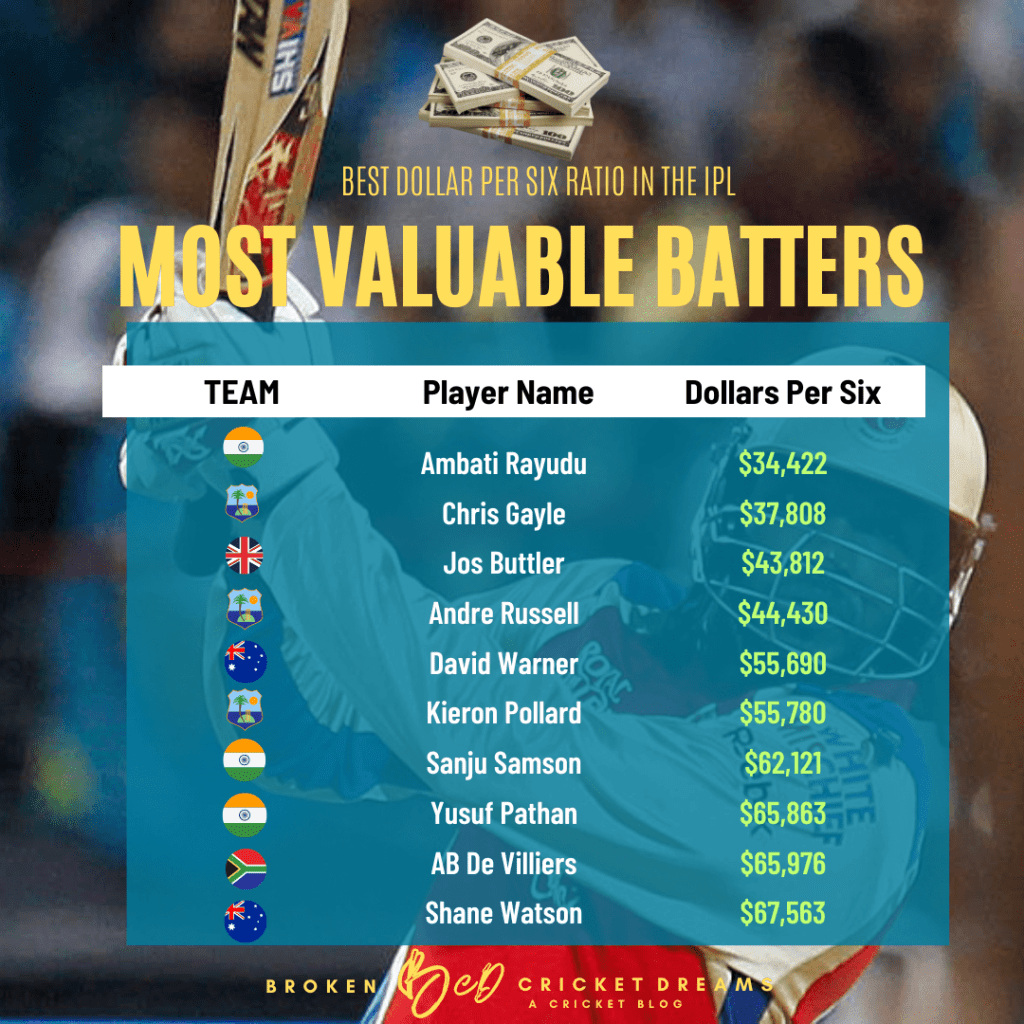
Since it took about $5,955,000 for his 173 sixes, Ambati Rayudu cost his franchises about $34,422 per six in the IPL.
Average IPL Salary: $425,357 ($5,955,000 over 14 seasons)
| Year | Team | Salary | Sixes |
| IPL 2010 | MI | $25,000 | 13 |
| IPL 2011 | MI | $66,000 | 9 |
| IPL 2012 | MI | $66,000 | 14 |
| IPL 2013 | MI | $66,000 | 4 |
| IPL 2014 | MI | $641,000 (INR 4 Crore) | 8 |
| IPL 2015 | MI | $641,000 (INR 4 Crore) | 16 |
| IPL 2016 | MI | $641,000 (INR 4 Crore) | 12 |
| IPL 2017 | MI | $641,000 (INR 4 Crore) | 3 |
| IPL 2018 | CSK | $346,000 (INR 2.2 Crore) | 34 |
| IPL 2019 | CSK | $346,000 (INR 2.2 Crore) | 7 |
| IPL 2020 | CSK | $346,000 (INR 2.2 Crore) | 12 |
| IPL 2021 | CSK | $346,000 (INR 2.2 Crore) | 17 |
| IPL 2022 | CSK | $892,000 (INR 6.75 Crore) | 15 |
| IPL 2023 | CSK | $892,000 (INR 6.75 Crore) | 9 |
Since it took $13,497,500 for his 357 sixes, Chris Gayle cost his franchises about $37,808 per six in the IPL.
Chris Gayle’s Average IPL Salary: $1.038 Million ($13,497,500 over 13 seasons)
*Note: Chris Gayle withdrew from IPL 2008
| Year | Team | Salary | Number of Sixes |
| IPL 2009 | KKR | $800,000 | 10 |
| IPL 2010 | KKR | $800,000 | 16 |
| IPL 2011 | RCB | $650,000 | 44 (Replacement) |
| IPL 2012 | RCB | $2,000,000 | 59 (Retained) |
| IPL 2013 | RCB | $2,000,000 | 51 |
| IPL 2014 | RCB | $1,521,000 (INR 9.5 Crore) | 12 (Retained) |
| IPL 2015 | RCB | $1,521,000 (INR 9.5 Crore) | 38 |
| IPL 2016 | RCB | $1,521,000 (INR 9.5 Crore) | 21 |
| IPL 2017 | RCB | $1,521,000 (INR 9.5 Crore) | 14 |
| IPL 2018 | PBKS | $314,500 (INR 2 Crore) | 27 |
| IPL 2019 | PBKS | $283,000 (INR 2 Crore) | 34 |
| IPL 2020 | PBKS | $283,000 (INR 2 Crore) | 23 |
| IPL 2021 | PBKS | $283,000 (INR 2 Crore) | 8 |
Since it took about $6,528,000 for his 149 sixes, Jos Buttler cost his franchises about $43,812 per six in the IPL.
Jos Buttler’s Average IPL Salary: $816,000 ($6,528,000 over 8 seasons)
| Year | Team | Salary | Sixes |
| IPL 2016 | MI | $560,000 (INR 3.8 Crore) | 11 |
| IPL 2017 | MI | $560,000 (INR 3.8 Crore) | 15 |
| IPL 2018 | RR | $692,000 (INR 4.4 Crore) | 21 |
| IPL 2019 | RR | $692,000 (INR 4.4 Crore) | 14 |
| IPL 2020 | RR | $692,000 (INR 4.4 Crore) | 16 |
| IPL 2021 | RR | $692,000 (INR 4.4 Crore) | 13 |
| IPL 2022 | RR | $1.32 Million (INR 10 Crore) | 45 |
| IPL 2023 | RR | $1.32 Million (INR 10 Crore) | 14 |
Since it took about $8,768,000 for his 193 sixes, Andre Russell cost his franchises about $45,430 per six in the IPL.
Andre Russell’s Average IPL Salary: $797,091 ($8,768,000 over 11 seasons)
| Year | Team | Salary | Sixes |
| IPL 2012 | DD | $450,000 | 3 |
| IPL 2013 | DD | $450,000 | 0 |
| IPL 2014 | KKR | $96,000 (INR 60 Lakh) | 0 |
| IPL 2015 | KKR | $96,000 (INR 60 Lakh) | 19 |
| IPL 2016 | KKR | $96,000 (INR 60 Lakh) | 15 |
| IPL 2017 | KKR | Withdrawn | – |
| IPL 2018 | KKR | $1.1 Million (INR 7 Crore) | 31 |
| IPL 2019 | KKR | $1.1 Million (INR 7 Crore) | 52 |
| IPL 2020 | KKR | $1.1 Million (INR 7 Crore) | 9 |
| IPL 2021 | KKR | $1.1 Million (INR 7 Crore) | 14 |
| IPL 2022 | KKR | $1.59 Million (INR 12 Crore) | 32 |
| IPL 2023 | KKR | $1.59 Million (INR 12 Crore) | 18 |
Since it took about $12,586,000 for his 226 sixes, David Warner cost his franchises about $55,690 per six in the IPL.
David Warner’s Average IPL Salary: $899,000 ($12,586,000 over 14 seasons)
| Year | Team | Salary | Sixes |
| IPL 2009 | DD | $30,000 (15 Lakh, Pre-Signing) | 5 |
| IPL 2010 | DD | $30,000 (15 Lakh) | 14 |
| IPL 2011 | DD | $750,000 | 11 |
| IPL 2012 | DD | $750,000 | 14 |
| IPL 2013 | DD | $750,000 | 14 |
| IPL 2014 | SRH | $881,000 (INR 5.5 Crore) | 24 |
| IPL 2015 | SRH | $881,000 (INR 5.5 Crore) | 21 |
| IPL 2016 | SRH | $881,000 (INR 5.5 Crore) | 31 |
| IPL 2017 | SRH | $881,000 (INR 5.5 Crore) | 26 |
| IPL 2018 | SRH | Withdrawn | – |
| IPL 2019 | SRH | $1.7 Million (INR 12 Crore) | 21 |
| IPL 2020 | SRH | $1.7 Million (INR 12 Crore) | 14 |
| IPL 2021 | SRH | $1.7 Million (INR 12 Crore) | 6 |
| IPL 2022 | DC | $826,000 (INR 6.25 Crore) | 15 |
| IPL 2023 | DC | $826,000 (INR 6.25 Crore) | 10 |
Since it took about $12,439,000 for his 223 sixes, Kieron Pollard cost his franchises about $55,780 per six in the IPL.
Kieron Pollard’s Average IPL Salary: $1.037 Million ($12,439,000 over 13 seasons)
| Year | Team | Salary | Sixes |
| IPL 2010 | MI | $750,000 | 17 |
| IPL 2011 | MI | $900,000 (Retained) | 6 |
| IPL 2012 | MI | $900,000 | 14 |
| IPL 2013 | MI | $900,000 | 29 |
| IPL 2014 | MI | $1.2 Million (INR 7.5 Crore) | 15 |
| IPL 2015 | MI | $1.2 Million (INR 7.5 Crore) | 28 |
| IPL 2016 | MI | $1.2 Million (INR 7.5 Crore) | 16 |
| IPL 2017 | MI | $1.2 Million (INR 7.5 Crore) | 22 |
| IPL 2018 | MI | $849,000 (INR 5.4 Crore) | 7 |
| IPL 2019 | MI | $849,000 (INR 5.4 Crore) | 22 |
| IPL 2020 | MI | $849,000 (INR 5.4 Crore) | 22 |
| IPL 2021 | MI | $849,000 (INR 5.4 Crore) | 16 |
| IPL 2022 | MI | $793,000 (INR 6 Crore) | 9 |
Since it took about $11,306,000 for his 182 sixes, Sanju Samson cost his franchises about $62,121 per six in the IPL.
Average IPL Salary: $942,166 ($11,306,000 over 12 seasons)
*Note: Sanju Samson did not play a single game in IPL 2012 but was still in the squad.
| Year | Team | Salary | Sixes |
| IPL 2012 | KKR | $22,000 (Did not play) | – |
| IPL 2013 | RR | $22,000 | 5 |
| IPL 2014 | RR | $641,000 (INR 4 Crore) | 17 |
| IPL 2015 | RR | $641,000 (INR 4 Crore) | 8 |
| IPL 2016 | DD | $620,000 (INR 4.2 Crore) | 8 |
| IPL 2017 | DD | $620,000 (INR 4.2 Crore) | 19 |
| IPL 2018 | RR | $1.26 Million (INR 8 Crore) | 19 |
| IPL 2019 | RR | $1.26 Million (INR 8 Crore) | 13 |
| IPL 2020 | RR | $1.26 Million (INR 8 Crore) | 26 |
| IPL 2021 | RR | $1.26 Million (INR 8 Crore) | 17 |
| IPL 2022 | RR | $1.85 Million (INR 14 Crore) | 26 |
| IPL 2023 | RR | $1.85 Million (INR 14 Crore) | 24 |
Since it took about $10,406,400 for his 251 sixes, Yusuf Pathan cost his franchises about $65,863 per six in the IPL.
Average IPL Salary: $867,200 ($10,406,400 over 12 seasons)
| Year | Team | Salary | Sixes |
| IPL 2008 | RR | $475,000 | 25 |
| IPL 2009 | RR | $475,000 | 12 |
| IPL 2010 | RR | $475,000 | 24 |
| IPL 2011 | KKR | $2.1 Million | 13 |
| IPL 2012 | KKR | $2.1 Million | 7 |
| IPL 2013 | KKR | $2.1 Million | 14 |
| IPL 2014 | KKR | $521,000 (INR 3.25 Crore) | 20 |
| IPL 2015 | KKR | $521,000 (INR 3.25 Crore) | 12 |
| IPL 2016 | KKR | $521,000 (INR 3.25 Crore) | 13 |
| IPL 2017 | KKR | $521,000 (INR 3.25 Crore) | 6 |
| IPL 2018 | SRH | $298,700 (INR 1.9 Crore) | 11 |
| IPL 2019 | SRH | $298,700 (INR 1.9 Crore) | 1 |
Since it took about $16,560,000 for his 251 sixes, AB De Villiers cost his franchises about $65,976 per six in the IPL.
AB De Villiers’ Average IPL Salary: $1.183 Million ($16,560,000 over 14 seasons)
| Year | Team | Salary | Sixes |
| IPL 2008 | DD | $300,000 | 1 |
| IPL 2009 | DD | $300,000 | 12 |
| IPL 2010 | DD | $300,000 | 0 |
| IPL 2011 | RCB | $1.1 Million | 14 |
| IPL 2012 | RCB | $1.1 Million | 15 |
| IPL 2013 | RCB | $1.1 Million | 15 |
| IPL 2014 | RCB | $1.2 Million (INR 7.5 Crore) | 24 |
| IPL 2015 | RCB | $1.2 Million (INR 7.5 Crore) | 22 |
| IPL 2016 | RCB | $1.2 Million (INR 7.5 Crore) | 37 |
| IPL 2017 | RCB | $1.2 Million (INR 7.5 Crore) | 16 |
| IPL 2018 | RCB | $1.89 Million (INR 11 Crore) | 30 |
| IPL 2019 | RCB | $1.89 Million (INR 11 Crore) | 26 |
| IPL 2020 | RCB | $1.89 Million (INR 11 Crore) | 23 |
| IPL 2021 | RCB | $1.89 Million (INR 11 Crore) | 16 |
Since it took about $12,837,000 for his 190 sixes, Shane Watson cost his franchises about $67,563 per six in the IPL.
Shane Watson’s Average IPL Salary: $1.070 Million ($12,837,000 over 12 seasons)
| Year | Team | Salary | Sixes |
| IPL 2008 | RR | $125,000 | 19 |
| IPL 2009 | RR | Withdrawn | – |
| IPL 2010 | RR | $125,000 | 9 |
| IPL 2011 | RR | $1.3 Million (Retained) | 17 |
| IPL 2012 | RR | $1.3 Million (Retained) | 14 |
| IPL 2013 | RR | $1.3 Million (Retained) | 22 |
| IPL 2014 | RR | $2 Million (INR 1.25 Crore) | 14 |
| IPL 2015 | RR | $2 Million (INR 1.25 Crore) | 14 |
| IPL 2016 | RCB | $1.4 Million (INR 9.5 Crore) | 12 |
| IPL 2017 | RCB | $1.4 Million (INR 9.5 Crore) | 1 |
| IPL 2018 | CSK | $629,000 (INR 4 Crore) | 35 |
| IPL 2019 | CSK | $629,000 (INR 4 Crore) | 20 |
| IPL 2020 | CSK | $629,000 (INR 4 Crore) | 13 |
Since it took about $11,922,000 for his 168 sixes, KL Rahul cost his franchises about $70,964 per six in the IPL.
Average IPL Salary: $1.192 Million ($11,922,000 over 10 seasons)
| Year | Team | Salary | Sixes |
| IPL 2013 | RCB | $22,000 | 0 |
| IPL 2014 | SRH | $160,000 (INR 1 Crore) | 3 |
| IPL 2015 | SRH | $160,000 (INR 1 Crore) | 5 |
| IPL 2016 | RCB | $160,000 (INR 1 Crore, Transferred) | 16 |
| IPL 2017 | RCB | Withdrawn | – |
| IPL 2018 | KXIP | $1.73 Million (INR 11 Crore) | 32 |
| IPL 2019 | KXIP | $1.73 Million (INR 11 Crore) | 25 |
| IPL 2020 | KXIP | $1.73 Million (INR 11 Crore) | 23 |
| IPL 2021 | KXIP | $1.73 Million (INR 11 Crore) | 30 |
| IPL 2022 | LSG | $2.25 Million (INR 17 Crore) | 30 |
| IPL 2023 | LSG | $2.25 Million (INR 17 Crore) | 4 |
Since it took about $15,862,000 for his 203 sixes, Suresh Raina cost his franchises about $78,138 per six in the IPL.
Suresh Raina’s Average IPL Salary: $1.22 Million ($15,862,000 over 13 seasons)
| Year | Team | Salary | Sixes |
| IPL 2008 | CSK | $650,000 | 18 |
| IPL 2009 | CSK | $650,000 | 21 |
| IPL 2010 | CSK | $650,000 | 22 |
| IPL 2011 | CSK | $1.3 Million (Retained) | 17 |
| IPL 2012 | CSK | $1.3 Million (Retained) | 19 |
| IPL 2013 | CSK | $1.3 Million (Retained) | 18 |
| IPL 2014 | CSK | $1.2 Million (INR 7.5 Crore) | 19 |
| IPL 2015 | CSK | $1.2 Million (INR 7.5 Crore) | 16 |
| IPL 2016 | GL | $1.256 Million (INR 9.5 Crore) | 10 |
| IPL 2017 | GL | $1.256 Million (INR 9.5 Crore) | 13 |
| IPL 2018 | CSK | $1.7 Million (INR 11 Crore) | 12 |
| IPL 2019 | CSK | $1.7 Million (INR 11 Crore) | 9 |
| IPL 2020 | CSK | Withdrawn | – |
| IPL 2021 | CSK | $1.7 Million (INR 11 Crore) | 9 |
Since it took about $12,626,000 for his 158 sixes, Glenn Maxwell cost his franchises about $79,911 per six in the IPL.
Average IPL Salary: $1.148 Million ($12,626,000 over 11 seasons)
| Year | Team | Salary | Sixes |
| IPL 2012 | DD | $22,000 | 0 |
| IPL 2013 | MI | $1 Million | 4 |
| IPL 2014 | KXIP | $961,000 (INR 6 Crore) | 36 |
| IPL 2015 | KXIP | $961,000 (INR 6 Crore) | 8 |
| IPL 2016 | KXIP | $961,000 (INR 6 Crore) | 8 |
| IPL 2017 | KXIP | $961,000 (INR 6 Crore) | 26 |
| IPL 2018 | KXIP | $1.4 Million (INR 9 Crore) | 9 |
| IPL 2019 | KXIP | Withdrawn | – |
| IPL 2020 | KXIP | $1.5 Million (INR 10.75 Crore) | 0 |
| IPL 2021 | RCB | $1.96 Million (INR 14.25 Crore) | 21 |
| IPL 2022 | RCB | $1.45 Million (INR 11 Crore) | 15 |
| IPL 2023 | RCB | $1.45 Million (INR 11 Crore) | 31 |
Since it took about $15,011,000 for his 182 sixes, Robin Uthappa cost his franchises about $82,478 per six in the IPL.
Average IPL Salary: $1 Million ($15,011,000 over 15 seasons)
| Year | Team | Salary | Sixes |
| IPL 2008 | MI | $800,000 | 9 |
| IPL 2009 | RCB | $800,000 (traded) | 3 |
| IPL 2010 | RCB | $800,000 | 27 |
| IPL 2011 | PWI | $2.1 Million | 10 |
| IPL 2012 | PWI | $2.1 Million | 10 |
| IPL 2013 | PWI | $2.1 Million | 12 |
| IPL 2014 | KKR | $801,000 (INR 5 Crore) | 18 |
| IPL 2015 | KKR | $801,000 (INR 5 Crore) | 7 |
| IPL 2016 | KKR | $801,000 (INR 5 Crore) | 8 |
| IPL 2017 | KKR | $801,000 (INR 5 Crore) | 21 |
| IPL 2018 | KKR | $1 Million (INR 6.4 Crore) | 21 |
| IPL 2019 | KKR | $1 Million (INR 6.4 Crore) | 10 |
| IPL 2020 | RR | $421,500 (INR 3 Crore) | 7 |
| IPL 2021 | CSK | $421,500 (INR 3 Crore, Transferred) | 5 |
| IPL 2022 | CSK | $264,000 (INR 2 Crore) | 14 |
Since it took about $14,096,100 for his 149 sixes, Yuvraj Singh cost his franchises about $95,605 per six in the IPL.
Average IPL Salary: $1.281 Million ($14,096,100 over 11 seasons)
| Year | Team | Salary | Sixes |
| IPL 2008 | KXIP | $1.06 Million | 19 |
| IPL 2009 | KXIP | $1.06 Million | 16 |
| IPL 2010 | KXIP | $1.06 Million | 14 |
| IPL 2011 | PWI | $1.8 Million | 18 |
| IPL 2012 | PWI | Withdrawn | – |
| IPL 2013 | PWI | $1.8 Million | 15 |
| IPL 2014 | RCB | $2.24 Million (INR 14 Crore) | 28 |
| IPL 2015 | DD | $2.56 Million (INR 16 Crore) | 10 |
| IPL 2016 | SRH | $1.03 Million (INR 7 Crore) | 13 |
| IPL 2017 | SRH | $1.03 Million (INR 7 Crore) | 8 |
| IPL 2018 | KXIP | $314,500 (INR 2 Crore) | 2 |
| IPL 2019 | MI | $141,600 (INR 1 Crore) | 6 |
Since it took about $14,500,400 for his 148 sixes, Shikhar Dhawan cost his franchises about $97,976 per six in the IPL.
Average IPL Salary: $906,275 ($14,500,400 over 16 seasons)
| Year | Team | Salary | Sixes |
| IPL 2008 | DD | $50,000 | 8 |
| IPL 2009 | MI | $50,000 (trade) | 0 |
| IPL 2010 | MI | $50,000 | 3 |
| IPL 2011 | DC | $300,000 | 7 |
| IPL 2012 | DC | $300,000 | 18 |
| IPL 2013 | DC | $300,000 | 5 |
| IPL 2014 | SRH | $2 Million (INR 12.5 Crore) | 7 |
| IPL 2015 | SRH | $2 Million (INR 12.5 Crore) | 6 |
| IPL 2016 | SRH | $2 Million (INR 12.5 Crore) | 8 |
| IPL 2017 | SRH | $2 Million (INR 12.5 Crore) | 9 |
| IPL 2018 | SRH | $817,600 (INR 5.2 Crore) | 14 |
| IPL 2019 | DC | $817,600 (INR 5.2 Crore, Transferred) | 11 |
| IPL 2020 | DC | $817,600 (INR 5.2 Crore) | 12 |
| IPL 2021 | DC | $817,600 (INR 5.2 Crore) | 16 |
| IPL 2022 | PBKS | 1.09 Milllion (INR 8.25 Crore) | 12 |
| IPL 2023 | PBKS | 1.09 Milllion (INR 8.25 Crore) | 12 |
Since it took about $29,910,000 for his 257 sixes, Rohit Sharma cost his franchises about $116,381 per six in the IPL.
Rohit Sharma’s Average IPL Salary: $1.869 Million ($29,910,000 over 16 seasons)
| Year | Team | Salary | Sixes |
| IPL 2008 | DC | $750,000 | 19 |
| IPL 2009 | DC | $750,000 | 18 |
| IPL 2010 | DC | $750,000 | 14 |
| IPL 2011 | MI | $2 Million | 13 |
| IPL 2012 | MI | $2 Million | 18 |
| IPL 2013 | MI | $2 Million | 28 |
| IPL 2014 | MI | $2 Million (INR 12.5 Crore) | 16 |
| IPL 2015 | MI | $2 Million (INR 12.5 Crore) | 21 |
| IPL 2016 | MI | $2 Million (INR 12.5 Crore) | 16 |
| IPL 2017 | MI | $2 Million (INR 12.5 Crore) | 9 |
| IPL 2018 | MI | $2.36 Million (INR 15 Crore) | 12 |
| IPL 2019 | MI | $2.36 Million (INR 15 Crore) | 10 |
| IPL 2020 | MI | $2.36 Million (INR 15 Crore) | 19 |
| IPL 2021 | MI | $2.36 Million (INR 15 Crore) | 14 |
| IPL 2022 | MI | $2.11 Million (INR 16 Crore) | 13 |
| IPL 2023 | MI | $2.11 Million (INR 16 Crore) | 17 |
Since it took about $29,820,000 for his 250 sixes, MS Dhoni cost his franchises about $119,280 per six in the IPL.
MS Dhoni’s Average IPL Salary: $1.864 Million ($29,820,000 over 16 seasons)
| Year | Team | Salary | Sixes |
| IPL 2008 | CSK | $1.5 Million | 15 |
| IPL 2009 | CSK | $1.5 Million | 9 |
| IPL 2010 | CSK | $1.5 Million | 8 |
| IPL 2011 | CSK | $1.8 Million | 23 |
| IPL 2012 | CSK | $1.8 Million | 9 |
| IPL 2013 | CSK | $1.8 Million | 25 |
| IPL 2014 | CSK | $2 Million (INR 12.5 Crore) | 20 |
| IPL 2015 | CSK | $2 Million (INR 12.5 Crore) | 17 |
| IPL 2016 | RPS | $1.65 Million (INR 12.5 Crore) | 14 |
| IPL 2017 | RPS | $1.65 Million (INR 12.5 Crore) | 16 |
| IPL 2018 | CSK | $2.36 Million (INR 15 Crore) | 30 |
| IPL 2019 | CSK | $2.36 Million (INR 15 Crore) | 23 |
| IPL 2020 | CSK | $2.36 Million (INR 15 Crore) | 7 |
| IPL 2021 | CSK | $2.36 Million (INR 15 Crore) | 3 |
| IPL 2022 | CSK | $1.59 Million (INR 12 Crore) | 10 |
| IPL 2023 | CSK | $1.59 Million (INR 12 Crore) | 10 |
Since it took about $16,560,000 for his 251 sixes, Virat Kohli cost his franchises about $120,470 per six in the IPL.
Virat Kohli’s Average IPL Salary: $1.761 Million ($28,190,000 over 16 seasons)
Also Read: Virat Kohli Net Worth 2023 (in Dollars USD and Indian Rupee INR): How Do Cricketers Earn Money?
| Year | Team | Salary | Sixes |
| IPL 2008 | RCB | $50,000 | 4 |
| IPL 2009 | RCB | $50,000 | 8 |
| IPL 2010 | RCB | $50,000 | 12 |
| IPL 2011 | RCB | $1.8 Million | 16 |
| IPL 2012 | RCB | $1.8 Million | 9 |
| IPL 2013 | RCB | $1.8 Million | 22 |
| IPL 2014 | RCB | $2 Million (INR 12.5 Crore) | 16 |
| IPL 2015 | RCB | $2 Million (INR 12.5 Crore) | 23 |
| IPL 2016 | RCB | $2 Million (INR 12.5 Crore) | 38 |
| IPL 2017 | RCB | $2 Million (INR 12.5 Crore) | 11 |
| IPL 2018 | RCB | $2.67 Million (INR 17 Crore) | 18 |
| IPL 2019 | RCB | $2.67 Million (INR 17 Crore) | 13 |
| IPL 2020 | RCB | $2.67 Million (INR 17 Crore) | 11 |
| IPL 2021 | RCB | $2.67 Million (INR 17 Crore) | 9 |
| IPL 2022 | RCB | $1.98 Million (INR 15 Crore) | 8 |
| IPL 2023 | RCB | $1.98 Million (INR 15 Crore) | 16 |
Some interesting revelations here.
Ambati Rayudu may probably be one of the steals of the IPL auctions!
Because Rayudu was an uncapped player for early part of his IPL career, his IPL salary was comparatively low to his contemporaries. He was a clutch player for both MI & CSK over the years and was worth every penny.
However, take this list with a grain of salt. The fact that Rohit Sharma, MS Dhoni, and Virat Kohli end at the bottom of the list is due to the fact that they were retained almost every time. We are only comparing dollars per six here, but these three provided their IPL franchises a lot more value—Leadership, Fours, Runs, Orange Caps, IPL Titles, brand value, fan loyalty, match winning performances, and much more.
Thanks for reading, until next time.
Please do share ahead with your cricket loving friends!
Also Read:
Chris Gayle has hit the most sixes in the IPL (357), followed by Rohit Sharma (257) and AB De Villiers (251).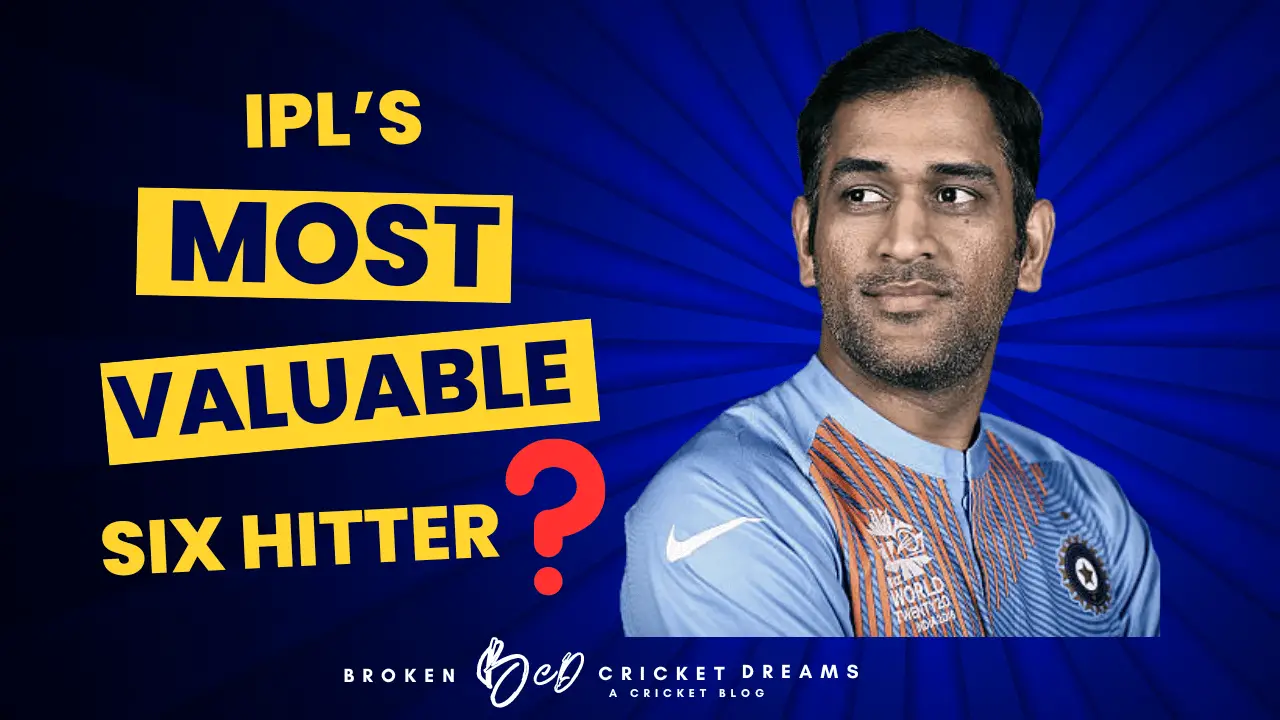
Ambati Rayudu ($34,442), Chris Gayle ($37,808), and Jos Buttler ($43,812) have the best ratios of dollar per six in IPL history.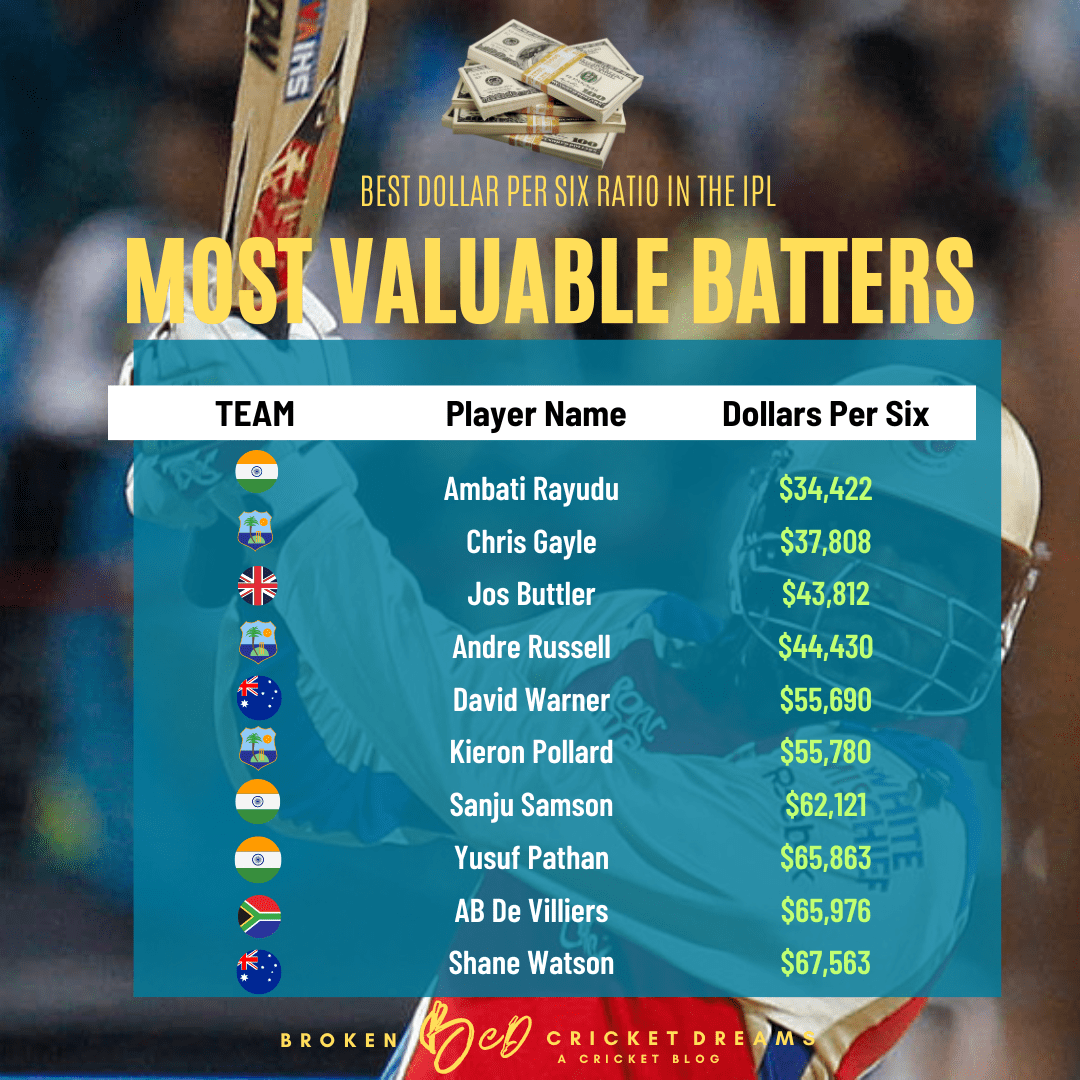
© Copyright @Nitesh Mathur and Broken Cricket Dreams, LLC 2023. Originally published on 03/16/2024. Unauthorized use and/or duplication of this material without express and written permission from this site’s author and/or owner is strictly prohibited. Excerpts and links may be used, provided that full and clear credit is given to Broken Cricket Dreams with appropriate and specific direction to the original content (i.e. linked to the exact post/article).
Let’s jump straight in. The day has finally arrived when the New Zealand great, Neil Wagner, announced his retirement.
After all, he was fifteen days away from his 38th birthday. How long could he possibly bowl his bloody bouncers on flat pitches through the dead heat in the middle of Day 3?
Well probably till he was 82 or somethin’. Wagner could likely continue to bowl his heart out if his team needed him to till the very day he died.
Because that is what Wagner did.
Did Wagner swing it like Southee? No.
Did he bend it like Boult? Nope.
Was he as fast as Shoaib? As scary as Murali? As consistent as McGrath?
No, No, and No.
So what made Wagner special? One word—Grit. Author Travis Bradberry’s quote can be applied to perfectly sum up Wagner’s character:
“Grit is that ‘extra something’ that separates the most successful people from the rest. It’s the passion, perseverance, and stamina that we must channel in order to stick with our dreams until they become reality.”
He has batted for 107 minutes to save a Test. He bowled with a fractured toe once and with broken fingers another time.
Surely he has grit. After all, he famously said, “Unless they carry me off a stretcher, I am going to try and do everything I can.”
You can’t help but love Neil Wagner. He is a fighter. He is a warrior.
Wagner could swing it just enough. He was ultra scary for short periods of time. He could crank up his speeds for a few spells in a Test. And boy, was he consistent with those short ball spells used to trap set batters.
The fact that he could combine these multiple skill sets together over long periods of time is what set him apart.
Although Wagner in his own words did not think of himself as the “most talent or most gifted bloke,” he was exactly the type of character that the team needed. One that would give it his all regardless of the conditions or the circumstances of the match.
Someone who would never give up.
His arduous journey to the Kiwi Test cap would instill in him the valuable lesson of perseverance. Born in South Africa, Wagner came would play alongside AB de Villiers & Faf du Plessis in the Affies school team.
Partially due to the quota system, Wagner never got his big break in South African cricket. So he decided to leave his home nation to find a better opportunity in England. Although he had a couple of decent seasons in the County circuit, this did not work out either. It was coach Mike Hesson who sought Wagner’s services in New Zealand.
At the age of 26, Wagner finally had a new home.
Fast forward a decade, one of Wagner’s and New Zealand’s shining moments was the World Test Championship Final win in 2021.
It featured perhaps New Zealand’s best fast bowling unit—Tim Southee, Trent Boult, Neil Wagner, and Kyle Jamieson.
Four versatile bowlers that played their own roles beautifully. Statistically speaking, Southee, Boult, and Wagner are definitely in the Top 5 of New Zealand’s all time bowling list (If you take Vettori out of the list, Hadlee-Southee-Boult-Wagner are clearly NZ’s Top 4 fast bowlers).
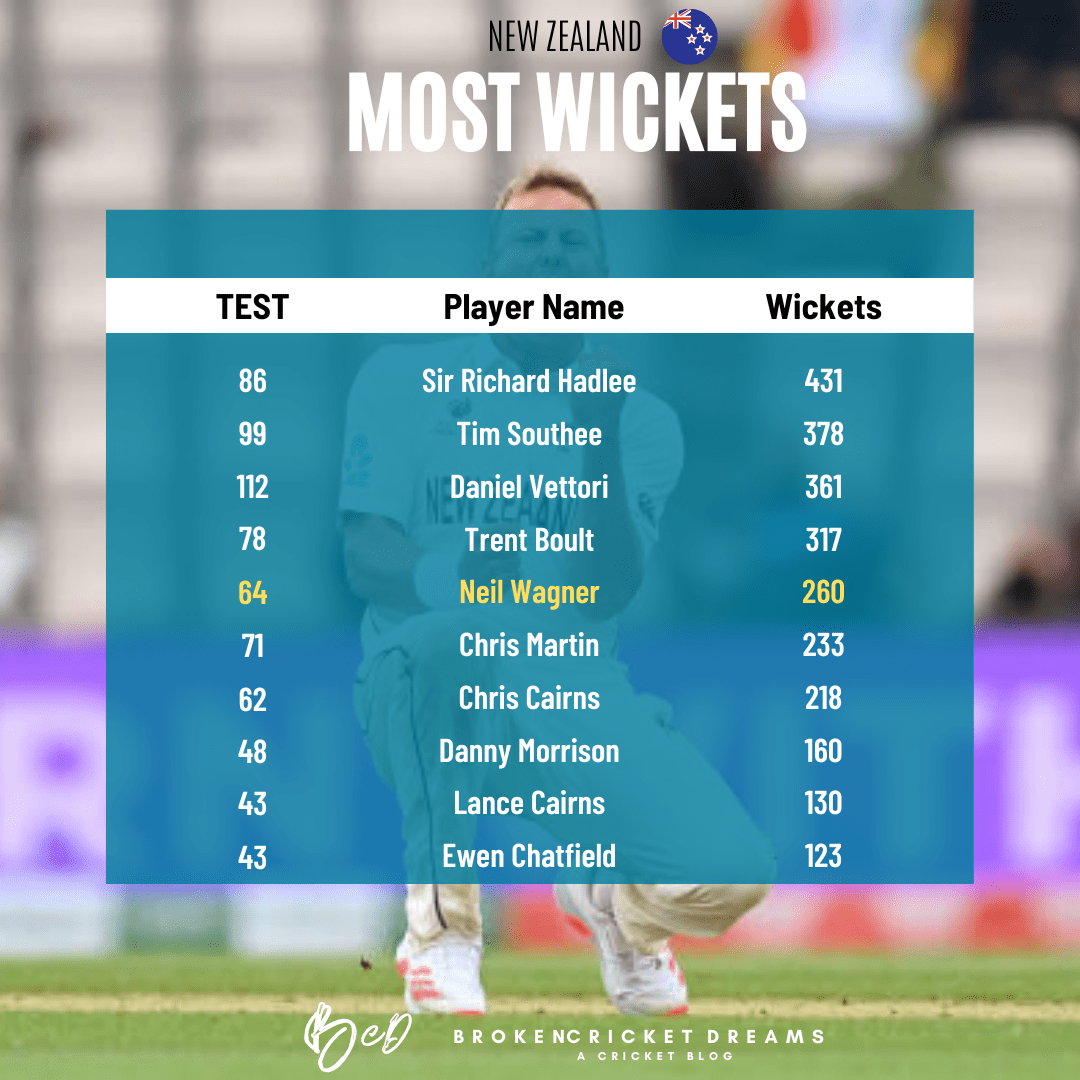
In Test cricket, Wagner is New Zealand’s
It is astonishing what Wagner has accomplished as a first change bowler. Jarrod Kimber brilliantly described in his video essay that “there is no other bowler in the history of cricket like Neil Wagner.” Definitely recommend watching this after this article.
In an era of T20 dominance, Wagner ended up playing 205 first class matches, including 64 Tests. Although he played 116 List A matches and 86 domestic T20s, he never played a single limited over international.
As a fast bowler, Neil Wagner was involved in multiple great battles.
My favorite one of them all, Neil Wagner vs Matthew Wade & Steve Smith.
Two characters that just never back down. Wagner kept bowling bouncers, Wade kept taking the blows and later pulled and hooked Wagner. And the leg slip setup to Steve Smith in that series was just wonderful to watch. A great diving caught and bowled later in the series as well.
Another memorable moment was the 1-run win against England in 2023. What an ending.
The roar of a tiger. The expressions. The perfect team man.
His energy and the whole vibe. It felt like he simultaneously played for the fun of the game like like an innocent child but also played with the seriousness as if his life depended on it.
What did Neil Wagner teach me?
Wagner taught me to never back down in the face of adversity. Win or lose, but give it every ounce of energy you got. He taught me to tackle problems from different perspectives and keep innovating. He taught me to encourage others while learning from them at the same time.
And most importantly, he taught me to stay true to who you are.
Humility, character, determination. That’s what Neil Wagner was all about.
I will leave you with another quote, this time from the legendary basketball player, Larry Bird.
“I’ve got a theory that if you give 100% all of the time, somehow things will work out in the end.”
Neil Wagner gave his 100% all the time, both on and off the field.
And at the end of the day, things did work out for him in the end.
Neil Wagner, Legend.
Do watch Neil Wagner’s emotional retirement press conference.
Ross Taylor, BJ Watling, and Neil Wagner, three of the stalwarts of NZ’s WTC Final victory have stepped off the international scene. The transition period is real. Only Southee, Boult, and Williamson left now. Let’s appreciate them while we can.
If you like these type of tribute and biographical articles, do check out this page for more such articles.
Jimmy stares at the clock.
It’s 3 o’clock. Just 15 minutes to go. School is about to end. Yet another day in the third grade comes to a close.
The bell rings.
Jimmy and his friends scream from the bottom of their lungs. The sprint out the door. They catch the bus and go home.
Jimmy does his homework, completes his chores, watches cartoons, and goes to sleep.
One day goes by. Then another. And another.
The same cycle repeats.
20 years later, Jimmy becomes a successful banker.
Jimmy Anderson, Financial Analyst
Michael is one of the most popular students at his university.
He has an INSANE daily schedule.
He wakes up at 4 AM, studies for his midterms, eats breakfast, and goes to marching band practice swiftly at 6:30.
It’s 9 AM now, which means it is lecture time.
He focuses on his classes, finishes his homework during lunch, peruses world history brooks at the library, and takes a short break for some delightful coffee.
At 3 PM, he goes to his entrepreneurship club. To finish off his day, he decides to volunteer at the Food Bank.
He later catches the 9 PM train while he studies some more before he reaches home and crashes on his couch at 10:30 PM.
10 years later, Michael gets a coveted job at the United Nations headquarters.
Michael Jordan, US Policy Analyst, Diplomat in Training.
Roger is a doctor.
Serena is an engineer.
Rafael is a lawyer.
Novak is a successful businessman.
Roger spends his entire life in Switzerland. Serena spends her entire life in the United States.
Rafael spends his entire life in Spain, and you guessed it—Novak spends his entire life in Serbia.
Roger Federer, Serena Williams, Novak Djokovic, and Rafael Nadal never cross paths in their entire lives.
We can have our endless debates—Who was the greatest of all-time? Michael Jordan? LeBron James? Or was it Kobe Bryant?
We can have our mindless fan wars. Kohli vs Rohit vs Dhoni.
We can have our arguing, fighting, and grappling. We can have our podcasts, pre-match analysis, post-match analysis, stories & tributes, the numbers game, and the statistical predictions.
But for once, just once, imagine if this all went away on a whim.
Imagine a world without sports.
Just imagine and think—can be just take a step back for once, reflect, and be grateful for what we do have?
What does sports means to you? How would life have been different without it? Comment Below.
If you like these types of articles, you may like:
© Copyright @Nitesh Mathur and Broken Cricket Dreams, LLC 2023. Originally published on 02/24/2024. Unauthorized use and/or duplication of this material without express and written permission from this site’s author and/or owner is strictly prohibited. Excerpts and links may be used, provided that full and clear credit is given to Broken Cricket Dreams with appropriate and specific direction to the original content (i.e. linked to the exact post/article).
Who are the greatest South African cricketers of all-time?
With the passing of Mike Procter, the Proteas family lost another legend. Today we explore the list of greatest cricketers this African nation has produced.
Let’s dive right in.
Some of the criteria we used to compile this list includes: Most Wickets/Runs in International Cricket*, international caps, ICC Hall of Fame status, World Cup performances, captaincy record, fielding & keeping record, anecdotes (especially for players in the early twentieth century), and match winning performances.
*We considered also considered first class stats for the pre-1990s eras.
We first look at the top 10 wicket-takers across formats. Also listed below are the top few wicket-takers in each format for South Africa.
| Player | Wickets |
| Shaun Pollock | 823 |
| Dale Steyn | 697 |
| Makhaya Ntini | 661 |
| Allan Donald | 602 |
| Jacques Kallis | 572 |
| Morne Morkel | 535 |
| Kagiso Rabada | 506 |
| Imran Tahir | 291 |
| Lance Klusener | 272 |
| Vernon Philander | 269 |
*Does not include wickets taken for World XI teams
We now move on to the batting side of things.
| Player | Runs | Centuries |
| Jacques Kallis | 25422 | 62 |
| AB de Villiers | 19864 | 47 |
| Hashim Amla | 18553 | 55 |
| Graeme Smith | 17224 | 37 |
| Herschelle Gibbs | 14661 | 35 |
| Gary Kirsten | 14087 | 34 |
| Quinton de Kock | 12347 | 28 |
| Faf du Plessis | 11136 | 23 |
| Mark Boucher | 10289 | 6 |
| Hansie Cronje | 9279 | 8 |
Here are some other stats that will help us give us a complete picture.
Also Read:
Without further ado, here is the complete list of the 50 greatest South African cricketers of all-time. Enjoy!
Note: Basil D’Oliveira is not considered since he played international cricket for England. He was born in South Africa and moved to England in 1966.
Colin Bland revolutionized fielding with unmatched athleticism and set an example for future Protea teams. According to ESPNCricinfo, “Colin Bland will go down in cricket history as one of the greatest cover fielders.” With such greatness, I had to put him in this list.
Embed from Getty ImagesJP Duminy specialized in playing cameos in pressure situations down the order. Played a key part in the monumental 414 chase against Australia at Perth in the 4th innings, stitching a 111-run partnership with AB de Villiers.kepp
Embed from Getty ImagesFanie de Villiers, a force to be reckoned with in South African cricket during the 1990s, claimed 85 Test scalps and 121 ODI dismissals with his precise bowling
Embed from Getty ImagesJock Cameron, a cricketing stalwart of the early 20th century, distinguished himself with his masterful wicketkeeping skills and gritty batting. Once in a 1929 County cricket match, he took six catches and also had one stumping.
Embed from Getty ImagesKepler Wessels, a true pioneer in South African cricket, won hearts with his gutsy batting, shrewd leadership, and the sheer joy he brought to the game, playing a key part in the nation’s cricketing resurgence while charming fans with his infectious spirit and love for the sport. Played for both Australia and South Africa.
*Only South African statistics shown. Overall, he played 40 Tests & 109 ODIs.
Embed from Getty ImagesFirst South African to play 50 Tests. A constant force behind the stumps much like Boucher in the 2000s. Holds the South African record for joint most dismissals (26) in a 5-Test series.
Embed from Getty ImagesNow known for his administrative positions in the ICC, Richardson was earlier South Africa’s keeper post the isolation period. Solid keeper.
Embed from Getty ImagesOne of the most classical batters in South African history, producing some of the slowest innings of all-time. Noted for carrying the bat and batting for nine hours for a 105 against Australia.
Embed from Getty ImagesA specialist limited over batter, Miller will go down as perhaps the greatest #6 ODI batter of all-time along with Michael Bevan, Jos Buttler, and MS Dhoni.
At #6, Miller scored 2718 runs, 3 centuries, and twenty 50+ scores at an average of 40.56 & 104.78 SR. When in form, Killer Miller is just a sight to watch.
*He might rise up the list by the end of his career.
Embed from Getty ImagesNot many people can boast that they changed their field of expertise. Jonty Rhodes definitely did. With his iconic diving catches and flying run outs, he captured audiences worldwide.
Also Read: Top 32 Best Fielders in Cricket History: Jonty Rhodes, Paul Collingwood…Can You Guess The Rest?
Embed from Getty ImagesDaryll Cullinan, renowned for his elegant batting, showcased his prowess in memorable matches like his 275 against New Zealand in 1999, and his crucial knocks against Sri Lanka and England, solidifying his reputation as a key figure in South African cricket during the 90s.
Embed from Getty ImagesHeld the record for most wickets in a South Africa’s domestic season (65) at that time. Played his entire career in South Africa’s isolation.
Embed from Getty ImagesBrian McMillan, a key figure in South African cricket during the 1990s, played pivotal roles in memorable matches such as the 1992 World Cup and the historic readmission series, showcasing his all-round skills with both bat and ball
Embed from Getty ImagesGarth le Roux, a fearsome fast bowler, struck fear into batsmen with his raw pace and hostile deliveries, making him a formidable force in South African cricket during the 1980s, and leaving a lasting impact with his aggressive bowling style and crucial wicket-taking ability.
*His entire career was during South Africa’s isolation
Embed from Getty ImagesHerbie Taylor, a cricketing legend of the early 20th century, was celebrated for his elegant batting style and astute captaincy, leading South Africa with distinction and leaving an enduring legacy as one of the country’s finest batsmen and leaders on the cricket field.
Also served in World War I.
Embed from Getty ImagesJimmy Sinclair, a cricketing pioneer of the late 19th and early 20th centuries, captivated audiences with his exceptional batting and laid the foundation for South African cricket’s rich heritage.
One of South Africa’s earliest cricket legends.
Embed from Getty ImagesOne of the premier left handed batters of the 2010s, Elgar’s leadership ensured that South Africa had one world class senior batter during their transition period. One word comes to mind when watching Elgar bat, tenacity. Ready to take body blows and challenge the world.
Embed from Getty ImagesVernon Philander gave the South African bowling an edge like never before. They have always had pace, seam, and bounce. Philander’s ability to swing it both ways was exactly what the Proteas needed to complement Steyn & Morkel.
Embed from Getty ImagesTrevor Goddard, a cricketing stalwart of the 1950s and 1960s, was a formidable all-rounder celebrated for his left-arm spin bowling and solid batting, playing a pivotal role in South African cricket history with his match-winning contributions and leadership on the field, earning him a revered status among fans and peers alike.
Embed from Getty ImagesPlayed international a few years past his prime due to international isolation. 22,635 first class runs is a testament to his talent.
*played 12 Tests and 40 ODIs from 1991-1994
Embed from Getty ImagesFirst South African fast bowler to 100 test wickets. One of the early greats of South African proud fast bowling history.
Embed from Getty ImagesA late entrant on the international stage, he grabbed his opportunity with both hands. His epic at Adelaide, blockathon at Delhi, and captaincy towards the end of his career, was the highlight of his career. Still plies his trade around the world after re-inventing himself as a swashbuckling T20 opener.
Also Read: Faf du Plessis & AB De Villiers’ Friendship: Broken Dreams of Faf and ABD
Embed from Getty ImagesBruce Mitchell, a luminary of South African cricket during the 1930s and 1940s, captivated audiences with his elegant stroke play and strategic brilliance, amassing over 3,000 Test runs at an impressive average of 48.88.
Embed from Getty ImagesIf you search hard enough, Imran Tahir is probably still playing somewhere around the world and running around the ground with his infectious celebration. Completed South Africa’s bowling attack in the 2010s. One of the greatest spinners to play for South Africa and definitely the greatest leg spinner.
Embed from Getty ImagesJimmy Cook, a stalwart of South African cricket during the apartheid era, demonstrated exceptional resilience and skill, dominating domestic cricket with his prolific run-scoring and earning widespread admiration despite being denied international opportunities due to the country’s sporting isolation.
*played 3 Tests and 4 ODIs between 1991-1993.
Embed from Getty ImagesWe are halfway there…
A child prodigy that fulfilled his potential. After Graeme Smith retired, Quinton de Kock fit straight through. Even though his Test and ODI careers did not last as long as people would have wanted, he provided plenty of memories. He always got his best out against India and his swivel sixes is still one of the sweetest shots in cricket.
*may continue to rise up the list
Embed from Getty ImagesOne of the top bowlers of the current era. Alongside Jasprit Bumrah, Rabada is a complete bowler across formats. If he stays fit, he has the potential to break Steyn’s record of 439 Test wickets.
*will most likely continue to rise up this list
Embed from Getty ImagesDudley Nourse, a cricketing legend of the mid-20th century, captivated audiences with his elegant batting style and remarkable consistency, leaving an enduring legacy as one of South Africa’s finest batsmen, whose contributions during the pre- and post-war era remain etched in cricketing folklore.
He served in the Middle East during the World War.
Embed from Getty ImagesPeter Pollock, a pace bowling sensation of the 1960s and 1970s, showcased his fiery pace and lethal accuracy, leaving a lasting impact on South African cricket with his ability to dismantle batting lineups, epitomizing the spirit of aggression and skill on the field.
Embed from Getty ImagesCharismatic batter. Even more charismatic captain. Legacy tarnished due to the match fixing scandal. Died too early.
Embed from Getty ImagesFor every Michael Jordan, there is a Scottie Pippen. The height and constant line and length made him a threatening bowler. Combined with Steyn, the duo destroyed plenty of batting line ups around the world.
Embed from Getty ImagesEddie Barlow, the dynamic all-rounder of South Africa in the 1960s and 1970s, left an indelible mark with memorable performances like his 114 against Australia in 1966 and his vital contributions in the series against England in 1965
Embed from Getty ImagesGary Kirsten, a prolific batsman of the modern era, distinguished himself with his exceptional technique and unyielding determination, playing a pivotal role in South African cricket’s resurgence in the 1990s and early 2000s. He produced memorable performances such as his monumental 275 against England in 1999 and 188* in an ODI, solidifying his status as one of the nation’s cricketing icons.
Coached India to 2011 World Cup victory to further cement his name in history.
Embed from Getty ImagesMakhaya Ntini, a relentless fast bowler, broke barriers as the first black African cricketer to play for South Africa, leaving an indelible mark with his raw pace, fierce competitiveness, and memorable performances, inspiring a generation of young cricketers and symbolizing the transformation of South African cricket.
Embed from Getty ImagesAubrey Faulkner, a cricketing pioneer of the early 20th century, mesmerized audiences with his remarkable all-round abilities, excelling as a stylish batsman and a cunning spin bowler, leaving an enduring legacy as one of South Africa’s greatest cricketers and a trailblazer for generations to come.
Embed from Getty ImagesHugh Tayfield, a spin bowling maestro of the 1950s, spun his way into cricketing history with his impeccable accuracy and cunning variations, amassing a record-breaking tally of wickets for South Africa and etching his name among the pantheon of cricketing legends.
Embed from Getty ImagesMark Boucher is perhaps the most prominent figure behind the stumps in modern cricket. For 15 years, he almost played every match for the Proteas and was a constant force. He had moments with the bat as well such as sealing the 434 chase against Australia in 2006.
Embed from Getty ImagesIf you look purely from career stats, Klusener might not be able to compete with the rest of South Africa’s great all-rounders. However, his 1999 World Cup heroics pushes him up. This was the closest South Africa were to a World Cup win.
281 runs at 140.5 average and 122.17 SR to go along with his 17 wickets and 4 player of the match performances. Pioneered the finisher and power hitting role in ODI cricket.
Embed from Getty ImagesHerschelle Gibbs was quite the character. The dynamic between the strokemaker Gibbs & gritty Smith helped them become a strong partnership over the years. Gibbs had several moments of his own- The Six Sixes in the 2007 ODI World Cup, 175 in that iconic 434 chase, (oh yeah, and dropping Steve Waugh in the 1999 World Cup).
Embed from Getty ImagesClive Rice, a dominant force in South African cricket during the apartheid era, showcased exceptional leadership and all-round skills, symbolizing resilience and determination, and leaving a lasting legacy as a true cricketing icon.
*played 3 ODIs in 1991 at the age of 42
Embed from Getty ImagesTime for the Final 10!
Allan Donald took South African fast bowling to new heights. Handed off the baton to the likes of Shaun Pollock, Ntini, and provided a template for Steyn to follow. Action, pace, celebration, Donald had it all.
Embed from Getty ImagesAccording to ESPNCricinfo, Mike Procter was “probably one of the most natural talents the game has ever seen.” Set the tone for great right handed fast bowling all-rounders to come from this region of the world.
Embed from Getty ImagesOne of the most elegant opening batters of all-time. He had all the ingredients—Time, Placement, Finesse. Fastest to 3000, 4000, 6000, and 7000 ODI runs.
Embed from Getty ImagesOne of the greatest left-handed openers of all-time, certainly in the Top 3 of the 21st century. Not the prettiest stroke player, it was his grit, courage, and leadership that differentiated Smith from the rest. Playing with a broken hand, Smith earned the respect of the mighty Australians and the rest of the cricketing fraternity. His captaincy led South Africa to a new era after the match fixing crisis.
Embed from Getty ImagesA cricketing genius known for his sublime batting, international cricket missed out on one of the great talents. Played only 4 Tests but showed what he could do with 2 hundred, 2 fifties, and average of 72.57. Otherwise racked up 28358 runs with the best score of 356.
*played 4 Tests in 1970
Also Read: 155 Greatest Cricketers of All Time (Men’s): Who Is the King of Cricket? (Updated 2023)
Embed from Getty ImagesOne of the most elegant left handers of his time, Graeme Pollock played the last of his 23 Tests at the age of 26. Scored a magnificent 274 in the same test as Richards’ 140. South Africa declared for 622/8 and won by an innings and 129 at Durban against Australia. Little did they know that this was their last international series.
Embed from Getty ImagesOpened the bowling for over a decade and built partnerships with Donald, Ntini, and later Steyn. Solid batter down the order as well and captained South Africa to the 1998 Commonwealth Gold, still one of the only victories to their name.
Also Read: 17 South Africa World Cup Chokes and Heartbreaks: The Complete List (Men’s & Women’s Combined)
Embed from Getty ImagesThe most versatile batter of the modern age. He had the technical abilities to score 33 (220) and 43 (297) and the destructiveness to score the fastest hundred. One of the original stars of the IPL. Unfortunate to not lift a World Cup and retired from international cricket during his prime.
Also Read: Top 11 Cricketers Who Retired Too Early – The Lost Generation
Embed from Getty ImagesThe most prolific South African Test fast bowler and arguably the best fast bowler of all-time. He had the perfect action, the rhythm, the speed, and that iconic celebration. The heart of the South African Test team that won around the world between 2008-2015. Freak injuries curtailed his career but his passion came through with multiple comeback attempts.
Also Read: Dale Steyn, The Embodiment of Simplicity and Intensity, Retires—The Greatest Fast Bowler of Them All
Embed from Getty ImagesSimply the Greatest. Jacques Kallis is a name synonymous with consistency, hardwork, and discipline. His batting numbers themselves push him into legendary status but it was his fast bowling that provided South Africa the balance they needed.
Embed from Getty ImagesHonorable Mentions: Ken McEwan, Albie Morkel, Paul Adams, Cyril Vincent, Anrich Nortje, Vincent van der Bilj, Herbert Taylor, Alan Courie, Basil D’Oliviera, Frank Roro, Eric Petersen, Hylton Ackerman Sr, Henry Fotheringham, Ken McEwan, Stephen Jefferies, Denys Hobson, Ray Jennings, Jock Cameron, Denis Lindsay, Dave Richardson, Jimmy Sinclair, Herbie Taylor, Jackie McGlew, Temba Bavuma, Neil McKenzie, Ashwell Prince, Chris Morris, Wayne Parnell, Charl Langeveldt, Keshav Maharaj, Andre Nel, David Richardson, Nicky Boje
Future Stars: Tristan Stubbs, Tabriz Shams, Lungi Ngidi, Heinrich Klaasen, Aiden Markram
Note: “Frank Roro is widely considered the first great black African cricketer” according to ESPNCricinfo although he did not play international cricket.
One key aspect of picking South Africa’s greats was looking at their tournament history and squads.
South Africa won the 1998 Commonwealth Games, 1998 Champions Trophy, and the ICC Test Mace (2013-2015). They were also semi-finalists in the 1992, 1999, 2007, 2015, and 2023 ODI World Cups along with the 2009 & 2014 T20 World Cups.
Here are the complete squads of those tournaments (except for the Test mace).
*replaced due to injury
The rich tapestry of South African cricket is woven with the extraordinary contributions of countless remarkable players spanning different eras.
From the pioneering feats of Jimmy Sinclair and Herbie Taylor to the modern-day brilliance of stars like AB De Villiers and Dale Steyn, each player has left an indelible mark on the sport, shaping its history and inspiring generations.
Through their skill, resilience, and unwavering passion, these cricketing icons have not only entertained fans but also united a nation, showcasing the transformative power of sport in South Africa and beyond.
Who were your favorite players? Comment below.
You May Also Like: Top 50 Greatest West Indies Cricketers of All Time: The Complete List (2023), List of 62 South African Born Cricketers Who Represented Other Nations: How Many South African Cricketers played for Australia, England, and New Zealand?
Jacques Kallis, Dale Steyn, AB De Villiers, Greame Pollock, Barry Richards, Graeme Smith, Hashim Amla, Mike Procter, and Allan Donald were judged as the Top 10 Greatest South African Cricketers of All-Time. 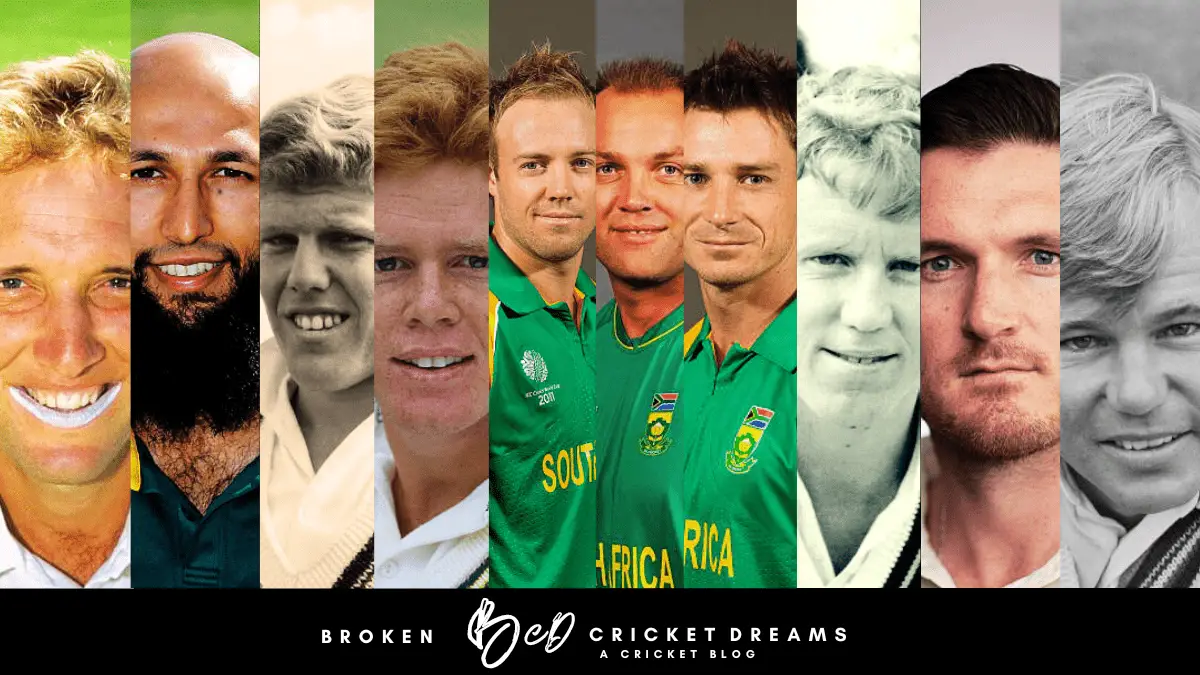
Some great players like Graeme Pollock, Barry Richards, Mike Procter, Clive Rice, Eddie Barlow, Jimmy Cook, Kepler Wessels, Peter Kirsten, David Richardson, Garth le Roux, Vincent van der Bijl, and Ken McEwan lost out on some or all of their careers in the isolation era.
Sources: ESPN Cricinfo’s All-Time XIs South Africa Edition
© Copyright @Nitesh Mathur and Broken Cricket Dreams, LLC 2023. Originally published on 02/18/2024. Unauthorized use and/or duplication of this material without express and written permission from this site’s author and/or owner is strictly prohibited. Excerpts and links may be used, provided that full and clear credit is given to Broken Cricket Dreams with appropriate and specific direction to the original content (i.e. linked to the exact post/article).
In 1918, US President Woodrow Wilson gave a speech in the US Congress that would be regarded as the “Fourteen Points.” It proposed potential resolutions to end the ‘Great War’ (World War I), outlined how the world could move towards peace and prevent future wars, and was a key factor during the Treaty of Versailles.
Now I know what you may be thinking. What kind of comparison is this? Cricket is not war!
It definitely isn’t, but we can all agree that cricket has its share of problems.
Two years ago, I wrote an article about 15 Problems that will plague cricket in the next decade. It’s time to provide actionable solutions and remedy some of those problems.
As much as we don’t like to talk about it, money is the center of most issues facing cricket.
Over the past year, I have worked on investigating approximately how much money it takes to host a Test match, why teams like New Zealand lose money, and learn about the economics of modern-day cricket. This includes:
Yesterday, the West Indies and England reminded us how special Test cricket truly is. The ebbs and flows, last day drama, the inspiration of an injured Shamar Joseph and Jack Leach fighting for their countries, the comeback of Tom Hartley, the camaraderie between the teams, and much, much more.
It reminded me why I started watching cricket in the first place, and I would love more of days like yesterday.
Hence, without further ado, here are my Fourteen Points to help preserve Test cricket, reduce the conflicts in the current cricketing calendar, and help fuel the growth of cricket in smaller nations.
A Test match fund shall be formed from ICC’s annual budget to support the endeavors of Test cricket around the world. This budget shall, at a minimum, include match fees (players, support staff, ground staff, umpires, administrators), minimum set of cameras to support the DRS (decision review system), miscellaneous finances (hotel, food, and travel), advertising & marketing costs, and all such costs which shall be deemed necessary and proper for carrying into execution a proper Test match. The distribution of the budget shall be approximately proportional to the number of Tests a cricketing nation hosts per year.
In 2015, the Test Match fund was pondered, where the ICC would offer $12.5 million to the non-Big 3 Test playing countries to support Test matches over a few years.
This idea, however, never materialized. In our research, we found that it takes anywhere from $350,000-$1.4 million to host just a single one Test match, which is often a burden on the smaller nations. If a team hosts 2 three-match Test series in a year, that could incur a cost ranging from $2 million-$8.5 million per year.
Even at the lower estimates, $2 million for 12 Test playing nations would cost the ICC about $24 million per year. That is a lot of money.
This will be a huge effort on the part of the ICC, which may require additional sponsorships, broadcast rights expansions, etc.
To start off this process, the ICC Test match fund could be piloted among the cricketing nations who are losing money to host a Test (ex: New Zealand, South Africa, Sri Lanka, West Indies, Pakistan, etc.).
“Unless the boards change the economic model, I don’t think Test cricket will thrive outside of the Big 3.”
– Johnny Grave, Cricket West Indies’ CEO
An adequate minimum Test match fees shall be established to players across all nations for both women’s & men’s Test cricket, the monetary value of which should be updated every two years based on inflation and market economics. Boards are free to provide additional bonuses to their players.
Currently, India pays its men’s Test players $18,800 per Test, Australia pays about $12,500-$17,725 USD per Test, and England pays its players around $17,600. On the other hand, a New Zealand men’s Test match fee is about $6,600 USD.
The ICC will need to setup a committee and decide what a decent minimum Test match fee is and then work with each of the cricket boards to split duties on minimum fees.
For example, if we decide that $ 17,600 (like England) is a good enough Test match fee and NZ cricket board are already paying their players $6,600, then the ICC would jump in and make up the deficit of $11,000 per Test per player. Hence, the Big 3 may not need support from the ICC (and will be allowed to pay their players bonuses on top of the minimum fee), but the ICC would need to help the other countries out.
Once again, we are asking ICC to bear a potentially high cost, but does the ICC even have this much money?
If not, how can they bring in more money? If this causes the ICC to host more World Cups and tournaments, then this will crowd the already crowded cricket calendar. We do not want to create more issues to solve one problem.
South Africa sending a second-string squad to New Zealand in favor of a strong domestic SA20 franchise tournament is now a well-documented phenomenon and caused reactions from several players like Steve Waugh.
“We’ve got to figure out a way for them [other countries] to be incentivized to play international and particularly Test cricket. That requires transparency from all cricket boards around the world to try to figure out how to pay the players the best way they can.”
– Usman Khawaja
“…Similarly to save Test wicket they should introduce standard match fee for all the boards, so that all players of Test cricket nations can have the same match fee.”
Mohammad Hafeez
Two Test match windows, one each for the Northern & Southern hemispheres respectively, shall be implemented for three months of the year.
A few people have suggested having 3-month window where only Test cricket is played. However, I think this is an incomplete solution since the Northern and Southern hemispheres have different seasons for cricket.
What could happen is from May-July, there should be a window to play Tests in England, West Indies, and the subcontinent nations while December-February should have a window for Test cricket in New Zealand, South Africa, and Australia. In these windows, we may simultaneously see the Ashes, Ind-SA Tests, and NZ-Pak Tests for example. So the focus of the fan base is solely on Test cricket.
Now we cannot stop franchise cricket for six months, so what can be done?
We can customize the window per nation. For example, when a country is hosting or touring for Test cricket within those two larger windows, they are not allowed to host a franchise league. This will help avoid clashes that we are seeing with South Africa and the SA20. On the flip side, leagues like the BBL can benefit because the BBL will have all their international players to choose from.
This will definitely cause backlash by the franchises because prime time will be taken away from them.
For example, this rule would mean The Hundred cannot be scheduled in the summer months when Test cricket takes priority. This is the time that students have vacations, the weather is decent, and there is time to spend with family. The broadcasters may also suffer due to lower television ratings.
A 3 month dedicated window for Test cricket every year for both the men & women’s teams is the only way to protect the greatest format .. no other cricket but Test around those 3 months .. the other 9 months for all the leagues ICC events .. 👍👍
— Michael Vaughan (@MichaelVaughan) January 20, 2024
The bilateral ODI series shall be abolished from the cricket calendar.
As simple as, no more bilateral ODI series.
Don’t worry, I am not advocating the ‘Death of ODI cricket’ or anything like that. We saw in the 2023 ODI World Cup that fans still enjoy ODI cricket albeit in a smaller dose. Removing ODI bilaterals will provide space in the calendar to accommodate Test cricket, franchise leagues, and qualification matches (more on this, a few sections later).
Loss of sponsorships and advertising revenues for host countries.
The bilateral T20I series shall be abolished from the cricket calendar.
Read point IV. Same as above.
This year, India will only have the 3-match T20I series against Afghanistan and the IPL to choose its players for the World Cup. The franchise tournaments will be enough to assess the player pool for T20 World Cups.
India does not allow their players to play in foreign leagues, so players will not have opportunities to improve and fight for their places in the World Cups.
Every four years, the league of Test nations shall assemble to play in a Test World Cup during the two 3-month Test windows. The top eight ranked teams shall compete, four winners proceed to a round-robin semi-final, and the Top 2 compete in the Best of 3 final series at a pre-determined venue.
Four 3-match series will occur for the Top 8 ranked teams during the first six months of the year in two different neutral countries (ex: Aus v WI (#1 v#8), Ind v SL (#2 v #7), Eng v Pak (#3 v #6), SA v NZ (#4 v #5)).
The four winners will then play 6 Tests in a round-robin format in the ‘Final Stage’ of this Test World Cup. The Top 2 teams will then play a 3-match series for the World Cup Final.
Note: During this Test World Cup year, regular bilateral Test series will not take place since this will take place during the Test windows.
The teams that did not qualify in the Top 8 or lost in the first stage may not play much Test cricket that year.
"The only effort that's been made to try to keep it relevant, I think has made it worse!" 📉@markbutcher72 believes the introduction of the World Test Championship has contributed to the decline of Test cricket.
— Wisden (@WisdenCricket) January 6, 2024
Listen: https://t.co/TM5IR1qWlC
Watch: https://t.co/2rbV1ybjQ3 pic.twitter.com/x7njEOHdE1
Relegation and Promotion shall be established in Test cricket that will feed into the Test Match World Cup. Teams will be promoted and relegated at the end of every two-year cycle.
The 12-Test playing nations will be divided into two brackets (#1-6 in Bracket A and #7-12 in Bracket B). At the end of each two-year league, the bottom two of Bracket A will be demoted to Bracket B and vice-versa.
The detailed rules are outlined here: Relegation & Promotion Proposal in World Test Championship. Each team will play 18 Tests and 5 series during this time (against each member of their bracket).
The top eight-teams (all 6 teams in Bracket A and top 2 of Bracket B) will compete in the Test World Cup.
Since we are proposing Test match windows, some windows may have too much Test cricket if that’s even possible.
The two-match Test series shall no longer be in existence. If for some reason, due to calendar conflicts, financial reasons, or unforeseen circumstances, there is only space for 15-20 days, then a three-match four-day Test series shall take place with the approval of the cricket boards of the interested parties.
If the Test match fund and calendar problems are solved with the above solutions, then there will not be a need for a 2-Test series (since teams will have enough money to host Tests).
However, if the situation arises that only 2-Tests are possible, then instead a 3-match 4-day Test series should take place. This will only add two days to the overall match time and maybe an additional week for the overall tour.
This could result in too many draws if multiple teams agree on this approach.
“I’m not sure whether it’s changing it to four-day Test matches, so you can have an extra day to make sure that you play that third Test match.”
– Faf du Plessis
The cricket boards will have to allocate their respective annual budgets to the betterment of domestic cricket. This includes, but is not limited to, advertising, recruiting, providing better facilities, etc. The ICC shall subsidize cricketing boards with a poor financial situation.
Franchise cricket is popular because the best players play in these leagues and sponsorship/TV revenue is high. On the other hand, County Cricket is shown on some YouTube channels, if at all.
The ICC should have a mandate to oversee that cricket boards are actively publicizing domestic cricket. This could be done by providing boards additional capital for domestic tournaments, having free to air channels, or by marketing domestic tournaments on social media channels.
This could take additional manpower and resource, which will increase the costs of all parties involved.
Each visiting team will be provided at least one practice match (for a 3-Test series) and two practice matches (for a series with 4 or more Tests). An impartial inspector from the ICC shall monitor practice pitches to ensure they are closely aligned with the pitches that the series will offer.
I have no problems with India coming up with rank turners or South Africa’s bounce troubling batters. I do, however, have a problem with multiple Tests finishing within two to three days and the lack of practice matches.
England have gone to India for a 5-match Test series without a practice match!
What should happen are at least 2 mandatory practice 4-day matches on pitches with similar conditions. If India plan on putting up rank turners, they need to make rank turners for these practice matches. If the series will have a variety of surfaces (for example, Dharamsala and Chennai), then the two practice matches need to have different surfaces. The ICC need to get involved as the impartial spectator to ensure consistency in pitches.
This could mean longer tours for visiting teams and time away from home.
The ODI & T20 World Cup qualification systems shall be revamped and the ODI Super League shall be revived. No country, with the exception of the host nation, will be guaranteed a place in an ICC tournament. The space provided by the abolishment of bilateral series will be replaced by qualifying rounds that feed into the ODI Super League and World Cup qualifications.
The ODI Super League shall be revived for the benefit of ‘Associate’ nations like the Netherlands and Scotland.
Unlike the first edition of the ODI Super League, the Super League will be divided into a few groups (for example, 18-team Super League with 3 groups of 6). Every few months, a country will hold a Qualification round to play some of the matches. After a couple of rotations, each team in the group have played against each other twice (at least 10 matches per team before the World Cup).
These matches will be all be a part of World Cup qualification. No additional friendly bilateral games.
Scheduling could be a problem with the various franchise leagues going around.
Each ICC World Cup tournament for both men’s & women’s cricket shall be held every four years, staggered by two years for the format. The Test World Cups will occur in the years there is no bilateral World Cups.
There are too many World Cups happening now. T20 World Cups in 2021 & 2022, an ODI World Cup in 2023, and another T20 WC coming up in 2024.
That’s an overkill. Rather, we can have ODI World Cups in 2027, 2031, 2035, etc. while T20 World Cups are hosted in 2029, 2033, 2037, etc. – also every four years. Then there will be space for the Test World Cup in 2028, 2032, 2036, etc.
This should also be implemented in the women’s game (One idea could be to stagger all 4 – 2027 Men’s ODI, 2028 WODI, 2029 – MT20, 2030 – WT20, etc.).
Players might retire earlier if they know they cannot make it to the next ICC tournament.
If a player is nationally contracted by their national cricket boards, they are limited to a maximum of three leagues (IPL, domestic league, and one other) per year or four leagues per year (if no IPL contract provided) or risk being fined their match fees. If a player does not have a national contract, they are not obligated to follow this limit.
We can come up with a compromise so that nationally contracted players can play a maximum of 3 leagues per year (including the IPL), any 4 leagues (if no IPL deals), and no restrictions if without a contract.
If Test windows and minimum Test match fees is implemented, then this should benefit both international cricket and the players themselves.
Players may not sign the national contract at all and be franchise freelancers if that benefits them in the long run.
The Indian Premier League (IPL) shall not expand beyond the three-month window it is currently provided. The franchises are free to invest in other leagues around the world and a one-month window will be allocated for an annual Champions League.
It is clear that IPL franchises are starting to own stakes in other leagues. In the past, the Champions League did not provide value because a single player would have conflicts over multiple franchise but end up playing for their IPL teams.
If the IPL team starts doing year long contracts (for example, the same player plays for MI, MI Cape Town, MI NY, etc.), then there shouldn’t be a conflict of interest as before.
For yet another competition to be in the cricket calendar, the IPL has to stop at the 10 teams, 3-month format. If the IPL is any longer, international cricket may cease to exist.
I was trying to write this article for a couple of weeks but for some reason, couldn’t find the words and ideas. But on a day where Shamar Joseph and Tom Hartley created history and Test cricket came to life, the idea just magically flowed through.
Much like Woodrow Wilson’s Fourteen points and the League of Nations (precursor to the United Nations), I fully expect the ICC to not pay attention to any of this and lead to major chasms in cricket in the coming years (much like the US themselves did not join the League of Nations, thereby weakened it, and ultimately were not able to prevent World War II).
This article may sound a bit quixotic in nature, but we have to start somewhere, don’t we? The world can only change if conversations begin.
The future of cricket is at stake. Will the ICC do something about it?
What are your thoughts? I want to know, comment below! How would you solve the problems that cricket faces today?
If you like reading about potential solutions to problems in cricket, do read the following:
© Copyright @Nitesh Mathur and Broken Cricket Dreams, LLC 2023. Originally published on 01/29/2024. Unauthorized use and/or duplication of this material without express and written permission from this site’s author and/or owner is strictly prohibited. Excerpts and links may be used, provided that full and clear credit is given to Broken Cricket Dreams with appropriate and specific direction to the original content (i.e. linked to the exact post/article).
What do Aristotle, Socrates, René Descartes, Swami Vivekananda, Bertrand Russell, Immanuel Kant, Confucius, Dostoevsky, Jean-Jacques Rosseau, and Ravichandran Ashwin have in common?
These are the names of some of the greatest thinkers and philosophers of all time.
They didn’t just exist! They thought outside the box. Questioned the status quo. Changed the world.
And yes, you may have noticed that I subtly slipped in Ravichandran Ashwin’s name in there. Why, you may ask?
Because Ravichandran Ashwin is more than your average cricketer. He is different. He is also a thinker and has transformed into one of the most influential cricketers of this generation.
As Ashwin gets closer to his monumental 500th wicket, we look at 11 Moments which illustrates how Ravichandran Ashwin has changed the way YOU think about cricket.
Let’s start with the elephant in the room—The non-strikers run-out or ‘Mankad’ as it was known in the pre-Ashwin era.
The most infamous moment was Ashwin vs Buttler. Watch the video below.
And if you are looking for more, here is another incident from 2012.
Ashwin’s involvement about the non-strikers run-out opened a conversation in cricket that was long overdue.
What do the laws of cricket say? Why does ‘Spirit of Cricket’ get selectively applied in this case? What can the bowlers do to gain advantage just like the batters when backing up?
There is still some way to go to desensitize the non-strikers run-out completely, but the bowlers are at least warning the batters more often (also a little bit of tension during the game is always fun).
Ashwin’s highest scores in Test cricket read: 124, 118, 113, 106, 103, 91*, 72, 70, 68, 67, 62, 61, 58, 58, 58, 56, 54, 50.
These are significant scores. Ashwin has scored plenty of hundreds against the West Indies (both home & away) and also has had key contributions in South Africa, Australia, England, Bangladesh, and Sri Lanka. That is serious pedigree.
After the 50 in tough conditions in Bangladesh, Dinesh Karthik described Ashwin as a ‘Scientist.’
“I call him a scientist. He keeps discovering new things about himself. Be it bowling or batting. That is very nice for a cricketer. And that is why – the talent he has, he has maximized it over the years.”
My favorite Ashwin batting innings was the chase in the 2nd Test against Bangladesh in 2022. Chasing a target of 145, India had collapsed to 74/7 with Mehidy Hasan Miraz bamboozling the Indian batting.
Then came in the duo of Shreyas Iyer & Ravichandran Ashwin, constructing a counterattacking rearguard effort. By the end of it, Ashwin had scored the highest score in a fourth innings chase by a batter at #9 or below (42*) and stitched together the highest 8th wicket partnership in a successful fourth innings chase (71*) with Iyer.
No wonder he climbed to the #1 spot in Test all-rounder ranking and ranks as one of the Best 55 All-Rounders of All-Time in our list.
It was the 2010 IPL that brought Ashwin into the national contention.
Playing under captain MS Dhoni, Ashwin began opening the bowling and keeping things tight in the Powerplays.
Remember in those days, spinners opening the bowling was still a rare instance. Even Sunil Narine would debut a year later.
Ashwin ended up with the best economy (6.10) in the competition (for anyone bowling more than 6 overs in the whole IPL), CSK won the IPL for the first time, which started what would become a famed legacy, the Dhoni-Ashwin partnership began, and Ashwin (and India) was on his way to a glorious golden eighteen months.
The golden age of Indian cricket in recent memory between 2007-2013 from the 2007 T20 World Cup to the 2013 Champions Trophy Final.
Oh yeah and there was the 2011 World Cup Final as well.
In a rain-curtailed low scoring Champions Trophy Final thriller, MS Dhoni in the most MS Dhoni fashion, handed the ball to Ravichandran Ashwin.
A six to win, four to tie. Wet conditions. Ashwin does a mini-pause, Tredwell starts to move, Ashwin spins the ball prodigiously.
A magnificent spell of 4-0-15-2 to drive India home in a famous victory.
Border-Gavaskar Trophy 2020-21. We are never forgetting this, are we?
Third Test Day 5. Series in the balance. Rahane departs early.
Rishabh Pant & Cheteshwar Pujara are full flow. Pant departs on 97, Hazlewood bowls a jaffa to Pujara, Vihari suffers a hamstring injury.
Surely Australia is cruising to victory here? Think again.
Ashwin & Vihari come together to put together one of the greatest rearguard actions in recent Test history.
Ashwin had already been suffering back pains. Now the fast bowlers were bowling bouncers and targeted his rib cage. He suffered but stayed in the game. By the end of the day, he was pulling short balls for four.
“Methods, madness, and courage” are characteristics that drive Ashwin. In his own words,
“There is a method to my madness. People ask, ‘What is he doing? Why is he trying so many different things. It is a matter of perception.”
One of the things that sets him apart is the ability to take risks and always try out something new.
He began his career as an off-spinner and when T20 cricket demanded, he opened the bowling.
As leg spinners gained prominence in the 2010s and Ashwin was dropped from the limited overs side in 2017, he knew he had to do something different.
He changed his action, experimented with delivery strides, added the carrom ball in his arsenal of weapons, and even developed the leg spinner.
Watch this video where explains his different variations to Ian Ward and how he bowled Alastair Cook with a beauty!
Ashwin has received a new lease of life with the Rajasthan Royals in the IPL. It jumpstarted his comeback into the Indian T20I side, but more than that, it is the manner in which has gone about his cricket at RR which is heartening to see.
In the 2022 IPL, he has helped finish games in the lower order, batted at #3, and has even opened the batting when situations demand it.
Once again we see a common theme—Ashwin continues to try new things to become a better version of himself every day.
If you think you have seen everything, think again.
Ashwin went one step further than changing his batting number around. He became the first player in the IPL to tactically retire himself out. He was batting on 28* (23), but at the end of the 19th over, he left the ground.
This provided specialist finishers, Riyan Parag and Shimron Hetmyer, the extra few balls to finish off the innings.
Ravichandran Ashwin has become such a cult figure for out-of-the-box tactics that after Rohit Sharma retired himself during the double Super Over against Afghanistan, coach Rahul Dravid said, “Rohit retiring himself out was Ashwin-level thinking.”
Now let’s come to one of the most iconic moments in recent memory.
An India vs Pakistan match to cherish. In the 19th over, Virat Kohli played the shot heard around the world against Haris Rauf.
India were getting closer, but Hardik Pandya departed. A few balls later, Virat Kohli was on the non-strikers end.
Then came time for the finisher from the Nidahas trophy final, Dinesh Karthik. His comeback story and career revamp as a finisher had led to this one moment. But he was stumped when Nawaz bowled a wide one near outside his leg.
Next ball, Ravichandran Ashwin is in. Nawaz attempts a similar delivery.
What does Ashwin do? HE LEAVES IT. I repeat, he leaves it! The audacity, brilliant! Wide ball called. Scores leveled.
Next ball, he just lifts the ball straight past the bowler for a four.
Calm, collected, champion. That is Ravi Ashwin for you.
The world is changing every day due to the internet and social media.
Cricket is also changing and players have to ensure they are planning for the future during their careers. We can already see the likes of Stuart Broad and Dinesh Karthik commentating before retirement. Others have put their hats into the coaching baskets.
Ashwin in his usual self, has done something slightly differently. He has started a YouTube channel! And not just any channel – the thoughtful interviews and Kutti stories have already garnered him 1.34 Million YouTube subscribers!
What is neat about this experience is the insights we are gaining from Ashwin about what happens inside the dressing room. The media is known for speculation and controversies, but Ashwin brings a more human, deeper side to the Indian cricket team. I hope more cricketers follow this path in the future.
Here is an interview series with Harsha Bhogle on India’s stories during ODI World Cups.
One characteristic I admire about Ravichandran Ashwin is his honesty and the ability to speak his mind regardless of the pressure.
We have already seen from a strategic point of view that he never backs down and keeps improving his skills.
Off the field as well, he doubles down on this personality trait. We can see from the press conference below (where he questions why journalists have a pre-determined view about Indian pitches) or the memorable sledge against Tim Paine that Ashwin will always be up for a fight.
Not many athletes have dual careers at the beginning of their careers. Ashwin graduated with a BTech degree.
Listen to Ashwin in his Cricbuzz interview about his journey:
“My dad used to wake me up at 5:30…My mom wanted me to be an engineer. And I did it, because I actually struggled through it. I actually slogged my entire sweat out to actually do engineering and cricket. It used to be extremely hard. And extremely hard is an understatement.”
Along with family pressure, he also suffered a pelvis injury, which kept him out of cricket for a year in his peak high school years.
As a society, we judge and admire individuals after success has been achieved, but it is often the stories behind the scenes that helps us understand the true character of the individual.
And finally, where there is cricket, there is Ashwin.
In modern-day cricket, there is barely any space for free time. There is always a World Cup, international cricket, or T20 leagues happening around the world.
But whenever Ashwin finds time, you can see him playing in the TNPL and other local matches.
Here is a hilarious clip of Ashwin reviewing a ball TWICE in the small ball because he was not satisfied with the discussion.
Classic Ashwin!
Ravichandran Ashwin pioneered the retired out, made non-strikers run-out cool again, finished clutch matches in Test cricket, opened the batting in T20 cricket, put the body on the line to fight for his country, bowled off spin, leg spin, carrom ball, won World Cup matches on his own, started a YouTube channel, and even took two reviews on the same ball!
Ravichandran Ashwin is not just a cricketer. He transcends human nature. A true genius, thinker, philosopher, and scientist.
I’m glad to have watched Ravichandran Ashwin’s career unfold.
If this is not a story we should all appreciate, I don’t know what is.
The page you requested could not be found. Try refining your search, or use the navigation above to locate the post.
The page you requested could not be found. Try refining your search, or use the navigation above to locate the post.
Today we will discuss the salary of a Bangladesh Premier League (BPL) player in the West Indies.
With the great Bangladesh generation of the Bangladesh comprising of Shakib, Tamim, Mahmudullah, Liton, and more—the BPL has generated lots of hype over the years.
However, there’s one question on every cricket fan’s mind: just how much do these players make?
Also Read: Why Shakib And Co are the True Fab 5 of this Era, Gentleman’s Game No More: Shakib Al Hasan & Ollie Robinson Highlight Larger Disciplinary Issue
| Category | Salary Amounts – $USD (BDT) |
| Category A | $72,897 (BDT 80 Lakh) |
| Category B | $45,561 (BDT 50 Lakh) |
| Category C | $27,337 (BDT 30 Lakh) |
| Category D | $18,224 (BDT 20 Lakh) |
| Category E | $13,668 (BDT 15 Lakh) |
| Category F | $9,112 (BDT 10 Lakh) |
| Category G | $4,556 (BDT 5 Lakh) |
Note: We use the conversion, $1 US Dollar = 109.77 Bangladeshi Taka (BDT) as of 1/18/2024.
| Category | Salary Amounts – $USD |
| Category A | $80,000 |
| Category B | $60,000 |
| Category C | $40,000 |
| Category D | $30,000 |
| Category E | $20,000 |
*The draft salary amounts include tax
Note: We have provided ranges because signings (both local & overseas) and retention/transfer amounts are not disclosed.
However, the minimum and maximum for player signings will align with the category table above. Hence, a local player signing can range from $4,556-$72,897 (5-80 Lakh BDT) and an overseas player signing can range from $20,000-$80,000.
The number of players in the BPL is also highly variable due to the clashes with the BBL, SA20, and ILT20 (so there are lots of replacements/players that will only play for a few games).
Also Read: What is the Salary of ILT20 player (International League T20) in the UAE?, What is the Salary of a SA20 player in South Africa?
Overseas Signings: Mohammad Haris, Najibullah Zadran, Mohammad Hasnain, Stephen Eskinazi, Bilal Khan
| Player | Category | Salary |
| Muhammad Waseem | C | $40,000 |
| Curtis Campher | D | $30,000 |
| Player | Category | Salary |
| Shuvagata Hom | D | $18,224 (BDT 20 Lakh) |
| Ziaur Rahman | D | $18,224 (BDT 20 Lakh) |
| Nihaduzzaman | D | $18,224 (BDT 20 Lakh) |
| Shohidul Islam | D | $18,224 (BDT 20 Lakh) |
| Tanzid Hasan Tamim | D | $18,224 (BDT 20 Lakh) |
| Al-Amin Hossain | C | $27,337 (BDT 30 Lakh) |
| Shykat Ali | D | $18,224 (BDT 20 Lakh) |
| Imranuzzaman | E | $13,668 (BDT 15 Lakh) |
| Shahadat Hossain Dipu | E | $13,668 (BDT 15 Lakh) |
| Salauddin Sakil | E | $13,668 (BDT 15 Lakh) |
Overseas Signings: Johnson Charles, Iftikhar Ahmed, Khushdil Shah, Mohammad Rizwan, Moeen Ali, Rakheem Cornwall, Sunil Narine, Rashid Khan, Andre Russell, Matthew Forde, Naseem Shah, Noor Ahmad, Zaman Khan
Local Signed/Retained Players: Liton Das, Towhid Hridoy, Mustafizur Rahman, Tanvir Islam
| Player | Category | Salary |
| Imrul Kayes | B | $45,561 (BDT 50 Lakh) |
| Jaker Ali | C | $27,337 (BDT 30 Lakh) |
| Mahidul Islam Ankon | D | $18,224 (BDT 20 Lakh) |
| Mrittunjoy Chowdhury | C | $27,337 (BDT 30 Lakh) |
| Rishad Hossain | E | $13,668 (BDT 15 Lakh) |
| Musfik Hasan | E | $13,668 (BDT 15 Lakh) |
Overseas Signings: Saim Ayub, Lahiru Samarakoon, Usman Qadir
Local Signings/Retentions: Mosaddek Hossain, Arafat Sunny, Shoriful Islam, Taskin Ahmed
| Player | Category | Salary |
| Sadeera Samarawickrama | C | $40,000 |
| Chaturanga de Silva | C | $40,000 |
| Player | Category | Salary |
| Irfan Sukkur | C | $27,337 (BDT 30 Lakh) |
| Mohammad Naim | C | $27,337 (BDT 30 Lakh) |
| Saif Hassan | C | $27,337 (BDT 30 Lakh) |
| Alauddin Babu | D | $18,224 (BDT 20 Lakh) |
| SM Meherob | G | $4,556 (BDT 5 Lakh) |
| Sabbir Hossain | E | $13,668 (BDT 15 Lakh) |
Overseas Signings: Fakhar Zaman, Ibrahim Zadran, Shoaib Malik, Paul Stirling, Abbas Afridi, Yannic Cariah, Mohammad Amir
Local Signings/Retentions: Tamim Iqbal, Mahmudullah, Mehidy Hasan Miraz
| Player | Category | Salary |
| Dunith Wellalage | C | $40,000 |
| Player | Category | Salary |
| Mushfiqur Rahim | A | $72,897 (BDT 80 Lakh) |
| Soumya Sarkar | D | $18,224 (BDT 20 Lakh) |
| Mohammad Saifuddin | C | $27,337 (BDT 30 Lakh) |
| Kamrul Islam | D | $18,224 (BDT 20 Lakh) |
| Khaled Ahmed | C | $27,337 (BDT 30 Lakh) |
| Rakibul Hasan | E | $13,668 (BDT 15 Lakh) |
| Pritom Kumar | E | $13,668 (BDT 15 Lakh) |
Overseas Signings: Evin Lewis, Dhananjaya de Silva, Faheem Ashraf, Mohammad Wasim
Local Signings/Retentions: Nahidul Islam, Nasum Ahmed
| Player | Category | Salary |
| Shai Hope | A | $80,000 |
| Dasun Shanaka | A | $80,000 |
| Kasun Rajitha | C | $40,000 |
| Player | Category | Salary |
| Akbar Ali | D | $18,224 (BDT 20 Lakh) |
| Anamul Haque | E | $13,668 (BDT 15 Lakh) |
| Mahmudul Hasan Joy | C | $27,337 (BDT 30 Lakh) |
| Parvez Hossain Emon | E | $13,668 (BDT 15 Lakh) |
| Afif Hossain | B | $45,561 (BDT 50 Lakh) |
| Mukidul Islam | C | $27,337 (BDT 30 Lakh) |
| Rubel Hossain | C | $27,337 (BDT 30 Lakh) |
| Habibur Rahman Sohan | E | $13,668 (BDT 15 Lakh) |
Overseas Signings: Babar Azam, Brandon King, Nicholas Pooran, Azmatullah Omarzai, Wanindu Hasaranga, Ihsanullah, Matheesha Pathirana, Yasir Mohammad
Local Signings/Retentions: Nurul Hasan, Mahedi Hasan, Hasan Mahmud
| Player | Category | Salary |
| Michael Rippon | C | $40,000 |
| Player | Category | Salary |
| Rony Taludkar | B | $45,561 (BDT 50 Lakh) |
| Fazle Mahmud | D | $18,224 (BDT 20 Lakh) |
| Hasan Murad | E | $13,668 (BDT 15 Lakh) |
| Shamim Hossain | C | $27,337 (BDT 30 Lakh) |
| Abu Haider | D | $18,224 (BDT 20 Lakh) |
| Ashiqur Zaman | G | $4,556 (BDT 5 Lakh) |
| Ripon Mondol | G | $4,556 (BDT 5 Lakh) |
Overseas Signings: Dushan Hemantha, Samit Patel, Richard Ngarava, George Scrimshaw
Local Signings/Retentions: Najmul Hossain Shanto, Zakir Hasan, Mashrafe Mortaza, Tanzim Hasan Sakib
| Player | Category | Salary |
| Ryan Burl | B | $60,000 |
| Harry Tector | E | $20,000 |
| Ben Cutting | D | $30,000 |
| Player | Category | Salary |
| Mohammad Mithun | C | $27,337 (BDT 30 Lakh) |
| Yasir Ali | C | $27,337 (BDT 30 Lakh) |
| Ariful Haque | D | $18,224 (BDT 20 Lakh) |
| Nayeem Hasan | C | $27,337 (BDT 30 Lakh) |
| Rejaur Rahman Raja | D | $18,224 (BDT 20 Lakh) |
| Shafiqul Islam | D | $18,224 (BDT 20 Lakh) |
| Jawad Mohammad Royen | E | $13,668 (BDT 15 Lakh) |
The theory of evolution by Charles Darwin revolves around the idea of ‘Survival of the Fittest.’
A decade ago, the Bangladesh Premier League was a decent league that attracted some talent from around the world.
Fast forward to 2024 with ILT20 & SA20 pairing with the IPL and paying their players loads of money, the BPL is not thriving. The mismanagement of the league, lack of DRS, discipline issues, and lack of availability does not help either.
Will the BPL survive? What do you think?
For other content on Finances in Cricket, do read:
Sources: BPL T20 PLAYERS’ DRAFT 2024 (youtube.com), BPL 2024 Player’s Draft Base Price
Image Courtesy: Canva.com
The average salary range of a Bangladesh Premier League (BPL) player is $20,472-$52,969. The estimated maximum salary cap for the entire BPL ranges from $2.6 million-$6.6 Million for about 127 players, divided among 7 teams.
No, the BPL is the 9th richest league in the world by player salaries (or the third poorest league) with the IPL still standing at #1.
Mushfiqur Rahim was the most expensive player in the 2024 Bangladesh Premier League (BPL) draft. He was the only category A player priced at 80 Lakh BDT ($72,897).
© Copyright @Nitesh Mathur and Broken Cricket Dreams, LLC 2023. Originally published on 01/18/2024. Unauthorized use and/or duplication of this material without express and written permission from this site’s author and/or owner is strictly prohibited. Excerpts and links may be used, provided that full and clear credit is given to Broken Cricket Dreams with appropriate and specific direction to the original content (i.e. linked to the exact post/article).
Today we will discuss the salary of International League T20 (ILT20) player in the UAE.
The league has generated enormous hype due to the salary they pay their players. Will this threaten to collapse the international cricket calendar.
How much do these players make? Can the ILT20 compete with the IPL?
The second season of the ILT20 will run from 19 January-17 February 2024 in the UAE. This time around, these matches have been granted official List A status. In any case, here are the wage slots for the 18-men squad in the ILT20 league.
| Wage Slots | Salary Amounts (Minimum) |
| Slot 1 | $340,000 |
| Slot 2 | $260,000 |
| Slot 3 | $220,000 |
| Slots 4-5 | $140,000 |
| Slot 6 | $100,000 |
| Slots 7-8 | $60,000 |
| Slots 9-10 | $40,000 |
| Slots 11-12 | $20,000 |
| Slots 13-18 | $10,000 |
Another reason the ILT20 has garnered interest is because of its overseas player limit. The ILT20 has instilled a limit of nine overseas players in the XI. This is much more extreme than the 4-5 we see in the other teams.
This is how the teams stack up:
*Mujeeb is banned from ILT20 for a season or two due to a breach in contract
Which team are you supporting?
Also Read: How Many Cricket Leagues Are There in the World?
Cricket is at a breaking point. We have said this time and time again.
We are now at an extremely crucial juncture in cricket’s history. Not only is international cricket competing with franchise leagues for a spot in the calendar, the T20 leagues themselves are at odds with each other.
The SA20, ILT20, BBL, BPL, and New Zealand’s Super Smash are all competing for top talent between December and February, after which the PSL and IPL take over. Which leagues will survive?
We do not know, but international cricket may not. Test cricket (outside of the Big 3), definitely, will not.
For other content on Finances in Cricket, do read:
The average salary of an International League T20 (ILT20) player is $138,888 (maximum 18 players in the squad with a maximum purse of $2.5 million).
No, the ILT20 is the second richest cricket league in the world after the Indian Premier League (IPL).
The ILT20 offered top players like David Warner up to $450,000 for the ILT20 competition.
© Copyright @Nitesh Mathur and Broken Cricket Dreams, LLC 2023. Originally published on 01/09/2023. Unauthorized use and/or duplication of this material without express and written permission from this site’s author and/or owner is strictly prohibited. Excerpts and links may be used, provided that full and clear credit is given to Broken Cricket Dreams with appropriate and specific direction to the original content (i.e. linked to the exact post/article).
Today we will discuss the salary of a SA20 player in South Africa.
After years of failing to develop a T20 league, it looks like South Africa finally have a competition that will survive (with the help of the IPL franchises, of course).
However, with Test match tour to NZ being deprioritized due to SA20, there is one question in everyone’s mind: just how much do these players make?
*Note: The amounts shown below are average auction prices. Since pre-auction signing salaries are undisclosed, some of those players are probably earning much higher amounts since the average salary of a SA20 player is $110,000.
Also, the wildcard picks have a minimum salary of R. 175,000, but this can be outside the salary purse.
| SA20 Team | Average Auction Salary Amounts |
| Durban Super Giants | $86,550 |
| Joburg Super Kings | $98,640 |
| MI Cape Town | $63,270 |
| Paarl Royals | $71,620 |
| Pretoria Capitals | $95,200 |
| Sunrisers Eastern Cape | $106,030 |
We use the conversion, $1 USD = 18.69 South African Rand (as of 1/7/2024)
Now we summarize the salaries for each team based on both the 2023 SA20 Auction as well as the 2024 mini-auction.
If you’re interested in learning about the 2023 major auction as it happened, check this article on the Key Takeaways from the 2023 SA20 Auction.
Note: For replacements, we show the price the original player was auctioned for.
Total Number of Squad Players: 18
Pre-Auction Picks: Quinton de Kock, Kyle Mayers, Reece Topley, Prenelan Subrayen, Naveen-ul-Haq, Bhanuka Rajapaksa
Wildcard: Nicholas Pooran
| Player | SA20 Salary (in South Africa Rands) | SA20 Salary (in USD $) |
| Keshav Maharaj | R. 2,500,000 | $134,000 |
| Heinrich Klaasen | R. 4,500,000 | $240,000 |
| Matthew Breetzke | R. 175,000 | $9,400 |
| Keshav Maharaj | R. 2,500,000 | $134,000 |
| Wiaan Mulder | R. 1,900,000 | $102,000 |
| JJ Smuts | R. 2,300,000 | $123,000 |
| Dwaine Pretorius | R. 4,100,000 | $219,000 |
| Keemo Paul | R. 850,000 | $45,000 |
| Tony de Zorzi* (replaced Kyle Abbott) | R. 175,000 | $9,400 |
| Junior Dala | R. 175,000 | $9,400 |
| Jason Smith | R. 175,000 | $9,400 |
| Bryce Parsons | R. 75,000 | $4,000 |
Total Number of Squad Players: 19
Pre-Auction Picks: Faf du Plessis, Gerald Coetzee, Moeen Ali, David Wiese, Sam Cook, Zahir Khan, Romario Shepherd
Wildcard: Imran Tahir, Kyle Simmonds* (replaces Aaron Phangiso, who was the 2023 wildcard)
| Player | SA20 Salary (in South African Rands) | SA20 Salary (in USD $) |
| Reeza Hendricks | R. 4,500,000 | $240,000 |
| Donovan Ferreira | R. 5,500,000 | $294,000 |
| Leus Du Plooy | R. 1,500,000 | $80,000 |
| Nandre Burger | R. 175,000 | $9,400 |
| Wayne Madsen | R. 850,000 | $45,000 |
| Lizaad Williams | R. 325,000 | $17,400 |
| Sibonelo Makhanya* (replaces Harry Brook) | R. 2,100,000 | $112,000 |
| Dayyaan Galiem | R. 1,600,000 | $86,000 |
| Ronan Hermann | R. 75,000 | $4,000 |
Total Number of Squad Players: 19
Pre-Auction Picks: Kagiso Rabada, Dewald Brevis, Sam Curran, Liam Livingstone, Rashid Khan* (Kieron Pollard will replace him), Tom Banton
Wildcard: Jofra Archer* (Nuwan Thushara replaces Archer)
| Player | SA20 Salary (in South African Rands) | SA20 Salary (in USD $) |
| Rassie van der Dussen | R. 3,900,000 | $209,000 |
| Ryan Rickelton | R. 1,000,000 | $53,500 |
| Grant Roelofsen | R. 175,000 | $9,400 |
| Delano Potgieter | R. 175,000 | $9,400 |
| Olly Stone | R. 850,000 | $45,000 |
| George Linde | R. 3,900,000 | $209,000 |
| Beuran Hendricks | R. 275,000 | $14,700 |
| Duan Jansen | R. 3,300,000 | $177,000 |
| Christopher Benjamin | R. 175,000 | $9,400 |
| Neelan van Heerden | R. 175,000 | $9,400 |
| Thomas Kaber | R. 175,000 | $9,400 |
| Connor Esterhuizen | R. 75,000 | $4,000 |
Total Number of Squad Players: 19
Pre-Auction Picks: David Miller, Jos Buttler, Obed McCoy, Kwena Maphaka
Wildcard: Fabian Allen, Andile Phehlukwayo (2023)
| Player | SA20 Salary (in South African Rands) | SA20 Salary (in USD $) |
| Jason Roy | R. 1,500,000 | $80,000 |
| Wihan Lubbe | R. 350,000 | $18,700 |
| Mitchell van Buuren | R. 175,000 | $9,400 |
| Dane Vilas | R. 3,300,000 | $177,000 |
| Lungi Ngidi | R. 3,400,000 | $182,000 |
| Tabraiz Shamsi | R. 4,300,000 | $230,000 |
| John Turner | R. 425,000 | $22,700 |
| Lorcan Tucker | R. 175,000 | $9,400 |
| Ferisco Adams | R. 325,000 | $17,400 |
| Evan Jones | R. 1,700,000 | $91,000 |
| Bjorn Fortuin | R. 1,500,000 | $80,000 |
| Codi Yusuf | R. 175,000 | $9,400 |
| Lhuan-dre Pretorius | R. 75,000 | $4,000 |
Total Number of Squad Players: 18
Pre-Auction Picks: Migael Pretorius, Anrich Nortje, Jimmy Neesham, Corbin Bosch (Paarl Royals earlier), Colin Ingram* (signed as replacement in 2023)
Wildcard: Phil Salt, Senuran Muthusamy (2023)
| Player | SA20 Salary (in South African Rands) | SA20 Salary (in USD $) |
| Eathan Bosch | R. 175,000 | $9,400 |
| Wayne Parnell | R. 5,600,000 | $300,000 |
| Rilee Rossouw | R. 6,900,000 | $370,000 |
| Will Jacks | R. 1,100,000 | $59,000 |
| Kyle Verreynne | R. 175,000 | $9,400 |
| Theunis de Bruyn | R. 1,000,000 | $53,500 |
| Shane Dadswell | R. 175,000 | $9,400 |
| Paul Stirling | R. 425,000 | $22,700 |
| Adil Rashid | R. 2,400,000 | $128,000 |
| Matthew Boast | R. 1,600,000 | $86,000 |
| Daryn Dupavillion | R. 1,700,000 | $91,000 |
| Steve Stolk | R. 75,000 | $4,000 |
Total Number of Squad Players: 18
Pre-Auction Picks: Aiden Markram, Ottniel Baartman, Dawid Malan, Liam Dawson
Wildcard: Craig Overton, Jordan Hermann (2023)
| Player | SA20 Salary (in South African Rands) | SA20 Salary (in USD $) |
| Temba Bavuma (replaces Tom Abell) | R. 850,000 | $45,000 |
| Tristan Stubbs | R. 9,200,000 | $492,000 |
| Sarel Erwee | R. 175,000 | $9,400 |
| Adam Rossington | R. 425,000 | $22,700 |
| Marco Jansen | R. 6,100,000 | $326,000 |
| Sisanda Magala | R. 5,400,000 | $289,000 |
| Brydon Carse | R. 425,000 | $22,700 |
| Simon Harmer | R. 200,000 | $10,700 |
| Ayabulela Gqamane | R. 175,000 | $9,400 |
| Caleb Seleka | R. 175,000 | $9,400 |
| Beyers Swanepoel | R. 600,000 | $32,000 |
| Andile Simelane | R. 75,000 | $4,000 |
2024 is the year where international cricket calendar might finally crash.
The inaugural seasons of SA20, ILT20, and MLC were all a huge season. Now, there is virtually no open space in the international calendar.
The SA20, with its backing from the IPL franchises, will ensure South African cricketers make a decent living, but it may come at the expense of international cricket.
Is it worth it? Can the leagues and international cricket co-exist? What is the solution?
So many questions. What do you say? Comment Below! For now, we can go and enjoy good cricket in the SA20.
For other content on Finances in Cricket, do read:
For other content on South African read, check these out:
The average salary for a SA20 player is about $110,000. Teams had a salary purse of 39.1 Million Rands or $2.09 Million for a maximum of 19 players in their squads. 
No, the Indian Premier League (IPL) is the richest cricket league in the world. The SA20 (South African T20 League) is the 3rd richest league by average player salaries.
Tristan Stubbs (R. 9,200,000 or $492,000) is the most expensive player in the SA20 competition.
© Copyright @Nitesh Mathur and Broken Cricket Dreams, LLC 2023. Originally published on 12/16/2023. Unauthorized use and/or duplication of this material without express and written permission from this site’s author and/or owner is strictly prohibited. Excerpts and links may be used, provided that full and clear credit is given to Broken Cricket Dreams with appropriate and specific direction to the original content (i.e. linked to the exact post/article).