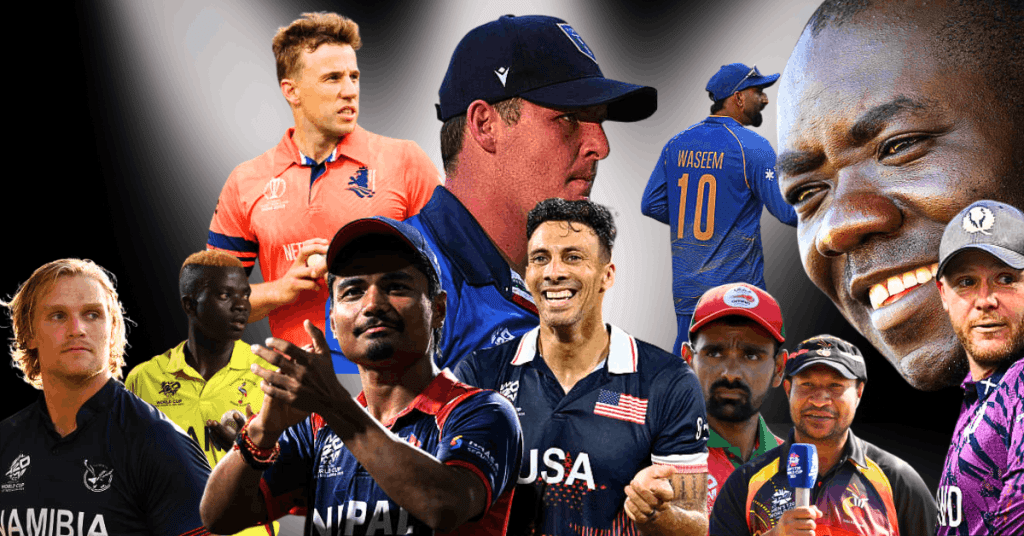
Toss: Netherlands won the toss and chose to bat first.
Venue: Zayed Cricket Stadium, Abu Dhabi
Umpires: Marais Erasmus & Rod Tucker
What Actually Happened
Winner: Ireland won by 7 wickets
Scores: Netherlands 106/10 – Ireland 107/3
Player of the Match: Curtis Campher
Best Figures
Curtis Campher – 4/26 (& Mark Adair 4-0-9-3)
Fred Klassen – 1/18
Most Runs
Max O’Dowd – 51(47)
Gareth Delany – 44 (29)
Moments of The Day: Ireland Medium Pacers, Top Order Give Them First Victory in T20 World Cup Over Netherlands
Curtis Campher’s historic 4 in 4rules the day for Ireland. Netherlands were nudging along nicely at 51/2 with Max O’Dowd stabilizing the innings. Then came the young all-rounder. Caught behind, LBW, LBW, bowled. Ackerman, Ryan Ten Doeschate, Scott Edwards, Roelof van der Merwe. Netherlands 51/6. Campher joins Rashid Khan & Lasith Malinga. Second T20 World Cup hat-trick after Brett Lee in the inaugural 2007 T20 WC.
Mark Adair restricts Netherlands – History repeats itself, or does it? The day before Ireland were at a similar position before coming back to score 140. At 88-6 with Max O’Dowd still there, anything could have happened. Not to be though after Adair took his wicket and ended with miserly figures of 4-0-9-3.
Paul Stirling, Gareth Delany finish it off. Stirling’s uncharacteristic 30* (39) ensured no collapses for Ireland. However it was Delany’s 44* (29) with 5 fours and 2 sixes that made sure Ireland win with a comfortable net run rate.
Broken Cricket Dream of the Day: RTD and RVDM
Ryan Ten Doeschate and Roelof Van der Merwe, Dutch legends, came back to the international squad for this World Cup after employing their trades in T20 cricket and County cricket for a few years. However, the rustiness was apparent as they were victims of the 4 in 4.
Is it 4 in 4 or a double hat-trick? Have your say? Lots of debate yesterday.
Why is 4 wickets in 4 balls being called a double hat trick? Last I looked a hat trick is 3 in 3. So double that is 6 in 6. You don’t get a double hundred if you score 101
No need to go elsewhere for the Points Table, Highest Run Scorer, Highest Wicket Taker, Most Catches, and Most Dismissals. We will keep updating it in every article!
Jatinder Singh – 73* runs (Oman, 1 Match)
Zeeshan Mahmood – 4 wickets (Oman, 1 Match)
Calum MacLeod (Scotland, 1 Match) – 3 catches
Zane Green (Namibia, 1 Match), Neil Rock (Ireland, 1 Match) – 1 dismissal
Group A Table
Teams
Played
Won
Lost
Tied No-Result
Points
Net Run Rate
1. Sri Lanka
1
1
0
0
2
+ 2.607
2. Ireland
1
1
0
0
2
+ 1.755
3. Netherlands
1
0
1
0
0
– 1.755
4. Namibia
1
0
1
0
0
– 2.607
T20 World Cup 2021 Points Table
Also, if you have not yet read our T20 World Cup Previews, here is a list of all of them! Check them out and share ahead:
Image Courtesy: Graphic (original work), Kyle Coetzer – Photo by Francois Nel-ICC/ICC via Getty Images, Mahmudullah – Photo by Mike Hewitt-ICC/ICC via Getty Images
IPL is done, international cricket is back, and so is #BCDPredictions! Let us see how good the predictions of our fellow cricket fans on social media is.
We asked our viewers to respond with
#Winner
#Top4
#BestAssociates
#PlayerofWC
#MostRuns
#MostWickets
#BestCatch
#Surprise
#BrokenDream
So what do you say? Will we see any surprises? Are South Africa, Bangladesh, Afghanistan the dark horses for the tournament? How about rising Scotland? Any emerging players? Will we miss Faf, Tahir, Morris, Chahal, Narine, and more?
If you do not have enough information yet to do the predictions, check out these previews below.
#MostRuns: Buttler (may not be an Indian, cannot rule QDK too)
Discussion:
“…With Neesham, Boult, Lockie, Phillips, Kane, Jamieson all playing IPL advantage for them and not Pak…Guptill, Seifert, Kane, Conway, Phillips, Neesham, Santner, Sodhi/Southee, Boult, Ferguson, Kyle.”
“Babar, Rizwan out for less then 20 runs, then Pak may lose 99% if against NZ and India if chasing 170…For India, even after Rahul, Kohli, Pant Surya, Hardik, Jadeja, Shardul are there.”
“I feel having times like SA, Aus, WI, Eng in same group made Group B easy to qualify.”
Rohit-Rahul/Babar-Rizwan most settled opening pair
Toss: Bangladesh won the toss and chose to field first.
Venue: Al Amerat Cricket Ground, Muscat
Umpires: Ahsan Raza & Richard Kettleborough
What Actually Happened
Winner: Scotland won by 6 runs
Scores: Scotland140/9 – Bangladesh 134/7
Player of the Match: Chris Greaves
Best Figures
Mahedi Hasan – 3/19
Brad Wheal – 3/24
Most Runs
Chris Graves – 45 (28)
Mushfiqur Rahim – 38 (36)
Moments of The Day: Bangladesh’s Spinners, Chris Greaves, and MacLeod’s Catching Makes It Scotland’s Day
Bangladesh Spinners Turn The Screws – George Munsey and Matthew Cross had taken Scotland up to 45/1 in 7 overs after the early wicket of their captain. Within the next 5 overs, Bangladesh took full control with the Mahedi Hasan-Shakib al Hasan duo. Scotland
Chris Greaves and Mark Watts Manifest Recovery of the Ages – Switch hits, smart running, and with proper cricketing shots, the Greaves-Watts partnership of 51 (34) gave Scotland belief. Watts departed by Greaves continued on his merry way to 45. Add Safyaan Sharif’s 8* (2) including a mighty six, Scotland got much needed momentum.
Calum MacLeod Catches Three Out of Thin Air – Although tight all-round bowling was the reason Bangladesh could not chase the score, equally as important was Calum MacLeod’s role as a boundary rider. Important catches of Shakib, Mahmudullah, and Nurul Hasan was the difference between a win or loss. One drop, and Bangladesh close that six run margin. However, MacLeod’s brilliance made sure that did not happen.
Honorable Mention: There Is Swing at the T20 World Cup! Taskin, Saifuddin, Brad Wheal, & Josh Davey all found some hints of swing
Broken Cricket Dream of the Day: The Musfiq-Shakib Partnership
Mushfiqur Rahim has been one of the best wicketkeeper-batters over the past decade, and Shakib Al Hasan is undoubtedly one of the greatest all-rounders of all time (and now the highest wicket taker in T20Is). However, today’s loss might be attributed to their slow partnership – 47 (46) recovery was done, but could not carry on. 38 (36) & a painful 20 (28) does not do justice to their talents and experience.
No need to go elsewhere for the Points Table, Highest Run Scorer, Highest Wicket Taker, Most Catches, and Most Dismissals. We will keep updating it in every article!
Jatinder Singh – 73* runs (Oman, 1 Match)
Zeeshan Mahmood – 4 wickets (Oman, 1 Match)
Calum MacLeod (Scotland, 1 Match) – 3 catches
Group B Table
Teams
Played
Won
Lost
Tied No-Result
Points
Net Run Rate
1. Oman
1
1
0
0
2
+ 3.135
2. Scotland
1
1
0
0
2
+ 0.300
3. Bangladesh
1
0
1
0
0
– 0.300
4. Papua New Guinea
1
0
1
0
0
– 3.135
T20 World Cup 2021 Points Table
Also, if you have not yet read our T20 World Cup Previews, here is a list of all of them! Check them out and share ahead:
Image Courtesy: Graphic (original work), Kyle Coetzer – Photo by Francois Nel-ICC/ICC via Getty Images, Mahmudullah – Photo by Mike Hewitt-ICC/ICC via Getty Images
Moments of The Day: Amini-Vala’s Fluency, Maqsood’s Over, and the Ilyas-Jatinder Show
Bilal Khan, Kaleemullah set the tone for Oman. PNG never really recovered from the maiden wicket over & the 1-run wicket over. Tony Ura & Lega Siaka were both bowled for ducks.
Assad Vala & Charles Amini turn it on for PNG. Left-arm batters are a joy to watch. Put two of them together, and it is even better. Captain Vala and Amini regularly danced down the track and hit lofted shots to muster a 81 (60) partnership.
Then a W, 1, W, 0, W, 0 over by opposing captain Maqsood caused a collapse from which PNG never recovered.
Honorable Mention: 131-run partnership from Aqib Ilyas (50*) and Jatinder Singh (73*) as Oman coasted to victory; Jatinder Singh does the Shibhar Dhawan ‘Gabbar; celebration after a catch.
Broken Cricket Dream of the Day: The Run Out
PNG had recovered from 0/2 and were coasting at 81/2. Then came the hara-kiri moment—ran from the non-striker’s end a, Nadeem picked the ball, and direct hit. Amini was looking so good…as
Tweets of the Day
Despite not having the best days on the field, it was a huge moment for Papua New Guinea nevertheless. Here are some tweets and threads that made this day special for the players and the fans in the backdrop of the beautiful mountains behind Oman’s stadium.
PNG support staff in tears during their national anthem. It's the tears of reaching to this stage after such hardwork, cricket is a beautiful sport. pic.twitter.com/TfJfV46n7t
The World Cup is about to start. And that means the latest nation will be joining. Papua New Guinea.
You will hear them being referred to as a family a lot. And compared to other cricket teams they certainly feel more like a family than a collection of athletes.
Today is the first day of the Cricket World Cup and in a COVID-induced twist of events, it's kicking off in Muscat, Oman
Having cut my teeth playing on cement & sand for the national junior team a decade+ ago, feels surreal to watch cricket in a beautiful stadium in Oman on ESPN pic.twitter.com/v0S44pFwzf
No need to go elsewhere for the Points Table, Highest Run Scorer, Highest Wicket Taker, Most Catches, and Most Dismissals. We will keep updating it in every article!
Jatinder Singh – 73* runs (Oman, 1 Match)
Zeeshan Mahmood – 4 wickets (Oman, 1 Match)
Jatinder Singh (Oman), George Munsey (Scotland) – 2 catches
Group B Table
Teams
Played
Won
Lost
Tied No-Result
Points
Net Run Rate
1. Oman
1
1
0
0
2
+ 3.135
2. Papua New Guinea
1
0
1
0
0
– 3.135
2. Bangladesh
4. Scotland
T20 World Cup 2021 Points Table
Also, if you have not yet read our T20 World Cup Previews, here is a list of all of them! Check them out and share ahead:
At the end of a close series, Australia marched ahead in the multi-series with 4 wins & 11 points, while India languished at just 5 points, with 1 win.
India have closed gaps in all formats, but Australia are still one step ahead. Without further ado, here are some highlights from this series—Scorecards, Stats, Summaries, and Awards.
India saw lots of Beth Mooney. A constant source of runs for the Australian team. With scores of 59 (tour match), 125* & 52 (ODI), 34 & 61 (T20I), she was the highest run scorer across the three formats. Mooney, who had replaced Rachael Haynes in the T20I squad, has now risen to #1 ranking. Her best innings came in the 2nd ODI, taking Australia from 52/4 in the 16th over to 275/5 on the last ball. She stitched two partnerships—126 (137) with McGrath & 97* (71) with Nicola Carey.
Tahlia McGrath & Darcie Brown were the finds of the series for Australia.
McGrath was an all-round package with contributions of 74 & 3/45, 47 & 1/46 (ODI), 28 (Test), and 42* & 44* to finish things off in the T20Is.
Darcie Brown set the tone for Australia in the first ODI. With Perry not back at her best with the ball, Brown took responsibility with a match-winning 4/33 in only her 2nd ODI, limiting India to 225. Hannah Darlington, the debutant also chipped in with a couple of wickets.
The series cannot be summarized without the contributions of Sophie Molineux. She was consistently among the wickets and stifled India’s run rate in the middle overs, taking 11 wickets in total. The most courageous moment of the series came in the 3rd ODI when Molineux got hit in the lip and started bleeding. She went off the field, but came back with her face bandaged to finish her quota of overs. However, it could not prevent the end of the streak.
Jhulan Goswami might be coming to the end of her career, but she still has what it takes at the international level. In the first ODI, she scored 20 to get India to a respectable total of 225 after a brief collapse. In the 2nd ODI, her batting again came at the fore with 28* but was at the receiving end of an umpiring no-ball call which resulted in Australia’s last ball victory. Joy and sorrow within minutes. Redemption soon followed in the 3rd ODI with a player-of-the-match performance—3/37 & 8* with a last-ball six. For her all-round performance, Elyse Villani on commentary started #JusticeForJhulan to get Goswami to play T20 cricket.
Mandhana & Rodrigues came back in style after doubts on their ability. Mandhana’s 127 in the Test match and 52 in the T20I reinforced her class after a lean season. Jemimah Rodrigues was the story of The Hundred as the 2nd highest scorer with 249 runs, 3 50s, and the best innings of the tournament with that 92*. She continued her form in the T20I, scoring 49* in a rain-effected game.
With Jemimah out of the ODI side, debutant Yastika Bhatia grabbed her opportunity with scores of 35 & 64 in the ODIs. Her fluency and promotion at #3 meant India did not miss Jemimah or inured Harmanpreet Kaur much. Good foil for stalwart Mithali Raj.
Awards
Australia Women
India Women
Emerging Player
Georgia Wareham
Yastika Bhatia
Surprise Package
Tahlia McGrath
Pooja Vastrakar
Broken Cricket Dream
Australia’s Record ODI Streak Breaks
Jhulan-Mithali’s Final Test Match?
Australia Women Vs India Women 2021 Series Awards
Where Do They Go From Here?
The much awaited ODI World Cup will commence in March 2022. Australia plays its first match against arch-rivals England on March 4th, while India begin their journey on the 5th. Here is the detailed schedule.
So what did I think of the series?
Do not go by the scoreline, but it was much closer than expected. In each match, India competed most of the game, either falling narrowly or just before the end. In the Tests, India actually dominated (if only for a 5th Day…).
However there is still a long way to go. In parallel to men’s cricket, this era of Indian-Australian rivalry resembles the early 2000s. Australia are at the top of the world across formats & have just completed a famous streak. India have a new fanbase with good shows in the recent World Cups. Their best show can defeat any team on their day, but it might still take a decade to establish a decent bench strength like Australia.
Imagine it is the 1940s. You are working at Bell Labs, one of the world’s premier research laboratories, an abode of inventions. Computers are at the beginning of their evolution, and programming still occurs on punched cards.
You work day and night in the week, and guess what? One error in the code and the program stops. Hard work down the drain. On the bright side, the machine detects and warns you that there is an error.
So as a brilliant scientist who has been a part of the Manhattan Project, what do you do? You work nights & weekends and develop an algorithm so that the machine can itself correct the errors, without the need for human intervention.
The year is 1950. You have published this paper and revolutionized computer science & information theory.
Now fast forward to the 2004. You are playing for the Indian national cricket team, one of the world’s premier cricketing nations, an abode of talent. Wicketkeeper batters are at the beginning of their evolution, and finishing limited over games is still at its infancy.
You work day and night on tours, and guess what? One poor series, and the selectors drop you. Hard work down the drain. On the bright side, selectors warn you that you have to play a different role in order to come back.
So as a budding young cricketer who has been a part of the 2004 U-19 World Cup, what do you do? You practice day in and day out, improve your technical faults, and comeback as a successful opener in swinging conditions to help India win a series in England in 2007.
A few months go by. Inconsistency creeps in. Dropped.
Lather, rinse, repeat.
The year is 2021. You have claimed your fame to glory in that Nidahas Trophy final and revolutionized the role of a finisher.
Your name is Karthik, Dinesh Karthik.
…
Dinesh Karthik’s story is not in the career averages or amount of runs scored. Neither is it in number of comebacks. It is in the way the comebacks were constructed. Over the years, inconsistency has decreased, reassurance has increased, and in his own words, he has managed to stay ‘relevant.’
In simple terms, he has perfected the art of self-correction.
Dinesh Karthik’s Initialization
Algorithms have improved vastly since the Hamming code days. Yet, there are three main components of a self-correcting algorithm: Initialization, self-calibration, and error correction.
Under-19 Days
On the back of good domestic form, Dinesh Karthik was selected for the 2004 U-19 World Cup. This team included future Indian nationals in Robin Uthappa, Suresh Raina, Shikhar Dhawan, Ambati Rayudu, and RP Singh. Following a decent domestic and India A season, he found himself in the national reckoning alongside Parthiv Patel as India were trying to find a permanent replacement to makeshift keeper in Rahul Dravid.
He would not bat in an ODI for another two years, but was picked for Tests against Australia, South Africa, Bangladesh, Pakistan, and Zimbabwe. After having a top score of only 46 in his first six Tests, he finally made a mark scoring 93 in the second innings against Pakistan. However, a loss of form and Dhoni’s memorable 148 at #3 in that Pakistan ODI series meant Karthik was briefly dropped from the Test side and traveled only as a reserve keeper for the next year.
One of the interesting traits of Karthik’s unusual career has been that when he is dropped in Tests, he finds a place in ODIs and vice versa. Later in his career, he was recalled in ODI & Test cricket based on his T20 form.
Case and point is 2006. Karthik enjoyed a good run in the limited overs although he was out of the Test side.
Although he would not get a game in the ODI World Cup, he played as a pure batter in the inaugural T20 World Cup with Dhoni behind the stumps. Low scores followed in the T20 World Cup, but he provided India with a bit of magic in the semi-final—a one handed diving catch to dismiss Graeme Smith.
Nasser Hussain on commentary summed up Dinesh Karthik’s entire career accurately in one sentence
“They say Dinesh Karthik is the two extremes—he drops dollies and he takes some spectacular catches.”
Error Correction Part I: Karthik’s Golden Year in Test Cricket
The year 2007 was DK’s best time in Test cricket.
By this time, it was clear that he could not make the XI based on his keeping skills alone. The Fab 4’s presence meant that the middle order was crowded. However, Sehwag & Gambhir had been dropped, which meant there was a slight opening.
Enter Dinesh Karthik 2.0—the opener. With Wasim Jaffer, he formed a brief yet formidable partnership.
In the third Test at Cape Town, the Jaffer-Karthik experiment paid dividend with a 153-opening partnership in the first innings. Karthik scored 63 as an opener and followed it up with 38* at #7.
In the tour of Bangladesh, he was given a permanent opening spot and returned with scores of 56, 22, and 129, his only Test century. Then, came India’s tour of England. Despite not scoring a hundred, scores of 60, 77, & 91 meantthat he ended up as India’s highest Test scorer—263 runs, 3 fifties, 518 balls faced to go along Jaffer’s 409 balls, which helped India successfully dent the new ball.
“It’s good story Dinesh Karthik. He began life as a dashing middle order batsman and wicketkeeper, and he has been transformed really into an opening batsman of substance.”
India historically won 1-0, India’s first victory on English soil in 21 years (a decade of horror shows the significance of that series victory).
Pushed back to the middle order after just 2 more Tests, he could only muster 157 runs in 11 innings with a best of 52 against Pakistan, Sri Lanka, and New Zealand. He would get another opportunity in Tests in 2010 before being dropped for another eight years.
On his come back against Afghanistan’s inaugural Test in 2018, he himself said in a press conference that in his earlier stint in Test cricket,
“I guess I wasn’t good enough before… I was not consistent enough.”
When he was out of favor in Tests in 2008, he did receive several opportunities in ODIs, scoring a few middling scores and featuring in India’s 2009 Champions Trophy squad. His best ODI innings of 79 runs came in 2010 with a 196-run partnership with Sachin Tendulkar during his historic double century.
14 innings later, with only 1 50+ score & 2 ducks, he was dropped—this time for three years.
Error Correction Part II: Dinesh Karthik, Journey To The Center Again
More competition, more errors, longer time to fix. Enter Dinesh Karthik 3.0—the middle order batter.
It took a 3-year hiatus before Karthik stormed back. In IPL 2013 as the #3 batter for Mumbai Indians, he amassed 510 runs, only behind Rohit Sharma for MI. The innings where his highest score that season of 86 was possibly his best IPL innings (so far).
This performance earned him a ticket on the 2013 Champions Trophy and his best ‘List A’ moment came in the warm-up games, when he scored two back to back centuries, scoring 106* & 146* batting at #6. This tournament is fondly remembered for the beginning of the Shikhar Dhawan-Rohit Sharma opening partnership, which meant Karthik did not get much of a chance with 51* against West Indies his best knock.
A few months later, India failed to qualify for the Asia Cup finals and Karthik’s 21* vs Afghanistan would be his final innings for yet another 3 years.
Let us take a slight detour like his career took around 2014.
What is your favorite part about watching Dinesh Karthik? For me, it has always been his unconventional demeanor, starting from his batting routine. The moment he arrives at the crease, it is pure theater. Walking in with urgency, rolling the gloves around, dancing from side to side, taking guard, moving his helmet, meditating on the side. Excitement and apprehension at the same time.
As a keeper he is always chirping and speaking to the bowler, most famously with his partnership in KKR with Varun Chakravarthy or with R Ashwin in Team India.
But surely, so much energy must definitely be a burden. A volcano ready to erupt if the energy is not channeled properly.
A Nervous Bundle of Energy
In order to come back to the Indian national side, DK needed to recalibrate.
In a Breakfast With Champions interview with Gaurav Kapur, he described the time with Abhishek Nayar as a ‘mental bootcamp.’ 40-lap swimming, 45-minute uphill runs, sweeping the house, visualizing match scenarios, and extreme fitness training pushed DK out of his comfort zone. He reflected that
“When you push yourself out of your comfort zone when nobody is watching you and there is no glory attached to it and you just do it quietly because somewhere in life you want to achieve something, overall in time it does help you.”
This experience added an extra dimension to DK’s wide array of skills. He was always a good player of spin, but once he was in a good head space post-Nayar, he literally reinvented his batting—the sweeps, laps, reverse sweeps, and swivel across the crease came with increased frequency.
Errors Correction III – Consistency in Domestic Cricket
While his 2013 comeback was largely on the backs of the IPL, the 2017 comeback was due to the weight of runs in domestic trophy. He was among the runs in Ranji Trophy and has been consistent in the Syed Mushtaq Ali Trophy for the past five years.
At the peak of his batting powers, DK was hitting the ball as nicely as anybody at that time. Sanjay Manjrekar stated that at that time, Dinesh Karthik and Hardik Pandya were the only two Indian batters who could time the ball from ball one.
By this time, the pattern was set. Another Champions Trophy, yet another come back. Although he did not make the XI, in the next few matches after the trophy he scored 50*, 48, 37, 64* in consecutive games across ODIs & T20Is. It was a signal that he had added consistency to his arsenal.
Accuracy Improvement – Dinesh Karthik, The Finisher
After grinding it out in domestic cricket and becoming a much more calm and mature individual, it was time for Dinesh Karthik 4.0 to enter—Dinesh Karthik, the finisher.
From after the 2017 Champions to before the 2019 Cricket World Cup, DK slowly grew into the finisher role, remaining not-out 20 times out of the 35 ODIs or T20Is he played in.
After 14 years of sharpening his skills, beast mode was finally unlocked in the Nidahas Trophy in Sri Lanka.
Short & sweet contributions in every game: 13* (6), 2* (2), 39* (25), 2* (2), and 29* (8). He could not be dismissed throughout the series.
The final was a night to remember. With Mustafizur’s wicket maiden in the 18th and a struggling Vijay Shankar at the other end, hope was all but lost.
The Night of the Final
Then comes in Dinesh Karthik. Rubel Hossain steams in and attempts a yorker. DK sits back and hits it over a long on for six. There is still life left in the game. Then came a heave for four and another one for six! Colombo crowd is going wild.
Couple of balls later, Karthik moves around crease and scoops it over fine leg—22 run over.
Final over, DK off strike, India need 12.
Wide, dot, 1,1, 4 (Shankar), Out. Five runs, one ball, one man. Over pitched delivery outside the off stump, DK times it with a full follow through. FLAT SIX. INDIA WIN! Captain Rohit Sharma said that DK was a bit upset being moved to #7, but he managed to channel the anger into good effect.
Given that India have not won a major ICC trophy since 2013, this memorable win stands at a high place for Indian fans. With 120 million and 211 millionviews for the 19th and 20th over respectively, this is easily the most watched cricket video (and possibly any sports video). Relive those moments below.
The Comeback Ends & The 2019 Cricket World Cup
He continued his Nidahas Trophy form in IPL 2018 with the Kolkata Knight Riders franchise, scoring 498 runs at 49.80 with a strike rate of 147.77.
However selection across formats would come back to haunt him. He would make another comeback in Test cricket, but scores of 4, 0, 20, 1, 0 would be the end of his Test career. He would be in and out of the limited overs side, sometimes batting at #4 in Asia Cup ODIS, and sometimes almost finishing T20Is in New Zealand.
A score of 97* in IPL 2019 followed as he narrowly made the cut in the World Cup squad.
The Russian Roulette selection among Dinesh Karthik, Kedhar Jadhav, Manish Pandey, Rishabh Pant, Vijay Shankar, and most infamously, Ambati Rayudu probably hurt all five and India in the 2019 Cricket World Cup semi-final. Surprisingly promoted to No. 5, he tried to stem the fall of wickets before Jimmy Neesham’s brilliant catch ended his ODI career.
Is There Another Comeback On The Horizon?
He was one of the casualties of India’s post-tournament analysis, even dropped from the T20I side, where he had reasonable success.
Post-COVID, he had a tough time at the 2020 IPL, averaging only 14.08, his second worst season. Although he took KKR to a playoff spot in 2018, he would relieve captaincy duties to Eoin Morgan for the remainder of 2020 and 2021.
Since then, he has been vocal about fighting for a place in one of the T20 World Cups in the next two years purely as a finisher. Still the best finisher in India alongside Ravindra Jadeja & Hardik Pandya, the real question is, will we see DK 5.0?
Commentary Stint and The T-Shirt Collection
Even though we do not know his cricketing career will pan out, there is already a brief glimpse into the future.
He has become a social media celebrity with his Sky Sports stint providing apt analysis, providing daily weather updates, and most famously, showing the world his enviable T-shirt collection.
Karthik’s Legacy: Did he underachieve or overachieve?
Representing your nation in one international tournament is is an honor. In a topsy-turvy career, Karthik has somehow managed to be a part of the 2007 ODI World Cup, 2007 T20 World Cup, 2009 Champions Trophy, 2013 Champions Trophy, 2017 Champions Trophy, and the 2019 ODI World Cup. Sprinkle a couple of Asia Cups in there as well.
There are two school of thoughts on Dinesh Karthik’s career. Did he fulfill his potential? Maybe. Maybe not.
From a glass half empty perspective, one can observe that as a gifted batter and a giant in domestic cricket, he could not make most of his opportunities and cement a place in the Indian national team. On the other hand, he never got an extended run in one format at a time, constantly playing in different roles and formats. Hence, the fact that we are still talking about him after 17 years is still an achievement.
DK’s career consisted of memorable high peaks in a relatively plateau of a career. Opening in England, twin List A tons in Champions Trophy warm ups, winning an IPL Trophy with Mumbai Indians and T20I World Cup in 2007, stumpings and catches galore, and giving fans the Nidahas Trophy Final to cherish, he has made his mark.
“Even if I don’t get the opportunity to play sport at the highest level, I want to be content with the fact that I have given it everything I have had. Not only on the field, but off the field.”
The Road Less Traveled By
Robert Frost wrote in his famous poem The Road Not Taken
Two roads diverged in a wood, and I— I took the one less traveled by, And that has made all the difference.
When India needed a wicketkeeper, Dinesh Karthik was a wicketkeeper. India needed an overseas opener, in came DK, the opener. When they needed a #4, he became a #4. Finally, when all the spots were filled, he became a specialist finisher.
Although he was an anomaly in the previous era, current Indian wicketkeepers might keep an eye on his career very carefully. It is likely that not all of KL Rahul, Rishabh Pant, Sanju Samson, Ishan Kishan, KS Bharat will get a constant run. So they should be prepared to be dropped and come back stronger, maybe with a different role.
Dinesh Karthik’s career might not have gone according to the original plan but his journey has been interesting nevertheless. He modified his approach, adapted to the circumstances, and always strived to improve his individual game.
What Can We Learn From Dinesh Karthik?
Numerous players were dropped at an early age and could never find a way to come back. Others could manage to comeback only briefly because they were pigeonholed to a single role. Karthik frequently took the road less traveled by, refined his old skills, while learning new ones at the go.
When he arrived in the international arena, he was a good player who had the potential to excel in three formats and don several roles. After years of repetitive self correction and recalibration, he has now developed his own unique niche—overs 16 to 20 as a T20 finisher, a position where he is the best. Power-hitters like Pollard, Russell, and Pandya might be better finishers in general but not many have the match awareness and can play the field as Karthik does in those end overs.
So what can we learn from Dinesh Karthik? Always be self-aware, prepare for the worst, focus on the process, wear nice shirts, be yourself, adapt to the surroundings, be ready for the opportunity, and provide energy to others around you.
I would love to finish this article with a bang, but what can I say—The finisher is not yet finished.
The Stats
Test: 26 matches, 1025 runs, 25.00 average, best of 129, 100s/50s – 1/7, 57 catches, 6 stumpings
ODI: 94 matches, 1752 runs, 30.20 average, best of 79, 50s-9, 64 catches, 7 stumpings
T20I: 32 matches, 399 runs, 33.25 average, 143.52 SR, best of 48, 14 catches, 5 stumpings
T20: 321 matches, 6221 runs, 27.40 average, 133.55 SR, best of 97*, 193 catches, 61 stumpings
IPL & Dinesh Karthik’s Career In a Nutshell
2004: ODI, Test debuts
2004-05: Tests only
2006: T20I debut, ODIs only
2007: ODI World Cup, Test opener, T20I World Cup (winner), Syed Mushtaq Ali winners (captain)
2008: 1 T20I, 3 Tests only, Delhi Daredevils
2009-2010: Mostly ODIs, some T20Is, 1 Test, Delhi Daredevils
2011: Kings XI Punjab
2012: Mumbai Indians
2013: ODIs only, Champions Trophy winner, Mumbai Indians (winners)
2014: ODIs only, Delhi Daredevils
2015: Royal Challengers Bangalore
2016: Gujarat Lions
2017: Champions Trophy, ODIs, Gujarat Lions
2018: T20Is, Nidahas Trophy, Test recall, ODI #4 battle, Kolkata Knight Riders (captain)
2019: T20Is, ODIs, ODI World Cup, dropped, Kolkata Knight Riders (captain)
2020: Kolkata Knight Riders (captain, 7 matches)
2021: Syed Mushtaq Ali winners (captain), Kolkata Knight Riders
“The lead up to the [2008 auctions], Dinesh Karthik the person was convinced the best player from Tamil Nadu, the biggest name from Tamil Nadu playing for the country…definitely CSK were going to pick me. The question was whether they were going to make me captain or not….It was the biggest dagger to my heart. It’s been 13 years and I am still waiting for that elusive call from CSK”