After the defeat, or ‘thrashing’ India received from England in the 2022 WC semi-finals, fans worldwide were frustrated at another disappointing finish. Here are my honest thoughts for Those Who Care and Run Indian Cricket. An open letter, “Enough is enough.”
Dear Indian Cricket Administrators,
Enough is enough.
2014 T20 World Cup Final. 2015 ODI World Cup Semi-Final. 2016 T20 World Cup Semi-Final. 2017 Champions Trophy Final. 2019 ODI World Cup Semi-Final. 2021 World Test Championship Final. 2022 T20 World Cup Semi-Final. 2023 World Test Championship Final.
9 Long Years. 7 ICC knockout matches. 3 captains. Different coaches. Same result. So close, yet so far.
When India suffered 0-4 losses to England & Australia in the 2011 disastrous Test tours, MS Dhoni frequently said, ‘It is the processthat matters.’ The same talks continued throughout the decade.
Process. Journey. Learnings. Yes, learning is good. Making mistakes is good…if and only if, they lead to tangible changes. Not if they result in the same mistakes again.
We have Questions. More questions. LOTS of questions. What is the exact process? Who decides these processes? Because if the same story plays over and over again, and India keeps losing in key moments, then there is an inherent problem with the process itself.
Then the blame game starts. IPL vs internationals. Not able to play in overseas leagues. Injuries. Handling the ‘pressure.’ Retrospective selection debates. Rest & rotation.
Excuses.Enough is enough.
This letter is not to single out individuals, players, coaches, team management, or even the system. I’m not questioning the commitment or the lack of trying. These are professionals, and they try to do their best on and off the field.
Rather, I’m questioning the status quo. The Hero Worship. Administrative bias. Selections and Experimentation. Media leaks. Lack of the winning mentality.
The current England team is doing something right. After the 2015 World Cup debacle, they took some tough decisions. The team of Eoin Morgan, Andrew Strauss, and Nathan Leamon invested in a system that would produce results and backed players that fit their system.
Enjoy the journey. Learn from the process. Keep improving. All this is good, but at the end of the day, results matter. The IPL wouldn’t still exist if it wasn’t a profitable venture. Brazil (5), Germany (4), and Italy (4) wouldn’t be as feared in the soccer world if they hadn’t won that many trophies consistently over time.
You know why West Indies in the 2010s were so good? Because they won World Cups AND had fun doing it. That’s the ideal situation. Process plus results. Why can’t India get there? Why can’t India win both bilaterals and World Cups?
The Power of the IPL and depth of India’s pool of talent—A blessing and a disguise. There is a key difference between gradual progress and stagnation. It is high time that Team India starts converting this golden generation of players and financial power into trophies.
Lost opportunity. Enough is enough.
The fans are just as much as stakeholders in the game as the administrators and players themselves.
One of these days, the confidence in the team might be a disappear. The team needs to start winning world tournaments. That’s it.
And this is not to say that India is a bad team. Not even close. Coming to the semi-finals in almost every competition ten years in a row is no joke. However, the final hurdle is sometimes the most important step. And not getting over that step points to deeper issues.
It’s a well-known idiom to “Hope for the best and Prepare for the worst.” But maybe, just maybe, that is not the right way to go.
Don’t play safe. For once, just go all out. Try something new. Take some risks. Make courageous selections.
Indian fans can live with defeat. What they can’t live with is manner of defeats and making the same mistakes over and over again.
Something needs to change. Otherwise, all that will be left is Broken Dreams.
Because enough is enough.
Sincerely, A Cricket Fan
Join 5,104 other subscribers
Salary of Cricketers (Men’s) from Each of the 12 Nations (Updated 2025)—The Complete Guide
24 Cricketers with Musical Talent Who Will Rock You Ft. Don Bradman, Sreesanth, and AB De Villiers
15 Cricket Problems That Needs to Be Solved in the Next Decade | How to Fix Cricket 101
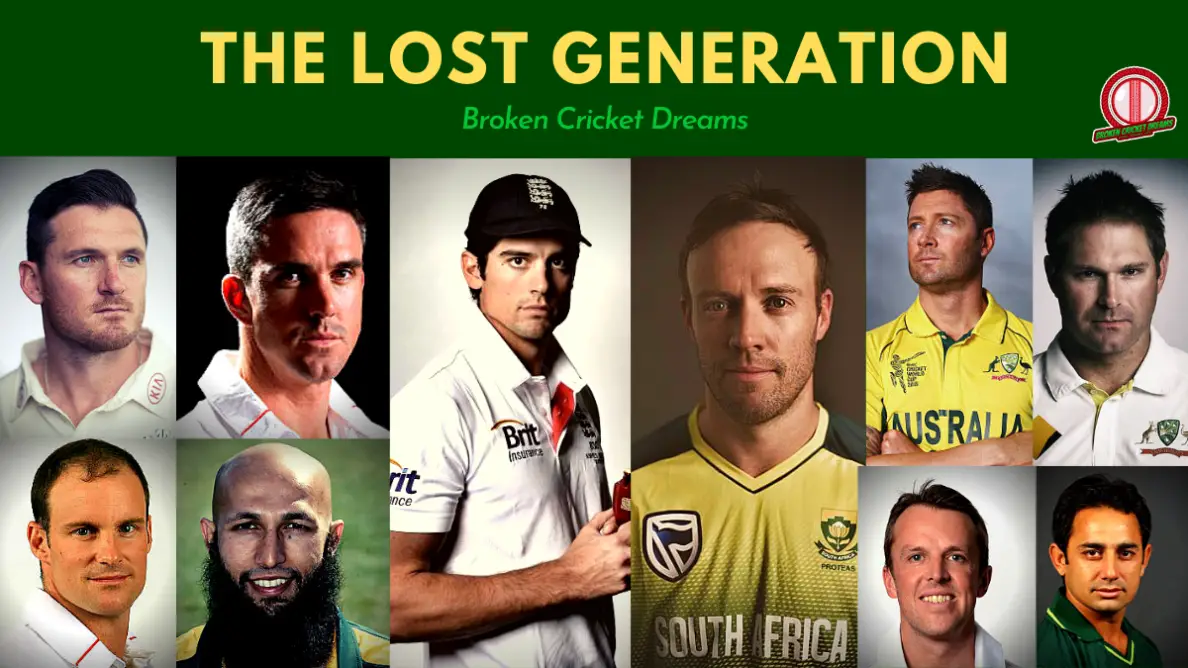
Top 11 Cricketers Who Retired Too Early – The Lost Generation of Alastair Cook, Kevin Pietersen, AB De Villiers, Hashim Amla, and Michael Clarke
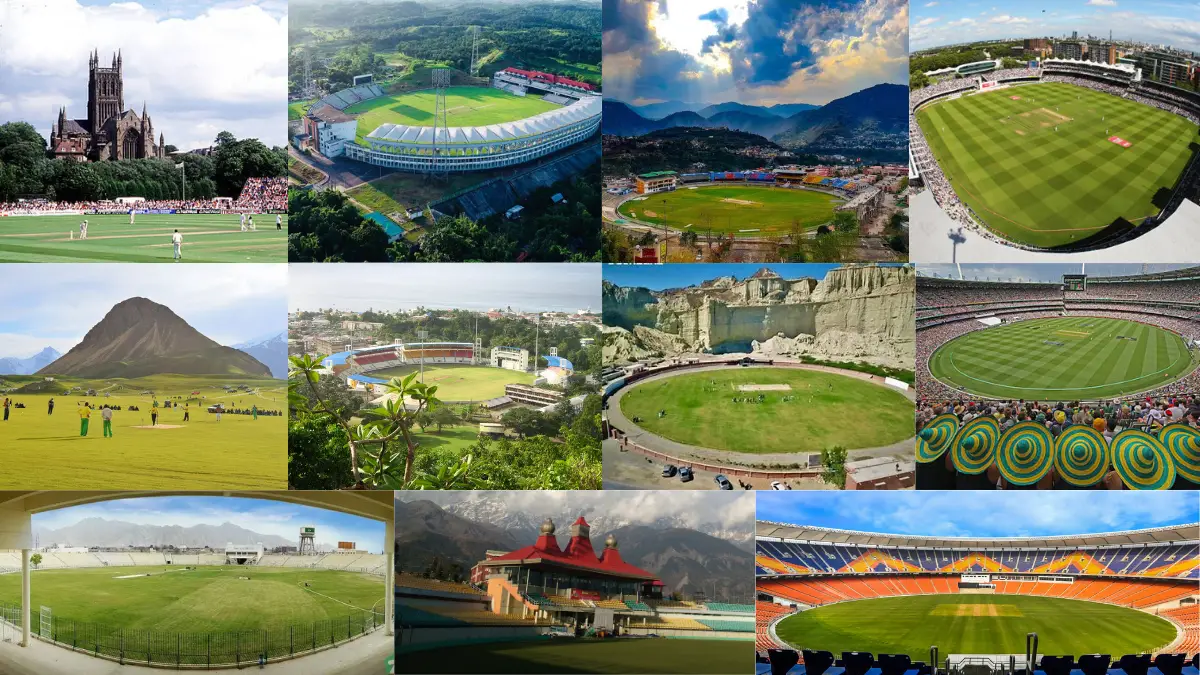
Most Beautiful Cricket Stadium in Each of the 12 Countries – Lord’s, Newlands, MCG, Galle,…Which Is Your Favorite?
List of 63 South African Born Cricketers Who Represented Other Nations: How Many South African Cricketers played for Australia, England, and New Zealand?
USA Cricket—The Complete Guide to Cricket in America (Updated 2023)
22 Unlucky Cricketers Wasted Talents: Alex Hales, Fawad Alam, Robin Uthappa, Can You Guess The Rest?
What Rahul Dravid Taught Me
Fantasy Cricket – Commentators XI
My Favorite Player from Each Country: Unity In Diversity XI – #5 Will Shock You
South Africa World Cup Chokes, a phrase we have often heard before, maybe too often.
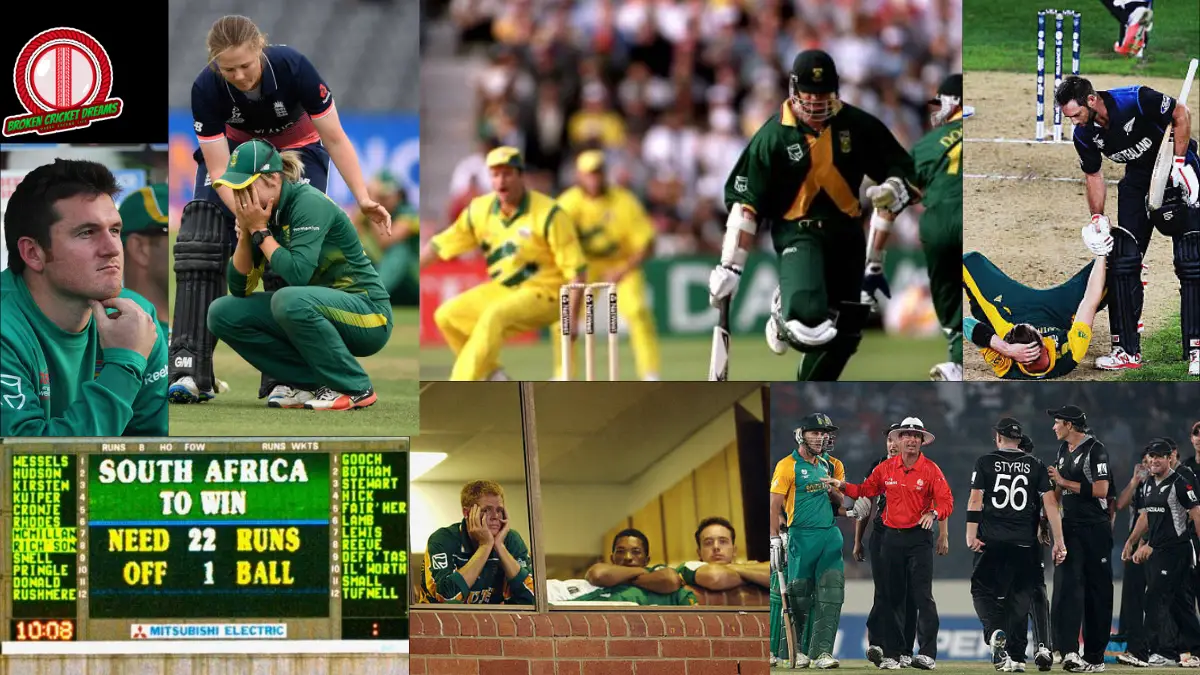
I personally do not like the ‘choker’ term, but there is a reason why the Proteas have earned this tag—rain interruptions, inexplicable collapses, internal politics, dropped catches & runouts, mathematical errors, and sometimes they just don’t show up on the big day. So, to refresh your memories, here is the List of Top 21 South Africa World Cup Chokes & Heartbreaks—Men & Women Combined.
Top 21 List of South Africa World Cup Chokes
Here is the complete list of South Africa’s heartbreaks.
The heartbreaks of all heartbreaks. 8 runs needed in 1 over, 1 wicket remaining. Lance Klusener, in the form of his life, hits two fours. 1 run needed in 4 balls. Klusener – 31*(14). Surely, Proteas has one foot in the finals. Unfortunately, not enough feet as Klusener calls for a panic run, Allan Donald ball watches, runs late, and gets run out. Match Tied. The tie breaker? The Super Six match between Australia and South Africa, which Australia won, most famously known for Steve Waugh’s comment to Herschelle Gibbs, “You just dropped the World Cup.”Waugh went on to make a century and Australia won that clash.
Well on the field, you cannot really blame South Africa. With the bat, Faf-ABD-Miller got South Africa to a massive total in a, wait for it, rain curtailed game. NZ had less overs to chase, Baz went all out, Grant Elliot played the innings of his life, and Dale Steyn was on his feet at the end.Rain had arrived when SA were cruising at 216/3 in 38 overs. They got 281 in 43, but NZ magnificently chased 299 (DL).
What’s the fuss with DL method? Or the DLS vs VJD methods? Well, long, long time ago these rules did not exist. 22 needed in 13. Anyone’s game. Rain intervened for a short 10-minute break. Next thing you know, South Africa need 22 runs in 1 ball. Explain that.
Virat Kohli, Axar Patel, and Shivam Dube had scratched up to 176 after being 3/34. South Africa kept coming back with Maharaj’s wickets, Quinton de Kock’s run out, and brilliant fielding throughout. On the batting front, Stubbs-de Kock manufactured a comeback after being down 2/12. Surely, they had the belief this time. They had held their nerve in all of their close matches so far. Then, came Klaasen’s historic knock. He blew Axar Patel’s away and was on a 51*(23). One of the best innings in a World Cup Final. 27 was needed of 28, 6 wickets in hand. Then, Hardik Pandya dismissed Klaasen with a wide one and Jasprit Bumrah did what Bumrah always does. Kept it tight, didn’t give anything away, and bowled a gem of a delivery to dismiss Jansen. Arshdeep came in and Maharaj got stuck. At the end, the last hope, Miller skied a wide one and Suryakumar Yadav took the catch of the final. The Proteas short by 7 runs. Short , once again.
Myburgh, Max O’Dowd, Colin Ackermann, Tom Cooper, and Scott Edward’s little contributions took Netherlands to 158/4. Quick start by the Proteas but regular wickets and THAT CATCH by former South African cricketer, Roelof van der Merwe meant SA could only get to 145/8.From top of the group to crashing out. They only needed to win one game of the last two and they failed. The No-Result vs Zimbabwe will pinch them as well.“
6. 2003 World Cup Group Stage Exit (Math/DL Method)
1, 0, 0, 5 wides, 1, SIX!, 0, RAIN. Match Tied. South Africa eliminated in the group stage at a home world cup.
Murali bowling to Klusener-Boucher. Last ball-Dot. Reason? South Africa management had miscalculated the DL method and stayed at 229. Had they taken a single, SA would have qualified for the next round.
When asked captain Shaun Pollock in the post-match presentation whether there was any confusion over DL calculations, Pollock replied with “Yeah, Boucher was given a message of 229.”
“So for the second time in a row, South Africa exited with a Tied game. South Africa and the public couldn’t believe it. One run the difference between success and failure.”
In a chase of 157, South Africa were 109/3 with Laura Wolvaardt at 61*. South Africa finally believed after Australia had dominated throughout on the back of Beth Mooney’s 74*. In comes Schutt. Wolvaardt departs. Despite Chloe Tryon’s best efforts, South Africa still fell 19 runs short.
Chasing 299, South Africa were 209/6 in 39.3 overs. They had a mini-collapse earlier, but Annerie Dercksen started to provide Laura Wolvaardt much needed support. They were behind the rate, but the match could have gone down the wire.
But it was not to be. After Dercksen’s dismissal and Wolvaardt’s century, back-to-back wickets meant that they collapsed and lost by 52 runs.
Earlier, there were dropped catches, which took India to a competitive 298. 3rd World Cup Final loss in a row.
New Zealand came out aggressive, and South Africa were a bit loose in the field. No balls, wides, misfields, and great display of batting from Halliday, Kerr, and Bates got the White Ferns to 159. However, Wolvaardt & Brits started positively getting to 51/0 in 6.4 overs. Without another 108 runs needed in 80 balls with 10 wickets in hand, they were right in it. Then, Brits lost her wicket, Tahuhu bowled a 1-run over, and pressure got to Wolvaardt. Amelia Kerr took both Laura & Anneke’s wickets in the same over, and South Africa never recovered.
To beat the great Australian team in the semi-finals, and still lose their 2nd consecutive Finals (3rd including Men’s) will surely hurt.
Meg Lanning gets Australia to 134/5. Runs on the board, but still chaseable with South Africa’s solid batting order. But then, rain intervened. Again. And now they needed 98 in 13 overs, much more challenging with the higher required rate.Laura Wolvaardt played a gem of a knock 41* (27) and brought it down to 19 off 6, but unfortunately, no Carlos Brathwaite moment for them.
South Africa scored a competitive 218. South Africa defending their last over – Dropped dot ball, 1, Wicket, Four. Another last over heartbreak. The difference between the sides? Extras.4 given by England and 25 by South Africa.
Small total to chase, good partnership. All looking good. Then some harsh fighting on the field, a run-out, and the collapse. Perfect ingredients for the ideal South African choke.
From 108-2 in 24 overs to 172 all out in the small chase of 222.
4 wins out of 5. Net Run Rate of +0.739. Temba Bavuma unites the team after Quinton de Kock sits out. Surely, nothing can stop them now? Nope. England & Australia both won 4/5 and had an EVEN BETTER net run rate. The Stoinis-Wade partnership in the low scoring first match hurt South Africa.
In their final match against England, they had scored 189/2 and won against the great English side. Even that wasn’t enough as they had to restrict England to 131 to get their NRR high enough.
India won this one comfortably. South Africa could only get to 116 in chase of 154. Had they got 10 more runs, they would have qualified to the semi-finals of the inaugural T20 World Cup, but lost out due to NRR yet again.
South Africa could only score 101, while England’s stalwarts Sarah Taylor, Charlotte Edwards, and Heather Knight breezed through the chase in 16.5 overs.
Why are South Africa called ‘Chokers’ in world cricket? South Africa have failed to qualify due to rain & nerves in 1992, 1999, 2007, 2011, and 2015 ODI World Cups along with 2007, 2009, 2014, and 2022 T20 World Cups, 2014, 2022 Women’s T20 World Cup and 2000, 2017, and 2022 Women’s ODI World Cups.
Comment below on your thoughts about South Africa World Cup Chokes and Heartbreaks! Also, feel free to checkout some of our other recent articles.
Ranking Virat Kohli’s best innings is no easy task.
With 71 hundreds, 127 fifties, and countless other important knocks out of his 529 international innings, picking the Top 25 is a challenge. As Roman philosopher, Lucius Anneas Seneca is credited of saying,
“It is a rough road that leads to the height of greatness.”
– Lucius Anneas Seneca
Kohli’s consistency and the ability to rise to the top from the depth of hardship is what makes him truly great.
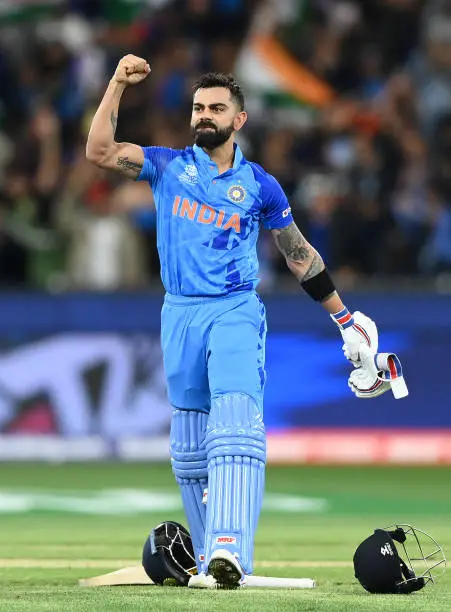
The winning moment at the MCG give cricket fans chills. Literal chills. This match reminded us of Virat Kohli’s eternal greatness. No man has been as dominating of a cricket player in all the three formats. Here is our Top 25 ranking of Virat Kohli’s best innings across T20I, ODI, and Test cricket.
Venue: Melbourne Cricket Ground (MCG), Melbourne, Australia
Context: Melbourne Cricket Ground. 90,000 crowd. T20 World Cup 2022. India 31-4. Pakistan pacers all over India. The ghost of 2021. The 71st hundred wait. Questions on his form. Mental health break. And then came that innings. Then came that shot—The Shot Heard Around the World.From 31-4 to needing 28 runs in 8 balls to winning the match on the last ball.The chase master is back.The King is back.
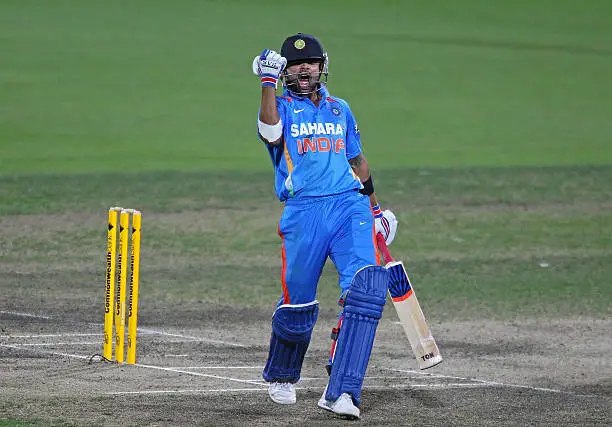
Context: A love story begins in Australia. The coming of age for Virat Kohli. Needing to chase 320 in 40 overs, Kohli and co did it in 36.4 overs. Malinga’s figures of 7.4-0-96-1 says it all. The way Kohli handled the pressure, accelerated…this was only the signs to come for the record chaser he was about to become.
Venue: Punjab Cricket Association IS Bindra Stadium, Mohali, Chandigarh India
Context: Virat Kohli Mohali innings. India vs Australia 2016 knock-out match. What an innings under pressure. Must-win game. A virtual quarter final. Australia & James Faulkner run into Virat Kohli at his absolute peak. Steady innings to begin with but flourish at the right time. The running, six hitting, and MS Dhoni, this innings had everything.
Context: A glimpse of Virat Kohli, the captain, before he was the official captain. India had never won a Test series in Australia and chasing 364 on Day 5 was unthinkable. Enter Kohli. Centuries in both innings. Aggressive approach. Got India so close, but he was caught on the boundary with sixty runs still to go. India continued their positive approach and collapsed agonizingly short.
5. 119 (181) & 96 (193) vs South Africa, India Tour of South Africa 2013-14
Format: Test
Opposition: South Africa
Venue: New Wanderers Stadium, Johannesburg, South Africa
Context: One of the great Test matches of the 2010s. Will always be remembered for the Faf-De Villiers partnership as South Africa almost chasing 438 before the draw was announced eight runs short.However, the game was nicely setup by the dominance of Kohli in both innings.
6. 169 (272) vs Australia, 2013-14 Border Gavaskar Trophy
Format: Test
Opposition: Australia
Venue: Melbourne Cricket Ground, Melbourne, Australia
Context: This match will always be remembered for THAT partnership. Virat Kohli & Ajinkya Rahane smashing Mitchell Johnson’s bouncers. The transition from the Dravid-Tendulkar-Laxman era to the Kohli-Rahane era was complete.
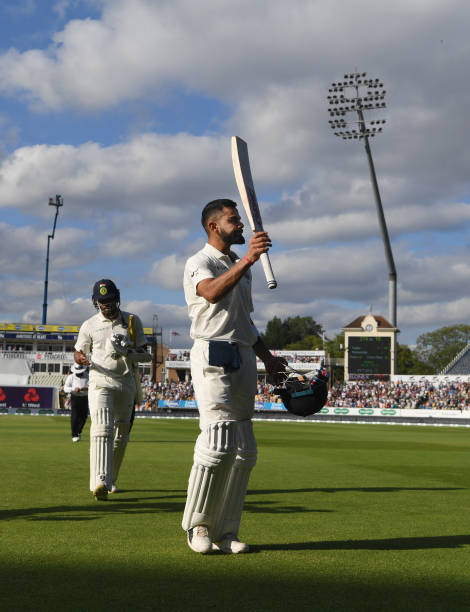
Context: 134 runs in 10 innings. Six single digit scores. 2 ducks. And a Jimmy Anderson. Probably the lowest point in Kohli’s career, technically and mentally. To come back in the next tour, score 593 runs, dominate Anderson, and conquer his inner demons is a life lesson for us all. It all started with this 149 in tough conditions.
Context: Some of the best shots you will ever see. Dancing down the wicket, straight over the bowlers’ head, numerous inside out shots.The series will be remembered for the emergence of Kohli-Rohit duo as the next stars of Indian cricket.
Venue: Shere Bangla National Stadium, Mirpur, Bangladesh
Context: The scorecard doesn’t tell you what we all felt that day. Pakistan 83/10 and India won by 5 wickets. Easy, right? Wrong. Due to the comeback kid, Mohammad Amir. Rohit, Rahaneweregone for ducks. Raina soon followed, India 8/3. Then came Kohli’s masterclass, one full of patience, perseverance, and maturity.
Venue: Vidarbha Cricket Association Stadium, Jamtha, Nagpur, India
Context: One of the highest scoring ODI series in memory. Although he was already scoring loads of runs earlier in the series, this chase was the best of them all.
Context: Test matches mean a lot more when the team wins. Although India lost 4-1 in THAT Sam Curran series, Kohli’s 97 & 103 ensured at least one win in the series.
Context: Among his plethora of centuries and fifties, this one is usually forgotten. After 31-2 with both Sehwag & Sachin back in the hut, Kohli & Gambhir’s steady 83-run partnership got India back in the game. Useful, impact knock.
20. 89*(47) vs West Indies, 2016 T20 World Cup Semi-Final
Format: India
Opposition: West Indies
Venue: Wankhede Stadium, Mumbai, India
Context: Yet another one of Kohli’s ICC men T20 World Cup classic. After Rohit-Rahane 40s provided India a decent start, Kohli took the mantle to finish the innings off. From 50*(33) to 89*(47), but it was not meant to be.
Context: A Top-25 Kohli series should probably include one of his seven double centuries. A marathon 365 (673) partnership between Rahane & Kohli. NZ were out of the game in the first innings.
Context: A solid knock. India win against Pakistan via Kohil magic, a theme over the last decade. Better yet, India started the 2015 WC well and went onto play the semi-finals despite dismal preparations.
Venue: Maharashtra Cricket Association Stadium, Pune
Context: Known as the ‘Kedar Jadhav match’ who scored a 120 (76) from #6, Kohli held the innings together. From53-4, a 200-run partnership followed between the two before Pandya finished it off.
Context: Not all matches have a positive ending. Although India lost, Kohli dragged India close. The next best score was 40, and India lost by 24 runs.
Context:Things have to begin somewhere, don’t they? Virat’s maiden ODI ton, including a 224-run partnership with Gautam Gambhir. Rescued India in chase of 316 after they were 23-2 after 3.4 overs.A glimpse of greatness for years ahead.
Frequently Asked Questions – Virat Kohli’s Best Innings in Each Format
Other Virat Kohli Content
What is Virat Kohli’s Best Innings in T20I Cricket?
Virat Kohli’s Best Innings in T20I cricket are as follows: 82* (52) vs Pakistan (2022 T20 World Cup), 82*(53) vs Australia (2016 T20 World Cup), 72*(44) (2014 T20 Worl Cup Semi-Final, 89* (47) vs West Indies (2016 T20 World Cup Semi-Final), and 49 (51) vs Pakistan (2016 Asia Cup).
What is Virat Kohli’s Best Innings in ODI Cricket?
Virat Kohli’s Best Innings in ODI cricket are as follows: 133*(86) vs Sri Lanka (2012), 100* (52) vs Australia (2013), 115*(66) vs Australia (2013), 160*(159) vs South Africa (2018), and 183*(146) vs Pakistan (2012).
What is Virat Kohli’s Best Innings in Test Cricket?
Virat Kohli’s Best Innings in Test cricket are as follows: 141 vs Australia (2013), 119 vs South Africa (2013), 169 vs Australia (2013), 149 vs England (2018), and 153 vs South Africa (2018).
Why waste time when there is so much cricket to come? Let’s save all that energy for the World Cup itself!
Here is the Quickest Preview of the 2022 T20 World Cup team-by-team.
1. Afghanistan
No longer minnows, BBL experience of Rashid-Nabi-Qais-Mujeeb, future stars in Farooqi and Gurbaz, and guaranteed 5 games in Group 1, expect them to overthrow one of Australia/England/New Zealand.
2. Australia
Reigning world champions, defeated by England in bilateral series, acquisition of Singaporean finisher Tim David, the Steve Smith issue, Maxwell’s form, Wade’s fireworks, the promise of Cameron Green (and not actually being in the team), can they make it 2 in 2 at home?
3. Bangladesh
Will Bangladesh ever win another T20I?Shakib-Liton key if the Tigers have any hope.
4. England
The return of Alex Hales, golf injury to Bazball’s Bairstow, where does Stokes even fit, finishing trio Brook-Moeen-Livingstone, but will Wood’s pace & the Topley-led bowling hold up?
5. Ireland
Post the Porterfield & O’Brien generations and the dropping of Andy McBrine, onus is on the new generation of Balbirnie-Delany-Tector-Tucker to bring with them new hope—expect them to be contenders to go to the next round & look out for Josh Little.
6. India
New captain, 30+ bilateral games, injuries to Bumrah-Jadeja-Chahar, comeback of a 37-year-old, the 19th over scars, Dravid as coach, Pandya-Surya on fire, is it finally their time to shed the ‘chokers’ of the last decade tag?
7. Namibia
Best names (Pikky Ya France, for example), great jerseys, shrewd captain in Erasmus, and a David Wiese – surely they will repeat the magic of 2021?
Conway’s consistency, Allen’s aggression, Williamson’s wisdom, flying Phillips, blistering Bracewell, nifty Neesham, the spinners/all-rounders, and with the Boult-Southee-Ferguson-Milne combo – can we ever really count the Kiwis out?
10. Pakistan
Babar-Rizwan, Rizwan-Babar, that’s all Pakistan is these days, aren’t they? Wrong—There’s Rauf, and Naseem, and Shaheen, but it all depends on Nawaz-Shadab, both with the bat and ball.
11. Scotland
Last chance for Scotland’s great generation (Berrington-MacLeod)? Have some internal issues to sort out.
12. South Africa
Killer Miller, mighty Markram, Rabada-Nortje, oh yeah and there is the Temba Bavuma vs Reeza Hendricks thing to sort out, but forget about them all and look out for Tristan Stubbs, it’s Proteas time now.
13. Sri Lanka
Asia Cup champions, modern T20 template, inspirational captain-finisher-allrounder Shanaka, and the brilliance of Bhanuka Rajapaksa – the dark horses of the 2022 T20 World Cup.
14. West Indies
The end of the great generation, Hetmyer misses a flight, Pooran-Lewis-Holder to carry the load, good fast bowling unit, and who in the worldis this Yannic Cariah?
15. Zimbabwe
If they want to qualify to the next round, it will happen on the shoulders of Sikandar Raza and Sean Williams, maybe with a little bit of Blessing (Muzarabani).
16. UAE
Participation points? Captaincy change & good show in Asia Cup but will be tough for them to progress to the next round.
Finally here are my predictions and some images from the T20 World Cup media event.
— Broken Cricket Dreams Cricket Blog (@cricket_broken) October 2, 2022
Now, calls have come for his axe on the eve of the 2022 T20 World Cup following his horrid series against India where he scored 0(4), 0(7), and 0(8) while Hendricks sat on the sidelines. Although he led South Africa courageously in the 2021 T20 World Cup and handled Quinton de Kock during tough times, an average of 23.54 with 116.49 strike rate is way below par for a modern T20 opening batter.
Although Bavuma has rightly faced criticism, there has been lots of slander and accusations that he is only in the XI to fulfill the quota. We will explore this and debunk some myths.
Quota System in South African Cricket: The Complete Guide
*Disclaimer: I am trying to learn about this from an outsider’s point of view. Hence, this research is conducted through official documents from the South African cricket board with the hope of an unbiased analysis.
“Transformation is defined as a process describing the establishment of a sport system focused on the principles of Human capital development, equitable resource distribution, elimination of all inequalities, increased access to participation opportunities, skill and capability development at all levels and in all areas of activity, empowerment of the individual, respect for each other, fair and just behavior, innovation to give South Africa a competitive edge in world sport.”
In the SA cricket board’s 2021 Integrated Report, they further elaborate that “Transformation is about improved access, fair opportunity and support for all South Africans, within and beyond the boundaries of the cricket field.”
Key Points on Quota & Selections
The document provides an insight into how transformation targets play an part in South African cricket’s selection. Here is a brief summary with quotes from the official document. Some interesting finds.
“It is expected that the selection committee will play its role in ensuring that transformation is aggressively achieved at all levels without compromising the principle of selecting the best team based on current form and the pitch or game conditions.
“When selection between two players is debatable and neither is a clear choice (e.g. both have similar track records and ability), where relevant, preferencemust be given to the player of colour.“
“In measuring our transformation progress, the panel will be measured on a season average basis rather than on a match-by-match basis.”
“Special attention must be given to the development and the creation of opportunities to play black African cricketers at all levels”
“We acknowledge that transformation ins not progressing as fast as it could.”
South African Cricket Transformation Target: The Rules
The South Africa cricket reservation targets must be met as per the Eminent Persons Group (EPG) scorecard projections. By the latest transformation targets, on average about 6 players of color, including 2 black African cricketers should be in the playing XI.
Not only that, but the transformation target is also implemented all throughout South Africa’s cricketing system, from age-level groups to senior internationals.
Here is a truncated version of the projections for the men’s cricket team for the next decade.
Quota Projections
Team (Men’s)
Forecast December 2022 % Black African
Forecast December 2026% Black African
Forecast December 2030 % Black African
Senior International Team
24%
28%
32%
South Africa A/Emerging/U-19
27-29%
32-33%
34-35%
SA School & Colts
31%
35%
37%
U-17 National Camp
31%
35%
37&
Team (Men’s)
Forecast December 2022 % Generic Black
Forecast December 2026% Generic Black
Forecast December 2030 % Generic Black
Senior International Team
50%
56%
60%
South Africa A/Emerging/U-19
50-55%
56-60%
60-64%
SA School & Colts
52%
57%
62%
U-17 National Camp
52%
58%
62&
So, how does the South Africa cricket team reservation work?
For South Africa’s senior men team, in 2022, 24% of the players should be Black Africans while 50% overall should be colored.
This means about 2-3 Black African players and 5-6 colored members should be in the XI, while the corresponding figures are 3-4 Black African and 7-8 colored in the squad of 15.
By 2030, the figures will rise to 32% and 60% respectively i.e. the South African XI may need to have an average of 7 colored players (3-4 Black Africans).
Interesting Observations
One thing to note is that consistently in junior level cricket, the transformation target percentages are a lot higher than the international requirement. This definitely sheds a light on the focus of changing the system from the grassroots level and hoping to have an impact in the international level down the road.
The SA20 has no transformation targets (this could be a cause of conflict in the future. If the homegrown South African T20 league does not have transformation requirement since it is in the franchise model, why should the other parts of SA cricket have it? This may have been a factor in no interest for Bavuma in the SA20 auction).
What Happens if Transformation Targets are not Fulfilled by South African Cricket?
According to South African cricket’s Integrated Report 2020/21, here is what happens if guidelines are not followed.
Risks: “Non-adherence to CSA undertakings with the Minister of Sport, Arts, and Culture on transformation in cricket can lead to a withdrawal of privileges accorded to National Federations.“
Required Actions to Improve Performance: “Tranche payments linked to performance; CSA monitoring and evaluation to improve access and redress.”
To demonstrate how detailed the transformation targets are, here are the results from the 2020/21 selection report statistics.
Women’s Team
The Senior Women had an “on-field Black demographic representation of 48% against CSA target of 50%.” In particular,
Women’s Team
Target (2018-19)
Actual (2018-19)
Target (2019-20)
Actual (2019-20)
Black African
27%
26%
24%
20%
Black
54%
47%
54%
47%
Among the 154 selections for the women’s team, the proportions were
Women’s ODIs: 45 White, 22 Black African, 8 Colored, 13 Indian
Women’s T20Is: 35 White, 21 Black African, 4 Colored, 6 Indian
Men’s Team
The Proteas Men met their Black African player target for EPG 2020 – but did not meet is Black target.
Men’s Team
Target (2018-19)
Actual (2018-19)
Target (2019-20)
Actual (2019-20)
Black African
25%
22%
22%
23%
Black
60%
49%
50%
44%
South African Contracted Players
From the 16 nationally contracted players, the proportion is: 8 White, 2 Colored, 4 – Black African, 2 – Indian. 116 selections (62%) of all the 187 selections came from these contracted players. The other 71 selections (38%) came from 16 non-contracted – 10 White, 3 Colored, 3 Black African, 0 Indian. In particular,
Men’s T20I: 59 White, 24 Black African, 17 Colored, 10 Indian
So Where Does South Africa’s 2022 T20 World Cup Squad Stand?
So let’s get back to the question at the beginning. Where does Temba Bavuma fit in this conversation?
The World Cup squad has 3 Black Africans, 8 White, and 7 Colored players.
Black African: Temba Bavuma, Lungi Ngidi, Kagiso Rabada
Colored: Reeza Hendricks, Wayne Parnell
Indian: Keshav Maharaj, Tabraiz Shamsi
White: Quinton de Kock, Heinrich Klassen, Aiden Markram, David Miller, Anrich Nortje, Rilee Rossouw, Tristan Stubbs, Marco Jansen
Can South Africa Afford to Drop Temba Bavuma?
In short, yes…if they play both Lungi Ngidi & Kagiso Rabada.
South Africa’s quota concern for the upcoming world cup is NOT Temba Bavuma. Instead, it may be how to balance the bowlers.
With Quinton de Kock-Rilee Rossouw-Aiden Markram-David Miller-Tristan Stubbs, South Africa have a very stable and explosive core of batters. Since no adjustment can be made in the middle order, SA will have to fit all their colored players in the bowling line up. For example, in the India vs South Africa ODI, they went with a bowling line up Parnell, Maharaj, Rabada, Shamsi, and Ngidi (which is all good for now since they are in decent form).
In conclusion, regardless of SA’s choice to play Bavuma or Hendricks, the quota is not impacted. However, with Parnell, Ngidi, and Rabada almost certainties, Nortje & Jansen might be in the sidelines.
None of this actually matters since the first tenet of the transformation goals is to select the best team on the day and the targets will be calculated on average at the end of the season.
Should South Africa Drop Temba Bavuma?
It is never a good sign to drop a captain on the eve of a World Cup, so Bavuma should still be in the squad for sure. However, it may still be good to give Reeza Hendricks some game time since he was in red-hot form.
It may be worth dropping Bavuma down the order and play him as an insurance policy to stem the flow of wickets in case of a collapse rather than as an opening batter.
2015 World Cup Semi-Final, Kyle Abbott, & Vernon Philander
The quota system is South African cricket came into focus on March 24, 2015. South Africa crashed out of the World Cup due to Grant Elliot heroics.
Thriller of a game, but so near, yet so far for the Proteas yet again.
In the days to come, news came of the internal politics. Although SA had been fielding up to 5 players of color in the early matches (Amla, Duminy, Philander, Tahir, Behardien). However due to injuries, only 3 players were fielded including in the Quarter Finals, where South Africa crushed Sri Lanka by 9 wickets.
Instead of going with an unchanged XI, Vernon Philander (injured in the prior couple of games) replaced Kyle Abbott, who had a good tournament till that point. Later, it was revealed that the South African administrators called the coach/captain and interfered with the selection process.
This broke the team apart and unraveled the heights of the 2007-2015. Kyle Abbott took a Kolpak deal, while Philander retired early. Philander, himself is quoted that there are no hard feelings between him and Abbott.
“When I go to Durban, I have a beer with Kyle. There are no hard feelings between us two. But the point is: Cricket SA must sort out their stuff. What happened was a knock to both of us.”
Where Does South African Cricket Go from Here?
Kevin Pietersen’s exodus to England had already signaled for things to come due to unofficial quotas in the early days. However, South African cricket’s success had hidden the internal conflicts under the carpet.
The Khaya Zondo case revealed that several black African cricketers were picked, but only to ‘make up the numbers and carry the drinks.’ Michael Holding in his conversation with Makhaya Ntini expressed in the SJN hearings how secluded Ntini felt. Kagiso Rabada has been over bowled and not rested/rotated because he ticks the boxes and is really good.
From Faf du Plessis’ “we don’t see color,’ to AB de Villiers’ captaincy hesitations to the SJN hearings, Black Lives Matters, kneeling, etc., the matter is more complex than it seems from the outside.
Is the Transformation Quota System the way to go for South African cricket?
South Africa is not the only country to combat this issue. In the United States, Affirmative Action & India’s reservations with the Mandal Commission have similarly been implemented and received backlash at some point or time or another.
In my own analysis, I did not like treating human beings as statistics and separating them by categories. I am sure as the years go by the implementation will become less strict as equal opportunities would create more organically grown diverse players.
So, is the quota system the best way to go for South African cricket?
I’m not in the best way to answer that, but in order to reverse the prejudice of centuries of discrimination, systematic and grassroots changes are indeed needed.
What do you think about the quota system in South African cricket?
Sources and Further Reading on Quota System in South African Cricket
Frequently Asked Questions (FAQ) – Quota System in South African Cricket
What is the quota system in South African?
As of 2022, 2 players of black African ethnicity and 6 colored players need to be fielded in the XI (on average).
Does South Africa cricket team have reservation policy?
Yes, the South African cricket team has a reservation policy to meet transformation targets. The men’s South African team has a target of 22% Black African and 20% Black cricketers in their squads and XIs.
The SA20 Auction caught everyone’s attention this week, which leads to the logical question, “What are the Richest Cricket Leagues, and where does SA20 league rank?” Here is a quick answer.
The Indian Premier League is the richest cricket league in the world. As per the 2022 Mega Auction & Retention, the IPL paid its players a whopping $116,339,000 combined for its 234 players who play for their ten franchise teams in a three-month season. The upcoming UAE International T20 & SA20 rank behind at #2 & #3 in terms of player salaries, while the Abu Dhabi T10 League is at #10 with a $2,500,000 combined salary for about 100 players.
Times are changing, T20 cricket is becoming infused with money, and different leagues are popping left and right. The SA20 Auction threw Tristan Stubbs and co into stardom, the UAE international T20 League will be a game changer, and the Big Bash is trying to attract overseas talent in their much-hyped Draft while keeping domestic stars like David Warner.
Richest Cricket Leagues (Lowest to Highest)
Players now have choices, but maybe too many choices.As many as six leagues are scheduled between November & February. That is a daunting stat.
So, in Part III of our new series, Cricket & Finances, we try to help these players out & distinguish which leagues pay their players the most. We also cover the minimum salaries, average wages, total team salary cap, number of players a league can take, and the window it occupies in the cricket calendar.
Make Sure to Read the Earlier Content on Cricket & Finances
How The Overall Cost Was Calculated:For leagues where all the information is public (like IPL auction player by player cost), each player’s cost was added for the total.For leagues where only partial information was available, thefranchise’s maximum purse/salary cap was multiplied by the number of teams in that particular league.
*Note: This article covers individual player salaries, not tournament prize money.
11. Abu Dhabi T10 League ($2,500,000)
Abu Dhabi T10 League Average Cricketer Salary:$25,000
Minimum Wage:$5,000
Maximum Amounts:$50,000-$100,000
*$50,000 is the minimum amount paid for the highest category of player in the draft. However, to attract certain cricketers, the actual amounts may be higher.
Calendar Window:November-December
Salary Cap Estimate (Per Team): $400,000-$600,000
Number of Teams: 6
Total Players: 100-110 (16-18 players per team)
10. Lanka Premier League ($3,000,000)
Lanka Premier League (LPL) Average Cricketer Salary:$30,000
Maximum Amounts:$72,897 (BDT 80 Lakh) – Local Players, $80,000 – Overseas Players
Calendar Window:January-February
Salary Cap Estimate (Per Team): $371,000-$943,000
Number of Teams: 7
Total Players: 127 Players (as of BPL 2024)
*The BPL have suffered due to payments and franchise trouble in the last couple of years. In the earlier years, the BPL paid its foreign players up to $200,000 making it more lucrative than even the BBL. Now, the board has taken over the league instead of franchises.
Pakistan Super League (PSL) Average Cricketer Salary:$66,667
Minimum Wage:$7,500
Maximum Amounts:$170,000
Calendar Window:February-March
Salary Cap Estimate (Per Team): $1.2 Million
Number of Teams: 6
Total Players: 108 (18 per team)
Ramiz Raza has proposed changing the current drafts system (Platinum, Diamond, Gold, Silver, Emerging categories) to the auction formatand increase thesalary cap from $950,000 to $1.5 million. The salary cap is currently at $1.2 Million. Watch out for the PSL. This is a fast-rising league and will survive.
Indian Premier League (IPL) Average Cricketer Salary:$497,175
Minimum Wage:$26,000
Maximum Amounts:$2,133,000
Calendar Window:March-June
Salary Cap Estimate (Per Team): $11 Million (Rs. 90 crore)
Number of Teams: 10
Total Players: 234 (20-30 Per Team)
The mind-numbing thing to think about is that each IPL franchise has a larger salary cap space & auction purse is more than most other cricket leagues. Here are the details from the IPL 2022 Mega Auction.
Final Thoughts: The IPL is now having considerable influence in T20 leagues around the world. The same business groups are now buying stakes in foreign franchise leagues. This includes teams like Trinbago Knight Riders, MI Cape Town, MI Emirates, Dubai Capitals, etc.
Which are the Richest Cricket Leagues in the World?
Which is the richest cricket league in the world?
The Indian Premier League (IPL) is the richest cricket league in the world with an average player salary of $497,175.
What are the Top 5 richest cricket leagues in the world?
The Top 5 richest cricket leagues in the world (by average player salary) are the Indian Premier League (IPL), UAE International T20 League, SA T20 League, the Big Bash, and the Hundred.
How much money does each T20 league give their players?
T20 leagues contribute the following amount to their cricketers combined: 1. Indian Premier League ($116, 339,000) 2. UAE International T20 ($15,000,000) 3. SA T20 League ($13, 421, 200) 4. Big Bash League ($10,000,000) 5. The Hundred ($9,000,000) 6. Pakistan Super League ($5,700,000) 7. Bangladesh Premier League ($4,800,000) 8. Caribbean Premier League ($4,500,000) 9. Lanka Premier League ($3,000,000) 10. Abu Dhabi T10 League ($2,500,000) All prices above in $US Dollars.
How much money can a cricketer earn from each T20 league?
Average cricketer salaries per T20 league is as follows: 1. Indian Premier League ($497,175) 2. UAE International T20 ($138,889) 3. SA T20 League ($133,000) 4. Big Bash League ($75,000) 5. The Hundred ($75,000) 6. Pakistan Super League ($53,000) 7. Caribbean Premier League ($50,000) 8. Bangladesh Premier League ($40,000) 9. Lanka Premier League ($30,000) 10. Abu Dhabi T10 League ($25,000) All prices above in $US Dollars.
SA20 Auction gathered lots of attention around the world.
This was not like South Africa’s earlier failed attempts to a T20 league. Graeme Smith is at the head of the organization (league commissioner), the IPL groups own all the franchises, and there was even an auction in this one. This was actually quite an enthralling event to witness.
Big Takeaways & Highlights from SA20 Auction
Sri Lankan (most) players go unsold despite a stellar Asia Cup performance
MI Cape Town stay true to their franchise and get as many as six uncapped South African players
This was a proper T20 league auction. Not one where home grown players’ reputation was kept in thought. T20 captain Temba Bavuma, Test captain Dean Elgar, and Andile Phehlukwayo were all unsold.
Tristan Stubb’s profile skyrockets. From an injury replacement at Mumbai Indians to $519,000 price at the SA20 auction.
Just like the IPL, the auction propelled a few relatively unknown names in the bags of riches. In this case, it was Donavon Ferreira at $311,000.
Prior to the auction, each franchise could acquire the services of maximum five players – 1 South African (capped), 1 uncapped, and three overseas players.
MI Cape Town (owned by Mumbai Indians group): Kagiso Rabada, Rashid Khan, Sam Curran, Dewald Brevis (uncapped)
Durban Super Giants (owned by Lucknow Super Giants group): Quinton de Kock, Jason Holder, Kyle Mayers, Reece Topley, Prenelan Subrayen (uncapped)
Base price -175,000 Rands ($10,000): Chris Wood, Duanne Olivier, Daryn Dupavillon
SA20 Auction Round 10 – The Nexxt
This was an express round for uncapped players.
Players
International Team
Franchise
Price Sold (South African Rands)
US Dollar Conversion
Jordan Cox
*Uncapped English player
Sunrisers Eastern Cape
R. 325,000
$18,000
Dilshan Madushanka
Sri Lanka
Durban Super Giants
R. 275,000
$15,235
List of Unsold Players in Round 9
Base price -175,000 Rands ($10,000): Andile Simelane, Tiaan van Vuuren, Jonathan Bird, Caleb Seleka, Matthew Boast, Bryce Parsons, Dunith Wellalage
SA20 Auction Round 11 – The eXXpress Auction
Players
International Team
Franchise
Price Sold (South African Rands)
US Dollar Conversion
Johnson Charles
West Indies
Durban Super Giants
R. 425,000
$24,000
Adam Rossington
*Uncapped English
Sunrisers Eastern Cape
R. 425,000
$24,000
Nandre Burger
*Uncapped South African
Joburg Super Kings
R. 175,000
$10,000
Donavon Ferreira
*Uncapped South African
Joburg Super Kings
R. 5,500,000
$311,000
Matthew Breetzke
*Uncapped South African
Durban Super Giants
R. 175,000
$24,000
Mitchell van Buuren
*Uncapped South African
Paarl Royals
R. 175,000
$10,000
Wihan Lubbe
South Africa
Paarl Royals
R. 350,000
$20,000
Marco Marais
*Uncapped South African
Pretoria Capitals
R. 175,000
$10,000
Delano Potgieter
*Uncapped South African
MI Cape Town
R. 175,000
$10,000
Roelof van der Merwe
South Africa/Netherlands
Sunrisers Eastern Cape
R. 175,000
$10,000
Marques Ackerman
*Uncapped South African
Sunrisers Eastern Cape
R. 175,000
$10,000
Ferisco Adams
*Uncapped South African
Paarl Royals
R. 325,000
$18,000
Imraan Manack
*Uncapped South African
Paarl Royals
R. 175,000
$10,000
Christiaan Jonker
South Africa
Durban Super Giants
R. 175,000
$10,000
Evan Jones
*Uncapped South African
Paarl Royals
R. 1,700,000
$96,000
Malusi Siboto
*Uncapped South African
Joburg Super Kings
R. 175,000
$10,000
Ramon Simmonds
*Uncapped South African
Paarl Royals
R. 175,000
$10,000
James Fuller
*Uncapped South African/New Zealand
Sunrisers Eastern Cape
R. 425,000
$24,000
List of Unsold Players in Round 10
Base price – 850,000 Rands ($48,000): Adam Lyth
Base price: – 425,000 Rands ($24,000): Jeffrey Vandersay, Jake Lintott, Paul Walter, Tom Moores, Sam Cook, George Scrimshaw
Base price -175,000 Rands ($10,000): Grant Roelofsen, Glenton Stuurman, Mbulelo Budaza, Ziyaad Abrahams, Aya Gqamane, Steve Eskinaz, Diego Rosier, Khaya Zondo, Johan van Dyk, Pieter Malan, Dayyan Galiem, Henry Brookes, Farhaan Behardien, Pite van Biljon, Unmukt Chand, Bayers Swanepoel
SA20 Auction – Round 12 – The eXXpress Auction
Players
International Team
Franchise
Price Sold (South African Rands)
US Dollar Conversion
Odean Smith
West Indies
MI Cape Town
R. 1,700,000
$96,000
Jimmy Neesham
New Zealand
Pretoria Capitals
R. 3,600,000
$203,000
Eoin Morgan
England
Paarl Royals
R. 2,000,000
$113,000
Kusal Mendis
Sri Lanka
Pretoria Capitals
R. 425,000
$24,000
Brydon Carse
England
Sunrisers Eastern Cape
R. 425,000
$24,000
Sarel Erwee
South Africa
Sunrisers Eastern Cape
R. 175,000
$10,000
Simon Harmer
South Africa
Joburg Super Kings
R. 200,000
$11,000
Wiaan Mulder
South Africa
Durban Super Giants
R. 1,900,000
$107,000
Caleb Seleka
*Uncapped South African
Joburg Super Giants
R. 175,000
$10,000
Daryn Dupavillon
South Africa
Pretoria Capitals
R. 1,700,000
$96,000
Ziyaad Abrahams
*Uncapped South African
MI Cape Town
R. 175,000
$10,000
Wesley Marshall
*Uncapped South African
MI Cape Town
R. 175,000
$10,000
Aya Gqamane
*Uncapped South African
Sunrisers Eastern Cape
R. 175,000
$10,000
Codi Yusuf
*Uncapped South African
Paarl Royals
R. 175,000
$10,000
Olly Stone
England
MI Cape Town
R. 850,000
$48,000
Grant Roelofsen
*Uncapped South African
MI Cape Town
R. 175,000
$10,000
Shane Dadswell
*Uncapped South African
Pretoria Capitals
R. 175,000
$10,000
Eathan Bosch
*Uncapped South African
Pretoria Capitals
R. 175,000
$10,000
Tom Abell
*Uncapped English
Sunrisers Eastern Cape
R. 850,000
$48,000
Final List of Unsold Players in Round 12
Temba Bavuma, David Bedingham, Andile Phehlukwayo, Roston Chase, Craig Overton, Siyabonga Mahima, Thimas Kaber, Paul Walter, Sam Cook, Diego Rosier, Farhaan Behardein, Pieter Malan, Rahkeem Cornwall, Hardus Viljoen
Frequently Asked Questions – Get to Know the Players
Who is Junaid Dawood?
Junaid Dawood is a 25-year-old leg break bowler who plays domestic cricket in South Africa.
Who is Shaun von Berg?
Shaun von Berg is a South African bowling allrounder from South Africa.He is a 36-year-old cricketer who has played 124 first class matches and has taken 447 wickets. He was recently purchase by the Pretorius Capitals in the SA20 auction.
Does Ross Taylor still play cricket?
Even though Ross Taylor retired earlier in 2022, he still plays exhibition cricket. He played for the Road Safety series and was in the SA20 auction. He was unsold with base price at 850,000 Rands ($48,000).
Who is Nandre Burger?
Nandre Burger is a 27-year-old South African cricketer. He is a left-handed medium-fast bowling all-rounder.
Who is Donavon Ferreira?
Donavon Ferreira is a 24-year-old South African cricketer. He is a wicketkeeper from Pretoria. He was sold for 5,500,000 South African Rands ($311,000) in the SA20 Auction to Joburg Super Kings.
Who is Matthew Breetze?
Matthew Breetze is a 23-year-old South African cricketer who is a wicket-keeper from the Eastern Province.
Which team purchased Mitchell van Buren in the SA20 Auction?
Mitchell van Buuren, a 24-year-old legspinner from South African was purchased by the Paarl Royals.
Who is Wihan Lubbe?
Wihan Lubbe is a South African cricketer who has played 2 T20Is.
Was Unmukt Chand picked up the 2022 SA20 Auction?
No, Unmukt Chand, an U-19 World Cup winning captain from India who now plays for Team USA, was not picked up for SA20 Auction. His base price was 175,000 South Africa Rands.
Who are the captains in SA20 cricket league in South Africa?
Rashid Khan (MI Cape Town), Quinton de Kock (Durban Super Giants), Aiden Markram (Sunrisers Eastern Cape), Faf du Plessis (Joburg Super Kings), David Miller (Paarl Royals), and Wayne Parnell (Pretoria Capitals) are the six captains of the SA 20 franchise league.
How many foreign players can play in the XI in SA20?
Four foreign players can play in the XI at the same time in SA 20.
Ben Stokes: Phoenix from the Ashes released today on Amazon Prime Video, the same day the English scored a commanding century against South Africa. This is a story that captures England captain, Ben Stokes’ journey through the ups and downs of his illustrious career.
Ben Stokes: Phoenix from the Ashes Review: Skip It or Watch It?
I will get straight to the point—The Review. Ben Stokes: Phoenix from the Ashes Review is not necessarily a must watch documentary. However, it is an important one.
It is skippable in the sense that Ben Stokes’ career is an open book—Humble roots in New Zealand, an upcoming youngster in the England circuit, The Bristol brawl incident, eleven-month court trial & media pressure, Carlos Brathwaite 4 sixes in Kolkata, IPL heroics, the 2019 World Cup final and Headingly heist, finger and knee injuries, his father’s terminal brain cancer, mother’s legal suit against The Sun newspaper for exploiting another personal tragedy, global pandemic, mental health break, and captaincy comeback. In a sense, nothing new is revealed about Ben Stokes. In addition, the picturization and flashback sequences are not the most coherent.
However, it is an important film due to the first-person points of view of Stokes & his family as well as Sam Mendes’ interview with Stokes while he was struggling with his mental health. It was courageous for Stokes to explain what he was going through on such a large platform. Appearances of Joe Root, Stuart Broad, manager Neil Fairbrother, and Stokes’ father adds immense value to the documentary.
Watch It For: The Interview, Highlight Packages, Ben Stokes’ cricket practice videos from U-12 & U-15 cricket, Mark Wood’s comic timing, Joe Root’s heartfelt messages
Don’t Watch it for: The overly dramatic background music
Prime Video Summary: A refreshingly honest filmabout an extraordinary cricketer. Directors Chris Grubb and Luke Mellows were allowed unprecedented access to Ben’s Life with interviews and insights by Sam Mendes.
Protagonist: Ben Stokes
Major Cast:
Teammates: Joe Root, Jos Buttler, Mark Wood, Stuart Broad, Jofra Archer
Commentators/Ex-Cricketers: Ian Bishop, Isa Guha, Shane Warne
Other: Dean Wilson (journalist), Phil Scott (England’s strength & conditioning coach), Neil Fairbrother (Stokes’ Manager), Vithushan Ehantharajah
Context: The Bristol brawl halted Stokes career due to the litigation, investigation, and media tensions that followed. The documentary walks through what Stokes’ family went through at this point. Although he was not found guilty of affray, the media only portrayed the negative side of things. Stokes had already been involved in a few incidents earlier in the England team like punching lockers, getting banned from driving to four speeding tickets, etc., and this incident was almost the nail in the coffin.
Stokes clears up what exactly happened and why he was involved in the incident in the documentary (he was defending his friends from homophobic abuses)
2. Heartbreak at the 2016 T20 World Cup Final
Quotes: That experience would have broken lesser mortals; Makes you even more hungry
“That experience would have broken lesser mortals” – Ian Bishop
Context: The 2016 T20 World Cup Final would forever be remembered for Ian Bishop’s iconic Remember the Name phrase when describing Carlos Brathwaite’s heroics. On the other end of the spectrum was Stokes, absolutely gutted. How he came back from the lows of 2016 to the highs of 2019s is an inspirational journey for all.
Context: The 2016 T20 World Cup final was a disappointment. However, it is portrayed in the film that the 2017 Bristol incident was the most impactful turning point in Ben Stokes’ career and life. He became a more mature individual, grew closer to family, and learned which people who could trust. At this point, he almost quit cricket and had to dive deep to figure out what used to drive him to give it his all.
4. Mental Health Awareness
Quote: This can happen to someone who is perceived as invincible; I noticed how emotionless I was
“This can happen to someone who is perceived as invincible” – Joe Root
Context: The interview was conducted two weeks after Ben Stokes’ suffered his major panic attack and decided to take a break from cricket. Stokes looked visibly fatigued and recalled a panic attack he suffered which included shortness of breath.
Mental health, especially in sport, is an important topic and can occur to anybody regardless of his or her stature.
5. The Larger-Than-Life Hero
Quote: His life is a story you could not script; Trauma, grief, strength, and defiance
“His life is a story you could not script” – Sam Mendes
Context: Rarely hasa cricketer in recent memory suffered the ebbs and flows to the extent as Stokes has. He has touched glory with starring roles in World Cup and Ashes victories. On the other hand, he has had to see his father, a former Rugby league player in New Zealand, pass away after a fight with terminal brain cancer.
If you have yet to see this documentary, check out the trailer below.
Ben Stokes: Phoenix from the Ashes Frequently Asked Questions (FAQ)
Who is the director of Ben Stokes – Phoenix from the Ashes documentary?
Chris Grubb & Luke Mellows is the director of Ben Stokes – Phoenix from the Ashes. Sam Mendes, who also interviews Ben Stokes, is the producer alongside Sunil Patel & Mark Cole.
Where can I watch Ben Stokes Phoenix from the Ashes?
Ben Stokes: Phoenix from the Ashes is released in Amazon Prime Video on August 26, 2022 worldwide.
Technology in cricket has often been an area of debate. Ten pieces of technology have fundamentally changed how the game is played:
(1) The DRS, (2) Hawkeye, (3) Virtual Eye,(4) Snickometer, (5) Ultra-Edge, (6) Hotspot (7) LED stumps, (8) Spidercam, (9) Bushnell (sporting optics), and (10) Stump Mic.
Today, we look at several aspects of these technologies: Cost, impact, and history.
Why Do We Need Think About Technology in Cricket?
Let’s rewind our clocks to 21st March, 2018.
ICC World Cup Qualifiers in Zimbabwe. Scotland vs West Indies. A spot in the World Cup on the line.
Over 31.4, Ashley Nurse to Richie Berrington: Berrington is adjudged LBW out by the umpire, but it would have definitely gone down the leg side.
There was no DRS.
Couple of overs later, rain arrived. West Indies beat Scotland by 5 runs (DLS method). Heartbreak for Scotland.
Jason Holder later said in the post-match presentation:
“That’s beyond my control. I think it’s a question for the ICC. At the beginning of the tournament, they set up the rules, and those rules are the rules we played with. It’s cricket. Sometimes it goes for you, sometimes it goes against you.”
– Jason Holder
Landscape of Cricket is Changing
In a tournament as important as the World Cup Qualifiers, there should be no excuse that technology is not used (not all games were televised either, but that is a separate issue).
So, why was DRS not used? It’s because implementing technology in cricket is expensive and not all cricket boards & broadcasters have that kind of money.
Cricket is going where the money is going. Franchise cricket is taking over the cricket calendar and players now have various choices in how to earn money (as they should).
Recently, in our Finances in Cricket section, we have explored:
We will now explore how money is utilized from the administration side of things. For example, how much money is needed to host a Test match as compared to limited over matches & franchise leagues?
However, in order to answer this question, we must first understand the economics of technology used. Let’s begin our exploration.
Technology in cricket is used predominantly for three reasons—Ball Tracking, Edge Detection, and Infrared Imaging.
The reason for the high costs for these technologies are as follows: (1) initial installation costs of the technology itself, (2) additional camera setup, (3) maintenance & staff costs to ensure the technologies run smoothly.
1. DRS (Decision Review System): $20,000-60,000 Per Day
What is the Full Form of DRS? What Does DRS Stand For?
DRS stands for Decision Review System.
The Decision Review System is the entire toolkit utilized via broadcasters to assist umpires during a cricket match. The DRS primarily helps in LBW decisions (ball tracking) & faint nicks (edge detection/hot spot).
How Much Does DRS Cost?
Minimum Cost: $12,000-15,000 per day (4 camera system)
Maximum Cost: $60,000-100,000 per day
Test Match Estimate: $300,000-$500,000 per Test ($600,000 – $2.5 million for a Test series depending on the amount of Tests and the technologies used).
World Cup 2023 Estimate: $2.8 million-$4.8 million (48 ODI matches)
Currently, a complete system of DRS costs approximately $100,000 per day. Hence, a full five-day Test match would cost around $500,000 and a five-match Ashes series will cost around $2.5 million. It was estimated that the 2021-22 full-package Big Bash league would cost around $2 million AUD ($1, 333, 600 USD) at an average of $32,787 AUD ($21,862 USD) per match for the 61 matches.
According to a Cricbuzz report, the Bangladesh Premier League in 2019 bought a DRS package without Snicko, Ultra-edge, and Hotspot for $75,000 per match (Just the Ball-tracking technology and ultra motion replays) and a full-package would have cost them $100,000 per match.
Currently, a team captain can review a decision up to two unsuccessful DRS decisions. In Test matches, the reviews are reset after 80 overs.
Impact/Features:
DRS has certainly impacted cricket for the positive. Although it has taken a few years to evolve, the DRS has definitely helped cricket in getting rid of the howlers (recall, 2008 Sydney Test).
It has also provided cricket yet another strategic aspect (think Headingly 2019 – Tim Paine Review). Finally, the DRS has changed the dynamics of the game. For example, spinners have drastically benefitted in LBW decisions since the beginning of the review system.
The most common DRS technology used is for Ball-Tracking purposes. Hence, the majority of DRS costs goes in the implementation of Hawk-eye.
2. Hawkeye
How Much Does Hawkeye Cost?
Hawkeye has been used in multiple sports—Tennis, Rugby, Gaelic Football, Soccer, NASCAR, etc.
In Gaelic Football, it was estimated that the installation cost of Hawkeye is 250,000 pounds ($317,600). It would take them a further 500,000 pounds ($635, 200) to run it the entire season.
With Hawk-eye, cricket broadcasters have data like never before.
In 2013, ESPNCricinfo integrated Hawkeye data with their live score coverage. This included addition of features such as: (1) Pitch Map, (2) Ball Speeds, (3) Beehive (trajectory of the ball), (4) variable bounce, and (5) Wagon Wheel.
Virtual Eye is the other ball-tracking company based in New Zealand.
How Does Virtual Eye Work?
According to Virtual Eye (also known as Eagle Eye), they utilize the “high-frame rate cameras” to “track the centre of the ball in every frame…[Their] software then calculates the precise ball track in 3D space and predicts the path once the release, bounce, and impact points are known.”
Impact/Features:
Similar to Hawkeye, Virtual Eye provides (1) Wagon Wheels, (2) Pitch Maps, (3) Six Distances, (4) 3D Flyovers, and (5) ball tracking.
In the BPL report, they paid for $75,000 instead of $100,000 and missed out on Hotspot, Snicko-meter, and Ultra-Edge.
It is known that Hotspot costs around $10,000. However, due to concerns with the technology (silicone tape/other bat coatings could fool the system), it has not been used unanimously in the DRS packages over the years.
4. Snicko-meter (Real-time Snicko – RTS)
How Much Does Snicko-meter Cost?
Real-Time Snicko (RTS) can cost around £2,500 ($3430.50).
How Does Snicko-meter Work?
The snicko-meter utilizes the stump mic and measures sound waves (via an oscilloscope).
The technology is made effective with split-screen display (one showing the waves in the snicko-meter & the other displaying slow motion camera). This ensures the sound corresponds to the nick of the bat.
Ultra-edge is Hawkeye’s version of the Snicko. After the 2015 testing with MIT (Massachusetts Institute of Technology) in Boston, USA, it was accepted by the ICC. In particular, Ultra-edge can differentiate between the sounds of clothing, bat, and pad.
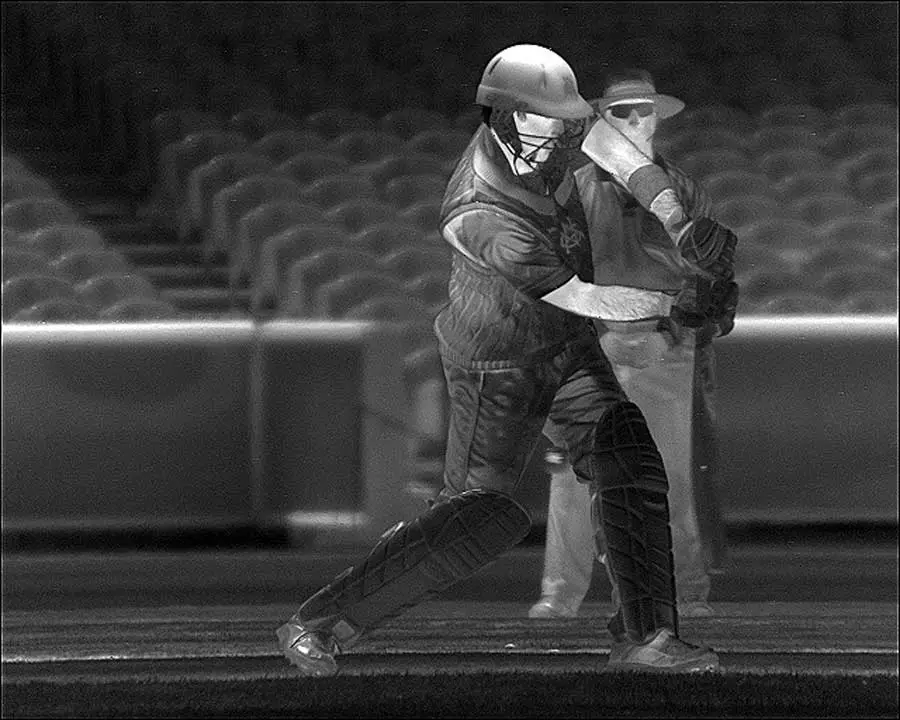
With a four-camera setup, Hotspot uses infrared thermal imaging technology to detect where the ball hits.
Impact/Features:
The pros of HotSpot was that it could catch even the faintest of edges. However, the inventor himself had doubts of the validity of the HotSpot during the 2013 Ashes since coating on bat can prevent HotSpot to be displayed.
In addition, it has been suggested that HotSpot has not been preferred in India since it is a military technology.
Is one possible faint nick worth $10,000 per match?
There are other technologies that have enhanced the level of cricket broadcasting over the past decade: Helmet cameras, Stump Mics, LED Stumps, SpiderCam, etc. These technologies are not necessarily part of the DRS and, we may not have all the cost information.
Although I could not find the exact cost of the Spidercam, I bet this can cost the broadcasting companies upwards of hundreds of thousands or even a few million dollars.
How does the Spidercam Work?
The Spidercam tries to offer a ‘bird-eye’s view’ on the cricket ground. It is made possible with a cable suspended camera system. This helps the camera move in multiple directions.
On Amazon, Bushnell range finder for golf costs anywhere from $100-300. For professional sporting equipment, it may be a bit more expensive.
How does the Bushnell Work?
A range finder is used to measure distances of remote objects and has been used in the military and golf.
Watch this videoof Simon Doull explaining in a Cricbuzz discussion that the range finder plots from the “middle of the ground to the grandstand and tiers of the grandstand. It’s not where the ball might have landed.”
Impact/Features:
With T20 cricket, displaying the distance of sixes has become central to broadcasting needs.
10. Stump Mic
Impact/Features:
Stump microphones are placed near the stumps and pick up sounds like edges (important for snicko & Ultra-edge to work) as well as sledges & Rishabh Pant singing spider man main theme song.
Bonus
PitchVision
Their catch phrase is “technology used in the highest level of the game is now available for everyone to use.”
2008 – DRS is first experimented in the India-Sri Lanka Test series. Virtual Eye technology made an error in Virender Sehwag’s dismissal. Dilshan was given not out due to lack of evidence. Doubts crept in.
2009 – Review system started to be officially implemented in Test matches (with agreement from both teams)
2018 – ICC Women’s World Twenty20 first ICC T20 World Cup to feature the DRS
Who Pays for These Technologies?
In the early days of the DRS, the broadcasters of the home team used to take most of the responsibility of these costs.
Now, the payment is usual divided between the home team cricket board & the broadcasters. However, as the review system gets further uniformed around the world (especially with World Cups and major tournaments), the ICC has started to bear some of the responsibility and subsidize the overall cost.
Final Thoughts
Although cricket might not have as much broadcasting prowess as other sports like American football, but it is certainly in the right direction. I hope more independent companies can chime in as well, which may help reduce the costs. The competition may also drive better products.
I also hope that the ICC can make uniform regulations and can cover the costs, especially in major tournaments like the World Cup Qualifiers.
What is the difference between Ultra-edge & snickometer in cricket?
Ultra-edge is Hawkeye’s version of the snicko.
What does DRS stand for?
DRS stands for Decision Review System.
Why is Hotspot technology not used in cricket anymore?
HotSpot technology is not used in cricket anymore due to doubts about the validity of the technology. Bat coating & silicone tape can hide the image detection on Hot Spot.
West Indies from the 1980s and Australia from the early 2000s have usually held the tag of the greatest cricket teams to ever to be assembled, but do they have a new challenger now?
With the Australia women team winning the 2022 Commonwealth Gold medal, the debate is on—is this Australian women team among the greatest cricketing sides ever?
List of Greatest Cricket Teams
We will consider the modern-day cricket i.e. only the eras after the 1970s (there were great dominant Australian teams in the 1940s and earlier as well).
Winners of the 1975 ODI World Cup, 1979 ODI World Cup, and Runner Up in the 1983 ODI WC (regarded as a massive upset), Clive Lloyd’s men etched their name into glory.They were world beaters in Test match cricket as well with towering fast bowlers even till the mid-1990s.
Record
Most Consecutive Test Series without defeat (29), from 1980-1995
Key Players
Clive Lloyd (C), Garfield Sobers, Sir Vivian Richards, Sir Gordon Greenidge, Desmond Haynes, Michael Holding, Malcolm Marshall, Sir Andy Roberts, Joel Garner, Courtney Walsh, Curtly Ambrose, Lance Gibbs, Colin Croft, Deryck Murray, Lawrence Rowe, Alvin Kallicharan, Roy Fredericks, Rohan Kanhai, Larry Gomes
2020 T20 World Cup, 2022 ODI World Cup, 2022 Commonwealth Gold, 26 Winning ODI Streak (2018-2021)
Women’s cricket in Australia was always going to be one step forward due to awareness and funding. They have most of the ODI and T20 World Cups anyway, so how much better could this team be?
Well, this team is very, very good. They do not lose Test matches, have only lost a couple of ODIs in the last four years, and when it seemed the gas was running out, Ash Gardner & co made sure Australia had the mental strength to comeback from jaws of defeat. All this with the great Ellyse Perry on the sidelines.
16 Series Without Defeat (2001-2004) followed by 9 series (2005-2008)
Key Players
Ricky Ponting, Steve Waugh, Matthew Hayden, Adam Gilchrist, Justin Langer, Shane Warne, Glenn McGrath, Brett Lee, Shane Watson, Andrew Symonds, Michael Bevan, Mark Waugh, Dean Jones, Darren Lehmann, Damien Martyn, Stuart MacGill, Jason Gillespie, Simon Katich, Brad Hogg, Brad Hodge, Michael Kasprowicz, Andy Bichel, Nathan Bracken
During this era, South Africa did not win a World Cup. Nor did they establish absolute dominance, but the thing was in an era where the Australian side had begun their descent, no team in the world was quite as strong.
South Africa though challenged teams all around the world, most notably winning in Australia and drawing in India. The era finally collapsed after 2015-16 season, but they gave it all in their final stand – The Blockathon.
Test Record
14 series without defeat (2008-14)
Key Players
Graeme Smith, Jacques Kallis, Faf du Plessis, Hashim Amla, AB De Villiers, Dale Steyn, Morne Morkel, Mark Boucher, Vernon Philander, JP Duminy, David Miller, Imran Tahir, Shaun Pollock (end of career), Makhaya Ntini (end of career), Ashwell Prince
Most World Cup winning teams are some of the greatest teams in a nations history, but why did I choose the England 2015-2022 team? It is because of the dominant nature of their high risk ODI cricket that they became famous for. Started by Brendon McCullum in the 2015 ODI World Cup, Eoin Morgan took the baton and carried England forward.
Yes flat pitches, bigger bats, and all but 498/4, 481/6, 444/3, 418/6, 408/9, & 399/6 is just another level of dominance. High risk meant that they lost more often, but they changed ODI cricket forever.
Key Players
Eoin Morgan, Joe Root, Alex Hales, Jonny Bairstow, Jason Roy, Jos Buttler, Ben Stokes, Jofra Archer, Liam Plunkett, Adil Rashid, Chris Woakes, Moeen Ali, David Willey, Sam Curran, Mark Wood, Tom Curran, Chris Jordan, Liam Livingstone, James Vince, Joe Denly
Honorable Mention
Sri Lanka (1996-2015), Pakistan (1985-1999), India (2008-2013), India (2018-present), South Africa (1992-1999), England (2008-2011)
Do you agree that these are the greatest cricket teams? Comment below and let us know.