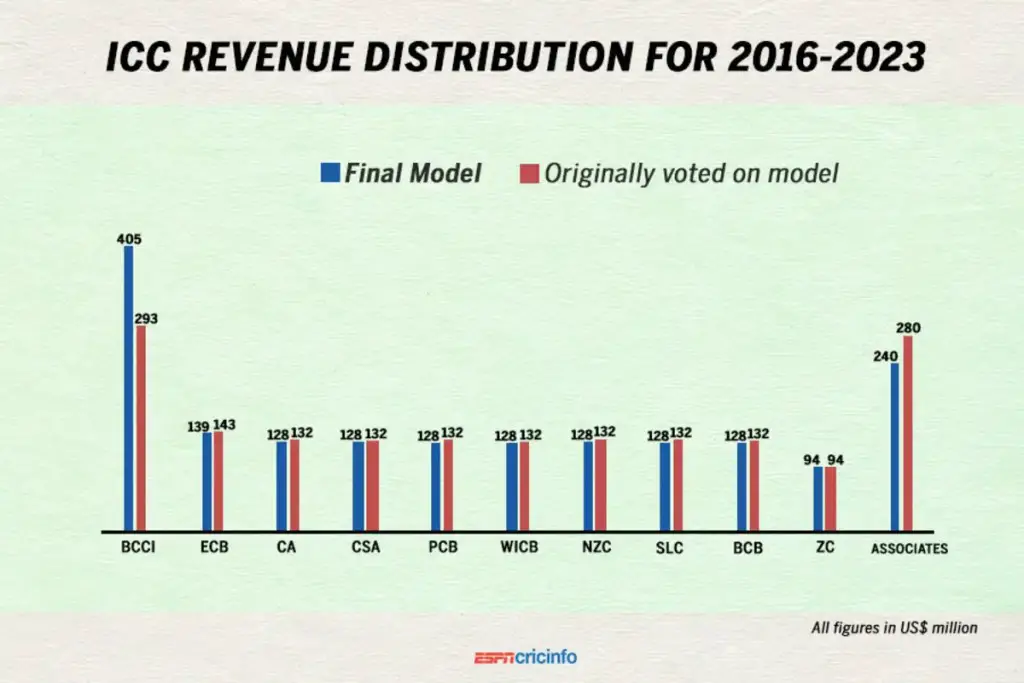
This will help us provide an insight into the workings of the ICC and help us answer questions like:
How much does it cost the ICC to host a World Cup?
How much revenue does the ICC make from global tournaments?
Why has there been a recent influx in World Cups?
I read this 39 page document so you don’t have to.
Let me break it down for you.
Key Takeaways
The ICC earned about 95.59% of their annual revenue from ICC events in 2022 ($412,862,000 out of $431,929,000). In 2021, ICC events contributed to 93.38% of their annual income ($432,146,000 out of 462,767,000).
On the flip side, ICC events contributed the organization 75.27% of their expenditures in 2022 ($168,262,000 out of $223,554,000) and only 70.37% in 2021 ($96,510,000 out of $137,160,000).
The ICC has been profitable with total comprehensive income of $208,375,000 in 2022 and $325,607,000 in 2021 respectively. Adding prior years surplus and general reserves, ICC had a total surplus of $912,999,000 as of 31st December, 2022.
In 2021-2022, senior Men’s ICC tournaments added a profit (+ $602,968,000) to the ICC, while senior Women’s ICC tournaments (– $15,160,000) and U-19 ICC tournaments for both men & women combined (– $7,011,011) led to losses.
The ‘Advance to Full Members’ was $693,331,000 in 2022 and $513,331,000 in 2022 & 2021 respectively, while ‘Advance Allocated to Associate Member’s was $89,716,000 and $66,275,000 in the same period.
Total Revenue Generated from ‘Commercial’ ICC Events (2021-2022)
Now we look at the 2021-2022 tournament breakdown.
ICC Event
Revenue
Expenses
Total Income
2021 World Test Championship (WTC) Final
$36,318,000
$12,469,000
+ $23,849,000
2021 T20 World Cup (Men’s)
$383,624,000
$65,699,000
+ $317,925,000
2022 U19 World Cup (Men’s)
$13,822,000
$19,028,000
– $5,206,000
2022 ODI World Cup (Women’s)
$24,316,000
$35,025,000
– $10,709,000
2022 T20 World Cup (Men’s)
$354,795,000
$84,589,000
+ $270,206,000
Value in Kind* (2021)
$12,204,000
$12,204,000
$0
Value in Kind (2022)
$19,929,000
$19,929,000
$0
Total
+ $845,008,000
– $248,943,000
+ 596,065,000
*Definition in the glossary at the bottom of the article
This table reveals quite a bit of information. What have we learned here?
The ICC takes a hit financially while hosting the Women’s World Cup and U-19 World Cups.
The 2021 ICC Men’s T20 World Cup was the most profitable tournament for the ICC in the last couple of years.
It would be interesting to see how much the 2023 Men’s ODI World Cup earned when the next round of financials come out.
Total Revenue Generated from ‘Pathway’ ICC Events (2021-2022)
But wait, there is more.
ICC also helps fund the global and regional tournaments. They are not considered ‘commercial’ events.
ICC Event
Expenses
2021 ODI World Cup Qualifier (Women’s)
$2,208,000
2021 T20 World Cup Regional Qualifiers (Women’s)
$1,518,000
2021 T20 World Cup Regional Qualifiers (Men’s)
$1,794,000
2021 CWC League 2 (Men’s)
$314,000
2022 Women’s Championship
$30,000
2022 Commonwealth Games Qualifier (Women’s)
$257,000
2022 T20 World Cup Regional Qualifiers (Women’s)
$695,000
2022 U19 T20 World Cup Qualifier (Women’s)
$828,000
2022 U19 World Cup Qualifier (Men’s)
$977,000
2022 T20 World Cup Qualifier (Men’s)
$1,138,000
2022 CWC Challenge League (Men’s)
$1,549,000
2022 T20 Regional’s Qualifier’s (Men’s)
$1,902,000
2022 CWC League 2 (Men’s)
$2,315,000
Total
– $15,525,000
We can clearly see that these pathway tournaments do not earn ICC big profits.
In essence, they virtually treat these global and regional qualifiers as investments for the growth of the game.
Long Term View: How Has Net Income from ICC Tournament’s Changed Over the Years?
Have you wondered why we have had an influx of ICC tournaments in recent times?
Let’s jog back our memories. In men’s senior tournaments alone, we have had:
2024 T20 World Cup
2023 ODI World Cup
2023 World Test Championship Final
2022 T20 World Cup
2021 T20 World Cup
2021 World Test Championship Final
2019 ODI World Cup
The clear and simple answer is: ICC tournaments (especially senior men’s tournaments) contribute majority of the earnings to the ICC.
We can see from this chart, that there were peaks during 2007, 2011, 2015, and 2019, when the Men’s ODI World Cup took place (2007 had both the ODI and the T20 World Cup in the same year).
Even though the ODI format has received criticism in recent times, it is here to stay as the ODI World Cup generates a lot of wealth for the ICC (both the 2017 ODI Women’s World Cup and the Champions Trophy did very well financially).
On the other hand, we can see that the ICC took a hit in 2008 & 2018, two years when no major men’s ICC tournament took place. 2020 was an aberration due to the COVID, but the +$384,000 they did earn was due to the profitability of the Women’s T20 World Cup that broke barriers.
Why Did the ODI World Cup Shrink to 10 Teams?
According to this chart from ICC’s 2007/08 Annual Report, we can see that most of ICC’s money comes from these events. Even in 2007, ICC earned 93.66% of their revenue through events. Most of their costs are distribution of funds to the Members.
If cricket is to grow around the world, the ICC needs to be profitable year after year.
And here lies the double-edged sword of running an international sporting organization. We have often criticized the ICC for shrinking the participation in ODI World Cups, skewed formatting, and India-Pakistan games scheduled for the sole reason of financial gain.
But that profit is necessary for them to invest in the women’s game, U-19 cricket, and regional tournaments around the world because these tournaments provide no financial incentives.
In simple terms—the more money ICC earns from men’s tournaments, the more they can distribute to their members (How that distribution occurs is a deep dive for another day).
****
What do you all think? Is there a better solution for ICC to increase their profits than shoving multiple ICC tournaments in a short period of time?
Thanks for reading! Here is some bonus content for you cause I felt like it today.
Other Observations: ICC World Cup Costs in the Earlier Days
Cricket tournaments have become more professional over the years.
Now it takes multi-million dollars to host an ICC event which includes breakthrough commercial deals. Only a couple of decades ago, it did not take as much money to host a world tournament (and the inflation was lower).
Total Comprehensive Income: “Comprehensive income is the sum of a company’s net income, as recorded on their income statement, and unrealized income (or ‘other comprehensive income’).”
Value in Kind: “Sponsorship received in forms of goods and/or services rather than money.”
In 1918, US President Woodrow Wilson gave a speech in the US Congress that would be regarded as the “Fourteen Points.” It proposed potential resolutions to end the ‘Great War’ (World War I), outlined how the world could move towards peace and prevent future wars, and was a key factor during the Treaty of Versailles.
Now I know what you may be thinking. What kind of comparison is this? Cricket is not war!
It definitely isn’t, but we can all agree that cricket has its share of problems.
Yesterday, the West Indies and England reminded us how special Test cricket truly is. The ebbs and flows, last day drama, the inspiration of an injured Shamar Joseph and Jack Leach fighting for their countries, the comeback of Tom Hartley, the camaraderie between the teams, and much, much more.
It reminded me why I started watching cricket in the first place, and I would love more of days like yesterday.
Hence, without further ado, here are my Fourteen Points to help preserve Test cricket, reduce the conflicts in the current cricketing calendar, and help fuel the growth of cricket in smaller nations.
A Test match fund shall be formed from ICC’s annual budget to support the endeavors of Test cricket around the world. This budget shall, at a minimum, include match fees (players, support staff, ground staff, umpires, administrators), minimum set of cameras to support the DRS (decision review system), miscellaneous finances (hotel, food, and travel), advertising & marketing costs, and all such costs which shall be deemed necessary and proper for carrying into execution a proper Test match. The distribution of the budget shall be approximately proportional to the number of Tests a cricketing nation hosts per year.
How will it work?
In 2015, the Test Match fund was pondered, where the ICC would offer $12.5 million to the non-Big 3 Test playing countries to support Test matches over a few years.
This idea, however, never materialized. In our research, we found that it takes anywhere from $350,000-$1.4 million to host just a single one Test match, which is often a burden on the smaller nations. If a team hosts 2 three-match Test series in a year, that could incur a cost ranging from $2 million-$8.5 million per year.
Potential Problems
Even at the lower estimates, $2 million for 12 Test playing nations would cost the ICC about $24 million per year. That is a lot of money.
This will be a huge effort on the part of the ICC, which may require additional sponsorships, broadcast rights expansions, etc.
To start off this process, the ICC Test match fund could be piloted among the cricketing nations who are losing money to host a Test(ex: New Zealand, South Africa, Sri Lanka, West Indies, Pakistan, etc.).
Who Said What?
“Unless the boards change the economic model, I don’t think Test cricket will thrive outside of the Big 3.”
An adequate minimum Test match fees shall be established to players across all nations for both women’s & men’s Test cricket, the monetary value of which should be updated every two years based on inflation and market economics. Boards are free to provide additional bonuses to their players.
How Will it Work?
Currently, India pays its men’s Test players $18,800 per Test, Australia pays about $12,500-$17,725 USD per Test, and England pays its players around $17,600. On the other hand, a New Zealand men’s Test match fee is about $6,600 USD.
The ICC will need to setup a committee and decide what a decent minimum Test match fee is and then work with each of the cricket boards to split duties on minimum fees.
For example, if we decide that $ 17,600 (like England) is a good enough Test match fee and NZ cricket board are already paying their players $6,600, then the ICC would jump in and make up the deficit of $11,000 per Test per player. Hence, the Big 3 may not need support from the ICC (and will be allowed to pay their players bonuses on top of the minimum fee), but the ICC would need to help the other countries out.
Potential Problems
Once again, we are asking ICC to bear a potentially high cost, but does the ICC even have this much money?
If not, how can they bring in more money? If this causes the ICC to host more World Cups and tournaments, then this will crowd the already crowded cricket calendar. We do not want to create more issues to solve one problem.
“We’ve got to figure out a way for them [other countries] to be incentivized to play international and particularly Test cricket. That requires transparency from all cricket boards around the world to try to figure out how to pay the players the best way they can.”
– Usman Khawaja
“…Similarly to save Test wicket they should introduce standard match fee for all the boards, so that all players of Test cricket nations can have the same match fee.”
Mohammad Hafeez
III. Introduction of Test Match Windows
Two Test match windows, one each for the Northern & Southern hemispheres respectively, shall be implemented for three months of the year.
How Will it Work?
A few people have suggested having 3-month window where only Test cricket is played. However, I think this is an incomplete solution since the Northern and Southern hemispheres have different seasons for cricket.
What could happen is from May-July, there should be a window to play Tests in England, West Indies, and the subcontinent nations while December-February should have a window for Test cricket in New Zealand, South Africa, and Australia. In these windows, we may simultaneously see the Ashes, Ind-SA Tests, and NZ-Pak Tests for example. So the focus of the fan base is solely on Test cricket.
Now we cannot stop franchise cricket for six months, so what can be done?
We can customize the window per nation. For example, when a country is hosting or touring for Test cricket within those two larger windows, they are not allowed to host a franchise league. This will help avoid clashes that we are seeing with South Africa and the SA20. On the flip side, leagues like the BBL can benefit because the BBL will have all their international players to choose from.
Potential Problems
This will definitely cause backlash by the franchises because prime time will be taken away from them.
For example, this rule would mean The Hundred cannot be scheduled in the summer months when Test cricket takes priority. This is the time that students have vacations, the weather is decent, and there is time to spend with family. The broadcasters may also suffer due to lower television ratings.
Who Said What
A 3 month dedicated window for Test cricket every year for both the men & women’s teams is the only way to protect the greatest format .. no other cricket but Test around those 3 months .. the other 9 months for all the leagues ICC events .. 👍👍
The bilateral ODI series shall be abolished from the cricket calendar.
How Will it Work?
As simple as, no more bilateral ODI series.
Don’t worry, I am not advocating the ‘Death of ODI cricket’ or anything like that. We saw in the 2023 ODI World Cup that fans still enjoy ODI cricket albeit in a smaller dose. Removing ODI bilaterals will provide space in the calendar to accommodate Test cricket, franchise leagues, and qualification matches (more on this, a few sections later).
Potential Problems
Loss of sponsorships and advertising revenues for host countries.
V. Abolishment of the Bilateral T20I Series
The bilateral T20I series shall be abolished from the cricket calendar.
How Will it Work?
Read point IV. Same as above.
This year, India will only have the 3-match T20I series against Afghanistan and the IPL to choose its players for the World Cup. The franchise tournaments will be enough to assess the player pool for T20 World Cups.
VI. Transformation of the two-year World Test Championship cycle into a Concentrated Test World Cup
Every four years, the league of Test nations shall assemble to play in a Test World Cup during the two 3-month Test windows. The top eight ranked teams shall compete, four winners proceed to a round-robin semi-final, and the Top 2 compete in the Best of 3 final series at a pre-determined venue.
How Will it Work?
Four 3-match series will occur for the Top 8 ranked teams during the first six months of the year in two different neutral countries (ex: Aus v WI (#1 v#8), Ind v SL (#2 v #7), Eng v Pak (#3 v #6), SA v NZ (#4 v #5)).
The four winners will then play 6 Tests in a round-robin format in the ‘Final Stage’ of this Test World Cup. The Top 2 teams will then play a 3-match series for the World Cup Final.
Note: During this Test World Cup year, regular bilateral Test series will not take place since this will take place during the Test windows.
Potential Problems
The teams that did not qualify in the Top 8 or lost in the first stage may not play much Test cricket that year.
Who Said What
"The only effort that's been made to try to keep it relevant, I think has made it worse!" 📉@markbutcher72 believes the introduction of the World Test Championship has contributed to the decline of Test cricket.
VII: Two-Tiered Test League with Relegation & Promotion
Relegation and Promotion shall be established in Test cricket that will feed into the Test Match World Cup. Teams will be promoted and relegated at the end of every two-year cycle.
How Will it Work?
The 12-Test playing nations will be divided into two brackets (#1-6 in Bracket A and #7-12 in Bracket B). At the end of each two-year league, the bottom two of Bracket A will be demoted to Bracket B and vice-versa.
The top eight-teams (all 6 teams in Bracket A and top 2 of Bracket B) will compete in the Test World Cup.
Potential Problems
Since we are proposing Test match windows, some windows may have too much Test cricket if that’s even possible.
VIII: 4-Day 3 Match Series instead of 2 Tests
The two-match Test series shall no longer be in existence. If for some reason, due to calendar conflicts, financial reasons, or unforeseen circumstances, there is only space for 15-20 days, then a three-match four-day Test series shall take place with the approval of the cricket boards of the interested parties.
How Will it Work?
If the Test match fund and calendar problems are solved with the above solutions, then there will not be a need for a 2-Test series (since teams will have enough money to host Tests).
However, if the situation arises that only 2-Tests are possible, then instead a 3-match 4-day Test series should take place. This will only add two days to the overall match time and maybe an additional week for the overall tour.
Potential Problems
This could result in too many draws if multiple teams agree on this approach.
Who Said What
“I’m not sure whether it’s changing it to four-day Test matches, so you can have an extra day to make sure that you play that third Test match.”
IX. Advertising Revenue and ICC Funding for County Cricket, Sheffield Shield, Ranji, and other domestic four-day tournaments.
The cricket boards will have to allocate their respective annual budgets to the betterment of domestic cricket. This includes, but is not limited to, advertising, recruiting, providing better facilities, etc. The ICC shall subsidize cricketing boards with a poor financial situation.
How Will it Work?
Franchise cricket is popular because the best players play in these leagues and sponsorship/TV revenue is high. On the other hand, County Cricket is shown on some YouTube channels, if at all.
The ICC should have a mandate to oversee that cricket boards are actively publicizing domestic cricket. This could be done by providing boards additional capital for domestic tournaments, having free to air channels, or by marketing domestic tournaments on social media channels.
Potential Problems
This could take additional manpower and resource, which will increase the costs of all parties involved.
X: Mandatory Practice Games with Similar Pitches
Each visiting team will be provided at least one practice match (for a 3-Test series) and two practice matches (for a series with 4 or more Tests). An impartial inspector from the ICC shall monitor practice pitches to ensure they are closely aligned with the pitches that the series will offer.
How Will it Work?
I have no problems with India coming up with rank turners or South Africa’s bounce troubling batters. I do, however, have a problem with multiple Tests finishing within two to three days and the lack of practice matches.
England have gone to India for a 5-match Test series without a practice match!
What should happen are at least 2 mandatory practice 4-day matches on pitches with similar conditions. If India plan on putting up rank turners, they need to make rank turners for these practice matches. If the series will have a variety of surfaces (for example, Dharamsala and Chennai), then the two practice matches need to have different surfaces. The ICC need to get involved as the impartial spectator to ensure consistency in pitches.
Potential Problems
This could mean longer tours for visiting teams and time away from home.
XI. Revival of the ODI Super League, Revamping of Qualification Systems & ICC Rankings
The ODI & T20 World Cup qualification systems shall be revamped and the ODI Super League shall be revived. No country, with the exception of the host nation, will be guaranteed a place in an ICC tournament. The space provided by the abolishment of bilateral series will be replaced by qualifying rounds that feed into the ODI Super League and World Cup qualifications.
How Will it Work?
The ODI Super League shall be revived for the benefit of ‘Associate’ nations like the Netherlands and Scotland.
Unlike the first edition of the ODI Super League, the Super League will be divided into a few groups (for example, 18-team Super League with 3 groups of 6). Every few months, a country will hold a Qualification round to play some of the matches. After a couple of rotations, each team in the group have played against each other twice (at least 10 matches per team before the World Cup).
These matches will be all be a part of World Cup qualification. No additional friendly bilateral games.
Potential Problems
Scheduling could be a problem with the various franchise leagues going around.
XII. Staggered ODI & T20 World Cups every 2 years, Removal of the ICC Champions Trophy
Each ICC World Cup tournament for both men’s & women’s cricket shall be held every four years, staggered by two years for the format. The Test World Cups will occur in the years there is no bilateral World Cups.
How Will it Work?
There are too many World Cups happening now. T20 World Cups in 2021 & 2022, an ODI World Cup in 2023, and another T20 WC coming up in 2024.
That’s an overkill. Rather, we can have ODI World Cups in 2027, 2031, 2035, etc. while T20 World Cups are hosted in 2029, 2033, 2037, etc. – also every four years. Then there will be space for the Test World Cup in 2028, 2032, 2036, etc.
This should also be implemented in the women’s game (One idea could be to stagger all 4 – 2027 Men’s ODI, 2028 WODI, 2029 – MT20, 2030 – WT20, etc.).
Potential Problems
Players might retire earlier if they know they cannot make it to the next ICC tournament.
XIII. Maximum Leagues Cap for Nationally Contracted Players
If a player is nationally contracted by their national cricket boards, they are limited to a maximum of three leagues (IPL, domestic league, and one other) per year or four leagues per year (if no IPL contract provided) or risk being fined their match fees. If a player does not have a national contract, they are not obligated to follow this limit.
How Will it Work?
We can come up with a compromise so that nationally contracted players can play a maximum of 3 leagues per year (including the IPL), any 4 leagues (if no IPL deals), and no restrictions if without a contract.
If Test windows and minimum Test match fees is implemented, then this should benefit both international cricket and the players themselves.
Potential Problems
Players may not sign the national contract at all and be franchise freelancers if that benefits them in the long run.
XIV: Re-Establish Champions League, Limit Expansion of the IPL
The Indian Premier League (IPL) shall not expand beyond the three-month window it is currently provided. The franchises are free to invest in other leagues around the world and a one-month window will be allocated for an annual Champions League.
How Will it Work?
It is clear that IPL franchises are starting to own stakes in other leagues. In the past, the Champions League did not provide value because a single player would have conflicts over multiple franchise but end up playing for their IPL teams.
If the IPL team starts doing year long contracts (for example, the same player plays for MI, MI Cape Town, MI NY, etc.), then there shouldn’t be a conflict of interest as before.
Potential Problems
For yet another competition to be in the cricket calendar, the IPL has to stop at the 10 teams, 3-month format. If the IPL is any longer, international cricket may cease to exist.
Final Thoughts
I was trying to write this article for a couple of weeks but for some reason, couldn’t find the words and ideas. But on a day where Shamar Joseph and Tom Hartley created history and Test cricket came to life, the idea just magically flowed through.
Much like Woodrow Wilson’s Fourteen points and the League of Nations (precursor to the United Nations), I fully expect the ICC to not pay attention to any of this and lead to major chasms in cricket in the coming years (much like the US themselves did not join the League of Nations, thereby weakened it, and ultimately were not able to prevent World War II).
This article may sound a bit quixotic in nature, but we have to start somewhere, don’t we? The world can only change if conversations begin.
The future of cricket is at stake. Will the ICC do something about it?
What are your thoughts? I want to know, comment below! How would you solve the problems that cricket faces today?
Related Articles
If you like reading about potential solutions to problems in cricket, do read the following:
How much money does it really take to host a Test match?
We have heard the claims that cricketing countries like New Zealand & South Africa ‘lose money’ while hosting a Test match. Well, how much money are they losing? Why are they losing so much money?
Don’t worry, I got you. Here is a research article on how much money it costs to host a Test match.
A 2-Test series can cost about $679,500-$2.3 million, while a 5-Test series Ashes may incur expenses ranging from $ 3.043 million to a whopping $7.3 million.
Hence, on average, it takes around $350,000-$1.4 million to host a Test match. The vast range is due to the choices made by the national board – whether to have 4-cameras or 16, whether to purchase the complete version of the DRS or just the Hawkeye, number of support staff, choices for hotels and flights, etc.
Factors that impact the cost of hosting a Test match include (but are not limited to) technology, the review system, player match fees, umpires’ fees, post-match awards, broadcasting & commentating team, security personnel, support staff, hotels, food, flights, busses, incidentals, and facilities.
*Note: Apart from the host cricket board, some of these expenses may be shared between sponsors, broadcasters, ICC, and state/ national governments.
Other articles in Cricket & Finances: Money, Money, Money!
How Much Money Does it take to Host a Test Match – The Top 9 Factors
It takes a village to host a Test match. This includes the players themselves, the commentators, ground staff, umpires, ball boys & girls, bus drivers, security personnel, administrators, ticket sellers, the media, and most importantly, the fans.
We take all these dimensions and come up with estimates for a 2-Test series and a 5-Test series.
We consider an Australia-England Test series for our 5-match estimates and teams like West Indies, Sri Lanka, and Pakistan for our 2-match estimates.
Note: All numbers are in $ USD. Also, some costs might be one-off cost to the host country (for example, ground covers, initial camera equipment, speed gun, stumps, cost of buying land & building the stadium, etc.). Some of these costs may be offset by themaintenance costs of the one-off items, and hence, should not impact the overall estimate range much.
*If you use any of our derivations and data, please link this article to avoid copyright issues.
1. Technology: $120,000-$2.6 Million
What Does it Include?
DRS (Hawkeye, Hotspot, Snicko, etc.), Cameras (4-16, SpiderCam), Stumps (Stump Mic, LED Stumps, Zing Bails), Bushnell Range Finder, and Speed Gun
Note: To cut costs, some boards may choose to only purchase Hawkeye with minimal cameras, while other nations might purchase a full set of DRS/camera setup.
2. Broadcasting & Commentators: $20,000-$1 million
What Does it Include?
This includes the salary of commentators, behind-the-scenes broadcasters.
According to various reports online, commentators can earn $1000-$5000 in match fees and around $50,000 per series. Some commentators even take home paychecks of up to a million dollars per year.
How Much will a 2-match Test series cost?
Minimum Cost: $20,000 ($1,000 match fee per Test for set of 10 commentators)
Maximum Cost: $750,000 ($50,000 series fee for set of 15 commentators)
How Much will a 5-match Test series cost?
Minimum Cost: $375,000 ($5,000 match fee per Test for set of 15 commentators)
Maximum Cost: $1 million ($50,000 series fee for set of 20 commentators)
Sky Sports signed 19 commentators for the 2023 Ashes season.
Note: The cost for technology, broadcasting, and commentators may be shared between the cricket board and broadcasting companies. This may also be negotiated in the various TV/streaming multi-year broadcasting deals.
3. Player Match Fees & Match Awards: $130,000-1 Million
What Does it Include?
This will only include the match fees for the players in the playing XI. We do not include yearly contracted salary for this calculation since that is a separate transaction between a player & its cricket board.
How Much will a 2-match Test series cost?
Minimum Cost: 126,500
Maximum Cost: $145,000
Calculation Method: Test Match Fees * 2 (number of Test) * 11 (number of players in the playing XI). With player of the match/series awards (plus many more nowadays), this cost will increase to $130,000-$160,000.
How Much will a 5-match Test series cost?
Minimum Cost: $687,500
Maximum Cost: $1 million
Calculation Method: Test Match Fees * 5 (number of Test) * 11 (number of players in the playing XI). If we add the award costs, this cost will increase to $700,000-$1,025,000.
Note, each board will pay each of their players separately, so we will not double count this value (i.e. we will only count the expense for the host team).
This includes umpires, video umpire, reserve umpire, and referee. Some online websites estimate umpires may earn around $5,000 match fees for Test cricket.
A team like West Indies may be responsible for arranging flights from island to island or countries like Australia or India, where distances between cities is more convenient by air.
For domestic travel, we assume host boards will pay for players from both teams involved.
This will total to about 45-80 members total (squad: 15 players, 5 net bowlers per team, 3-5 coaches, umpires & referees: 5-8, commentators: 10-20, miscellaneous/administrators: 1-10)
How Much will a 2-match Test series cost?
The current India-West Indies series takes place in Roseau & Port of Spain. For a 2-Test series, we consider one flight.
Note: These estimates may vary depending if the national boards consider business or economy class and how soon they book their tickets.
How Much will a 5-match Test series cost?
We will consider the 2021 Ashes for this scenario. We check current one-way prices for Brisbane-Adelaide (around $300), Adelaide-Melbourne ($100), Melbourne-Sydney ($100), and Sydney-Hobart ($125). This totals to about $625 per member of the flight.
Minimum Cost: $28,125: 45*625
Maximum Cost: 50,000: 80*625
Surprised by these numbers? Note, that even though West Indies might not be the richest cricket board, Caribbean is still a pretty exotic place for travel.
6. Buses: $42,000-$105,000
What Does it Include?
Buses includes hiring a couple of drivers, tips for the drivers, and the cost to rent a charter bus. Each team will have a separate bus and there will also be a bus for support staff. According to Gogo Charters, it costs about £ 456-613 ($588-790) per day per charter bus, plus a 10% tip. We will estimate this around $700 per bus for a total of $2100 for three buses.
7. Hotels, Food, & Incidentals: $200,000-$2 million
What Does it Include?
According to the U.S. Department of State Foreign Per Diem Rates, “The maximum lodging amount is intended to substantially cover the cost of lodging at adequate, suitable and moderately-priced facilities. The M&IE portion is intended to “substantially cover the cost of meals and incidental travel expenses such as laundry and dry cleaning.”
Cannot forget the dry cleaning and the laundry. Nobody wants stinky, smelly, and rainy tours.
For a reference, Adelaide’s Maximum Per Diem rate based on (1) Maximum Lodging Rate, (2) Meals & Incidentals is $324. Here is the estimate list for other Australian cities.
How Much will a 2-match Test series cost?
A two-Test series has a maximum of 10 days. However, we can consider one tour match, a couple days between each game, and a couple of days before/after the series for a total of 20 days.
The current Sri Lanka-Pakistan series is an 18-day affair for example. We will consider Galle’s per diem rate of $216 as an average (although it varies from city to city).
Minimum Cost: $194,400 (45 *$216*20)
Maximum Cost: $777,600 (80*216*20)
How Much will a 5-match Test series cost?
The 2023 Ashes takes place between June 16th and July 13th, totalilng 45 days (without any tour matches). To keep it simple, we will take 50 days and the $598 per diem estimate for London.
This may include security guards, pitch curators, groundsperson, cleaners, stadium food organizers, support staff, pavilion steward’s, etc.
According to Glassdoor, a security guard in London earns annually £ 24,070 ($31,028 USD), a security officer earns about £ 26,383 ($34,000), and an assistant groundsperson earns about £ 22,000 ($ 28,000). The director of security and people in higher positions may earn £ 50,000-100,000 ($65,000-100,000).
We estimate around 50-100 support staff & security personnel are needed to make a Test match happen. We will take £ 20,000 ($26,000) as an average. We will estimate 1-month salary (1/12) for the 2-Test series & 2-month salary (1/6) for 5-Test series.
Case Studies & Quotes: Cost of Hosting a Test Match
Our estimates match with the interviews and situations that we have already seen. Here is the result of rising cost of hosting a Test match and the uneven monopoly of the Big 3 in world cricket today.
Situation 1: The COVID Comeback Season
The pandemic caused England to go to great measures to restart cricket.
For the West Indies and Pakistan series, they paid these countries £ 500,000 ($644,628) for charter flights. In addition, the per day cost was £ 238,000 ($306,842), while the season cost was 10 million pounds. One quote caught my eye.
“The good thing is they are England, and they expected to receive 120 Million pounds in ‘broadcast revenue.'”
Situation 2: Cricket Ireland Cancels Test Series
Ireland cancelled their plan of playing a Test match against Bangladesh and played a T20I instead.
“With the expected cost of hosting a Test estimated at 1 million pounds ($US 1.14 million), Cricket Ireland has chosen to prioritise white ball cricket ahead of the T20 World Cups.”
“The Yorkshire chairman and chief executive, Colin Graves, had said the county would not bid to host an Ashes Test in 2013 or 2015 because, at a cost of £ 1-2 million, ‘it would represent too great a financial risk.’ ‘
– The Guardian
Situation 4: South Africa’s Problems Continue
South Africa will not be playing many Tests in the next FTP. They have, however, hosted a successful SA T20, which gives them hope fo a financial revival.
“CSA earns a tenth of the money on a Test that it will earn for a white ball match.”
– Firdose Moonda
Situation 5: Afghanistan vs West Indies match ends within 3 Days, Costs Money Nevertheless
“Take the Afghanistan v West Indies game in Lucknow. It finished in two and a half days, but all the people working on it have been booked for the five days. The grounds, the staff, the food, everything…it’s probably cost them US $200,000 to $300,000. Perhaps more. And if your yearly grant is to the tune of $ 4 million, that means you have spent close to 10% of your [yearly] budget on playing one Test match.”
According to ESPN Cricinfo, it cost the Zimbabwe cricket board $1 million to host a two-Test series against the West Indies.
“We do lost a lot of money – about $300,000-$400,000, to host a Test series. It’s money we don’t have.”
– Tavenga Mukuhlani, ZC Chairman
Situation 8: Playing Against India & the Big 3 the Only Hope (which is not sustainable)
“Unless it is against the Big 3, Cricket New Zealand loses about $700,000.”
– The Telegraph, Sydney Morning Herald
So, why do New Zealand, South Africa, & other countries lose money while hosting a Test series?
Expenses are only one part of the puzzle. Revenue is the other.
While the Big 3 has broadcasting profits on their sides, countries like Zimbabwe get as little as $1 million per season from sponsorship. A 2-Test series wipes out 20% of the annual reserves, and hence, they cannot afford to host Test matches.
The income, ticket sales, & sponsorship are not large income to balance the expenses of hosting a Test match.
Although New Zealand are a joy to watch in Test cricket and were also the winner of the inaugural WTC Final, they suffer from a similar economic fate.
What does the Future of Test Cricket Hold?
Revenue in cricket comes from (1) ticket sales, (2) broadcasting deals, (3) sponsorship deals, (4) ICC money, and (5) federal/state funding (depending on the country). While India is always on the net positive side due to their sheer volume of cricket fans, other countries unfortunately do not have similar infrastructure or fan following. Subsidizing Test cricket a part of a larger ICC Test fund has been suggested in the past, but is it enough?
Can Test cricket survive the rising costs? More importantly, will the ‘Middle 5’ – West Indies, South Africa, New Zealand, Pakistan, and Sri Lanka continue their investment in Test cricket?
Test cricket is actually thriving these days (See, Bazball), but the business model of Test cricket is dying.
Something needs to change quickly.
Otherwise, Test cricket started with the Ashes. It may also end in ashes.
If You Liked this, here are other Articles You Might Be Interested In
This comprehensive guide provides an in-depth look at the Border-Gavaskar Trophy (BGT), one of the most celebrated Test series in the cricket world today.
We will discuss the history of BGT, and look at some of the prominent players who have played a major role in making this tournament what it is today, including the most runs and wickets. The upcoming BGT 2023 schedule and how they can follow the tournament as it unfolds in India is also displayed.
Key Takeaways
The Border Gavaskar trophy has been held 15 times since 1996, 8 of which were hosted by India and 7 by Australia.
India has won the Border–Gavaskar Trophy 9 times(96-97, 97-98, 2000-01, 04-05, 08-09, 2010-11, 12-13, 16-1)
Australia has won the Border Gavaskar Trophy 5 times (1999-2000, 04-05,07-08,11-12, 14-15).
Sachin Tendulkar (3262), Ricky Ponting (2555), and VVS Laxman (2434) are the highest run scorers in Border Gavaskar Trophy history.
Anil Kumble (111), Harbhajan Singh (95), and Nathan Lyon (94) are the highest wicket-takers in the Border -Gavaskar Trophy.
India has won in Australia twice (2018-19, 2020-21). Australia has won in India 4 times, but only once since 1996 (1947-48, 1956-57, 1959-60, 2004-05).
The Border-Gavaskar Trophy is a Test series held between India and Australia named after Sunil Gavaskar and Allan Border. Although India and Australia have been playing Test series since 1947, this series officially began in 1996 when Australia toured India for one Test match. Since then, it has been held every 2-3 years in either India or Australia.
History of India vs Australia Test Series at a Glance
Since 1947, both Australia and India have hosted the Test series on 14 occasions each (28 series total). Australia has won 12 times each, India has won 11 times, and the series has been drawn five times. The entire table of the India-Australia Test series is summarized below.
*Note that the Border-Gavaskar Trophy officially begins in 1996.
Host
SeasonPlayed
Series Winner
Series Score
Tests
Australia
1947-1948
Australia
4-0
5
India
1956-1957
Australia
2-0
3
India
1959-1960
Australia
2-1
5
India
1964-1965
Drawn
1-1
3
Australia
1967-1968
Australia
4-0
4
India
1969-1970
Australia
3-1
5
Australia
1977-1978
Australia
3-2
5
India
1979-1980
India
2-0
6
Australia
1980-1981
Drawn
1-1
3
Australia
1985-1986
Drawn
0-0
3
India
1986-1987
Drawn
0-0
3
Australia
1991-1992
Australia
4-0
5
India
1996-1997*
India
1-0
1
India
1997-1998
India
2-1
3
Australia
1999-2000
Australia
3-0
3
India
2000-2001
India
2-1
3
Australia
2003-2004
Drawn
1-1
4
India
2004-2005
Australia
2-1
4
Australia
2007-2008
Australia
2-1
4
India
2008-2009
India
2-0
4
India
2010-2011
India
2-0
2
Australia
2011-2012
Australia
4-0
4
India
2012-2013
India
4-0
4
Australia
2014-2015
Australia
2-0
4
India
2016-2017
India
2-1
4
Australia
2018-2019
India
2-1
4
Australia
2020-2021
India
2-1
4
India
2022-2023
India
2-1
4
History of the Border-Gavaskar Trophy
Now we will present each Border-Gavaskar Trophy Test series in detail, in reverse chronological order.
BGT 2022-23 (India 2-1)
Hosts: India
Number of Tests: 4
Venues: Nagpur, Delhi, Indore, Ahmedabad
This series was marked by the excellence of India’s three spin allrounders – Ravichandran Ashwin, Ravindra Jadeja, & Axar Patel. Resurgence of Virat Kohli, Usman Khawaja’s defiance, and Nathan Lyon’s effectiveness were factors in yet another absorbing Test series.
Stats
Player of the Series in BGT 2022-23: Ravichandran Ashwin
Highest Runs Scorer in BGT 2022-23: Usman Khawaja (333)
Virat Kohli’s 50, Tim Paine’s rearguard effort, 36 ALL OUT, Ajinkya Rahane’s Melbourne 100 & captaincy, Shubman Gill’s emergence, Smith and Labuschagne’s successful partnership, and Pat Cummins doing it all. Siraj suffers but delivers, Thakur & Sundar lead India’s next generation, Ashwin-Paine spice up the tournament, Vihari takes body blows, and the yin and yang of Pujara-Pant gives India series victory and breaches the Gabba fortress.
Stats
Player of the Series in BGT 2020-21: Pat Cummins
Highest Runs Scorer in BGT 2020-21: Marnus Labuschagne (426)
Note: Bharat Sundaresan is going to release his book on the 2020-21 Border-Gavaskar Trophy during the 2023 BGT in India. He was in the thick of things traveling to each city and discussing the events of each day with Melinda Farrell.
BGT 2018-19 (India 2-1)
Hosts: Australia
Number of Tests: 4
Venues: Adelaide, Perth (Perth Stadium), Melbourne, Sydney
If you saw the first season of The Test, you will realize what a thorn Pujara was in Australia’s plans. He defended, defended, and defended some more. In the process, he scored tons of runs. Rishabh Pant & Tim Paine provided several cute moments, Nathan Lyon vs Pujara & Pant was mesmerizing. Bumrah’s slower delivery to dismiss Shaun Marsh will forever be etched in memory. To sum it up though, it was Kohli’s captaincy and the fast-bowling revolutionwas key to India’s success.Australia was without the services of Warner & Smith as they tried to recover from the ball tampering scandal, but this does not take anything away from India.
Stats
Player of the Series in BGT 2018-19: Cheteshwar Pujara
Highest Runs Scorer in BGT 2018-19: Cheteshwar Pujara (521)
Rishabh Pant (350), Virat Kohli (282)
Marcus Harris (258), Travis Head (237)
Highest Wicket-Taker in BGT 2018-19: Jasprit Bumrah, Nathan Lyon
Mohammad Shami (16)
Pat Cummins (14), Josh Hazlewood (13), Mitchell Starc (13)
Steven Smith’s 109 in Pune – One of the greatest centuries on Indian soil by an Australian batter.
Australia started with a massive win and hope to win a series in India.Pujara scored another double century and a couple of fifties. Beginning to be a pattern, isn’t it? Steve Smith with scores of 109, 178, 111 was at his absolute best, but the Ravis (Ashwin & Jadeja) were just too hot to handle. Other players played decent roles as well. Nathan Lyon took an eight-for and Steve O’Keefe delivered that first win with 6-fers. KL Rahul with twin fifties, Matt Renshaw, Shaun Marsh, Rahane, Wade all contributing as well in what was a competitive series.
Stats
Player of the Series in BGT 2016-17: Ravindra Jadeja
Highest Runs Scorer in BGT 2016-17: Steven Smith (499)
Although India did not exorcise the ghosts of 2011, Team India provided that glimmer of hope. It was Mitchell Johnson’s year and even though he was Australia’s highest wicket-taker, the partnership between Virat Kohli & Ajinkya Rahane will be remembered forever.Just check this clip out.Virat Kohli’s twin tons in Adelaide made for a classic Test and set his career up. But Steve Smith. 769 Runs. Genius. Nathan Lyon. 23 Wickets. Australian legends coming into their own in this series.MS Dhoni surprises with his retirement after the 3rd Test, and Ryan Harris retires after yet another memorable performance.
Stats
Player of the Series in BGT 2014-15: Steven Smith
Highest Runs Scorer in BGT 2014-15: Steven Smith (769)
Michael Clarke’s unforgettable year, MS Dhoni’s double, and the greatness that Ravichandran Ashwin is.Pujara scored a double as well, and Vijay continued in the prime of his life with 167.But this series will be remembered for Shikhar Dhawan’s glorious 187 on debut, Starc’s 99 at #8, and Steven Smith starting to make runs on Asian soil.
Stats
Player of the Series in BGT 2012-13: Ravichandran Ashwin
Highest Runs Scorer in BGT 2012-13: Murali Vijay (430)
Cheteshwar Pujara (410), MS Dhoni (326), Virat Kohli (284)
Michael Clarke (286), Ed Cowan (265), David Warner (192)
Highest Wicket-Taker in BGT 2012-13: Ravichandran Ashwin (29)
Australia crushes India. Shall I say anymore?A drubbing. A disaster. Michael Clarke smashes 329* and 210, Ricky Ponting averages 108.8 and also scores a double. Hilfenhaus & Siddle take 50 wickets among themselves. James Pattinson announces himself (briefly) on the international stage. Rahul Dravid gets bowled 7 times. An end of an era. Kohli’s 116 in the 4th Test India’s only positive. This tour will always be remembered for the infamous 0-8.
Stats
Player of the Series in BGT 2011-12: Michael Clarke
Highest Runs Scorer in BGT 2011-12: Michael Clarke (626)
Ricky Ponting (544), Mike Hussey (293), David Warner (266)
Virat Kohli (300), Sachin Tendulkar (287)
Highest Wicket-Taker in BGT 2011-12: Ben Hilfenhaus (27)
Short but sweet series. The Mohali Test is an all-time classic. VVS Laxman, back spasms, and a successful chase with the lower order. In the second Test, Tendulkar continued his dream resurgent year with 214 & 53*. In the second innings, Rahul Dravid was yet again going to be demoted from his #3 position for someone else. That someone else turned out to be Cheteshwar Pujara, who scored a counterattacking 72. Cheteshwar Pujara—counterattacking Australians since 2010.
Stats
Player of the Series in BGT 2010-11: Sachin Tendulkar
Highest Runs Scorer in BGT 2010-11: Sachin Tendulkar (403)
Murali Vijay (176), Suresh Raina (118)
Shane Watson (271), Ricky Ponting (224), Tim Paine (183), Marcus North (141)
Highest Wicket-Taker in BGT 2010-11: Zaheer Khan (12)
Harbhajan Singh (11), Pragyan Ojha (9)
Mitchell Johnson (8), Ben Hilfenhaus (8), Nathan Hauritz (6)
Anil Kumble retires at the Feroz Shah Kotla. Ishant Sharma continues his growth with a player of the series performance. Although Hussey, Katich, Johnson, Krezja, and Watson played key roles for Australia, it was clear that Australia was in a transition era.
Stats
Player of the Series in BGT 2008-09: Ishant Sharma
Highest Runs Scorer in BGT 2008-09: Gautam Gambhir (463)
The series turned out to have both off-field and on-field drama. What began as a great era of Test series from 2000-01 ended with 2007-08 with some questionable decisions and the Monkeygate crisis.Tendulkar still scored runs, Anil Kumble still took wickets, but Brett Lee was the pick of the players in the series.
Stats
Player of the Series in BGT 2007-08: Brett Lee
Highest Runs Scorer in BGT 2007-08: Sachin Tendulkar (493)
VVS Laxman (366), Virender Sehwag (286)
Matthew Hayden (410), Andrew Symonds (410), Michael Clarke (316), Michael Hussey (292), Ricky Ponting (268)
Highest Wicket-Taker in BGT 2007-08: Brett Lee (24)
Australia finally breaches the India fortress feat Damien Martyn. A young Michael Clarke, game-changing Gilchrist, and Gillespie all contributed to their effort. India’s spin trios—Kumble, Harbhajan, and Murali Kartik took 60 wickets among themselves but fell short.
Stats
Player of the Series in BGT 2004-05: Damien Martyn
Highest Runs Scorer in BGT 2004-05: Damien Martyn (444)
Michael Clarke (400), Simon Katich (276), Matthew Hayden (244), Justin Langer (228), Adam Gilchrist (218)
A series for the ages. Ricky Ponting & Rahul Dravid at the top of their games scoring 706 & 619 runs respectively. Dravid’s 233 & 72* with VVS Laxman torturing Australia once again. Sachin Tendulkar resists his cover drive temptation to score 241*, Kumble India’s top performer with the ball yet again, Ganguly scores a ton. Sehwag, Hayden, Martyn, Steve Waugh all among the runs. Gillespie, Agarkar, MacGill, and Lee among the wickets. Something for everybody. Many great players of this era in peak form. Deserved 1-1 drawn series.
Stats
Player of the Series in BGT 2003-04: Rahul Dravid
Highest Runs Scorer in BGT 2003-04: Ricky Ponting (706)
Matthew Hayden (51), Justin Langer (369), Simon Katich (353)
The series that began the rivalry. Steve Waugh’s final frontier was so close, yet so far. VVS Laxman’s greatest innings of the century, the 281, and the partnership turned narrative around for this series and Indian cricket in general. Shane Warne’s expression that day said it all. Sourav Ganguly, the charasmatic captain leading India after the match-fixing era, Sachin Tendulkar doing what he does best (along with his googlies), and Harbhajan Singh being a class apart. India’s top three bowlers in the charts read: Harbhajan (32), Tendulkar (3), Zaheer Khan (3).From Australia’s end, Hayden, McGrath, Gilchrist, Waugh, Warne, and Gillespie all played a role in the series.
Stats
Player of the Series in BGT 2000-01: Harbhajan Singh
Highest Runs Scorer in BGT 2000-01: Matthew Hayden (549)
Steve Waugh (243), Michael Slater (166)
VVS Laxman (503), Rahul Dravid (338), Sachin Tendulkar (304), SS Das (173)
Highest Wicket-Taker in BGT 2000-01: Harbhajan Singh (32)
Sachin Tendulkar (3), Zaheer Khan (3)
Glenn McGrath (17), Jason Gillespie (13), Shane Warne (10), CR Miller (6), Mark Waugh (3)
With the exception of individual performances by India, Australia completely blew the visitors away. Ricky Ponting was the top run-scorer and Glenn McGrath was the highest wicket taker of ther series, two names that would come up time and again over the next decade. Tendulkar was the player of the series, but VVS Laxman’s 167 gave Australia a taste of what they were about to face in the future.
Stats
Player of the Series in BGT 1999-2000: Sachin Tendulkar
Highest Runs Scorer in BGT 1999-2000: Ricky Ponting (375)
Justin Langer (289), Steve Waugh (276), Adam Gilcrist (221)
1998—The year of Sachin Tendulkar. He continued his Sharjah exploits in Test cricket. Here is a clip of the battle between Shane Warne vs Sachin Tendulkar in India for the first time. Although Australia got a consolation win, India defeated Australia by healthy margins in the first two Tests.
Stats
Player of the Series in BGT 1997-98: Sachin Tendulkar
Highest Runs Scorer in BGT 1997-98: Sachin Tendulkar (446)
Navjot Singh Sidhu (341), Mohammad Azharuddin (311)
Mark Waugh (280), Mark Taylor (189), Ian Healy (165)
Highest Wicket-Taker in BGT 1997-98: Anil Kumble (23)
Javagal Srinath (8), Venkatapathy Raju (7)
Gavin Robertson (12), Shane Warne (10), Michael Kasprowicz (8)
Nayan Mongia starred in India’s first Border-Gavaskar Trophy win over Australia. Another key contributor, Anil Kumble, would stand up again and again in the India-Australia Tests for years to come.
Stats
Player of the Series in BGT 1996-97: Nayan Mongia
Highest Runs Scorer in BGT 1996-97: Nayan Mongia (152)
Highest Wicket-Taker in BGT 1996-97: Anil Kumble (9)
The schedule for the 2023 BGT 2023 is shown below:
1st Test, Nagpur, 9-13 February, 2023
2nd Test, Delhi, 17-21 February, 2023
3rd Test, Dharamsala, 1-5 March, 2023
4th Test, Ahmedabad, 9-13 March, 2023
The ODI series is scheduled as follows:
1st ODI (D/N), Mumbai (Wankhede), 17 March, 2023
2nd ODI (D/N), Visakhapatnam, 19 March, 2023
3rd ODI (D/N), Chennai, 22 March 2023
Who were Sunil Gavaskar and Allan Border?
Sunil Gavaskar and Allan Border were two of the greatest cricketers in history.
Gavaskar was an iconic Indian batsman who played 125 Tests for India, scoring a then-record 34 centuries. He held several batting records and is widely regarded as one of the greatest batsmen ever to have graced the game. On the other hand, Border was an Australian all-rounder who captained Australia to their first World Cup win in 1987. He played 156 Tests for Australia and is widely considered to be one of the greatest captains of all time. Together, these two legends were instrumental in establishing the Border-Gavaskar Trophy which has become one of the most eagerly anticipated cricket series.
The Border-Gavaskar Trophy was established in 1996 as a tribute to two of cricket’s finest players, Sunil Gavaskar and Allan Border. The series has since become one of the most anticipated events in international cricket, with some of the greatest matches being played between India and Australia over the past two decades. The trophy is contested every two years, alternating between India and Australia, with the last edition being hosted Down Under in 2020-21. The series has seen some of the greatest contests in cricket history, providing for a thrilling and intense experience for all fans.
We will just wait and watch what BGT 2023 has to offer. With all the recent past, I’m sure it will be nothing short of delightful.
The Border-Gavaskar Trophy was established in 1996 as a tribute to two of cricket’s finest players, Sunil Gavaskar and Allan Border. The series has since become one of the most anticipated events in international cricket, with some of the greatest matches being played between India and Australia over the past two decades. The trophy is contested e very two years, alternating between India and Australia, with the last edition being hosted Down Under in 2018-19. The series has seen some of the greatest contests in cricket history, providing for a thrilling and intense experience for all fans.
When is the next Border-Gavaskar Trophy?
The next Border-Gavaskar Trophy will take place in February-March 2023 in India. It will consist of 4 Tests and 3 ODIs.
Who has won the most Border-Gavaskar trophies (BGT)?
India has won the Border-Gavaskar Trophy 9 times, while Australia have held it five times.
How many times has India won the Border-Gavaskar Trophy in Australia?
India has won the Border-Gavaskar Trophy twice (2018-19 & 2020-21).
How many times has Australia won the Border-Gavaskar Trophy (BGT) in India?
Australia has won the Border Gavaskar Trophy exactly once in India (2004). However, Australia has won it thrice more before the inception of the BGT.
How many times has Australia won the Border-Gavaskar Trophy?
Australia has won the BGT 5 times.
How many times has India won the Border-Gavaskar Trophy?
India has won the BGT 9 times.
Who currently holds the Border Gavaskar Trophy?
India is the current holder of the Border-Gavaskar Trophy, winning away from home 2-1 in 2020-21.
Currently, there are at least 34 cricket stadiums in USA (including grounds, parks, etc.), two of which have been certified by the International Cricket Council (ICC) and 24 local cricket grounds are being used by Minor League Cricket teams. Additionally, five more upcoming stadiums are currently being planned.
These stadiums are located all across the US, from California to Florida, North Carolina to Texas, and Georgia to name a few. Their sizes range from large-scale venues with plenty of seating space to small grassy fields that are more intimate in size.
In the United States, cricket has gained more popularity in recent years, leading to the development of cricket stadiums in various parts of the country. This article will discuss how many cricket stadiums are in the United States, which ones they are, and what kind of events they host. Read on to discover more about cricket stadiums in America!
At present, there are at least two international-level cricket stadiums in the United States, with plans to expand the number up to five to ten in the near future.
These include:
Central Broward Regional Park Stadium Turf Ground in Lauderhill, Florida (10000 seating capacity, ICC status for ODI & T20 cricket)
Church Street Park in Morrisville, North Carolina (3500 permanent seating with potential expansion to 5000 seats)
AirHogs Stadium in Grand Prairie, Texas (7000 seating capacity with a potential expansion to 20000 seats)
Smart Choice Moosa Stadium in Pearland, Texas (near Houston)
Indianapolis World Sports Park in Indianapolis, Indiana
Leo Magnus Cricket Complex, ‘Woodley’ Park in Los Angeles, California
Each of these stadiums has its own unique history and features that make it an exciting place to watch cricket. Most of them host domestic and international matches, as well as tournaments and development programs for the sport itself.
Upcoming Cricket Stadiums in the USA
Apart from existing cricket stadiums, there are also four upcoming venues in plan — each with varying seating capacities and location.
Marymoor Park in Redmond, Washington
Santa Clara County Fairgrounds in San Jose, California
An upcoming proposed stadium in Orange County, California
New York Oval. in New York
Marine Park in Brooklyn, Spring Creek Park in Queens, or Aqueduct Racetrack in Queens (Shortlisted locations for a possible major cricket stadium in the New York area)
It is expected that the stadiums in the Bay Area and Washington may each seat around 10,000-20,000 spectators with a cost of $30 million combined.
Historic & Smaller Cricket Grounds in the United States
Apart from the major stadiums, there are also numerous smaller cricket grounds in the United States. These grounds have been used by Minor League clubs and other clubs for generations as well as hosting various tournaments over time.
Philadelphia Cricket Club Ground in Wissahickon Heights, Philadelphia, Pennsylvania
Belmont Cricket Club Ground in Elmwood, Philadelphia, Pennsylvania
Young America Cricket Club Ground in Stenton, Philadelphia, Pennsylvania
Germantown Cricket Club Ground in Manheim, Pennsylvania (earlier in Nicetown)
Merion Cricket Club Ground in Haverford, Pennsylvania
Boca Raton Cricket Club Ground in Boca Raton, Florida
Brian Piccolo Park in Cooper City, Fort Lauderdale, Florida
St. George’s Club Ground in Bloomingdale Road, Manhattan, New York
Red House Cricket Ground in Harlem, New York
*Citi Field in New York
*Minute Maid Park in Houston, Texas
*Dodger Stadium in Van Nuys, Los Angeles, California
*Note, the Cricket All-Stars tournament featuring Shane Warne, Sachin Tendulkar, Shoaib Akthar, etc. took place at famous baseball grounds—Citi Field, Minute Maid Park, and Dodger Stadium.
Minor League Cricket is a new franchised cricket league in the United States, which was founded in 2019. It currently has 26 teams, most of which have their own home cricket parks.
Handy line up 🏏
World Cup winner Former fastest 100 world record holder U19 World Cup winner and captain USA first IPL player S&C coach 🤣
I am very fortunate and grateful at the same time that I get coach and support all the players.
Established in 2007, the Central Broward Regional Park Stadium in Lauderhill is the biggest cricket stadium in the United States. It has two pitches and offers seating for up to 10,000 fans. Every Spring it hosts the American college cricket tournament and is also home to the Ft. Lauderdale Lions of Minor League Cricket.
The Moosa Stadium in Pearland, Texas was established in 2015 and is a rising cricket stadium. It provides seating for up to 2,500 fans with the potential for further expansion. It is the home of Lone Star Athletics.
The AirHogs Stadium in Grand Prairie, Texas is a professional baseball stadium that has been transformed into a cricket ground. It offers seating for up to 7,000 spectators and has the potential for further expansions. This ground has become quite popular with local cricket enthusiasts.
The Indianapolis World Sports Park was built with an investment of $5 million and it hosted the 2015 ICC T20 World Cup Americas Division One qualification tournament.
The Leo Magnus Woodley Park is a sporting complex established in 1978 and named after Jamaican cricketer, Leo Magnus. It comprises five cricket fields (Marder, Severn, Wong, Woodley and Wright) and is home to the Hollywood Master Blasters and Socal Lashings of Minor League Cricket. Historically, it was the home of the Hollywood Cricket Club.
Founded in 1854, Philadelphia Cricket Club Ground is the oldest cricket club in the USA, while Germantown Cricket Club is the second oldest surviving cricket club in the United States. The Belmont Cricket Club (1874-1914), home to one of America’s greatest cricketers, Bart King, was one of the great clubs in American cricket.
The stadiums listed above host a variety of events for both spectators and players.
These include domestic and international matches, tournaments, camps and academies to help with cricket development in the US. The following is a list of some of the events hosted at US cricket stadiums:
International Matches & CPL
A total of 27 ODI matches (12 Moosa, 15 Ft. Lauderhill) and 14 T20I matches (all Ft. Lauderhill) international matches have been hosted by the US.
New Zeland, Sri Lanka, India, West Indies, Bangladesh, Ireland, Papua New Guinea, Scotland, Nepal, Oman, Namibia, and the USA have all played here. Ft. Lauderhill has been used as one of West Indies’ home venue in bilateral series.
Minor League Cricket began in 2020 as the precursor to Major League Cricket, USA’s much anticipated T20 franchise competition. 27 teams took place in the inaugural tournament with Silicon Valley Strikers emerging as the winner.
National Championships and Other tournaments
These tournaments are organized by US cricket associations and involve women’s, men’s, U-19, and other teams from different states across the country.
Apart from major leagues, regional club tournaments, tape ball cricket, and college cricket also occur on a regular basis.
4. Major League Cricket and 2024 T20 World Cup to Take Place Across USA’s Top Cricket Stadiums
In 2023, Major League Cricket (MLC) is set to take place between July 13th and 30th.
The Grand Prairie Stadium in Dallas is the main location with franchises from Dallas, Los Angeles, San Francisco, Seattle, New York City, and Washington D.C. The following year in 2024, the 20-team T20 World Cup will be jointly hosted by the United States and West Indies.
5. Conclusion – The Growing Popularity of Cricket in America
Cricket is quickly gaining popularity in the United States, with more people becoming aware of and involved in the game.
The US Cricket Association has advocated for the expansion of cricket in America, resulting in cricket stadiums located across the country, academies and clubs to help players hone their skills.
Stadiums such as Church Street Park & Moosa Stadium are paving the way for even more growth. The upcoming 2024 T20 World Cup and Major League Cricket will bring even more attention to the sport, and with continued growth, cricket will become an increasingly popular sport in America.
Maybe the future even holds a partnership with Minor League Baseball stadiums similar to the conversion of the Texas Airhogs stadium.
5. Frequently Asked Questions (FAQ) – Cricket Stadiums in USA
How many cricket stadiums in the USA?
Currently, there are at least 33 cricket stadiums in the USA. Two stadiums are ICC certified, 5 are in the planning phase, while the rest are park and local grounds.
Which cricket stadiums will host the 2023 Major League Cricket?
The Airhogs stadium in Dallas, Texas will be the host of the inaugural Major League Cricket held between July 13-30.
How many teams participate in Minor League Cricket in the USA?
26 teams compete in Minor League Cricket (MiLC) in the United States.
How many teams will compete in the 2023 Major League Cricket in the USA?
Six franchises from from Dallas, Los Angeles, San Francisco, Seattle, New York City, and Washington D.C. will compete in the 2023 Major League Cricket (MLC).
Discussing the richest cricket boards is common in the world of cricket today.
Dwaine Pretorius becomes the latest to retire from internationals to focus on T20 leagues. He follows Colin de Grandhomme, Trent Boult, Martin Guptill, and several others in becoming free agents. The SA 20 league, aka IPL in South Africa, has gained a lot of attention in being the ‘final hope’ for South African cricket. But why is that South African, New Zealand, and West Indies cricketers in particular are leaving international cricket?
It all boils down to the money. Today, we discuss the richest cricket boards in Part 4 of our series, Cricket & Finances. Here is quick overview:
The BCCI (Board of Control for Cricket in India) is the richest cricket league in the world with an estimated $2 billion annual revenue. The BCCI is followed by the ECB (England & Wales Cricket Board) at $368 Million, and CA (Cricket Australia) at $270 Million in annual revenue. The CSA (Cricket South Africa) has revenues of $46 million, NZC (New Zealand Cricket) is at $42 million, and CWI (Cricket West Indies) is at $28 million. Those are not bad numbers, but exploring a bit in-depth, we see that CSA had a total comprehensive loss of $11.6 million, NZC suffered a loss of $4.6 million, and CWI incurred a loss of $10 million.
World’s Richest Cricket Boards (Lowest to Highest)
We looked at the financial statements and Annual Reports of each of these respective boards to come up with the revenue, expenditure, and total surplus/loss.The ranking of the national cricket board is displayed with the (annual revenue) and partners/sponsors.
*all figures are in $US dollars.
12. Zimbabwe Cricket – ZC ($5.5 Million)
Revenue:$5,520,442
Total Operating Costs:$6,953,991
Total Deficit:–$1,239,606 (LOSS)
Total Comprehensive Income (after surplus on lands and buildings): – $1,192,166
Is Zimbabwe Cricket profitable?No, Zimbabwe Cricket (ZC) is not profitable with a deficit of $1.1 million in 2020.
Based on Annual Reports & financial statements ending on 31 December 2020.
Partners
Banaqua, Swift, Zimpharm, Dandemutande, A May, Ihsan, Swift, Windmill Pvt Ltd
Is Afghanistan Cricket Board profitable?Yes, Afghanistan Cricket Board (ACB) is marginally profitable with a surplus of $390,000 in 2019 (breakeven).
*Note: This is based on the 2019 Annual Report, published in 2020. US withdrawal of Afghanistan occurred around August 2021. No new annual reports have been published since then.
Highlights from the 2019-20 Annual Report
“Afghanistan Cricket Board as the owner of the league spent around $369,000 for the implementation of the Shpageeza Cricket League (SCL).
The distribution of revenue for ACB was as follows:
84% ICC Distribution
9% Government
4% Marketing
3% Shpageeza
Partners
Main Sponsor:Partner with ACB
National Team Sponsor:Super Cola
Official NFT:Rario
Cloth Manufacturing Partner:TYKA
IT Partner:Afghan Telecom
Other Partners:Asian Cricket Councial, ICC
SCL Sponsor: Etisalat
Main Jersey Sponsor:Diva Group
Medical Partner:Blossom Health Care
Beverage Partner:Habib Gulzar Limited
Umpires Jersey Sponsor:RTA Sports
Other Sponsors:Kam Air, Dafa News, Madava Hospital, Tayyab Yasir Limited, Refai Shaheen Construction Company
Retained earnings at the end of the financial year:310,166 ($333,000)
Based on Annual Reports & financial statements ending on 31 December 2021.
Is Cricket Ireland profitable?No, Cricket Ireland is not profitable with a deficit of 1,230,869 Euros ($1.3 Million). On the other hand, in 2020, the Cricket Ireland was profitable with a surplus of 1,537,632 Euros ($1.65 Million).
Partners
Main Sponsors & Men’s Shirts Rights Holder:ITWConsulting
Official Ireland Women’s Team Partner & Official Technology Partner:Hanley Energy
Official Airline Partner:Turkish Airlines
Official sponsor of Inter-Provincial Series:Test Triangle
Official IT Services Partner:Techfynder
Official Currency Exchange Partner:ClearCurrency
Official Partners:Amul, O’Neills, Ulster University, Tildenet, Club Travel, La Manga Club, ICC, Sport Ireland, Sport Northern Ireland, The Hope Foundation, Federation of Irish Sport, Arachas Insurance, Mansfield Sports Group
Total Revenue:7,994,291,865 SL Rupee ($22,022,843)
Total Expenses:5,883,380,298 SL Rupee ($16,207,659)
Net Surplus:2,138,726,491 SL Rupee ($5,891,809)
Total Comprehensive Income (after assets, taxes, actuarial gain, etc.): 2,478,605,198 SL Rupee ($6,8282,113)
Is Sri Lankan Cricket Board profitable? Yes, Sri Lankan Cricket Board (SLCB) is profitable with a surplus of 2,478,605,198 SL Rupee ($6,8282,113) in 2021.
Based on Annual Reports & financial statements ending on 31 December 2021.
Highlights from the 2021 Annual Report
The distribution of SLCB’s revenue was as follows:
Total Income: PKR Rs. 6,330,842,117 ($27, 665,780)
Total Expenses:PKR Rs. 7,086,927,287 ($31 Million)
Total Deficit: -PKR 756,085,170 (-$3.3 Million) (LOSS)
Is Pakistan Cricket Board profitable? No, Pakistan Cricket Board (PCB) is not profitable with a deficit ofPKR 756,085,170 (-$3.3 Million) in the 2020-21 season.
Based on Annual Reports & financial statements ending on 30 June 2021.
*PKR Rs. denotes Pakistan Rupees
Commercial Partners
Men’s team:Pepsi, TCL, Parkview City
Women’s team: Pepsi
Commercial Partner:Trans Group
Broadcast & Live Streaming Partner: Ary Zap, Willow, Sony, Etisalat, Fox Sports, Flow Sports, SkySport, Sky Sports, ICC TV, SuperSport
Is the Bangladesh Cricket Board profitable? Yes, the Bangladesh Cricket Board (BCB) was profitable in 2020 with a surplus of BDT 832,68,87,010 ($79.2 Million)
Based on AnnualGeneral Meeting 2021, which summarized CWI’s financial statements from 2020.
*BDT – Bangladesh Taka
Highlight from the 2017-2020 BCB Activity Report
“In the six years between 2011 and 2016 the Board had earned US $33.32 million in media, team sponsor, and other rights while in just three years from 2017 to 2020, the BCB’s earnings stood at approximately US $29 million from the same sources.”
Total Revenue:$66,401,000 NZD ($42, 217, 755.80 USD)
Total Expenditure:$46,496,000 NZD ($29,604,000 USD)
Total Surplus: $792,000 NZD ($504,000 USD)
Total Comprehensive Deficit (after Unrealized Loss and Valuation of Foreign Currency Hedging): – $6.7 Million NZD (- $4.26 Million USD)(LOSS)
Is New Zealand Cricket profitable?No, New Zealand Cricket (NZC) is not profitable with a net deficit of $ 6.7 Million NZD ($ 4.26 Million USD) in 2021.
Based on the 2021-22 Annual Report and corresponding financial statements for fiscal year ending on 31 July 2022.
Highlight from the 2021-22 Annual Report
ICC Women’s World Cup 2022 – Surplus of $2.6 Million NZD ($ 1.653 Million USD)
$1.8 Million NZD ($1.14 Million USD) provided to support NZC’s High Performance Center.
“Over 95% of all NZC revenue is derived from our teams’ participation in these FTP and ICC events…”
NZCB Commercial Partners
Official Broadcast Partner:SparkSport
International Broadcast Partner:Pitch
Major Bank & Official Bank:ANZ
Official Vehicle Provider:Ford
Official Hotel Supplier:Accor
Official Supplier:Air New Zealand
Official Clothing Sponsor:Canterbury of New Zealand
Official Sports Drink:Powerade
Official Sponsor of NZ Cricket Umpires:G.J. Gardner Homes
Official Car Rental Partner:Hertz
Partner of the BLACKCAPS and WHITE FERNS (3 -year Deal): KFC
Official Radio & Digital Partner:MediaWorks
Official Partners:Gillette, Les Mills, Dulux, Asahi Beverages NZ
Funding Partners:Sports NZ, New Zealand Community Trust, Perry Foundation, Southern Trust
Total Revenue:778, 353,000 Rands ($45,767,156 USD)
Total Expenses:995,624,000 Rands ($58,492,910 USD)
Total Comprehensive Loss: -197,874,000 Rands ($-11,625,097 USD) (LOSS)
End of Year Balance (After adding up previous years’ savings):272 Million Rands ($16 Million)
Is Cricket South Africa profitable? No, Cricket South Africa was not profitable in 2021-22 with a net deficit of -197 Million South African Rands (loss of $11.625 Million US dollars).
Based on the 2021-22 Integrated Report and corresponding financial statements for fiscal year ending on 30 April 2022.
Highlights from the Integrated Report 2021-22
“The curtailment of the planned four T20 matches against India due to Covid-19 pandemic severely impacted CSA’s results, with a -R 250 Million (- $14.7 Million USD). This revenue loss was mitigated to a certain extent by committed cost reductions through all business areas, resulted in a reported loss of R198 Million ($11.6 Million USD).”
“CSA does not own cricket stadiums, so proceeds generated by these venues are shared, with CSA receiving 20% and stadium operators (CSA members) receiving 80%.”
Revenue Division
53% Broadcast Rights: 413 Million SA Rands ($24 Million)
33% ICC distribution: 256 Million SA Rands ($15 Million USD)
4% Sponsorships (Professional), 2% Sponsorships (Amateur): 52 Million SA Rands ($3 Million USD)
Is Cricket Australia profitable? Yes, Cricket Australia (CA) is profitable with a net surplus of $ 10.7 million AUD ($7.4 million USD) in 2021. Hence, Cricket Australia is on #3 in the richest cricket boards in the world.
Based on the 2021-22 Annual Report and Statement of Comprehensive Income for fiscal year ending on 30 June 2022.
Partners
Broadcast Partners:Fox Sports, Seven West Media, ABC Radio, Macquarie Radio Network, Sports Entertainment Network
International Broadcast Partners:Sony, Fox Sports Asia, beIN, BT Sport, Supersport, Kwese Sports, Sports Max, Flow Sports, Willow, ATN, SKY Network Television, National Broadcasting Corporation of Papua New Guinea
Total Comprehensive Income:$20,751,000 Pounds ($25,229,066 USD)
Is the England & Wales Cricket Board profitable? Yes, England & Wales Cricket Board (ECB) is profitable. According to the 2021-22 Financial Statements, the ECB had a net surplus of $20.7 million pounds ($25.2 million US dollars). Hence, the ECB is the 2nd among the richest cricket boards on the planet.
Based on the 2021-22 Financial Statements for fiscal year ending on 31 January 2022.
Is the Board of Control for Cricket in India profitable? Yes, the Board of Control for Cricket in India (BCCI) is profitable with a net surplus of INR 529 Crore ($64.8 million US dollars). Furthermore, the profit has grown to an estimated $2 billion as of 2022.
Based on the 2016-17 Financial Statements for fiscal year ending on 31 March 2017.
Although official documents were limited to 2017, we investigated further based on Twitter data and media reports from reputable sources. For example, the infographic by Forbes India shows the mammoth growth in BCCI’s net worth between 2014 & 2018. BCCI’s net worth is shown to be INR 11,916.8 crore ($1.224 billion US dollars).
Since then, BCCI’s rise has been exponential. Here are some of the highlights of major rights and sponsorships, including the mammoth $6.2 billion IPL media rights between 2023-2027.
In conclusion, about $1.24 billion revenue will be achieved annually by the IPL media right alone. The ICC revenue and all of the other sponsorships will make up another billion (and will change everywhere as the negotiations with each sponsor changes). The BCCI is easily #1 on the list of the world’s richest cricket boards.
*Note: The estimated Revenue for ICC’s broadcasting income from the 2023 ODI World Cup is about $533.29 Million, from which $58.23-116.47 million is expected to be taxed by the Indian government.
Partners
India’s sponsors and partners are as follows:
Team Sponsor:BYJU’S: The Learning App
Official Broadcaster:Star Sports ($944 Million)
Title Sponsor:Mastercard
Official Partners:Dream11, Hyundai, Ambuja Cement, Killer Jeans(Kewal Kiran Clothing)
The only profitable cricket boards are the BCCI, ECB, CA, Bangladesh Cricket Board (BCB), and Sri Lankan Cricket Board (SLCB).
This is the concerning aspect. If the national body is not profitable, they have to cut back on salaries, systems, and leagues. This is exactly why South Africa are hoping that the SA20 league generates so much revenue that the surplus can raise players’ salaries and keep them in the domestic circuit.
How Do Cricket Boards Earn Money?
Cricket boards earn money in a variety of ways—ICC revenue, media rights, sponsorships, ticket sales, etc. Here is a visual from ESPNCricinfo illustrating the2016-2023 revenue distribution from the ICC to the top cricketing nations.